Kashmir parties divide into two categories:
1. Political parties
2. Jihadi militias
1. Political parties divide into three subcategories:
A) Parties endorsing annexation to India with mainly nationalism and secularism ideologies.
They include:
– Jammu & Kashmir National Conference party under leadership of Dr. Farooq Abdullah who believe Kashmir is part of India but should be self-goverend.
– Indian National Congress party which is not very far from Jammu & Kashmir National Conference party and have less popularity.
B) Parties which want independence, including:
– Jammu Kashmir Liberation Front under leadership of Yasin Malik was established in 1965 and its members reside in both India and Pakistan. The party is only political with no military activities.
– People’s Conference party under (ex-)leadership of Abdul Ghani Lone which has a military branch and less popular in Kashmir.
– Jammu and Kashmir Democratic Freedom Party led by Shabir Ahmad Shah which demands referendum to be accepted by everyone. The party has a military branch Muslim Janbaz with minimal activity.
C) Parties endorsing annexation to Pakistan and their policy is to divide Kashmiri parties and so far could gather 31 parties.
These parties reached consensus “All Parties Hurriyat Conference”(Tehreek e Hurriyat) on 9 March 1993 which is a united front of Kashmiri movements against Indian government and mainly active in politics.
In recent years, the Hurriyat Conference had internal conflicts and has two main factions, one of which is currently led by Syed Ali Shah Geelani and the other by Mirwaiz Umar Farooq. Farooq’s faction opposes Gilani’s faction. Umar Farooq’s faction is very popular in the city of Srinagar, and its military wing is known as the Umar al-Mujahideen.
Syed Ali Shah Geelani and Mirwaiz Umar Farooq and other party leaders have a tough competition to lead the Hurriyat Conference.
The main parties of the consensus include:
– Jamaat-e-Islami founded and led by Abul A’la Maududi with political activities and Islamic education to Kashmiri people.
– All Jammu and Kashmir Muslim Conference was founded in 1987 by Sheikh Muhammad Abdullah and Chaudhry Ghulam Abbas with mission of liberating Kashmir from India and annex to Pakistan.
– Rabet al-Mujahideen party currently led by Nusrat Alam and its military branch by Ishtiyaq Ahmad.
– Anjuman-e Shar’i Shi’ayan was founded by a Shiite scholar Sayyid Yusef Musavi and currently led by Sayyid Hasan Musavi Safavi, mainly concerned with Islamic issues of Shias.
– Other parties such as Muslim League(Farooq Rahmani), Muslim League(Sheikh Abdul Aziz), Muslim Union led by Mulawi Abbas Rahhmani which is mostly supported by Shias, Public movement led by Farid Behnaji, Jamiat Ahl al-Hadith led by Mawlana Taheri, Harakat Tahrir Jammu and Kashmir led by Saadallah Tantari, People’s Resistance Movement led by Ghulam Ahmad Mir which has secular ideology, also want annexation to Pakistan.
2. Militia groups fighting India for Kashmir and Jammu independence and are mainly supported by Pakistan (ISI). They include:
– Hizbul Mujahideen:
Hizbul Mujahideen is among the largest militia groups in Kashmir which fights for the independence against India. It was founded in September 1988 by Muhammad Ahsan Dar with HQ in Muzaffarabad town in free Kashmir.
India, USA and EU put this group in blacklist of terrorist groups but Pakistan and Turkey have close ties with it. In despite of their mission “peace and justice”, declined the negotiation and chose military action to end India’s occupation.
– Lashkar-e-Taiba:
This Salafi Jihadi group was founded in 1987 by Hafiz Saeed. They are accused by India for terrorist attacks to India parliament in 2001 and Mumbai in 2008 (In three days of attacks in Mumbai the militants bombed, fired and took hostages in 10 different locations such as malls, railway station, hospitals, etc., which resulted in 195 people killed and more than 300 injured.). The group is in blacklist of terrorist groups by Russia and western countries.
– Harakat al-Mujahideen or Harakat Ansar:
It was founded in 1986 and their forces were trained by al Qaeda bases in east of Afghanistan during Taliban reign over Afghanistan.
– Jaish-e-Mohammed:
It was founded in 2000 by Masood Azhar in Karachi with activities in Kashmir only. This group is in close relationship with Lashkar-e-Taiba and other Salafi groups of Pakistan.
– Al-Badr group:
This group separated from Hizb-ul-Mujahideen but is not active much in Kashmir.
– Ansar Ghazwat-ul-Hind:
Separated from Hizb-ul-Mujahideen which was founded by Zakir Rashid Bhat and follows al Qaeda with discords with Pakistan and Kashmir group coalition.
– Islamic State of Jammu and Kashmir:
This group had limited activities so far and India believes they are related to ISIS thus subdued them severely.
Tag: Lashkar-e-Taiba
-
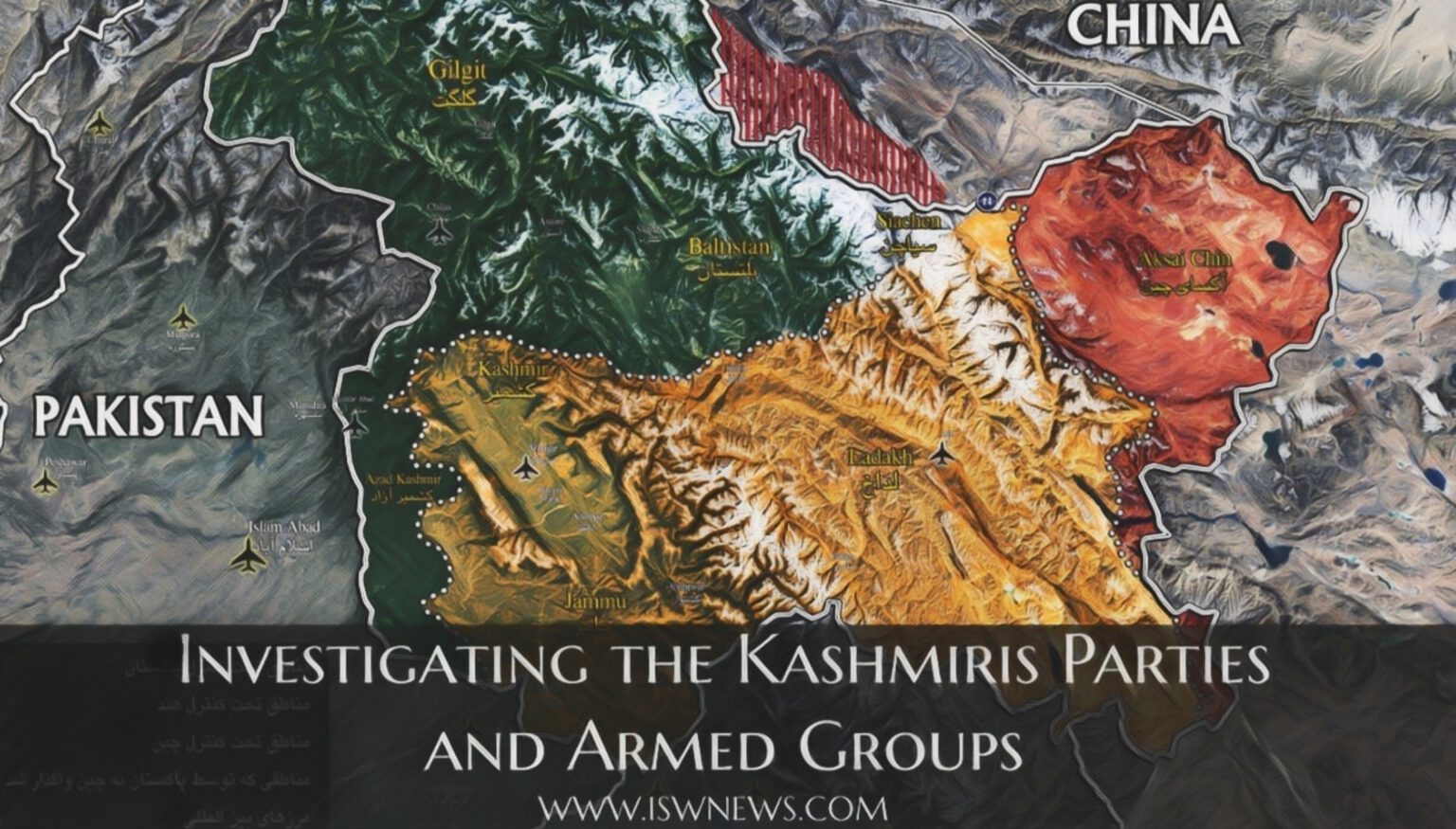
Investigating The Kashmiris Parties and Armed Groups
-

Opinion: How is the relation between Afghanistan and India?
In recent week Subrahmanyam Jaishankar, India’s FM, after meeting with Zalmay Khalilzad and American and Russian FMs talked with Mohammad Hanif Atmar (who was assigned as Afghanistan FM recently by Ashraf Ghani) regarding the bilateral relation and development of Afghanistan.
It is said that the topics covered in these meetings include USA-Taliban peace agreement, Afghan-Afghan talks and the future of India’s projects in Afghanistan.
India has invested extensively in Afghanistan in recent years, and considering Taliban’s growing power, India is concerned about its projects. India has increased its ties with Afghanistan through Iran and aerial transportation and in return pressed its old enemy, i.e., Pakistan through Afghanistan’s stance.
India considers Ashraf Ghani its old partner and considers Afghanistan a potential threat due to Taliban’s ties with Sipah-e-Sahaba and Lashkar-e-Taiba. In recent years Taliban supported attacks on Indian army by these groups, which concerns India.
Therefore, we can decode Taliban’s spokesperson words on showing interest to have relations with India. He even talked about passing a bill to condemn foreign terrorist groups.
Has Taliban revised their policies? What is India’s reaction? What is Pakistan reaction, as the main supporter of Taliban to all these? What is the effect on relations with Iran?
These are questions to be answered soon. -

Emphasis Prospect of Iran-Pakistan Relations Following the Victory of “Tehreek-e-Insaf” Party in Pakistan Elections and Party’s Emphasis on Having a Strong Relation with Iran.
The victory of “Pakistan Movement for Justice”(Tehreek-e-Insaf) in political sphere of Pakistan, is the result of the political chaos in Pakistan that has been going on in recent years.
The presence and growth of extremist groups like Taliban, Lashkar-e-Taiba (Army of the Good) etc… and influence of foreign countries, tensions with neighbouring countries and political corruption , … all of these are of problems that has left the political sphere of Pakistan in turmoil.
According to statements of Imran Khan (Leader & option of this party for prime minister) and regarding the developments in the region, a number of issues can be considered:
1. Presence of Pakistan in Saudi Coalition
The future of Pakistan’s presence in Saudi Coalition and Yemen War, is kind of vague because of Imran Khan being the prime minister.
Of course the power of Pakistan’s Army against politicians and their influence on the victory of “Pakistan Movement for Justice”, will prevent Imran Khan to be independent in decision-making.
However Imran Khan’s presence in Saudi Coalition, because Saudis are supporting America in pressuring the Pakistan, can be abolished. In this regard it must be said that Pakistan’s economy is dependant on Saudi and rotation in foreign policy requires a new economy.
2. Pakistan’s relations with Afghanistan
Imran Khan welcomed negotiations on this subject, and said that one of his priorities in future is to try to establish peace and security for Afghanistan
3. Pakistan’s relations with Iran
Imran Khan, in his statements, declared that making good relations with neighbouring countries, and in his meeting with Iran’s ambassador informed us about his interest in extending Pakistan’s relations with Iran.
The project of “Iran–Pakistan gas pipeline” (Peace Pipeline) is of Pakistan’s main concern in its relations with Iran. However right now because of India’s pulling off (under the pressure of America) and the project is stopped.
The expenses of this project is very high and is out of Iran and Pakistan’s capability, and Iran has stopped this project until India as the third side of the deal, declare that they are ready to come in.
Exporting gas of Iran to Pakistan and trade relations are of common subjects between the two countries.
The Quetta-Zahedan railway, trade & maritime relations via Oman Sea and Gwadar Bay, joint fight against terrorism specially in borders of the two countries, support of Iran towards Kashmir against India, mutual export and export and … are of mutual cases in relations between Iran and Pakistan.
The role of Pakistan in changes of region, with regards to military power of this country, is considerable. But political dependency and influence of foreign countries like America and Saudi Arabia, were always the reason for the Pakistan’s political and security turmoil.
In fact, the policy of Pakistan have been this from the beginning of “Iranian Revolution”, meaning that Pakistan has always tried to have a “Middle Ground” dealing with Iran and Saudi Arabia, Saudi for economic stability & internal security, Iran as a powerful and influential neighbour.
What we discovered about capability of Iran-Pakistan relations in future, is that their relations will grow in trade & gas export from Iran to Pakistan.
Also the expectation about Pakistan that, 1) Pakistan will act as a “Mediator” between Tehran and Ryadh by Imran Khan’s government, & 2) that Pakistan will stop its cooperation with Saudi Coalition in Yemen War, is inappropriate.
Because Imran Khan has a long way from achieving internal stability , and he must stabilize the basis of his government so that Pakistan can play a important role in issues of the region, or he can prefer the interests of having relation with Iran over Saudi money & Amercia’s pressure, which its hard to reach with situation of Pakistan at the moment.