Tag: Nagorno-Karabakh war

  • Syrian militants return from Azerbaijan and Azerbaijan’s opposition to the transfer of militant families to Karabakh

    Syrian militants return from Azerbaijan and Azerbaijan’s opposition to the transfer of militant families to Karabakh

    Recently, another group of Syrian militants returned to Syria after the war ended in the Nagorno-Karabakh region, bringing the total number of militants who have returned to Syria from Nagorno-Karabakh to about 1,000.
    During the Nagorno-Karabakh war, a total of 2,600 Syrian mercenaries were transferred to Nagorno-Karabakh by Turkey to assist the Azerbaijan army.

    On the other hand, after the end of the battles in Nagorno-Karabakh and the re-domination of Azerbaijan over the occupied territories in the region, there are reports of Turkish coordination to transfer the families of Syrian (Turkmen) militants to Nagorno-Karabakh and settle in these areas. According to sources close to the Syrian militants, two offices were opened in the city of Afrin to register them and transfer them to Nagorno-Karabakh. But a week later, it became clear that the Azerbaijani authorities were opposed to doing so and transferring the militants and their families to Nagorno-Karabakh, and Turkey’s efforts to do so have so far failed, and given the Iranian leader’s explicit warnings in this regard, it seems highly unlikely that the Republic of Azerbaijan will make such a mistake.

    Due to the opposition of the Azerbaijani authorities to the settlement of Syrian militants in Nagorno-Karabakh, the rest of the militants are expected to gradually return to Syria.

  • Official announcement of the end of the war between Armenia and Azerbaijan!

    Official announcement of the end of the war between Armenia and Azerbaijan!

    In his statement, Armenian Prime Minister Nikol Pashinyan described the agreement as a difficult one. “I have signed an agreement with the presidents of Russia and Azerbaijan to end the war in Nagorno-Karabakh, which is difficult for all of us,” he said.
    Nikol Pashinyan added :This ceasefire is very painful for our people and for myself. This is not a victory, but it will not be a defeat unless you acknowledge that you have lost. We will never admit that we have lost and this will be the beginning of the era of national unity for us. I kneel before the martyrs of all of you. I bow to all the soldiers, officers, generals and volunteers who defended our homeland with their lives.”

    The text of the agreement is as follows:
    (Direct translation from the Russian text)

    “We, President of the Republic of Azerbaijan I. G. Aliyev, Prime Minister of the Republic of Armenia N. V. Pashinyan and President of the Russian Federation V. V. Putin, have declared the following:

    1- A complete ceasefire to all hostilities in the zone of the Nagorno-Karabakh conflict are declared from 00:00 Moscow time on November 10, 2020. The Republic of Azerbaijan and the Republic of Armenia, hereinafter referred to as the “Parties”, will be stopped at their positions.

    2- The Agdam region and the territories held by the Armenian Party in the Gazakh region of the Republic of Azerbaijan shall be returned to the Azerbaijan party until November 20, 2020.

    3- Along the line of contact in Nagorno-Karabakh and along the Lachin corridor, a peacekeeping contingent of the Russian Federation will be deployed in the amount of 1,960 servicemen with small arms, 90 armored personnel carriers, 380 units of automobile and special equipment.

    4- The peacekeeping contingent of the Russian Federation will be deployed in parallel with the withdrawal of the Armenian armed forces. The duration of the stay of the peacekeeping contingent of the Russian Federation is 5 years with automatic extension for the next 5-year periods, if none of the Parties declares 6 months before the expiration of the period of intention to terminate the application of this provision.

    5- In order to increase the effectiveness of control over the implementation of the agreements by the Parties to the conflict, a peacekeeping center will be deployed to control the ceasefire.

    6- The Republic of Armenia will return the Kalbajar region to the Republic of Azerbaijan by November 15, 2020, and the Lachin region by December 1, 2020, leaving behind the Lachin corridor (5 km wide), which will ensure the connection of Nagorno-Karabakh with Armenia and at the same time will affect the city of Shusha.
    By agreement of the Parties, in the next three years, a plan for the construction of a new traffic route along the Lachin corridor, providing communication between Stepanakert and Armenia, with the subsequent redeployment of the Russian peacekeeping contingent to protect this route will be determined.
    The Republic of Azerbaijan guarantees the safety of traffic along the Lachin corridor and the safety of citizens, vehicles and goods in both directions.

    7- Internally displaced persons and refugees will return to the territory of Nagorno-Karabakh and adjacent areas under the control of the Office of the UN High Commissioner for Refugees.

    8- The exchange of prisoners of war and other detainees and bodies of the dead will be carried out.

    9- All economic and transport links in the region will be unblocked. The Republic of Armenia will provides transport links between the western regions of the Republic of Azerbaijan and the Nakhichevan Autonomous Republic in order to organize the unimpeded movement of citizens, vehicles and goods in both directions. Control over transport communication is will be carried out by the bodies of the Border Guard Service of the FSB of Russia. By agreement of the Parties, the construction of new transport communications linking the Nakhichevan Autonomous Republic with the western regions of Azerbaijan will be provided.”

    November 2020
    President of the Republic of Azerbaijan
    Prime Minister of the Republic of Armenia
    President of the Russian Federation

    Following the announcement, angry people stormed the government building in Yerevan. The sound of gunfire was also heard in Republic Square in Yerevan.
    On the other hand, simultaneously with the announcement of the new agreement, the city of Baku, the capital of Azerbaijan, was attacked with two ballistic missiles.
    According to Azerbaijani officials, the two attacks were carried out in the Khirdalan and Sumqayit areas, and both missiles were intercepted and destroyed.

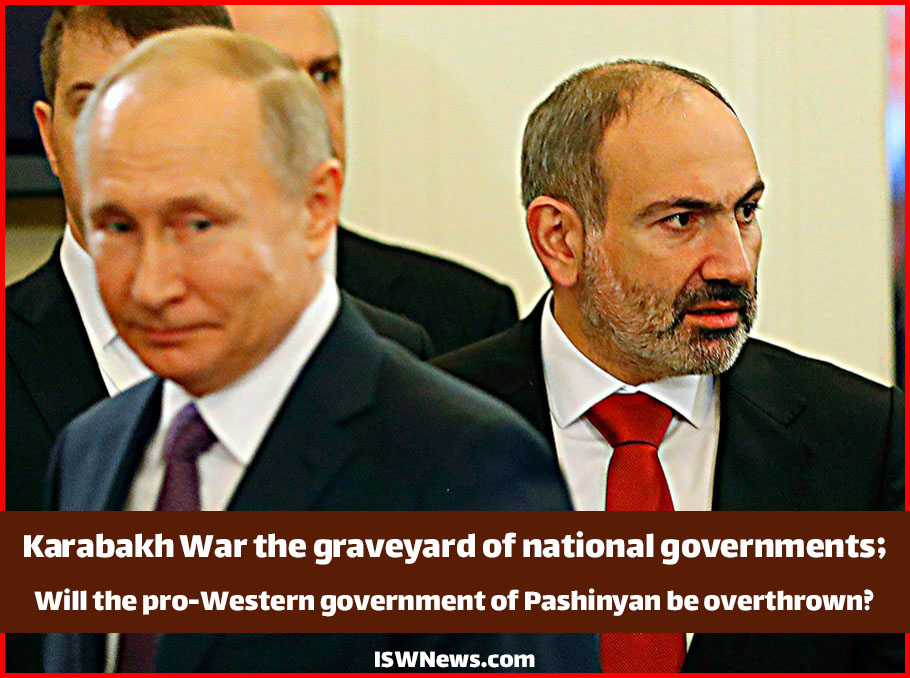
  • Karabakh War the graveyard of national governments; Will the pro-Western government of Pashinyan be overthrown?

    Karabakh War the graveyard of national governments; Will the pro-Western government of Pashinyan be overthrown?

    Relations between Azerbaijan and Armenia over the disputed region of Nagorno-Karabakh have been strained since the start of the war on September 27. According to Russian President Vladimir Putin, this bloody war has killed 5,000 people and has shown a different face of new battles. The Armenian army has lost airspace in the Nagorno-Karabakh region in the face of Israeli and Turkish drone strikes. Many attribute this to the deterioration of equipment and low-tech weapons and old anti-aircraft radars.
    Of course, the country’s ground forces also leave their strongholds and retreat, leaving weapons, ammunition and equipment on the battlefield. Such behavior is very strange in a classic army. Usually, any experienced soldier destroys weapons, equipment and ammunition while retreating, which is less common in this war. Even the newly deployed forces of Armenia to Nagorno-Karabakh are facing a shortage of supplies and the logistics of Armenia are practically inoperable. Their border forces also withdrew along the border lines of the occupied territories with Iran without any special resistance.
    The Armenians lost control of the Mataghis Dam (Sugovushan) and the Aras Dam, the cities of Fuzuli, Jibrayil, Hadrut, Zangilan and Qubadli, and Azerbaijan reached the international border of Armenia along the Aras River. Even the Armenian Defense Minister admits to successive defeats. The display of the destroyed and looted equipment of the Armenian army and the capture of the Armenian forces by the Azerbaijani coalition have also greatly lowered the morale of the Armenian forces. However, the resistance of the defense forces of the Nagorno-Karabakh region during the recent battles has been far greater than that of the Armenian army, which is also very strange.

    Many have so far cited the power of the coalition forces of Azerbaijan, Turkey, Pakistani Army Special Forces, Syrian and Caucasian terrorists as the main reason for the superiority on the battlefields with the Armenian forces.

    But why have the Armenian Armed Forces done so little over the past month except to retreat and counter-attack?

    Although the Armenians are positioned in the highlands, they do not make good use of this advantage, and Azerbaijani forces have reached the vicinity of Shusha and the Lachin crossing, which threatens the most important communication corridor between Armenia and Nagorno-Karabakh.

    Air and artillery strikes inside Armenia have also destroyed some military equipment inside the country. The Prime Minister of Armenia has asked the Russian Federation for help in concluding a defense and military pact, which has been met with a cold reaction from the President of the Russian Federation, Vladimir Putin.
    Putin has stated that he is willing to intervene militarily in favor of Armenia only if Armenian territory is attacked, which shows a clear difference of position with the history of the Russians in the first Nagorno-Karabakh War.
    However, Russia, with its military base in Gyumri, could thwart all efforts by hostile forces with its air force and air defense in the area.

    Iran has also closed the Norduz border terminal on the border between East Azerbaijan Province and Armenia, and some believe this is due to internal pressures from pro-Azerbaijani rallies in Azeri cities. In any case, Iran’s move to suspend economic relations with Armenia has caused more economic problems for Armenia, as Georgia’s borders with Armenia have been closed and the situation in Armenia is deteriorating.

    In addition to the above, the Prime Minister of Armenia dismissed the Border Command of the country due to the shooting in “ceasefire conditions” from inside Armenia to Azerbaijani forces on the Aras border and the reciprocal response of Azerbaijani forces. Although Azerbaijan denies any response to the fire of the Armenian side, the fire of both sides is undeniable. Also, the three-time violation of the ceasefire during the war, which both sides accuse each other of, is not something that can be considered the will of the political parties.

    If we study the history of the armed forces of the countries that inherited the former Soviet Union, we come across strong relations between the armed forces of these countries and Russia, which raises the issue of influence in the military forces of these republics.
    It is not yet clear whether the Russian elements are violating the ceasefire, but there are hands on the Armenian side that are leading the way to military defeat, political instability and protest. Armenia’s political atmosphere is against Prime Minister Pashinyan, who effectively controls the government and the commander of the country’s military. A number of political activists and the media have criticized his actions in the Nagorno-Karabakh conflict.

    But why should such a thing happen in Armenia during a war?

    The political record of the Prime Minister of Armenia Nikol Pashinyan shows that he has entered the field of politics from the world of journalism (editor of Haykakan Zhamanak newspaper) and has a history of opposition to the pro-Russian government in 2007 and political imprisonment, which was pardoned in 2009. Pashinyan, who has been a member of parliament for the country since 2012, founded the “Civil Contract” party in 2015 and the “My Step Alliance” in 2018.

    He was the main protester against the results of the 2018 National Assembly elections and the victory of Serzh Sargsyan, the Former President and (pro-Russian) Republican Candidate, and called the election results fraudulent.

    Pashinyan was able to organize a wave of opposition against Sargsyan by marching from the city of Gyumri to Yerevan, and Sargsyan resigned as prime minister on April 23. Pashinyan became prime minister on May 8 of that year by a majority vote. But his promises to solve the challenges of previous periods without a proper solution not only failed, but also led to popular protests and opposition before the Karabakh war.

    The distinguishing feature of Pashinyan in this period can be called the greater Westernization and diminishing of Russia’s political and economic role in Armenia. Attending NATO military exercises, establishing economic ties with the European Union instead of Russia, and making controversial remarks about the Gyumri base have been hot topics during his tenure. The Pashinyan government’s determination to join the North Atlantic Treaty Organization (NATO) also exacerbates Iran’s concerns, which is against the national interests of Iran.

    Opposition initiative

    During a meeting with the Prime Minister, Robert Kocharyan andSerzh Sargsyan proposed his resignation in order to find a way out of the crisis, and it is not unlikely that if the prime minister refuses, the option of a march and a military coup to save the country from military defeat in the Nagorno-Karabakh war will happen, which in the current situation will be accepted by the majority of the country’s society.

    It can be argued that the recent war has provided the greatest opportunity for Russian supporters in Armenia to oust the Pashinyan under the pretext of inefficiency and military defeat, and to end the work of the pro-Westerners in this country.
    Of course, Pashinyan, as a journalist, has not learned a lesson from the history of the Nagorno-Karabakh war. A similar scenario was planned in 1992 for Azerbaijani President Ayaz Mutalibov, in which the militants of the Azerbaijani Popular Front (supporters of Abulfaz Elchibey) evacuated the Lachin and Shusha fronts against the invasion of the Armenian army and after the Khojaly tragedy, these militants ended the life of the government with the presence of several thousand forces in Baku and in front of the Presidential Palace.
    However, the next government of Azerbaijan did not last long, and the military defeats combined with the economic crisis and the political coup of Heydar Aliyev, which had the political support of Iran, led to the collapse of the “Abulfaz Elchibey” government and the political and military elements of the “Abulfaz Elchibey” government were dismissed and imprisoned as the cause of Azerbaijan’s defeats.

    Such a possible change could change the course of the recent war, and Armenia, with the support of the Russians, this time will show a new face with a new strategy that will not be pleasant for the Azerbaijani coalition at all. This unhappiness starts from the fact that the Azerbaijani coalition, like a gambler, has put all its cards on the table and its military strategy has been known over the past month. The air superiority under the flight of drones, heavy shelling, infiltration of commando groups behind the opponent’s front and then armored and infantry attacks of Azerbaijan is a strategy that has nothing to hide.

  • Video: Another evidence of the presence of Syrian militants in Nagorno-Karabakh

    Video: Another evidence of the presence of Syrian militants in Nagorno-Karabakh

    This captured Syrian mercenary named Yusuf Al-Abed Al-Haji is from the village of Al-Ziyadiyah on the outskirts of Jisr al-Shughur in Syria’s Idlib; In the video, he admits that they were promised $2000 monthly salary.

    He also admits in the video that he came to Karabakh to kill infidels and was promised an extra $100 per head for every Armenian. Of course, this part of the confession of this Syrian mercenary has no special value, and he may have been forced to say this. But the video proves once again that a significant number of Syrian mercenaries are fighting Armenian forces on the front lines.

    Video: Capture of a Syrian militant in Karabakh by Armenian forces

    Prominent Syrian militant commander killed in Karabakh

    New evidence on the presence of Syrian terrorists in the battlefields of Nagorno-Karabakh + Videos

    Takfiris in Azerbaijan?! + Video

  • Disclosure: Behind the scenes of Karabakh and the Islamic Republic of Iran + Video

    Disclosure: Behind the scenes of Karabakh and the Islamic Republic of Iran + Video

    Ilham Aliyev in a meeting with high commanders of army in a military base two weeks ago talked about treachery of a “Azerbaijani Popular Front Party” in 1992 which gained power by giving the town Shusha to Armenia in Nagorno-Karabakh war. Although talking about it is not a new subject in Azerbaijan media and many analysts knew it already, however, digging what Ilham Aliyev stated has an important aspect which involves Islamic Republic of Iran and Azerbaijan media won’t talk about that aspect never.

    Ilham Aliyev speech regarding Azerbaijani Popular Front Party treachery


    Azerbaijani Popular Front Party
    In the last years of Soviet era, political and racial crises in addition to conservative policies if communism, prepared a situation for radical movements and parties to expand including “Azerbaijani Popular Front Party”. The leadership was a hardcore fan of Pan-Turkism since the beginning and inclined toward Turkey. Calling northwestern provinces of Iran “Southern Azerbaijan” and slogan of “one nation, two governments” are among their inventions.

    With the help of reforming and daring behaviors Azerbaijani Popular Front Party could absorb the Azerbaijani refugees rejected from Armenia which enabled the movement to have a more important role in Karabakh conflict.
    The ever increasing tension in Karabakh and transforming into an armed crisis in the last days of communism sovereignty, emphasized on the importance of having army for everyone. Azerbaijani Popular Front Party, the biggest and most important party of the time, could get armed just before the independence of the Republic.

    The evolutions suggested Azerbaijani Popular Front Party is the main candidate for the leadership of the newly independent Azerbaijan Republic but the parliament reassigned Ayaz Mutalibov, the last communist leader of Azerbaijan, with the condition to abolish communism party and swear to the new republic.

    While the newly formed government did not have an army and tensions increasing everyday in Karabakh, there was the necessity for an armed party, therefore Azerbaijan divided between former communist politicians in power with Azerbaijani Popular Front Party and its armed supporters controlling the critical areas.

    There was a harsh competition between the government without army (former communists) and the army without government (Azerbaijani Popular Front) and each side was trying hard to compensate for their weakness. It is obvious that such a critical situation is in favor of Azerbaijani Popular Front, since they can increase their power using their armed supporters. At the same time, Ayaz Mutalibov government was negotiating with Armenians over Karabakh, which was an alarm for Azerbaijani Popular Front, since after the crisis is overcome the government would naturally turn toward armed militia to disarm them.

    Iranian peace and foreign coup
    On 7 May 1992 presidents of Armenia and Azerbaijan met in Tehran. In the joint statement of three countries presidents it was mentioned that there will be a seven days ceasefire and delegates of both side start negotiations in Karabakh with supervision of Iran FM.

    Signing the agreement of Karabakh- Tehran, 7 May 2020


    Obviously Caucasian political sides did not like it, as Iran took the upper hand to solve the issue of Karabakh, having more influence than Turkey and USA. As mentioned above, Azerbaijani Popular Front also did not want the conflict to be solved by Ayaz Mutalibov government. Beside their political future was in danger with their extreme anti-Iran policies, therefore, on 8 May 1992 (just one day after the agreement in Tehran), 2,500 militia affiliated to Azerbaijani Popular Front left Shusha town around 20:00 and the remaining forces could not defend against 700 Armenian soldiers and the town and surrounding villages fell.

    Azerbaijani Popular Front Party hoped that many protests would rise in different parts of the country and the government would resign under pressure of people and the parliament, but it didn’t happen so leaders of Azerbaijani Popular Front Party tried another plan. Azerbaijani Popular Front Party recalled their forces from the front lines to the capital for a coup which caused Armenians to occupy more lands.

    Despite of no evidence of foreign influence in the coup, the new government leans toward Turkey and USA greatly and ditched Iran out of Karabakh conflict entirely.
    Iran’s FM deputy traveled to Baku after the incidents but new officials of Azerbaijan showed no interest in Iran role in Karabakh conflict and repeated their claims over northwestern provinces of Iran.

    Heritage of “Azerbaijani Popular Front Party” rule
    Azerbaijani Popular Front Party era, since the very beginning, faced many challenges. Leaving border stations by Azerbaijani Popular Front militia to do the coup, left them to Armenians and with ground connection between Armenia and Nagorno-Karabakh Autonomous Oblast, gave Armenia upper hand. Before Armenia was only the supporter of Armenians of Karabakh on the paper but now the lost villages and towns were victims of political ambitions of Azerbaijani Popular Front Party, which never taken back.

    Having open relationship with Israel and cold relationship with Iran are among the important changes in foreign policy of that time.
    One year later, not only Azerbaijani diplomats sent to Turkey to seek military aid returned empty handed, but Turkey even did not stop exporting electricity and wheat to Armenia and this put a lot of pressure on ruling party by Azerbaijan media until some political movement even demanded reform in relationship with Iran and asking Islamic Republic to supervise solving the issue of Karabakh.
    Therefore, in order to control the public mind, the State minister of Azerbaijan raised the myth of Iran’s support for the Republic of Armenia during the Nagorno-Karabakh conflict, but nevertheless, the sending of humanitarian aids to refugees of Azerbaijan never stopped by Iran.

    Click to see the full size map


    YOUR SUPPORT IS CRITICAL TO KEEP ISWNews ALIVE!

    I’d like to thank readers for their confidence and support. Thanks to your support we can continue to perform our duty on reporting the important events in the region. So If you like our contents, please don’t feel embarrassed to contribute and help our project, for as little as 1 Dollar. Your contribution, however small, will help ensure our project continuity. Thank you.