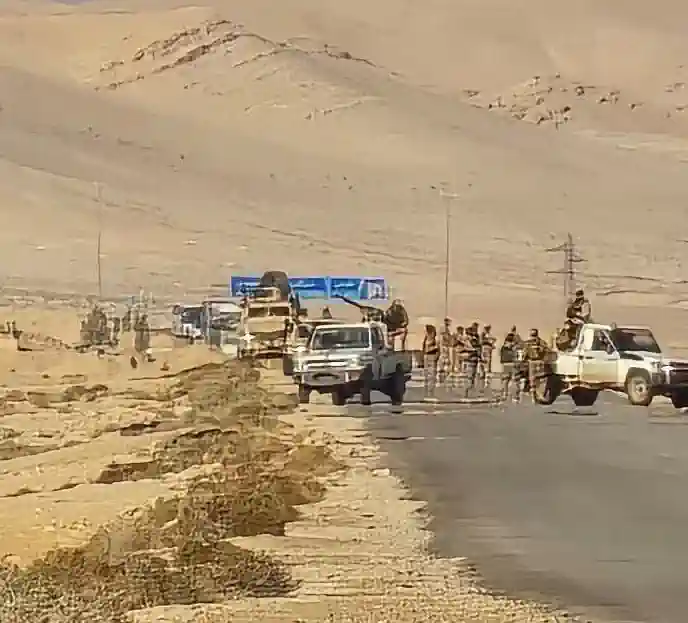
Speculation continues regarding how the attack was carried out and who was behind it. Some believe it was conducted by someone within Syria’s security forces, while others attribute it to ISIS.
U.S. President Donald Trump identified ISIS as the prime suspect and vowed to take “serious revenge” against the group.
Following the incident, American warplanes flew over Homs province and Palmyra last night. Reports indicate that targets in Deir ez‑Zor and Homs (near Palmyra) were struck by U.S. aircraft.
If ISIS is indeed responsible, this would mark the group’s first direct attack on U.S. forces in the Palmyra region since the rise of the al‑Joulani government.
Simultaneously, U.S. drones flew over the area, conducting aerial reconnaissance and imaging operations. After the visit and drone activity, the forces returned to the Al-Tanf base in Homs.
Some Syrian sources suggest that the U.S. may be planning to establish a new military base in Palmyra. This comes despite the American-led coalition already maintaining several active bases in eastern Syria—particularly in Deir ez-Zor and Hasakah—under the pretext of combating ISIS.
A Syrian military source said, “at around 13:30 (local time) on Wednesday, the Israeli regime targeted a number of residential buildings in the city of Tadmur from the Al-Tanf area. This attack resulted in the martyrdom of 36 people, the injury of more than 50 others and the occurrence of material damages.”
Israeli strikes in Tadmur
Investigations show that the Israeli fighter jets fired several missiles towards Palmyra by flying over the Jordanian sky and using the airspace of the US-occupied Al-Tanf region.
In the past, the Zionist regime had repeatedly used the US-occupied area in al-Tanf to attack Syria and the axis of resistance.
Israeli strikes in Tadmur
The al-Tanf region in the southeast of Syria has been occupied by American forces for years, and the Syrian army and resistance forces are not allowed to approach the 55-kilometer radius of this area.
In recent years, the Israeli regime’s army has repeatedly violated Syria’s territorial integrity with airstrikes. Most of the Israeli regime’s illegal strikes in the past year, allegedly aimed at assassinating senior resistance commanders and destroying Syrian army’s facilities and ammunition depots. During these strikes, hundreds of civilians and SAA servicemen were martyred and injured.
Following the onset of Operation Al-Aqsa Storm by the Palestinian resistance movement Hamas, Israeli airstrikes against various regions in Syria, especially Damascus and Homs governorates, have increased.
The Tadmur desert is one of the main targets of ISIS terrorist, despite ongoing operations by Syrian army forces and allies. Given the history of ISIS in such attacks against the Syrian army, it is possible that this terrorist attack was also carried out by ISIS elements.
On November 1, ISIS elements in a Syrian government-flagged military vehicle approached a Syrian Army checkpoint near al-Birat road at the entrance to the city of Tadmor and opened fire on Syrian Army forces, killing two SAA members. After the exchange of fire, ISIS lowered the Syrian government flag and raised ISIS flags. At the end of the clashes, ISIS forces fled to the desert of Homs.
The Syrian desert continues to experience heavy fighting, despite extensive air and ground operations by the Syrian army and its allies against ISIS hideouts. This shows that the tactics and decisions of the Syrian army to deal with the ISIS cells in the Syrian desert are not effective enough and it must implement new plans to deal with the threats.
According to a Syrian military source, at about 23:34 local time, Israeli warplanes used US-occupied airspace in the al-Tanf area to attack the Tadmur area, killing one Syrian soldier and wounding three others. This source added that the aggression targeted a communications tower and some points around it.
Simultaneously with the attack, an American Bombardier E-11A aircraft was flying on the Iraqi-Syrian border. The aircraft is responsible for radio communication relays between operating units on the battlefield.
In recent days, Russian air operations in the eastern deserts of Syria in the provinces of Homs, Deir Ezzor and southern al-Raqqa have increased dramatically. According to the latest field information, at least 20 ISIS members have been killed and many more wounded in more than 40 airstrikes in the past two days.
Most airstrikes are carried out in areas such as the deserts around Ithriya, al-Rasafah, al-Sukhnah and the deserts around the city of Tadmur, as well as the eastern deserts of Deir Ezzor against ISIS gatherings, positions and hideouts.
It is worth mentioning that so far, several clearing operations have been carried out by the Syrian army with the support of its allies in the desert areas of eastern Syria. Nevertheless, despite the efforts made, the threat of ISIS cells in the eastern deserts of Syria is still high, and we see attacks of ISIS against the personnel, armored vehicles and small posts of the Syrian army and the resistance forces in these areas on a weekly and monthly basis.
Of course, this issue is not limited to the areas controlled by the Syrian government south of the Euphrates River, and the northern areas of the Euphrates River, where it is under constant surveillance by US and SDF forces, are not free of ISIS threats and witness daily and weekly movements and operations.
In this regard, it seems that a special and long-term redesign and action plan is needed to clear the eastern deserts of Syria and to minimize ISIS activities in these areas; A plan to be implemented jointly by Iraqi and Syrian forces on both sides of the border.
In recent days, the Syrian army leaded by Soheil Hassan, advancing and defeating ISIS defense lines in southern province of #Raqqah
therefore , a large number of oil and gas wells were freed through the last week.
Also Resistance forces are approaching to Al-Sukhnah in #Tadmur–#DeirezZor axis. It is also possible for them to advance towards T2 station in Hamimah axis
Regarding the type of advancements, two points can be considered :
– #SAA can approach to Al-Sukhnah from the top
and bottom in parallel with downstream advancements of the Resistance Forces , and surround the large amount of #ISIS in center of Syria!
Of course, considering the suicide nature of ISIS behavior, this move has its own advantages and disadvantages that are not included in this article.
– SAA can continue its advances in southern Raqqah province & reach to Deir ez Zur , meantime resistance forces will advance towards Deir ez Zur along the highway.
Remember these two, in the coming weeks, we will say more about this