Tag: Zangezur Corridor

  • Yankees in Caucasus: Assessing the Security and Geopolitical Implications of U.S. Involvement in the Zangezur Corridor Project

    Yankees in Caucasus: Assessing the Security and Geopolitical Implications of U.S. Involvement in the Zangezur Corridor Project

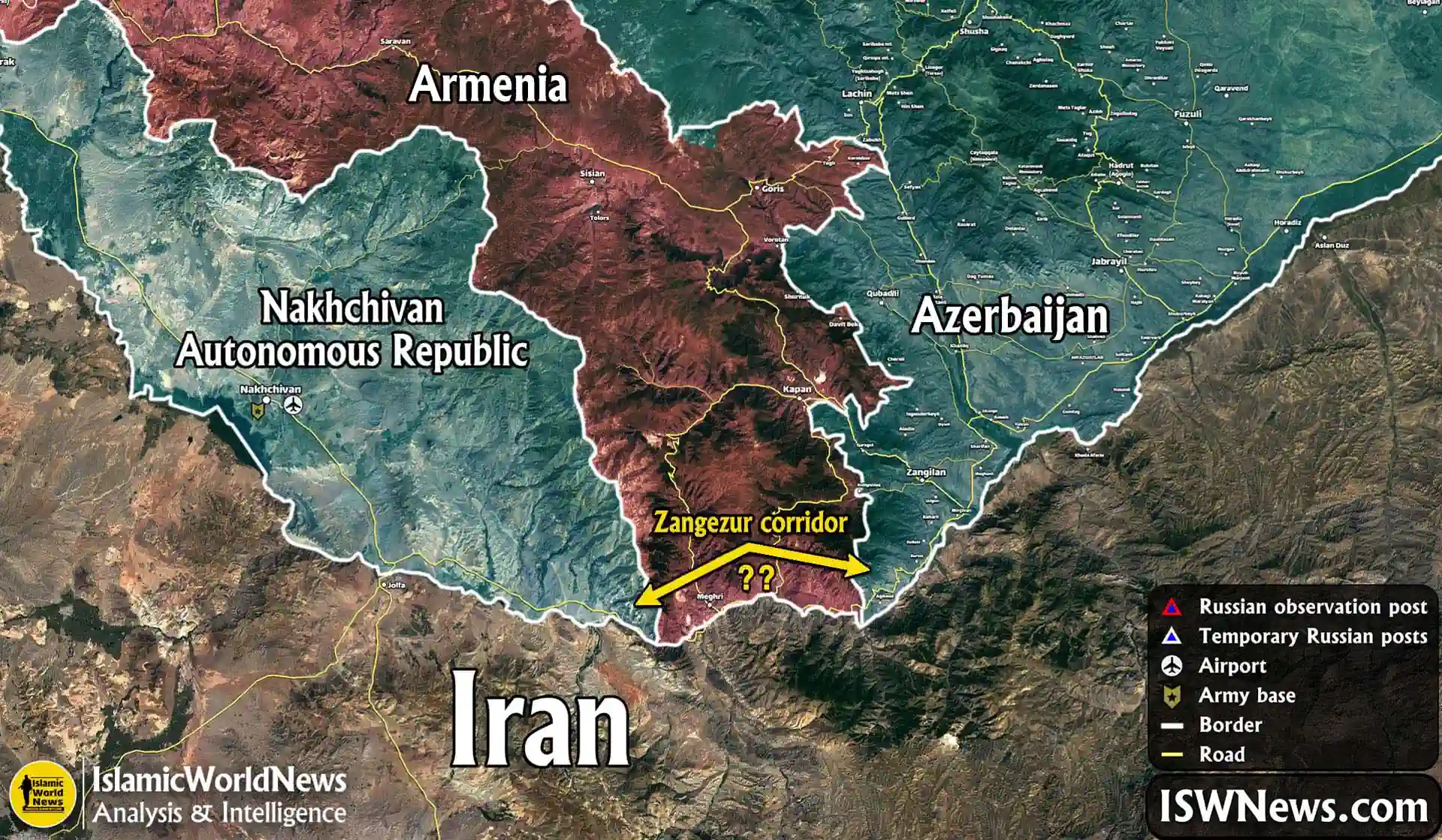
    In recent years—particularly following the Second Karabakh War, which ended with Azerbaijan’s victory over Armenia—the creation of the Zangezur Corridor through Armenia’s Syunik Province has sparked a new geopolitical contest in this vital region. Azerbaijan, capitalizing on its military strength and support from Turkey and Israel, is pursuing ambitious geo-economic goals that have met with strong opposition from Iran and Russia. The signing of a peace agreement in Washington, brokered by Donald Trump, which facilitated U.S. involvement in the project, has added another layer of complexity to the issue.

    According to the Washington agreement, the corridor has been renamed the “Trump Road for Peace and Prosperity” (TRIPP) and leased to an American company for a 99-year term.

    A closer look at the project’s objectives and the recent alignment between Baku and Ankara with the West reveals that the Zangezur/Trump Corridor is part of the broader contest over a new multipolar world order. While Azerbaijani officials emphasize its economic and transit benefits—claiming it could even benefit Iran or Armenia—the underlying Western strategy aims to forge a “Turkic-NATO” alliance to contain the China-Russia-Iran axis.

    The opaque nature of the American company

    Although much has been written about the corridor’s economic and logistical implications, its security and political dimensions remain underexplored. As noted, the U.S. involvement goes beyond commercial interests and could influence both the construction and strategic outcomes of the corridor. Given the hegemonic and capitalist nature of Washington’s political system, its economic and security agendas are deeply intertwined. Separating these motives in the Zangezur project would be an oversimplification.

    Why the Middle Corridor matters to Washington

    The strategic importance of the Caucasus and the Middle Corridor has grown significantly for the U.S., especially after the war in Ukraine. The conflict has rendered the northern route of China’s Belt and Road Initiative unstable, and Washington opposes the development of the Iranian branch of the Middle Corridor. As a result, the preferred route connecting China to Europe now runs through Turkic-speaking countries—Kazakhstan, Azerbaijan, and Turkey.

    Expanding the Middle Corridor also supports other Western economic-security projects, such as the Trans-Caspian gas pipeline and the transfer of rare earth materials from Central Asia for defense industries. The overarching goal, led by the U.S., is to develop the “Turanic” corridor to exclude Russia and China from Eurasian trade while maintaining Western access to Central Asia.

    Washington is not content with merely supporting the corridor—it seeks to control it. The Zangezur segment has become a key component of this strategy. Trump’s involvement in the corridor serves three core security-economic objectives:

    1. Establishing a presence at Iran’s border to monitor its military and security movements
    2. Undermining Russia’s influence in its traditional sphere and leveraging the Caucasus in the Ukraine conflict
    3. Controlling the Middle Corridor to exert pressure on China.

    As observed, the security dimensions of the Zangezur Corridor project—particularly for Iran and Russia—are highly significant, which helps explain the strategic alignment between Moscow and Tehran on this issue. Without a doubt, the United States is likely to deploy its military and intelligence capabilities alongside engineering teams to support such a complex and multifaceted initiative, potentially reshaping the regional landscape.

    It’s important to recognize that the interplay between military dominance and financial control is not merely academic—it’s a matter of survival for the current global financial system centered around the United States. In this context, the deployment of U.S. forces near Iran and Armenia under the guise of the Zangezur Corridor can be interpreted as a de facto military outpost, reinforcing Washington’s strategic footprint in the region.

    Objectives and Motivations Behind U.S. Involvement in the Zangezur Corridor

    • Recent studies suggest that foreign military bases established through regional alliances can enhance U.S. economic development. In contrast, bases acquired through military occupation tend to harm the U.S. economy. For example, in models where bases are set up via occupation, hostility between the host government and the foreign military tenant is more likely. Therefore, the U.S. has opted for alliance-based deployment in the Zangezur Corridor project.

    • Another strategic motivation for U.S. presence in the corridor is the potential training of extremist forces near Iran’s northwestern borders. Russian officials have claimed that the U.S. military base in al-Tanf, Syria, has been converted into a “terrorist training center.” Sergey Naryshkin, head of Russia’s Foreign Intelligence Service, stated that American forces trained 500 ISIS members and other extremists—primarily migrants from the Caucasus and Central Asia—for operations against Russian troops in Syria. If the U.S. applies a similar model near Iran or in the Caucasus, it could pose serious security risks for both Iran and Russia, especially given the increasing use of drones by extremist groups.

    • Central Asia’s strategic value is rising due to its energy reserves and rare minerals. To secure access to these resources and ensure energy and military security, the West needs a foothold in the region. Russia, China, and Iran currently hold significant influence there, and expanding Western presence would weaken this axis. In the event of regional tensions, the U.S. could use the Zangezur Corridor and its associated military infrastructure as a logistical base.

    Former Iranian ambassador to Baku, Seyed Abbas Mousavi, commented on the nature of the American company involved in the corridor: “A transregional country is entering our region through a private company. We don’t know the true nature of these companies. It’s possible that later, under the pretext of supporting them, the U.S. will deploy military forces to the region, which could be dangerous and certainly requires close cooperation among Iran, Russia, Armenia, Azerbaijan, and Turkey.” Recent developments suggest that the company involved is likely of a military-security nature, as evidenced by the lifting of U.S. sanctions on Azerbaijan’s military equipment sector. Supplying arms to Azerbaijan effectively amounts to indirect U.S. military presence near Iran’s borders.

    In summary, U.S. military involvement in the South Caucasus via the Zangezur Corridor offers strategic advantages for both Washington and NATO. It enables pressure on China, Russia, and Iran while boosting U.S. geopolitical and geo-economic influence in Central Asia and the South Caucasus. However, this approach contributes to the militarization of the region, contradicting stated goals of stability and potentially harming smaller regional states—especially Armenia and Azerbaijan.

  • Iran President Receives Envoys From Azerbaijan, Armenia

    Iran President Receives Envoys From Azerbaijan, Armenia

    ISWNews Analysis Group – President Raisi held talks with assistant of Azerbaijani President Ilham Aliyev in special affairs Khalaf Khalaf and secretary of the Security Council of Armenia Armen Grigoryan, when the president and the two representatives discussed developments in the Caucasus region.

    In the meetings, the Iranian president stressed the need to enhance relations between these northern neighbors and Iran with the aim of countering plots that aim to create divisions and disrupt the bilateral relations between Armenia and Azerbaijan.

    Raisi went on to say that the Islamic Republic of Iran, as a powerful neighbor of both Azerbaijan and Armenia, is fully prepared to help resolve the two countries’ disputes and problems.

    Emphasizing the importance of maintaining border lines and the existing geopolitical structure of the region, the president stated that Iran welcomes regional dialogues in the form of 3+3 or any other format that can contribute to resolving issues and opening up avenues for cooperation between Azerbaijan and Armenia.

    He further noted that the countries in the region have the capacity to resolve regional problems and that the engagement of foreign countries into the region, under any pretext, is not in the best interest of any of the regional states.

    Mohammad Jamshidi, the Iranian president’s deputy chief of staff for political affairs, said that in both meetings, the President emphasized that the Zangezur Corridor serves as a platform for NATO’s presence in the region and poses a threat to national security, which the Islamic Republic of Iran strongly opposes.

    Simultaneously with these meetings, Chief of Staff of the Armed Forces of Iran General Mohammad Bagheri announced the readiness to send observers to the borders of Armenia and the Republic of Azerbaijan.

  • Opinion: Iran Increasingly Uneasy About Threats to Common Border With Armenia

    Opinion: Iran Increasingly Uneasy About Threats to Common Border With Armenia

    Before the Second Karabakh War, Tehran was not particularly concerned about its border with Armenia. After the war, Iran’s main concern became Azerbaijan’s hopes to realize the Zangezur Corridor by force, in such a way that the 40-km border between Iran and Armenia could be compromised or blocked. In truth, Iran has no objection to the implementation of the ninth clause of the 2020 Karabakh ceasefire agreement, which includes granting Azerbaijan communication access to Nakhchivan. During the past three decades, communication between Baku and this region only took place via Iran. While Tehran does not object to this arrangement, it strongly opposes the change of international borders in the Caucasus, the blocking of the Iranian-Armenian border and the possibility of renewed conflict between Armenia and Azerbaijan.

    For this reason, the massive maneuvers of Iran’s army and the Islamic Revolutionary Guard Corps (IRGC) on its northwestern border in September and October 2021, unprecedented in the three decades since the collapse of the Soviet Union, signals the level and depth of Iran’s concerns about recent developments in the South Caucasus. Indeed, the outbreaks of violence between Armenia and Azerbaijan, the repeated threats of Baku to open the Zangezur Corridor by force, Turkey’s ongoing support of Azerbaijan and Russia’s silence and ambiguous position regarding the region have further exacerbated Tehran’s concerns. On the sidelines of the 7th Summit of the Astana Peace Process in Tehran, Supreme Leader Ayatollah Ali Khamenei met with Turkish President Recep Tayyip Erdoğan and clearly delineated that “if there is a policy to block the Iranian-Armenian border, the Islamic Republic will oppose it because this border has been a communication route for thousands of years.”

    Recent fighting between Armenia and Azerbaijan in September 2022 resulted in nearly 300 deaths and dozens of injuries on both sides, further aggravating Iran’s concerns. Some news sources even announced that Tehran had deployed 50,000 troops to the Armenian border. Indeed, Mohammad Pakpour, commander of the IRGC’s ground forces, on September 16, visited the units located on the border with Armenia, Azerbaijan and Nakhichevan, stating that their readiness level is high. Additionally, the chief of staff of the Iranian Armed Forces, Mohammad Bagheri, during a military parade on the anniversary of the Iran-Iraq War (1980–1988), declared, “Iran will not tolerate any change in the borders in the region and call on Azerbaijan and Armenia to solve the issues between them peacefully, through dialogue. We do not seek conflicts and wars, but we do not remain silent when it is necessary to resist them.”

    Several reasons underline Iran’s concerns regarding the possible blocking or destruction of its border with Armenia. If this border is destroyed, all of Iran’s northwestern regions will border Azerbaijan and Nakhchivan—and the number of Iran’s neighbors will decrease from 15 to 14. Iran will also lose one of its most crucial transit routes to the Caucasus, as the land route through Iran and Armenia that reaches Georgia is a main part of the Persian Gulf–Black Sea Corridor. The Iranian government’s decision to open a consulate in Kapan, the administrative center of Armenia’s Syunik Province bordering the Islamic Republic and the reciprocal decision of the Armenian government to open a consulate in the northwestern Iranian city of Tabriz clearly indicate Tehran’s desire to preserve and strengthen this transit route. Indeed, in terms of diversifying transit routes, Iran hopes to maintain this corridor (Iran-Armenia-Georgia) parallel to the North-South Corridor (Iran-Azerbaijan-Russia).

    Additionally, in terms of water resources in the Aras river basin, Turkey and Armenia are “upstream” countries, while Iran and Azerbaijan are “downstream” countries. Therefore, if Baku captures the southern part of Syunik Province along the Zangezur Corridor, then Azerbaijan will become an “upstream” country, leaving Iran as the only “downstream” country with limited control over the water supply.

    In a wider sense, Iran also has deeper concerns about geopolitical change and the balance of power in the region. In this context, Tehran considers the regional roles of Turkey, Israel, the United States and the North Atlantic Treaty Organization as extremely influential. From this point of view, Iran, unlike Russia and others, does not view the tensions in the South Caucasus merely as a “border clash” between Yerevan and Baku. In truth, opening the Zangezur Corridor would also provide direct military access for Turkey as a NATO member in the Caucasus.

    Indeed, a significant number of Iranian elites and experts believe that Azerbaijani President Ilham Aliyev’s emphasis on “uniting the geography of Turkic world” via the Zangezur Corridor and the expansion of Turkey’s presence in the South Caucasus will strengthen Pan-Turkism in the region, which could incite ethnic and separatist sentiments. In addition, considering the close relations between Azerbaijan and Israel, Tehran is worried that, if Baku does capture the southern part of Syunik Province, this will bolster Israel’s intelligence, espionage and security presence vis-à-vis Iran.

    As a result, although, among Iran’s 15 neighbors, its border with Armenia is the shortest, this 40-km border is of the utmost strategic importance for Tehran. Although the Azerbaijani authorities have stated many times that there is no real threat to the Iranian-Armenian border, Tehran’s reactions in the past two years and after the Second Karabakh War clearly show that Iran is extremely worried about the realization of the Zangezur Corridor by force, especially if this compromises its highly consequential border with Armenia.

    It seems that the new diplomatic developments of the past two months have not reduced Tehran’s worries. In Prague, a quadrilateral meeting between the leaders of Armenia and Azerbaijan together with the presidents of France and the European Council took place, as well as the historic meeting of Armenian Prime Minister Nikol Pashinyan with Turkish President Recent Tayyip Erdogan. Yet, during both the meeting between Iranian President Ebrahim Raisi and Pashinyan on the sidelines of the UN General Assembly and the meeting between the Raisi and Aliyev in Astana, Kazakhstan, Iran’s opposition to changing international borders in the Caucasus was clearly emphasized. As such, Brigadier-General Mohammad Pakpour, commander of the Islamic Revolutionary Guard Corps Ground Forces (IRGC) announced that “the massive exercise dubbed ‘Eghtedar/Power’ of the IRGC ground forces will be held at the northern border in the Aras region at the regional IRGC Ashura military base.”
    Tehran’s decision to hold this military maneuver one year after large-scale military exercises near the Azerbaijani border, clearly shows that “Iran increasingly uneasy about threats to its common border with Armenia”.

    Source: The Jamestown Foundation

  • Continuation of border conflicts between Azerbaijan and Armenia

    Continuation of border conflicts between Azerbaijan and Armenia

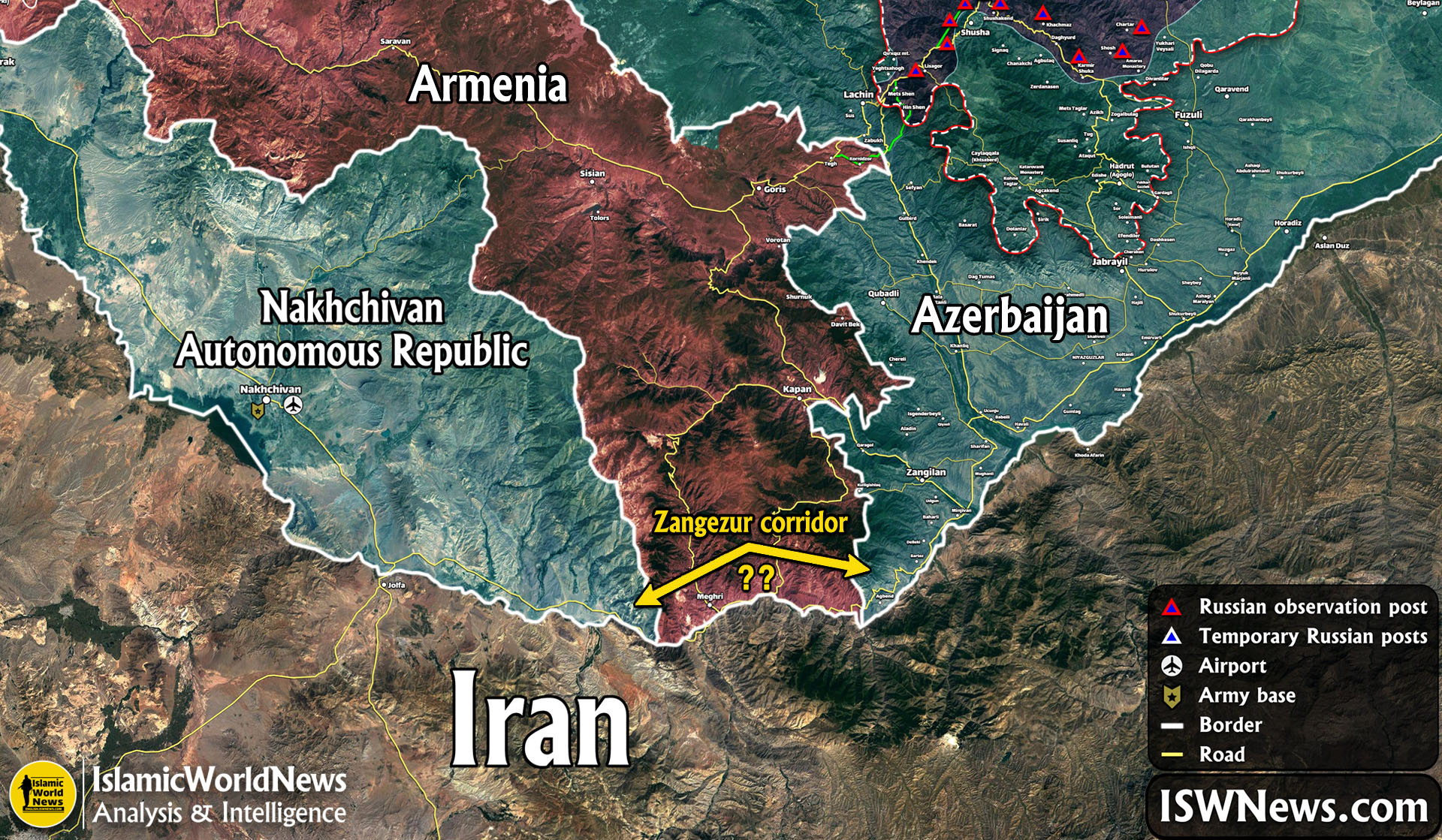
    The Azerbaijani army has published a statement and accused Armenia of violating the ceasefire in the Kalbajar and Lachin axes and has again used this issue as a pretext for artillery and airstrikes on Armenian positions. The Armenian Ministry of Defense also confirmed the attacks of Azerbaijan and announced that the Azerbaijani army has again used drones to target Armenia in Jermuk region.

    Tensions continue in Karabakh and the borders of the two countries while Russia announced the beginning of a ceasefire between Azerbaijan and Armenia yesterday. However, it seems that Russia’s measures to reduce tensions are useless and the parties involved, especially Azerbaijan, do not adhere to the ceasefire.

    Therefore, Russian President Vladimir Putin has announced to the CSTO (Collective Security Treaty Organization) that Russia will take further steps to reduce tensions on the borders of Azerbaijan and Armenia. The special envoy of Russia, Igor Khovaev, will also travel to Baku and Yerevan to meet the officials of the two countries.

    The government of Baku is still seeking for the creation of a corridor known as the Zangezur Corridor to connect the main land of the Republic of Azerbaijan to Nakhchivan, and in the meantime, any tension in the Karabakh region and the borders of the two countries is used as a pretext for launching attacks and intensifying tensions and conflicts in this region, so that if the situation becomes acute, it can use this issue to carry out a final and big operation to achieve its goal.

    Read more: New conflicts between Armenia and the Republic of Azerbaijan + Map