The Pakistani government and the Tehrik-i-Taliban Pakistan (TTP) have agreed to extend an indefinite ceasefire and are negotiating to end two decades of war in Pakistan’s tribal areas, according to Pakistani news agencies. But other local media outlets denied the agreement, citing the visit of a 50-member delegation of Pakistani tribal leaders to the Afghan capital, Kabul, and insisted that the Pakistani delegation begin talks with Pakistani Taliban leaders.
The Pakistani delegation, mediated by the Haqqani Network, met with Tehreek-e-Taliban Pakistan (TTP) leader Noor Wali Mahsud, his deputy Maulvi Faqir Mohammad and a number of other senior members of the group to discuss extending the ceasefire.
The talks coincide with the release of a UN report on the existence of eight military and training bases for the Jaish-e-Mohammad terrorist group and three military and training bases for the Lashkar-e-Taiba terrorist group in Nangarhar and Kunar provinces. The report also said that the Tehreek-e-Taliban Pakistan (TTP) is the largest terrorist group linked to members of the East Turkestan Islamic Movement, the Islamic Movement of Uzbekistan, Jamaat-e-Ansarullah Tajikistan and other terrorist groups in Afghanistan.
Negotiations between the Pakistani government and the Tehreek-e-Taliban Pakistan (TTP) are being mediated by the Afghan Taliban, while their previous talks have failed and resulted in bloody clashes.
After STARStreak missile launch, the missile accelerates to more than Mach 4, making it the fastest short-range surface-to-air missile in existence. It then launches three laser beam-riding submunitions, increasing the likelihood of a successful hit on the target. The darts are guided to the target at a maximum distance of 1.5 meters from each other.
Starstreak has been in service with the British Army since 1997 And in 2012 Thales relaunched the system as ForceSHIELD.
The warhead of this missile consists of three darts. Each dart or submunition has 450 grams of PBX-98 explosive and the total weight of the darts is 900 grams. Each dart is 396 mm long and 22 mm in diameter. Each dart consists of a rotating fore-body, with two canard fins, attached to a non-rotating rear assembly with four fins. The rear assembly of each dart also houses the guidance electronics including a rearwards facing sensor.
The submunitions on this missile is made from a tungsten alloy; Because tungsten has a density about three times that of steel, which increases its kinetic energy and range and height, and the impact of its fragments on the body of the target aircraft is greater. The reason why tungsten fragments are most effective is the high hardness of tungsten-based alloys, which is very suitable for penetrating the aircraft body.
Delayed impact mechanism is used in darts. On impact with the target a delayed-action fuse is triggered, allowing the projectile to penetrate the target before the explosive warhead detonates. This activation mechanism is designed to fragment and maximise damage inside the target.
STARStreak air defense missile performance
The first stage rocket motor has a very short burning time; this launches the missile from the tube but burns out before leaving the tube to protect the operator. This is to prevent damage to the operator due to the high speed and temperature of the exhaust gases. Four metres away from the operator, when the missile is at a safe distance, the second stage motor fires. This rapidly accelerates the missile to a burn-out velocity exceeding Mach 4. As the second stage burns out, three dart sub-munitions are released. The three sub-munitions have enough kinetic energy to manoeuvre to meet a target evading at 9 g at 7,000 metres.
In the new versions of this missile, the maximum effective firing range has been increased to more than 7 km and the maximum operating ceiling to 5 km.
Variants of STARStreak missile: ATASK (Air To Air Starstreak) Variant: This type is made for shooting from a helicopter. This was developed in combination with McDonnell-Douglas and Lockheed-Martin electronics between 1995 and 1998 specifically for use with the AH-64 Apache. However, this type of missile has not yet entered service.
ATASK (Air To Air Starstreak) Variant
Lightweight Multiple Launcher (LML) Variant: The Lightweight Multiple Launcher can be mounted on a tripod as a fixed launcher or on a light vehicle such as a Land Rover or Humvee. This type holds three STARStreak missiles ready for firing. While STARStreak missiles are designed to target high-speed air targets, the LML adds the capability to defeat surface targets such as Light Armoured Vehicles, trucks and fixed installations, as well as aerial targets such as drones and helicopters. A very precise laser guidance system is also included in this system, which allows the operator to select target tracking modes manually or automatically.
Lightweight Multiple Launcher (LML) Variant
RAPIDRanger Variant: RAPIDRanger is a lightweight, highly automated multi-missile launcher which can be fitted to most tracked and wheeled military vehicles. In this type, a four-round launcher is installed on various armored vehicles. RAPIDRanger can also be loaded with a range of missiles from Thales and other providers, adding the ability to attack ground targets such as armoured personnel carriers, static installations and platforms. The addition of an integral 360° surveillance sensor provides the RAPIDRanger with completely autonomous system operation for 24/7 force protection.
RAPIDRanger Variant
Seastreak Variant: Seastreak is a naval type of this missile. In this model, the CIWS (close-in weapon system), which includes 24 STARStreak missiles, is formatted in two blocks of 12 missiles. This system is used on warships to deal with short-range targets.
Seastreak Variant
Self-propelled high-velocity missile (SP HVM) Variant: In this type, an eight-round launcher with internal storage for a further 8 missiles is mounted on the Alvis Stormer armored vehicle.
Self-propelled high-velocity missile Variant
Starstreak Avenger Variant: This system was built based on the needs of the US military in the early 1990s. In this type, the Starstreak missile launcher is installed on the Boeing Avenger vehicles replacing one pod of Stinger missiles with one pod of four Starstreak missiles. As a result, the vehicle has a quadruple pod of the Stinger missile and a quadruple pod of the Stinger missile.
Left image: Avenger Air Defense System – Right image: Boeing Starstreak Avenger System
Starstreak Mark II Variant: This is an upgraded version of the Starstreak missile. In this type, the missile range has been increased to more than 7 km. THOR/Multi Mission System (MMS) Variant: This type has a four-round Starstreak missile launcher mounted on the Austrian Pinzgauer cross-country chassis.
THOR/Multi Mission System Variant
Starstreak anti-aircraft missile specifications: Length: 1.397 m Diameter: 13 cm Weight: 14 kg Range: 7 km Speed: Mach 4 + Flight ceiling: 5 km Guidance: SACLOS Origin: UK
Click to view full sizeClick to view full size
“STARStreak Anti-Aircraft Missile” collection of posters in Arabic, Kurdish, Azeri, Russian, Persian for social media:
According to the Yemeni Rescue Government oil ministry, the Chinese tanker APOLYTARES entered the port of Al-Shihr on the coast of Hadhramaut province to load oil which was extracted from the Saudi coalition-occupied oilfields in the eastern provinces of Yemen.
This is the second time that Chinese tankers have entered the southern coast of Yemen to plunder crude oil. The APOLYTARES tanker also entered the port of Al-Shahar on April 10, transporting 2,375,090 barrels of oil worth $ 251 million to China.
On this account, the Chinese have so far looted about 5 million barrels of Yemeni oil through the mediation of the Saudis and the UAE and handed over the money at a low price to the resigned and illegal Yemeni government. According to the Yemeni Rescue Government oil ministry, this amount of money is enough to pay the salaries of all Yemeni employees for more than two months!
China’s support for Saudi Arabia and the UAE in the Yemeni war has not been limited to oil purchases, and the introduction of CH-4 and Wing Loong 1 and 2 reconnaissance and combat drones has been on the agenda in recent years.
In recent days, with the infiltration of Russian and LPR forces from the east and north into the city of Severodonetsk and the occupation of the first residential areas, the urban war in Severodonetsk practically began. The advance of the Russian forces in the neighborhoods of the city is done in media silence, and only the images published by the Russian forces from inside the city confirm the amount of the advances.
At least one-third of the city is now under Russian and LPR control. According to some estimates, there are about 2,000 Ukrainian troops, as well as an unknown number of foreign fighters in the city of Severodonetsk. But with the Russian army advancing inside the city, most of these forces have retreated to the western part of Severodonetsk and will probably be pushed to Lysychansk soon.
The city of Severodonetsk, unlike the city of Mariupol, does not have strong defenses and the possibility of long-term resistance by Ukrainian forces seems unlikely.
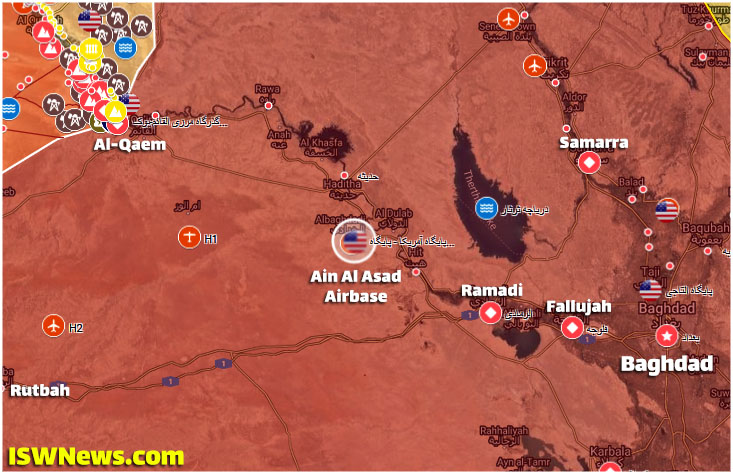
Late on May 30, Ain Al Asad Airbase was targeted by six 122mm rockets. So far, no information has been released about the possible damages and casualties of this attack.
The Iraqi International Resistance Group took responsibility for the attack by releasing a statement and claimed that attacked location of the American occupying forces at Ain Al Asad Airbase with six 122-mm rockets.
The last time that the Ain Al Asad Airbase was attacked was at April 30 which the base was attacked with two 122 mm rockets by the same group.
According to data obtained by ISWNews, this is the 86th attack by Iraqi resistance groups on US assets in Iraq in 2022.
The Ababil-2 drone is a target, reconnaissance and suicide drone. Ababil-2, which was initially produced with a reconnaissance and target mission, was later defined as a suicide drone and is now at the disposal of the Iranian Armed Forces with this mission.
The Ababil series started operating in 1987. Ababil-1 was also used as a suicide drone during the Iraq-Iran war in 80s. Ababil-2 has been in mass production since 1991 by Iran Aircraft Manufacturing Industries (HESA) And since then entered the service of the Iranian Armed Forces.
The Ababil-2 drone does not need a runway to land and take off. The Ababil can be launched from a zero-length jet-assisted take-off platform or by a pneumatic catapult launcher with the help of a rocket attached to the end of the UAV. For landing and recovery, a parachute or skids can be used for conventional landings on a runway or field.
This drone with a high operating rate is a potential threat to a variety of enemy equipment from tanks, personnel and defense systems on the battlefield.
Ababil-2 has an operating range of 100 km, a flight duration of 75 to 120 minutes, a flight ceiling of 11,000 feet (3352.8 m) and a maximum cruising speed of 220 km/h and 370 km/h in dive mode.
Guidance and control of Ababil-2 is done by the ground control center. In this case, the images are transmitted online to the control and command center. The newer Ababil-2 models are equipped with 123 system (automatic stabilizer) and GPS. “123 System” is a new project in the electro avionics engineering department of HESA. This system provides features such as easy flight with more safety by non-professional pilots (in long and short range), automatic take-off and semi-automatic landing, planning and guidance on a desired route with the help of global navigation system, the possibility of disconnecting the control center from the drone and automatic operation of the drone, sending information from the UAV to control center in 17 separate channels, including information on engine speed, ascend and rotation angles, fuel quantity, battery voltage, altitude, and travel speed for Ababil-2.
Ababil-2 uses a cheap camera with 12 megapixel image quality.
Ababil-2 is responsible for tasks such as reconnaissance, battlefield surveillance, border patrol, aerial photography, artillery firing correction, as bait to luring air defenses, carrying out suicide missions and training drone personnel.
Two Ababil-2 models have been observed to date that also have different engines. The difference in appearance of these models is in the tail, the first model has a vertical tail attached to the main body and the second model has two identical vertical tails on the rear wing.
Left image: with two identical vertical tails – Right image: with one vertical tail
Ababil-2 specifications: Length: 2.88 m Wingspan(rear): 3.25 m Height: 0.91 m Empty weight: ~ 27 kg Maximum take-off weight: 83-128 kg Payload: 40 kg of cargo or explosives Internal fuel capacity: 16 liters Engine: W3 or MD series with 20-30 hp Maximum speed: 370 km/h Cruise speed: 250 km/h Combat range: 120 km Endurance: 75-120 minutes Service ceiling: 3352.8 m Origin: Iran
Click to view full size imageClick to view full size image
“Ababil-2 Drone” collection of posters in Arabic, Persian, Kurdish, Russian, Chinese, Azeri and Hebrew for social media:
According to the Turkish Ministry of Defense, he was killed by an explosive device planted by PKK militants in northern Iraq. Another Turkish soldier was also wounded in the incident.
With the death of this Turkish soldier, the death toll of the Turkish army in Operation Claw Lock increased to 19 servicemen.
It should be noted that on the morning of April 18, Turkey has launched a new ground and air cross-border offensive named ‘Operation Claw Lock’ against Kurdish militants in northern Iraq. Turkish military has conducted dozens of military operations against PKK militants in northern Iraq in recent years.
According to Iranian military officials, “this strategic base has all kinds of Iranian combat, reconnaissance and suicide drones, armed with indigenous missile and bomb systems and electronic warfare systems. More than 100 Kaman-22, Kaman-12, Ababil-5, Mohajer-6, Fotros and Karrar drones equipped with all kinds of ammunition are stationed in this base. Also, Arash suicide drone and Omid anti-radar drones and various combat drones equipped with Balaban and Ghaem guided smart bombs, Shafagh laser-guided missiles and Almas missiles are stationed at this base and are ready to carry out operations.”
In this visit, other new achievements of the Army, such as “Heidar 1 missile” to increase the range and carry out long-distance operations by Kaman-22 drone and “Heidar 2 cruise missile” to increase the range and operational capacity of drones that can carry cruise missiles, were unveiled.
It is noteworthy that the Air Force of the Islamic Republic of Iran is one of the four separate service branches of the Iranian Army, which has several combat drone battalions. These battalions have the ability to carry out all kinds of reconnaissance, combat, electronic warfare, deception, suicide, training, support and supplementary operations with fighter jets.
Iranian drones in the underground Strategic Drone Base 313Video report of Major General Bagheri’s visit to the underground “UAV Base 313” of the Islamic Republic of Iran Army
Ankara’s “noble ideas” regarding Syrian refugees conceal a diabolical plan to resume major hostilities throughout northern Syria. The Turks have learned a couple of military lessons in Syria, for example, now the Turkish General Staff knows that its army is not capable of single-handedly crushing even the remnants of the Takfiri or defeating the guerrillas from the YPG. Moreover, the Turkish army will be afraid to enter into direct conflict with Assad’s forces, in whose ranks Hezbollah and the IRGC operate. For this reason, the Erdogan-Bahceli tandem decided to create a million-strong army of refugees who will have to join the ranks of the Jabhat al-Nusra and Turkoman groups. Moreover, even strong disagreements between these rebels will not interfere with the Turkish expansion plan. After all, the former are concentrated in Idlib province, which makes their main goal the fight against Assad in the nearest areas, such as Aleppo, Hama and Latakia. As for the second, the Turks will transfer pan-Turkists to the northeast of Syria for the war against the Kurds and a number of Arab tribes (for example, Shammar).
In parallel with the military actions, the Turks will continue the policy of assimilation, which was previously seen in the north of Aleppo and Idlib. Ankara is building schools, mosques, state institutions, police stations in Turkish, moreover, Turkish passports have been issued to all Syrians without exception, where Arabic names have been changed to Turkish. Moreover, even despite the loyalty of Syrian rebel groups and jihadists to Ankara, priority in any issue or dispute is always given to the armed forces consisting of Turkomans.
Erdogan very timely announced a plan for the “resettlement of refugees” and a new intervention in the northeast of Syria, since it is known that Russia is reducing its armed forces due to military operations in Ukraine. The vacuum left by the Russians will be occupied by the Syrians and Iranians, with whom, from the point of view of the NATO Middle East outpost, it is impossible to conduct dialogues, since they are the “main enemies” of the resurgent “Ottoman Empire”. The Kremlin’s current problems in Eastern Europe have become one of the main inspirers of Erdogan’s new Syrian campaign. The second reason is the close military-political alliance with Zionism.
After all, in fact, Erdogan’s goal is not the SDF or even Assad, Ankara is trying to prepare as much as possible for future wars against the Islamic Republic of Iran. Erdogan’s adviser has already unveiled a plan according to which Turkey will become the most important partner of Zionism in aggression against Iran. At the beginning of the year, Ankara intensified its occupation in northern Iraq, advancing 200 km deep. According to local sources, the Turks have 36 military bases in northern Iraq. The Iraq campaign is only part of Erdogan’s overall anti-Iranian strategy under the leadership of Zionism. Syria and Iraq are key parts of the Axis of Resistance alliance, and creating additional problems for them in the form of Turkish occupation is a Zionist plan to weaken the alliance.
Turkey is not at all embarrassed to be the tip of the Zionist spear, it is worth remembering Thomas Friedman’s map of Ankara’s geopolitical ambitions, where almost the entire Islamic world is captured by the “new Ottomans”, with the exception of the Zionist colony, which, judging by map, will peacefully coexist with the modern “Ottoman port”.