During a parade held on April 18th, 2022 in Tehran, a new drone called “Ababil 5” (also known as Ababil-V or AB-V) was revealed to the public. Prior to this event, no official information about the Ababil 5 drone had been released. Although the exact specifications of the Ababil-5 drone have not been officially disclosed, we will analyze the available footage to review its specifications and features in this article.
The aerodynamic design of this UAV is generally akin to that of the Mohajer-6. While the Mohajer-6 features a High Boom Tail configuration, the Ababil-5 employs a Boom Tail configuration. This design choice not only shortens the runway length needed for landing and takeoff but also enhances the drone’s ability to perform more intense maneuvers.
Types of aircraft tail configurations
The body of this drone has sharp angles and lines, which are clearly designed to reduce the radar cross section from the front, i.e., when the bird is approaching the radar.
Sharp angles and lines
Considering the dimensions of the truck floor, the Ababil-5 drone is estimated to have a wingspan of approximately 12 meters.
Ababil-5 estimated wingspan
The Ababil-5 boasts a wingspan that is 20% larger than that of the Mohajer-6. This increase in wing area allows for a greater cargo mass, enabling the Ababil-5 to carry six Qaem-1 bombs, compared to the Mohajer-6, which can carry up to four bombs.
Click to view full sizs
The landing gear is designed to retract, which helps to reduce drag and minimize the radar cross-section. This reduction in drag, facilitated by the retractable landing gear, enhances the UAV’s cruise speed, flight endurance, and range.
Another reason for incorporating retractable landing gear at the front of the body is to prevent obstruction of the electro-optical’s view. If the camera system were placed in front of the landing gear, as seen in the Mohajer-6, the increased distance from the drone’s center of mass would require additional balance weight, potentially affecting the drone’s performance. Therefore, retractable landing gear is utilized to avoid these issues.
Ababil-5 front wheel landing gear
The rear wheel landing gear is fixed type. According to the published images, the base of the rear wheels are connected to each other by a wire, which limits the amount of final bending of the landing wear during landing and prevents the body from hitting the runway surface.
Ababil-5 rear wheel landing gear
When it comes to weaponry, the Ababil-5 has been observed equipped with Qaem Glide bombs, Almas missiles, and Arman-1 bombs. This drone is capable of carrying six Ghaem-1 bombs and four Ghaem-5 bombs.
Almas missiles, Qaem smart bombs, and Arman-1 bombs
Given that the Ababil-5 has been adopted by both the Iranian Army and the IRGC, and considering it is manufactured by the Iran Ministry of Defense, there’s a possibility that the ammunition used in the Mohajer-6 could be compatible with the Ababil-5, due to the similarity of some of their components.
Click to view full size
Carrying a larger number of bombs or cargo effectively increases the lethality of the UAV, and economically, it destroys targets with fewer sorties and hunts targets at a lower cost. Also, reducing the number of flight sorties can be important both in terms of maintenance and increasing the operational rate of the fleet.
In terms of camera system, the Ababil-5 drone can be equipped with a more advanced electro-optical system, in addition to using older electro-optical systems such as the Eagle 4 models. This advanced camera features at least 60x zoom capabilities, along with a thermal imaging camera and a laser rangefinder.
Ababil-5 electro-optical systemDuring the 1402 Joint Drone Exercise of the Islamic Republic of Iran Army, the Ababil-5 drone was used to observe an Arleigh Burke-class destroyer in the Indian Ocean for four hours
This drone is powered by a piston engine. Images from the NAZAJA exercise in February 2024 reveal that the Ababil-5 is equipped with a Rotax 915 iS engine or a similar model. The Rotax 915 engine delivers up to 141 horsepower at its peak performance.
Rotax 915 in Ababil-5
Overall, Rotax engines are commonly employed in many Iranian drones. Due to sanctions targeting Iran’s military and aviation sectors, direct procurement from Rotax is not feasible. Consequently, to cater to the varied requirements of drones in Iran, numerous components of different Rotax engines have been domestically produced, with some models achieving a complete localization rate of 100%.
With the Rotax 915 iS engine, the Ababil-5 achieves a flight ceiling of approximately 7,000 meters (23,000 feet) and a speed of around 210 kilometers per hour. Its maximum takeoff weight is estimated to be about 1,000 kilograms.
The Ababil-5 drone boasts a flight duration of 12 hours in combat mode, and up to 24 hours in reconnaissance mode without a combat payload. It has a maximum range of up to 2,400 kilometers.
Video showcasing the Ababil-5 drone’s performance during the Islamic Republic of Iran Army Ground Forces exercise in February 2024
Ababil-5 UCAV specifications: Length: ~ 8 meters Wingspan: ~ 12 meters Maximum range: up to 2,400 kilometers Flight ceiling: 7,000 meters Flight endurance: 12 hours combat – 24 hours reconnaissance Engine type: Rotax 915 – 141 horsepower (at its peak) Speed: 210 km/h Hardpoints: 2, with the ability to carry 6 missiles and bombs Maximum takeoff weight: ~ 1,000 kilograms Weapons payload: up to 150 kilograms Origin: Iran
Ababil-5 UCAV – Click to view full size
More images of Ababil-5 drone:
Click to view full size
“Ababil 5” UAV poster collection in Farsi, Russian, Arabic, Chinese and Hebrew:
The Chengdu Aircraft Corporation’s (CAC) J-36 fighter jet has garnered significant attention due to its unique design. It was first publicly observed during a test flight over Chengdu, accompanied by a J-20S fighter jet.
The J-36 fighter features a diamond-like double delta wing configuration, lacking both a tail and a vertical rudder. The removal of the vertical rudder is intended to reduce the radar cross-section. The wing angles suggest that it has been aerodynamically optimized for supercruise capability.
The J-36 fighter jet employs five trailing edge control surfaces on each wing, including two split flap rudders at outboard wing edges to enhance maneuverability.
Two split flap rudders at outboard wing edges to enhance maneuverability.
A notable aspect of the J-36’s design is its use of three low-radar section turbofan engines, with the two outboard engines likely featuring thrust vector control (TVC). The engine with a movable nozzle enhances the fighter’s maneuverability. The use of three engines is a unique and innovative choice for this type of fighter jet. Previous designs and previews depicted the J-36 with two engines, making the current configuration even more distinctive.
The J-36 features three air intakes: one located on top of the fuselage behind the cockpit, and two on the underside of the fuselage.
Rendered images of the J-36 fighter jet. These images show the location of the three engines, three air intakes at the top and bottom of the fighter, and the weapons bay.
Based on available information, the J-36 fighter is estimated to be between 20 and 26 meters in length, with a wingspan of approximately 24 meters and a wing area of over 200 square meters. Its maximum takeoff weight is estimated to be between 45 and 55 tons.
Military experts estimate that J-36 can achieve speeds of Mach 2.5 and has a combat radius of approximately 3,000 kilometers, which is considered exceptionally long for a fighter jet.
The J-36 has three weapons bays. The large, central bay is approximately 7.6 meters long, and can accommodate missiles such as the PL-17 air-to-air missile or heavier air-to-surface missiles. There are two smaller bays under the J-36’s fuselage that can carry smaller missiles. Given the large ammunition bays, the J-36 is likely to also serve as a tactical bomber.
J-36 underbody weapons bayJ-36 flight test over Chengdu city escorted by a J-20S fighter jet
Another sixth-generation fighter from China is the J-50, developed by the Shenyang Aircraft Corporation (SAC). It was observed during a flight test over Shenyang on December 26, 2024.
The J-50 fighter jet also incorporates the specific airframe design characteristics of a sixth-generation fighter jet. This prototype features a combination of a delta configuration with a cranked-arrow design with sharply swept lambda wings with droopped wing tips.
A view of various delta configurations. The J-50 is a combination of the cranked arrow and lambda configurations. The J-36 configuration is similar to the diamond configuration.Images of the J-50 fighter. The cranked-arrow design with sharply swept lambda wings with droopped wing tips are evident in the images.
One fascinating aspect of the J-50’s airframe and aerodynamic design is its folding control surfaces. These surfaces can be folded and aligned horizontally along the wing, and when needed, they can be unfolded to act as two vertical fins. This feature enhances the fighter’s maneuverability and control in the absence of vertical rudders. The incorporation of this technology indicates that the J-50 is designed for both air superiority and strike roles.
A video rendering of the fuselage and aerodynamics of the J-50 fighter jet. The video shows how the folding wings work on this fighter jet.
Based on available information, the J-50 is approximately 22 meters in length, with a wingspan of 22 meters and a wing area of about 145 square meters. Its maximum takeoff weight is estimated to be around 40 tons. The J-50 can reach speeds of Mach 2 and has a combat radius of approximately 2,200 kilometers.
The J-50 fighter jet uses two engines and has two air intakes under the fuselage.
The J-50 is smaller in size compared to the J-36, resulting in smaller ammunition bays and the ability to carry fewer missiles. Its moderate size makes it more suitable for carrier-based operations.
J-50 fighter jet test flight over Shenyang
It is important to note that the names of these two sixth-generation fighters have not been officially announced by their manufacturers. The names used, J-36 and J-50, are speculative and have been attributed by military experts.
In general, while initial information suggests that China has achieved sixth-generation fighter jet status with the J-36 and J-50, the exact roles and capabilities of these aircraft remain unknown. Sixth-generation fighter jets are distinguished not only by their unique appearances but also by critical internal components and advanced technologies such as engine design, control systems, and artificial intelligence, etc. which collectively define their true capabilities.
China has indeed made significant strides in military aviation, appearing to lead in the development of sixth-generation fighter jets. Meanwhile, the United States has been working on its own sixth-generation fighter under the Next Generation Air Dominance (NGAD) program, which has faced delays and challenges due to technical complexities and high costs. Western European countries and Japan are collaborating on two projects, Tempest and the Future Combat Air System, to keep pace in the sixth-generation fighter race. Russia is also developing a sixth-generation fighter known as the PAK DP/MiG-41.
This Nazir radar, with its 800 km range, can detect targets at altitudes exceeding 30 km. It can identify various low radar cross-section targets, such as drones and cruise missiles.
Nazir radar
With the Nazir radar in Gilan, the entire airspace over the Baku government, Armenia, large parts of eastern Turkey, most of Georgia, western Turkmenistan, part of southwestern Kazakhstan, and the Caspian Sea will be under Iran’s air defense surveillance.
Air-launched ballistic missiles, launched from fighter jets, can be highly effective and strategically advantageous for attacking targets. Their significance is especially notable when surprise and rapid deep strikes are required in environments with sophisticated and impenetrable defense systems.
Sparrow missiles gained great attention after their remnants were discovered following the Israeli attacks on Iran on April 19 and then again on October 26. The missile boosters from the first attack were found in Al-Azizia, Wasit Province, which is 100 kilometers from the Iranian border and near Baghdad. In the second attack, the remnants were located in Salahuddin Province.
Ballistic missiles pose a significant threat to Israel, with Iran being one of the most formidable adversaries in this domain. Iran’s advancements in ballistic missile technology have made it a powerful force, causing considerable concern for Israel.
The Israelis initiated the development of anti-ballistic missile defense systems to mitigate the threat posed by ballistic missiles. However, testing these systems necessitated the use of ballistic missiles, which European countries did not possess in their arsenals. Additionally, treaties like the INF prevented the United States from supplying Israel with these types of missiles.
This situation gave the Israeli regime a viable excuse, with American assistance, to develop high-speed, maneuverable target missiles to test and enhance its anti-ballistic capabilities. Additionally, producing these missiles could enable the Israeli regime to use them offensively, if necessary, to strike distant targets and enemy defense systems.
The Israelis designed the missile to be carried and launched by a fighter jet. This approach could significantly enhance the strategic offensive capabilities of their fighter jets.
The development of this target missile, known as Project Sparrow, was initiated by Israel’s Rafael Military Industries with support from the American company Raytheon.
The Sparrow missile family consists of three models: Black Sparrow, Blue Sparrow, and Silver Sparrow. Depending on the mission requirements, the warheads can be of three different types: liquid-filled warheads, high-explosive warheads, and inert warheads.
Sparrow missile warheads
Equipped with explosive warheads, Sparrow missiles offer strategic advantages to the Israeli Air Force. Carried by fighters or bombers, these missiles can cover greater distances than ground-launched variants, thanks to the increased range provided by the aircraft and the launch altitude. Their speed and high maneuverability make them particularly effective against heavily defended, deep, and strategic targets.
Furthermore, there is the potential for Sparrow missiles to be equipped with nuclear warhead. Due to Israel’s policy of nuclear ambiguity, this capability is not officially listed in the Sparrow catalog. However, if Israel were to pursue this option, it would undoubtedly pose a significant and dangerous threat.
The official catalog from Rafael Military Industries outlines three flight profiles for these missiles: ballistic trajectory to mimic Scud-level missiles with conventional warheads, barrel roll, and maneuvering to simulate stealthy competitors like Iranian missiles with maneuverable warheads.
Three flight profiles for Sparrow missiles
Let’s take a closer look at the different models in the Sparrow series. As previously mentioned, there are three models: Black Sparrow, Blue Sparrow, and Silver Sparrow. According to the official catalog, two of these missiles are equipped with detachable warheads.
Sparrow missiles, from top to bottom: Black Sparrow, Blue Sparrow, and Silver Sparrow
Black Sparrow and ROCKS missile: The Black Sparrow is designed as a Scud-B missile simulator. While its speed is unknown, its range is estimated to be between 600 and 800 kilometers. This missile can be launched from F-16 and F-15 fighters. The Black Sparrow measures 4.85 meters in length, weighs 1,275 kilograms, and uses inertial/GPS guidance.
Black Sparrow missile test by Israeli F-15 fighter jetA video of Black Sparrow ballistic missile (the early version)
Israel has developed another missile based on the Black Sparrow, called the ROCKS missile. This missile closely resembles the Black Sparrow in both dimensions and appearance.
ROCKS missile
The ROCKS missile was displayed at the 2019 Aero India air show in Bengaluru, India.
The ROCKS missile at the Aero India air show in Bengaluru, India, 2015
According to available information, the ROCKS missile is a supersonic missile with a speed of approximately Mach 3. It utilizes inertial guidance and GPS for mid-course navigation. Additionally, during the final phase to reach its target, the ROCKS missile is equipped with an electro-optical seeker, and an alleged anti-radiation homing system to enhance its anti-radar capabilities.
The circular error probable (CEP), or the accuracy of this missile, is estimated to be around 3 meters.
The ROCKS ballistic missile can be outfitted with either a penetrating or high-explosive warhead. When equipped with a delay warhead, it becomes particularly effective against fortified targets buried deep underground.
From the limited images available of the ROCKS missile, it appears that the warhead is approximately 1.2 meters in length and has a diameter of about 500 millimeters. Based on the missile’s overall length and weight, and comparing these dimensions with the warhead, it is estimated that the warhead weighs around 150 kilograms.
The range of this missile is estimated to be up to 800 kilometers.
Footage of a ROCKS missile test targeting a sea-based objective captures the final moments of impact from the electro-optical seeker’s viewpoint.
A key question is whether radar-absorbing materials are used in the ROCKS version. While Israel has access to this technology through the U.S., its application in ROCKS is uncertain. The Israelis place significant emphasis on the electro-optical and anti-radiation systems, highlighting their potential to enhance the missile’s targeting accuracy. This emphasis likely stems from their awareness of Iran’s advanced electronic warfare capabilities.
Blue Sparrow missile: The Blue Sparrow missile features a detachable warhead equipped with a Divert Attitude Control System (DACS). DACS consists of small rocket thrusters mounted on the projectile. When activated and fired at short intervals, these thrusters cause the projectile to rotate or change its angle of motion, enabling it to maneuver towards the target. In its role as a target missile, the Blue Sparrow simulates Iranian missiles with maneuverable warheads. When used offensively, it functions as a high-speed, maneuverable ballistic missile.
NASA tests control thrusters on Orion launch abort system
The Blue Sparrow missile boasts a range of approximately 1,000 kilometers and can reach speeds between Mach 5 and 9, classifying it as a hypersonic ballistic missile.
The Blue Sparrow missile uses a GPS and dual inertial guidance system. The implementation of dual inertia significantly reduces the potential for error. The missile’s accuracy, or circular error probable (CEP), is estimated to be approximately 3 meters.
The Blue Sparrow measures 6.51 meters in length and weighs 1,900 kilograms. Published images indicate that its detachable warhead, including the guidance system, is 2.8 meters long with a diameter of about 530 millimeters.
Given the dimensions of the warhead and the overall weight of the missile, the Blue Sparrow warhead’s weight, similar to the ROCKS, is estimated to be around 150 kilograms.
In classified U.S. documents related to the Israeli attack on Iran, leaked on October 15, 2024, this missile is referred to by the code name “Golden Horizon.”
Blue Sparrow ballistic missile tests by Israeli F-15 and F-16 fighters
Silver Sparrow missile: The Silver Sparrow missile is another variant in the Sparrow series. Similar to the Blue Sparrow, it features a detachable warhead. However, it is larger and heavier in terms of both dimensions and weight.
The Silver Sparrow has been reported to measure 8.39 meters in length and weigh 3,130 kilograms.
There are no images of the Silver Sparrow missile or its tests available. Reportedly, due to its high weight, the first test launch was conducted by a C-130 aircraft. The Silver Sparrow was initially tested on September 2, 2013. The launch, originating from the Mediterranean Sea, was detected by the Russian missile early warning radar in Armavir, and the Israelis confirmed the test shortly thereafter.
Based on the available information, the Silver Sparrow warhead appears to be very similar in size to the Blue Sparrow’s. However, a larger booster has been used to extend its range, which is estimated to be up to 1,500 kilometers.
Based on official catalog information, the missile’s guidance system utilizes both GPS and inertial navigation. Its accuracy is estimated to be around 3 meters, similar to the Blue Sparrow missile.
Specifications of the Sparrow family missiles: Type: Air-launched ballistic missile Manufacturer: Rafael Advanced Defense Systems Origin: Israel
Black Sparrow missile: Range: up to 800 km Length: 4.85 m Weight: 1275 kg Propulsion: single stage solid propellant Guidance: GPS/INS
ROCKS missile: Range: up to 800 km Length: 4.85 m Weight: 1275 kg Warhead length: ~ 1.2 m Warhead diameter: ~ 500 mm Warhead weight: ~ 150 kg Propulsion: single stage solid propellant Guidance: GPS/INS – EO seeker Speed: ~ Mach 3 Accuracy: ~ 3 m CEP
Blue Sparrow Missile: Range: up to 1000 km Length: 6.51 m Weight: 1900 kg Warhead length: 2.8 m Warhead diameter: ~ 530 mm Warhead weight: ~ 150 kg Propulsion: single stage solid propellant Guidance: GPS – Dual INS Speed: Mach 5 + Accuracy: ~ 3 m CEP
Silver Sparrow Missile: Range: up to 2000 km Length: 8.39 m Weight: 3130 kg Warhead length: 2.8 m Warhead diameter: ~ 530 mm Warhead weight: ~ 150 kg Propulsion: single stage solid propellant Guidance: GPS – Dual INS Speed: Mach 5 + Accuracy: ~ 3 m CEP
Sparrow and ROCKS missiles – click to view in full size
Sparrow and ROCKS missile posters in Persian and Russian:
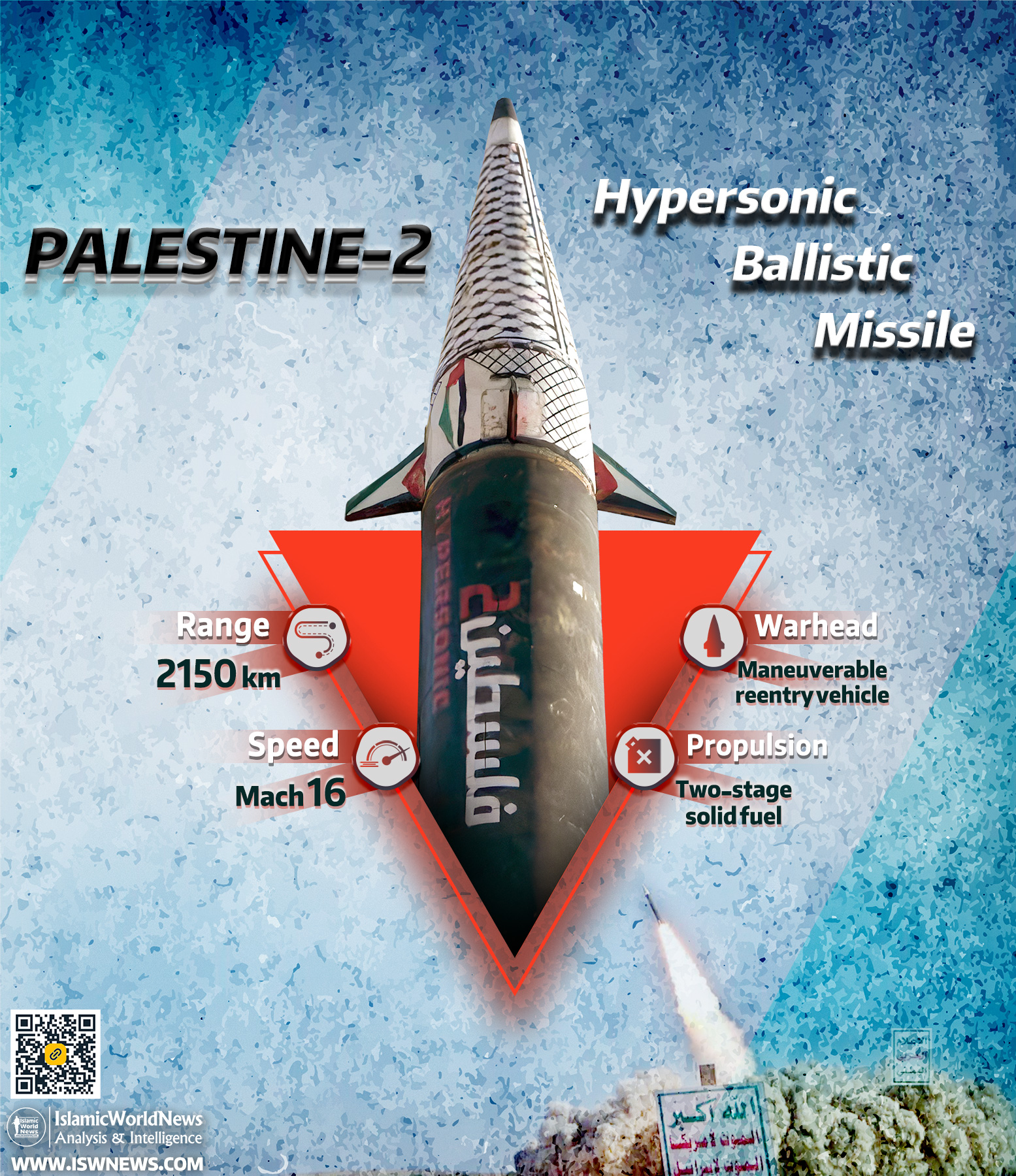
Palestine-2 hypersonic missile, is a two-stage solid-fueled missile with a speed of Mach 16, and its warhead is capable of maneuvering inside atmosphere.
The Palestine 2 missile is Yemen’s adaptation of the Iranian Kheibar Shekan 2 missile. To enhance its capability to strike deeper into Israeli-occupied territories, Yemen has reduced the missile’s warhead weight and extended its range to 2,150 kilometers.
Palestine-2 missilePalestine-2 missile
In general, the Palestine and Hatem class missiles of the Yemeni army are derived from the Iranian Kheibar Shekan 1 and 2 missiles.
The Hatem 1 and 2 missiles have a three-cone warhead similar to the Iranian Kheibar Shekan-1 missile, and the Palestine 1 and 2 missiles have a single-cone warhead derived from the Iranian Kheibar Shekan-2 missile.
The range of the Palestine-1 missile is 1,800 kilometers, like the Iranian Khaybar Shekan-2. However, the range of the Palestine-2 missile has been slightly increased to about 2,150 kilometers.
Khaybar Shekan 1Khaybar Shekan 2Iranian Khaybar Shekan 1 and 2
It seems that the “need for greater range” of attack is a good explanation for the reason behind the manufacturing of Yafa drone, which is a UAV that has its roots in the Sammad class, and is considered as a big development in terms of range, compared to previous drones.
The first prototype of the Samad class drones was unveiled in 2018. Like Yaffa UAV, Samad had a long and flat wing design, which could reach a greater range, while it rises high in the air. The aircraft needs to fly at high altitudes in order to be able to reach a greater range in this flying method. The high flight altitude provides the enemy with the opportunity to detect the presence of the drone more quickly and its radars will be able to issue early warning.
The possible path of the Yafa drone towards Tel Aviv
The path that the drone had flown, was effective in misleading the Israelis. The long route of the drone flight and its circumvention over the waters far from the Israeli-occupied territories may have played a role in confusing them.
One of the most vital segments of an aircraft is its propulsion system. In the Sammad drone, two German two-cylinder engines 3W-110i B2 with 10 horsepower have been utilized, and a Chinese two-cylinder DLE-170 engine with approximately 17 horsepower has been applied in the more advanced versions.
The state of affairs in Yemen and the sanctions imposed on the Arab country make the usage of accessible equipment a priority for the Yemeni army. The aforementioned engines have dual capabilities and are being utilized in civilian aerial industries and are easily accessible. Of course, the extensive usage of the German engine by the Axis of Resistance has forced Germany to adopt a more vigilant approach in this respect, and the Germans have attempted to cut the access of resistance groups to the 3W-110i B2 engines.
For instance, based on the findings of Germany’s intelligence services, some 42 engines of this class were purchased in Greece in 2015 and then ended up in Iran. For this reason, the German officials have imposed a series of restrictions on the dealing of this sort of dual-use engine. The usage of a Chinese engine, which is both more powerful, on the other hand, the seller does not have a significant problem with the type of usage, as well as Iran’s success in developing a more powerful version of this class of engine, were among Tehran’s response to the restrictions imposed by the West.
It can be predicted that similar Chinese engine or an upgraded Iranian version of that engine will be used on Jaffa suicide drone.
Video of the unveiling of the Yafa suicide drone
The Yaffa UAV requires a rocket booster to be able to start moving and speed up, like the previous variants of the Samad drone, and after reaching the appropriate speed and altitude, a piston engine begins working.
Yafa drone’s rocket booster
The prototypes of the Samad drone are probably utilize civilian GPS for navigation in the guidance and navigation segment, which naturally allows the UAVs to strike fixed targets, but it cannot be expected to perform appropriately, when it comes to encountering GPS disruptors.
The Yemeni Armed Forces have applied a combination of inertial and GPS guidance to resolve this problem during the overhaul of the Yafa drone. A computer set controls the UAV’s trajectory. The suicide Yafa drone can improve the chances of reaching its target by choosing a more proper route. According to data released by the United States, two types of gyroscopes, the V-9 and V-10, have been installed on Yemeni drones. For instance, the V-10 version has been found among the remnants of Qasef drone. One of the advantages of an inertial conduction system is that it is very hard to be disrupted.
V10 gyroscope
In terms of dimensions, the Yafa UAV is obviously larger than the previous versions so that it can carry more fuel inside its fuselage. More fuel will help Yafa drone to fly a longer range. In accordance with the images of Yaffa drone, the aircraft has a length of 3 meters and a wingspan of about 6 meters. With these features, the range of Yafa drone is perhaps about 2,500 kilometers. This range is consistent with the expected 2,600-kilometer route flown to conduct air strike on Tel Aviv city.
Consistent with the route covered and the type of its engine, the average speed of Yafa UAV is between 140 and 180 kilometers per hour and enjoys a flight duration of 14 hours.
The drone has a high-explosive warhead, which weighs between 20 and 50 kilograms.
Based on the official announcement by the Yemeni authorities, the drone is classified among stealth aircraft, possibly due to the fact that a honeycomb structure is being used inside its fuselage.
On the whole, the Yafa UAV is considered as a long-range suicide drone, which has extended the space of operations of the Yemeni Armed Forces to the city of Tel Aviv as well as the southern half of occupied Palestine. It is also considered a significant breakthrough in terms of the range and guidance compared to the Samad class drone. Given that Israel is a regime, which possesses a powerful defense system and is widely supported by extra-regional powers, this UAV is certainly not an armament that changes the balance of war against the Israeli regime. Nonetheless, the Yafa drone represents a growing trend of cutting-edge modern technologies in the Yemeni army.
Specifications of the Yafa suicide drone: Type: Suicide Drone Country of Manufacture: Yemen Unveiled: July 23, 2024 Length: 3 m Wingspan: 6 m Engine: Piston Range: 2,500 km Speed: 180 km/h Flight Duration: 14 hours Navigation: INS – GPS – Radio Warhead Weight: Up to 50 kg Takeoff Type: JATO
Yafa suicide drone – click to view full size
More images of Yafa drone:
Click to view full size
The collection of Yaffa suicide drone posters in Arabic, Hebrew, Farsi and Russian languages:
The Shahed-238 suicide drone was first unveiled informally in October 2023 in the Parchamdar (Flagship) Documentary. This drone has a similar platform and the same dimensions to the Shahed-136, but the fundamental difference is the use of a mini-turbojet engine instead of a piston engine.
The Shahed-136, despite its low radar cross-section (RCS), due to its piston engine, low speed, and distinctive loud noise, provided the enemy’s air defense systems and even ground forces with enough time to identify it. However, the use of a turbojet engine in the Shahed-238, while increasing the speed and reducing the noise, along with the drone’s specialized airframe, provides much better protection against heavy machine guns and anti-aircraft cannon, improving the overall success rate of the drone.
A video of the flagship documentary in which the new version of Shahed-136 (now, known as Shahed-238) with micro-turbojet engine can be seen.
Examination of the available turbojet engines produced in Iran, as well as images of the Russian version of this drone from the Ukraine war, suggests the likelihood of using the Toloue-10 engine on the Shahed-238 drones.
The Tolou-10 turbojet engine with a thrust of 1100 to 1200 Newtons increases the speed of the Shahed-238 to 500 to 600 kilometers per hour.
The change in propulsion and engine design increases the weight of the drone. The piston engine MD550 or a similar engine used in the Shahed-136 weighs 17.59 kilograms, while the Toloue-10 turbojet engine weighs around 20.5 kilograms. Additionally, the placement of the micro-turbojet engine within the airframe reduces the space available for carrying fuel. Modifications have also been made to the upper part of the fuselage to accommodate the air intake, which further increases the weight and reduces the drone’s fuel carrying capacity. The fuel type has also been changed from gasoline to Jet-A, primarily due to the fuel requirements of the new engine.
All of these factors, in addition to the increased speed, mean a reduction in the endurance of this drone. It is worth noting that with the changes made, the maximum takeoff weight has increased from 250 kilograms to 380 kilograms.
Air intake for the micro turbojet engine in the Shahed-238 drone
This is not the first time the Toloue-10 engine has been used in Iranian drones. In the past, the Toloue-10 engine had also been used on the Shahed-191 drone.
The use of a jet engine, while turning the Shahed-238 into a fast suicide drone, also has its disadvantages. The piston engine of the Shahed-136 has a very low thermal signature, which made it difficult for infrared-guided missiles like shoulder-launched missiles to lock onto the drone. However, with the change from a piston to a jet engine, more heat is generated, making it easier for infrared-guided missiles to lock onto the drone.
Shahed-238 variants:
The jet-powered Shahed-238 suicide drone has been displayed in three classes so far: a basic and standard model, a model equipped with an imaging infrared (IIR) seeker in the nose, and a model (possibly) equipped with a passive anti-radar seeker.
From right to left: the model equipped with an imaging infrared seeker in the nose, the basic and standard model,and the model equipped with a passive anti-radar seeker.
The standard version of the Shahed-238 drone, like the Shahed-136, is equipped with inertial and satellite guidance and is used to attack fixed ground targets.
The model equipped with a thermal seeker is guided by inertial and satellite navigation to the target area and uses the seeker in the final dive phase to select and lock onto the target. The use of the imaging infrared seeker in the nose significantly increases the accuracy and allows the drone to be used against moving targets as well.
Shahed-238 equipped with thermal seeker
The model equipped with a passive anti-radar seeker is used to suppress the enemy’s radar systems. In this version, the drone enters the target area using inertial and satellite guidance, and then the anti-radar seeker, after detecting radar signals, locks onto the enemy’s radar systems or radio towers and attacks them.
Shahed-238 equipped with anti-radar seeker
It should be noted that the leaked documents show that a drone similar to the Shahed-238, which has been supplied by Iran to Russia and is being produced in that country, is known as the M-237 in the Russian Federation.
After the release of these documents, due to the presence of thermal seekers in the Russian drones, some people mistakenly thought that this drone was a new and different version of the Shahed-238, and therefore the name of the Iranian drones equipped with thermal seekers is also Shahed-237. However, it should be noted that according to the official information published by Iran, the official name of all versions of this drone is the Shahed-238, and only the exported or licensed version is known as the M-237, which can be renamed again in the destination country. Changing the name of exported weapons is a common and normal practice in Iran’s military industries.
All the information published in these documents is almost completely consistent with the information presented on the banner of the Shahed-238 drone at the Iranian National Aerospace Park. But an interesting point that was not available before is that the thermal seeker-equipped version of this drone, in addition to the ability to attack ground targets, also has the ability to attack air targets such as drones. The leaked document shows that the Shahed-238, or the M-237, has locked onto a US MQ-9 Reaper drone.
Right: Leaked documents from the M237 UAV – Left: Shahed-238 banner in the Iranian National Aerospace Park
In addition to all the mentioned models, there is another version of the Shahed-238 drone that has been displayed in one of the promotional videos, but has not been exhibited in any exhibitions so far and no information about it is available. In this model, the Shahed-238 is equipped with an electro-optical camera under the nose. One can speculate that the features of this drone are similar to other Shahed-238 models, and the only difference is the version of camera. Therefore, this model, in addition to the capability of being a suicide drone, also has reconnaissance and surveillance capabilities, and helps the operator in selecting visual targets.
Shahed-238 equipped with an electro-optical camera
Due to the use of a jet engine and increased power, the flap actuators (high-lift devices) also need to be reinforced. For this reason, the Shahed-238 uses eight actuators on the wings, while the Shahed-136 had four actuators on its wings.
The difference between the actuators in Shahed-238 and Shahed-136
According to the available information, the maximum takeoff weight of the Shahed-238 drone is around 380 kilograms, and it is equipped with a 50-kilogram warhead.
The launch and take-off method of the Shahed-238 drone is similar to the Shahed-136. This drone can be launched with the help of a vehicle or using a rocket booster (JATO). There are also speculations about the launch of this drone from fighter jets, which, given the limitations of this task, will most likely remain speculative. However, if this is true, the limitation of the reduced range of this drone compared to the Shahed-136 model will also be eliminated.
Specifications of Shahed-238 suicide drone: Type: Suicide drone Country of Origin: Iran Unveiled: 2023 Length: 3.5 meters Wingspan: 3 meters Engine: Toloue-10 jet engine Range: up to 1200 km Speed: up to 600 km/h Impact speed: + 700 km/h Flight ceiling: 30 thousand feet (9144 meters) (equivalent to Shahed-191) Flight endurance: 2 hours Guidance system: GPS/INS – GNSS Warhead weight: 50 kg Max take-off weight: 380 kg Launch platform: JATO or vehicle-assisted Landing type: With parachute
Shahed 238 suicide drone – click to view in larger size
More images of Shahed 238 suicide drone:
Click to view full size
Shahed-238 posters in Persian, Russian, Chinese, Arabic and Hebrew:
The advanced Khibiny ECM is usually in the form of two cylindrical pods that are mounted on the wing tips of the fighter jet, or in some models, two pods on the wing tips and one pod under the belly of the fighter jet, providing protection for the aircraft against threats. This system, after detecting a missile attack, creates a radio-electronic protective layer around the fighter jet, preventing the hostile missile from reaching its target and deflecting it from its course.
The history of this system’s development dates back to the Soviet Union era and the Kaluga Research Radio Engineering Institute (KNIRTI). In Russia, the main companies involved in the design and production of airborne electronic warfare systems are known as Concern Radio-Electronic Technologies (CRET in the Russian abbreviation). One of the most well-known and active companies responsible for the design of many of Russia’s current electronic warfare (EW) systems is the Kaluga Research Institute of Radio Engineering (KNIRTI). This institute produces a complete range of airborne electronic warfare systems, all derived from a common baseline (platform) and produced in various variants to suit the country’s fighter aircraft. This platform is referred to as Khibiny (the name of a mountain range in Russia) in Russian literature.
The initial design and development of Khibiny electronic countermeasures system took place from 1977 to 1990. In 1995, the first successful operational test of Khibiny electronic countermeasures system was conducted, and a second test was passed in 1997. Finally, in 2014, the Khibiny ECM was officially unveiled and put into operation on the Sukhoi-34, which was the main platform for the development of this pod.
The Khibiny system is available in several versions: – L-175V Khibiny-10V (or L175B Khibiny-B) for Sukhoi-34 – L-175M Khibiny-10M for Sukhoi 33, 34 and 35 – L-265V Khibiny-10V for Sukhoi-34 – L-265 Khibiny-10М for Sukhoi-35S – L-420 Khibiny-U for Sukhoi-30SM and Sukhoi-35S
Here are the key features of the Khibiny system as described in the Russian documents: – Capability to detect and counter single or group threats against identified threat signals – Active jamming by transmitting radar signals across a wide range of frequency bands, targeting up to four separate targets simultaneously – Passive jamming by creating false thermal targets and dipole reflectors – Launching anti-radar missiles towards emitting targets
Images of Khibiny-M L-265M10 components (for installation on Su-35S wingtips) displayed at MAKS 2017.
The Khibiny system suite is typically installed on the wing tips of advanced Sukhoi platforms like the Su-35S fighter, Su-34 bomber, and Su-30SM fighter. The first pod on one wing tip acts as a receiver to detect the enemy’s radio frequencies and emissions, while the second pod on the other wing tip generates countermeasure signals and misleads the enemy’s systems.
According to some Ukrainian and Belarusian experts, who are major utilizers of Russian systems, the older Khibiny variants have certain limitations. These include reliance on Digital Radio Frequency Memory (DRFM) in Russian electronic warfare designs, high output power that can potentially compromise the carrying aircraft, and overall size and cost compared to modern systems. These shortcomings are likely to become more apparent as electronic warfare techniques advance.
To address these issues and improve performance against emerging threats, Russia has updated the Khibiny electronic countermeasures system, introducing the latest Khibiny-U model, which is technologically more advanced compared to the Soviet-era versions.
The Khibiny-U electronic warfare complex, which has been developed for the Su-30SM and Su-35S aircraft, consists of the following components: – RTU 518-PSM (SAP 518-SM) pod with an active jamming system, installed on the right wingtip. – RTU 518-LSM1 (SAP 518-SM1) pod with a passive receiver to detect threatening electromagnetic spectrum emissions, installed on the left wingtip. – KS REP system installed inside the fuselage behind the cockpit. Additionally, SAP-14, SAP-134, or SAP-18 pod is usually installed under the aircraft’s belly to further complement the Khibiny-U complex.
SAP-518SM pods on the wingtips and KS REP pods behind the cockpit on the Sukhoi-30SMSAP-14 pod under belly of Indian Su-30MKI fighterSukhoi-35S fighter equipped with two Khibiny-U pods at the wingstips
According to Russian media outlets, the unveiling and completing of Khibiny-U significantly improved the electronic countermeasures system’s capabilities against enemy radars. The electronic countermeasures system greatly enhances the stealth capabilities of the Russian Aerospace Force’s fighter jets, making them highly resistant to NATO air defense systems for a wide range of operations.
In the development of Khibiny-U, the prototype versions were tested in Syria, utilizing the experience gained from the Syrian conflict. However, the real-world experience of the Ukraine war and field testing under more challenging conditions will provide even better opportunities to further improve and refine this system.
It is noteworthy that several Russian Su-30 and Su-35 fighter jets have been shot down by the Ukrainian forces and their allies during the Ukraine conflict. While this may reveal Russia’s military capability in this respect for NATO, these experiences will be highly valuable and influential for Russia in the future development of this system.
On October 7, coinciding with the start of the Operation al-Aqsa Flood, the Izz al-Din al-Qassam Brigades, the military wing of the Palestinian Hamas movement, unveiled a new rocket system called Rajum and officially announced the entry of this system into the battlefield against the Israeli regime by releasing a video of launching this type of rocket.
It is said that the Izz al-Din al-Qassam Brigades used this rocket system to provide cover fire for their operational forces and destroy Israeli army positions on October 7.
The al-Qassam Brigades have not yet provided detailed information about this rocket system, but studies show that the 114mm short-range Rajum rockets weigh between 2 and 3 kilograms and have an effective range of about 8 kilometers. This rocket system is mainly used in close ground and guerrilla battles. One of the main strategic advantages of this rocket system is its quick mobility due to its suitable weight, based on enemy targets and the needs of the resistance.
A video Rajum rocket system – In this attack that took place on a military point near Karam Abu Salem in the south of the Gaza Strip, 4 Zionist soldiers were killed and 10 others were wounded.
The Rajum rockets have been designed and produced by Palestinian engineers in the Gaza Strip based on the needs of the resistance and the geographical conditions of the battlefield. The Rajum rocket system consists of 5 launch tubes arranged in three rows side by side, and each system has the ability to launch 15 rockets.
This rocket system has been used several times during the Operation Al-Quds Storm against various targets, including the positions of the Israeli army in the Re’im, Karem Abu Salem, Nirim, Amitai and Kissufim areas, and its most prominent operation was the attack on the temporary military post of the Israeli regime’s army in the Karem Abu Salem area on May 5, 2023, when four Israeli military personnel were killed and 10 others were injured.
The specifications of Rajum Rocket System: Type: Short-range rocket system Manufactured: Palestine Manufacturer: Al-Qassam Brigades, military wing of the Hamas movement Unveiled: October 7, 2023 Maximum rocket firing rate per minute: 20 rockets
The specifications of the rocket: Effective range: About 8 kilometers Operational range: 15-17 kilometers Rocket weight: 2 to 3 kilograms
The Azarakhsh defense system is very agile and, considering its dimensions, components, and overall weight, it can be installed on various vehicles and deployed against aerial targets from any location in the shortest possible time.
When it comes to the detection and tracking section, the Azarakhsh defense system simultaneously utilizes passive phased array radar with 360-degree coverage and an electro-optical and infrared imaging system for detecting and tracking targets. According to official sources, the radar detection range of the Azarakhsh defense system is reported to be 50 kilometers, and the electro-optical and thermal system has a range of 25 kilometers.
In the missile section, as the name suggests, this system uses four ready-to-launch ‘Azarakhsh’ air-to-air missiles, which now acts as a surface-to-air missile for target destruction.
The Azarakhsh missile, also known as the Iranian Sidewinder, is a missile with a “fire-and-forget” capability, requiring no guidance after launch. It utilizes an infrared search and track (IRST) system in its nose cone to be able to engage targets. It should be noted that due to the change in the missile’s performance from air-to-air to surface-to-air, the structure of its infrared search and track system has likely undergone changes.
Azarakhsh missile- click to view full size
The Azarakhsh missile has four movable fins at the missile head and four fixed stabilizing fins at the rear section. The end sections of rear fins are also movable.
Based on the provided information, the maximum range of the Azarakhsh missile system is 10 kilometers, and its infrared search and track system locks onto targets within a 6-kilometer range. The total weight of the missile is 70 kilograms, and its warhead is high-explosive fragmentation (HE-frag) type weighing approximately 4.5 kilograms. The length and diameter of the Azarakhsh missile are 3000 and 127 millimeters, respectively.
The Azarakhsh missile’s propulsion system has not been disclosed so far, but based on the released video of the missile’s launch, it can be speculated that its solid fuel propulsion system has also undergone improvements compared to previous versions of the Azarakhsh missile, making it more advanced. The speed of this missile is estimated to be around Mach 1.8.
It is worth mentioning that this system is capable of operating in various weather conditions and at any time of day or night, and it can be linked with other Iranian air defense systems.
Video of live test and performance of Azarakhsh air defense system
Specifications of Azarakhsh air defense system: Type: fully mobile short-range low-altitude air defense system Origin: Iran Manufacturer: Defense Industries Organization (Sâzmân-e Sanâye’-e Defâ’ – SASAD) Unveiled: 17 February 2024 Radar detection range: 50 km Electro-optical tracking range: 25 km Ready to launch missiles: 4 missiles Azarakhsh missile: Length: 3000 mm Diameter: 127 mm Missile weight: 70 kg Warhead weight: 4.5 kg HE-Frag Range: 10 km Speed: Mach 1.8
Azarakhsh short-range air defense system – click to view in full sizeClick to view in full size
Infographics of Azarakhsh air defense system in Russian and Farsi:
The Arman air defense system is a fully mobile air defense system, previously known as the Tactical Sayyad air defense system, observed during a military parade in April 2022. It’s worth noting that the export version of this system was showcased at the Russia’s ARMY-2023 Expo in capital Moscow under the name Tactical Sayyad air defense system.
This air defense system was renamed from Tactical Sayyad to Arman missile system to honor and preserve the memory of the martyr Arman Aliverdi.
A key innovation in the design of the Arman air defense system is the integration of radar and missile launchers in a single vehicle. This design, known as Transporter Erector Launcher and Radar (TELAR), along with the 360-degree coverage angle, increases the overall system’s agility and enables a quicker response to emerging threats. As a result, one unit of the Arman air defense system consists of a radar-carrying vehicle and three vertical missile launchers.
This air defense system is available in two variants, equipped with an active electronically scanned array (AESA) radar for the Islamic Revolutionary Guard Corps (IRGC) Aerospace Force and a passive electronically scanned array (PESA) radar for the Islamic Republic of Iran Air Defense Force. The active phased array radar of this system belongs to the Najm-804 radar family, and the passive phased array radar seems to be of the Joshan radar system.
The Arman air defense system, with the mentioned radars, is capable of detecting 24 targets within a range of 180 to 200 kilometers. It intercepts targets at a range of 160 kilometers and engages with targets at a range of 120 kilometers. The maximum engagement altitude of this radar is 27 kilometers, and it has the capability to engage up to 6 targets simultaneously.
As evident from the images, the Arman air defense system uses a triple missile launcher. According to available information, the Arman air defense system utilizes Sayyad-3F missiles, which are the vertically launched variant of the Sayyad-3 missile. The length of the Sayyad-3F missile is 6.1 meters, its diameter is 40 centimeters, and it weighs approximately 1000 kilograms. This missile has a range of 120 kilometers and a maximum engagement altitude of 27 kilometers.
The vertical launch capability in this system allows it to fire missiles without the need to change the angle and rotate the launcher towards the target, significantly increasing the air defense system’s responsiveness to threats.
Additionally, the air defense system has the capability to increase the number of missiles. By default, one unit (TELAR) of the Arman air defense system is equipped with three vertical-launch missiles. However, the air defense system can be connected to one or two missile carrier vehicles without radar (TEL), equipped with 6 vertical-launch missiles.
Replica of the Arman missile system (Tactical Sayyad) in two modes: TEL version with the capacity of carrying 6 missiles and TELAR version with the capacity of carrying 3 missiles
One notable feature of this air defense system is its “self-protection mechanism” against threats, which represents a significant advancement compared to previous air defense systems such as the Khordad-3 and Khordad-15 air defense systems. According to available information, the integrated protection in this air defense system allocates one of the canisters specifically for this purpose. In fact, the Arman air defense system is equipped with another short-range air defense system in one of its canisters, providing protection against low-altitude threats such as cruise missiles and air-launched bombs.
According to an estimation by the Tansim News Agency defense desk, the small and unidentified missile, which was observed alongside the Tactical Sayyad air defense system or the Arman air defense system at an exhibition in September 2022, is likely to be arranged in a quad-pack, meaning four missiles placed together in one of the canisters, providing the Arman air defense system with the ability to engage targets within a few kilometers range.
A possible missile for the self-defense system embedded in the Arman defense system
Specifications of Arman air defense system: Type: High-altitude medium-range anti-ballistic missile system Origin: Iran Producer: Aerospace Industries Organization (AIO) Unveiled: 17 February 2024 System range: 120 km Altitude of fire: 27 km
Radars: Najm-804 AESA radar and Joshan PESA radar Detection range: 200-180 km Interception range: 160 km Engagement range: 120 km Altitude of fire: 27 km Maximum target detection: up to 24 targets Number of simultaneously engaged target: 6 targets Reaction time: less than 20 seconds Batteries: 3 missiles on each TELAR (expandable to 6 in TEL version)
Missile: Sayad-3F (SD3-F) vertically launched missile Range: 120 km Altitude of fire: 27 km Length: 6.1 meters Diameter: 40 cm Weight: 1000 kg Speed: Mach 4.5 – 5.1
Arman Air Defense System – Click to view full sizeClick to view full size image
Infographics of Arman air defense system in Russian, Hebrew and Farsi:
History and development: After the First Persian Gulf War and Saddam’s use of the Al-Hussein missile against some neighboring countries such as Saudi Arabia, exposed the controversial performance the Patriot air defense system, And the production program of the anti-ballistic system was specially placed on the agenda of the Israeli regime.
The Arrow anti-ballistic system has been jointly funded and developed by Israel and the United States since 1986, and its production and development process has continued until today. According to the Israeli regime, this system is more effective than the American MIM-104 Patriot system to repel ballistic missile attacks.
Undertaken by the MALAM division of the Israel Aerospace Industries (IAI) and Boeing, it is overseen by the Israeli Ministry of Defense’s “Homa” administration and the U.S. Missile Defense Agency.
Israel initially produced the Arrow system domestically, but on February 11, 2003, IAI and Boeing signed an agreement, valued at over $25 million for fiscal years 2003–2004, to establish production facilities for the manufacture of components for the Arrow missile in the United States. In March 2004, IAI awarded a $78 million production contract to Boeing; the total contract value could exceed $225 million through second quarter 2008. As a result of successful implementation of this contract Boeing is responsible for production of about 35 percent of Arrow missile components, including the electronics section, booster motor case and missile canister, at its Huntsville, Alabama, facilities. IAI, the prime contractor of the Arrow system, is responsible for integration and the final assembly of the Arrow missile in Israel.
Boeing also coordinates the production of Arrow missile components manufactured by more than 150 American companies located in over 25 states.
Today, Boeing’s share in the production of the “Arrow 3” system has reached 40-50%.
The first launch of the Arrow interceptor took place on August 9, 1990, designed to test the missile’s control and guidance systems. This test was stopped after a few seconds due to a malfunction in the systems and the missile was destroyed in the sky. This missile had several unsuccessful tests in 1991. Although the missile was finally successful in 1992, and the missile design was changed to Arrow 2. Although Arrow 2 also encountered problems many times, after solving the problems in 1998, the Arrow 2 system was delivered to the army for testing.
On March 14, 2000, the first complete Arrow 2 battery was rolled out in a ceremony at Palmachim Airbase.
In June 2001 Arrow missiles were test-fired in the course of a joint American-Israeli-Turkish exercise code-named Anatolian Eagle, in the southeast of Turkey.
In October 2002 the second battery was declared operational.
In the continuation of the development of the Arrow anti-ballistic system, changes were made on the Arrow 2 missile, and each of these changes was placed in different blocks. The Arrow 2 block-2 missile entered the test phase in 2003. In 2007, Arrow 2 block-3 was also tested. In September 2008, a Blue Sparrow missile, capable of simulating “Scud-C/D” missiles was used to test the Arrow 2 block-4, but the test failed; The next test was repeated on April 7, 2009 and this time it was successful.
By August 2008 the United States and Israeli governments have initiated development of an upper-tier component to the Israeli Air Defense Command, known as Arrow 3. The development is based on an architecture definition study conducted in 2006–2007, determining the need for the upper-tier component to be integrated into Israel’s ballistic missile defense system. According to Arieh Herzog, the main element of this upper tier will be an exoatmospheric interceptor, to be jointly developed by IAI and Boeing. Arrow 3 was declared operational on January 18, 2017.
By April 2011 Israel’s Missile Defense Organization (IMDO) launched initial definition of a new block-5 upgrade to the complete Arrow system that will merge the lower-tier Arrow 2 and exoatmospheric Arrow 3 into a single national missile defense system. According to Arieh Herzog, the planned block-5 will include new ground- and airborne sensors, a command and control system, and a new target missile – the Silver Sparrow – to simulate potentially nuclear-capable delivery vehicles developed by Iran.[68] According to the U.S. Missile Defense Agency, block-5 is expected to be able to deal with “more stressing regional threats” by increasing total defended area by some 50 percent.
In 2017, the Arrow 4 system was defined and put on the agenda for future complex threats. These threats included hypersonic cruise missiles or any other supersonic aircraft. It should be noted that research on Arrow 4 has gained more speed after the unveiling of the Iranian Fattah hypersonic missile.
Until today, parts of Arrow anti-ballistic system, such as radar, have been exported to countries such as the Republic of Azerbaijan. But Arrow, as a complete system, serves only in the army of the Israeli regime. It should be noted that a contract for the full sale of the Arrow system has recently been concluded with Germany.
Financial sources of the project: From the beginning of the design of the Arrow anti-ballistic system, the United States has had a direct role in financing it. Estimated credits required for this project are 1.6 billion dollars and the price of each Arrow missile is estimated at 3 million dollars. However, according to the financial report of the Congressional Research Service (CRS) published in 2023, the total financial assistance of the United States to the Arrow anti-ballistic system reaches 4.5 billion dollars. Estimates of Israel’s spending on the Arrow program show that Israel has spent more than 60 million dollars annually for this project independently, which amounts to more than 2 billion dollars. As a result, the Arrow anti-ballistic system program has cost more than 6.5 billion dollars so far.
An image of the United States financial aid report to the Arrow program
Design and parts: The Arrow system consists of the hypersonic Arrow anti-missile interceptors, Arrow 2 and Arrow 3, the Elta EL/M-2080 “Green Pine” and “Great Pine” early-warning AESA radars, the Elisra “Golden Citron” (“Citron Tree”) C3I center, and “Brown Hazelnut” (“Hazelnut Tree”) launch control center. The system is mobile and can be moved to other prepared sites.
Each missile of the system is placed in a canister and all 6 of them are placed on a truck. Each Arrow anti-ballistic system battalion includes 4 to 8 mobile launchers (24 to 48 missiles), a mobile Green Pine early warning radar unit, a radar power supply unit truck, a radar cooling unit truck, a radar control unit truck, a Elisra Golden Citron control center, Brown Hazelnut mobile launch control center and mobile communications center, resulting in 11 to 15 trucks per battalion.
The model set that shows how to arrange the components of the arrow system. 1- Arrow missile launcher 2- Golden Citron control center 3- Communication center 4- Brown Hazelnut launch control center 5- Green Pine early warning radar antenna 6- Radar control center 7- Radar power unit 8- Radar cooling unit
Green Pine early warning radar: The Green Pine early warning radar model EL/M-2080 has a range of 500 km and the Block-B Super Green Pine version or EL/M-2080s has a range of 900 km. This radar also has a Block-C version, the specifications of which have not been revealed yet.
The Green Pine radar is an active electronically scanned array (AESA) radar. This radar is active in the X-band and is capable of detecting 30 targets at a speed of 3000 meters per second (equivalent to Mach 8.8) in a maximum range of 500 to 900 km depending on the model. The accuracy of missile guidance by the green pine radar is up to 4 meters of the target, and after that the missile acquires the target and hits with its own radar.
The Green Pine early warning radar antenna has a width of 9 meters and a height of 3 meters. This radar system consists of an antenna, a power system (including a diesel generator and fuel tank), a cooling system and a radar control center, and it has 2000 to 2300 modules that send and receive waves and weighs 60 tons.
The Green Pine radar is mobile and can be moved using 4 trailers, but it is not possible to set it up anywhere. In general, it takes about 24 hours to set up a green pine in a new operational site.
Golden Citron control center The “Golden Citron” truck-mounted net-centric open systems architecture Battle Management Command, Control, Communication & Intelligence Center can control up to 14 intercepts simultaneously. The system provides fully automatic as well as Human-in-the-Loop options at every stage of battle operation management. It is also capable of interoperability with other theater missile defense systems and C3I systems. Notably Link 16, TADIL-J, communications were being altered to allow interoperability with Patriot fire control units. Assigned targets can be handed over to the Patriot’s AN/MPQ-53 fire control radar. The “Golden Citron” has three banks of operator consoles laid out in a U shape. All in all, the “Golden Citron” is manned by 7–10 operators.
Brown Hazelnut launch control: The “Brown Hazelnut” launch control center is located at the launch site, up to 300 km from the “Golden Citron” fire control center. It employs microwave and radio data and voice communications links to the “Green Pine” and “Golden Citron”. The launch method is a vertical hot launch from a sealed canister, providing all-azimuth coverage. “Brown Hazelnut” also has missile maintenance and diagnostic capabilities
Missiles (interceptors): The Arrow anti-ballistic system includes several missiles, including Arrow 1, Arrow 2 (including five models), Arrow 3 and Arrow 4.
Arrow 1: The Arrow 1 was a two-stage solid propellant missile that was not put into service. The test of this missile failed on August 9, 1990. The ninth and last test of this missile, which was successful, was conducted on June 12, 1994, from a ship in the Mediterranean Sea. Although several tests of this missile failed and some of them were successful, but in the end this missile was not put into service; And the development of Arrow 1 ceased and further research continued with the “smaller, faster and more lethal” Arrow 2 missile.
This Arrow 1 had inertial and command update mid-course guidance, with a terminal infrared focal plane array. Also, the Arrow-1 interceptor had the capability of thrust vectoring in both stages. The exact specifications of the Arrow 1 missile have not been revealed, but its estimated specifications are available.
Specifications of Arrow 1: Length: 7.5 meters Body diameter: 1.2 meters Length of the second stage: 2.5 meters Weight: about 2000 kg
Arrow 1 missile replica
Arrow 2: The Arrow 2 missile project was developed to achieve a smaller but faster and more lethal missile. The development of this missile started in 1994 and it successfully passed its first tests on July 30, 1995. These experiments continued until 1998. On November 1, 1999, an Arrow 2 missile successfully intercepted and destroyed a Scud missile. After this success, the first battalion of this system was activated on March 14, 2000 during a ceremony at the Palmachim Air Base.
This two-stage missile is equipped with solid propellant booster and sustainer rocket motors. The Arrow-2 missile uses an initial burn to carry out a vertical hot launch from the container and a secondary burn to sustain the missile’s trajectory towards the target at a speed of Mach 9. Thrust vector control is used in the boost and sustainer phases of flight. At the ignition of the second stage sustainer motor, the first stage assembly separates. The Arrow missile is launched before the threat missile’s trajectory and intercept point are accurately known. As more trajectory data becomes available, the optimum intercept point is more precisely defined, towards which the missiles is then guided. The 500 kg kill vehicle section of the missile, containing the warhead, fusing and the terminal seeker, is equipped with four moving delta aerodynamic control fins to give low altitude interception capability. The dual mode missile seeker has a passive infrared seeker for the acquisition and tracking of tactical ballistic missiles and an active radar seeker used to home on air-breathing targets at low altitudes. The infrared seeker is an indium antimonide focal plane array.
The kill vehicle is designed to achieve a hit-to-kill interception, but if this is not achieved, the proximity fuze will direct the warhead fragments at the target shortly before reaching the closest point to the target. The high explosive directed blast fragmentation warhead is capable of destroying a target within a 40–50 m radius. In this manner, Arrow also differs from Patriot PAC-3, THAAD, and Standard Missile 3, which rely purely on hit-to-kill technology in which the kinetic force of a precise impact causes the destruction of the threat.
Video of the successful interception of a Yemeni missile outside the atmosphere by an Arrow-2 missile, May 2025Arrow 2 missile
Arrow 2 Block-2 missile: A successful test of the Arrow 2 block-2 took place on January 5, 2003. Four missiles were launched towards four simulated targets in order to examine the interceptor’s performance during special flight conditions as well as system performance during a sequence of launches. The test did not include actual interceptions. Another successful test held on December 16, 2003, examined the system’s ability to intercept and destroy incoming missiles at significantly high altitudes, around 60 km.
On July 29, 2004, Israel and the United States carried out a joint test at the Naval Air Station Point Mugu Missile Test Center in California, in which the Arrow interceptor was launched against a real “Scud-B” missile. The test was a success, with the interceptor destroying the “Scud” that flew a 300 km (190 mi) trajectory at an altitude of 40 km.
This system conducted another test on August 26, 2005. This test was aimed at examining the Arrow’s ability to detect a splitting warhead of a separating ballistic missile. During the test, despite the correct detection, it could not destroy it due to a technical defect.
In March–April 2005 the ability of “Green Pine” and “Golden Citron” to work with Patriot system elements operated by U.S. Army was successfully tested against simulated “Scud”-type targets during regular series of U.S.–Israeli biennial exercises code-named “Juniper Cobra”.
Actual testing of the complete Arrow system was resumed in December 2005, when the system successfully intercepted a target at an unspecified but reported record low altitude.
A picture of the Arrow system launcher, which is the same for all types of this system.
Arrow 2 Block-3 missile: On February 11, 2007, an Arrow 2 block-3 successfully intercepted and destroyed a “Black Sparrow” target missile simulating a ballistic missile at high altitude. It was the first so-called distributed weapon system test conducted in Israel, which required two Arrow units deployed some 100 km apart to share data on incoming threats and coordinate launching assignments. It was also the first time the Link 16 data distribution system was used to connect two Arrow units.
Arrow 2 Block-4 missile: On April 15, 2008, the Arrow system successfully detected and made a simulated intercept of a new target missile. During the test, a target missile was launched from an Israeli F-15 at a height of 27.5 km. The missile split into multiple warheads, making it harder to intercept it. Nevertheless, “Green Pine” tracked the warhead, simulating an intercept. In September 2008, another test attempted against the “Blue Sparrow” missile but the test failed. Eventually the Arrow 2 block-4 was successfully tested against the “Blue Sparrow” on April 7, 2009.
This missile was also tested on July 22, 2009 against an airborne missile with a range of 100 km fired from a C-17 Globemaster III transport aircraft, but the test was unsuccessful.
This missile successfully passed several other tests until 2015. These tests revealed the need to create a new Battle Management Center, launchers with high shooting availability, better communication with other missile systems and wider ranges of interceptions. Because the probability of success was not high and better launchers should have been used to protect the crew. Also, the control center was facing problems in transmission and correct detection of the firing position, which had to be solved.
Arrow 2 Block-5 missile: By April 2011 Israel’s Missile Defense Organization (IMDO) launched initial definition of a new block-5 upgrade to the complete Arrow system that will merge the lower-tier Arrow 2 and exoatmospheric Arrow 3 into a single national missile defense system. So, a new ground and airborne sensors, a command and control system, and a new target missile – the Silver Sparrow – to simulate potentially nuclear-capable delivery vehicles were defined for test.
The planned block-5 will optimize the existing Super Green Pine radar to operate with the AN/TPY-2 radar as well as with radars commanding anti-ballistic missiles aboard United States Navy destroyers. U.S. radars will be used to support closed-loop operations if Israel and U.S. targets in the region come under attack.
Arrow 3: By August 2008 the United States and Israel have initiated development of an upper-tier component to the Israeli Air Defense Command, known as Arrow 3. Arrow 3 missile was tested on January 23, 2012 and was declared operational on January 18, 2017.
Arrow 3 operates at greater speeds, greater range and at greater altitudes than Arrow 2, intercepting ballistic missiles during the space-flight portion of their trajectory.
Arrow 3 is a two-stage solid fueled missile. Unlike the Arrow 2 missile, this missile only uses “Hit-to-Kill” method to deal with ballistic missiles. The concept of Hit-to-Kill uses the effect of kinetic energy and direct impact to destroy the target instead of proximity fuze. These types of weapons are also called kinetic energy weapons.
Arrow 3 – Interceptor section in the last stage
The interceptor part of the last stage of this missile consists of a solid fueled propellant with the ability a thrust vectoring, which is very reliable at the same time as simplicity and cheapness. At the tip of this section, there is an infrared seeker that tracks the target and provides the possibility of high accuracy.
The location of the ‘hit-to-kill’ part in the Arrow 3 missile
This missile and its system are designed to intercept targets at an altitude of more than 100 km and with longer ranges; Thus, the range of this missile reaches 2400 km.
The interception capability of this system has not been revealed, but the Arrow 3 system is expected to intercept 5 ballistic missiles within 30 seconds.
According to Isaac Ben Yisrael, the former chairman of the Israeli Space Agency, Arrow 3 may serve as an anti-satellite weapon, which would make Israel one of the world’s few countries capable of shooting down satellites.
Arrow 3 missile and launcherVideo of how the Arrow 3 system worksVideo of the Israeli Ministry of Defense’s explanation of how the Arrow 3 system works
Arrow 4 missile: In 2017, after the Arrow 3 missile entered service, the Israeli Ministry of Defense set a new goal and plan for defense against future threats. The main goal was to deal with hypersonic missiles. These weapons, whether cruise or ballistic, were among the targets that could not be intercepted and engaged by the Arrow system. In the new program, the goal was to develop a new radar and a new control center and a new missile. In early 2021 Israel revealed that the development of the Arrow 4 interceptor was ongoing and that the system was targeting the interception of hypersonic threats such as hypersonic cruise missiles and hypersonic glide vehicles. Efforts to counter hypersonic threats took on new urgency following a November 2022 announcement by Iran that they had tested a hypersonic missile that could hit Israel in as little as four minutes.
Specifications of Arrow anti-ballistic missile system: Type: Anti-Ballistic Missile Origin: Israeli and American regime Manufacturer: Israel Aerospace Industries and Boeing Defense, Space & Security (BDS) Entered service: since 2000
Arrow 2 missile: Range: 150 km Speed: Mach 9 Flight altitude: 50 km Length: 6.8 to 7 meters Diameter: 500 mm Weight: 2800 kg Warhead: 150 kg HE fragmentation Propulsion: two-stage solid propellant Guidance: PRH – ARH
Arrow 3 missile: Range: 2400 km Speed: Not disclosed Altitude of fire: more than 100 km Length: Not disclosed Diameter: about 0.5 meters Weight: Not disclosed Warhead: Hit-to-Kill Propulsion: two-stage solid propellant Guidance: INS – Gimbaled seeker
Radar: EL/M-2080 Green Pine Detection range: 500 km in EL/M-2080 – 900 km in EL/M-2080s Engagement range: 300 km at an altitude of 40 km against the Scud missile Number of simultaneously detected targets: 30 targets with a maximum speed of Mach 8.8 Number of simultaneously engaged targets: Not disclosed Reaction time: Not disclosed Batteries: 6 launchers mounted on a trailer
Arrow (Hetz) anti-ballistic system – click to view full size
More images of Arrow system:
Click to view full size
Infographics of ‘Arrow anti-ballistic missile system’ in Farsi, Hebrew, Russian and Azeri: