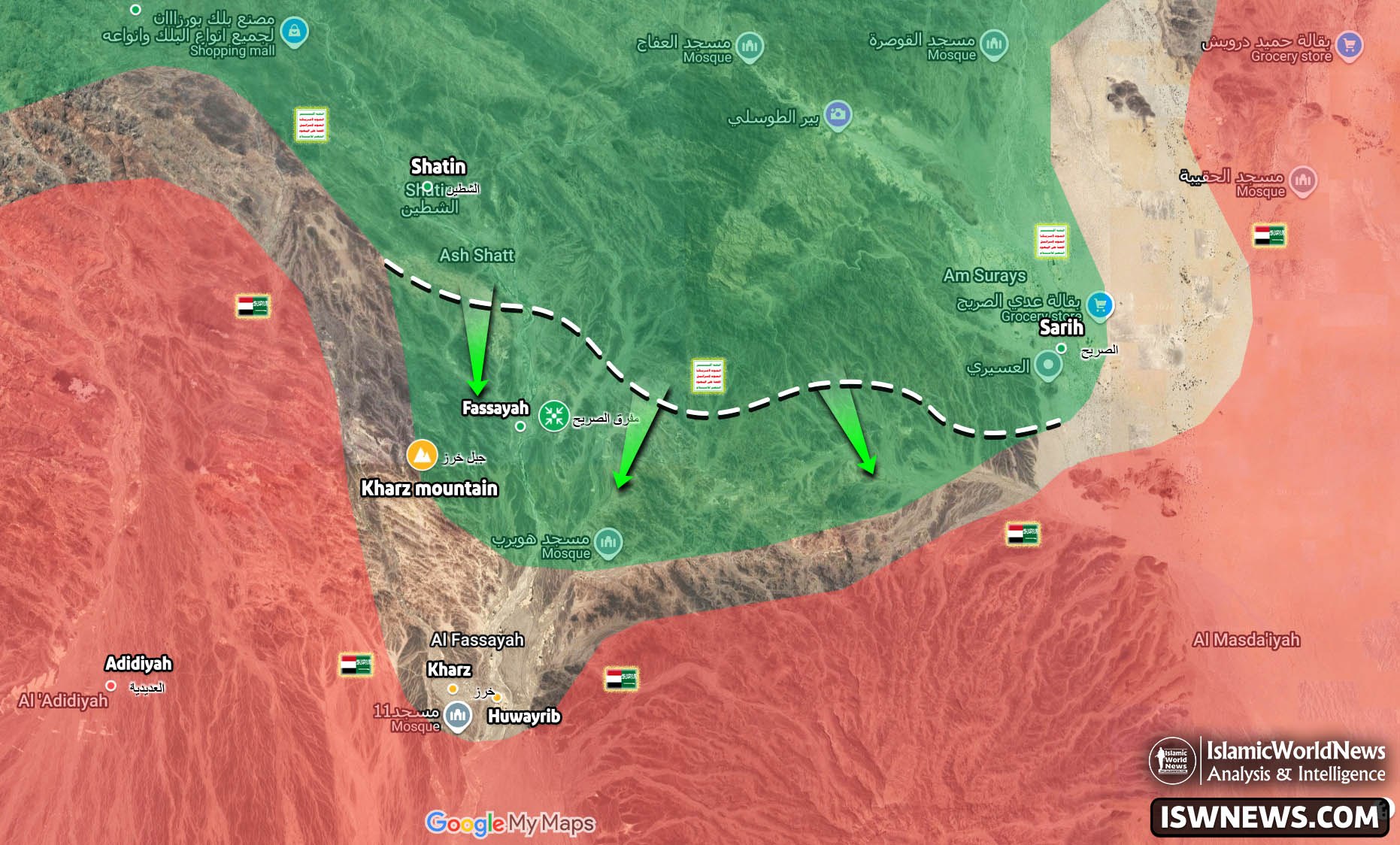
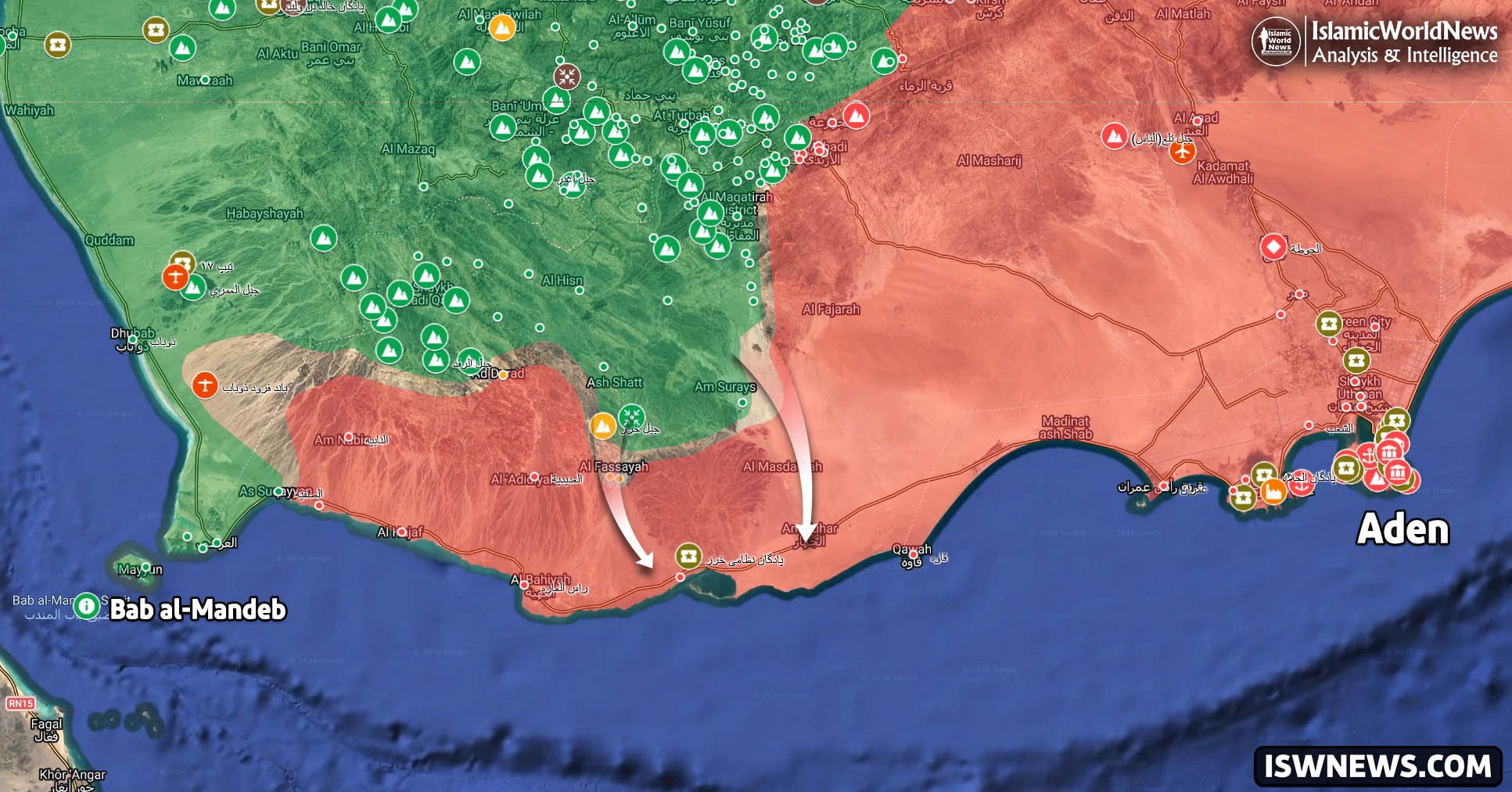
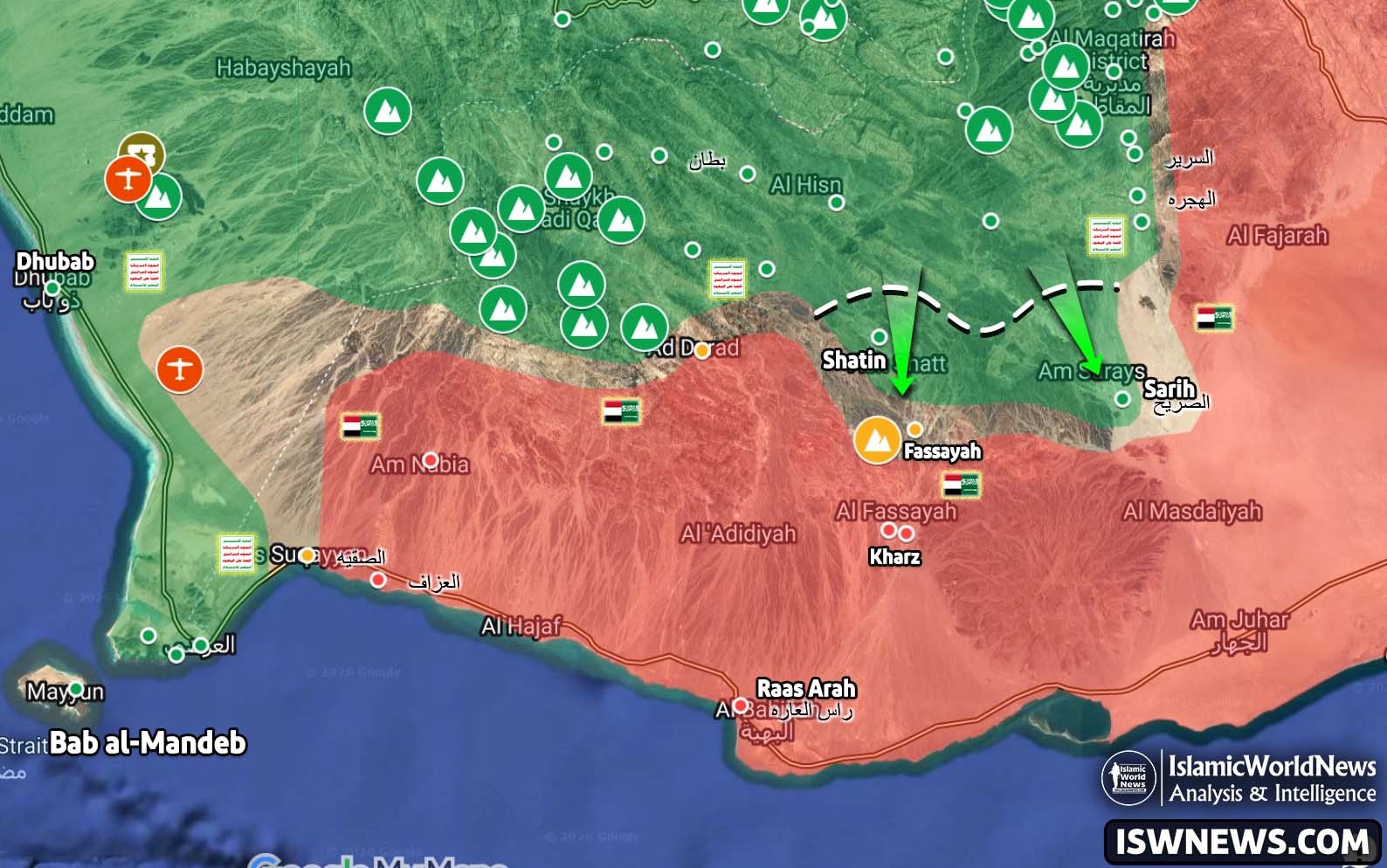
According to the latest field reports in southwestern Lahij Governorate, Yemeni armed forces and popular committees, after pushing back Al-Amaliqa and Tariq Saleh’s forces from the al-Sarih junction, succeeded in clearing the al-Fasayha area. Tariq Saleh’s forces have currently withdrawn from this axis, and Al-Amaliqa forces are resisting Yemeni Army attacks in the Huwayrib and Kharaz areas.
Yemeni forces have also attacked from the Durad axis toward the Ghayl al-Barir and al-Adidiyah areas, which has not yet yielded definitive results.
On the eastern axis of the Bab al-Mandeb Strait, the 17th Brigade of the Al-Amaliqa forces has withdrawn from the al-Saqiya area, and as of this moment, no reliable news has been received of Yemeni forces entering this area.
Last night’s Yemeni Army operation on this axis was a combination of media warfare, missile attacks on the Kharaz and Ras al-Arah bases, and a ground assault. The dissemination of news of a large-scale withdrawal from Ras al-Arah was in this context, and this has not materialized on the battlefield as of this moment.
Yemeni armed forces are currently 25–30 kilometers from the coastal road and the waters of the Gulf of Aden.
If Yemeni armed forces succeed in securing the three aforementioned points, Saudi coalition forces in the Ras al-Arah area and the eastern front of the Bab al-Mandeb Strait will be completely encircled, with no option but to surrender or flee to the sea!
The Saudi coalition is not in a favorable position on the western axis of Lahj Governorate. This dire situation stems from successive defeats in the Kahbub heights, effective missile and drone strikes on military gatherings and equipment, and the wounding of Major General Hamdi Shukri, commander of the Fourth Military Region of the forces of the resigned government, in a Yemeni Army missile attack on the Madariba district administration building in the Ras al-Arah area. In one of the Yemeni Army’s drone attacks, Bilal Shakir Shukri, one of the commanders of the Al-Amalika forces and nephew of Hamdi Shukri, was also killed. Therefore, the collapse of this front in the coming days is certain, and we will soon witness another victory for the resilient people of Yemen.
Iran’s Naval Blockade in the Strait of Hormuz: From Economic Pressure to Global Crisis Contagion
The naval blockade against Iran—which has effectively already begun—can, at the tactical level, swiftly target the main flow of Tehran’s foreign currency revenues, given that over 90% of its foreign trade and the bulk of its oil exports pass through the Persian Gulf. Disruption along this route could generate daily losses of up to roughly $435 million and, in the short term, even lead to a halt in oil production due to limited storage capacity. However, at the strategic level, the core issue is not the “initial effectiveness” but rather the “sustainability and management of consequences”—since this blockade is being imposed at a global chokepoint through which about 20% of the world’s energy flow transits. Any disruption there would directly translate into higher energy prices, global inflation, and pressure on energy-importing economies, particularly in Asia.
This interdependence transforms the blockade from a unilateral leverage tool into a “crisis contagion mechanism,” whose costs are transferred to third parties and gradually generate reverse political pressure on Washington. On the other hand, effective implementation of the blockade demands a continuous and extensive naval presence, preparedness to intercept non-Iranian vessels, and acceptance of the risk of confrontation with major powers such as China—a fact which, as analyses explicitly state, turns this operation into an open-ended military commitment that is, in the medium term, “unsustainable.” Furthermore, legal constraints arising from the transit passage regime in the Strait of Hormuz effectively rule out the possibility of complete closure, and any effort to extend the blockade to third-party ships would raise the threshold of conflict from a bilateral to a multilateral level. Consequently, in the current situation, the naval blockade should be analyzed not as a definitive solution, but rather as a pressure instrument with short-term functionality and long-term uncontrollable repercussions—one that, while capable of severely pressuring Iran’s economy in its initial phase, will in all likelihood, over a longer horizon, lead to the erosion of America’s strategic capacity and credibility due to the networked nature of the energy economy and operational limitations. In any case, the issue of the naval blockade of Iran and its feasibility in strategic terms is analyzed as follows:
Attrition in the “Endless” Mission: Pentagon experts warn that a full blockade of Iran’s ports and coastlines would constitute a massive military operation with no time ceiling. America’s geographic distance and the need for a permanent naval presence render this mission “unsustainable” logistically in the medium and long term, to the point that the U.S. military would effectively lack the capability to fully cover all trade exchanges across such a vast geographical area.
The Industrial Self-Sanction Trap: Contrary to initial assumptions, this blockade targets the U.S. defense industry even more than Iran. The obstruction of sea lanes halts the trade of critical mineral commodities such as sulfur, which is essential for copper and cobalt extraction. This crisis severely diminishes America’s ability to “repair battle-damaged equipment” and “produce jet engines and drones,” while driving up input prices by as much as 165%.
Economic Deadlock and Shifting Objectives: A daily cost of $2 billion, with a projected total expenditure of up to $1 trillion, coupled with the inability to eliminate Iran’s underground military capabilities, is pushing Washington toward a strategy of “graceful exit.” In practice, America’s geographic distance and the vulnerability of allied supply chains have minimized Washington’s resilience in the face of a war of attrition.
Return to Direct Clash between Iran and the United States: From Tactical Pause to the Likelihood of a War of Attrition
A return to direct confrontation between Iran and the United States depends less on sheer political will than on the disruption of the fragile balance now established between the costs of continuing the war and the costs of retreating. From the American perspective, the main precondition for resuming hostilities is that the naval blockade, economic pressure, and limited airstrike threats fail to compel Tehran to accept Washington’s preferred arrangements—particularly given that, according to available sources, Iran, despite enduring heavy military blows, has not collapsed; rather, it has emerged from the first phase with more uncompromising leadership, buried reserves of enriched uranium, and greater political cohesion. Conversely, from Iran’s standpoint, the condition for re-entering direct war is that Washington or Israel crosses the line from deterrence and pressure into infrastructure warfare, high-level assassinations, intensified blockade, or attempts to impose “unconditional surrender”—because, based on field data in Tehran, the prevailing assessment is that any ceasefire without credible guarantees would merely be a pause for a renewed attack within a shorter interval. For this reason, Iran’s planning horizon is not focused on a quick end to the war, but on readiness for a months-long, attritional conflict. Under such circumstances, the second phase of the war will most likely manifest not as a large-scale ground invasion, but as a hybrid, escalating form of combat.
The characteristics of this conflict can be outlined as follows: expansion of strikes on Iran’s economic and energy infrastructure by the U.S. and Israel, and in response, reciprocal Iranian attacks on energy facilities, refineries, ports, shipping routes, and American and allied interests in the region—a pattern whose early signs have already been observed in strikes on Assaluyeh, disruptions to Qatar’s LNG capacity, and threats to navigation in the Strait of Hormuz. The decisive point, however, is that the U.S. also faces serious deterrent obstacles to re-entering an unlimited war. In other words, according to some estimates, the cost of war has reached approximately $2 billion per day and could exceed $1 trillion, while the blockade of Hormuz itself places pressure on America’s own defense supply chain, with West Point assessments even describing it as a “pre-logistics crisis” for replenishing equipment and munitions. Hence, the most probable scenario is that, if negotiations fail again, the second phase of the war will not be a lightning offensive, but a multi-level war of attrition, in which the U.S. seeks, without engaging in ground occupation, to incrementally raise the economic and infrastructural costs for Iran, while Iran, relying on the survival of its missile capacity, the Hormuz leverage, and its ability to generate regional insecurity, raises the costs of continued conflict for the U.S., its allies, and the global economy. Thus, the central issue in returning to direct hostilities is not the mere feasibility of initiating war, but each side’s capacity to endure the consequences of its second phase.
Validating NATO’s Confrontation with the U.S.: Genuine Rupture or Structural Dependency?
The claim of “NATO confronting the U.S.” reflects, more than an operational scenario, a transition from a value-based alliance to an asymmetric and “transactional” security order. The 2026 U.S. National Defense Strategy, with its absolute prioritization of homeland defense and deterrence of China in the Indo-Pacific region, has reduced NATO to a secondary instrument, placing the main burden of conventional defense against Russia on European allies. This paradigm shift, combined with Washington’s pressure to increase defense spending to 5% of GDP, has deepened the rifts inherited from the first Trump era to the level of a “crisis of strategic trust,” where analysts at think tanks such as Brookings and the IISS regard unilateral U.S. actions as undermining the foundations of Western deterrence.
The February 2026 war in Iran and the crisis over the proposal to annex Greenland have acted as key accelerators of this operational divergence. The joint U.S.-Israeli strikes on Iran, conducted without sufficient consultation with Brussels, triggered a bipolar reaction across Europe. While countries such as Spain, deeming the war illegal, refused to provide their bases (Rota and Morón) or airspace to U.S. forces, Washington threatened to suspend their membership or sever trade relations entirely, thereby challenging NATO’s cohesion. Simultaneously, the U.S. insistence on acquiring Greenland and the threat of imposing 25% tariffs on European goods have been legally interpreted as violations of Article 1 of the Washington Treaty, and for the first time, intelligence services of long-standing allies such as Denmark were compelled to factor the United States in as a “potential security risk” in their calculations. Despite these unprecedented tensions, structural limitations preclude an outright institutional confrontation, since the 1949 treaty lacks a mechanism for expelling or counteracting members, and Article 13 only provides for voluntary withdrawal. As a result, Europe’s reaction is proceeding not through direct confrontation within NATO, but through the “gradual Europeanization of security” and the activation of parallel structures now taking shape. The “Readiness 2030” plan—with its €800 billion budget and the SAFE financial instrument for joint arms procurement prioritizing European industries—alongside the drafting of the EU’s “Article 42.7 Handbook” as a substitute for NATO’s Article 5, signals a serious effort to manage dependency on America and prepare for the scenario of a potential U.S. exit from the alliance. This process, rather than collapse, has given rise to a “realist NATO,” in which raw power and European defense autonomy replace earlier idealism.
With the breakdown of negotiations, the likelihood of NATO’s formal entry into war remains near zero, owing to the firm opposition of countries such as Spain and Italy and the lack of consensus over the legal legitimacy of operations. The economic costs arising from $106 oil and a monthly financial burden of €3 billion for Europe, coupled with the closure of the Strait of Hormuz, severely constrain the allies’ financial capacity for a protracted conflict. Militarily, the rapid depletion of U.S. interceptor missile stockpiles (e.g., THAAD and SM-3)—which would take up to six years to replenish—has confronted Washington with a “munitions gap” and weakened NATO’s readiness to defend other fronts. Under these conditions, the most plausible scenario is the continuation of unilateral U.S. intervention with limited support from certain specific allies, alongside the acceleration of European defense independence plans (such as Readiness 2030) to decouple from Washington’s security orbit.
The Bab al-Mandab Strait and Its Impact in the Second Phase of the Conflict
In the second phase of the war, the Bab al-Mandab Strait could function as a “complementary chokepoint” and Iran’s most significant strategic leverage mechanism, since Tehran is capable of transforming a regional crisis into an international geoeconomic blockade by affecting 12% of global trade and 22% of container traffic.
This map shows how two vital energy bottlenecks in the world, the Strait of Hormuz and Bab al-Mandeb, can become tools of geopolitical pressure and disrupt the flow of global trade due to regional tensions.
Based on analyses from think tanks such as the Israeli regime’s National Security Studies Institute and Al Jazeera, Iran—through its allied proxy Ansarallah—possesses not only the capability to block alternative energy export routes—such as the East-West pipeline in Saudi Arabia that delivers oil to Yanbu port, which still requires passage through this strait to reach Asia—but also, by forcing vessels to reroute around the Cape of Good Hope, it has increased shipping companies’ operational costs by up to $50 million per week and created the risk of oil prices spiking to $150–200 per barrel.
Brigadier General Yahya Saree, Spokesman of the Yemeni Armed Forces: A clash occurred today between a number of American destroyers and warships in the Gulf of Aden and Bab al-Mandab while they were protecting two American commercial ships. The result of the clash was as follows:
A direct hit on an American vessel.
Forcing the two American commercial vessels to withdraw and return.
Several of our ballistic missiles struck their targets despite warships’ attempts to intercept them.
The Yemeni military forces used a number of ballistic missiles during more than two-hour clashes.
Yemeni Armed Forces persist with their military operations: enforcing a blockade on Israeli navigation in the Red and Arabian seas until a ceasefire is achieved in Gaza, and the imposed siege is lifted.
The Yemeni Armed Forces affirm that they will take all necessary military procedure within the legitimate right of defense of our country, our people, and our nation, by targeting all hostile American and British targets in the Red and Arab seas.
God is sufficient for us, and He is the best disposer of affairs, the best protector, and the best helper.
According to the plan, militant forces affiliated to Tareq Saleh, a Yemeni military commander and the nephew of the late President Ali Abdullah Saleh, will control the coastal areas from Hays city to Bab al-Mandab Strait, as well as the Southern Transitional Council (STC) forces will control the coastal regions from Ras al-Ara area to Aden governorate. The implementation of this plan faces problems, because tribes such as al-Sabiha tribes in Lahij Governorate, southern Yemen, want their share and try to control this region.
The seventh brigade of Amaliqa forces as well as groups of Al-Sabihah tribal militants prevented Tareq Saleh’s forces from constructing a base and settling in the Bab al-Mandab coastal strip, located in southwestern Taizs Governorate, on July 28.
The tension was accompanied by a halt in the movement of Tariq Saleh’s forces near Dhubab town, and al-Sabiha tribes warned Tareq’s forces against any military movement towards Bab al-Mandab. After this event, Tareq Saleh ordered more forces to be sent to Dhubab town, but eventually, due to resistance from al-Sabihah tribes, he was forced to retreat from Dhubab towards Mocha.
Al-Sabiha tribes claim that the southwestern lands of Taizz Governorate belong to these tribes and Tareq Saleh’s forces must also retreat from their other positions. They did not stop at this condition and demanded that their militants be officially recognized within the framework of the Saudi-led coalition forces and also Abu Dhiyab al-Alkami return to his position in command of support for national resistance forces (under Tareq Saleh’s command) and also hand over the killers of a soldier named Saadan Ali Saeed.
Tariq Saleh, on July 30, in his first reaction to the clash with al-Sabiha tribes in Bab al-Mandab, published a statement entitled leadership statement of national resistance forces. Saleh considered Bab al-Mandab within his operational space in this statement and referred to a plan that has been approved in joint operations with the participation of Abdul Rahman Abu Zaraa Al Muharrami, commander of Amaliqah forces. He also considered establishing himself in all areas of Taizz Governorate and securing international navigation routes as part of his duties.
Following this escalation, Tareq Saleh’s adviser Nabil Al-Sufi announced in a tweet that the plan to establish joint forces (under Tareq Saleh’s command) was designed by the United Arab Emirates and includes the area from Hays in the south of Al-Hudaydah Governorate to Bab al-Mandab. Also, the Southern Transitional Council forces will protect the coastal areas from Ras al-Ara region to Aden to ensure the security of Bab al-Mandab Strait. In addition, Djibouti’s armed forces will be stationed on the other side of the strait.
In this regard, some local sources reported that the Southern Transitional Council forces transferred control of al-Ardhi region in Bab al-Mandab to Tareq Saleh’s forces on July 31.
Based on the circumstances on the ground, this plan can be considered as part of the US-led coalition’s deployment to support a future naval war with the Ansar Allah movement. In recent months, the Ansar Allah movement has strengthened its naval force with the support of Iran and other resistance groups and has armed its forces with various missiles and speed boats.
The tension between al-Sabiha tribes and Tareq Saleh’s forces can also be considered as a sabotage by some Saudi officials to disrupt the United Arab Emirates’ plan, as they are not interested in resuming hostilities with the Ansar Allah movement and are not willing to completely surrender southwestern Yemeni coasts to the United Arab Emirate. Therefore, they play a role with the card of al-Sabiha tribes in this axis.
Altogether, the conflicts in the Red Sea and the vital Bab al-Mandab Strait seem to be important issues, which have been raised since the early years of the Yemen war and they have turned into more serious topics with the permanent deployment of the United States’ naval coalition or Combined Task Force 153 to the waters of the region.
The US and Israel resort to sabotaging the Yemen peace process and destroying relations between Iran and Saudi Arabia in order to send Saudi Arabia back to war with the Ansar Allah movement. Despite avoiding re-engagement in Yemen, the Saudi authorities continue to show inflexible reactions in negotiations as well as military deployment in a bid to maintain their positions! However, such an attitude is expected to weaken the efforts to find a political solution in line with achieving peace in Yemen.
Military situation in southern Yemen – click to view full size
If we take a look at the evolutions of Yemen from Spring (March), we see Saudi Coalition is following three goals:
1. In west coast of Yemen (north of Hajjah and south of al Hudaydah)
2. East of Sanaa until south of Baydha
3. East, north and west of Sa’adah (axes such as Taiz and Jawf and we will address the details of the battlefield in this axis)
In summary, Saudi Coalition (with leadership of Saudi Arabia and UAE) want their benefits and opposing Iran influence, i.e., AnsarAllah movement.
To achieve it, occupying Sanaa and Sa’adah is considered the end of Iran influence in Yemen and a secure region according to their standards and supporting Mansoor Hadi and his forces are a mean to help with it.
Emirates seeks their benefits through supporting Southerners.
Other elements such as al Qaeda, ISIS and Saleh fans are useful for the Saudi Coalition as long as they fight with AnsarAllah.
As mentioned before the goal of west coast battle is to cut AnsarAllah’s access to sea with two main axes:
1. South of al Hudaydah
2. North of Hajjah
1. South of al Hudaydah axis: (Purple arrow)
Al Hudaydah operation was started by leadership of Emirates in west coast using three streams (militia following Tariq Saleh, Southern and local forces) which was defeated by AnsarAllah by opening numerous fronts along coastal strip and dummy attacks to drain their energy.
After that Saudi using Mansoor Hadi’s forces in addition to current forces continued the operation with more strength.
Occupying Bab al Mandeb-Zobab-Mocha-Khukha-Hays; was paved in a slow pace operation by Saudi Coalition and “Fazah-Majilis-Tuhayta” and some other points are added to the list.
(We explained al Hudaydah operation aspect by Saudi Coalition also in this article: Discussion on Aspects of the Saudi Coalition Operation in al-Hudaydah).
2. North of Hajjah axis: (Red arrow)
In north of Hajjah, after fall of Midi and Hayran and northern borders, Haradh is almost under siege and Saudi Coalition arrow of attacks pointing Abas.
According to the goal of cutting AnsarAllah’s access to sea, the Coalition forces are going to in three directions after occupying Midi and Hayran:
1. To Haradh, 2. To Abas and then Ma’ras and then Zaydiyah and Zahra. 3. To Lahiya and then in coastal strip and finally reaching al Hudaydah.
Conclusion:
The joining point of the two operations is al Hudaydah city and the outcome is to cut AnsarAllah’s access to sea, thus AnsarAllah will resist with its highest power.
Saudi Coalition attack from north which is Hajjah can shake AnsarAllah’s defense in al Hudaydah for several reasons and on the other side, AnsarAllah is trying to make the war longer and by using heat defense is trying to drain the Coalition budget and power, which is supported by US and Israel design and Emirates and Saudi money and company of hired governments.
These mines are used to target the Saudi Coalition’s warships and boats; however, about 4 million tons of oil is transported daily from the Bab al Mandeb Strait to the Mediterranean Sea, and if Ansarallah needs, they can disrupt this easily.
1. Al-Hudaydah:
The attack of UAE-backed forces against Ad-Durayhimi was repelled by heavy resistance from “Popular Committees” forces & Ansarallah’s snipers being deployed in northwest of Ad-Durayhimi.
Also coalition forces with blind bombardments targeting public places and yesterday Coalition warplanes attacked Ad-Durayhimi Hospital.
Ansarallah’s feint attacks in countryside of al-Fazah continues, and still the advances of UAE-backed forces are stopped in this area.
2. Saudi Arabia resumed the transportation of its oil tankers in Bab-Al Mandab.
Following up the effective attacks by navy forces of Ansarallah & the Army, for a short period of time Saudi Arabia had suspended its oil tankers from crossing “Bab-Al Mandab Strait”.
3. Ansarallah’s drone attack against Malek Khaled Airport in city of “Khamis Mashit” in south of Saudi Arabia.
Ansarallah media claimed that a Saudi warplane was targeted. Coalition’s medias didn’t publish anything about this attack.
4. Ansarallah says that their drones & missile division in a joint operation, have successfully targeted the UAE-backed forces in west coast.
1. According to Saudi-led coalition claim, final positions of the army and Ansarallah have fallen in Nu’man district, from governorate of Al-Bayda.
With the fall of Aqabat alQoanda` region, in northern Al-Bayda, Nu’man district is now in the hands of Saudi-led coalition. With the fall of Nu’man, two district of Almalajam & Nate’ will also go under heavy attacks.
2. Al-Hudaydah:
Today’s clashes in past days lines, namely south and east of airfield, sporadically continues, and also west side (main building of airfield), north side and airdefense base is under control of Ansarallah.
(After that Ansarallah’s officals and spokeman denied the fall of Al-Hudayda airfield, now videos and pictures that are out, shows us the true nature of these clashes)
Destroying the armored vehicles of the Coalition on the Western shores by Ansarallah
Today attacks, by UAE-Backed forces with the aim of advancing in west side of airfield ( airfield’s square and alKornish region ), is stopped and so the coalition forces retreated to Al-Manzar.
Also there is no changes for situation of other fronts in southern Al-Hudayda (Ad-Durayhimi and Al-Jah). And because of constant attacks by Ansarallah, coastal road is still blocked.
Also an UAE drone was downed in airfield’s sky by Ansarallah (picture down below)
3. A coalition drone was downed in Al-Dhaher District, north of Saada Governorate.
4. New comments of Martin Griffiths, UN’s special envoy for Yemen:
I will continue negotiating with all parties, so that i stop the war in Al-Hudayda from continuation. My priority is to stop the war in Al-Hudayda and going back to political negotiations. The constructive participation of Ansarallah’s leader in Sana’a inspired me, and i am waiting for my meetings with President (resigned) Mansour Hadi and his government. I repeat the UN’s obligation for attaining a political agreement in Yemen. I welcome the obligation and parties tendency for joining the internal political process of Yemen (which UN Facilitates it).
5. Islamic Republic of Iran Army, dispatched its naval squadron & “Khark” helicopter carrier to Yemen seas.
Khark helicopter carrier after 4 years of repair, alongside with Iran’s 54th Naval Squadron of IRI Navy, was sent to the region in order to keep the security of open waters of Aden Gulf, northern Indian ocean, and Bab-el-Mandeb strait.
(With regards to nature of this missions, despite what is being said in western medias, it doesn’t seem that Iran has any plan for military intervention in Yemen. However, this action is not without influence security of Iranian ships which are under threats of Saudi-led coalition in these regions.)
As we are witnessing in the last several years, taking over “Bab al Mandab-Dhubab-Mocha-Khukha-Hays” was a slow motion which Saudi coalition is doing on western shore of Yemen and now by attacking south of al Hudaydah, it begins a new phase.
After previous articles (Monthly Report on Yemen’s developments 29 May 2018), the line of position of Saudi coalition in western shore is weak and vulnerable due to the narrow width and AnsarAllah’s attacks threaten it. (As this axis was under severe fire by AnsarAllah in recent days.)
Therefore we discuss this operation from two possible plans:
Direct attack to al Hudaydah from south and sea.
Defeating the “Jarahi-Zabid-Tuhayta” defense axis in south of al Hudaydah from Ta’izz and then attack to east and south of al Hudaydah.
First plan:
Possible targets (blue arrows): The first step is to capture Durayhimi, the secons is to attack al Hudaydah airport and at the same time the eastern road of al Hudaydah until the triple junction of “Mansuriah-Murawi`ah-al Hudaydah”, the third is to attack from land, sea and air to the city.
Second plan:
Possible targets (pink arrows): The first is to advance till Muqbana which provides defeating AnsarAllah’s defense line in Hajdah until Kamb and Barah, the second step is to attack to Jarahi and Tuhayta at the same time, the third is to coalesce fronts in Zabid and Husayniyah and then Beit Faqih and Mansuriyah and the fourth is to cut the eastern road of al Hudaydah and attacking the city from all directions.
Conclusion:
At the moment, the first point of view due to time limit for the Coalition and the overall situation (from AnsarAllah persistence and …) is more likely to occur than the second point of view. Indeed the Alliance Operation room knows that defeating AnsarAllah defense in south of al Hudaydah is not easy so they need to open more fronts such as Ta’izz and north of al Hudaydah and etc.
Moreover the coastal axis of the Coalition is not a reliable and safe for attacking to al Hudaydah and relying on it makes the Coalition to give casualties. From this point of view the second plan is considerable.
Al Hudaydah has a great importance at the moment; For AnsarAllah it is the biggest base to reach the coast and for the Coalition is an edge of the triangle of (cutting AnsarAllah’s connection to sea, occupying Saada and Sanaa) to reach victory, and also a critical importance for Emirates since they believe al Hudaydah is a point to reach Sanaa and have a more quota in Yemen’s future.
What is AnsarAllah’s reaction?
Considering the recent talk of Yemeni Army Spokesperson regarding threatening Emirates and having enough power to reclaim lost lands such as Khukhah and Hays, anticipation of the reclaiming operation is not likely; but it is easy to predict teasing and missile attacks to western shores of Yemen and even Emirates.
In the case of breaking the defense line in south of al Hudaydah, teasing and missile attacks and finally urban war is the sole trick of AnsarAllah to face and ground the Coalition.
AnsarAllah’s overall strategy in al Hudaydah and in all fronts of Yemen is the same method which results in prolonged war and exhausting the Coalition; if occurs, the Saudi Coalition might retreats from those regions or at least prepares the situation for AnsarAllah and Yemeni Army to reclaim the lost lands.