After the Col. Muammar Gaddafi overthrow in 2011 in Libya, that ended his more than 40-years governing, this country entered to a new stage of political and military actions. The actions that continue so far and have turned Libya into regional and trans-regional powers presence square. These clashes still continue, despite the numerous changing of governments. Among the most important reasons of this conflict continuation, can mention the factors like severe disagreements between the national congress early members and their supporting of Gen. Haftar, that announced the coup against national congress in a tv-speech, governments disability in disarming of armed groups and disability in forming a national army.
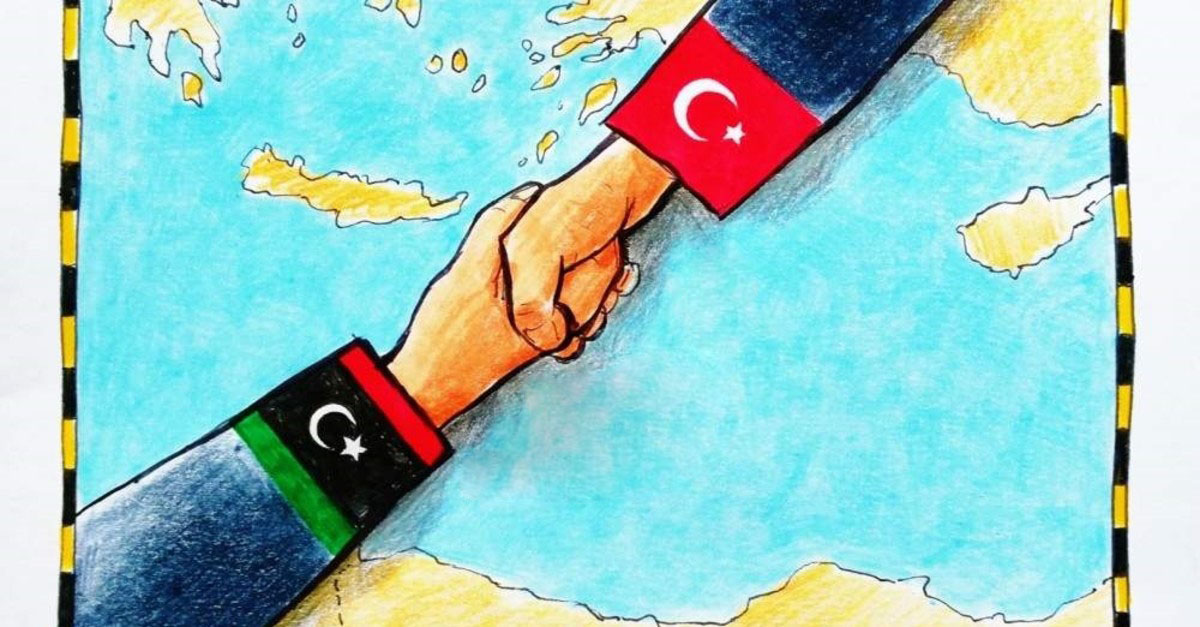
In the current situation, Gen. Haftar (LNA) has the control of more parts of Libya, with the support of some Libyan political groups, foreign countries like Saudi Arabia, UAE and some European countries; and also in other parts, the government stationed in Tripoli (GNA) is supported by Turkey and Qatar. Among the countries that involved in the Libyan conflict, the Turkey activities are more greater. This presence has many reasons including political, ideological and economic reasons.
The political and ideological dimensions of Turkey’s presence in Libya
The Government of National Accord (GNA) has the Muslim Brotherhood idealogy, that this issue is one of the main reasons of Turkey’s supports from the Tripoli based government in Libya. The AKP that is the ruling party in Turkey, supported of Muslim Brotherhood all over the Arab world in the Arab spring. The clear example of this issue, was supporting of Morsi in Egypt. Also, one of the reasons for Turkey and Qatar good relations, is the Muslim Brotherhood thoughts of Qatar. The thinking that one of its main rivals in the Sunnah world, is Wahhabism thinking by the Saudi Arabia leadership.
Erdogan, as the number one figure in Turkey in recent decade, is very interested in Muslim Brotherhood idealogy. Erdogan has studied at the Imam Khatib school, that is a religious school and promotes some of the Muslim Brotherhood ideas and has had activities in Turkey, and he is so interested in these ideas, regardless of political tendencies. Also, spreading of this ideology is a tool for the reviving the Ottoman geographical borders and ideas named Ottomanism by Erdogan, that include the Syria to Egypt and now the Libya.
Of course, the Libya has been the Mediterranean gateway for the Ottomans, since Ottoman empire. Therefore, the political reason for Turkey presence in Libya is an effort for the Brotherhood government domination in Libya in order to turning to a base for Turkey in the North Africa. In fact, the Turks believe that after the coup in Egypt and the Muhammad Morsi overthrow in Egypt as one of the Erdogan allies in north of Africa, Libya can fill this gap for Turkey.
The economic dimension of Turkey presence in Libya
But the other issue, is Turkey’s economic role. At the Muammar Gaddafi time, Turkey had many contractors in Libya, so with the Gaddafi overthrow, Turkey was from the countries that suffered economically in this country. Turkey’s economic activities in Libya were in the extent that this country had been turned to one of the major economic partners of Turkey. Turkey’s investments in Libya are estimated more than 28 billion dollars. Turkey wanted to follow this process after the Gaddafi overthrow, that Libyan economic negotiations with Turkey were postponed due to the Khalife Haftar confliction with the Government of National Accord.
On the other hand, access to the oil and gas as the cheap fuel and industrial motive is very important for Turkey. The issue that Turkey for reaching it, did drilling in Cyprus and even confronted with Europe. Libya is also from the countries that has a lot of natural resources. The sources that can release the Turkey from dependence on Russia and Iran.
Therefore, when the Government of National Accord asked Turkey to send the forces, the Turkish parliament allowed immediately Erdogan to dispatch military forces to Libya. After the Turkey policies failure in Syria and the hopelessness, or it’s better that say Erdogan’s fear of confronting with Syria and its supporters such as Iran and Russia, this country’s forces almost lost their efficiency in the Syria, and now for supplying the Turkey’s economic and political interests in Libya, should fight with Gen. Haftar that is backed by Saudi and UAE.
Tag: Gaddafi
-
Opinion: What is Turkey seeking in Libya?
-

Map: Latest Updates on Military Situation of Southern Tripoli, Libya, 20 July 2019
– The Libyan National Army after a long time halt in the Ain Zara area, start its advances and after severe engagements entered Yarmuk military camp. It is said Government of National Accord forces have retreated from the camp and engagements are continuing inside and around the camp.
– LNA forces controlling more of the areas around Zatarnah village in southeast of Tripoli.
– GNA warplanes bombed LNA forces position in Al Asabiyah.
– LNA reclaimed Kalibah area in south of Gharyan again. LNA troops, in an operation 20 days ago, were forced to retreat from Gharyan town and southern parts of it.
– The GNA Ministry of Justice granted former Gaddafi prime minister Al-Baghdadi Al-Mahmoudi a compassionate release.
Interactive map
-
Reviewing Changes and Currents Involved in Libya – Part two + Latest Military Situation Map in Libya
The secret hand of western intelligence services in scheming chaos and reinforcing terrorism in North Africa; and also Libyans themselves stirring up ethnic and political disputes cause the Libya crisis still remain unsolved even in post-Gaddafi conditions.
According to Paris Agreement and Statement between field-marshal Haftar (the general of Libyan army) and Fayez al-Seraj (president of the Government of National Accord, GNA) and with the mediation of the French; December 10th 2018, was chosen for presidential and parliamentary election in Libya.
Tribes like Tuareg, Tabu, Amazighs, and … which have a significant role in the North Africa’s developments; are weak at maintaining stability with other tribes or governments and become suppressed by the armies of other countries of this region.
Also, through these disputes and instability of governments, Intellectual Salafi talent which has deep roots in Libya has this chance to find a hang-out in deserts, though it is not like Iraq and Syria.
In the previous issue, four currents were considered as the main currents:
- Current which follows the army (Field Marshal Khalifa Haftar, LNA)
- Current which follows Government of National Accord, GNA
- Tuareg and other tribes
- ISIS and other terrorist groups
The last situation of these four Categories is as below:
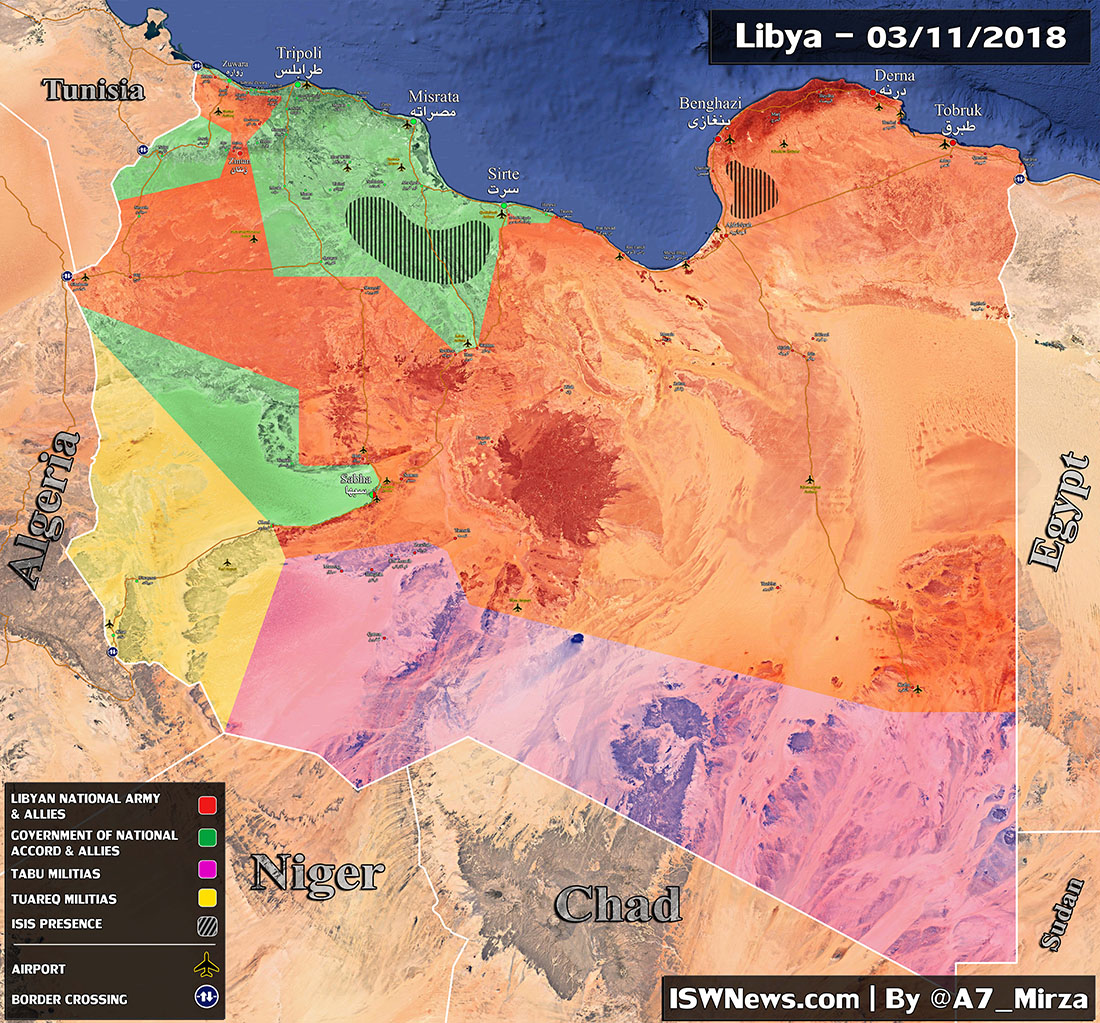
1. Current which follows the army (Field Marshal Khalifa Haftar, Libyan National Army,LNA) (red color on the map)
According to the last situation of the current which follows Haftar, this current expands its attacks to the center and the west of Libya after occupying the most of eastern regions of Libya by the support of foreign aids (U.A.E and Egypt).
Cities like Benghazi and Ajdabia which were under attacks of remaining of the radical groups, got under control, and Darnah –which was dominated by Shura Council of Mujahideen- was totally in possession of Haftar.
Field marshal Haftar in his last year trip to Russia, wanted the authorities to deploy forces and build military bases, but the Russians didn’t reach to an agreement with him.
Also, UAE wants to achieve results of what they wanted to invest in previous years, and didn’t have found any ally like Khalifa Haftar for that yet.
Haftar’s other ally, Saudi Arabia, did not have any military supportive role in Libya, and has mostly supported him [Haftar] because of his politics (more because his anti-Qatar manner).
2. Current which follows Government of National Accord, GNA (green color on the map)
This current which consists of different groups –from liberals to Salafies- has been involved in Tripoli’s conflicts till now. They think conqueror and the power-holder is the one who has control over the Capital.
When things going wrong, Liberals request Europeans for military and political support; and Salafies (closed to Muslim brotherhood) request for help from Qatar.
Libya Shield Force (based in northwest) usually do not resist against army (Haftar) and generally retreat when politicians reach to an agreement.
They usually have scattered struggles against Amazigh and other tribes. Tensions would subside with internal and external interference.
But in Tripoli, conflicts are heavier to maintain [their] political life and have more power. Libya Shield forces have had conflicts with ISIS-backed groups in Sirte, and in Sabratha have fought with groups which follow Al-Qaeda (in the form of internal conflicts).
3. Tuareg and other tribes (yellow color for Tuareg and purple color for Tabu on the map)
Libya, like other Islamic countries, is a country of different tribes and ethnics.
Amazigh, Tabu, and Tuareg, all are from tribes which not only reside in Libya, but also are habitants of North Africa region. Theses tribes had been fighting with Gaddafi together with other tribes and now have control of their own regions, and generally try to make peace with Haftar and National Accord.
They join to conflicts in some places like Sabha (in the heart of Libya) just for save their lives.
In general, Tuareg leans toward the Government of National Accord (Green) and Tabu tribes lean toward Field Marshal Haftar (Red).
The population of Amazigh tribes in Libya is less than 500,000, Tuareg is more than 500,000 (approximately), and Tabu is 52,000.
4. ISIS and terrorist groups (ISIS-occupied places on the map are shown by black hatching)
In the previous article, disestablishment of Ansar Al_Sharia (ISIS-affiliated) and weakening of Shura Council of Mujahideen in Libya, and presence of them in some cities like Benghazi and Darnah were discussed.
Following the clashes, rest of the Shura council of Mujahideen in Benghazi, lost the battle to the Haftar army and remainders retreated to the places under control of Government of National Accord, and acting as Benghazi defense brigade (their headquarters is in Jufra airport now).
ISIS too, is active in suburban areas around Benghazi, Ajdabiya and Sirte. But their activities have not gone further than disruptive attacks, bombings, and suicide operations.
Conclusions:
Libya, unlike Syria and Iraq, does not have neighbors which help it retrieve stability and security. Otherwise, they are usually tied up in their knots.
But certainly, even Libyans themselves and also foreign countries are not interested in giving aid; Europeans have a bad experience of Afghanistan, Syria, and Iraq. They see Libya a swamp like them and then most of their support is limited to air strikes.
U.S.A, especially in Trump administration, puts up its policy on not interference its army into Libya, and instead, uses its regional alternatives.
Countries like Saudi Arabia, U.A.E, and Egypt do not have the strength to do anything; they are not as powerful as being a superpower.
There is no agreement about type of governing [political] system in Libya; and that is the main problem.
Liberals (most of national accord government), social nationalists (Haftar), Salafists (radical groups and those closed to Muslim Brotherhood an Al-Qaeda) and etc…, none of them are willing to accept election results or reach to an agreement on internal issues.
There is a doubt about Libya’s future: will this country become a safe place for ISIS and groups like that?! In that case, distance between ISIS and Europe will be less than 300 KM, and that is a very bad news for Europe! Or it would be a stable and safe country which would progress and saves itself by gas and oil revenues.
Anyway, the recent state of Libya is closed to the first possibility and in the most optimistic case, it is moving toward this process.
Anyway, we should wait till the due date for election to see if this election is a beginning of stability and security in Libya, or it would lead to a civil war for the third time like 2014.
Interactive map of Libya: Here
 Click to see the full size map
