Tag: Karabakh

  • Latest Updates on Karabakh Clashes, 1 October 2020

    Latest Updates on Karabakh Clashes, 1 October 2020

    – The air defense of the Armenian army shot down an Israeli made drone Harop belonging to Azerbaijan Army in the skies of the city of Askran. (Image)

    – Armenian Army Air Defense shot down four UAVs in the skies of Yerevan.
    The S300 defense system is said to have thwarted the attack.

    Alleged footage of repelling drone strikes by the Armenian S-300 defense system

    – Following the sale of military weapons by the Zionist regime to the Republic of Azerbaijan, Armenia recalled its ambassador from Israel.

    – Russia has expressed concern over the deployment of Syrian and Libyan militants in Nagorno-Karabakh by Turkey.

    – Russia, the United States and France issued a joint statement calling on the Republic of Azerbaijan and Armenia to resume immediate and unconditional ceasefire talks.

    – Russian and Turkish Foreign Ministers call on the latest situation in the conflicts between the Republic of Azerbaijan and Armenia.

  • Latest Updates on Karabakh Clashes, 29 September 2020 (Map Update)

    Latest Updates on Karabakh Clashes, 29 September 2020 (Map Update)

    – Clashes continue in the southern axis of Nagorno-Karabakh around Fuzuli between Azerbaijani and Armenian forces. The Armenian army claims to have regained all the lines lost yesterday, but Azeri field sources denied this.

    – The Ministry of Defense of Azerbaijan announced the destruction of 4 tanks of the Armenian forces on the Fuzuli front.

    – Heavy clashes on the axis of Agdarreh (Martakert) and Madaghis-Talesh in the north of Karabakh region:
    During the recent clashes between Azerbaijan and Armenia on the Martakert and Madagis-Talesh axis, the bodies of 30 Azeri forces have been transferred to the rear. 13 of the dead are members of the army and members of the border guards and the Azerbaijani army. Another 15 are residents of the Talesh area who generally lost their lives in infiltration operations. Recent operations are based on infiltration of Armenian lines, and commandos have a special role to play in these operations.
    The exact number of casualties of Armenian forces on this front has not been published yet.

    – A Sukhoi 25 fighter jet of the Armenian army was shot down by a Turkish F16 fighter jet. The Ministry of Defense of Armenia confirmed the incident and announced that the pilot of this fighter jet had been killed.

    – According to the Ministry of Defense of Armenia, the damage to the Republic of Azerbaijan since September 27, 2020 has included the destruction of 82 vehicles, 1 aircraft, 4 helicopters, 49 UAVs and 80 armored vehicles.

    – UAVs of the Republic of Azerbaijan targeted a bus in the town of Vardenis in Armenia. Armenia has emphasized will retaliate with an appropriate response.

    – Azerbaijani artillery heavily bombarded the positions of the Armenian forces in Martuni (Khojavand).

    – Armenian air defense systems shot down an Israeli Hermes 900 UAV belonging to the Azerbaijani army near Khojaly.

    – The Armenian army claimed to have shot down an Azerbaijani Antonov An-2 light military aircraft.

    – An unidentified drone crashed in the skies of Malekan city in East Azarbaijan province of Iran. Some news sources claim that the drone belongs to the Army of the Republic of Azerbaijan.

    – The Army of the Islamic Republic of Iran has sent heavy military equipment to the border areas of northwestern Iran. This measure has been taken to prevent possible attacks by neighboring countries and to ensure the security of Iran’s northern borders.

    – According to the Azerbaijani “AzTV”, the Pakistani ambassador met with the President of Azerbaijan Ilham Aliyev while supporting the Azerbaijan military operation in the Karabakh and stated that he would do his best for the victory of Azerbaijan. Elham Aliyev also praised the deployment of troops from Pakistan and Turkey, calling them friendly and brotherly countries.
    Large numbers of Pakistani troops are said to be waiting to enter the battlefield behind the battle lines. Although Azeri sources exaggerate their number to 40,000, the presence of 5,000 people who entered the country from Lankaran and Baku airports has been confirmed.

    Click to see the full size map
  • Latest Updates on Karabakh Clashes, 28 September 2020 (Map Update)

    Latest Updates on Karabakh Clashes, 28 September 2020 (Map Update)

    – Azerbaijani forces captured villages Qervend, Qaraxanbeyli, Yukhari Abdulrahmanli, Ashagi Abdulrahmanli, Kend, Nuzgaz, Boyuk Marjanli in south of Karabakh from Armenia and Artsakh forces. (yellow color)

    – Azerbaijani forces entered important town Fuzuli in south of Karabakh region, but due to heavy counterattack and bombing by Armenian forces on the town, only a few Azerbaijani forces stayed in the town for defense.

    However, it should be noted that Armenia MoD stated that all areas in south of Karabakh region were recovered from Azeri forces…

    – According to defense ministry of Azerbaijan, strategic heights of Mrav mountain, north of Nagorno-Karabakh, are captured by their forces. This is not confirmed by ISWNews yet.

    – Azerbaijan Ministry of Defense claimed that more than 550 Armenian troops have been killed in the clashes of the recent two days, while Armenia claimed that more than 200 Azerbaijani troops have been killed in the recent fighting.

    – Azerbaijan claimed that in the recent conflict 6 killed and 19 injured.

    – Artsakh officials reported that at least 28 Armenian forces killed in today’s conflict in south of Karabakh.

    – Azerbaijan army artillery attack to Stepanakert(Khankendi) center of Nagorno-Karabakh and surrounding areas.

    – Azerbaijan president issued order of military immobilization.

    – Baku airport flights ceased after military situation was declared.

    – Armenia ambassador in Russia: Turkey sent almost four thousand Syrian militants from north of Syria to west of Azerbaijan. Azerbaijan rejected the claim.

    – Armenia foreign ministry: Turkish forces are helping Azerbaijan by drones and warplanes (F-16 fighter jets). Turkey and Azerbaijan coalition is a threat to the nations of the region.

    – According to field sources, the Syrian Turkish-backed militants who transferred by Turkey from northern Syria to Azerbaijan in recent weeks, have not yet effectively entered into clashes with Artsakh and Armenian forces in the Karabakh region.
    These mercenaries are mainly Syrian Turkmens and other Asian Turks specially Uyghurs who entered Azerbaijan in different battalions. No news of the exact number of these militants. However, due to increasing tension in Karabakh, hiding or denying their presence is useless and seems in near future there will be more information about them.

    Click to see the full size map
  • Latest Update on Karabakh Battles

    Latest Update on Karabakh Battles

    So far, however, Azerbaijani news agencies have reported limited progress along the border with the Islamic Republic of Iran, south of the occupied Nagorno-Karabakh region. The Armenian media also reported on Russia’s warning to Azerbaijanis to return to the ceasefire control lines, which this claim is questionable due to the lack of coverage in the Russian media.

    Armenia Ministry of Defense stated that Azerbaijan is using all missile systems 300mm and above, including the Smerch, Kasirga, Polonez and others” against Nagorno-Karabakh military. (Artsakh forces)
    Also an Azerbaijan UAV was shot down over the Stepanakert are, Armenia Mod reported.

    Video: Azerbaijani drones targeting Armenian positions in Nagorno-Karabakh. This image seems to be related to the “Bayraktar” Turkish drone, and Turkish drones are now bombing Armenian positions on behalf of Azerbaijan.
  • Heavy clashes between Azerbaijan and Armenia armies in Karabakh + (Map update)

    Heavy clashes between Azerbaijan and Armenia armies in Karabakh + (Map update)

    The conflict started from today morning in Karabakh area while each side accuses the other side for increasing the tension and starting the conflict.

    In the conflict that started in the morning by Azerbaijan army, according to Armenia, two helicopters and three drones of Azerbaijan army were shot down by Armenia. Armenian media and so-called Republic of Artsakh media, which occupied most of the Karabakh area, released images of attacking Azerbaijan tanks and vehicles.
    Armenia PM, Nikol Pashinyan, declaring war situation, reported of public immobilization and sending equipment to Karabakh area to confront Azerbaijan.

    Azerbaijan defense ministry also reported in recent days that Armenia is shelling the border towns and they will respond.
    Azerbaijan DM also confirmed shooting down their helicopter near Ter Ter area and the crew are alive. They claimed to destroy 12 Armenian OSA air defense systems so far.
    Azerbaijan media reported of Armenia and Artsakh artillery attacks on areas Gapanli, Cheraghli, Aqdam, Al-Khanli and Marjanli.
    Azerbaijan president, Ilham Aliyev, asked civilians in Karabakh area to get distanced from Armenian military points. He said they won’t attack Armenia since there is nothing in Armenia for Azerbaijan but won’t negotiate with those who occupied Karabakh, either.

    At the moment there are conflict at Nagorno-Karabakh border in fronts Aqdam, Terter, Fuzuli (east), Murovdag and Lev (north) between two sides and no significant ground advance has been reported.

    Click to see the full size map
  • Ethnic war is raging in Karabakh region

    Ethnic war is raging in Karabakh region

    The limited military operation of the Armenian army in July on the mountainous area of Tavush (Armenia) and Tuvuz (Azerbaijan) once again drew the attention of political and media circles to the Caucasus region. Both sides still claim that the other side has started military mischief. During the conflict, Azerbaijan and Armenia attacked each other’s military bases and units on the contact lines and behind the contact lines, and an unknown number of both countries were killed. It opened the way for people and political activists to take to the streets and areas close to the battle lines.

    The same public demand has become a lever of pressure on the country’s leaders after a week-long conflict has subsided, and they are trying to get out of the situation they are in.

    The untimely presence of Turkish forces in the Republic of Nakhchivan and the mainland of Azerbaijan and the air and ground military exercises may have been a show of strength at the beginning, but the general movement of the Republic of Azerbaijan shows that this is not a purely propaganda option. The country’s television and state media have suddenly adopted a new policy. They have revisited their archives and resumed broadcasting their country’s films and TV-series produced during the Soviet era and after independence. Mythical and warriors subjects such as Kuraoglu, the Qachaq Nabi, national heroes such as Brigadier General Hezi Aslanov (World War II) and films about World War II and the presence of Azeris in these battles and of course the Karabakh war are at the top of the schedule and all of a sudden, lustful films has faded!

    There are also invitations to singers and lesser-known TV personalities who are especially popular. The message of this kind of propaganda can be to strengthen nationalism in the richest country in the Caucasus, in order to erase the criticism of the opposition from the minds of the people over time and to strengthen their spirit of struggle and readiness for a new war.

    But the country’s propaganda machine is not content with just that and the joint military exercises with Turkey, the Bitalion match in Russia and the military maneuvers, put the Azerbaijani army in the spotlight.
    Scenes of mountain battles and offensive operations that draw viewers to the television to both lighten the burden of losing the military position in Tuvuz and to strengthen their mental readiness to enlist and support politicians in a possible war.

    The country’s political analysis program continues to emphasize the raising of the “Turks’ flag” and the assistance of Turkish forces in any war, and in the political analysis program Bizim Planetiz, which is broadcast on AZTV, the readiness of Turkish forces in battles, including the Syrian Turkmen, to take part in an ethnic war with the Armenians is mentioned.
    Of course, the Azeri side has also approached the Pakistani army for such battles, and the political and military support of this indebted country to Azerbaijan, which is expressed every day, is not unexpected.

    Azerbaijani President Ilham Aliyev has not been content with this and has declared the Nagorno-Karabakh region a place for Armenian terrorist groups from all over the world to infiltrate his country and Turkey. He emphasizes that Armenia is spreading fascist ideas. All this news, in addition to the violation of the ceasefire by Armenia along the contact lines between the two sides, is also broadcast daily on Azerbaijani television. Of course, on the Zangzur front, the capture of an Armenian army by the Azerbaijani army and his confessions have been complemented by the propaganda plan of Azerbaijan.

    Azerbaijani media have even accused Iran of cooperating with Armenia and Russia to send military equipment, citing the transfer of Russian-made Kamaz trucks through Iran (Norduz terminal) to Armenia as examples of such actions, while these images are not relevant this year. Any passing vehicle must be disinfected before crossing to prevent the transmission of the Corona virus. Of course, there are also reports of trucks carrying Russian weapons passing through Georgia to Armenia.

    All of these are speculations that are published daily on state television and in the media with the government.

    However, it has been reported that an unknown number of Turkish-backed terrorist groups in Syria (al-Qaeda-linked Central Asian Turks) and al-Qaeda-affiliated Caucasian forces have been transferred to Azerbaijan which shows that Turkey is overseeing this and they will be mercenaries for future military operations.
    Last week, news broke from northern Aleppo, Syria, that troops from the Samarkand Brigade had been sent to Azerbaijan, which made a lot of news on social networks.

    In general, the Syrian militants, given the experience of irregular warfare, can play a good role behind enemy lines or in the mountainous areas of Karabakh region.

    Psychological warfare, along with military preparations and the deployment of Turkish troops on the territory of the Nakhchivan Republic, strongly prove the predictions of an imminent military operation by Azerbaijan against Armenia.

    This new war could take place on different fronts during the last days of summer or the beginning of autumn, and end before the heavy snowfall of the Caucasus.

    The result of such wars, in which the Caucasian ethnicities are on one side and religious differences on the other, is nothing but loss and t helps strengthen Salafist fundamentalism, grow extremist nationalist sentiments, increase al-Qaeda’s influence in the Caucasus, create a crisis hub for US-EU intervention in the form of NATO, weaken Iran and Russia, and other unknown goals.

  • Opinion: An overview of Caucasians recruitment

    Opinion: An overview of Caucasians recruitment

    After the independence of the Republics of Azerbaijan and Armenia in the early years of 1990s, the former tensions between the two countries took an international aspect, and with entering of foreign countries into the diplomatic field for resolving the disputes between Baku and Yerevan, there were conflict in interests between the three main players in the Caucasus, Iran, Turkey and Russia; of course smaller footprints of Saudi Arabia, the Zionist regime and the US can be seen in the events of that time.
    The process of interaction between the different political groups in the Karabakh crisis, that also had a direct impact on the formation of political structure in the two countries, finally weakened the position of both countries of Iran and Turkey in the policy of Caucasus and led to the strengthening of Russia’s role.

    In recent weeks, the news about joint maneuvers between the Armenian and Russian forces and between the forces of Republic of Azerbaijan and Turkey, caused mixed reactions in Iranian media and this article tries to provide a comprehensive analysis based on the political situation of both countries of the Republic of Azerbaijan and Armenia.
    Although the Azerbaijani nationalists have always considered Russia as an absolute supporter of Armenia and have considered Moscow an enemy, but Moscow officials have shown in recent years that they are not reluctant for expanding their relations with Baku.

    It should be acknowledged that the Republic of Azerbaijan, in addition to having more population and trade exchange than its western neighbor, has many potentials including influencing on and impacting from Russian Muslims, and this country is still economically dependent on Moscow in the post-independence era.
    Therefore, this remarks of the former president of Azerbaijan “Ayaz Matlabov” that the solution for solving the Karabakh conflict is improving relations with Russia, can be considered partly correct; but it should be admitted that the dust of fear of Russia remains still on the body of Azerbaijani society.

    The news about holding of a joint drill between the Armenian and Russian forces in the political atmosphere of the Republic of Azerbaijan, spread this fear among the people once again; but after a few days, it became clear that the Russians were reluctant for holding the drill and in fact the news were a media bluff.

    But what surprised the media, was the publication of real images of a joint military exercise between the Azerbaijani and Turkish forces in the Nakhchivan Autonomous Republic; because the positive signal of Moscow to Baku was answered with a disappointing response.
    In general, the foreign policy of the Republic of Azerbaijan during the recent three decades has been based on maintaining relations with all of neighbors; because Baku officials know well that stabilizing their country’s position is only possible by maintaining a balance between the foreign powers including Russia, US, Turkey, Iran and the Zionist regime; and if any of political actors be strengthened, it leads to a sharp reaction by others.
    Holding the joint drill with Turkey can be considered with the aim of increasing power of Ankara, but it should not be forgotten that in recent weeks, Aliev has confronted with those internal opponent parties that are often supported by Turkey or are pro-Turkey. Therefore, it seems that this drill has been done for reassuring Ankara, so that Turkey does not to support Azerbaijani opposition parties.

    It is noteworthy that the Karabakh conflict, although is considered as the most important dispute-point between the two republics of Armenia and Azerbaijan; but in comparison to more important regions such as Syria, Iraq and Libya that are the center of conflict of interest between Russia, Turkey and Iran, is not so important; therefore, these recruitments cannot be considered too serious, but we may soon see making positioning in favor of Russia in Baku.

    YOUR SUPPORT IS CRITICAL TO KEEP ISWNews ALIVE!


    I’d like to thank readers for their confidence and support. Thanks to your support we can continue to perform our duty on reporting the important events in the region. So If you like our contents, please don’t feel embarrassed to contribute and help our project, for as little as 1 Dollar. Your contribution, however small, will help ensure our project continuity. Thank you.


  • Another Israeli drone shot down in Karabakh

    Another Israeli drone shot down in Karabakh

    The so-called Republic of Artsakh refers to the Armenian forces that, with the help of Armenia, took full control of the Nagorno-Karabakh Autonomous Oblast as well as the surrounding lands after the military conflict with Azerbaijan.

  • Disclosure: Behind the scenes of Karabakh and the Islamic Republic of Iran + Video

    Disclosure: Behind the scenes of Karabakh and the Islamic Republic of Iran + Video

    Ilham Aliyev in a meeting with high commanders of army in a military base two weeks ago talked about treachery of a “Azerbaijani Popular Front Party” in 1992 which gained power by giving the town Shusha to Armenia in Nagorno-Karabakh war. Although talking about it is not a new subject in Azerbaijan media and many analysts knew it already, however, digging what Ilham Aliyev stated has an important aspect which involves Islamic Republic of Iran and Azerbaijan media won’t talk about that aspect never.

    Ilham Aliyev speech regarding Azerbaijani Popular Front Party treachery


    Azerbaijani Popular Front Party
    In the last years of Soviet era, political and racial crises in addition to conservative policies if communism, prepared a situation for radical movements and parties to expand including “Azerbaijani Popular Front Party”. The leadership was a hardcore fan of Pan-Turkism since the beginning and inclined toward Turkey. Calling northwestern provinces of Iran “Southern Azerbaijan” and slogan of “one nation, two governments” are among their inventions.

    With the help of reforming and daring behaviors Azerbaijani Popular Front Party could absorb the Azerbaijani refugees rejected from Armenia which enabled the movement to have a more important role in Karabakh conflict.
    The ever increasing tension in Karabakh and transforming into an armed crisis in the last days of communism sovereignty, emphasized on the importance of having army for everyone. Azerbaijani Popular Front Party, the biggest and most important party of the time, could get armed just before the independence of the Republic.

    The evolutions suggested Azerbaijani Popular Front Party is the main candidate for the leadership of the newly independent Azerbaijan Republic but the parliament reassigned Ayaz Mutalibov, the last communist leader of Azerbaijan, with the condition to abolish communism party and swear to the new republic.

    While the newly formed government did not have an army and tensions increasing everyday in Karabakh, there was the necessity for an armed party, therefore Azerbaijan divided between former communist politicians in power with Azerbaijani Popular Front Party and its armed supporters controlling the critical areas.

    There was a harsh competition between the government without army (former communists) and the army without government (Azerbaijani Popular Front) and each side was trying hard to compensate for their weakness. It is obvious that such a critical situation is in favor of Azerbaijani Popular Front, since they can increase their power using their armed supporters. At the same time, Ayaz Mutalibov government was negotiating with Armenians over Karabakh, which was an alarm for Azerbaijani Popular Front, since after the crisis is overcome the government would naturally turn toward armed militia to disarm them.

    Iranian peace and foreign coup
    On 7 May 1992 presidents of Armenia and Azerbaijan met in Tehran. In the joint statement of three countries presidents it was mentioned that there will be a seven days ceasefire and delegates of both side start negotiations in Karabakh with supervision of Iran FM.

    Signing the agreement of Karabakh- Tehran, 7 May 2020


    Obviously Caucasian political sides did not like it, as Iran took the upper hand to solve the issue of Karabakh, having more influence than Turkey and USA. As mentioned above, Azerbaijani Popular Front also did not want the conflict to be solved by Ayaz Mutalibov government. Beside their political future was in danger with their extreme anti-Iran policies, therefore, on 8 May 1992 (just one day after the agreement in Tehran), 2,500 militia affiliated to Azerbaijani Popular Front left Shusha town around 20:00 and the remaining forces could not defend against 700 Armenian soldiers and the town and surrounding villages fell.

    Azerbaijani Popular Front Party hoped that many protests would rise in different parts of the country and the government would resign under pressure of people and the parliament, but it didn’t happen so leaders of Azerbaijani Popular Front Party tried another plan. Azerbaijani Popular Front Party recalled their forces from the front lines to the capital for a coup which caused Armenians to occupy more lands.

    Despite of no evidence of foreign influence in the coup, the new government leans toward Turkey and USA greatly and ditched Iran out of Karabakh conflict entirely.
    Iran’s FM deputy traveled to Baku after the incidents but new officials of Azerbaijan showed no interest in Iran role in Karabakh conflict and repeated their claims over northwestern provinces of Iran.

    Heritage of “Azerbaijani Popular Front Party” rule
    Azerbaijani Popular Front Party era, since the very beginning, faced many challenges. Leaving border stations by Azerbaijani Popular Front militia to do the coup, left them to Armenians and with ground connection between Armenia and Nagorno-Karabakh Autonomous Oblast, gave Armenia upper hand. Before Armenia was only the supporter of Armenians of Karabakh on the paper but now the lost villages and towns were victims of political ambitions of Azerbaijani Popular Front Party, which never taken back.

    Having open relationship with Israel and cold relationship with Iran are among the important changes in foreign policy of that time.
    One year later, not only Azerbaijani diplomats sent to Turkey to seek military aid returned empty handed, but Turkey even did not stop exporting electricity and wheat to Armenia and this put a lot of pressure on ruling party by Azerbaijan media until some political movement even demanded reform in relationship with Iran and asking Islamic Republic to supervise solving the issue of Karabakh.
    Therefore, in order to control the public mind, the State minister of Azerbaijan raised the myth of Iran’s support for the Republic of Armenia during the Nagorno-Karabakh conflict, but nevertheless, the sending of humanitarian aids to refugees of Azerbaijan never stopped by Iran.

    Click to see the full size map


    YOUR SUPPORT IS CRITICAL TO KEEP ISWNews ALIVE!

    I’d like to thank readers for their confidence and support. Thanks to your support we can continue to perform our duty on reporting the important events in the region. So If you like our contents, please don’t feel embarrassed to contribute and help our project, for as little as 1 Dollar. Your contribution, however small, will help ensure our project continuity. Thank you.


  • We want war!

    We want war!

    These people gathered in front of the Azerbaijani parliament and demanded a full-scale war with Armenia, chanting “We want Karabakh!” Some of them entered the parliament building.

  • Overview of the Karabakh control lines + Map of Karabakh

    Overview of the Karabakh control lines + Map of Karabakh

    In seventh century, a triangle area between river’s Kura, Aras and Zengezur mountain was called Karabakh. Terrain of the area is rich and includes prairies and high mountains. Near end of 18th century, local lord of the Karabakh was the most powerful lord among Caucasus lords but due to rampant diseases, many died or migrated, made Karabakh deserted.
     
    At the dawn of USSR, upon request of Karabakh inhabitants, the area was divided into two. Low prairies were given to Azerbaijan and Armenian inhabited high mountains were self-governed as ” Nagorno-Karabakh Autonomous Oblast”.

    After USSR dissociation and start of conflicts between Armenia and Azerbaijan at the beginning of 90s, it caused military confrontation that Armenia and Karabakh joint forces occupied some lands from Azerbaijan and Azerbaijani soldiers also occupied some lands from self-governed area near Khojavend and Maraga.

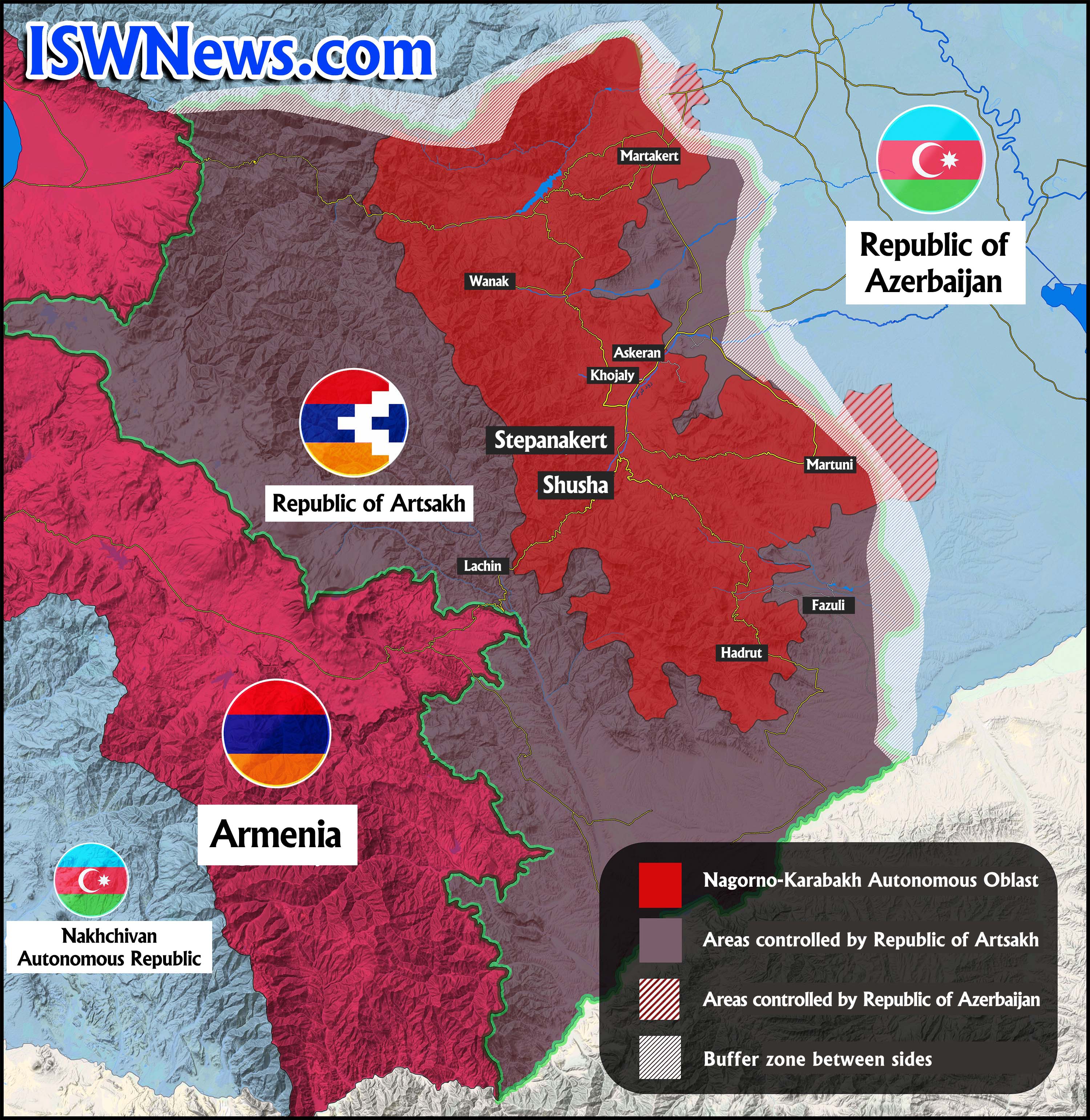
    As indicated on the map, control lines in Karabakh are divided into several areas:
    – Areas controlled by Republic of Artsakh including former self-governed area plus Azerbaijan occupied lands.
    – Part of former self-governed area occupied by Azerbaijan.
    – Buffer area between two sides which is indicated by white hatching area.

    Although areas controlled by Republic of Artsakh are governed by local officials, but Armenia has the task of defending the area due to previous law. It is noteworthy that news of fire exchange and killing or injuring from both sides due to violation if the border is limited to this buffer zone and neither side have violated the lands of the other side.

    Click to see the full size map