The Ansar Abi Bakr al-Siddiq group issued a statement calling the attack in retaliation for “Afifa al-Mustuma” who was killed by Turkish forces.
The Ansar Abi Bakr al-Siddiq group has announced its existence in Idlib province in the summer of 2020 and has carried out at least 10 operations against Turkish troops in the Idlib region so far.
On March 16, Erdogan mentioned Saudi Arabia and Greece military relations and without giving further details conditioned Saudis’ request for new drones to decreasing their relations with Turkey’s traditional enemy, i.e., Greece.
Since this request is said after several years of cold relations due to Khashoggi murder, it is a new chapter in Arabic states and Turkey relations partially due to USA new administration lack of support for the Saudi, inefficient Chinese ammo, etc., in Yemen war and also Saudi coalition recent defeats in Yemen.
If there is an agreement between Erdogan and MBS, other Arabian states such as UAE and Egypt will increase their relations accordingly which causes in Turkey’s economy boom and is necessary for Justice and Development Party (AK Party). Therefore, both sides look at this negotiation as a solution to their domestic and international issues which brings the importance of the relation between Turkey and Saudi Arabia to the next level.
The main topics of Turkey and Saudis talks are:
Contract for selling Turkish drones.
Wrapping up Khashoggi murder case.
Saudi Arabia and Greece relation.
Persuading other countries to increase their relations with Turkey.
And possibly the regional incidents such as Turkey interference in Yemen and confronting the Resistance axis countries.
Nevertheless, Iran’s and Resistance axis’ reaction in diplomacy in Yemen could influence the Saudi-Turkey bilateral relation.
This military post is the second Turkish base around the Bab al-Hawa border crossing in Idlib province. The base is perched on a high hill overlooking the surrounding area, and large-scale Turkish armored vehicles, troops and surveillance equipment have been transferred to the military post.
The new Turkish military base in Idlib will be the main station for the reception, accommodation and division of Turkish troops entering Syria from Turkey. According to local sources, there are 700 military vehicles, including 100 tanks, at the site. In addition to this equipment, many trucks continuously transfer logistical equipment to this base. Currently, the Turkish military is working to establish three more military posts near its new base in Idlib.
Simultaneously with the demonstration, security and counter-insurgency forces were deployed on the road leading to the embassy to protect the Turkish embassy and control the situation.
According to a video released by the Ashab al-Kahf group, the attack was carried out by a rocket. According to local sources, Turkish warplanes flew over northern Iraq today.
This morning, Turkish Defense Minister Hulusi Akar, accompanied by the Chief of General Staff Yasar Guler and a number of Turkish commanders, announced the end of the operation after visiting the ‘Claw Eagle 2’ operation room in Turkey’s Sirnak province.
Hulusi Akar claimed that 40 PKK members were killed in the Turkish operation in Gare Mountain and also stated that 4 army personnel were killed in the last four days.
According to information released by the Turkish Defense Ministry, the bodies of 13 Turkish nationals were found in a cave in Gare Mountain, while on the other hand the PKK said in a statement that the dead persons were the captured Turkish soldiers who had been killed by Turkish army bombardment on the location of prison in the Gare mountain.
On February 10, Turkey transferred its forces to the Gare Mountain in the northern Iraqi province of Dohuk and launched an operation ‘Claw Eagle 2’ against the PKK group, which according to the Ministry of Defense 50 locations of the PKK group have been targeted, including weapons depots and command centers.
The PKK also reported that more than 30 Turkish troops had been killed in the operation, saying that a number of Turkish troops were besieged in the Siane area in the Gare Mountain and that Turkish efforts to rescue them failed so far.
The Turkish Ministry of Defense announced yesterday that Turkish forces have launched another operation called “Claw Eagle 2” in northern Iraq. On the occasion of the start of the operation, the Turkish army released a video of the transfer of Turkish special forces to the foothills of Mount Gareh in areas controlled by the Iraqi Kurdistan region.
Clashes reportedly broke out between Turkish forces and the PKK after the transfer of Turkish troops to the region, with Turkey announcing that two of its troops had been killed in the fighting hours after the operation began. The admission that Turkish troops were killed a few hours after the start of the operation indicates heavy fighting and the possibility of more casualties.
The PKK group announced the intensity of the clashes in the area on Thursday and announced that several Turkish troops had been killed.
PKK reported that at least nine soldiers and one of the commanders of the Turkish Special Forces, Harun Tahan, were killed on Mount Gareh in northern Iraq. According to PKK, the forces that Turkey transferred to Mount Gareh near Emadiyeh in Dohuk province for the operation are parts of Turkish troops whom were inside the northern Iraq before.
Turkey’s “Claw Eagle 2” operation has begun inside Iraq, while in recent months and years Turkey has conducted several other operations to fight the PKK. Currently, the bombing of Kurdish-controlled areas in northern Iraq is carried out on a daily basis by Turkish planes, as a result of which dozens of civilians have lost their lives or been injured.
The operation, dubbed “Eren-7 Mercan-Munsuz”, is being carried out to clear areas of Tunceli province in eastern Anatolia, with 1,062 troops.
The province is divided into Pulumur, Ovacik, Nazimiye, Hozat, Cemisgezek, Pertek, Mazgirt and Tunceli Merkezi districts, and the Kurds of Kurmanji and Zazaki call this province Dersim (Silver Gate), while the Turkish government uses Tunceli (Bronze fist) to name it.
Map of Tunceli – Dersim province
It is worth mentioning that during the “Dersim genocide” which took place in two stages from March 20 to November 1937 and January 2 to December 1938, the Turkish army carried out a large-scale massacre to suppress the Alawites uprising of the Zaza people. According to Kurdish sources, 65,000 to 70,000 people, and according to Turkish officials, 12,000 people have been killed in air and ground attacks by the Turkish army in this region, and tens of thousands have been deported to central Turkey.
The Turkish government’s plan to integrate ethnic groups and deny the identity of ethnic minorities has sparked major uprisings in the country, and the Turkish military has committed war crimes to suppress these movements. This issue has also caused the liberation movements in the Kurdish and Zaza areas in the east of the country to have a lot of supporters. A large number of people in these areas have joined or assisted the paramilitary forces of the Kurdistan Workers’ Party.
The Zaza people are originally Deylam, and the Zaza language, in addition to being similar to Kurdish, is closely related to the Mazani, Gilaki, and Talshi Iranian languages. The exact number of Zaza people is not known, but their population in Turkey is estimated at about 4 million.
Also, most of the followers of Alawite religion, which include Anatolian Turks, Azeris, Tatars, Kurds, Zazas and Turkmen; are living in Turkey and Syria and a few in Lebanon. According to the fatwa of Imam Khomeini, the Alawites are a branch of the Twelver Shiite religion.
Twenty-five million people, or 30 percent of Turkey’s 83 million people, are Alawites, concentrated by the Alawite and Zaza populations in Turkey’s Tunceli province. It can be argued that given the Turkish military background in the region, ethnic and religious motives are high in recent operations.
This is the second Turkish military post to be established in Syria in recent weeks. Earlier, a military post was set up by Turkey near the village of Afis, north of the town of Saraqib on the southern outskirts of Idlib.
During the meeting, the Turkish delegation strongly called for the withdrawal of Syrian Democratic Forces (SDF) from the city of Ain Issa, stating that this is the only way to stop the clashes in the Ain Issa area. However, the Turks have promised the Russian side that the clashes will be temporarily suspended until the SDF decides on this.
On the other hand, the Syrian Democratic Forces (SDF) refuse to accept this and they are not willing to leave the town of Ain Issa.
In recent weeks, clashes and tensions in the Ain Issa area have reached their peak; The clashes are unprecedented since the end of Turkish Peace Spring Operation east of the Euphrates. Tensions and military operations by Turkish militants to advance in the region escalated to the point that the SDF was eventually forced to call for help from the Russian military police and Syrian army forces to prevent Turkish militants from advancing on Ain Issa.
It is worth mentioning that the Syrian and Russian army forces were present in a number of posts along the M4 route and around the town of Ain Issa in the past, but the control of this town is in the hands of the SDF.
Now, with the arrival of the Russian military police and the Syrian army in Ain Issa and the establishment of several new military posts in the region, tensions have eased but this is not enough.
The Syrian Democratic Forces, led by Shahin Jilo, a well-known PKK commander, on the one hand has called on Russia and Syria to help SDF against the Turkish army attacks, but on the other hand, he opposes the withdrawal of SDF from the Ain Issa. This has happened many times in the past in northern Syria, and the SDF has tasted defeat every time.
In the Afrin region, the SDF, which now leads the Syrian Kurds, refused to hand over Afrin to the Syrian and Russian armies to prevent the Turkish army operation in the area, and not just lost the Afrin, rather, a large area in the northwest of Aleppo province was occupied by Turkey.
and SDF after loosing a large areas of northeastern Syria to Turkey and its militants, finally was forced to call for help from the Syrian and Russian armies. Although this procrastination led to the loss of large areas east of the Euphrates…
Now, in the case of Ain Issa, the SDF repeats the same mistake of Afrin and refuses to surrender the town to the Syrian army.
It seems that the Syrian Democratic Forces, given that they are fully supported by the United States militarily and politically and are the tool of the US military in Syria, instead of focusing on the interests of Syria, pursue US goals in Syria and then their ethnic goals. It is too simplistic to assume that the SDF does not realize this and repeats a mistake several times; Rather, this is happening deliberately, and they prefer that the Syrian territories be occupied by Turkey but not controlled by the Syrian army.
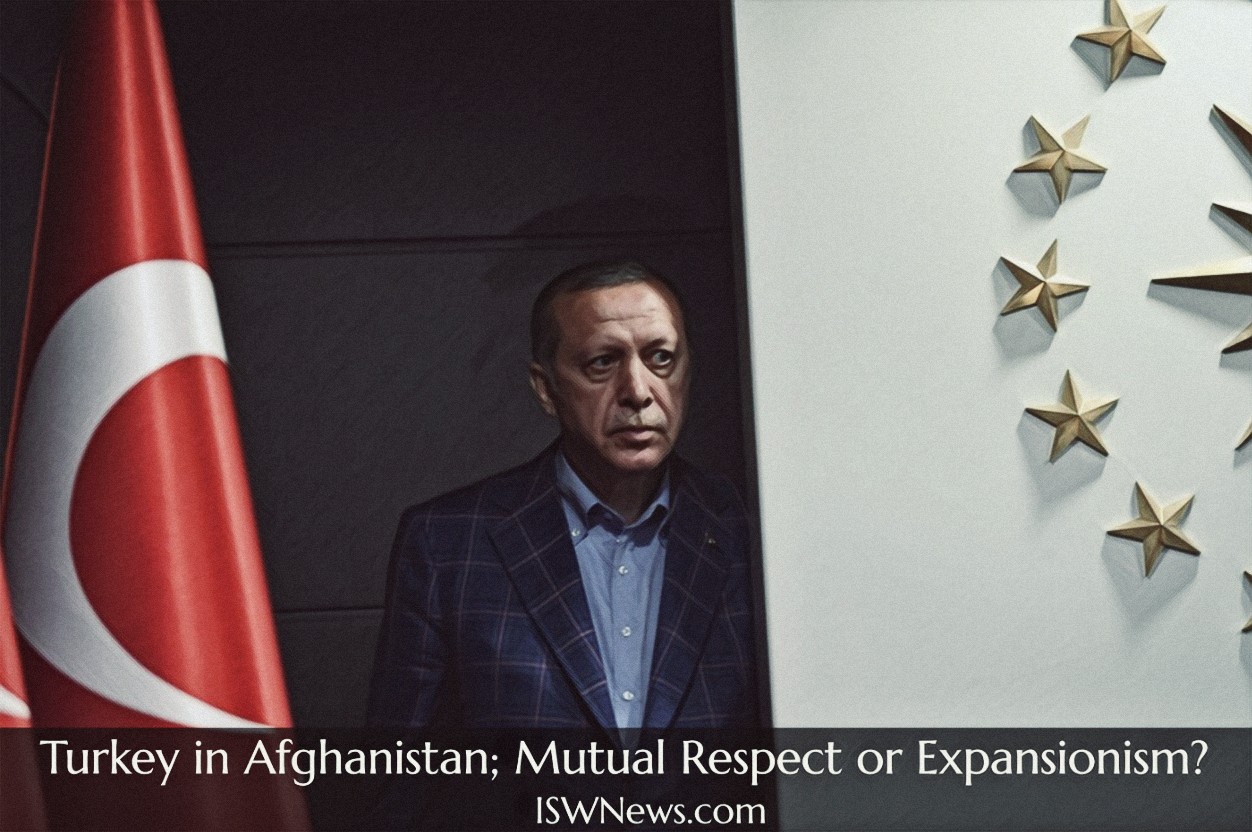
In recent days Recep Tayyip Erdogan, president of Turkey, has asked for military presence in Afghanistan by submitting a plan, renewal of his country’s presence in Afghanistan for another 18 months, to his country’s parliament. This is while the USA and NATO have committed to the agreement of their military forces’ withdrawal from Afghanistan. Of course Turkey in recent years has not seen its presence in Afghanistan by occupation and colonization, and to create this view in Afghanistan, it has been taking extensive measures, including building schools, TV channels, and so forth.
Generally the common reasons between Turkey and Afghanistan are as follows: 1-Sunni religion 2-Racial affiliation with Uzbeks, Turkmen, Ghezelbash, etc. 3-Presence of Muslim Brotherhood in Afghanistan, Jamiat-e-Islami Party, in the body of Afghan government.
Indeed, Turkey’s presence after 11th September and Afghanistan’s war entered a new stage as one of the members of NATO, and the Turkish government with special role of Ahmet Davutoglu and according to its national interests and taking into account political, economic, cultural, etc. consideration expanded its influence in Afghanistan and exploited its existing potentials in this country. Turkey began its military presence in Afghanistan in 2015 as a peacekeeping force, which initially reached 1079 and raised to 1206 in 2018. Erdogan, regardless of the USA peace agreement with Taliban, has demanded renewal of his country’s presence in Afghanistan for another 18 months. Turkey has a warm and close relationship with the Islamic party of Afghanistan and its leader, Gulbuddin Hekmatyar, in respect of ideas and stances as well as with General Abdul Rashid Dostum and the National Islamic Movement in terms of races. Somewhat these two parties can be considered Turkey’s main allies in Afghanistan.
They believe that Turkey’s presence in Afghanistan, whether military or civilian, is based on absolute respect and observance of Afghan people’s rights, and is not for implementing colonialism and occupation. On the other hand, opponents of Turkish influence in Afghanistan, either militaristic or non militaristic presence of this country in Afghanistan, are not satisfied with Turkish cultural influence which is implemented by TV channels, schools, and so forth, and condemn the view of secular Islamic in Turkey.
From previous years, Turkey has old relations with Afghanistan, and the government of Ottoman was the second country to announce Afghanistan’s independence from Britain. Turkey has established close links to Pakistan to fortify its influence in Afghanistan, and ita endeavors to reduce Iran’s mediation by its Uzbek and Turkmen neighbors. Turkey has been pursuing this issue before with the formation of Turkish countries council in 2009, and in general, it can be said that Turkey is trying to build a bridge between Azerbaijan and Turkmenistan to better exert its influence on Central Asian countries, including Afghanistan. Religious and racial commonalities are the main elements of Turkey’s foreign policy and in spite of the fact that Afghanistan is not a priority of Turkey’s foreign policy, the Erdogan government have not limited themselves to build military, cultural, etc. bases in this country, from Kabul and Mazar-e-Sharif to Jawzjan.
The Turkish army is currently stationed in eight observation posts and about 50 military posts in western Aleppo and the Idlib region. Observation posts of Al-Surman, Tal Al-Tawqan, Tal Al-Eis, Andan, Deir Samaan, Salwah, Ashtabraq mountain, Al-Zaytouna and military posts of (around)Saraqib, Al-Tarnabeh, Al-Nairib, Al-Mughir, Al-Zarba, Qaminas, Sarmin, Taftanaz Airport, Ma’ara Al-Misrin, Kafr Karmin, Tawama, Regiment 111, Mastumah base, Termanin, Atarib, Darat Izza, Bardaghli, Maataram, Nahlia, Bsanqol, Bazabor, Batabo, Mahambil, Abzamo, Ram Hamdan, Kar Nuran, Jinah, Mushayrifa, Tal Khatab, Bdama, Najiyah, Al-Za’iniya, Al-Ghassaniyah, Deir Sonbol, Al-Kufayr, Al-Barah, Al-Burnas, Ariha, Jannah Al-Qura, Basamas, Tal Nabi Ayyub, Al-Qiyasat, Maarata, Mar’iyan, Mantaf, Tel Arqam, Qoqafin, Balyon,Ruwaiha and Kansafra are among the military and observation posts in which the Turkish army is present.