Tag: US in Syria

  • From Deir Ezzor to Hasakah: The Rise of U.S. Military Activity at Qasrek Base

    From Deir Ezzor to Hasakah: The Rise of U.S. Military Activity at Qasrek Base

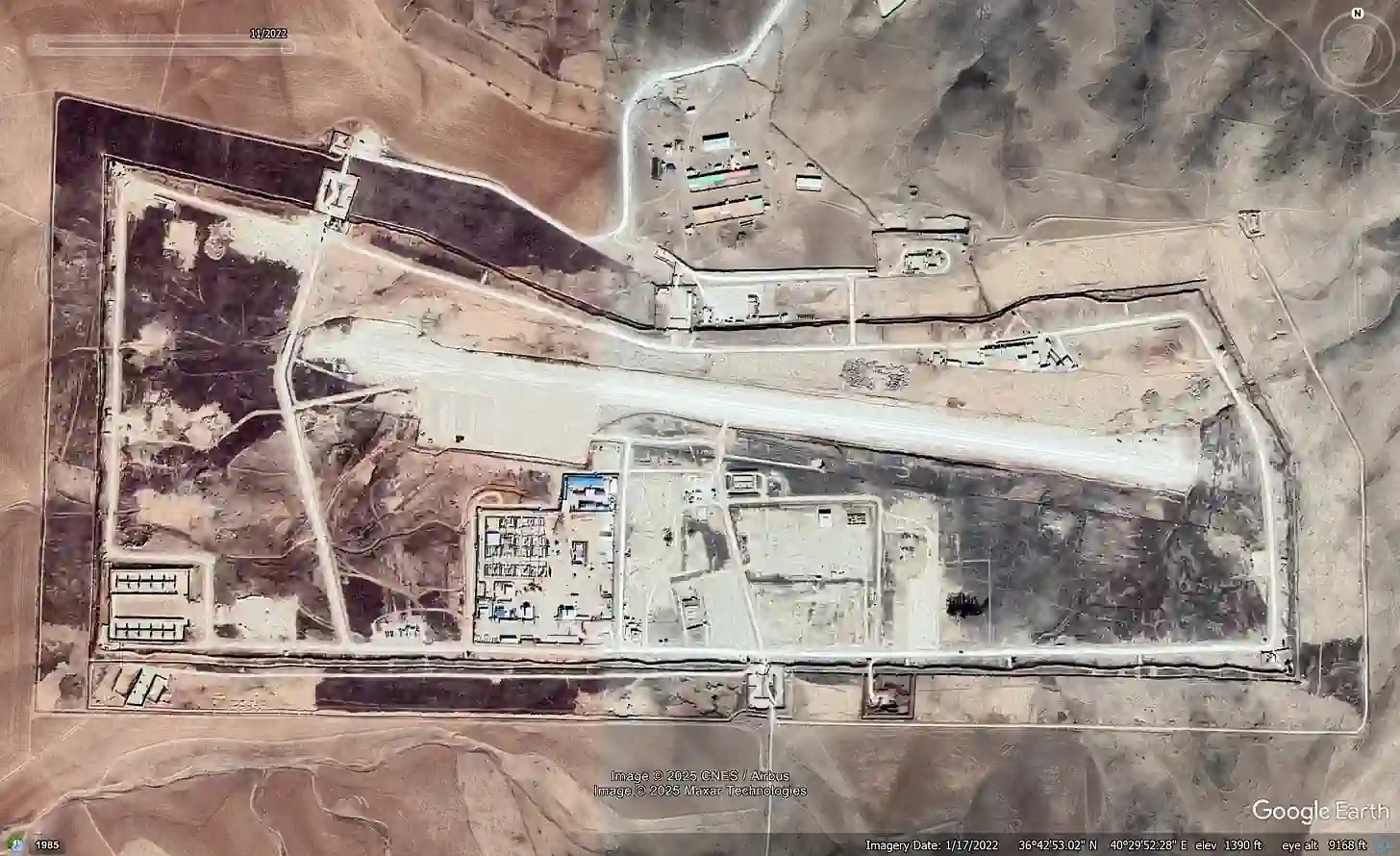
    Qasrak Base, located in northern Hasakah province near the town of Tal Tamer, functions as a joint facility between the Global Coalition against ISIS and the Syrian Democratic Forces (SDF). Covering an area of 1.8 square kilometers, the base was constructed in late 2017 and early 2018 on elevated agricultural land. The hill on which the base sits is locally known by the names “Jabal Ghol” and “Jabal Qalayeb.”

    Situated at geographic coordinates 36.706242, 40.511955, the Qasrak base lies roughly 30 kilometers from the center of Hasakah city and 33 kilometers from the Turkish border. Its 1.7‑kilometer runway is capable of accommodating military transport and cargo aircraft. As a strategic and logistical hub, Qasrek supports coalition operations in coordination with the Syrian Democratic Forces (SDF) and oversees the main supply routes linking Hasakah and Deir Ezzor.

    Right image: Location of Qasrak base from Hasakah; Left image: Location of this base relative to the Turkish border
    The longest runway built by the US in Syria

    Significant construction and expansion activities were first observed in early 2025, concentrated across three main sections. The eastern sector saw the most extensive work: land was leveled and covered with concrete at two separate points, likely in preparation for new facilities or warehouses intended for equipment and logistical supplies. The larger site measures approximately 193 by 94 meters, while the smaller one is about 84 by 60 meters.

    In addition to satellite imagery, multiple videos have documented the surge of activity at this base, including the movement of vehicles and convoys. The earliest footage, released by the Syrian Observatory for Human Rights (SOHR) in early 2025, showed heavy machinery and bulldozers, described as “expansion operations at the base.” Analysis of visible structures and geographic features further confirmed that the location was indeed the Qasrek base.

    Later, on September 28, 2025, the Syrian Observatory for Human Rights (SOHR) released a video showing military convoys belonging to the Global Coalition moving toward the base. On October 18, 2025, another video depicted several coalition trucks carrying military and logistical equipment along the route from the al‑Walid border crossing toward the base.

    A long line of trucks at the Al-Waleed border crossing on the way to the Qasrak base

    In addition to ground movements, aerial activity at the base has increased significantly, with military transport aircraft landing on multiple occasions. Compared to previous years, this level of operations is unprecedented; prior to Assad’s fall, the base had only limited air traffic. Notable examples include an American cargo plane documented by SOHR on May 24, 2025, and another coalition transport aircraft recorded on July 23, 2025. Furthermore, on October 18, 2025, Syria Now reported that a large American cargo plane, escorted by helicopters from the Iraqi border, landed at the base. Taken together, these developments indicate that the Global Coalition is actively redeploying forces at Qasrek, likely transforming it into a key military logistics hub in northeastern Syria.

    Activities in Deir Ezzor

    The expansion and intensification of activity has not been limited to the Qasrak base. Parallel, though distinct, developments have also been observed in Deir ez‑Zor—particularly at U.S. bases located in the al‑Omar oil field and the Conoco gas field. Alongside the rapid growth of Qasrak, satellite imagery shows American forces withdrawing from Conoco, al‑Omar, and the base near Green Village on the outskirts of Deir Ezzor.

    Photographs taken since early 2025 reveal extensive relocation of equipment and the evacuation of facilities at these sites. Reports first published in May 2025 indicated that the Pentagon intended to transfer forces from al‑Omar and Conoco in Deir ez‑Zor to Qasrek and al‑Shaddadi in Hasakah, thereby reducing the U.S. military presence in the region to fewer than 1,000 troops.

    Summary

    Satellite imagery shows that between January and October 2025, U.S. forces withdrew from the Conoco, al‑Omar, and Green Village bases in the Deir Ezzor countryside. At the same time, Qasrak base near Hasakah witnessed rapid engineering and logistical expansion from July 2025 onward, including the construction of new facilities and the repeated arrival of supply convoys. These developments appear to have effectively transformed Qasrak into the primary command and supply hub for U.S. forces in northeastern Syria.
  • Wall Street Journal: ISIS Resurging in Syria

    Wall Street Journal: ISIS Resurging in Syria

    The report also pointed to the withdrawal of U.S. troops and the transfer of parts of Deir ez-Zor province to SDF control as contributing factors to the rise in ISIS activity. In an interview with one SDF commander, the paper emphasized that the U.S. exit from Syria has emboldened ISIS fighters, giving them greater freedom of movement and operational confidence.

    More than reflecting an on-the-ground reality, the Wall Street Journal report appears to align with a broader media narrative aimed at legitimizing continued U.S. military presence in Syria. By repeatedly highlighting the spike in ISIS attacks following the American drawdown, the report conveys a message that any U.S. retreat from Syria equates to the return of terrorism!

    By emphasizing the inefficiency of the SDF in countering ISIS, the report subtly reinforces the notion that stability in northeastern Syria is only achievable through U.S. support and presence.

    Overall, reports like this—alongside field data and statistics—form part of the broader narrative warfare unfolding in Syria. Western media outlets aim to portray the withdrawal of their forces not as a political decision, but as a security threat. This framing seeks to convince domestic audiences and regional allies that a prolonged U.S. military presence in Syria remains both necessary and justified.

  • Rocket Attack On US Base In Deir ez-Zor

    Rocket Attack On US Base In Deir ez-Zor

    This is the second rocket attack on the US base at CONOCO gas facility and the ninth attack against US bases in Syria in recent days.

    Earlier, the US CENTCOM has announced that 24 US servicemen were injured as a result of recent attacks by the resistance axis on the United States’ military bases in Iraq and Syria.

    On October 25, Biden threatened Iran and said that American bases have nothing to do with Israel. This is despite the fact that the United States is the main supporter of Israel and the main partner of Israel’s crimes against Palestinians.

    Therefore, the resistance groups will continue to attack American bases until Israel’s crimes in Palestine are stopped, otherwise the scope of these attacks will increase.

  • The US Al-Tanf Base Under Drone Attacks!

    The US Al-Tanf Base Under Drone Attacks!

    The Islamic Resistance of Iraq issued a statement took responsibility for the attack. According to the statement, the attack was carried out using two suicide drones.

    It should be noted that this is the fourth attack by the Iraqi resistance groups against the positions of the American occupation in Syria and the second attack on Al-Tanf base in the last week.

    This attack took place while lately, Al-Jadid Al-Arabi media, citing some Iraqi sources, claimed that the Prime Minister of Iraq, Mohammad Shia al-Sudani, is trying to stop the attacks of the Iraqi resistance groups on the positions of the American occupation.

  • Drone Attack On US Forces in Deir ez-Zor

    Drone Attack On US Forces in Deir ez-Zor

    Initial reports indicated that in the last hours of October 19, the US occupation garrison in the al-Omar oil field in Deir Ezzor province was attacked by a suicide drone.

    No group claimed responsibility for the attack.

    It should be noted that earlier in the morning, the US bases at Conoco facility in Deir ez-Zor province and at al-Tanf area in southern Syria were also targeted by several rockets and drones.

    Considering the tense situation in the region and people’s anger at Israel’s crimes, it seems that in the coming days we will see an increase in such attacks against the US interests and Israel in the region.

  • Resistance Forces Attacks Two US Bases In Syria

    Resistance Forces Attacks Two US Bases In Syria

    On Thursday morning, the positions of the US coalition in the Conoco gas facility in northern Syria was targeted by rocket attacks by the resistance groups.

    Hours after this attack, the military base of the US occupation in al-Tanf area located in Homs province was also targeted by drone attacks. It is said that the explosion was heard from inside this base.

    So far, no group has officially claimed responsibility for these attacks, but according to the recent warnings of the Resistance and the current situation in the region, these attacks were carried out by the Resistance Axis.

    It seems that these attacks are aimed at increasing the cost and a serious warning to America to cast doubt on the position of the White House to enter the Gaza war.

    P.S > The Islamic Resistance of Iraq, by publishing a statement, took responsibility for the attacks against the US occupation in al-Tanf and CONOCO bases in Syria.

  • Syrian Army Blocked The US Convoy Near Qamishli

    Syrian Army Blocked The US Convoy Near Qamishli

    The convoy of the US occupation forces, consisting of four armored vehicles and covered by two attack helicopters, was about to pass near Tal al-Dhahab in the northern suburbs of al-Hasakah, but was stopped by the Syrian army checkpoint and forced to retreat.

    It is worth mentioning that most of Hasakah province is under the US control and its proxies, ie the Syrian Democratic Forces. Nevertheless, the Syrian army is still present in a part of the center of Hasakah city (security square), as well as parts of Qamishli city and the south of this city, and in a network of posts and checkpoints in the northern suburbs of Hasakah province.

    This is not the first time that the Syrian army prevents American convoys from passing around Qamishli; However, this incident took place, while the northeastern region of Syria is in the most tense situation due to the recent events.

    In recent weeks, reports have been published showing that the US terrorist army plans to launch an operation against the SAA and its allies in the region with the aim of cutting off the border areas of Syria and Iraq. Although the Pentagon has denied the existence of such a plan earlier this week, the US military activities and the transfer of troops and equipment in Iraq and Syria say something else.

  • Advanced U.S. Anti-Drone System Spotted In Northeastern Syria

    Advanced U.S. Anti-Drone System Spotted In Northeastern Syria

    A photo that surfaced online showed a vehicle of the system near a base of the coalition located at the Conoco gas facility in the eastern Deir Ezzor countryside.

    The FS-LIDS system uses a small, expendable drone dubbed the Coyote to intercept its target. The drone delivers a kinetic effect by crashing into enemy drones or exploding near them and dispersing blast fragments from its warhead.

    The newest version of the interceptor drone, the Coyote Block 2, is propelled by a jet engine, equipped with an active radar seeker and armed with a proximity warhead. It can engage threats at a range of more than 15 kilometers, and can even re-attack if it misses on the first pass.

    U.S.-led coalition bases in Syria’s northeastern region and its garrison in the southeastern area of al-Tanf were targeted with suicide drones on several occasions in the past.

    Earlier this year, a suicide drone hit a base of the coalition in the northeastern governorate of al-Hasakah. The attack, which killed a U.S. contractor and wounded a number of service members, sparked a limited confrontation with Iranian-backed forces in Syria.

    The U.S.-led coalition has been working to expand its presence in Syria for a while now, despite the disapproval of Damascus.

    The appearance of the FS-LIDS system came amid high tensions between U.S. and Russian forces over aerial operations in Syrian skies. It also came as the coalition and its proxies were massing forces along the frontline with government forces in Deir Ezzor.

    Source: SouthFront.org

  • U.S. Drones Violated Russian-Syrian Drills Area, Almost Got Shot Down (Video)

    U.S. Drones Violated Russian-Syrian Drills Area, Almost Got Shot Down (Video)

    Russian fighter jets harassed American combat drones on an anti-ISIS mission over Syria, the U.S. military said late on July 5.

    “Earlier today at approximately 10:40 AM, Russian military aircraft engaged in unsafe and unprofessional behavior while interacting with US aircraft in Syria,” said Lieutenant General Alex Grynkewich, the US general responsible for air operations in the Middle East.

    According to Grynkewich, three MQ-9 drones were on a mission against ISIS targets when three Russian fighter jets began the harassment.

    The video published by the US CENTCOM

    Video footage released by the U.S. Air Forces Central showed Russian jets dropping multiple parachute flares in front of one MQ-9 , forcing it to conduct evasive maneuvers. One Russian pilot then positioned its fighter jet in front of a MQ-9 and engaged the afterburner, making it difficult for the drone to fly safely.

    “These events represent another example of unprofessional and unsafe actions by Russian air forces operating in Syria, which threaten the safety of both US and Russian forces,” Grynkewich said.

    The commander urged Russian forces in Syria to stop their “reckless behavior” and comply with standards of behavior expected of a professional air force “so we can resume our focus on the enduring defeat of ISIS.”

    Meanwhile, Rear Admiral Oleg Gurinov, deputy chief of the Russian Center for Reconciliation in Syria, said in a statement that U.S. drones flew over an area where joint Russian-Syrian drills five times in violation of flight safety protocols.

    According to the commander, the Russian side once again expresses concern over the violations of the protocols linked with the flights of the U.S.-led coalition’s drones.

    “During the day, twelve violations were reported, including five over an area that was closed for flights due to the joint Russian-Syrian drills in northern Syria. We remind that the Russian side bears no responsibility for the safety of flight of unmanned aerial vehicles, which were not agreed with the Russian side,” Gurinov said.

    The Russian and Syrian militaries launched joint aerial drills on July 5. The drills, which will go on for six days, will include actions by aviation, air defense forces and electronic warfare to repel air attacks. U.S. drones were likely spying on the drills, not conducting a mission against an ISIS target as the U.S. military claimed.

    Tensions between U.S. and Russian forces in Syria have been mounting since the start of the special military operation in Ukraine. Last month, the U.S. deployed F-22 Raptors from Langley Air Force Base to the Middle East as a part of efforts to expand operations over the war-torn country.

    Unlike Russia, the U.S. military presence in Syria is not sanctioned by Damascus. The country considers this presence to be an occupation.

    The U.S. attempts to expand its drone operations over Syria without coordinating with the Russian side will eventually lead to an incident.

    Source: SouthFront.org

  • 22 US Servicemen Injured In Helicopter Crash In Syria

    22 US Servicemen Injured In Helicopter Crash In Syria

    According to the statement, the wounded military forces received medical treatment and 10 out of the injured servicemen were transferred to medical centers and special care units outside the region.

    According to the CENTCOM, the reason behind the incident is still under investigation.

    There have not been issued any further details on the crash incident. It is worth mentioning that from time to time, the eastern and northeastern regions of Syria witness joint operations by the US military and the so-called Syrian Democratic Forces (SDF) under the pretext of fighting terrorist groups.

    Although, the United States military and the SDF forces managed to arrest some of the elements and field commanders of the ISIS terrorist group during joint operations in recent years, terrorist activities and the movements of the ISIS elements continue to happen in the regions.

    The US CENTCOM statement
  • Resistance Forces Pounded Three US Bases In Syria (Video)

    Resistance Forces Pounded Three US Bases In Syria (Video)

    Late on March 24, the resistance groups in retaliation to the US airstrikes on positions of SAA and Iranian-backed groups in Deir Ezzor province, which led to the death of six Syrian servicemen, pounded the US positions at the CONOCO gas facilities and al-Omar oil field in Deir Ezzor province, and the al-Shadadi strategic base in the southern suburbs Hasakah province with several rockets and suicide drones.

    Read more: An American Contractor Was Killed In Syria; American Airstrike On Resistance Positions

    Minutes after the attack, an American military official stated that one of our bases in Syria’s Deir Ezzor province was targeted by at least eight rockets. US President Joe Biden also implicitly retreated from the escalation of tensions and said: “To make no mistake, the United States does not — does not, emphasize — seek conflict with Iran,, But be prepared for us to act forcefully to protect our people. That’s exactly what happened last night.”

    After the attacks ended, a US official told Al Jazeera that a US soldier was wounded following the rocket attack on three US bases in Syria. Also, the air defense systems shot down two of the three attacking drones.

    It should be noted that, hours before the start of the new round of resistance rocket attacks, in the morning of the same day, the positions of the US coalition in the Omar oil field were also targeted by a rocket attack. The US CENTCOM announced in a statement that “on the morning of March 24, ten rockets were fired at the Green Village compound, but this attack did not cause any damage or casualties. One of the rockets hit a residential house, causing heavy damage to the house and injures to two women and two children.”

    After about 12 hours have passed since last night’s attacks by resistance forces against the US, there is no military response from the US military. This shows that the US refuses to increase tensions and continue conflicts with Iran in Syria.

    Rocket attack on the positions of the US coalition in CONOCO gas facilities in Deir Ezzor province
    Explosions at the US base in the Omar oil field in Deir Ezzor province