Author: Mirza

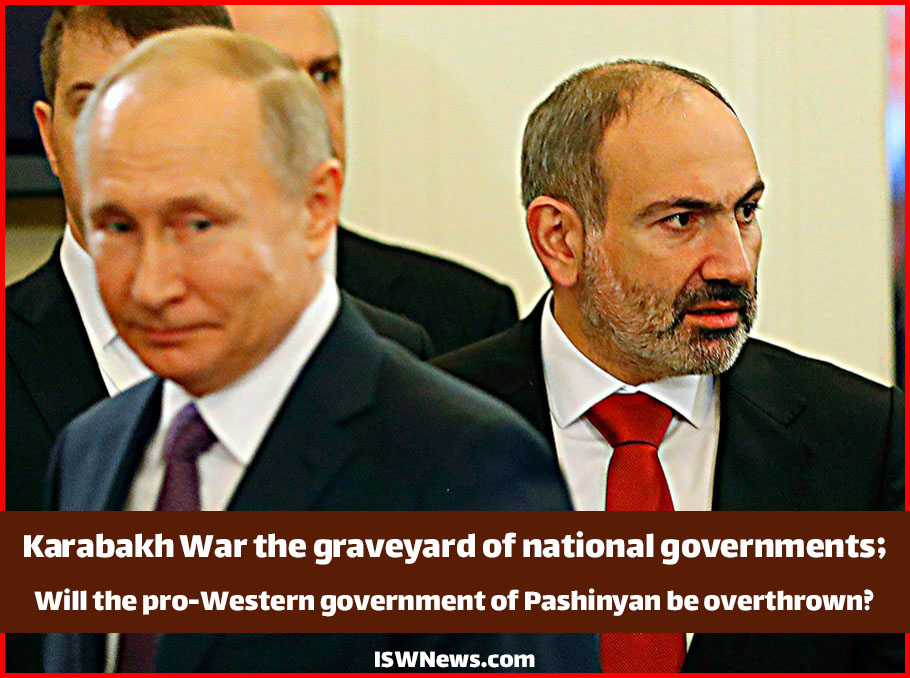
  • Karabakh War the graveyard of national governments; Will the pro-Western government of Pashinyan be overthrown?

    Karabakh War the graveyard of national governments; Will the pro-Western government of Pashinyan be overthrown?

    Relations between Azerbaijan and Armenia over the disputed region of Nagorno-Karabakh have been strained since the start of the war on September 27. According to Russian President Vladimir Putin, this bloody war has killed 5,000 people and has shown a different face of new battles. The Armenian army has lost airspace in the Nagorno-Karabakh region in the face of Israeli and Turkish drone strikes. Many attribute this to the deterioration of equipment and low-tech weapons and old anti-aircraft radars.
    Of course, the country’s ground forces also leave their strongholds and retreat, leaving weapons, ammunition and equipment on the battlefield. Such behavior is very strange in a classic army. Usually, any experienced soldier destroys weapons, equipment and ammunition while retreating, which is less common in this war. Even the newly deployed forces of Armenia to Nagorno-Karabakh are facing a shortage of supplies and the logistics of Armenia are practically inoperable. Their border forces also withdrew along the border lines of the occupied territories with Iran without any special resistance.
    The Armenians lost control of the Mataghis Dam (Sugovushan) and the Aras Dam, the cities of Fuzuli, Jibrayil, Hadrut, Zangilan and Qubadli, and Azerbaijan reached the international border of Armenia along the Aras River. Even the Armenian Defense Minister admits to successive defeats. The display of the destroyed and looted equipment of the Armenian army and the capture of the Armenian forces by the Azerbaijani coalition have also greatly lowered the morale of the Armenian forces. However, the resistance of the defense forces of the Nagorno-Karabakh region during the recent battles has been far greater than that of the Armenian army, which is also very strange.

    Many have so far cited the power of the coalition forces of Azerbaijan, Turkey, Pakistani Army Special Forces, Syrian and Caucasian terrorists as the main reason for the superiority on the battlefields with the Armenian forces.

    But why have the Armenian Armed Forces done so little over the past month except to retreat and counter-attack?

    Although the Armenians are positioned in the highlands, they do not make good use of this advantage, and Azerbaijani forces have reached the vicinity of Shusha and the Lachin crossing, which threatens the most important communication corridor between Armenia and Nagorno-Karabakh.

    Air and artillery strikes inside Armenia have also destroyed some military equipment inside the country. The Prime Minister of Armenia has asked the Russian Federation for help in concluding a defense and military pact, which has been met with a cold reaction from the President of the Russian Federation, Vladimir Putin.
    Putin has stated that he is willing to intervene militarily in favor of Armenia only if Armenian territory is attacked, which shows a clear difference of position with the history of the Russians in the first Nagorno-Karabakh War.
    However, Russia, with its military base in Gyumri, could thwart all efforts by hostile forces with its air force and air defense in the area.

    Iran has also closed the Norduz border terminal on the border between East Azerbaijan Province and Armenia, and some believe this is due to internal pressures from pro-Azerbaijani rallies in Azeri cities. In any case, Iran’s move to suspend economic relations with Armenia has caused more economic problems for Armenia, as Georgia’s borders with Armenia have been closed and the situation in Armenia is deteriorating.

    In addition to the above, the Prime Minister of Armenia dismissed the Border Command of the country due to the shooting in “ceasefire conditions” from inside Armenia to Azerbaijani forces on the Aras border and the reciprocal response of Azerbaijani forces. Although Azerbaijan denies any response to the fire of the Armenian side, the fire of both sides is undeniable. Also, the three-time violation of the ceasefire during the war, which both sides accuse each other of, is not something that can be considered the will of the political parties.

    If we study the history of the armed forces of the countries that inherited the former Soviet Union, we come across strong relations between the armed forces of these countries and Russia, which raises the issue of influence in the military forces of these republics.
    It is not yet clear whether the Russian elements are violating the ceasefire, but there are hands on the Armenian side that are leading the way to military defeat, political instability and protest. Armenia’s political atmosphere is against Prime Minister Pashinyan, who effectively controls the government and the commander of the country’s military. A number of political activists and the media have criticized his actions in the Nagorno-Karabakh conflict.

    But why should such a thing happen in Armenia during a war?

    The political record of the Prime Minister of Armenia Nikol Pashinyan shows that he has entered the field of politics from the world of journalism (editor of Haykakan Zhamanak newspaper) and has a history of opposition to the pro-Russian government in 2007 and political imprisonment, which was pardoned in 2009. Pashinyan, who has been a member of parliament for the country since 2012, founded the “Civil Contract” party in 2015 and the “My Step Alliance” in 2018.

    He was the main protester against the results of the 2018 National Assembly elections and the victory of Serzh Sargsyan, the Former President and (pro-Russian) Republican Candidate, and called the election results fraudulent.

    Pashinyan was able to organize a wave of opposition against Sargsyan by marching from the city of Gyumri to Yerevan, and Sargsyan resigned as prime minister on April 23. Pashinyan became prime minister on May 8 of that year by a majority vote. But his promises to solve the challenges of previous periods without a proper solution not only failed, but also led to popular protests and opposition before the Karabakh war.

    The distinguishing feature of Pashinyan in this period can be called the greater Westernization and diminishing of Russia’s political and economic role in Armenia. Attending NATO military exercises, establishing economic ties with the European Union instead of Russia, and making controversial remarks about the Gyumri base have been hot topics during his tenure. The Pashinyan government’s determination to join the North Atlantic Treaty Organization (NATO) also exacerbates Iran’s concerns, which is against the national interests of Iran.

    Opposition initiative

    During a meeting with the Prime Minister, Robert Kocharyan andSerzh Sargsyan proposed his resignation in order to find a way out of the crisis, and it is not unlikely that if the prime minister refuses, the option of a march and a military coup to save the country from military defeat in the Nagorno-Karabakh war will happen, which in the current situation will be accepted by the majority of the country’s society.

    It can be argued that the recent war has provided the greatest opportunity for Russian supporters in Armenia to oust the Pashinyan under the pretext of inefficiency and military defeat, and to end the work of the pro-Westerners in this country.
    Of course, Pashinyan, as a journalist, has not learned a lesson from the history of the Nagorno-Karabakh war. A similar scenario was planned in 1992 for Azerbaijani President Ayaz Mutalibov, in which the militants of the Azerbaijani Popular Front (supporters of Abulfaz Elchibey) evacuated the Lachin and Shusha fronts against the invasion of the Armenian army and after the Khojaly tragedy, these militants ended the life of the government with the presence of several thousand forces in Baku and in front of the Presidential Palace.
    However, the next government of Azerbaijan did not last long, and the military defeats combined with the economic crisis and the political coup of Heydar Aliyev, which had the political support of Iran, led to the collapse of the “Abulfaz Elchibey” government and the political and military elements of the “Abulfaz Elchibey” government were dismissed and imprisoned as the cause of Azerbaijan’s defeats.

    Such a possible change could change the course of the recent war, and Armenia, with the support of the Russians, this time will show a new face with a new strategy that will not be pleasant for the Azerbaijani coalition at all. This unhappiness starts from the fact that the Azerbaijani coalition, like a gambler, has put all its cards on the table and its military strategy has been known over the past month. The air superiority under the flight of drones, heavy shelling, infiltration of commando groups behind the opponent’s front and then armored and infantry attacks of Azerbaijan is a strategy that has nothing to hide.

  • Iran’s decisive warning to conflict sides in Karabakh: We don’t let anyone to pass the red lines

    Iran’s decisive warning to conflict sides in Karabakh: We don’t let anyone to pass the red lines

    Brigadier general Kioumars Heydari, commander of the Iranian Army’s Ground Forces: Keeping the geopolitics of the region is our red line and no power should change it and we won’t tolerate it.
    He considered deploying army units at borders to protect the borders as the red lines of the country and added: We never permit anyone to cross red lines of Islamic Republic of Iran, our red line is security, safety and comfort of our people and the army is beside people to provide their security and peace.

    Sending Mersad and Tor-M1 air defense systems to the northwestern borders of Iran

    Last week Brigadier general, Commander of the Islamic Revolutionary Guard Corps (IRGC) Ground Forces, stated that no change in geopolitical borders is tolerated and it is red line of Islamic Republic of Iran and if it is necessary we increase the presence of our forces at the border.

    IRGC Ground Force deployed more forces and equipment at the border area such as Aslanduz, Khoda Afarin and Jolfa after the conflict became tenser in Karabakh last month.
    In recent days some of Iranian Army’s 16th division armored equipment were deployed to northwest areas of the country.

    Sending military equipment to the border areas of northwestern Iran

    Some believe that this amount of equipment and forces in northwest of Iran is to prevent Azerbaijan and Turkey to use Iran soil to cut through Iran and Armenia border, which seems to be impossible considering Iran’s military strength and determination.
    The most probable scenario regarding Iran’s deploying SAMs and equipment and forces to northwest of the country is the “Show of Force”.
    Iran aims to show the power and decisive intent to keep the security and peace at its northwester border and preparation for any threat.

  • Yemen: Maas Base on the Verge of Fall!

    Yemen: Maas Base on the Verge of Fall!

    Marib:
    – Ansar Allah missile attack on Saudi coalition positions in Marib.
    – Tribes of Raghwan district are arresting and neutralizing fleeing militants from Madghal area and Maas base front lines using stop points in the district roads.
    – Ansar Allah forces are preparing for final attack to Maas base from eastern axis with support of Kataib al-Mout (Death Brigade) and Resistance advisers.
    – General Saghir bin Aziz, commander of Mansoor Hadi army, and other commanders of Saudi coalition left Maas base.
    – Ansar Allah advanced on the Sanaa-Marib road and the eastern axis of the Mass base, capturing Manama mountain from the control of the Saudi-led forces.

    Hudaydah:
    Saudi-led coalition forces have violated ceasefire regime in Hudaydah 298 times in the past 24 hours.

    Interactive map

  • More companies stopped sending UAV equipment to Turkey

    More companies stopped sending UAV equipment to Turkey

    The American company Garmin stopped sending GPS equipment used in UAVs to Turkey.
    The American company Trimble Navigation also stopped sending GPS equipment to Turkey after finding parts of the company in the Turkish drone and facing protests.

    Earlier, Canadian officials stopped sending equipment used in Turkish drones.
    Canadian companies Bombardier and L3Harris WESCAM have stopped shipping equipment used on Bayraktar drones. L3Harris WESCAM is a subsidiary of the well-known US of Defense company L3Harris and one of the leading manufacturers and exporters of electro-optical / infrared imaging and targeting sensor systems worldwide.

    Austria also stopped sending UAV equipment to Turkey.

    With the withdrawal of countries supplying Turkish UAV parts, the role of Israel in the Turkish UAV industry and the supply of Turkish UAV parts is likely to become more colorful.

  • Latest Updates on Karabakh Clashes, 5 November 2020

    Latest Updates on Karabakh Clashes, 5 November 2020

    – Clashes between the Azerbaijani and Armenian forces continue around Shusha and in the last 24 hours the lines of conflict have not changed significantly.

    – Shusha-Lachin road is closed to the public by Armenia due to the presence and infiltration of Azerbaijani forces in the area.

    – The Armenian Ministry of Defense announced the downing of four Azerbaijani drones in the Vardenis area inside Armenia.

    – Armenian artillery targeted the Tartar and Shikharkh areas.

    – Azerbaijani artillery targeted Khankendi (Stepanakert) areas.

    – According to the Armenian media, one person was killed and several others were wounded in an Azerbaijani artillery attack on the villages of Davit Bek and Agarak inside Armenia.

    – The Azerbaijani army repulsed the attack of the Armenian forces on the Zangilan front.

    – President of Azerbaijan Ilham Aliyev announced the control of Mirek and Kavdar villages of Jabrayil, Meshediismayilli and Shefibeyli villages of Zengilan, Basharat, Garakishiler and Garajalli of Qobadli.

    – More companies stopped sending UAV equipment to Turkey.

  • Latest Updates on Yemen, 5 November 2020

    Latest Updates on Yemen, 5 November 2020

    1- Marib
    – Ansar Allah and Saudi-led coalition forces conflict in fronts Madghal and Maas base continues. Ansar Allah had advances in Sanaa-Marib road and there is possibility to liberate Maas base in a few hours.
    – Saudi-led coalition warplanes bombed Madghal district 17 times in the last 48 hours.

    2- Hasan Irloo, Iran ambassador in Yemen:
    – Enemies claiming Sanaa administration is a puppet of Iran by deceiving and false methods.
    – Iran ambassador return to Yemen was a challenge and defeat for the enemies of Iran and Yemen.
    – If Trump is defeated in the election, they (Saudi coalition) will be orphan, specially that Joe Biden has said they should stop Yemen war.

    3- Dhale
    Southern forces operation in Moris front was defeated due to Ansar Allah resistance. Muhammad Qasem, a commander of south resistance, was injured.

    4- Al Hudaydah
    Saudi coalition violated ceasefire in the province 600 times in the last 48 hours.

    5- Ibb
    Ansar Allah intelligence forces arrested Saleh Abdalnur al-Rashedi, an ISIS commander in Yemen in al-Qaeda area after several hours of engagement.

  • Video: Iran’s IRGC unveils smart, automated system capable of launching long-range ballistic missiles

    Video: Iran’s IRGC unveils smart, automated system capable of launching long-range ballistic missiles

    “We are witnessing new achievements in this field (missile program) day by day, and today we are witnessing a nonpareil and a new achievement, which has the ability to launch missiles simultaneously or consecutively at desired intervals,” the chief commander of the IRGC, Major General Hossein Salami, said on Wednesday in a ceremony to launch the new defense system.

    He described Iran’s missile might as the result of the will power of the Iranian nation, and said enemies dread the power of Iranian missiles.

    “This is a strong pillar of … our establishment’s deterrence [doctrine] and reliable defense, and it is a formidable power by which the political will of our establishment is shown to the enemy and if necessary, it will be imposed on the enemy,” he added.

    The top IRGC commander pointed to malicious acts and conspiracies by the enemy and underlined the need for the country’s Armed Forces to fully stand ready and keep a watchful eye on potential threats facing the country.

    Emphasizing that Iran’s missile power guarantees the retreat of the enemies, Salami said this power has been successfully employed in various areas, including in the fight against the Daesh Takfiri terrorist group, and in the battle against counter-revolutionary elements in the west of the country and in remote areas, as well as in preventing the enemy from threatening the Iranian nation.  

    Over the past four decades, Iran has made major breakthroughs in the defense sector, manufacturing several military weapons and equipment for defense purposes, including missiles.

    Back in August, Iran unveiled a host of state-of-the-art defense achievements, including long-range ballistic and cruise missiles, designed and manufactured by experts at home as the Islamic Republic marked National Defense Industry Day.

    Speaking at the event broadcast live on TV, Iranian Defense Minister Brigadier General Amir Hatami said the country had inaugurated a surface-to-surface ballistic missile with a range of 1,400 kilometers named after top anti-terror commander Lieutenant General Qassem Soleimani, who was martyred by the US military in January.

    The Iranian defense chief further said Iran has developed a cruise missile, named Martyr Abu Mahdi, which has a range of over 1,000 kilometers.

    Abu Mahdi al-Muhandis was assassinated along with General Soleimani and a number of their comrades in a US drone raid near Baghdad International Airport on January 3, 2020.

    Source

  • Video: Azerbaijani forces suppressed on the Lachin-Shusha road

    Video: Azerbaijani forces suppressed on the Lachin-Shusha road

    The video shows moments of Azerbaijani forces approaching Shusha and being targeted by Armenian artillery. Examination of satellite images revealed that Azerbaijani forces were on the Lachin-Shusha road.
    Position of forces on the map

    Currently, the Azerbaijani forces are near Shusha, 12 km from Stepanakert (Khankendi), the center of the Karabakh region.

    This style of drone video has never been released by Armenia. Directing artillery fire by drones could be one of the reasons for the slowdown in the progress of the Azerbaijani army.

  • Syria : Sher Mughar observation post start to evacuate

    Syria : Sher Mughar observation post start to evacuate

    In recent weeks the Morek observation post, the biggest Turkish observation post in north of Hama, was evacuated and delivered to Syria.

    After evacuating Morek observation post, there are still seven observation posts and four to five military posts of Turkish army in Syrian government controlled lands. The observation posts that are currently under siege by the Syrian army are Sher Mughar observation post, Surman observation post, Tal Al-Tawqan observation post, Al-Eis observation post, Al-Rashedin observation post, Andan observation post and Jabal Sheikh Aqil observation post. Military posts are also located in Ma’ar Hatat, around Saraqeb and in Al-Zarba.

    Turkey is abandoning some of its observation posts in Syria’s Idlib

  • PKK militants attack to Peshmerga forces in north of Iraq

    PKK militants attack to Peshmerga forces in north of Iraq

    According to Chamanki officials, the conflict started after an explosion happened en route Peshmerga forces by PKK and continued until today noon.

    In recent weeks there was a war in media and harsh statements against each other. It started after Iqlim Kurdistan and Iraq government agreement over Sanjar, deploying forces by Kurdistan Democratic Party (PDK) led by Masoud Barzani, to areas in Iqlim which are controlled by PKK, and security head of Sarzir border port killed that PDK accused the opponent of it.

    PKK considers Iraq government agreement with PDK and sending Peshmerga troops to north as what Turkey wants. On Wednesday, PKK used the weak point of Iqlim Kurdistan and blew up the oil line of Iqlim to Turkey and took the responsibility in a statement.

    It seems Iqlim Kurdistan has too much political and financial troubles specially many employees and soldiers are unpaid, therefore avoids engaging with PKK. The local government issued a statement condemning the attack and claimed Iqlim Kurdistan considers any Kurdish-Kurdish war as killing brother thus it is their red line.

    A member of the PDK who was killed by the PKK
  • Latest Updates on Marib Front, 4 November 2020 (Map Update)

    Latest Updates on Marib Front, 4 November 2020 (Map Update)

    According to the latest news from the Marib Front, after Ansar Allah’s heavy attack on Saudi-led coalition positions on the outskirts of the Maas base, coalition auxiliary forces under the command of Saghir bin Aziz, Mansour Hadi’s army commander and several other Saudi coalition commanders were sent to the area yesterday and today. They have launched an operation on the northern and western axes of Madghal, but these attacks have been repulsed by Ansar Allah and popular committees forces.

    According to the latest information from the ISWNews field sources, Ansar Allah has succeeded in liberating the Sabbari and Saghiran areas on the western front of the Maas base, but clashes continue on the southern front in and around Manama mountain and its suburbs.
    Saudi coalition warplanes have also bombed Madghal district 11 times in the past 48 hours.

    As clashes escalate in western Marib, the Saudi coalition command room has turned its attention to the Maas base, known as the headquarters of the Seventh District. On the other hand, it is said that Ansar Allah also sent the Kataib al-Mout forces (as well as the advisers of the resistance) to the Marib fronts.

    Click to see the full size map
  • Latest news on Helmand conflicts, 4 November 2020 (Map Update)

    Latest news on Helmand conflicts, 4 November 2020 (Map Update)

    According to latest updates, Taliban militants took position in Bulan and around Hirmand river and there are conflict and air raids in Lashkargah front. Army forces are besieged in Chahe Anjir area and Nade Ali district, and Nahre Siraj-Marjah road is cut by Taliban.

    According to Afghanistan DM, in army attacks on Taliban in districts Nade Ali, Nahre Siraj, Nawah 16 Taliban militants killed and 9 injured.

    Taliban launched heavy attacks in fronts Mizan and Shajoy districts, Zabul province and Arghandab district and Qandahar-Helmand road which engaged Afghanistan army vastly.

    In despite of the unprecedented attacks by Taliban after the peace agreement with USA, it can be said that Qandahar or Lashkargah occupation by Taliban is not unlikely. It seems Taliban will reduce the attacks after US election result is announced and to get more points in Doha negotiations.