Mohammad Ismail Khan is an Afghan former politician who served as Minister of Energy and Water from 2005 to 2013 and before that served as the governor of Herat Province. He is also one of the leaders of Jamiat-e Islami of Afghanistan and the most influential jihadi commander in western Afghanistan since the Soviet–Afghan War era.
Mohammad Ismail Khan, after a long consultation with a group of jihadi commanders in different provinces of Afghanistan and former army commanders, established a new council under the title of “Islamic Council of Coherence of Resistance Against Taliban”. This council was formed on December 22 with the management and coordination of Mohammad Taha Sadiq, the son of Ismail Khan, in his house in Mashhad, the capital of Razavi Khorasan province.
In the meeting announcing the existence of this council, Ismail Khan emphasized on the armed struggle against the Taliban and said: “We must unite the ranks of the armed struggle against the Taliban.” Therefore, according to the words of Ismail Khan, “Islamic Council of Coherence of Resistance Against Taliban” is not only a political group and also pursues military goals.
Ismail Khan accused Karim Khalili and Muhammad Mohaqiq, one of the political leaders of Afghanistan and elders of the Hazara tribe, of performing poorly against the Taliban and stated: “Why these leaders, in the current crisis situation, are not present among the Hazara community and Afghan Shiites living in Iran?”
He also invited all the leaders and personalities of the opposition to the Taliban to gather under one flag and fight armed with this group for the liberation of the western region of Afghanistan from the occupation of the Taliban.
It should be noted that after the fall of Herat to the Taliban, Ismail Khan came to the city of Mashhad and pursued his anti-Taliban activities from Iran. Since March, he has held meetings and consultations with other Afghan political figures to form a united front against the Taliban.
On December 28, the defense ministers of three countries, Russia, Turkey and Syria, held a tripartite meeting in Moscow and discussed issues related to the solution of the Syrian crisis, migrants and the fight against terrorism in Syria.
According to the announcement by the Russian Ministry of Defense, in this meeting, solutions to the Syrian crisis were discussed and the need to continue the dialogue to achieve stability in Syria was emphasized. After this meeting, the defense ministers of Russia, Syria and Turkey pointed out the constructiveness of the talks and the need to continue the talks of the three countries in order to increase the stability of the situation in Syria and the whole region.
The Turkish defence ministry also announced in a statement that the Turkish defence minister Hulusi Akar and the head of its National Intelligence Organisation (MIT), Hakan Fidan, met Syrian defence minister Ali Mahmoud Abbas and Syrian intelligence chief Ali Mamlouk in Moscow along with Russia’s defence minister Sergei Shoigu on Wednesday.
It should be noted that after eleven years, this is the first time that the defense ministers of Syria and Turkey meet each other. Holding this meeting simultaneously with the threats of the Turkish authorities to start a new ground operation in northern Syria with the aim of clearing the border areas with Syria and confronting the Kurdish militias is considered as an important and strategic measure. An action that can determine the future of the battles in Syria.
According to sources inside Al-Jawf tribes, Al-Jawf governor Hossein al-Awadhi, during his meeting with US ambassador Steven Fagin on December 20, handed him a list of military leaders and tribes affiliated with the Islah Party And has accused them of preventing the work process of the Yemeni government in this province. This action has led to the relocation of the head of the Al-Jawf tribes and the senior members of the Islah Party in the city of Marib.
The appointment of Hossein Al-Awadhi to the post of Al-Jawf Governorate was made after the arrest of Sheikh Amin Al-Akimi in Saudi Arabia. Al-Awadhi is one of the prominent members of the People’s Congress Party and people close to Tareq Saleh, and his governorship is the result of Tareq’s close relations with the United Arab Emirates and the United States. In fact, Tareq Saleh has become the main lever of the US to advance its goals in Marib and Shabwa after settling in the southwest of Yemen.
It should be noted that the US military actions in Yemen in recent months have gone beyond the construction of bases, looting of oil resources and drone attacks, and their military advisors are training forces called “Border Guard” in the coastal areas of Hadhramaut and Al-Mahrah. The budget for the training and formation of this guard was provided by the United States, and the purpose of its formation is to help control and monitor the southern waters of Yemen.
Mazloum Abdi, the Syrian Democratic Forces said in a statement that an IS cell had targeted military buildings in Raqqa city, killing six members of SDF and wounding an unspecified number of others.
This attack took place on December 26, on SDF headquarters in al-Dari’yah neighborhood located in the west of Raqqa city, and during this conflict, 6 members of the Syrian Democratic Forces were killed. It is said that one of the elements of ISIS was killed during this conflict and the other person was arrested while wearing an explosive vest.
A few hours later, ISIS terrorist group took responsibility for this operation by publishing pictures of the perpetrator and claimed that 6 SDF servicemen were killed and 10 others were injured during this attack.
It should be mentioned that the Syrian Democratic Forces (SDF) started a security operation to identify and arrest other ISIS elements and possible support teams of these two ISIS members in the city of Raqqa, which is still ongoing.
According to Turkish media, this soldier was killed during a conflict with Kurdish militias in northern Iraq. With the death of this Turkish soldier, the number of Turkish Army casualties in operation “Claw Lock” increased to 71 servicemen.
Last week, the West Bank was full of conflicts, like most days, weeks and months of this year. According to statistics, 5 Palestinians were martyred last week and 302 operations against the Israeli regime were recorded.
Out of these 302 operations, 38 shooting operations, one car chase, 25 explosives and Molotov cocktails have been carried out. Also, 81 stone-throwing operations, 15 confrontations, 129 clashes, and 8 destruction of vehicles and military equipment were recorded.
The Palestinian martyrs in the last week are: Martyr brothers Mohammad and Mohanad Youssef Matir from the Qalandia refugee camp in Quds, who were run over by a Zionist last Saturday in the south of Nablus and were martyred.
Martyrs Mohammad and Mohanad Yusuf Matir
Martyr Tamer Azmi Nashrati, 23 years old, from the Jenin refugee camp, who was martyred in the clashes on Monday in this camp. Martyr Tamer was one of the members of Katibat Jenin, which is a part of Saraya al-Quds collection.
Martyr Tamer Azmi Nashrati
On Tuesday of last week, 50-year-old Naser Abu Hamid, who was suffering from cancer, was martyred due to the deliberate inaction of the prison officials and not allowing treatment in the prisons of the Israeli regime.
Martyr Naser Abu Hamid
Also, the Israeli Minister of Defence announced that he refuses to hand over the body of the martyr due to security issues. Israeli Defense Minister Benny Gantz ruled on Wednesday that his government will withhold the body of Palestinian prisoner Nasser Abu Hamid.
Naser Abu Hamid was from the Amari camp near Ramallah and was a member of al-Aqsa Martyrs’ Brigades, who was sentenced to 7 life sentences and 50 years in prison. But he was not the only member of Abu Hamid’s family who was in Israeli captivity. Apart from Nasser, the mother of this family has five other children, one of whom is a martyr and the rest are all sentenced to life imprisonment.
Naser Abu Hamid’s mother
1) Abdul Mon’em: Martyred 2) Nasr: 5 times life imprisonment 3) Sharif: 4 times life imprisonment 4) Muhammad: 2 life imprisonment 5) Islam: Life imprisonment
And at dawn on Thursday, 23-year-old Ahmad Atef Daraghmeh was shot dead by the Israeli regime during a raid on the city of Nablus. Daraghmeh was from the nearby town of Tubas and was a football player for the town’s local team. It was unclear whether he was taking part in the clashes.
The British Ministry of Defense issued a statement claiming responsibility for the drone attack on a target in the city of al-Bab, located in the Aleppo province of Syria on December 20.
“On Tuesday 20 December, a Reaper remotely piloted aircraft kept close observation on a building near Al Bab in northern Syria where at least one active Daesh terrorist was known to be present. Great care was taken to ensure that any potential risks to civilians were understood and minimised before the Reaper’s crew fired a salvo of two Hellfire missiles which both struck the target accurately.”
It should be mentioned that on December 20, a drone targeted a house in “Kholo” neighborhood in al-Bab city. Minutes after the incident, it became clear that one of the ISIS commanders, Basa’ Ahmed Al-Sawadi, AKA Abu Yaser Al-Yamani was targeted and seriously injured. After the attack, the body of this person was taken to the hospital, but no further information about his fate was released. Western media claim that he was killed.
Following the issuance of an order by the Saudi coalition command room for the withdrawal of Southern Transitional Council (STC) forces and Sudanese mercenaries from Al-And Airbase in Lahij province and the deployment of Al-Dara’ al-Watan (Nation Shield) forces in this important base, the tension between the South and Saudi Arabia increased. This tension increased when Al-Dara’s al-Watan forces prevented the 1st Brigade of Southern Transitional Council militants from entering Al-Anad base, and the armed forces of both sides went to the brink of battle.
Despite the increase of tensions, December 25, Sudanese forces have evacuated their positions in the Al-Anad base and handed over to the Dara Al-Watan forces. With this situation, the possibility of the southerners retreating from the suburbs of Al-Anad base also increases.
Al-Dara’ Al-Watan (Nation Nation) forces are militias that formed in November of this year with the support of Saudi Arabia and the key role of Sagheer bin Aziz and Tareq Saleh, from the pro-Saudi tribal armed forces in Hadhramaut province, the forces of Al-Yaman Al-Saeed (subordinate to Saghir bin Aziz) and part of Pro-Tareq Saleh forces in the west of Lahij province.
Undoubtedly, these developments are not unrelated to the house arrest of Aidarus al-Zoubaidi, the head of the Southern Transitional Council in Saudi Arabia, and indicate the implementation of the Saudi plan to limit the power of the southerners in the strategic points of southwest Yemen.
On December 20, the US aircraft targeted a house in the neighborhood of “Khalo” in al-Bab city, located in Aleppo province. Minutes after the incident, it became clear that one of the ISIS commanders, Basa’ Ahmed Al-Sawadi, AKA Abu Yaser Al-Yamani was targeted and seriously injured. After being injured, he was taken to a medical center, but no information about his health condition has been released yet.
Several other civilians were also seriously injured as a result of this attack.
Image attributed to “Basa’ Ahmad Al-Sawadi” AKA Abu Yaser al-Yamani
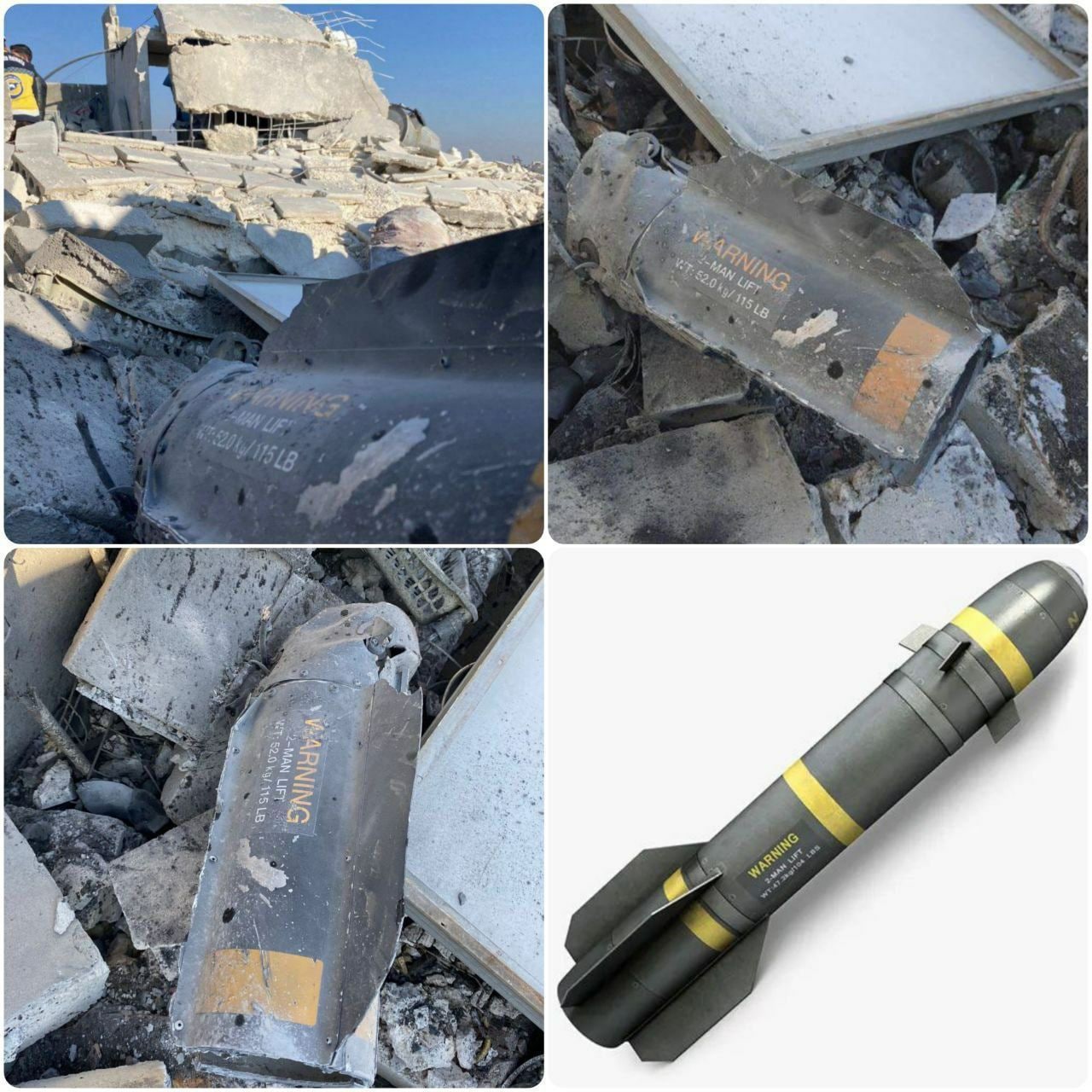
It is said that this attack was carried out by an American MQ-9 drone, and the remains of the missile at the scene of the incident show that this attack was carried out using an AGM-179 missile.
Remains of the missile at the scene of the attack
So far, the US officials and the US CENTCOM have not commented on the this attack.
Video of the attack siteTransfer of the injured to the medical center
On December 20, Bafel Talabani, the head of the Patriotic Union of Iraqi Kurdistan and Wahab Halabjai, the head of counter-terrorism of Sulaymaniyah, met and talked with Mazloum Abdi, the commander-in-chief of the Syrian Democratic Forces (SDF) in Syria’s Hasakah province.
In this meeting, which was also attended by Matthew McFarlane, the US CJTF-OIR commander, the latest political and military developments in the northeast of Syria, solving the problems of the region peacefully, the danger of ISIS and its hidden cells, maintaining good relations with neighboring countries and the strengthening of relations between the SDF and the PUK were discussed.
It is worth mentioning that this is the first time that Talabani has traveled to the areas under the control of the Syrian Democratic Forces in the northeast of Syria. Talabani’s visit to Hasakah in this sensitive time period and at the same time as the whispers of the start of the new Turkish operation in northern Syria, shows that he seeks to strengthen relations and support the Syrian Democratic Forces. Abdi also thanked Talabani for his trip to Hasakah for this reason and understanding this issue and the sensitivity of his trip.
After the formation of the ceasefire agreement in Yemen on April 2, 2022 and three periods of extension and finally its expiration on October 3, 2022, the areas under the control of the Saudi coalition were affected by a forced change in the head of the presidency (Resignation of Abd Rabbu Mansour Hadi and formation of the Presidential Council). This issue caused a series of tensions between different factions, and finally a kind of political and military deadlock prevailed between different groups under the command of the Saudi coalition. Therefore, the control of each of the parties was established over the regions, and now it is possible to distinguish the regions under the control of the groups in Yemen with more precision.
The map of Yemen war has been accurately edited in accordance with the latest field situation until December 16, 2022 and with the following categories and it is as follows:
1- Ansar Allah and popular committees: (green color) The areas under the control of Ansar Allah and popular committees include presence in 15 provinces in the west and center of Yemen, which include the capital, big cities and the majority of the country’s population. Despite the expiration of the cease-fire agreement with the mediation of the United Nations, there is no conflict in any of these fronts, and Ansar Allah is monitoring the fronts by carrying out various reconnaissance operations, as well as confronting the looting of Yemen’s oil resources by foreign tankers. Ansar Allah Movement and the National Salvation Government of Yemen are supported by the majority of the Yemeni people and the General People’s Congress and other Yemeni parties, as well as the foreign support of Iran and Islamic resistance groups.
2- The Saudi coalition and the Saudi-backed government of Yemen (ie the resigned government of Mansour Hadi): (red areas and all map colors except green) The areas under the control of the Saudi-led coalition forces include presence in 13 provinces of Yemen, which includes the largest area of this country. But the majority of these areas include desert and uninhabited areas. Despite this, the oil resources, the southern coast of Yemen and several strategic points are under the control of the Saudi coalition. The Saudi coalition uses these cases as tools to pressure Ansar Allah in negotiations. Nevertheless, despite the access of the Saudi coalition to all the areas under the control of the anti Ansar Allah groups, the factions under this coalition have competition and armed conflict with each other to control these areas. The structure of the resigned government of (Mansour Hadi) Yemen, like other countries involved in civil war, is a structure that divides positions and ministries between powerful factions in order to use the human power and military facilities of these factions against the main enemy. These factions include: Islah Party, Southern Transitional Council, Yemeni National Resistance under the command of Tareq Saleh, each of them have managed to influence and control parts of Yemen in recent years, especially after the resignation of Abd Rabbu Mansour Hadi and the formation of the Presidential Council. Which is explained as follows:
3- Southern Transitional Council: (blue color) The “Southern Transitional Council” (STC) is the name of a council consisting of the main currents of South Yemen, including Al-Hirak Al-Janoubi (Southern Movement), Southern Resistance and the South Arabian League Party, which was established on May 4, 2017, and their goal is to divide south Yemen. Currently, based on the Riyadh agreement in November 5, 2019, this movement holds the post of prime minister and half of the 24 ministries of the government. The geographical area under their control also includes: Aden province, most areas of Lahij and Abyan provinces and parts of Al-Dhale’, Hadhramaut and Taiz provinces.
It should be noted that the forces of Hizam al-Amni (Security Belt), Al-Haba Al-Hadhramiyah, Southern Resistance and other southern armed brigades are sub-groups of the Southern Transitional Council and are under the support of the United Arab Emirates.
4- Islah party: (purple color) The Islah Party (Reform Party) is one of the largest and oldest parties in Yemen, and it acts as the representative of the Muslim Brotherhood in Yemen. This party was formed on September 13, 1990 by Sheikh Abdullah ibn Husayn al-Ahmar, one of the elders of the Hashid tribe, and has been operating since 2007 under the chairmanship of Mohammed Abdullah al-Yadumi. After the start of the Saudi coalition’s invasion of Yemen, the Islah Party announced its support for this operation on April 3, 2015, and entered into a battle with Ansar Allah.
Currently, the cities of Marib, Taiz, Seiyun and the desert areas of Al-Jawf province and parts of Shabwah and Hajjah provinces are under the control of this party’s militants.
5- Forces loyal to Tareq Saleh (Yemeni National Resistance): (yellow color) “Yemeni National Resistance” is the name of a military group led by Tareq Saleh, the nephew of Ali Abdullah Saleh, the former president of Yemen, which was formed in December 2017. This organization has more than 10,000 members and consists of several factions, including former members of Ali Abdullah Saleh’s presidential guard, the former army soldiers and security forces separated from the Sana’a government, Al-Amaliqah and Al-Tihamah Resistance forces.
The areas under the control of Tareq Saleh forces are the southwestern region of Yemen, including the district of Hays in the south of Hudaydah province, the western areas of Taiz province, as well as the districts of Bayhan and Ain in Shabwah province. It is worth noting that this military group (Tareq Saleh forces) is under the support of the United Arab Emirates, the Amaliqah and Tihamah forces receive their orders from the command of the Saudi coalition, especially the UAE, instead of Tareq Saleh…
6- Al-Qaeda, Ansar al-Sharia and ISIS terrorist groups: (gray hachure) The activities of the Al-Qaeda terrorist group in Yemen under the name of “Al-Qaeda in the Arabian Peninsula” (AQAP) began in 2009 and continued under the name of Ansar al-Sharia group since 2011. After the resignation of Ali Abdullah Saleh and the presidency of Mansour Hadi, this group acted in a more organized manner and took full possession of some points; But the advance of Ansar Allah and the intelligence of the field commanders of this movement in taking control of the cities of Sana’a, Saada, etc., prevented Al-Qaeda from advancing. Therefore, in order to survive their activities, Al-Qaeda forces were stationed in the remote areas of Yemen, including the deserts of eastern Yemen, the north of Al-Baydha province, and several other places. Currently, this group does not have any city or region completely under their control, and their sphere of influence includes the desert areas of Hadhramaut, Shabwah and Abyan provinces. Also, after the Ansar Allah operation in the north of Al-Baydha province, Al-Qaeda members were transferred to the city of Marib and placed under the command of Islah Party.
The Islamic State Wilayat al-Yaman (Yemen province) group (IS-YP) also announced its formation in November 13, 2014, and apart from bombings, assassinations, etc., no special activity has been seen so far. ISIS members in Yemen are generally from extremist tribes in the east and south of Yemen and people separated from Ansar al-Sharia and al-Qaeda terrorists groups.
It should be noted that the formation of terrorist groups in Yemen is closely related to the actions of Mansour Hadi, the former president of the resigned government, Ali Mohsen Ahmar, the former vice president of the resigned government, and several other heads of parties and security institutions. In this regard, the criminal court of Yemen has convicted and prosecuted these people.
According to a Syrian military source, “at 00:30 Tuesday local time, the Israeli enemy fired several missiles from the north side of Lake Tiberias, targeting points around the city of Damascus. Air defense systems were activated to deal with missiles and intercepted a number of them. This attack resulted in the wounding of two Syrian soldiers and material damages.
It is worth mentioning that on November 22, the fighter jets of Israeli regime fired a number of missiles towards the central and coastal areas of Syria, during which four members of the Syrian army were martyred.