Category: West Asia

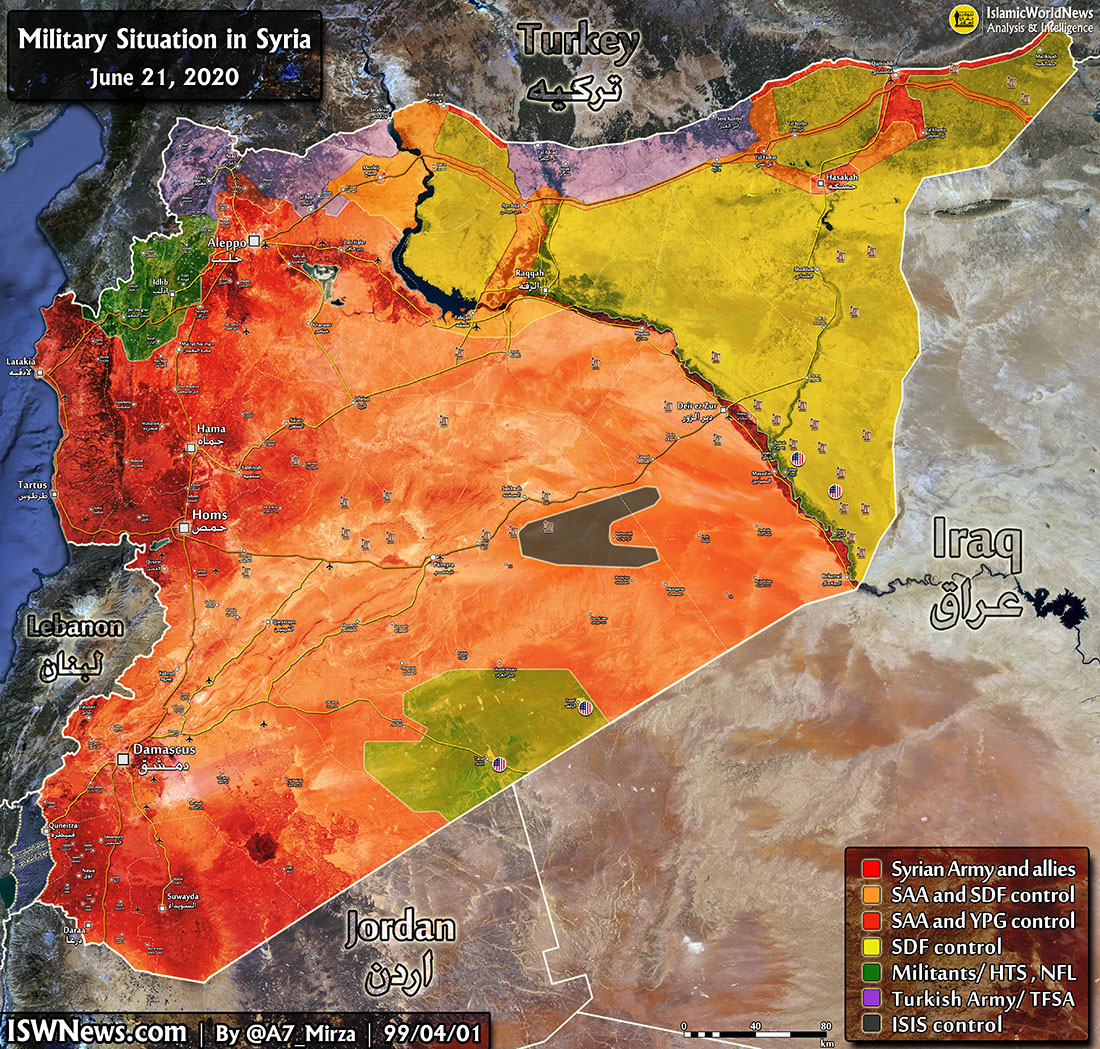
  • Latest Map of Frontlines in Syria until 21 June 2020

    Latest Map of Frontlines in Syria until 21 June 2020

    Northwest of Syria
    Following the second stage of Syrian Army operation in Idlib area, which was started on 19 December 2019, army troops liberated 2,345 km2 of land from Turkish-backed terrorists until 4 March 2020. 763 km2 of liberated land was in Aleppo province and 1,582 km2 in Idlib province.
    In despite that Turkish-back terrorists tried very hard in Idlib area to cut important M5 highway by occupying Saraqeb in the last two weeks of Syrian army operation to give Erdogan winning chips in Idlib ceasefire talks, but they failed and Saraqeb was finally liberated by Syrian army and Erdogan met with Putin empty handed.

    Controversial Moscow summit took place and Erdogan and Putin reached a new ceasefire in Idlib area which was imposed since 6 Match in Idlib and M4 highway.

    Details of Idlib ceasefire

    Since the starting date of ceasefire so far, although the advances stopped and 17th joint Russian-Turkish limited patrols launched in M4 highway, but terrorist groups have not retreated from designated areas in the ceasefire agreement. Patrols have not reached Jisr al-Shoghur yet and artillery fire exchange and daily conflicts continue in Idlib area.

    On the other hand in the last three months Syrian and Turkish armies strengthened their positions in Idlib front line and it seems there will be an imminent operation.

    East of Syria
    – After Turkish operation “Peace Spring” in east of Euphrates and occupying lands between Raas al-Ayn and Tal Abyadh to the depth of 32 km in fall 2019, front lines are unchanged and Turkish operation is halted since 25 November 2019 after announcing ceasefire and DMZ. There is only artillery fire exchange sparsely between SDF and Turkish-backed terrorists.
    In recent months, joint Russian-Turkish patrols launched several times in east and west of DMZ and near Syria’s northwest border.

    – Russian army took position in Qamishli airport and a large part of it turned into a Russian airbase. Russian warplanes number also increased in Deir Ezzor airport in recent days.
    In general, in recent month, Russian and Syrian armies’ presence increased in east of Euphrates. Syrian and Russian armies try to limit US influence in this area by increasing their troops and equipment which resulted in friction with SDF.

    – American troops still control oil and gas reservoirs in east of Euphrates even after show retreat from northeast of Syria and it seems they do not intend to leave in near future.

    – ISIS hidden cells are still active in deserts of east of Homs and south of Deir Ezzor. Their main activities are in east of Sukhnah, Kabajib and east of Mayadeen including daily and weekly sabotage and hit-and-run operations against Syrian army. Although Syrian army in recent months launched several security and cleansing limited operations, it is unlikely to cleanse the area without an extensive operation.

    South of Syria
    The front line in south is static and all the area is controlled by Syrian army. However, there are sparse IED operations by remainder of militants and ISIS terrorists from previous cleansing against Syrian army. It has been intensified in the last two months and Syrian army has deployed more troops in the southern areas to subdue these activities. Protests and some political activities have increased against Syrian government and allies in south of Daraa province in the last month.

    Click to see the full size map


    Read the previous article about Syria here: Latest Map of Fronts in Syria until 22 February 2020

  • Yemen: Latest Updates on Baydha Front, 22 June 2020

    Yemen: Latest Updates on Baydha Front, 22 June 2020

    Following Ansar Allah and popular commttees operation against Saudi-led coalition forces in north of Baydha and south of Marib provinces, important areas Soq Qaniya, Huran, Faleq mountain and Dumani mountain liberated.

    Soq Qaniy is an important point for Saudi coalition positions in south of Marib province, whose liberation helps Ansar Allah to liberate Qaniya and districts Abdiyah and Maheliyah.

    Interactive map of Baydha

  • Know Yemen better: Looking at position for Al-Jawf province in Yemen

    Know Yemen better: Looking at position for Al-Jawf province in Yemen

    Al-Jawf province covers 30,620 km2 with population of 750 thousand in north of Yemen at the border with Saudi Arabia.
    People in al-Jawf mainly do farming and herd raising and since the eastern half of the province is Rob’ al-Khali desert, the population is concentrated in mild weathered western part.

    Al-Jawf has 12 districts as follows: Al-Hazm, Khab and Shaaf, al-Ghayl, Khalaq, Bart al-Anan, Kharab al-Marashi, Hamidat, Rajzua, Zaher, Motun, Maslub and Matmah.

    Al-Jawf is important for having ancient sights, overlooking provinces Saadah and Marib and neighboring with Sanaa, Amran and Hadhramout.

    Al-Jawf geopolitical position has been important throughout the history as to connect Najran to Saba, Qataban and south of Yemen. This route had great trade importance and even Saudi coalition tried hard at the beginning of their assault to capture it.

    Al-Jawf has been the front line of the war with Saudi coalition since the beginning of it and near the end of 2015 the coalition advanced until al-Jawf crossroad and Hazm towns in an operation in west of Marib and al-Jawf provinces. Following the operation Hazm town was captured on 18 December 2015.
    Finally after several years of conflict, Ansar Allah reclaimed Hazm and western part of al-Jawf on 1 March 2020 in a heavy operation.
    Ansa rAllah tried to reclaim Hazm but Ali Abdullah Saleh intrigue interrupted it since the forces dispatched to other fronts.

    Tribes living in the province is the big tribe of Bakil most of whose subtribes are allies with Ansar Allah.


    Important military bases include Kanayes,Khanjar, Taibat al-Esm, Labanat, Boqa’, Gharimil from which Khanjar and Labanat are in control of Ansar Allah.

    To control and use al-Jawf province Ansar Allah needs to fulfill following missions:
    1. Claiming the western part of al-Jawf.
    2. Controlling roads Hazm-Jawf drossroad and Hazm-Khadhra crossroad port at the border with Saudi.
    3. Controlling all military bases in al-Jawf province.

    In addition by absorbing the tribes, Ansar Allah can win the fronts in Marib province and defeat Saudi coalition in north of Yemen border fronts which is important in Yemen war.

  • Yemen: Latest Updates on Marib front, 21 June 2020 (Map Update)

    Yemen: Latest Updates on Marib front, 21 June 2020 (Map Update)

    Saudi coalition warplanes bombed Majzar and Madghal fronts more than 7 and 9 times in the past few hours, respectively.
    Engagements in other fronts of west of Marib continue. Ansar Allah forces took position in Jufrah area and Maas base is still under control by Saudi coalition.

    It should be noted that during the last week clashes in the area, Ansar Allah could capture the Madghal village, center of the Madghal district but forced to retreat due to heavy counterattacks by the Saudi-led forces.

    Download HQ map

  • Yemen: Latest Updates on Baydha Front, 20 June 2020

    Yemen: Latest Updates on Baydha Front, 20 June 2020

    According to our field sources, Ansar Allah has managed to liberate the Naqa’h al-Aghwal and Rawaf areas, and clashes continue in Jabal al-Faleq, Jabal al-Dumani and Ber Mas’audah.

    Al-Faleq and al-Dumani heights are located in the province of Ma’rib and their liberation facilitates the process of clearing the Soq Qaniya road.

    The Saudi coalition command has sent Mansour Hadi forces with the help of Yaser al-Awadhi forces to reinforce the frontlines, and the Saudi-led coalition warplanes have also bombed the area more than 10 times.

    Interactive map of Baydha

  • Yemen: Southerners on the verge of capturing the Socotra island

    Yemen: Southerners on the verge of capturing the Socotra island

    Following the clashes between Hadi’s forces and the Southern Transitional Council (STC) forces and the withdrawal of Saudi forces from Socotra island yesterday, pro-Southern forces have seized various parts of the island.

    According to the latest news, southern forces have now taken control of a special forces base east of the city of Hadibu (the capital of Socotra province), and only a number of government buildings, the airport and the port of Socotra are under Mansour Hadi’s control.

    Given the recent developments and the lack of support from the Saudis for the resigned government of Mansour Hadi, the complete withdrawal of Mansour Hadi’s forces from the island is possible.

  • The Baghdad-Washington negotiations; a cover for the political dissolution of the Resistance

    The Baghdad-Washington negotiations; a cover for the political dissolution of the Resistance

    Reviving the strategic relationships and expanding the cooperations

    One of the issues that US officials have repeatedly used it for negotiating with Iraq, is the strategic relations. Due to the  current economic crisis in Iraq and necessity of increasing the international cooperation for overcome this crisis, the US has announced its tendency for the reviving the economic cooperations in the goods exports and energy field to Iraq. It should be said that the price of Iraqi oil has been decreased, economic corruption is widespread in this country, and Corona has had also influenced on economic growth. So, all of these issues cause al-Kadhimi’s hands in negotiations with the US be closed. But negotiation doesn’t just end here.

    Many Iraqi experts were considering the strategic negotiations between the US and Iraq only in security aspect and talking on the US troops  withdrawal, but what actually happened was that the diplomatic appearance of these talks led to US political and anti-Resistance aims be followed in cover of strategic relationships. Few days before the negotiations, Matthew H. Tueller the US ambassador in Baghdad had said in an interview with Baghdad Today: the partnership and cooperation between the two countries are not limited to the security sector, and the US wants to hold this strategic talk in all of the mentioned areas with the aim of strengthening the cooperations, so that the various challenges that Iraq still faces with them, will be solved.

    It seems that negotiations between Baghdad and Washington to be continued in the coming months, and it is clear that these negotiations will not reach a common point for exiting the Iraq from the crisis, but prolonging the negotiations is in the US favor, because when the Americans negotiate, they can delay their troops withdrawal from Iraq.

    Another point that is important regarding to these negotiations, is that the US has started the plan of economic pressure on governments in which Resistance groups are present, so that these groups can be controlled and disarmed by the sovereignty of the country that they are in it;  otherwise, sanctions and economic pressure will be imposed on all of the country, that we see its example in Lebanon.

    Also in Iraq, due to the indirect confronting between the US and Resistance groups, this country wants to disarm the Hashd al-Shaabi and control it, by imposing diplomatic and economic pressure on government. The analysts and Western strategic studies centers are also want to by making reports, to show that the continuing the presence of Hashad al-Shaabi and the Iraqi armed Resistance forces is unnecessary, and to introduce them as the main cause of the unrest in Iraq, because of connection with Iran.

    What is the Hashad al-Shaabi opinion about the Baghdad-Washington negotiations?

    As mentioned at the beginning of the article, Iraqi Resistance groups are seriously seeking the expulsion of US troops from Iraq and have announced that the negotiations aim should be determining the timetable for withdrawal of US troops from Iraq.
    Abu Ali al-Askari, security responsible at Iraqi Hezballah battalion wrote in his Twitter account about the points regarding to negotiation with Iraq: “we hoped that the political forces form a negotiating team with the American enemy, that their duty be only to determining the timetable for the withdrawal of aggressor troops from Iraq. But unfortunately, we were surprised by appointment of a group of people – as negotiators – that most of them are moving in the direction of US project n the country.”

    Also, Hadi al-Ameri the Badr organization chief wrote in his Twitter account, with warning the Iraqi negotiating team: “Do not disappoint the hopes of the millions of Iraqis that were in the streets for withdrawal of foreign troops and achieving the national sovereignty. The martyrs are waiting you for good message about withdrawal of international coalition forces and determining time of their withdrawal of Iraq.”

    Muhammad al-Ghaban the head of al-Fath coalition fraction in parliament also said in a statement that the Iraqi team should make its first priority in today talks with its US counterpart as what had been approved in parliament about expulsion of foreign troops from the country according to a time table.

    However, a day after the first round of negotiations on Saturday, June 13, Morgan Ortagus the State Department spokeswoman announced that the US will remain as the largest provider of humanitarian aids to Iraq. She said, without determining the time of her country’s withdrawal from Iraq: The strategic talks between Baghdad and Washington was positive, and we will remain in Iraq until destruction of ISIS.

    Due to the what seems about manner of these talks, the US still pursue the project of dismantle the Hashd al-Shaabi under the cover of its diplomatic relations with al-Kadhimi government, and maintains its bases in Iraq under the pretext of fighting with ISIS terrorism; that this is a kind of ignoring of Hashd al-Shaabi bravery in fighting with ISIS and reducing the importance of the Hasd al-Shaabi among Iraqi officials.

    As it seems, the US demand in  negotiation with Iraq is the long lasting presence of the US in Iraq with clear aims, and in addition to the economic view for presence in Iraq as a money market, the most important reason of it is controlling the Iraq foreign policy towards Iran and even entering in Iran’s national security sphere; so the Americans want to put pressure on the Islamic Republic of Iran, with their presence in Iraq.

  • Yemen: Yaser al-Awadhi intrigue is over!

    Yemen: Yaser al-Awadhi intrigue is over!

    After several days of conflict and several months of planning by Yaser al-Awadhi in northern part of Baydha province, Ansar Allah and Baydha tribes cleansed Radman district from Yaser al-Awadhi and his militia.

    Yaser al-Awadhi is a scholar supporting Ali Abdullah Saleh and an official in Islah party who engaged with Ansar Allah after Saleh joined Saudi coalition. He gathered militia from Al Awadh tribes in Radman district, north of Baydha province, in recent months and started acting against Ansar Allah, which was ended by cleansing Radman and militia escaping to Marib.

    Saudi coalition provoking corrupted scholars and politicians of Yemen such as Ali Abdullah Saleh and Hajur tribes tries to destroy Ansar Allah’s popularity and military strength but every time these intrigues were neutralized by Ansar Allah’s leader and commanders.

  • Latest updates on Yemen, 19 June 2020

    Latest updates on Yemen, 19 June 2020

    1. Marib
    – Saudi coalition attack to Jufra and Batin. Ansar Allah expelled them.
    – Saudi coalition warplanes bombed east of Majzar district 9 times and Hilan mountain.

    2. Baydha
    – Conflict between pro-Yaser al-Awazi forces and Ansar Allah and popular committees forces in Radman district.
    – Fall of Ansar Allah position and base in north of Radman is not correct and Ansar Allah sent reinforcement to the front with help of Baydha tribes.
    – Ansar Allah could cut Kharabah road to Soq Qaniyah and besieging Yaser al-Awazi forces in north of Radman by attacking Kharabah. The direction of the attacks are shown in the image.
    – Saudi coalition warplanes bombed Radman and Sawadiyah districts 15 times.

    3. Al Jawf
    – Saudi coalition forces attack to bases Labanat and Aqsha’.
    – Saudi coalition warplanes bombed areas Khasaf and Aqsha’ 11 times.
    – Ansar Allah attack to Alam al-Aswad and Alam al-Abyadh, east of al-Jawf, was expelled by Saudi coalition.

    Interactive map of Yemen

  • Latest Updates on Yemen, 17 June 2020

    Latest Updates on Yemen, 17 June 2020

    1. Marib
    – The intra-clashes between Saudi-led forces and Ubayd tribes were reported near the Ruwaik camp north of Marib. Due to recent defeats of Saudi coalition in fight with Ansar Allah, Ubayd tribes are having disagreements.
    – Saudi coalition warplanes bombed Jufra, Salb and Najd al-Ataq areas more than 25 times.

    2. Baydha
    – Naser al-Awadhi forces (a local commander proxy of Saudi coalition in Marib) to civilians in Radman district.
    – Saudi coalition warplanes bombed districts Radman and Sawadiyah 4 times.

    3. Al Hudaydah
    Saudi coalition forces violated ceasefire in the province 73 times in the last 24 hrs.

    4. Abudul Qader Murtadha, head of prisoners committee of rescue administration, reported of release of eight army and people’s immobilization forces in prisoners exchange in Dhale.

  • U.S. Impose Caesar Act Designations for Syria

    U.S. Impose Caesar Act Designations for Syria

    According to Caesar act or what USA calls supporting Syrian civilians, Syria’s economy and any allies which are helping in reconstruction of Syria are imposed pressure and sanctions.

    The act, which was voted by Congress, imposes economic, financial and bank sanctions on any country or organization which takes part in reconstruction of Syria active from today 17 June 2020 for five years. Syria’s departments and industries active in military, economy and energy are sanctioned as well.

    There are six conditions to remove the sanctions:
    1. Stopping aerial bombing civilians by Syria and Russia.
    2. Syrian, Russian and Iranian, and proxy groups forces obligation to stop bombing health, sanitation and education infrastructure and residential and commercial areas.
    3. Lifting limits imposed by Syrian, Russian and Iranian and proxy groups forces on sending humanitarian aids to sieged areas and giving freedom of transport to civilians.
    4. Releasing political prisoners and giving permission for human rights organizations to visit Syrian prisons.
    5. Providing freedom privilege to refugees to return home.
    6. Convicting perpetrators in Syria and starting the talks and national peace.

    According to this act, Russia due to providing forces and new warplanes for Syria, Iran due to contracts in energy and Syrian officials due to human rights violation, etc. are imposed with new sanctions.
    Trades between Syria and neighbors such as Lebanon and Iraq are included in the act as well.