Blog

  • Ansar Allah drone attack on al-Dhaba port on the coast of Hadhramaut

    Ansar Allah drone attack on al-Dhaba port on the coast of Hadhramaut

    Undoubtedly, this drone attack by Ansar Allah is a warning to foreign companies and oil buyers in the occupied areas of Yemen, and it can be examined from two perspectives:
    1- Warning to deployment of Israelis in the coastal town of Al-Riyan, that were sent to this area to loot the oil resources of Hadhramaut and Shabwa provinces. (More details)
    2- Preventing the transfer of Yemeni oil by the Nissos Kea ship, which is a warning to foreign ships and companies.

    According to the statements by Mabkhut Mubarak bin Ghadhi, the governor of the Saudi-backed government for the Hadramaut province, “this ship belongs to a Greek company, and the first drone explosion occurred between the ship and another vessel, and the second explosion occurred near the Greek ship. Also, the crew of the ship has not reported any casualties and damages from these explosions.”

    The statement of Brigadier General Yahya al-Sari’, a spokesman for the Yemeni Armed Forces regarding the attack:
    “We made a simple warning to prevent the looting of crude oil from an oil ship from Al-Dhabah port in Hadhramaut province. This ship violated the decision issued by the Yemeni authorities to ban the transfer and export of oil derivatives, and we warned to prevent the continued looting of Yemen’s oil wealth and its non-allocation to the people.
    This warning message was done after the competent authorities warned the crew of the ship and informed them of this decision based on current Yemeni laws and international laws. The ship was handled with caution and we wanted to maintain its security and the security of Yemeni infrastructure.
    We will not hesitate to do our duty to stop and prevent any ship that intends to loot the wealth of the Yemeni people, and with God’s help, we can launch more operations and warnings to defend our great people and protect its wealth from looting. We again warn all companies to fully comply with the decisions of the government authorities in Sana’a and refrain from any participation in the looting of Yemen’s wealth.”

    Geolocation of Dhaba port

    Location of the Marshall Islands-flagged Nissos Kea off the southern coast of Yemen. According to the local media, this ship has moved away from Al-Dhaba port after the explosions.
  • Central Asian countries are afraid of the gathering of terrorists in northern Afghanistan!

    Central Asian countries are afraid of the gathering of terrorists in northern Afghanistan!

    “International and Regional Border Security and Management Cooperation to Counter Terrorism” meeting with the cooperation of Central Asian countries, the Organization for Security and Cooperation in Europe (OSCE), the United Nations Office of Counter-Terrorism (UNOCT), the United Nations Regional Centre for Preventive Diplomacy for Central Asia (UNRCCA), European Union, Saudi Arabia and Qatar was held for two days in Dushanbe, the capital of Tajikistan, on October 18.

    During his speech on the first day of this meeting, Tajik President Emomali Rahmon expressed his concern about the gathering of foreign terrorists in the southern borders of Tajikistan and called for the creation of a security belt to prevent the dangers of terrorism in Afghanistan from entering the Central Asia region. Rahmon announced in this meeting that there are more than 40 terrorist bases and training centers in the northeastern provinces of Afghanistan, and thousands of terrorists have gathered in these bases.

    Ruslan Mirzayev, the head the executive committee of the regional anti-terrorist structure of the Shanghai Cooperation Organization, also provided additional information in this field and announced the deployment of 13,500 suicide and jihadist terrorists in the northern provinces of Afghanistan and the border with Tajikistan by the Taliban and considered it a great threat to the Central Asian region. Tajik Interior Minister Ramadan Rahimzadeh also claims that the Taliban issued Afghan passports to more than 3,000 of these people and settled them under the guise of refugees in the northern regions.

    After the Taliban came to power in Afghanistan, Tajikistan is the only Central Asian country that has not established any relations with Taliban. In addition, Tajikistan has supported political opponents and anti-Taliban armed groups and held various meetings against them.

  • Imran Khan supporters waiting for the march towards Islamabad

    Imran Khan supporters waiting for the march towards Islamabad

    The uncertainty of the date of Pakistan’s national elections by Shehbaz Sharif’s government has caused the anger and sharp reaction of Imran Khan, the former Prime Minister of Pakistan. In his recent statements, he has threatened to hold a protest march towards the city of Islamabad, the capital of Pakistan. Imran Khan stated that the purpose of holding this demonstration is to defeat the US leadership’s project of carrying out a soft political coup in Pakistan and restoring the power of the people’s government in this country.

    This warning comes while the Tehreek-e-Insaf party (led by Imran Khan) has won six out of eight seats in the mid-term elections of the Pakistani Parliament.

    In this regard, Pakistan’s “Geo TV” channel wrote in an article: “If Imran Khan organizes nationwide and long-term protests in Islamabad and other cities of Pakistan, he will be hanged!” At the same time Imran Khan was threatened with hanging, Omer Sarfraz Cheema, the head of the federal government of Punjab state and a supporter of Imran Khan announced that he will arrest Rana Sanaullah as soon as he enters Punjab state.

    Imran Khan’s conflict with Sharif’s government and his supporting parties started after Imran Khan’s impeachment in parliament and his dismissal on April. After this incident, the Tehreek-e-Insaf party is trying to win local and parliamentary seats and is trying to put pressure on the government to hold early national elections with protest rallies.

    Holding demonstrations and gatherings of millions in Pakistan is not a new thing. The rallies in 2014 led to a four-month sit-in against Nawaz Sharif in Islamabad. After Imran Khan removal, he has proposed holding peaceful demonstrations several times, but every time he stopped them after the protesters reached the capital of Pakistan!

  • Israel aggression on Syria’s Damascus

    Israel aggression on Syria’s Damascus

    According to the a Syrian military source, “At 23:03 local time on Friday, the Israeli enemy fired missiles from the north-east side of Lake Tiberias, targeting points around the city of Damascus. Air defense systems were activated to deal with missiles and intercepted a number of them. This attack resulted in material damages.”

    It is worth mentioning that on September 17 also the Israeli fighter jets fired a number of missiles from the Lake Tiberias towards the Damascus International Airport as well as places around the city of Damascus, which resulted in the death of five Syrian servicemen.

    Read more: 5 Syrian soldiers killed by Israeli airstrikes on Damascus

  • Latest Military Situation in Ukraine, 20 October 2022 (Map Update)

    Latest Military Situation in Ukraine, 20 October 2022 (Map Update)

    1- Ukraine’s Foreign Minister Dmytro Kolba, announced the proposal to cut off diplomatic relations with Iran. He raised this request with the President of Ukraine. This request was made because of the prominent role of Iranian Shahed-136 drones in the battles of Ukraine.

    2- Yuriy Ignat, a spokesman for the Ukrainian Air Force: “Russia is no longer firing its missiles at Ukraine from the Caspian Sea, but from near Rostov. Therefore, the time to prepare for attacks and take shelter is reduced. Russian strategic bombers use Kh-101 and Kh-55 missiles. These missiles fly at a speed of 900 kilometers per hour, and if they are launched from the Caspian Sea, the air force has more time to react and people have more time to enter the shelter. Now the distance is shorter and the time is also shorter.”

    3- The Parliament of Estonia officially declared Russia a terrorist state. This parliament also asked the parliaments of other countries to do the same and identify Russia as a sponsor of terrorism. They also demanded Russia’s exclusion from permanent membership in the UN Security Council and asked the European Union to impose more sanctions against Russia and Belarus.

    4- The Ministry of Foreign Affairs of Ukraine officially announced the request to purchase air defense systems from Israel. In response to this request, Benny Gantz, the Israeli Minister of Defense, announced that they will not hand over any weapons to Ukraine.
    In this regard, Benjamin Netanyahu, the former Prime Minister of Israel, also stated that if Israeli weapons are sent to Ukraine, they may fall into the hands of the Iranians. Whenever we have provided military assistance to one side of the field, in the end, the same weapons have fallen into the hands of the Iranians and they have used them against us.

    5- The New York Times published a report claiming that Iranian advisers were sent to Russia. This report states: “Iran has sent advisers from the Islamic Revolutionary Guard Corps to Russia to help solve the problems of drones. These advisers have been stationed in a military base in Crimea to train the Russians.”

    6- Hossein Amirabdollahian, Iran’s Foreign Minister: “We have told the Ukrainian authorities to provide a document about the use of Iranian drones in the war in Ukraine if there is any.”

    7- Donetsk:
    In the Bakhmut axis, the AFU 54th Brigade attacks to recapture the asphalt factory near the city of Bakhmut failed. The conflict in this axis between the parties continues and the Russian army and its allies have increased the attacks on the important city of Bakhmut. Currently, Russian forces have reached the eastern and southern entrances of Bakhmut city, and heavy clashes continue for several days in a row. After Russian retreats from the Kharkiv axis, the main focus of the Russians has been directed to the city of Bakhmut. It seems that the capture of Bakhmut has an important role in determining the future of battles for the Russians in this axis.

    8- Kharkiv:
    In the southern axis of Kharkiv, sporadic clashes between the Russian and Ukrainian armies continue in the southeast of Kupyansk and northwest of Svatove. In the last two weeks, the Ukrainian forces have made extensive advances in this axis and have pushed the Russian forces back several lines.

    9- The Russian army attacked positions of the Ukrainian forces in the city of Mykolaiv, with several “Shahed 136” suicide drones. The video below is about the failure of Ukrainian air defense to counter the Russian drones and the moment it was hit the target.

    10- Ukrainian Army and Volodymyr Zelenskyi, the president of Ukraine, claimed that they shot down 223 “Shahed-136” suicide drones in the past 36 days. The first Shahed drone allegedly was shot down on September 13 over the sky of Kupyansk.

    11- During the last two weeks, Geran 2 and 1 suicide drones (Shahed-136 and its smaller model known as Shahed-131) have targeted Ukrainian military and economic infrastructures in the cities of Kyiv, Lviv, Zhytomyr, Mykolaiv, Kharkiv, Poltava, Dnipro, Zaporizhzhia, Kremenchuk, Odessa, Rivne, Ternopil, Khmelnitsky, Ivano-Frankivsk. Despite the claim of Ukrainian officials about shooting down these drones, most of the drones hit their targets with high accuracy and the Ukrainian air defenses were unsuccessful in intercepting and destroying the drones. The city of Kyiv has been the host of the most Shahed-136 suicide drone attacks, and Russian attacks using these drones on different regions of Ukraine continues aggressively!

    12- On the front of Kherson and Mykolaiv, sporadic clashes between the Russian and Ukrainian armies continue. After the retreat of the Russian army from the eastern areas of the Ingulets River in the north of Kherson province, the clashes continue in the south of Davidyv Brid and Sukhanove area. Yesterday, the Russian army repelled the large-scale attack of the Ukrainian forces in the Sukhanove axis. Currently, most of the conflicts are concentrated in this axis, i.e. in the northwest of Kherson province. The Russian army is strengthening the Kherson front and has sent more troops to this area. Therefore, the Ukrainian forces are trying to break the Russian resistance in this axis and reach Kakhovka as soon as possible and bypass the city of Kherson from the left flank.

    Interactive map: here

    Click to view full size image
  • Opinion: Iran Increasingly Uneasy About Threats to Common Border With Armenia

    Opinion: Iran Increasingly Uneasy About Threats to Common Border With Armenia

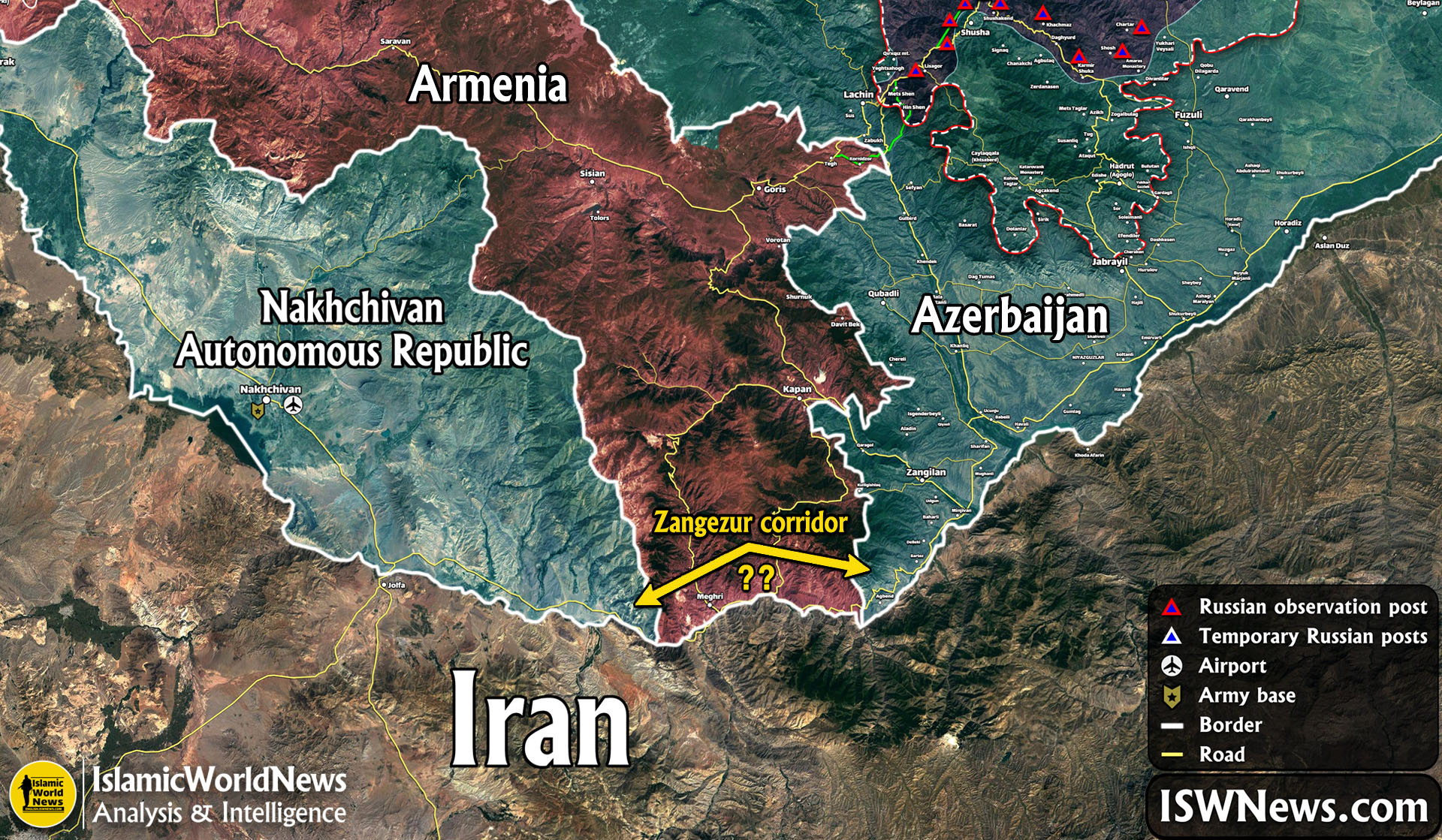
    Before the Second Karabakh War, Tehran was not particularly concerned about its border with Armenia. After the war, Iran’s main concern became Azerbaijan’s hopes to realize the Zangezur Corridor by force, in such a way that the 40-km border between Iran and Armenia could be compromised or blocked. In truth, Iran has no objection to the implementation of the ninth clause of the 2020 Karabakh ceasefire agreement, which includes granting Azerbaijan communication access to Nakhchivan. During the past three decades, communication between Baku and this region only took place via Iran. While Tehran does not object to this arrangement, it strongly opposes the change of international borders in the Caucasus, the blocking of the Iranian-Armenian border and the possibility of renewed conflict between Armenia and Azerbaijan.

    For this reason, the massive maneuvers of Iran’s army and the Islamic Revolutionary Guard Corps (IRGC) on its northwestern border in September and October 2021, unprecedented in the three decades since the collapse of the Soviet Union, signals the level and depth of Iran’s concerns about recent developments in the South Caucasus. Indeed, the outbreaks of violence between Armenia and Azerbaijan, the repeated threats of Baku to open the Zangezur Corridor by force, Turkey’s ongoing support of Azerbaijan and Russia’s silence and ambiguous position regarding the region have further exacerbated Tehran’s concerns. On the sidelines of the 7th Summit of the Astana Peace Process in Tehran, Supreme Leader Ayatollah Ali Khamenei met with Turkish President Recep Tayyip Erdoğan and clearly delineated that “if there is a policy to block the Iranian-Armenian border, the Islamic Republic will oppose it because this border has been a communication route for thousands of years.”

    Recent fighting between Armenia and Azerbaijan in September 2022 resulted in nearly 300 deaths and dozens of injuries on both sides, further aggravating Iran’s concerns. Some news sources even announced that Tehran had deployed 50,000 troops to the Armenian border. Indeed, Mohammad Pakpour, commander of the IRGC’s ground forces, on September 16, visited the units located on the border with Armenia, Azerbaijan and Nakhichevan, stating that their readiness level is high. Additionally, the chief of staff of the Iranian Armed Forces, Mohammad Bagheri, during a military parade on the anniversary of the Iran-Iraq War (1980–1988), declared, “Iran will not tolerate any change in the borders in the region and call on Azerbaijan and Armenia to solve the issues between them peacefully, through dialogue. We do not seek conflicts and wars, but we do not remain silent when it is necessary to resist them.”

    Several reasons underline Iran’s concerns regarding the possible blocking or destruction of its border with Armenia. If this border is destroyed, all of Iran’s northwestern regions will border Azerbaijan and Nakhchivan—and the number of Iran’s neighbors will decrease from 15 to 14. Iran will also lose one of its most crucial transit routes to the Caucasus, as the land route through Iran and Armenia that reaches Georgia is a main part of the Persian Gulf–Black Sea Corridor. The Iranian government’s decision to open a consulate in Kapan, the administrative center of Armenia’s Syunik Province bordering the Islamic Republic and the reciprocal decision of the Armenian government to open a consulate in the northwestern Iranian city of Tabriz clearly indicate Tehran’s desire to preserve and strengthen this transit route. Indeed, in terms of diversifying transit routes, Iran hopes to maintain this corridor (Iran-Armenia-Georgia) parallel to the North-South Corridor (Iran-Azerbaijan-Russia).

    Additionally, in terms of water resources in the Aras river basin, Turkey and Armenia are “upstream” countries, while Iran and Azerbaijan are “downstream” countries. Therefore, if Baku captures the southern part of Syunik Province along the Zangezur Corridor, then Azerbaijan will become an “upstream” country, leaving Iran as the only “downstream” country with limited control over the water supply.

    In a wider sense, Iran also has deeper concerns about geopolitical change and the balance of power in the region. In this context, Tehran considers the regional roles of Turkey, Israel, the United States and the North Atlantic Treaty Organization as extremely influential. From this point of view, Iran, unlike Russia and others, does not view the tensions in the South Caucasus merely as a “border clash” between Yerevan and Baku. In truth, opening the Zangezur Corridor would also provide direct military access for Turkey as a NATO member in the Caucasus.

    Indeed, a significant number of Iranian elites and experts believe that Azerbaijani President Ilham Aliyev’s emphasis on “uniting the geography of Turkic world” via the Zangezur Corridor and the expansion of Turkey’s presence in the South Caucasus will strengthen Pan-Turkism in the region, which could incite ethnic and separatist sentiments. In addition, considering the close relations between Azerbaijan and Israel, Tehran is worried that, if Baku does capture the southern part of Syunik Province, this will bolster Israel’s intelligence, espionage and security presence vis-à-vis Iran.

    As a result, although, among Iran’s 15 neighbors, its border with Armenia is the shortest, this 40-km border is of the utmost strategic importance for Tehran. Although the Azerbaijani authorities have stated many times that there is no real threat to the Iranian-Armenian border, Tehran’s reactions in the past two years and after the Second Karabakh War clearly show that Iran is extremely worried about the realization of the Zangezur Corridor by force, especially if this compromises its highly consequential border with Armenia.

    It seems that the new diplomatic developments of the past two months have not reduced Tehran’s worries. In Prague, a quadrilateral meeting between the leaders of Armenia and Azerbaijan together with the presidents of France and the European Council took place, as well as the historic meeting of Armenian Prime Minister Nikol Pashinyan with Turkish President Recent Tayyip Erdogan. Yet, during both the meeting between Iranian President Ebrahim Raisi and Pashinyan on the sidelines of the UN General Assembly and the meeting between the Raisi and Aliyev in Astana, Kazakhstan, Iran’s opposition to changing international borders in the Caucasus was clearly emphasized. As such, Brigadier-General Mohammad Pakpour, commander of the Islamic Revolutionary Guard Corps Ground Forces (IRGC) announced that “the massive exercise dubbed ‘Eghtedar/Power’ of the IRGC ground forces will be held at the northern border in the Aras region at the regional IRGC Ashura military base.”
    Tehran’s decision to hold this military maneuver one year after large-scale military exercises near the Azerbaijani border, clearly shows that “Iran increasingly uneasy about threats to its common border with Armenia”.

    Source: The Jamestown Foundation

  • Military Knowledge: Zolfaghar Ballistic Missile

    Military Knowledge: Zolfaghar Ballistic Missile

    Zolfaghar missile is equipped with a warhead weighing 579 kg and its range is 700 km. The guidance method of this missile is based on Inertial and global navigation satellite system and electro-optical terminal with the ability to guide until the last moment. Zolfaghar has anti-jamming capability and is resistant to any electronic warfare.

    In the Zolfaghar missile, the nose of the missile has changed from a pointed to a curved one. This change reduces the thermal effect of drag at high speeds; Therefore, the speed of this type is higher than the Fateh-110 models and has reached Mach 5.

    Zolfaghar ballistic missile guidance has been optimized. In this missile, the pointed shape of the warhead guide canards has been changed to trapezoidal shape. Also, these canards have been moved to the end of the warhead and behind the guidance, control and navigation section.

    The warhead of the Zolfaghar missile is detachable. Detachable warhead, while reducing the negative effects of connecting the body to the warhead in the final phase of the attack, reduces the possibility of intercepting by enemy air defense systems and reduces the probability of enemy air defense missiles hitting the Zolfaghar warhead.

    Read more: Military Knowledge: Fateh-110 Ballistic Missile

    So far, the dimensions of this missile have not been officially announced; But by examining the available images, it can be seen that its length has increased compared to the Fateh-110 missile.

    Zolfaghar missile has high agility due to its light weight and small dimensions, and like other missiles of the Fateh family, it can be installed and launched on a mobile chassis. This increases its survivability on the battlefield. Zolfaghar missile can be fired from a dual launchers.

    Zolfaghar Ballistic Missile

    In September 2020, a new type of this missile named “Zolfaghar Basir” with optical guidance and anti-ship mission was unveiled.

    The Zolfaghar ballistic missile has been used in two operations “Laylat al-Qadr” and “Strike of Muharram” against the ISIS terrorist organization in Syria.

    On the last night of Qadr in the month of Ramadan, which coincides with Sunday June 18, 2017, the IRGC Aerospace Force with the operational name “Laylat al-Qadr”, used 6 Zolfaghar missiles to attack the command headquarters and positions of ISIS in the Syria’s Deir Ezzor province. The missiles targeted ISIS positions in Deir Ezzor, at a distance of about 650 kilometers. This operation was carried out in response to the ISIS terrorist attack on Iranian Parliament in Tehran in 8 June 2017, which resulted in the martyrdom of 18 civilian.

    Read more: IRGC missile operation against ISIS terrorists in Syria’s Deir ez-Zor + Video

    In another operation on the morning of October 1, 2018, the IRGC Aerospace Force with the operational name “Strike of Muharram” (Zarbat-e Muharram) with 6 surface-to-surface ballistic missiles from Kermanshah in the west of Iran, destroyed the positions of ISIS terrorists in the Hajin area in the east of the Euphrates River in Syria. The 4 out of the 6 fired missiles were of the Zolfaghar type. Simultaneously with this operation, 7 IRGC drones have also targeted the positions of terrorists in the east of the Euphrates. This operation was carried out in response to the ISIS terrorist attack in September 22, 2018 in Ahvaz city, which resulted in the martyrdom of 25 Iranians and the wounding of 69 others.

    Read more: IRGC Missile and Drone Attacks on ISIS Terrorists in Hajin in Syria + Images

    Zolfaghar ballistic missile specifications:
    Length: 10.3 meters
    Diameter: 0.68 meters
    Weight: 4620 kg
    Warhead: high-explosive up to 579 kg
    Engine: single-stage solid fueled
    Range: 700 km
    Speed: Mach 5
    Guidance: Inertial and global navigation satellite system, electro-optical terminal
    Accuracy: 10 meters CEP
    Origin: Iran

    Click to view full size image

    Collection of posters of Zolfaghar ballistic missile in Russian (Зульфикар Ракета), Persian (موشک ذوالفقار), Chinese (佐勒菲卡爾 彈道式導彈), Hebrew (טיל בליסטי זולפיקאר), Arabic (صاروخ ذوالفقار), Azeri (Zülfüqar Raketi) and Kurdish (موشەکی زولفەقار):

  • Military Knowledge: Fateh-110 Ballistic Missile

    Military Knowledge: Fateh-110 Ballistic Missile

    Fateh 110 missile is produced by the Aerospace Industries Organization (AIO), a subsidiary of Iran’s Ministry of Defense and Armed Forces Logistics. According to the available information, the first tests of this missile were carried out in 2002. Fateh-110 is one of the most popular types of missiles produced by Iran’s military industrial.

    In the past 30 years, the development of the Fateh-110 missile has been carried out on the basis of “increasing the range and increasing the accuracy” and its various types have been produced over time. Therefore, in 2012, a version of the Fateh-110 missile with a pinpointing accuracy and an error rate of 10 meters was produced.

    Fateh-110 missile should be considered as Iran’s first important step in designing a solid fueled ballistic missile. The ignition mechanism of Fateh-110 is single-stage and uses solid fuel.

    So far, 10 generations of Fateh-110 missiles have been built, and their specifications are as follows:
    Fatih-110 generation 1: with a range of 200 km
    Fatih-110 generation 2: with a range of 250 km
    Fatih-110 generation 3: with a range of 300 kilometers and high accuracy
    Fatih-110 generation 4: with a range of more than 300 km and pinpoint accuracy
    Persian Gulf missile: an anti-ship type
    Hormuz 1 and Hormuz 2: an anti-radar type
    Fateh Mobin missile: anti-ship type with optical guidance
    Zolfaghar missile: with a range of 700 km
    Dezful missile: with a range of 1000 km
    Raad 500 missile: with a range of 500 km

    Read more: Military Knowledge: Zolfaghar Ballistic Missile

    Fateh-110 ballistic missile is able to target and destroy land and sea targets, enemy gathering points, command centers, ammunition depots, radars and other targets with high accuracy. The error rate of Fateh-110 missile is estimated to be less than 10 meters.

    The warhead of Fateh-110 missile is detachable type. Detachable warhead, while reducing the negative effects of connecting the body to the warhead in the final phase of the attack, reduces the possibility of intercepting by enemy air defense systems and reduces the probability of enemy air defense missiles hitting the Fateh-110 warhead.

    Fateh-110 missile has high agility due to its light weight and small dimensions, and like other missiles of the Fateh family, it can be installed and launched on a mobile chassis. This increases its survivability on the battlefield.

    The effective range of this missile is 300 km and its final range is estimated between 400 and 550 km.

    One of the most famous operations of Fateh-110 is the attack on the headquarters of the terrorist group of the Democratic Party of Iranian Kurdistan (KDPI) in September 8, 2018. In this operation, Fateh-110 missiles were fired from a distance of 230 km towards the headquarters of the KDPI terrorist group in Koysinjaq in the Kurdistan region of Iraq and very accurately targeted the meeting of their leaders. In this precise attack, 16 members of KDPI were killed, including 6 members of the central committee of this terrorist group. This attack was carried out in retaliation for the martyrdom of a number of IRGC servicemen who were killed by KDPI in July of the same year in the west of the country.

    Read more: IRGC Missile Attack on Terrorist Groups in Iraqi Kurdistan; Video + Images

    The operation against the Mossad base/villa near the Iraqi city of Erbil is another important and impressive operation of Fateh-110 ballistic missiles. In the morning of March 13, 2022, the IRGC Aerospace Force targeted the secret and sensitive center of the Israeli regime near the new US consulate in Erbil, with at least 10 ballistic missiles. Some of the missiles used in this operation were Fateh-110. The IRGC stated that the reason for the attack on the Mossad villa near Erbil was a response to the Israel’s recent evils activities against Iran national security.

    Read more: Iranian precise missile attacks on Israeli secret places in Erbil + Video

    Fateh-110 ballistic missile specifications:
    Length: 8.86 meters
    Diameter: 0.61 meters
    Weight: 3450 kg
    Warhead: high-explosive up to 500 kg
    Engine: single stage solid fuel
    Range: 300 km
    Speed: Mach 3
    Guidance: Inertial and global navigation satellite system. (+some versions with electro-optical terminal)
    Accuracy: 10 meters CEP
    Origin: Iran

    Click to view full size image

    Collection of posters of Fateh-110 Ballistic Missile in Russian (Баллистическая Ракета Фатех-110), Persian (موشک فاتح 110), Chinese (彈道式導彈 法塔赫-110), Hebrew (טיל בליסטי של פאתח-110), Arabic (صاروخ البالستي فاتح 110), Azeri (Ballistik Raketi Fateh-110) and Kurdish (موشەکی بالیستی فاتیح 110):

  • Latest Updates on Tahrir al-Sham operation in Afrin region (Map Update)

    Latest Updates on Tahrir al-Sham operation in Afrin region (Map Update)

    On the 17th of October, the ceasefire agreement between the Hayat Tahrir al-Sham and the Turkish-backed Syrian National Army (SNA-TFSA) was completely violated and clashes started between the parties. During these clashes, Tahrir al-Sham militants managed to seize several positions of SNA and control the areas of Maryamayn, Innab, Baslahay, Jalbul, Shawarighat al Jowz, Kafr Maz and Marasat Khatib. In addition to these areas, Tahrir Al-Sham also captured the two villages of Kafr Janah and Qatmah.

    But some time later, after the mediation of Turkey, the forces of Tahrir al-Sham withdrew from Kafr Janah and Qatmah, and the SNA forces were stationed in these two settlements.

    The Tahrir al-Sham control over these areas greatly increases the pressure on the city of Azaz from the west, and this issue can ultimately cause the fall of this city.

    On the other hand, Ahrar al-Sham militants also attacked the SNA militants in Baragheetha, Al-Tawaqli and Soran axes located in the east of Azaz. So far, no progress has been made in these areas.

    Currently, most of the Afrin region is under the control of Tahrir al-Sham. It is also reported from the city of Afrin that the security forces of Tahrir al-Sham have launched a new campaign to arrest their opponents in this city.

    Click to view full size
  • Washington Post: Russia has bought Fateh-110 and Zolfaghar missiles from Iran!

    Washington Post: Russia has bought Fateh-110 and Zolfaghar missiles from Iran!

    According to Washington Post, quoting the intelligence officials of one of the allied countries of Ukraine and the United States near Iran, an intelligence estimate shows that the Russian government has purchased several shipments of weapons, including Zolfaghar and Fateh-110 short-range ballistic missiles from Iran, and the arms industry of this country is preparing and delivering the first missile shipment to Russia.

    Read more:
    Military Knowledge: Fateh-110 Ballistic Missile
    Military Knowledge: Zolfaghar Ballistic Missile

    These sources pointed to Russia’s new order to Iran and claimed that Iran is allegedly prepared dozens of Shahed-136 and Mohajer-6 drones for Russia. It is also said that Iranian military advisors have visited the areas controlled by Russia and have provided instructions to the commanders of the Russian army about how to carry out operations with suicide drones.

    As the war in Ukraine has been prolonged and the missile and drone reserves of the Russian army have decreased, the role of Iran in the war in Ukraine has been highlighted as one of the suppliers of Russian weapons. In this regard, Ukrainian authorities and media have claimed Iran’s arms assistance to Russia, and over the past few weeks, they have published various footages of the flying or hitting of Shahed-136 and Shahed-131 suicide drones (a smaller version of Shahed-136) in different regions of Ukraine. They also claimed to have obtained the wreckage of a Mohajer-6 drone.
    Despite all these claims and footages, Iranian authorities deny Iran’s military aid to Russia and insist on Iran’s neutral position in the face of the war between Russia and Ukraine.

    Read more:
    Russian Army Massive Drone Attack on the Capital of Ukraine
    Ukrainian MiG-29 was downed while hunting the Shahed-136 drone!

  • Russian Army Massive Drone Attack on the Capital of Ukraine

    Russian Army Massive Drone Attack on the Capital of Ukraine

    The Russian army attacked 136 positions of Ukrainian forces in Kyiv, the capital of this country, with several suicide drones at dawn today. These attacks have hit the offices of energy companies and the railway station in Kyiv.

    According to Vitali Klitschk, the mayor of Kyiv, the Russian army used 28 suicide drones in this attack. According to him, the air defense systems of the Ukrainian army have succeeded in shooting down 23 drones. Despite these claims, various videos of today’s attack show the downing of just two drones over the Kyiv.

    Read more: Military Knowledge: Shahed-136 Loitering Munition

    The wave of fear and confusion among the Ukrainian officials shows the inability of them to deal with the Russian drone attacks, and the publication of unrealistic statistics of the downing of drones by the Ukrainian authorities can be attributed to this reason.

    It should be noted that last night, the Russian army attacked the fuel depot and power plant of Mykolaiv city and a military cargo in Ochakiv port located in the south of Ukraine with suicide drones.

    Successful and effective attacks by Shahed-136 suicide drones against military targets in Ukraine continue, while the Ukrainian army has been unable to neutralize these attacks so far.

    The moment the Shahed-136 drone hit a target in Kyiv city

    The unsuccessful attempt of the defense of the Ukrainian army to shoot down the Russian suicide drone

    The moment one of the Russian drones hit a building in Kyiv

    The destruction of one of the Russian drones by the Ukrainian army

    The destruction of one of the Russian drones by the Ukrainian army

    The moment Russian drones hit the city of Kyiv from the view of the camera of the Turkish news Anadolu Agency

    Read more: Ukrainian MiG-29 was downed while hunting the Shahed-136 drone!

  • Latest Updates on Yemen, 17 October 2022

    Latest Updates on Yemen, 17 October 2022

    1- On October 13, the Saudi Arabian delegation met with a number of prisoners of the Saudi coalition in Sana’a. Citing this news, local sources claimed that Ansar Allah and Saudi Arabia held a prisoner exchange negotiation in the city.

    2- On October 9, Hans Grundberg, the UN envoy for Yemen, announced the continuation of negotiations and efforts to extend the ceasefire.

    3- Al-Jawf:
    – The Saudi-backed Yemeni presidential council dismissed Sheikh Amin Al-Akimi, the governor of the resigned government Mansour Hadi for Al-Jawf, from his position by issuing a decree.
    – The Islah Party announced its opposition to the removal of Sheikh Amin Al-Akimi by publishing a statement and confirmed his arrest in Saudi Arabia since a year ago. It should be noted that Sheikh Amin Al-Akimi, among the staunch opponents of Ansar Allah and one of the elders of the pro-Saudi coalition tribes in Al-Jawf, was captured by Ansar Allah during the battles east of Al-Hazm city, but was released by the pardon of Sayyed Abdul Malik Badr al-Din al-Houthi, the leader of the Yemeni revolution, and went to the areas under the control of the coalition.

    4- Abyan:
    Due to a bomb explosion on the way of the armed convoy of the Southern Transitional Council in Modhyah district, seven STC members were killed and two others were wounded. The militants of Islah Party or al-Qaeda group are the main culprits of this attack.

    5- Shabwah:
    As a result of a bomb explosion at the military station of Shabwa Defense Forces in the As Said district, several militia members were killed and wounded. Shabwa Defense Forces claimed that the bomb was planted by Islah party militants.

    6- Taiz:
    Following the arrest of four members of the Al-Mashawalah tribe by the forces loyal to Tariq Saleh in Al-Wazeiyah district, an armed conflict took place between the parties in Al-Ahyouq and Al-Hadhara junctions.

    7- Hudaydah:
    The Saudi-led coalition forces have violated the ceasefire 109 times in the last 48 hours in this province.