Tag: Emirates

  • Investigating Tankers Explosion in Fujairah Port, Emirates

    Investigating Tankers Explosion in Fujairah Port, Emirates

    Sky News broadcasted a special program about it and contacted specialists from Washington and Manama to investigate the incident and drew some conclusions:
    1. No drone or missile was observed in Emirates’ sky thus the operation was done by ground elements.
    2. This was an attack by Iran or Houthis (AnsarAllah).
    3. The method of the attack is similar to the methods used by Iran’s forces (for example Quds Corp).


    Since no group or country took responsibility for it we can draw following conclusions:
    1. Independence of the incident details, it is a clear message to Emirates; do not rely on your oil export harbors, specifically in the war time!
    Oil customers in the world should know that in the war time and Iran’s limited export, they cannot procure their needs from Emirates or others and supporters of Iran’s enemies are not safe.
    2. Independent of who did the attacks, fear to report it or talk about details or even deny the news, show how brittle is Emirates security and economy which heavily depend on foreigners and oil money. This might result in escape of investment from Emirates.
    Fujairah pipeline brings 3/4 of the Emirates crude oil from Persian Gulf to Oman Sea detouring the Strait of Hormuz; is a huge oil reservoir.
    3. The scope of war with Iran is not limited to US huge battleships units, strategic bombers in Qatar or Israeli F-35s. The scope can reach Fujairah, Jizan, Golan and many other locations in the region. In another words, one hit ten receive.
    4. This incident shows that oil and economical war with Iran is not as easy as some tweets as Trump thinks. It shows even a simple incident is enough to disturb oil market of the world and influence the price, too.


    We are waiting for more details as Emirates media said they are investigating more.


    Image: The wreckage of UAE HSV-2 Swift, after it was attacked by C-802 missile near Bab-el-Mandeb in Yemen; 1 October 2016.

  • Emirates; The Pirates’ Shore!

    Emirates; The Pirates’ Shore!

    On 2nd December 1971, British under William Luce as head conducted negotiations with administration of Iran and established a country in Persian Gulf which was famous as home of pirates before.
    Immigrant Wahhabis who settled in southern shores of Persian Gulf under due to weakness of central administrations of Iran (Zand, Qajar and Pahlavi dynasties) are now called United Arab Emirates which consists of seven Emirates of Abu Dhabi, Dubai, Sharjah, Ras Al Khaimah, Ajman, Fujairah and Umm Al Quwain.


    Emirates Sheikhs (chiefs) are proclaiming to rule over the three islands Greater and Lesser Tunbs and Abu Musa from the incipient and accusing Iran to be occupier and sometimes have supports from the region or around the globe.
    But this proclaim considering Iran’s ruling over the aforementioned islands from old maps and documents, its mention in colonizers contracts with Qajar kings and etc., is not true which was rejected in UN Security Council as well.


    Authoritarianism and Corruption:
    Emirates under support of Britain not only proclaiming of right to rule over the three islands but also supports Iran’s sanctions, assaulting Yemen, condemning Syria and Hezbollah, supporter of Saddam during Iran-Iraq war (Emirates, Saudi Arabia, Kuwait, Bahrain and Qatar donating 50 billion dollars, 1,500 missiles to Saddam and supporting US Navy in confronting Iran), supporter of ISIS financially and military, supporter of Taliban, supporter of General Haftar in Libya’s civil war (sending fighter aircrafts and military equipment), military presence in Afghanistan among others.


    Confronting Iran:
    The reason behind having such a proclaim is not only limited to the rich oil resources of the islands but also to confront Iran’s rule over south of Persian Gulf and Strait of Hormuz, and since the only maritime route for tankers and large vessels is between Abu Musa and Tunbs islands due to depth of water.
    To retaliate Iran’s threat over shutting Strait of Hormuz, Emirates started building a 370 km pipeline to transport Arabic countries’ oil from Abu Dhabi to east of Emirates in Fujairah area. This pipeline can transport up to three quarter of Emirates oil export.
    They are building the world’s largest underground oil reservoir in Fujairah(eastern shore of Emirates on Gulf of Oman) with capacity of 42 million barrels of oil with help of South Korea.
    Emirates also bought or rented oil reservoirs in India and Japan so if Iran’s threat takes place nothing happens to western masters’ oil import.

    These plans need huge amounts of time and money which are happening under western countries’ long negotiations with Iran and imposing sanction on it.
    Thus, everytime Emirates repeats the proclaim over the islands, western countries’ from Obama’s to Trump’s administration to France’s Foreign Ministry and Arab rulers become excited and support the nonsense proclaims…

  • Everything About Yemen West Coast Battle

    Everything About Yemen West Coast Battle

    If we take a look at the evolutions of Yemen from Spring (March), we see Saudi Coalition is following three goals:
    1. In west coast of Yemen (north of Hajjah and south of al Hudaydah)
    2. East of Sanaa until south of Baydha
    3. East, north and west of Sa’adah (axes such as Taiz and Jawf and we will address the details of the battlefield in this axis)


    In summary, Saudi Coalition (with leadership of Saudi Arabia and UAE) want their benefits and opposing Iran influence, i.e., AnsarAllah movement.

    To achieve it, occupying Sanaa and Sa’adah is considered the end of Iran influence in Yemen and a secure region according to their standards and supporting Mansoor Hadi and his forces are a mean to help with it.

    Emirates seeks their benefits through supporting Southerners.

    Other elements such as al Qaeda, ISIS and Saleh fans are useful for the Saudi Coalition as long as they fight with AnsarAllah.


    As mentioned before the goal of west coast battle is to cut AnsarAllah’s access to sea with two main axes:
    1. South of al Hudaydah
    2. North of Hajjah


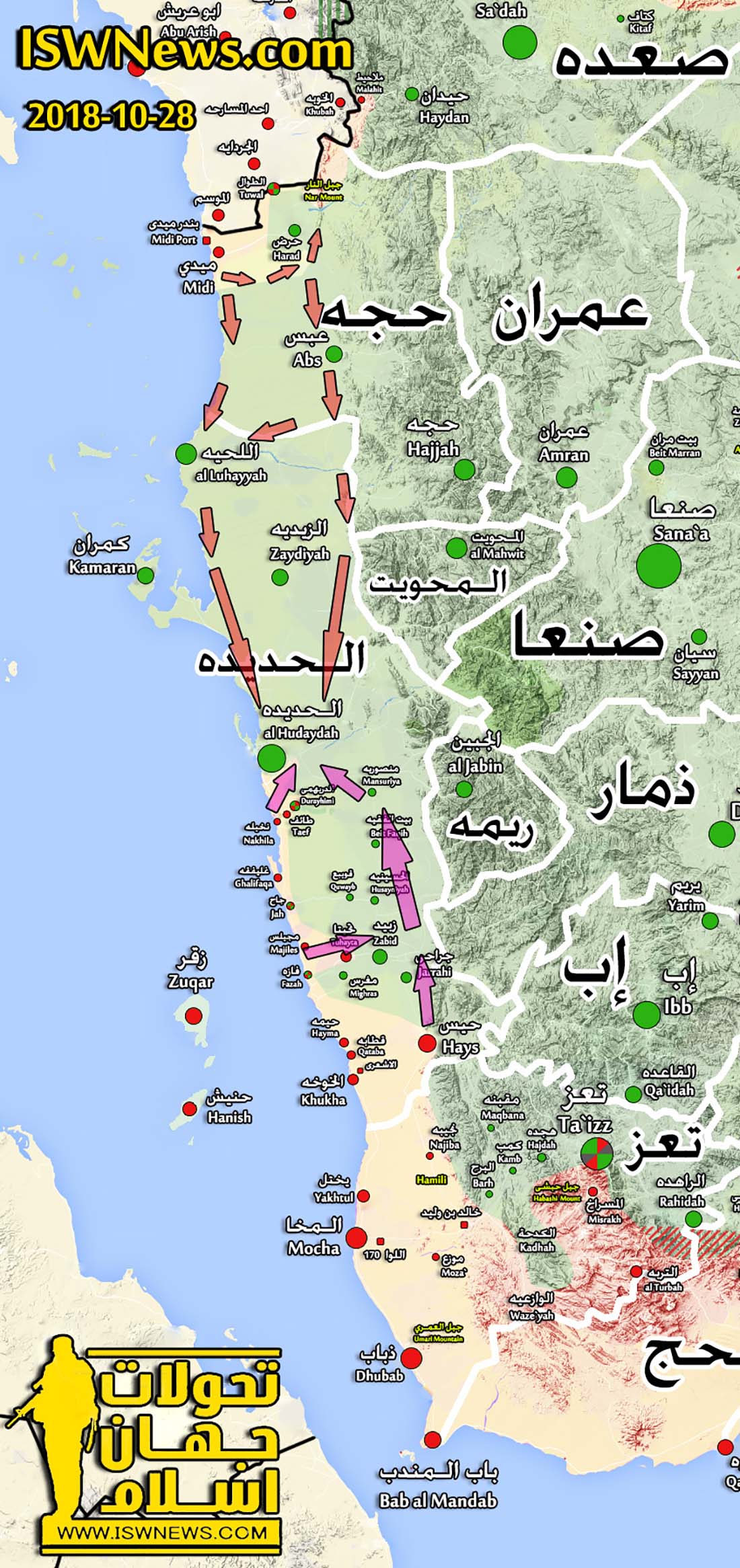
    1. South of al Hudaydah axis: (Purple arrow)
    Al Hudaydah operation was started by leadership of Emirates in west coast using three streams (militia following Tariq Saleh, Southern and local forces) which was defeated by AnsarAllah by opening numerous fronts along coastal strip and dummy attacks to drain their energy.

    After that Saudi using Mansoor Hadi’s forces in addition to current forces continued the operation with more strength.

    Occupying Bab al Mandeb-Zobab-Mocha-Khukha-Hays; was paved in a slow pace operation by Saudi Coalition and “Fazah-Majilis-Tuhayta” and some other points are added to the list.
    (We explained al Hudaydah operation aspect by Saudi Coalition also in this article:
    Discussion on Aspects of the Saudi Coalition Operation in al-Hudaydah).

    2. North of Hajjah axis: (Red arrow)

    In north of Hajjah, after fall of Midi and Hayran and northern borders, Haradh is almost under siege and Saudi Coalition arrow of attacks pointing Abas.

    According to the goal of cutting AnsarAllah’s access to sea, the Coalition forces are going to in three directions after occupying Midi and Hayran:

    1. To Haradh, 2. To Abas and then Ma’ras and then Zaydiyah and Zahra. 3. To Lahiya and then in coastal strip and finally reaching al Hudaydah.


    Conclusion:

    The joining point of the two operations is al Hudaydah city and the outcome is to cut AnsarAllah’s access to sea, thus AnsarAllah will resist with its highest power.

    Saudi Coalition attack from north which is Hajjah can shake AnsarAllah’s defense in al Hudaydah for several reasons and on the other side, AnsarAllah is trying to make the war longer and by using heat defense is trying to drain the Coalition budget and power, which is supported by US and Israel design and Emirates and Saudi money and company of hired governments.


    Download HD Map

  • Oil Exploitation in Yemen

    Oil Exploitation in Yemen

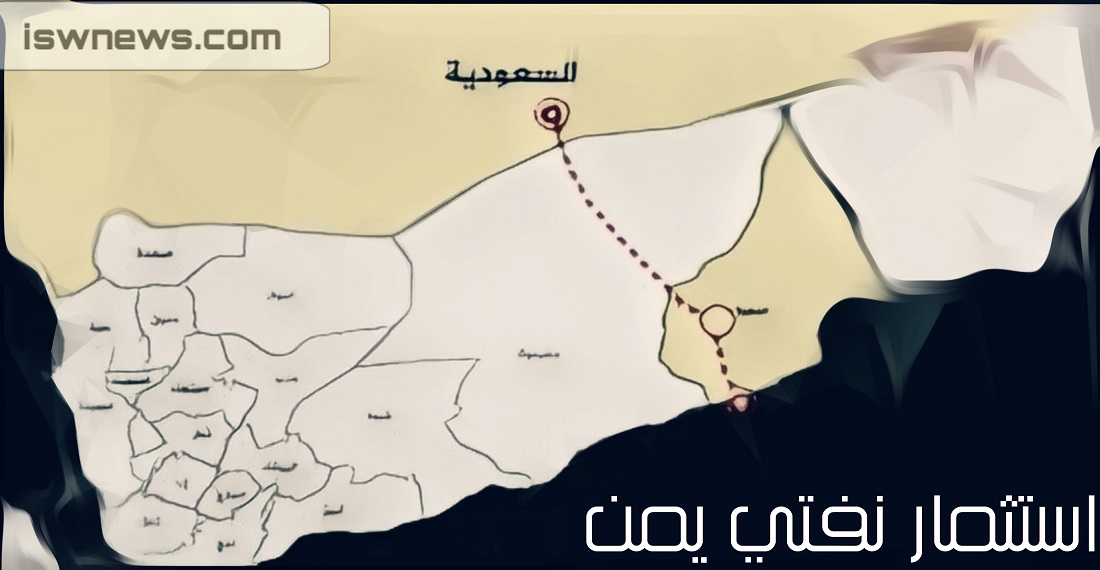
    These movements are part of Saudi and Emirates competition over oil and gas rich lands of south and east of Yemen and Saudi forces trying to occupy al Mahra governorate recently and building oil pipe from south of Saudi Arabia to Arab Sea and erecting a harbor in Mahra coast (Nashtun harbor).


    Saudi intends to turn Ghizah airport to a military airbase and change the demography of the governorate by settling Salafis similar to Dammaj Salafis in Sadaa governorate.


    Undoubtedly, Saudi’s primary target of this plan is to transport its own oil to coast of Arab Sea and avoid Hormuz and Bab al Mandab straits, which is its economy weakness, in addition to exploiting Yemeni oil and occupying east of Yemen.

    Now Emirates also wants its share from their alliance in Shabwah governorate and following Mansoor Hadi’s forces retreat, took control the strategic regions.


    Saudi and Emirates oil exploitation is basis for fall of a country which was once named Yemen

  • Discussion on Aspects of the Saudi Coalition Operation in al-Hudaydah

    Discussion on Aspects of the Saudi Coalition Operation in al-Hudaydah

    As we are witnessing in the last several years, taking over “Bab al Mandab-Dhubab-Mocha-Khukha-Hays” was a slow motion which Saudi coalition is doing on western shore of Yemen and now by attacking south of al Hudaydah, it begins a new phase.


    After previous articles (Monthly Report on Yemen’s developments 29 May 2018), the line of position of Saudi coalition in western shore is weak and vulnerable due to the narrow width and AnsarAllah’s attacks threaten it. (As this axis was under severe fire by AnsarAllah in recent days.)


    Therefore we discuss this operation from two possible plans:

    • Direct attack to al Hudaydah from south and sea.
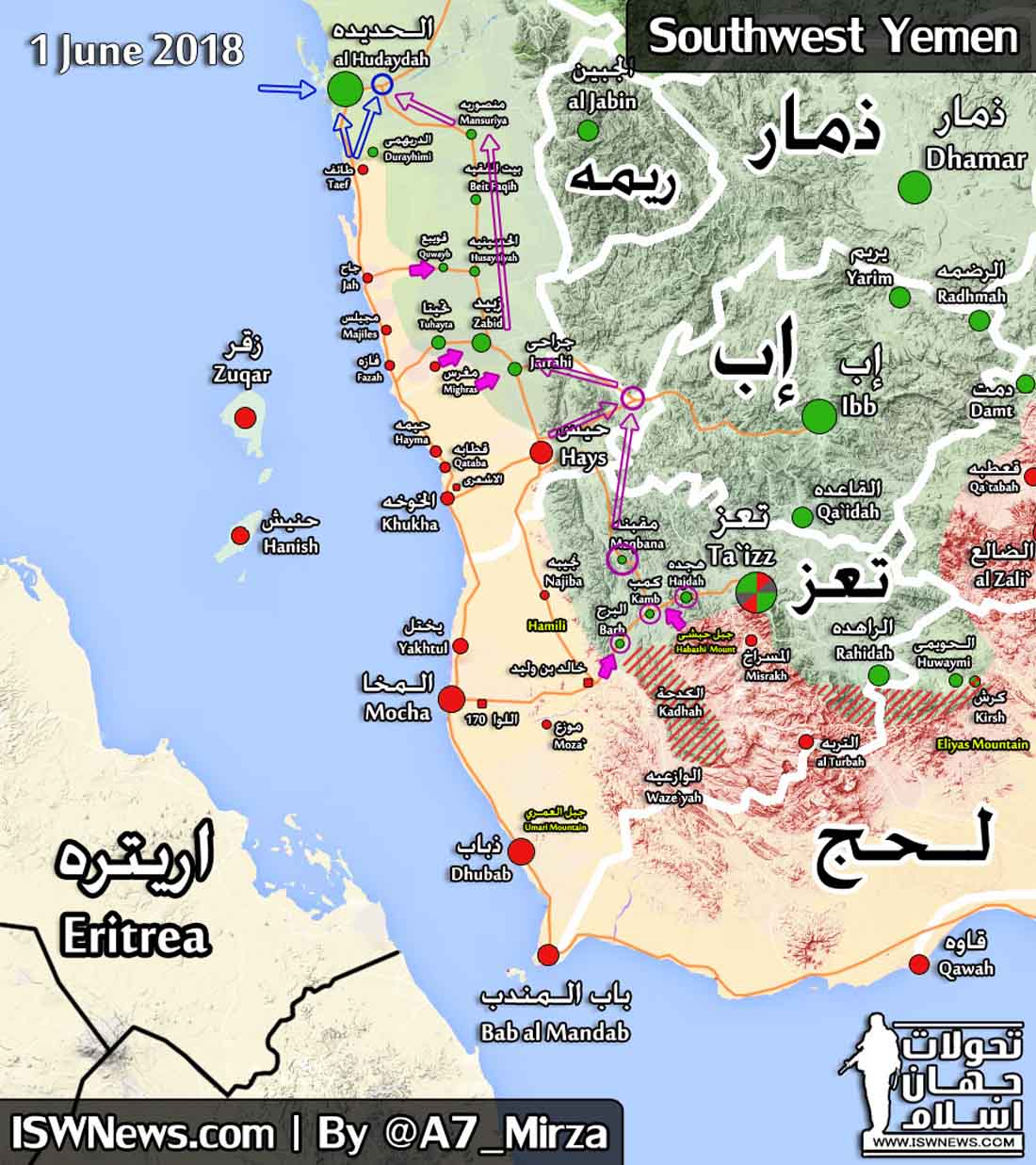
    • Defeating the “Jarahi-Zabid-Tuhayta” defense axis in south of al Hudaydah from Ta’izz and then attack to east and south of al Hudaydah.


    First plan:

    Possible targets (blue arrows): The first step is to capture Durayhimi, the secons is to attack al Hudaydah airport and at the same time the eastern road of al Hudaydah until the triple junction of “Mansuriah-Murawi`ah-al Hudaydah”, the third is to attack from land, sea and air to the city.


    Second plan:

    Possible targets (pink arrows): The first is to advance till Muqbana which provides defeating AnsarAllah’s defense line in Hajdah until Kamb and Barah, the second step is to attack to Jarahi and Tuhayta at the same time, the third is to coalesce fronts in Zabid and Husayniyah and then  Beit Faqih and Mansuriyah and the fourth is to cut the eastern road of al Hudaydah and attacking the city from all directions.


    Conclusion:

    At the moment, the first point of view due to time limit for the Coalition and the overall situation (from AnsarAllah persistence and …) is more likely to occur than the second point of view. Indeed the Alliance Operation room knows that defeating AnsarAllah defense in south of al Hudaydah is not easy so they need to open more fronts such as Ta’izz and north of al Hudaydah and etc.

    Moreover the coastal axis of the Coalition is not a reliable and safe for attacking to al Hudaydah and relying on it makes the Coalition to give casualties. From this point of view the second plan is considerable.

    Al Hudaydah has a great importance at the moment; For AnsarAllah it is the biggest base to reach the coast and for the Coalition is an edge of the triangle of (cutting AnsarAllah’s connection to sea, occupying Saada and Sanaa) to reach victory, and also a critical importance for Emirates since they believe al Hudaydah is a point to reach Sanaa and have a more quota in Yemen’s future.


    What is AnsarAllah’s reaction?

    Considering the recent talk of Yemeni Army Spokesperson regarding threatening Emirates and having enough power to reclaim lost lands such as Khukhah and Hays, anticipation of the reclaiming operation is not likely; but it is easy to predict teasing and missile attacks to western shores of Yemen and even Emirates.

    In the case of breaking the defense line in south of al Hudaydah, teasing and missile attacks and finally urban war is the sole trick of AnsarAllah to face and ground the Coalition.

    AnsarAllah’s overall strategy in al Hudaydah and in all fronts of Yemen is the same method which results in prolonged war and exhausting the Coalition; if occurs, the Saudi Coalition might retreats from those regions or at least prepares the situation for AnsarAllah and Yemeni Army to reclaim the lost lands.


    Map: Download


    If you’re able, and if you like our content and approach, please support the project. Our work wouldn’t be possible without your help:

    BTC: 1BvrWhL7UQQgv6BNwCiV56YMaMcxJy5T5A

    BCH: qpm7pgnypm0v070mh032s0vmgyl972zgk5atqtttnw

    ETH: 0x29722b2D6c64Bb1d83568d6a5026B02170E12460

  • Latest Updates on Yemen 18 & 19 April 2018; Saudi-led Coalition Operation for Al Hudaydah

    Latest Updates on Yemen 18 & 19 April 2018; Saudi-led Coalition Operation for Al Hudaydah

    1. Muhammad ali Houthi, chief of Yemen’s high council of revolution:
    “if Saudi coalition doesn’t stop the planning for the war on Hudayda, what our leader –Sayed Malik Houthi – announced is ready. They know our ability to respond, and with god’s will our military and political strategy will change”
    It’s been reported that the coalition led by Emirates is preparing an operation to occupy Hudayda. If coalition’s mission is successful in this axis (west of Yemen), Ansarullah and Yemeni fighters will be cut off from the sea and the ground blockade will be complete.


    2. Uganda’s foreign ministry denied talks between Emirate and Uganda for sending troops to Yemen. Recently Sudan faced problems for sending forces to Yemen and no longer can fulfill Saudi coalition’s expectations.


    3. Taking down an MQ9 drone (made in US) belonging to Saudi coalition in Hudayda by Yemen’s air defense.


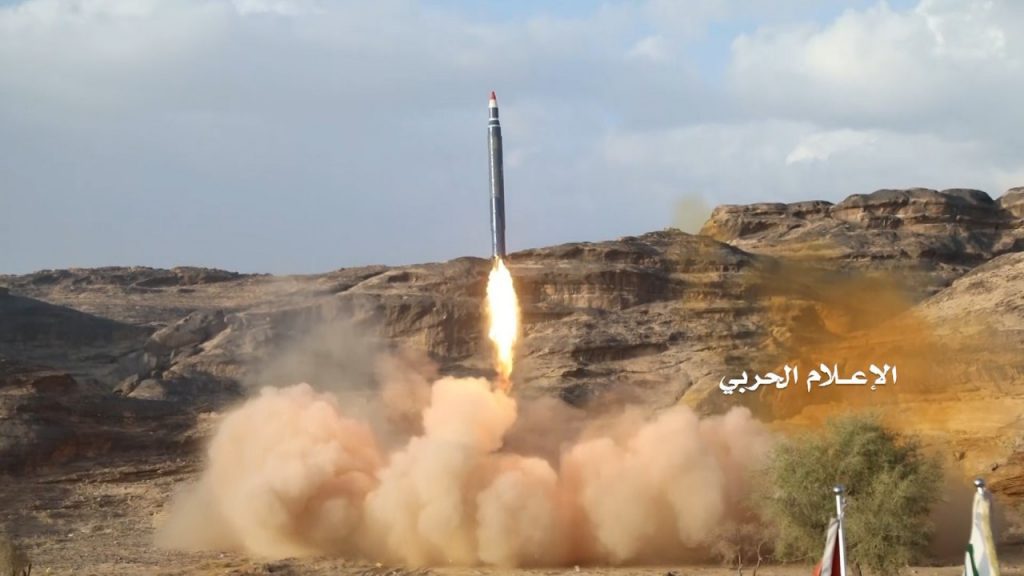
    4. Launching a Badr-1 missile to Jizan airport.


    5. Morocco called 6 of its F16s back to Morocco’s airports because of more severe civil war at home. while making no change in their position toward the Arab coalition, Morocco’s officials said it was due to the conflicts in Polisario.


    6. Yemeni army and popular committee fighters’ operation in al Maslub and al Maton districts going on with heavy clashes.