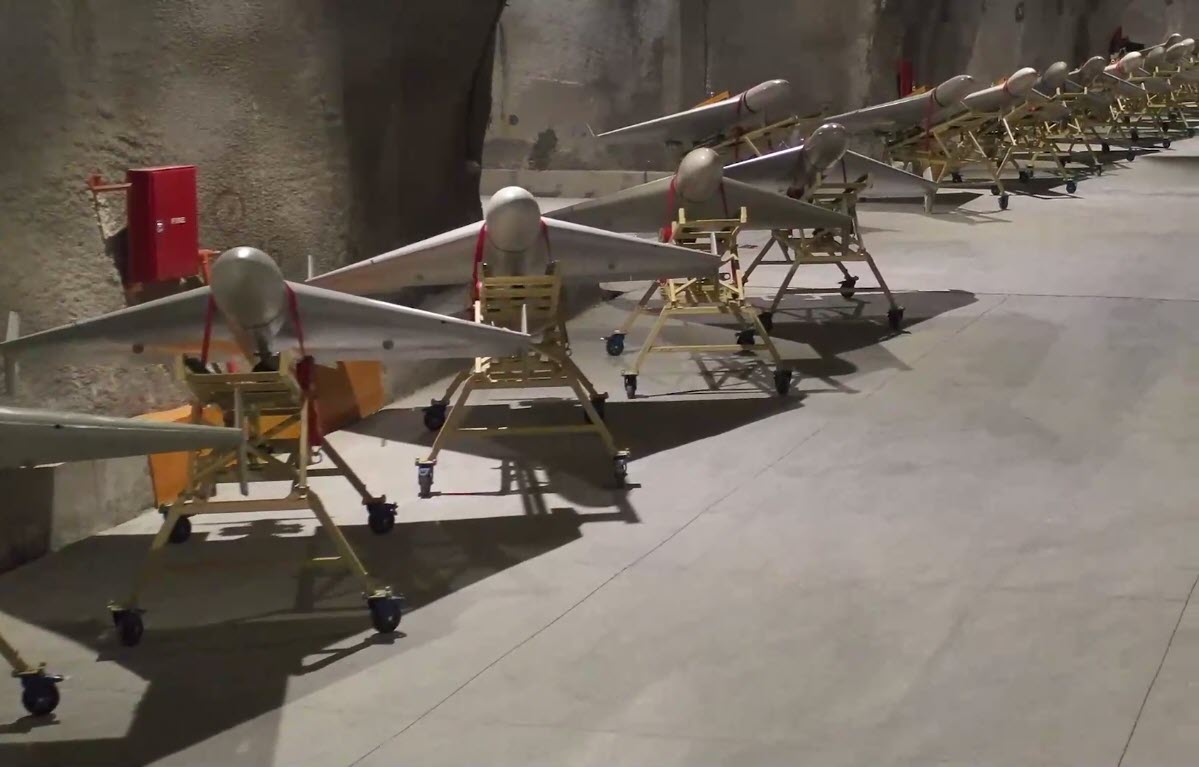
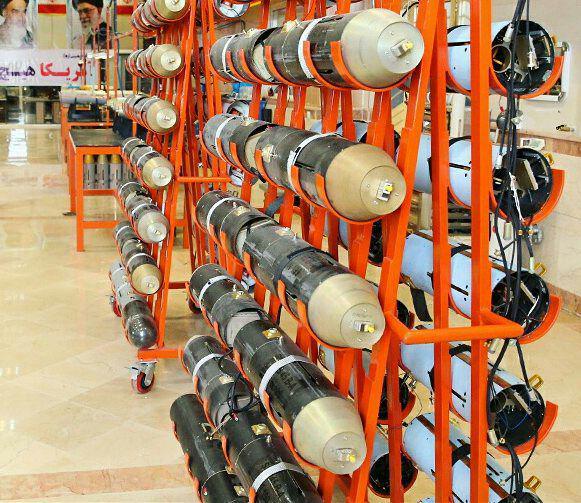
On the eve of “Revolutionary Guard’s Day” (Guardian’s Day), images of two underground missile and drone bases of the IRGC Aerospace Force were displayed in the presence of Major General Hossein Salami, IRGC Commander-in-Chief, Brigadier General Amir Ali Hajizadeh, IRGC Aerospace Force Commander and a number of other military commanders.
According to IRGC statement, these bases are built in the heart of the high mountains and house ground-to-ground missile systems with advanced equipment and attack drones. This is the first time that the IRGC Aerospace Force has unveiled its underground drone bases.
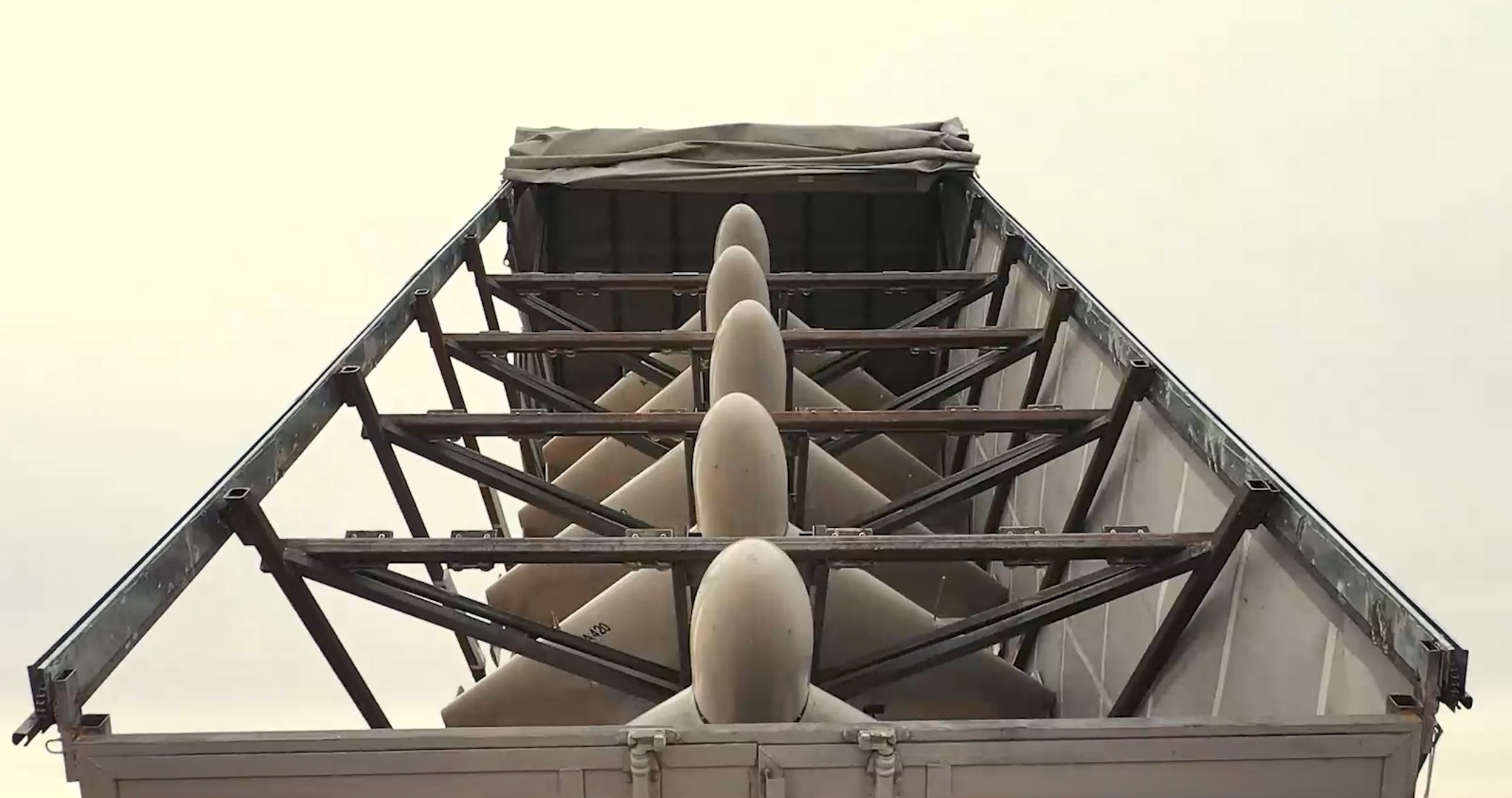
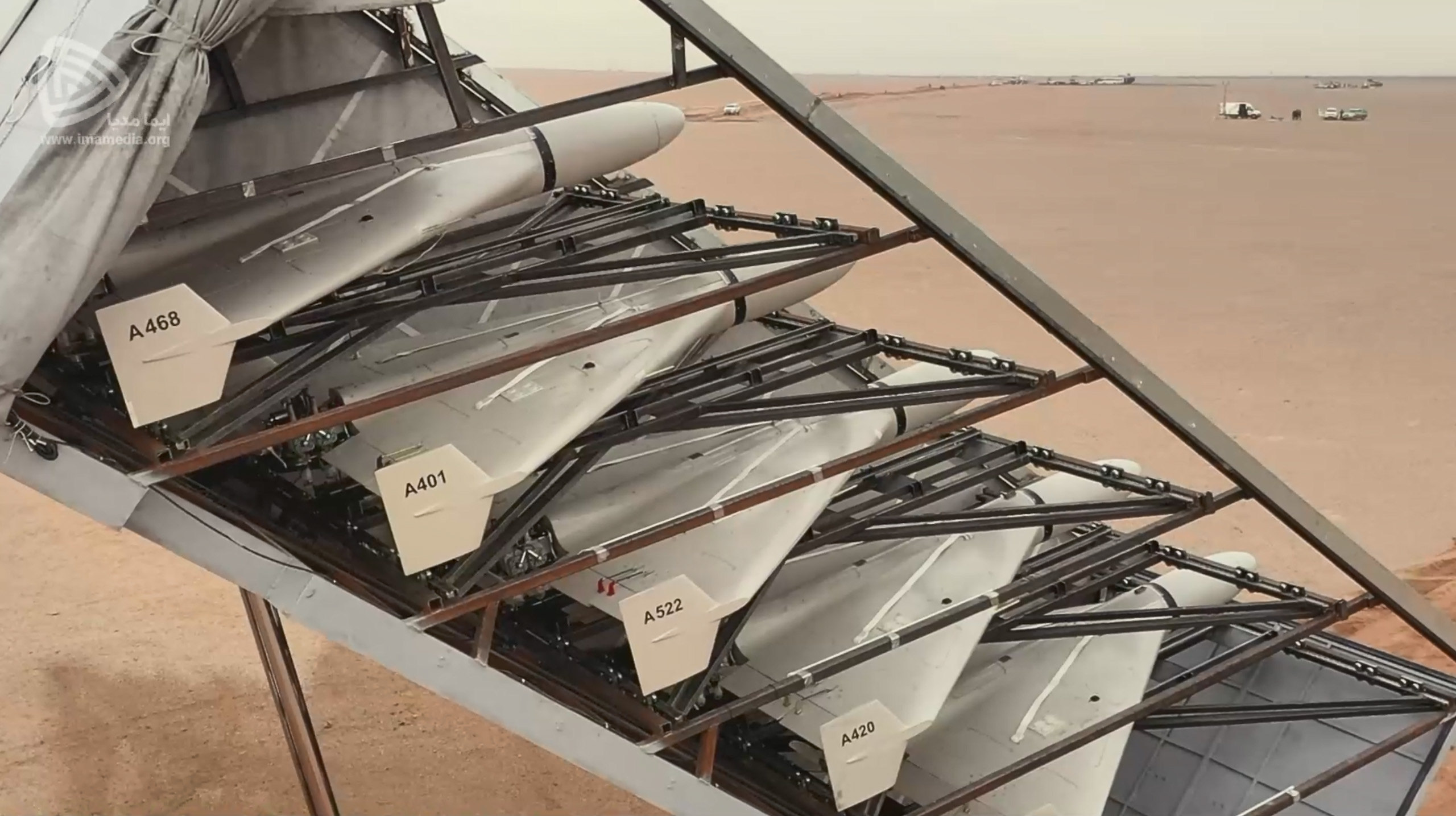
Commander of IRGC Aerospace Force stated: “Currently, we can launch 60 drones (swarm mode) from this base in a fraction of a second in the first wave. Because the range of these drones is extended and not limited; We have no target limitations and we can hit any hostile target at any range” Brigadier General Amir Ali Hajizadeh emphasized: “Our missile and simultaneous firing power has increased more than 6 to 7 times, and the preparation time for firing have been greatly reduced.”
Video released from IRGC underground tunnels – contains old footages of ‘Great Prophet 17’ exercise (PBUH)
In the ‘Great Prophet (PBUH) 17‘ exercise for the first time, close-up images of Shahed-136 suicide drone and its performance were shown publicly. As part of the exercise, Shahed-136 suicide drones launched from a pod or a rack with five launcher, hitting its targets with exemplary accuracy. This phenomenon attracted many comments but where does this high accuracy come from?
In some parts of the video released from the exercise in some frames, it seems that the color and amount of light reflection from the nose of the drone is different from the body, which can indicate the use of an infrared nose (IR Dome).
Footage of the performance of Shahed-136 drone in the Great Prophet (PBUH) 17 exercise
Due to the fact that the nose color is milky in color, it seems that ZnS sulfide (without applying hot isostatic pressing process) or magnesium fluoride is used in the manufacturing process to reduce the manufacturing cost. These materials are capable of transmitting infrared spectrum and largely absorb the visible spectrum. This feature could mean using a standard camera sensor that detects only the near-infrared (NIR) spectrum by absorbing the visible light spectrum through the infrared nose. (Visible camera sensors have the ability to detect near-infrared spectrum)
Considering the defense policies of the Iranian Armed Forces, weapons such as suicide drones should be as low-cost as possible, and using conventional/standard camera sensors instead of expensive infrared sensors is fully consistent with this strategy. Of course, it is possible to use infrared sensors in the MWIR and SWIR spectrum for night operations, and radar nest detectors for suppression operations of enemy defence systems.
Also, it is noteworthy that some sources, by examining the progress of infrared air-to-air missiles and examining their infrared nose, have rejected the use of infrared nose in Shahed-136. Because in the infrared imaging models of heat-finding missiles, a transparent nose is used. However, with the some more deep studies performed, it was revealed and confirmed that in the electro-optical system of Iranian Shahed-149 drone, a milky infrared nose has been used, which indicates that these noses can be used even for imaging sensors. Therefore, the idea of using an infrared nose for the Shahed-136 is still valid.
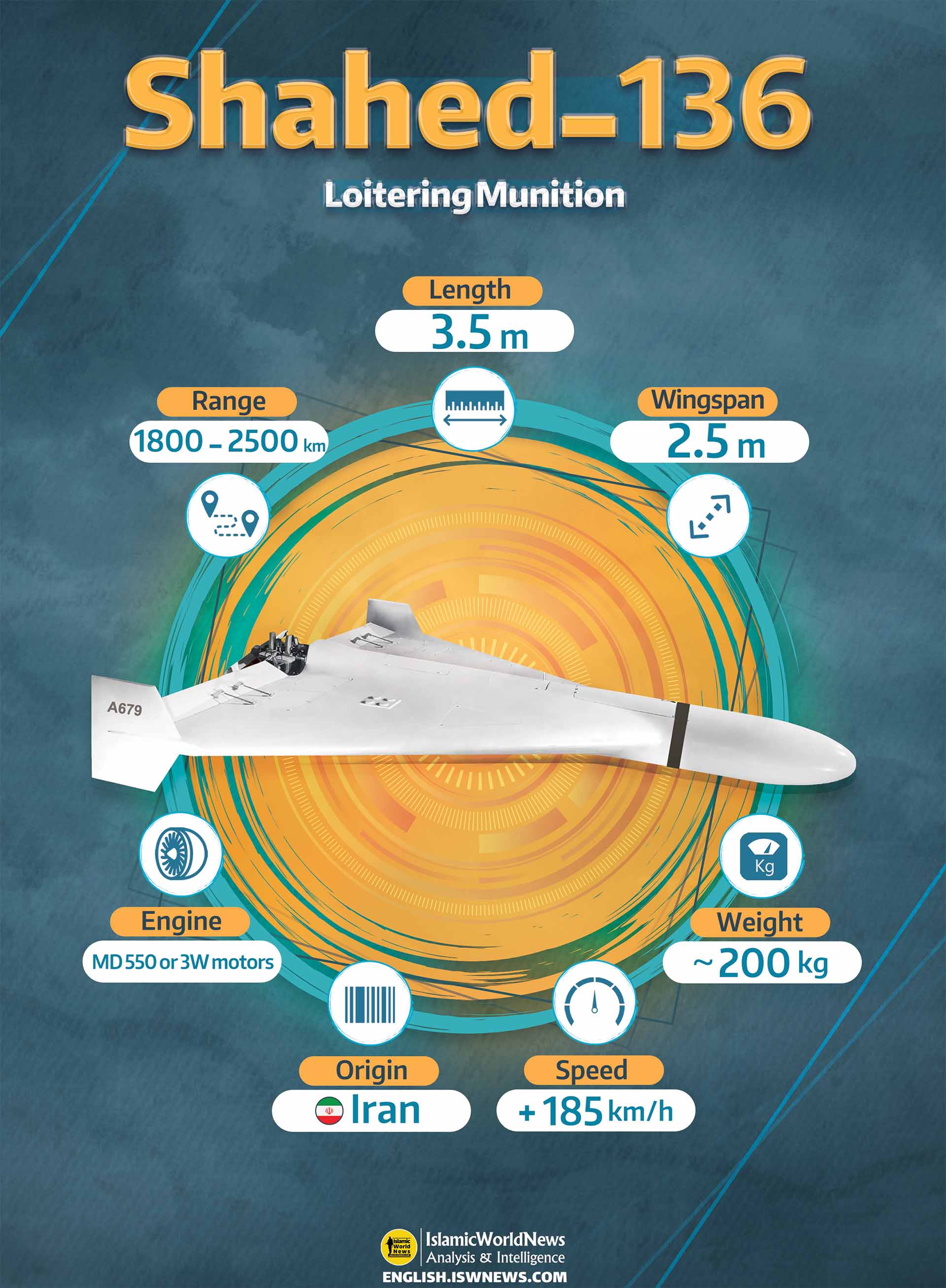
Shahed-136 suicide drone specifications: Length: 3.5 m Wingspan: 2.5 m Range: 1800 – 2500 km Weight: ~ 200 kg Speed: + 185 km/h Engine: MD 550 or 3W motors Origin: Iran
Shahed-136 suicide drone – click to view full size
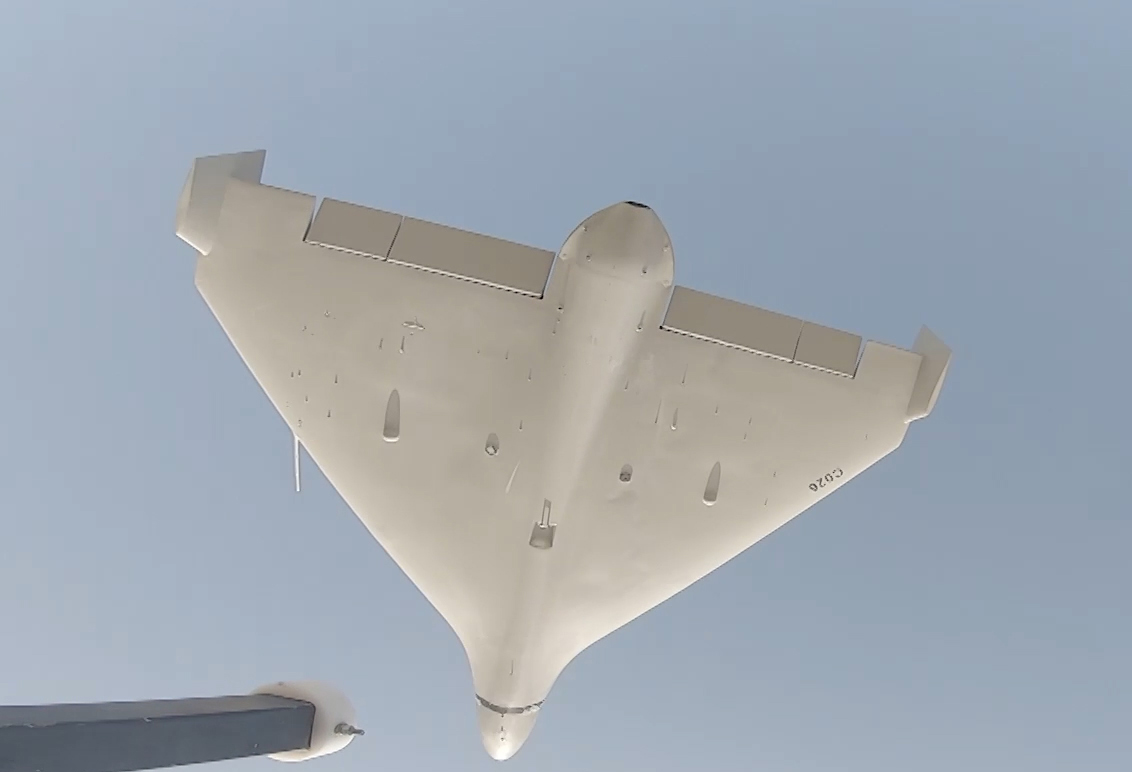
The new version of the Shahed-136 suicide drone equipped with a jet engine
The new version of Shahed-136 suicide drone, which was unveiled recently, is equipped with a mini turbojet engine and has a higher speed and less noise than the basic version of Shahed-136. This new version was first unveiled in an Iranian documentary in October 2023 and is now known as Shahed-238.
A screen grab of the new version of the Shahed-136 suicide drone equipped with a micro-turbojet engine
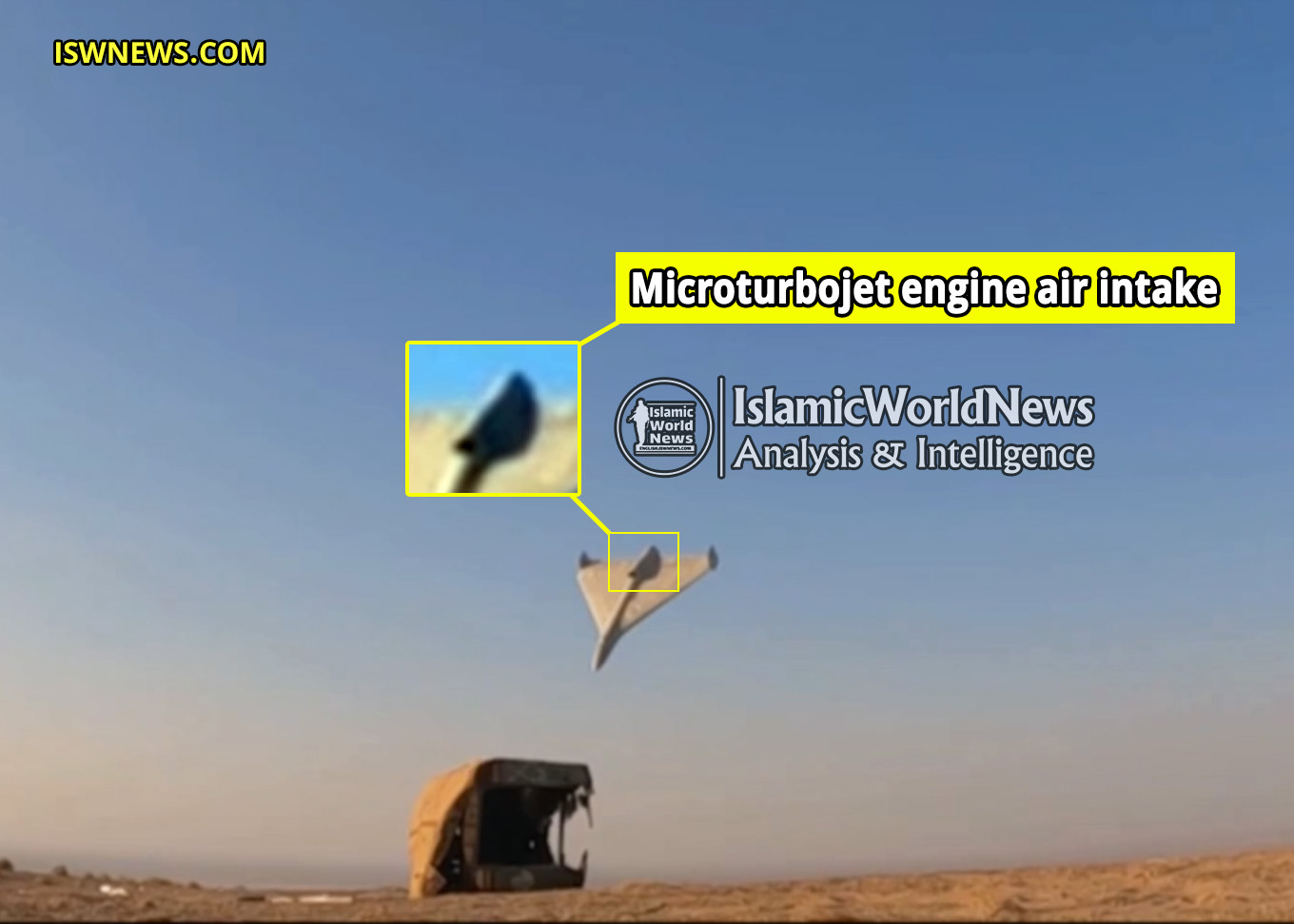
The Shahed-136, despite its low radar cross-section (RCS), due to its piston engine, low speed, and distinctive loud noise, provided the enemy’s air defense systems and even ground forces with enough time to identify it. However, the use of a turbojet engine in the Shahed-238, while increasing the speed and reducing the noise, along with the drone’s specialized airframe, provides much better protection against heavy machine guns and anti-aircraft cannon, improving the overall success rate of the drone.
Air intake of the micro-turbojet engine in the new version of the Shahed-136 drone
The increase in the speed of the UAV and its very low cross-sectional area make this UAV practically a more dangerous version than the previous one, and the air defense systems that previously had problems in intercepting the Shahed-136, become more vulnerable to this new suicide drone.
More images of the Shahed-136 drone:
Click to view full size
Shahed-136 Loitering Munition posters in Persian, Arabic, Kurdish, Azeri, Russian for Social Media:
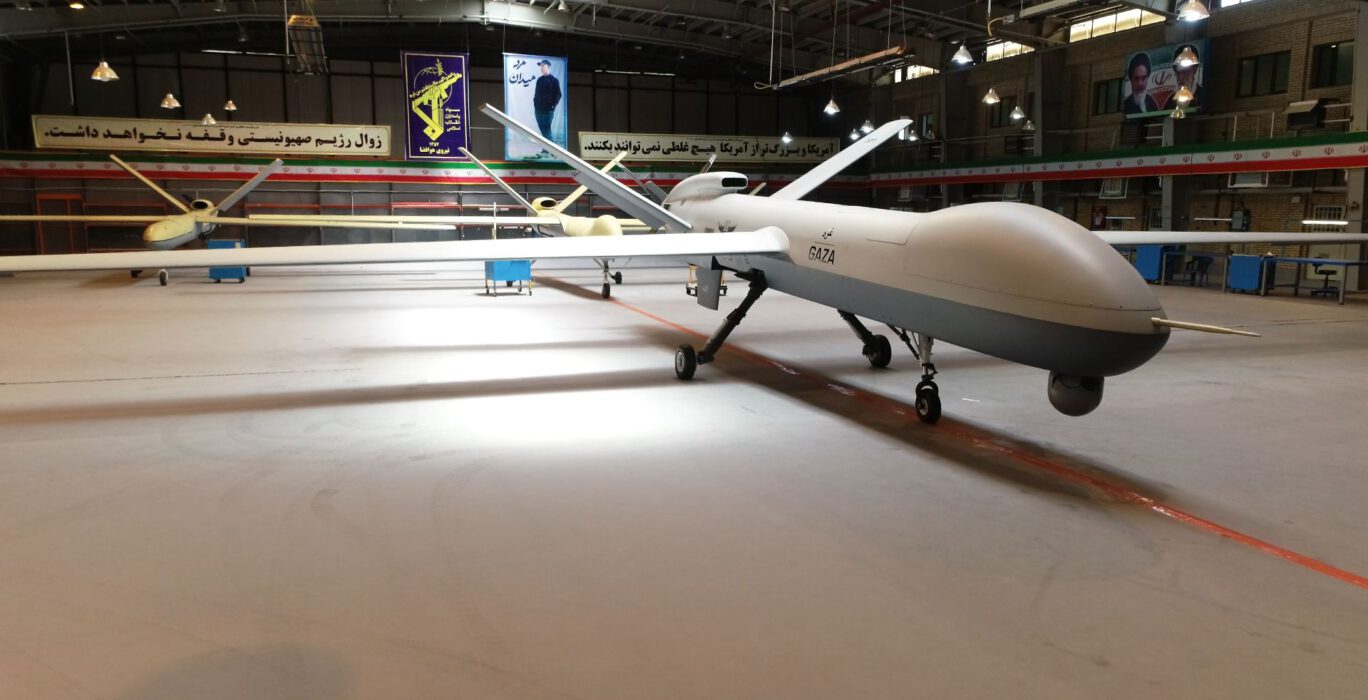
According to the published images, it seems that the Gaza drone uses the Rotary Bomb Launcher mechanism under its fuselage, which can carry up to 5 bombs. This is the first Iranian drone to use this mechanism. 8 bombs are also installed under the wings and in total this drone is capable of carrying 13 bombs.
In this ceremony, which was held in the presence of Major General “Hossein Salami”, Commander of the Islamic Revolutionary Guard Corps and General “Amir Ali Hajizadeh”, Commander of the IRGC Aerospace Force, “Gaza” reconnaissance combat drone, “9 Dey” missile and “Quds” radar system Unveiled.
Regarding the name of the Gaza drone, Major General Salami said, “We named this drone Gaza so that, God willing, it will be an eternal honor for those in Gaza who are resisting the Zionist aggression today.”
The Gaza drone, capable of carrying 13 bombs and 500 kilograms of equipment, as well as 35 hours of flight up to a radius of 2,000 kilometers, is capable of carrying out various combat and intelligence operations. The drone is also used in forest surveillance operations and natural disaster relief.
The defense system equipped with 9-Dey missile also has the ability to engage and destroy a variety of threats at close range, including cruise missiles and drones.
The Quds radar system is also capable of detecting low-altitude targets such as cruise missiles, helicopters and drones. This system has high agility and fast deployment and relocation in the required location is another feature of this system.
Unveiling ceremony of new and advanced weapons of the Islamic Revolutionary Guard Corps
“Kaman 22” is a new reconnaissance combat drone of the Iranian Air Force, equipped with various combat, optical and electronic warfare systems. This drone has the ability to identify, monitor and collect information and photograph distant targets and is designed based on the operational needs of the Iranian Air Force and is in the final stages of production.
The Kaman 22 drone with a range of 3,000 km and a 24-hour flight duration and carrying a variety of smart ammunition will bring a high combat capability to the Iranian army.
The Kaman 22 drone uses a design almost identical to the US MQ-9B drone and has seven pylons for carrying weapons, with six pylons under the two wings and one pylon under the fuselage.
In the position under the wing, four Qaem smart bomb, two unidentified glider bombs and below the fuselage an electronic warfare pod can be seen. Next to the drone is the Sattar-4 laser guidance bomb and the Shahin electronic warfare pod (AN / ALQ-101).
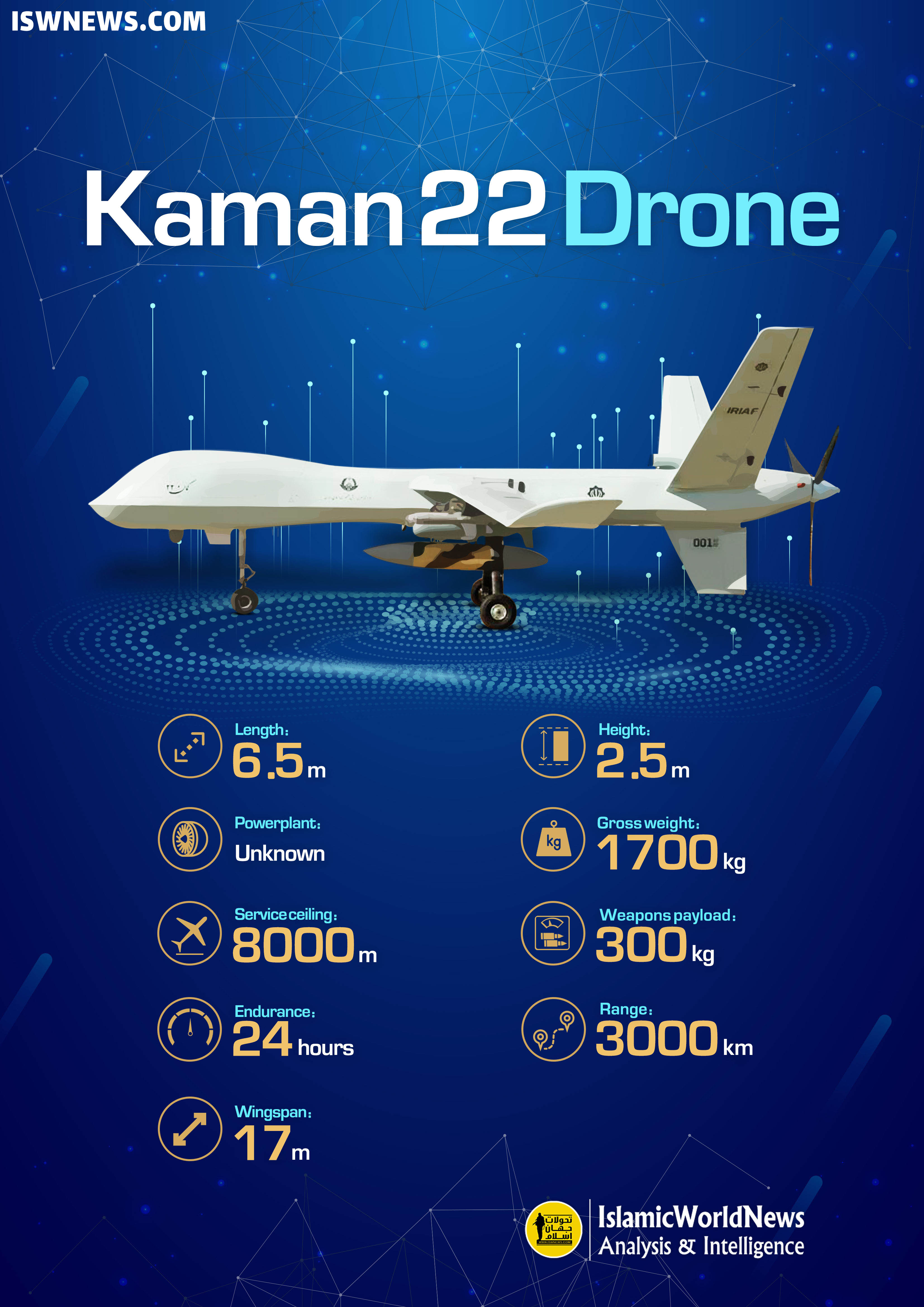
Specifications: Length: 6.5 m Wingspan: 17 m Height: 2.5 m Gross weight: 1,700 kg Powerplant: Unknown Service ceiling: 8,000 m Weapons payload: 300 kg Range: 3,000 km Endurance: 24 hours
Iran’s Air Force commander visiting ‘Kaman 22 project’ said: This drone is armed with weapons, optical and ECM pods and is about to finish the production phase.
It is the first wide body drone of Iran and has a flight duration of 24 hours and range of more than 3,000 km. It can carry 300 kg of payload. This drone resembles American drone MQ-9.
General Nasirzadeh said recently that Iran’s Air Force used this drone to control and guide the drill fields lately.
The previous model of Kaman, i.e., Kaman 12, was unveiled in 2018 which has a flight duration of 10 hours and range of 1,000 km. It was used in Iran’s army drill last year to control and observe the drill area.
#Iran Air Force unveiled a new reconnaissance combat drone ‘Kaman-22’ for the first time. This drones has the ability to carry out the long range operations with capability of carrying a variety of smart ammunitions. pic.twitter.com/mnvoDTlqTZ
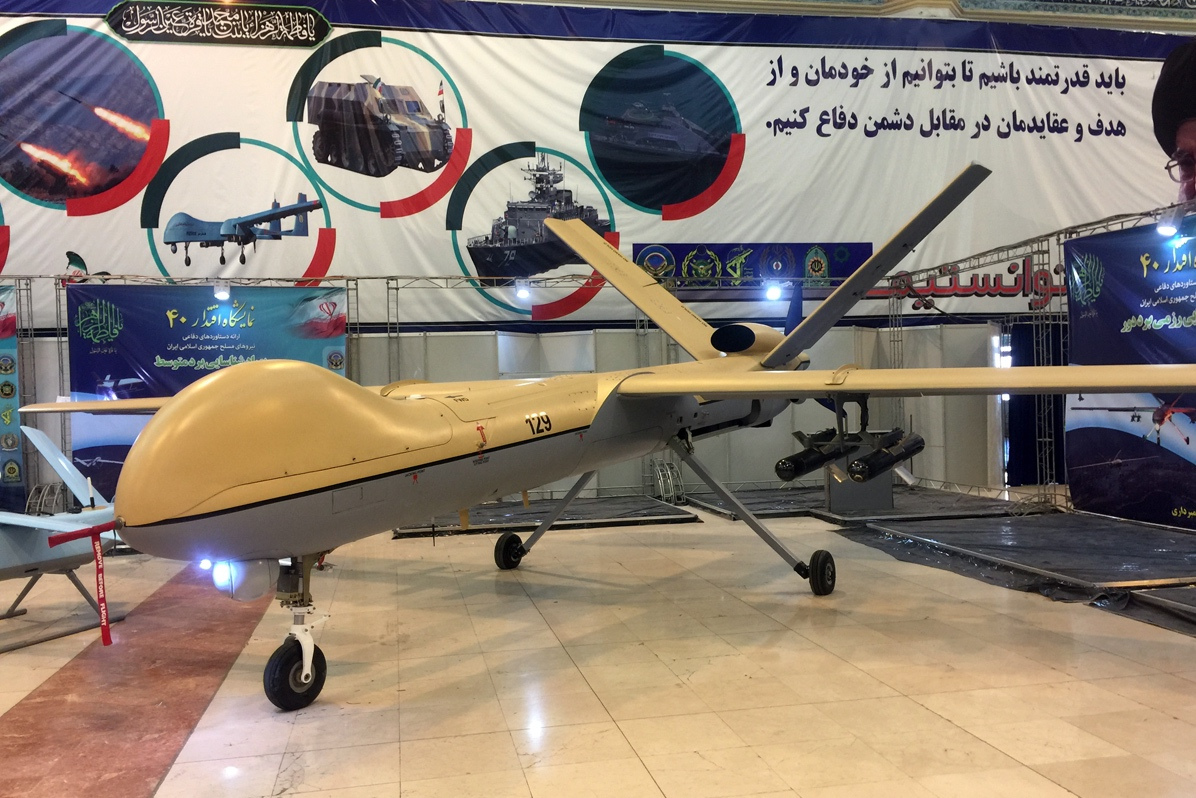
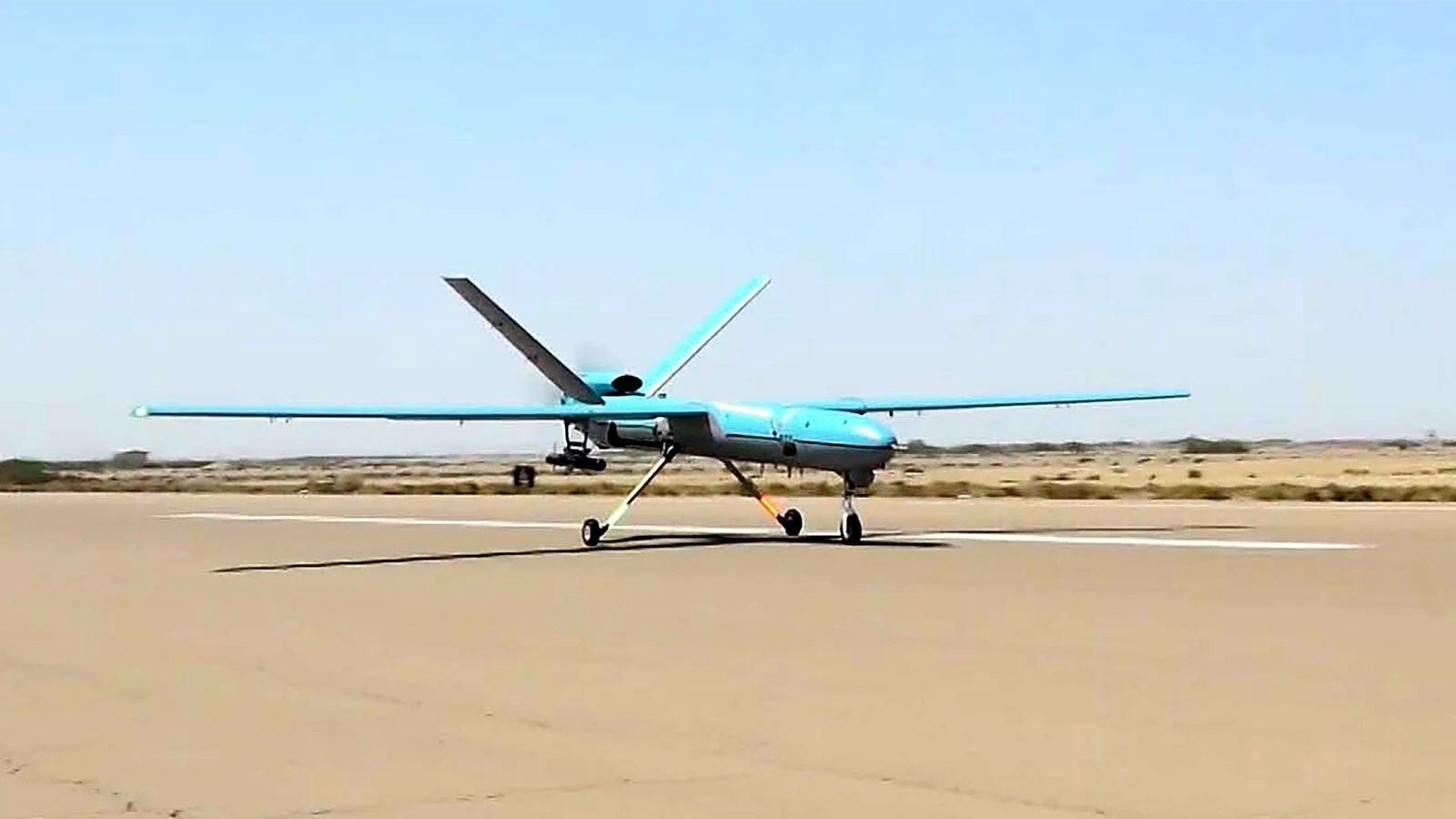
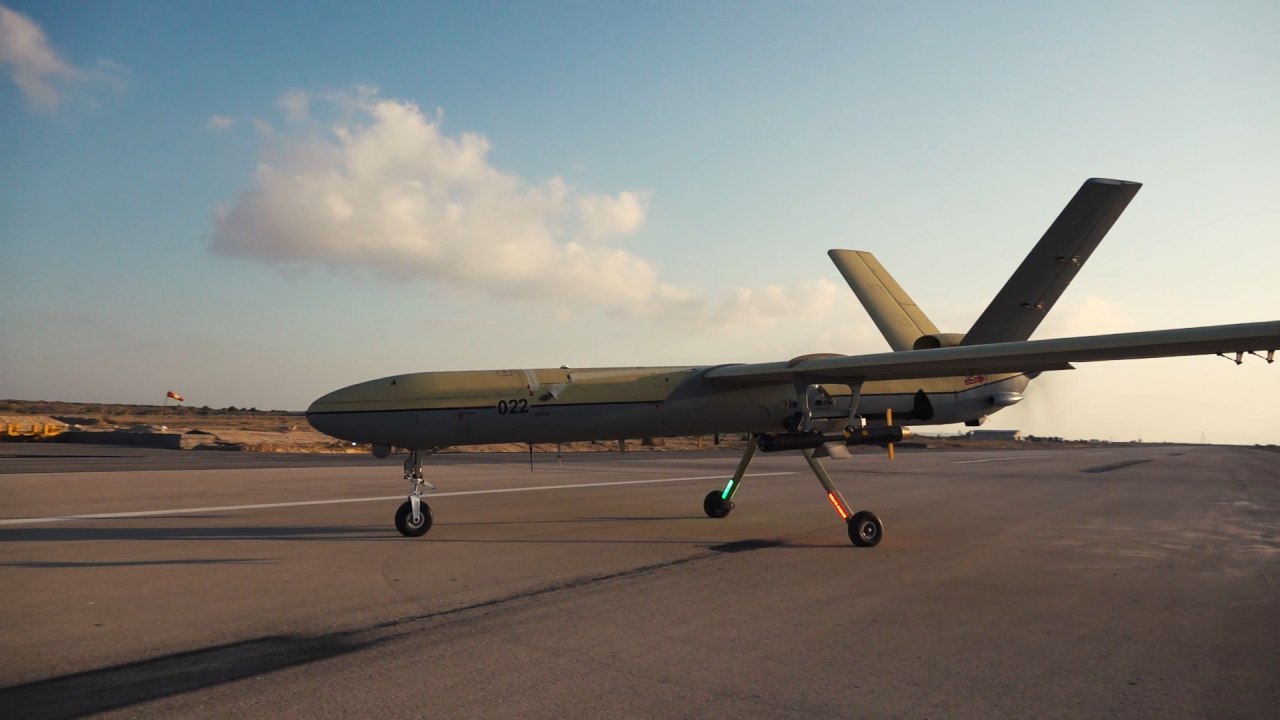
According to Major General Mohammad Ali Jafari, former commander-in-chief of the Iranian Revolutionary Guard Corps (IRGC), Shahed 129 performs reconnaissance and combat operations with a 24hr endurance and combat range of 1,700 km.
The control and guidance of this drone is done by fixed or mobile ground control station. Using a mobile control station that can be installed on a trailer or truck increases the useful and effective range of Shahed 129. Also, a version of this drone is equipped with a satellite guidance system.
Shahed 129 UCAV can use a wide range of bombs and missiles that are optimized for use in UAVs, however, Sadid bombs and missiles are mainly used for the Shahed 129. Sadid is the name of a family of Iranian guided bombs and missiles, designed and produced by the Iranian Revolutionary Guard Corps Aerospace Force. So far, various types of Sadid bombs and missiles have been developed by the IRGC.
Shahed-129 drone can carry eight bombs or four missiles. By installing Sadid guided bombs and missiles on this drone, the Shahed 129 drone can hit the desired targets in its operational area with the highest possible accuracy.
Images of some variants of Sadid guided bombs and missile family
This UCAV is powered by a Rotax914 turboprop engine and has a flight ceiling of up to 7300 meters.
The Shahed-129 drone has been widely used by Iran and its allies in the battles of Syria and Iraq against Al-Qaeda and ISIS terrorists, and has a very brilliant but little-known operational history. Shahed 129 drones have so far carried out more than 1000 successful operations in Iraq and Syria.
Shahed 129 in action
In February 2016, a new version of Shahed 129 was showcased, which was different from the previous Shahed129 drones. In this variant, there is an arc shape in the nose of the UAV, which is usually used in other drones as a place for the satellite antenna. Therefore, based on the information provided by General Hajizadeh, the commander of IRGC Aerospace Force, it can be said that this drone is equipped with a satellite guidance system, and this potentially increases the range and operational capabilities of the Shahed-129 drone. Of course, at the time of the unveiling of this new type, Iran did not have a special military satellite to use this capability and exclusively guide Shahed 129 by a satellite. But it seems that this capability has been designed and implemented with foresight and forecasting the developments of the aerospace industry of the Iranian Armed Forces for the near future. Also, this capability allows Iran’s allies to benefit from its satellite guidance capabilities if this special variant is purchased and used.
The new variant of Shahed 129 drone equipped with satellite guidance system
It is also worth mentioning that in December 2019, the first marine variant of this drone, known as the Simorgh drone, was handed over to the Islamic Republic of Iran’s naval forces. This drone has been specially built and optimized for use in the Iranian Navy units.
Marine type of Shahed 129 UAV named Simorgh UAV
Shahed 129 drone specifications: – Combat range: 1,700 km – Endurance: 24 hour – Ceiling: 7,300 m (24,000 ft) – Speed: 150 to 200 km – Length: 8 m, Wingspan: 16 m – Armament: 8 bombs or 4 missiles – Weapon payload: Up to 400 kg – Mission: Combat / Intelligence / Surveillance / Reconnaissance (CISR) – Manufacturer: Iran Aviation Industries Organization (IAIO), Iran Aircraft Manufacturing Industrial Company (HESA)
Click to view full sizeClick to view full size
Shahed-129 posters in English, Arabic (شاهد 129), Russian (Шахед 129), Azeri (Şahid 129), Kurdish (شاهێد 129), Hebrew (שאהד 129) and Chinese (沙赫德 129) for publication on social media:
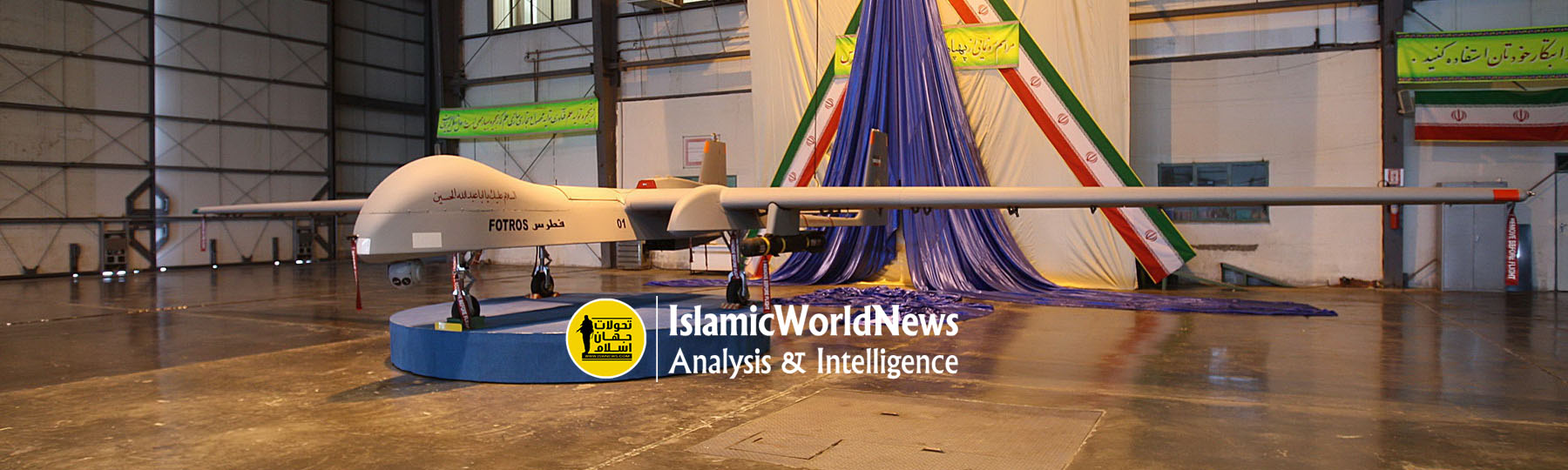
Fotros drone is an Iranian reconnaissance, surveillance and combat unmanned aerial vehicle built by Iran Aviation Industries Organization (under Iranian Defense Ministry), that was unveiled in memorial of liberation the Susangerd with the presence of Gen. Dehghan the former defense minister and Brigadier Gen. Hatami former defense minister deputy, in the defense ministry factories in Isfahan on November 2013.
Fotros specifications: Range: 2,000 km Flight duration: 30 hours Flight height: 7,600 m (25,000 feet) Speed: 150-250 km/h Lenght: 9 m Wingspan: 16 m Weapons: Two hardpoints Mission: Reconnaissance, surveillance and combat Origin: Iran
On 26 April 2019, the IRGC Ground Force’s Drone Division Colonel Akbar Karimloo said his forces will be receiving the Fotros drone from the Defense Ministry in the near future, and said that we are seriously checking the various items and parameters of Fotros drone, and the IRGC Ground Force’s Drone Division has decided to utilize Fotros in operational zones.
So, the IRGC Ground Forces are the first formal customer of the largest Iranian drone.
Click to view the full sizeClick to view the full size