Tag: Russia

  • Large Russian logistical convoy en route to Ain Issa

    Large Russian logistical convoy en route to Ain Issa

    The Russian convoy consists of 55 military vehicles, 200 Russian military police, electronic equipment and jamming systems. The convoy entered the city of Tabqah, which is controlled by the Syrian Democratic Forces (SDF), and will soon move towards Syrian Army positions in the Ain Issa area.

    Also on Monday, Russian forces sent reinforcements from their base in the city of Tal Tamar to the 93rd Brigade of the Syrian Army, located south of the town of Ain Issa.

  • Hezbollah committee visits Russia

    Hezbollah committee visits Russia

    The committee met with Lebanese ambassador the first thing. This trip takes three days and the Hezbollah delegation is scheduled to meet with officials from the Russian Foreign Ministry, the Federal Council and the Russian Duma.

    The committee met with Iranian ambassador and appreciated Islamic Republic helps and supports for Lebanese Resistance.

    Hezbollah’s delegation to Russia includes Ammar Mousavi, Hezbollah’s head of Arab and international relations, his deputy, Ahmad Mohana, and Hezbollah media adviser Ahmad Haj Ali.

    The main reason of inviting a committee of Hezbollah to Russia has not been stated but since both fight in the same front in Syria against terrorism and Russia’s stance against Zionist Regime violation of Lebanon’s air and maritime borders and political and financial crises in Lebanon, the key points can be talks over the regional incidents, lack of new government in Lebanon, Syria battle, preventing tension between Lebanon and Israel and expanding bilateral relations.
    In the meeting between the committee and Russia’s FM, Sergey Lavrov, forming the government in Lebanon, regional incidents and fighting terrorism were covered.

    Hebrew papers Yedioth Ahronoth claimed that Gabi Ashkenazi, Zionist Regime FM, will meet Lavrov in Moscow on Tuesday.

  • Russian Army helicopter crashed in Hasakah

    Russian Army helicopter crashed in Hasakah

    According to local reports, the pilot of the helicopter was killed and other crews were injured.

    However, the Russian Ministry of Defense denied any casualties. In response to the news circulating, the Russian Ministry of Defense confirmed in its statement that all the cabin crew members are alive, adding that they have been taken to the airport immediately and that there is no danger to their lives.

  • Russia’s security operation in Muslim inhabiting areas in north of Caucasus

    Russia’s security operation in Muslim inhabiting areas in north of Caucasus

    Investigating residents of these people and a hidden warehouse revealed 40 books and magazines belonging to Jihadi groups, several automatic weapons, handmade bombs, 3 kg TNT and one suicide belt. The operation is still continuing.

    Takfir wal-Hijra group, whose activities were banned by Russia’s court in 2010, is accused of collaborating with Salafi terrorist ISIS.

    This group had a financial network between 2015-2019 in Republic of Tatarstan for charity that was used to financing ISIS, according to officials.
    Russian Federal Security Service and Ministry of Finance collaborated to stop the group’s activities and its members were arrested.

    Salafi Jihadi groups activities in Muslim inhabiting areas of Russia specially in Caucasus have been always spotted and every year several operations are launched to fight them back.
    After USSR dissociation and attempt of several autonomous regions to be independence of Russia, Salafi terrorist Al Qaeda groups entered northern Caucasus under financial and arm support of Saudi Arabia of which Chechen war is an example. Al Qaeda entered war with Russia while recruiting from Russian Muslims and after Russians learnt about their idealogy, they formed their own Salafi Jihadi groups. It can be said Salafism is a revolutionary idealogy for independence and that is the attractive aspect of this movement.

  • Russia-Turkey talks on Ain Issa and SDF opposition

    Russia-Turkey talks on Ain Issa and SDF opposition

    During the meeting, the Turkish delegation strongly called for the withdrawal of Syrian Democratic Forces (SDF) from the city of Ain Issa, stating that this is the only way to stop the clashes in the Ain Issa area. However, the Turks have promised the Russian side that the clashes will be temporarily suspended until the SDF decides on this.

    On the other hand, the Syrian Democratic Forces (SDF) refuse to accept this and they are not willing to leave the town of Ain Issa.

    In recent weeks, clashes and tensions in the Ain Issa area have reached their peak; The clashes are unprecedented since the end of Turkish Peace Spring Operation east of the Euphrates. Tensions and military operations by Turkish militants to advance in the region escalated to the point that the SDF was eventually forced to call for help from the Russian military police and Syrian army forces to prevent Turkish militants from advancing on Ain Issa.

    It is worth mentioning that the Syrian and Russian army forces were present in a number of posts along the M4 route and around the town of Ain Issa in the past, but the control of this town is in the hands of the SDF.

    Now, with the arrival of the Russian military police and the Syrian army in Ain Issa and the establishment of several new military posts in the region, tensions have eased but this is not enough.

    The Syrian Democratic Forces, led by Shahin Jilo, a well-known PKK commander, on the one hand has called on Russia and Syria to help SDF against the Turkish army attacks, but on the other hand, he opposes the withdrawal of SDF from the Ain Issa. This has happened many times in the past in northern Syria, and the SDF has tasted defeat every time.

    In the Afrin region, the SDF, which now leads the Syrian Kurds, refused to hand over Afrin to the Syrian and Russian armies to prevent the Turkish army operation in the area, and not just lost the Afrin, rather, a large area in the northwest of Aleppo province was occupied by Turkey.

    and SDF after loosing a large areas of northeastern Syria to Turkey and its militants, finally was forced to call for help from the Syrian and Russian armies. Although this procrastination led to the loss of large areas east of the Euphrates…

    Now, in the case of Ain Issa, the SDF repeats the same mistake of Afrin and refuses to surrender the town to the Syrian army.

    It seems that the Syrian Democratic Forces, given that they are fully supported by the United States militarily and politically and are the tool of the US military in Syria, instead of focusing on the interests of Syria, pursue US goals in Syria and then their ethnic goals. It is too simplistic to assume that the SDF does not realize this and repeats a mistake several times; Rather, this is happening deliberately, and they prefer that the Syrian territories be occupied by Turkey but not controlled by the Syrian army.

  • Establishment of a joint Turkish-Russian center to monitor the Karabakh ceasefire

    Establishment of a joint Turkish-Russian center to monitor the Karabakh ceasefire

    According to the information provided, a joint center will be established on the territory of Azerbaijan and in the newly captured areas. The exact location of the center has not been announced yet, but “Aqdam” seems to be one of the possible options.

    The task of this joint center is to monitor the proper implementation of the ceasefire agreement in Nagorno-Karabakh. The establishment of a joint Turkish-Russian center in line with clause 5 of the Nagorno-Karabakh ceasefire agreement.
    Clause 5 of the ceasefire agreement states: “In order to increase the effectiveness of control over the implementation of the agreements by the Parties to the conflict, a peacekeeping center will be deployed to control the ceasefire.”

    The Kremlin previously stated that no agreement has been reached on the presence of Turkish troops in Nagorno-Karabakh. However, the Kremlin seems to be referring to the presence of Turkish troops alongside Russian military patrols inside the Nagorno-Karabakh region, not to their presence at the joint monitoring center.
    Turkish Defense Minister also stated that Turkey will be present in the joint peacekeeping force to monitor the implementation of the ceasefire agreement in Nagorno-Karabakh.

    However, later, the Russian foreign minister, Sergey Lavrov said: Turkish monitoring center on Karabakh will operate remotely using drones and Turkish observers will not travel to Karabakh.

    In the future, it will be determined whether Turkish troops will be physically present at the new Karabakh border or not.

  • Maps of Russia’s Observation Posts in Nagorno-Karabakh Released

    Maps of Russia’s Observation Posts in Nagorno-Karabakh Released

    The peacekeepers, including Russian military police, are currently stationed in the Lachin corridor.

    According to information provided by the Russian Ministry of Defense, 1960 Russian peacekeepers will be stationed in Nagorno-Karabakh and their main tasks include:
    – Collecting information on ceasefire violations and communicating this information to the command of the peacekeepers
    – Maintaining the safety of free transit and transport
    – Suppression of illegal actions against the civilian population

    There will also be 16 observation posts in the Nagorno-Karabakh region to monitor the implementation of the Karabakh peace agreement. The map below shows the location of these 16 observation posts in the Karabakh area. The Red Triangles are the site of Russian observation posts and red dotted are the main patrol areas for Russian peacekeepers.

    Location of Russian observation posts in Nagorno-Karabakh

    The map below shows the Lachin corridor. The red triangles of the Russian temporary posts are shown, the black dashes shows the Lachin corridor area.

    Map of Lachin corridor

    According to maps published by the Russian Ministry of Defense, the Russian zones of responsibility are divided into northern and southern parts, and the map below shows Russia’s operational area and observation posts in the southern part.

  • Azerbaijan shoots down Russian military helicopter + video

    Azerbaijan shoots down Russian military helicopter + video

    The Armenian Ministry of Defense announced that on Monday afternoon, November 10, a Russian Army Mi-24 helicopter was shot down by an anti-aircraft missile system in the border area near the town of Yeraskh.

    Two Russian servicemen were killed and a third was wounded and taken to the 102nd Russian military base in Armenia.

    Armenian sources claim that the Azerbaijani S-300 Zenit system in the Nakhchivan Autonomous Republic shot down the helicopter. However, the incident appears to have been caused by a MANPAD.

    The town of Yeraskh of Rayon Ararat is bordered by the town of Hyderabad of Rayon Sedrak of the Nakhchivan Autonomous Republic of Azerbaijan. This region is also located near the border of Armenia, Turkey and Nakhchivan and is relatively close to the borders of Iran.

    An hour later, Azerbaijan accepted responsibility and apologized for what happened to the Russian May-24 helicopter and announced its readiness to pay compensation to Russia.
    The Azerbaijani Foreign Ministry said in a statement that the incident was a tragic accident.

    The moment a Russian helicopter was targeted near Yeraskh
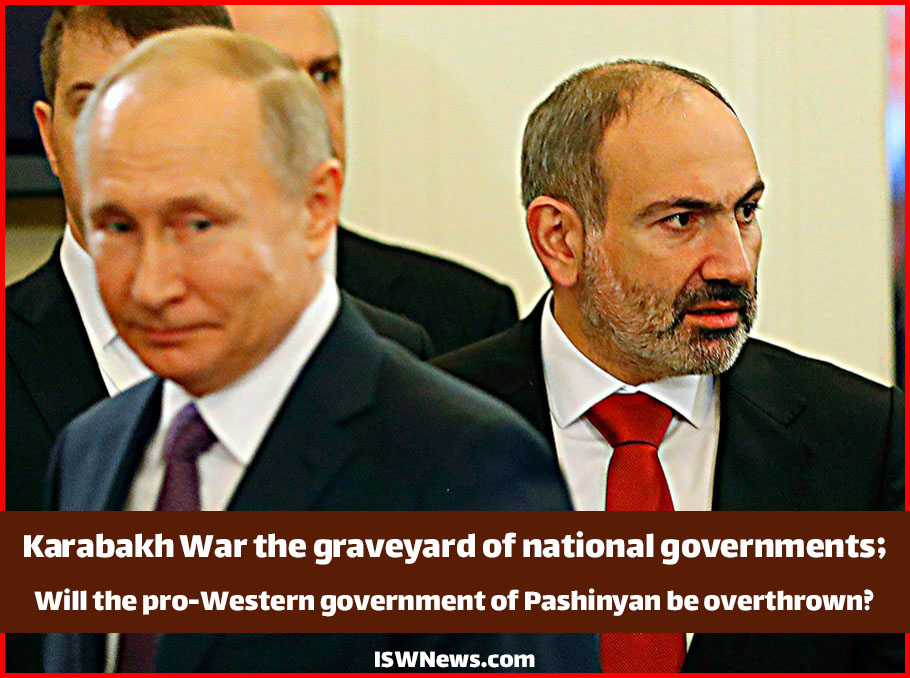
  • Karabakh War the graveyard of national governments; Will the pro-Western government of Pashinyan be overthrown?

    Karabakh War the graveyard of national governments; Will the pro-Western government of Pashinyan be overthrown?

    Relations between Azerbaijan and Armenia over the disputed region of Nagorno-Karabakh have been strained since the start of the war on September 27. According to Russian President Vladimir Putin, this bloody war has killed 5,000 people and has shown a different face of new battles. The Armenian army has lost airspace in the Nagorno-Karabakh region in the face of Israeli and Turkish drone strikes. Many attribute this to the deterioration of equipment and low-tech weapons and old anti-aircraft radars.
    Of course, the country’s ground forces also leave their strongholds and retreat, leaving weapons, ammunition and equipment on the battlefield. Such behavior is very strange in a classic army. Usually, any experienced soldier destroys weapons, equipment and ammunition while retreating, which is less common in this war. Even the newly deployed forces of Armenia to Nagorno-Karabakh are facing a shortage of supplies and the logistics of Armenia are practically inoperable. Their border forces also withdrew along the border lines of the occupied territories with Iran without any special resistance.
    The Armenians lost control of the Mataghis Dam (Sugovushan) and the Aras Dam, the cities of Fuzuli, Jibrayil, Hadrut, Zangilan and Qubadli, and Azerbaijan reached the international border of Armenia along the Aras River. Even the Armenian Defense Minister admits to successive defeats. The display of the destroyed and looted equipment of the Armenian army and the capture of the Armenian forces by the Azerbaijani coalition have also greatly lowered the morale of the Armenian forces. However, the resistance of the defense forces of the Nagorno-Karabakh region during the recent battles has been far greater than that of the Armenian army, which is also very strange.

    Many have so far cited the power of the coalition forces of Azerbaijan, Turkey, Pakistani Army Special Forces, Syrian and Caucasian terrorists as the main reason for the superiority on the battlefields with the Armenian forces.

    But why have the Armenian Armed Forces done so little over the past month except to retreat and counter-attack?

    Although the Armenians are positioned in the highlands, they do not make good use of this advantage, and Azerbaijani forces have reached the vicinity of Shusha and the Lachin crossing, which threatens the most important communication corridor between Armenia and Nagorno-Karabakh.

    Air and artillery strikes inside Armenia have also destroyed some military equipment inside the country. The Prime Minister of Armenia has asked the Russian Federation for help in concluding a defense and military pact, which has been met with a cold reaction from the President of the Russian Federation, Vladimir Putin.
    Putin has stated that he is willing to intervene militarily in favor of Armenia only if Armenian territory is attacked, which shows a clear difference of position with the history of the Russians in the first Nagorno-Karabakh War.
    However, Russia, with its military base in Gyumri, could thwart all efforts by hostile forces with its air force and air defense in the area.

    Iran has also closed the Norduz border terminal on the border between East Azerbaijan Province and Armenia, and some believe this is due to internal pressures from pro-Azerbaijani rallies in Azeri cities. In any case, Iran’s move to suspend economic relations with Armenia has caused more economic problems for Armenia, as Georgia’s borders with Armenia have been closed and the situation in Armenia is deteriorating.

    In addition to the above, the Prime Minister of Armenia dismissed the Border Command of the country due to the shooting in “ceasefire conditions” from inside Armenia to Azerbaijani forces on the Aras border and the reciprocal response of Azerbaijani forces. Although Azerbaijan denies any response to the fire of the Armenian side, the fire of both sides is undeniable. Also, the three-time violation of the ceasefire during the war, which both sides accuse each other of, is not something that can be considered the will of the political parties.

    If we study the history of the armed forces of the countries that inherited the former Soviet Union, we come across strong relations between the armed forces of these countries and Russia, which raises the issue of influence in the military forces of these republics.
    It is not yet clear whether the Russian elements are violating the ceasefire, but there are hands on the Armenian side that are leading the way to military defeat, political instability and protest. Armenia’s political atmosphere is against Prime Minister Pashinyan, who effectively controls the government and the commander of the country’s military. A number of political activists and the media have criticized his actions in the Nagorno-Karabakh conflict.

    But why should such a thing happen in Armenia during a war?

    The political record of the Prime Minister of Armenia Nikol Pashinyan shows that he has entered the field of politics from the world of journalism (editor of Haykakan Zhamanak newspaper) and has a history of opposition to the pro-Russian government in 2007 and political imprisonment, which was pardoned in 2009. Pashinyan, who has been a member of parliament for the country since 2012, founded the “Civil Contract” party in 2015 and the “My Step Alliance” in 2018.

    He was the main protester against the results of the 2018 National Assembly elections and the victory of Serzh Sargsyan, the Former President and (pro-Russian) Republican Candidate, and called the election results fraudulent.

    Pashinyan was able to organize a wave of opposition against Sargsyan by marching from the city of Gyumri to Yerevan, and Sargsyan resigned as prime minister on April 23. Pashinyan became prime minister on May 8 of that year by a majority vote. But his promises to solve the challenges of previous periods without a proper solution not only failed, but also led to popular protests and opposition before the Karabakh war.

    The distinguishing feature of Pashinyan in this period can be called the greater Westernization and diminishing of Russia’s political and economic role in Armenia. Attending NATO military exercises, establishing economic ties with the European Union instead of Russia, and making controversial remarks about the Gyumri base have been hot topics during his tenure. The Pashinyan government’s determination to join the North Atlantic Treaty Organization (NATO) also exacerbates Iran’s concerns, which is against the national interests of Iran.

    Opposition initiative

    During a meeting with the Prime Minister, Robert Kocharyan andSerzh Sargsyan proposed his resignation in order to find a way out of the crisis, and it is not unlikely that if the prime minister refuses, the option of a march and a military coup to save the country from military defeat in the Nagorno-Karabakh war will happen, which in the current situation will be accepted by the majority of the country’s society.

    It can be argued that the recent war has provided the greatest opportunity for Russian supporters in Armenia to oust the Pashinyan under the pretext of inefficiency and military defeat, and to end the work of the pro-Westerners in this country.
    Of course, Pashinyan, as a journalist, has not learned a lesson from the history of the Nagorno-Karabakh war. A similar scenario was planned in 1992 for Azerbaijani President Ayaz Mutalibov, in which the militants of the Azerbaijani Popular Front (supporters of Abulfaz Elchibey) evacuated the Lachin and Shusha fronts against the invasion of the Armenian army and after the Khojaly tragedy, these militants ended the life of the government with the presence of several thousand forces in Baku and in front of the Presidential Palace.
    However, the next government of Azerbaijan did not last long, and the military defeats combined with the economic crisis and the political coup of Heydar Aliyev, which had the political support of Iran, led to the collapse of the “Abulfaz Elchibey” government and the political and military elements of the “Abulfaz Elchibey” government were dismissed and imprisoned as the cause of Azerbaijan’s defeats.

    Such a possible change could change the course of the recent war, and Armenia, with the support of the Russians, this time will show a new face with a new strategy that will not be pleasant for the Azerbaijani coalition at all. This unhappiness starts from the fact that the Azerbaijani coalition, like a gambler, has put all its cards on the table and its military strategy has been known over the past month. The air superiority under the flight of drones, heavy shelling, infiltration of commando groups behind the opponent’s front and then armored and infantry attacks of Azerbaijan is a strategy that has nothing to hide.

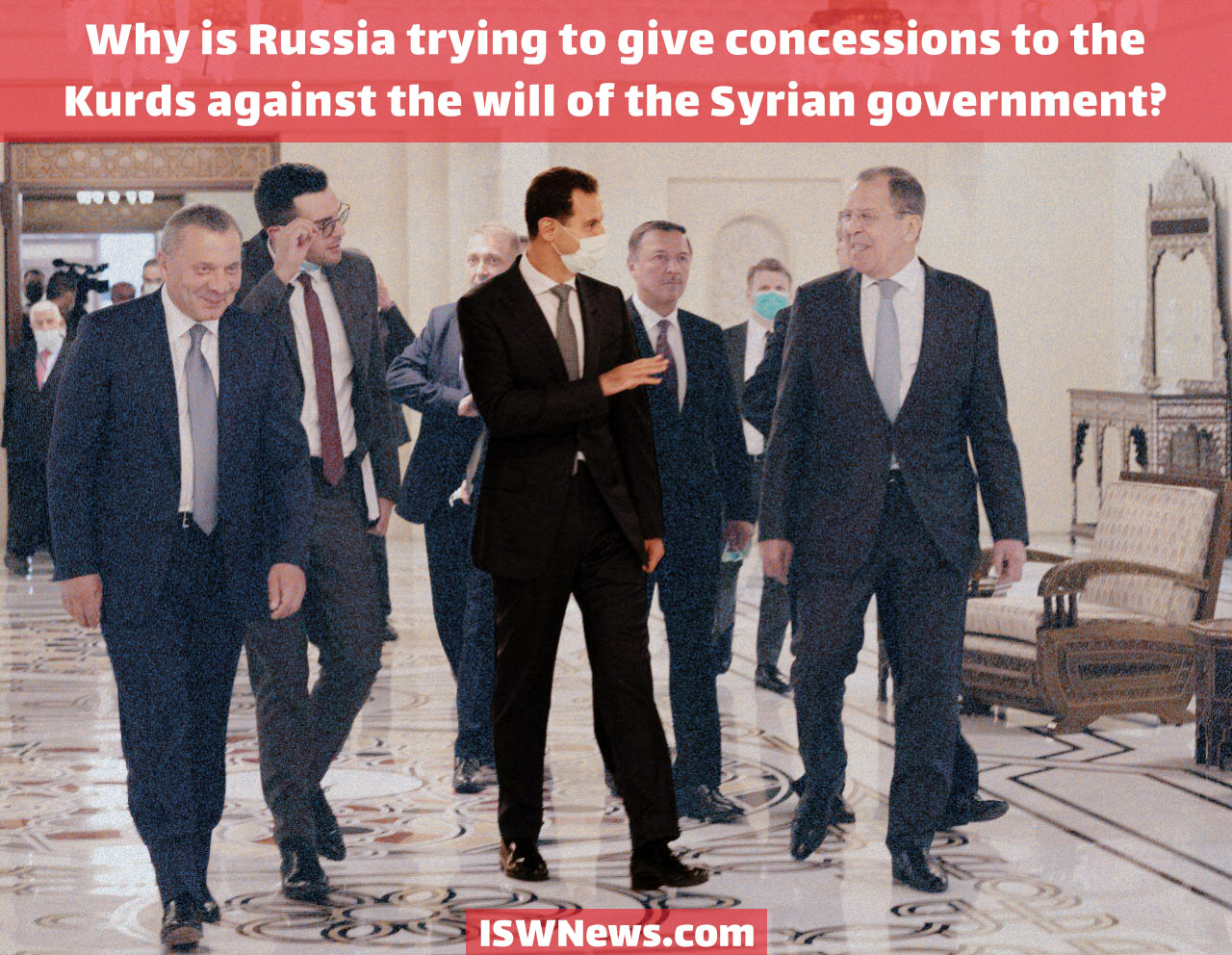
  • Why is Russia trying to give concessions to the Kurds against the will of the Syrian government?

    Why is Russia trying to give concessions to the Kurds against the will of the Syrian government?

    Since the beginning of the Syrian crisis, Russia, as a permanent member of the Security Council, has played a positive role in resolving the crisis. Until 2015, which was the time of Russia’s military intervention in the US-led war against Syria as one of the most important members of the Axis of Resistance, the role of this permanent member of the Security Council was merely to veto US and European resolutions against the Damascus government. Russia in cooperation with China has vetoed six of the seven Security Council resolutions against Syria since the crisis began in early 2011.

    Russia’s influence, however, increased dramatically after it entered the arena of the Syrian crisis in 2015, and in addition to the political sphere, it also extended to the military and economic spheres. There are various reasons for Russia’s involvement in the Syrian crisis, including the existence of a Russian naval base in the Syrian port of Tartus, confrontation with the US monopoly system, economic benefits including the activities of Russian oil and gas companies before the crisis in Syria, and Russia’s efforts to explore for gas in the Mediterranean to compete with competitors such as; Turkey, Israel, Greece and Egypt for exporting to Europe, as well as turning Syria into an economic gateway to the Middle East.

    Russia’s entry into the political and economic processes of Syria after the crisis subsides, preserving the structure or Bashar al-Assad?

    Now that the crisis has subsided and sovereignty has been established, the important challenge for the Syrian government and its allies is to rebuild and build political processes to unite to overcome the economic and political crisis. Russia is trying to play an effective role at this time as well.
    In this period, unlike during the war, Russia has commonalities with the Westerners, and that is the emphasis of both sides on the implementation of Resolution 2254, which in 2015 was not vetoed and approved by the Security Council, unlike other resolutions. The subject of this resolution is the creation of a political process in Syria for the transition period and the formation of a new constitution and political structure.
    The biggest weakness of this resolution is that it does not mention the fate of Bashar al-Assad.
    Russia also seems to agree with the policy of maintaining structure and changing the individual in order to attract capital for the reconstruction of Syria and to make a deal with the West. This is exactly the opposite of Iran’s position, which is to emphasize the preservation of Bashar al-Assad as a symbol of resistance and unity in Syria despite political reforms. Russia’s position was also reflected in the recent visit of a high-level delegation to Syria, emphasizing the need to hold elections under the new constitution, which, of course, was opposed by the Syrian government.

    Efforts to become international mediators and oil deals, most important Russian incentives to resolve Bashar al-Assad dispute with Kurds

    Another issue that Russia is trying to resolve in the Syrian political process by playing the role of mediator is the differences between the Syrian government and the Kurds. After the crisis in Syria began, the Kurds tried to secede from Syria and form an independent government, using the weakness of the government as well as US support; This issue was reduced to the formation of an autonomous region after the Turkish invasion and the lack of US support and support from the Syrian army. In fact, the Kurds realized that they could not survive without the support of the Syrian government. After the disappointment of the United States, the Kurds turned to Russia to solve their problems with the Syrian government and gain concessions from it, so that they might be able to use its influence in the Syrian government to gain concessions in the autonomous region.

    In this regard, a week before the Russian delegation’s visit to Syria, two Syrian Kurdish parties traveled to Moscow and signed an important five-point agreement there. The agreement, which was ratified by Russia, emphasizes the creation of a decentralized political system (creation of autonomous regions), work on Resolution 2254, the entry of Kurds into the Syrian constitutional negotiations, and the integration of Kurdish forces into the Syrian army. The agreement was one of the main points of Lavrov’s meetings with Bashar al-Assad and Syrian Foreign Minister Walid Muallem. Why Russia is trying to resolve the differences between the Kurds and the Syrian central government by granting them concessions does not seem to have a complicated answer. One of the reasons for this is the existence of oil resources in the Kurdish regions, which Russia has also signed agreements with the Syrian government to explore and extract, but due to the presence of the Americans, it is not possible to implement these agreements. In fact, the Russians are trying to drive the United States out of the region and gain economic benefits by making peace between the Kurds and the Syrian government.

    Russia is also trying to become an influential and trusted mediator in the world by resolving such issues politically. Another reason that can be mentioned in this issue; Russia’s efforts to build trust with the West to cooperate with Russia’s policies include efforts to rebuild Syria. In fact, Russia sees this as a concession to the West that they are willing to invest in Syria in return.
    So far, Russia has not been able to succeed due to the opposition of the Syrian government, but it remains to be seen whether in the future, with increasing economic pressures and in the absence of a cohesive economic and political presence of an important ally such as Iran, Bashar al-Assad’s government will be able to resist Russian policies or not.

  • Russian president Vladimir Putin talked on phone with Azerbaijan president

    Russian president Vladimir Putin talked on phone with Azerbaijan president

    As mentioned before, following the joint military drill of Turkey and Azerbaijan and dismissing pro-Russia officials in Azerbaijan, Baku needed to get confidence of Russia back.
    Moscow rejected Yereavn ‘s proposal of a joint military drill a while ago.

  • Presence of Russian warplanes at Deir Ezzor airport

    Presence of Russian warplanes at Deir Ezzor airport

    After the military entry of the Syrian and Russian armies to east of the Euphrates in the last year, the Russian army wants to expand its military influence in east of Syria. According to available information, the Russian army is setting up a new military base in the Maadan region in the east of Syria.
    Also, a part of Qamishli airport has been turned into the Russian air base, and the Russian fighter jets presence in Deir Ezzor is also interpreted in this regard.