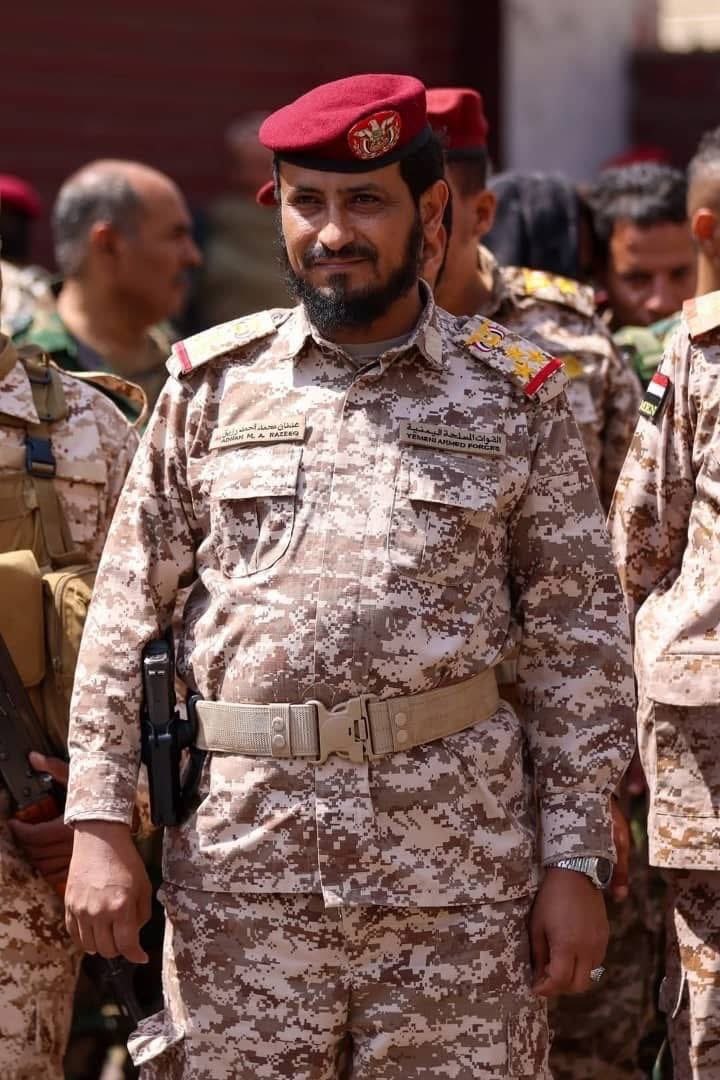
Local sources differ on the method of the attack. Some report that a roadside bomb was planted along the route of Razeeq’s convoy, while others—citing eyewitness accounts—claim the assault was carried out using an explosive dropped from a quadcopter allegedly operated by Ansar Allah!
Despite accusations from opposition media blaming Ansar Allah, evidence suggests the attack may have been orchestrated by armed militias of the Islah Party. Over the past month, Islah militants have engaged in fierce confrontations with Tareq Saleh’s forces in Taiz province, including repeated attempts to eliminate his affiliates in areas like al-Turba.
These militants, reportedly equipped with weaponized drones through ties with Turkey, have conducted similar deadly strikes on other Yemeni fronts.
Al-Jabzi, who leads a battalion within the 11th Division stationed on Yemen’s western coast, reportedly clashed with Islah checkpoint personnel in the al-Hujariyah area of al-Ma’afir district. He was wounded during the confrontation and subsequently detained.
In a separate incident, two individuals were injured in a firefight between Tareq Saleh’s men and Islah militants on Zaid al-Moshki Street in northeastern Taiz.
The arrests, assassinations, and skirmishes between Islah and Tareq Saleh factions reflect rising tensions between the two sides. These clashes are part of an ongoing cycle of armed confrontations in Taiz, a stronghold of the Islah Party. Historically, parts of the province were under Tareq Saleh’s control before his split from Ansar Allah, a legacy that continues to fuel his operations and mobilization against Islah Party in the region.
According to local sources, Tareq Saleh forces have surrounded the western villages of Al-Waziyah and demanded the surrender of armed men loyal to Abu Dhiab Al-Alaqami and the sheikhs who support him.
Al-Wazaiyah tribes have asked for help from their allies in the al-Shamaitin district and from al-Sabiha tribes on the coast of Lahij province.
It is worth mentioning that following Al-Alaqami’s conflict with Tareq Saleh, Al-Waz’iya and Al-Sabiha tribes had declared their support for Al-Alaqami.
Al-Alakami contacted several sheikhs of the Al-Sabiha tribes and reportedly obtained the support of these tribes in a possible battle with the forces of Tareq Saleh.
Some local sources reported that Tareq Saleh forces are preparing to attack Al-Alakami positions in Al-Waziyah district in Taiz province.
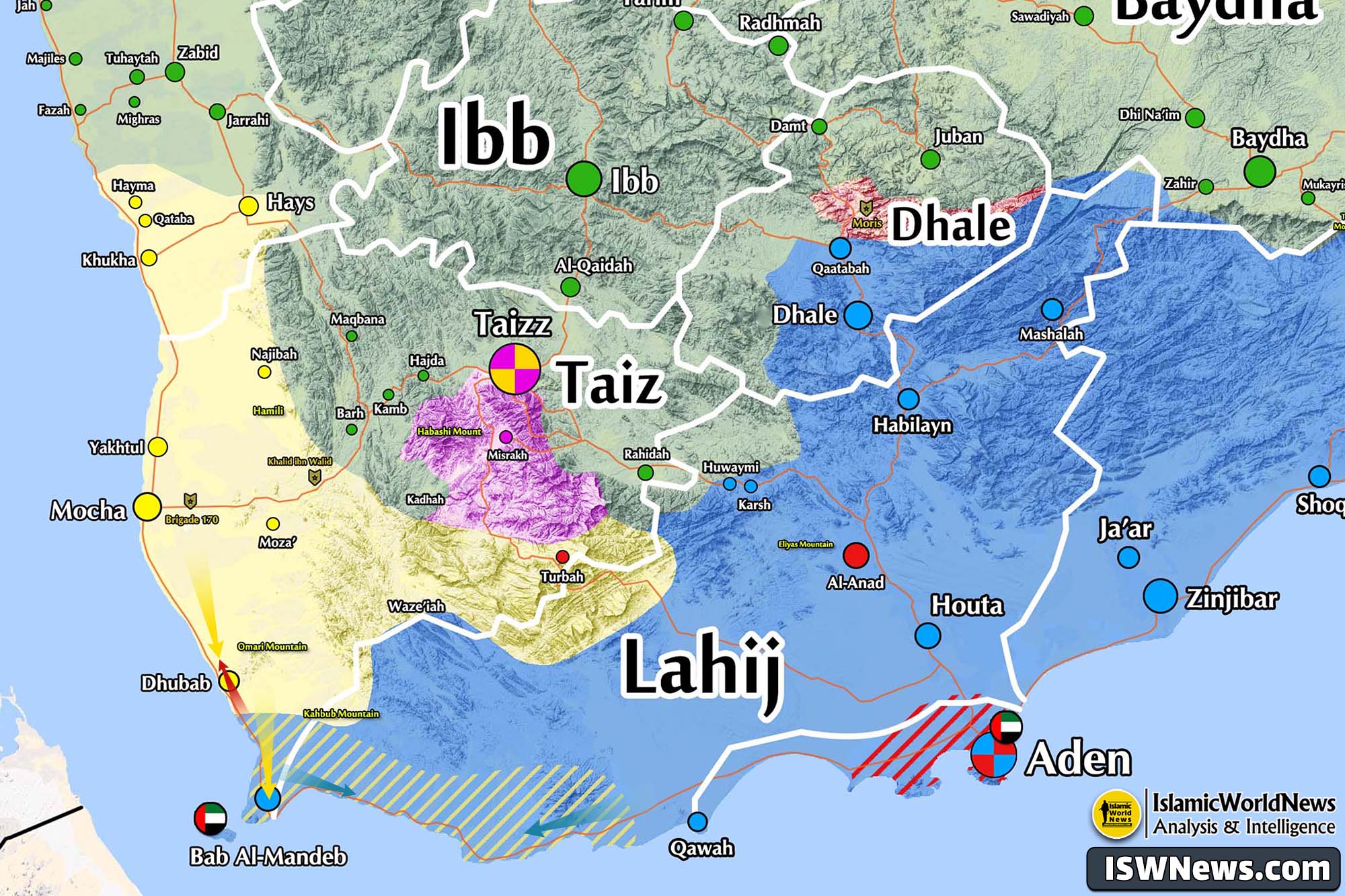
After the clashes with Tareq Saleh in the port town of Mocha, Al-Alakami went to the Al-Waziyah and invited the tribes of this region to rebel against Tareq Saleh. This disobedience has been welcomed by the Al-Sabiha tribes, the largest tribe living in the southwest of Yemen and one of the other opponents of Tareq Saleh.
Al-Sabiha had previously managed to expel Tareq Saleh’s supporters from the areas near Bab Al-Mandab Strait, especially Dhubab town.
Direction of clashes between the Al-Sabiha and Al-Wazaiyah tribes with the forces loyal to Tareq Saleh in the south of Taiz province – click to view in full size
During a meeting, the tribes of al-Waziyah district announced their separation from the Yemeni National Resistance headed by Tareq Saleh and declared their readiness to face his attacks.
This meeting was organized by the commander of the support brigade of the joint forces, Abu Diab Al-Alqami (under the command of Tareq Saleh), and more than 200 people from the sheikhs of the southwestern tribes of Yemen were present in this meeting. Tihamah forces have also organized rallies against Tareq Saleh and there is a possibility of their separation in the coming days.
Tareq Saleh’s advisor, Nabil al-Sufi, in response to the decision of al-Waziyah tribes, warned Al-Alakami and the tribal leaders and asked them to be rational and not make mistakes under the pressures.
Abu Diab Al-Alkami is one of the local commanders who oppose Tareq Saleh and is supported by the Al-Sabiha tribes, who do not have a good relationship with the UAE and their subordinate groups. In June, he clashed with Tareq Saleh’s forces in the city of Mocha and was freed from the siege through the mediation of local elders. Those around Tareq Saleh believe that his activity and the tribes of Al-Sabiha are under the pressure and incitement of Saudi Arabia against the UAE’s plans in the southwest of Yemen.
According to the plan, militant forces affiliated to Tareq Saleh, a Yemeni military commander and the nephew of the late President Ali Abdullah Saleh, will control the coastal areas from Hays city to Bab al-Mandab Strait, as well as the Southern Transitional Council (STC) forces will control the coastal regions from Ras al-Ara area to Aden governorate. The implementation of this plan faces problems, because tribes such as al-Sabiha tribes in Lahij Governorate, southern Yemen, want their share and try to control this region.
The seventh brigade of Amaliqa forces as well as groups of Al-Sabihah tribal militants prevented Tareq Saleh’s forces from constructing a base and settling in the Bab al-Mandab coastal strip, located in southwestern Taizs Governorate, on July 28.
The tension was accompanied by a halt in the movement of Tariq Saleh’s forces near Dhubab town, and al-Sabiha tribes warned Tareq’s forces against any military movement towards Bab al-Mandab. After this event, Tareq Saleh ordered more forces to be sent to Dhubab town, but eventually, due to resistance from al-Sabihah tribes, he was forced to retreat from Dhubab towards Mocha.
Al-Sabiha tribes claim that the southwestern lands of Taizz Governorate belong to these tribes and Tareq Saleh’s forces must also retreat from their other positions. They did not stop at this condition and demanded that their militants be officially recognized within the framework of the Saudi-led coalition forces and also Abu Dhiyab al-Alkami return to his position in command of support for national resistance forces (under Tareq Saleh’s command) and also hand over the killers of a soldier named Saadan Ali Saeed.
Tariq Saleh, on July 30, in his first reaction to the clash with al-Sabiha tribes in Bab al-Mandab, published a statement entitled leadership statement of national resistance forces. Saleh considered Bab al-Mandab within his operational space in this statement and referred to a plan that has been approved in joint operations with the participation of Abdul Rahman Abu Zaraa Al Muharrami, commander of Amaliqah forces. He also considered establishing himself in all areas of Taizz Governorate and securing international navigation routes as part of his duties.
Following this escalation, Tareq Saleh’s adviser Nabil Al-Sufi announced in a tweet that the plan to establish joint forces (under Tareq Saleh’s command) was designed by the United Arab Emirates and includes the area from Hays in the south of Al-Hudaydah Governorate to Bab al-Mandab. Also, the Southern Transitional Council forces will protect the coastal areas from Ras al-Ara region to Aden to ensure the security of Bab al-Mandab Strait. In addition, Djibouti’s armed forces will be stationed on the other side of the strait.
In this regard, some local sources reported that the Southern Transitional Council forces transferred control of al-Ardhi region in Bab al-Mandab to Tareq Saleh’s forces on July 31.
Based on the circumstances on the ground, this plan can be considered as part of the US-led coalition’s deployment to support a future naval war with the Ansar Allah movement. In recent months, the Ansar Allah movement has strengthened its naval force with the support of Iran and other resistance groups and has armed its forces with various missiles and speed boats.
The tension between al-Sabiha tribes and Tareq Saleh’s forces can also be considered as a sabotage by some Saudi officials to disrupt the United Arab Emirates’ plan, as they are not interested in resuming hostilities with the Ansar Allah movement and are not willing to completely surrender southwestern Yemeni coasts to the United Arab Emirate. Therefore, they play a role with the card of al-Sabiha tribes in this axis.
Altogether, the conflicts in the Red Sea and the vital Bab al-Mandab Strait seem to be important issues, which have been raised since the early years of the Yemen war and they have turned into more serious topics with the permanent deployment of the United States’ naval coalition or Combined Task Force 153 to the waters of the region.
The US and Israel resort to sabotaging the Yemen peace process and destroying relations between Iran and Saudi Arabia in order to send Saudi Arabia back to war with the Ansar Allah movement. Despite avoiding re-engagement in Yemen, the Saudi authorities continue to show inflexible reactions in negotiations as well as military deployment in a bid to maintain their positions! However, such an attitude is expected to weaken the efforts to find a political solution in line with achieving peace in Yemen.
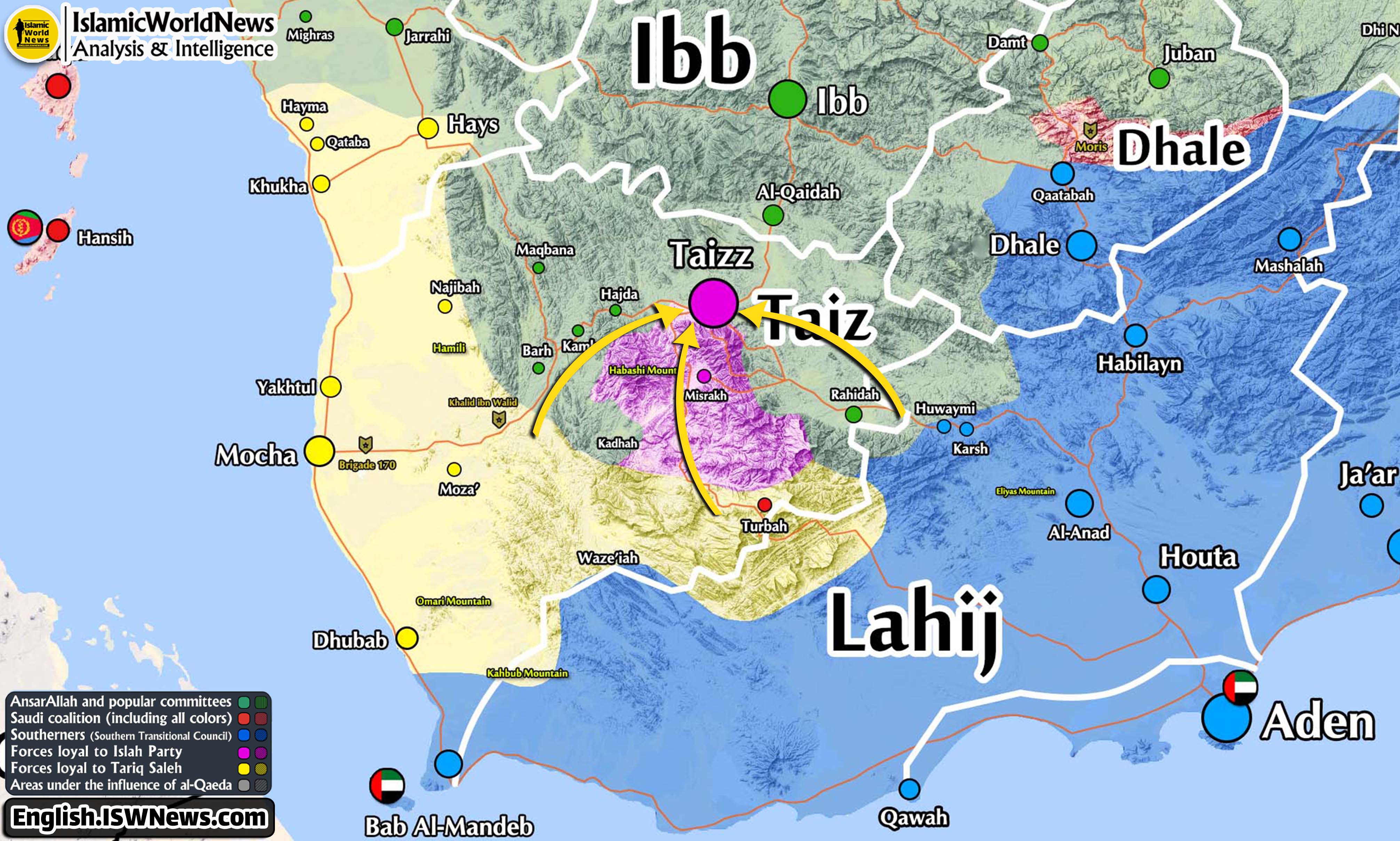
Military situation in southern Yemen – click to view full size
This conflict started on June 18 due to the dismissal of Al-Alkami from the command of the support brigade of the joint forces by Tareq Saleh. Now, Al-Alakami is refusing to obey this order, and the armed men of the “Support Brigade”, who are mainly from Al-Sabiha tribes, supports him.
One day after this incident, on the morning of June 19, the Support Brigade announced its separation from Tareq Saleh’s forces and took control of parts of Al-Khokha town, the Communications Building and Mocha road. Tareq Saleh has also issued an order to suppress these forces and his forces are being sent to Khokha. Also, the Al-Sabiha tribe has sent its armed men from the southern coast of Lahij province to help the Support Brigade in Al-Khokha, but due to the control of Tareq Saleh’s forces on the roads leading to Al-Khokha, it seems difficult and impossible for them to reach this town.
Taizz city was one of the main strongholds of opponents of Ali Abdullah Saleh especially the Islah Party in the onset of revolution in Yemen and even before the turning point. Following the aggression by the Saudi-led coalition, the Islah Party could mobilize its militants to control parts of the city and it kicked off confrontations with followers of Ansar Allah movement and Ali Abdullah Saleh. The climax of the conflicts occurred when the late president betrayed Ansar Allah and the movement’s fighters retreated from urban areas and took a position in northern areas of the city.
After over a decade of war in Yemen, several transformations and clashes happened in the country, but Taizz witnessed fewer changes due to its geographical situation, density of population and the spread of conflicts in other fronts.
At present, Ansar Allah controls strategic points in northern, eastern and western areas of the city. The strategic areas encompass the International Airport, major roads, including Taizz-Aden, Taizz-Sanaa and Taizz- Al-Hudaydah, as well as the heights overlooking the city.
The urban areas, military bases and administrative offices are under the control of the Islah Party and in some point under the supervision of the resigned government of Yemen. Moreover, there is side road in the southern Taizz, which connects the western entrance of the city to Al-Tarba town and Yemen’s southern cities. The side road is controlled by the militants of the Islah Party, which is utilized by the Saudi-led coalition to enter the battle grounds in Taizz.
Tareq Saleh is nephew of the late president of Yemen, who is commander of the Popular Resistance Committees, which is under supervision of the Saudi-led coalition. Tareq Saleh became a member of the presidential council of the resigned government of Yemen following the resignation of former President of Yemen Abdrabbuh Mansur Hadi. Tareq Saleh has a close relationship with the United Arab Emirates (UAE), and he contributes to certain programs of Saudi Arabia, including their confrontation against the Southern Transitional Council (STC). Some of his covert efforts and supports in forming the Popular Resistance Committees, handing over the control of the southern front of Al-Hudaydah and western parts of Taizz to al- Mocha Port, as well as his cooperation in the formation of Al-Dara’ Al-Watan militants paved the way for enhancing his power and influence in the developments of the occupied territories of Yemen.
As part of his latest attempts, Tareq Saleh met with a military delegation from Saudi Arabia and he visited the headquarters of the Popular Resistance Committees in Taizz, which are of great importance. According to local sources, he plans to implement a military operation in Taizz Governorate to take control of the region. The initiation of the operation can start along with Taizz- Al-Hudaydah and Taizz-Aden roads. Among the axes of confrontations, his militants’ attack on Ansar Allah’s strongholds in Taizz Governorate seems to be more probable than their strike on the Islah Party’s positions. The attack can happen along Albarh-Kamb-Hajda-Taizz fronts, because the Karsh front is controlled by the militants of the Southern Transitional Council. Furthermore, the Tareq forces require abundant equipment and militants to start operation in urban areas, but he cannot afford such an operation given the current circumstances in Taizz. In addition, he has started reaching consensus with certain commanders of the Islah Party.
Therefore, provided that the Yemen peace negotiations by the mediation of Omen and the United Nations fails to reach a conclusion or stops, one of the areas, which may experience conflicts, would be Taizz front. Of course, victory in this front would not be an easy job for any party, but the incursion into the axis can create new headaches for the Asar Allah movement.
After the formation of the ceasefire agreement in Yemen on April 2, 2022 and three periods of extension and finally its expiration on October 3, 2022, the areas under the control of the Saudi coalition were affected by a forced change in the head of the presidency (Resignation of Abd Rabbu Mansour Hadi and formation of the Presidential Council). This issue caused a series of tensions between different factions, and finally a kind of political and military deadlock prevailed between different groups under the command of the Saudi coalition. Therefore, the control of each of the parties was established over the regions, and now it is possible to distinguish the regions under the control of the groups in Yemen with more precision.
The map of Yemen war has been accurately edited in accordance with the latest field situation until December 16, 2022 and with the following categories and it is as follows:
1- Ansar Allah and popular committees: (green color) The areas under the control of Ansar Allah and popular committees include presence in 15 provinces in the west and center of Yemen, which include the capital, big cities and the majority of the country’s population. Despite the expiration of the cease-fire agreement with the mediation of the United Nations, there is no conflict in any of these fronts, and Ansar Allah is monitoring the fronts by carrying out various reconnaissance operations, as well as confronting the looting of Yemen’s oil resources by foreign tankers. Ansar Allah Movement and the National Salvation Government of Yemen are supported by the majority of the Yemeni people and the General People’s Congress and other Yemeni parties, as well as the foreign support of Iran and Islamic resistance groups.
2- The Saudi coalition and the Saudi-backed government of Yemen (ie the resigned government of Mansour Hadi): (red areas and all map colors except green) The areas under the control of the Saudi-led coalition forces include presence in 13 provinces of Yemen, which includes the largest area of this country. But the majority of these areas include desert and uninhabited areas. Despite this, the oil resources, the southern coast of Yemen and several strategic points are under the control of the Saudi coalition. The Saudi coalition uses these cases as tools to pressure Ansar Allah in negotiations. Nevertheless, despite the access of the Saudi coalition to all the areas under the control of the anti Ansar Allah groups, the factions under this coalition have competition and armed conflict with each other to control these areas. The structure of the resigned government of (Mansour Hadi) Yemen, like other countries involved in civil war, is a structure that divides positions and ministries between powerful factions in order to use the human power and military facilities of these factions against the main enemy. These factions include: Islah Party, Southern Transitional Council, Yemeni National Resistance under the command of Tareq Saleh, each of them have managed to influence and control parts of Yemen in recent years, especially after the resignation of Abd Rabbu Mansour Hadi and the formation of the Presidential Council. Which is explained as follows:
3- Southern Transitional Council: (blue color) The “Southern Transitional Council” (STC) is the name of a council consisting of the main currents of South Yemen, including Al-Hirak Al-Janoubi (Southern Movement), Southern Resistance and the South Arabian League Party, which was established on May 4, 2017, and their goal is to divide south Yemen. Currently, based on the Riyadh agreement in November 5, 2019, this movement holds the post of prime minister and half of the 24 ministries of the government. The geographical area under their control also includes: Aden province, most areas of Lahij and Abyan provinces and parts of Al-Dhale’, Hadhramaut and Taiz provinces.
It should be noted that the forces of Hizam al-Amni (Security Belt), Al-Haba Al-Hadhramiyah, Southern Resistance and other southern armed brigades are sub-groups of the Southern Transitional Council and are under the support of the United Arab Emirates.
4- Islah party: (purple color) The Islah Party (Reform Party) is one of the largest and oldest parties in Yemen, and it acts as the representative of the Muslim Brotherhood in Yemen. This party was formed on September 13, 1990 by Sheikh Abdullah ibn Husayn al-Ahmar, one of the elders of the Hashid tribe, and has been operating since 2007 under the chairmanship of Mohammed Abdullah al-Yadumi. After the start of the Saudi coalition’s invasion of Yemen, the Islah Party announced its support for this operation on April 3, 2015, and entered into a battle with Ansar Allah.
Currently, the cities of Marib, Taiz, Seiyun and the desert areas of Al-Jawf province and parts of Shabwah and Hajjah provinces are under the control of this party’s militants.
5- Forces loyal to Tareq Saleh (Yemeni National Resistance): (yellow color) “Yemeni National Resistance” is the name of a military group led by Tareq Saleh, the nephew of Ali Abdullah Saleh, the former president of Yemen, which was formed in December 2017. This organization has more than 10,000 members and consists of several factions, including former members of Ali Abdullah Saleh’s presidential guard, the former army soldiers and security forces separated from the Sana’a government, Al-Amaliqah and Al-Tihamah Resistance forces.
The areas under the control of Tareq Saleh forces are the southwestern region of Yemen, including the district of Hays in the south of Hudaydah province, the western areas of Taiz province, as well as the districts of Bayhan and Ain in Shabwah province. It is worth noting that this military group (Tareq Saleh forces) is under the support of the United Arab Emirates, the Amaliqah and Tihamah forces receive their orders from the command of the Saudi coalition, especially the UAE, instead of Tareq Saleh…
6- Al-Qaeda, Ansar al-Sharia and ISIS terrorist groups: (gray hachure) The activities of the Al-Qaeda terrorist group in Yemen under the name of “Al-Qaeda in the Arabian Peninsula” (AQAP) began in 2009 and continued under the name of Ansar al-Sharia group since 2011. After the resignation of Ali Abdullah Saleh and the presidency of Mansour Hadi, this group acted in a more organized manner and took full possession of some points; But the advance of Ansar Allah and the intelligence of the field commanders of this movement in taking control of the cities of Sana’a, Saada, etc., prevented Al-Qaeda from advancing. Therefore, in order to survive their activities, Al-Qaeda forces were stationed in the remote areas of Yemen, including the deserts of eastern Yemen, the north of Al-Baydha province, and several other places. Currently, this group does not have any city or region completely under their control, and their sphere of influence includes the desert areas of Hadhramaut, Shabwah and Abyan provinces. Also, after the Ansar Allah operation in the north of Al-Baydha province, Al-Qaeda members were transferred to the city of Marib and placed under the command of Islah Party.
The Islamic State Wilayat al-Yaman (Yemen province) group (IS-YP) also announced its formation in November 13, 2014, and apart from bombings, assassinations, etc., no special activity has been seen so far. ISIS members in Yemen are generally from extremist tribes in the east and south of Yemen and people separated from Ansar al-Sharia and al-Qaeda terrorists groups.
It should be noted that the formation of terrorist groups in Yemen is closely related to the actions of Mansour Hadi, the former president of the resigned government, Ali Mohsen Ahmar, the former vice president of the resigned government, and several other heads of parties and security institutions. In this regard, the criminal court of Yemen has convicted and prosecuted these people.
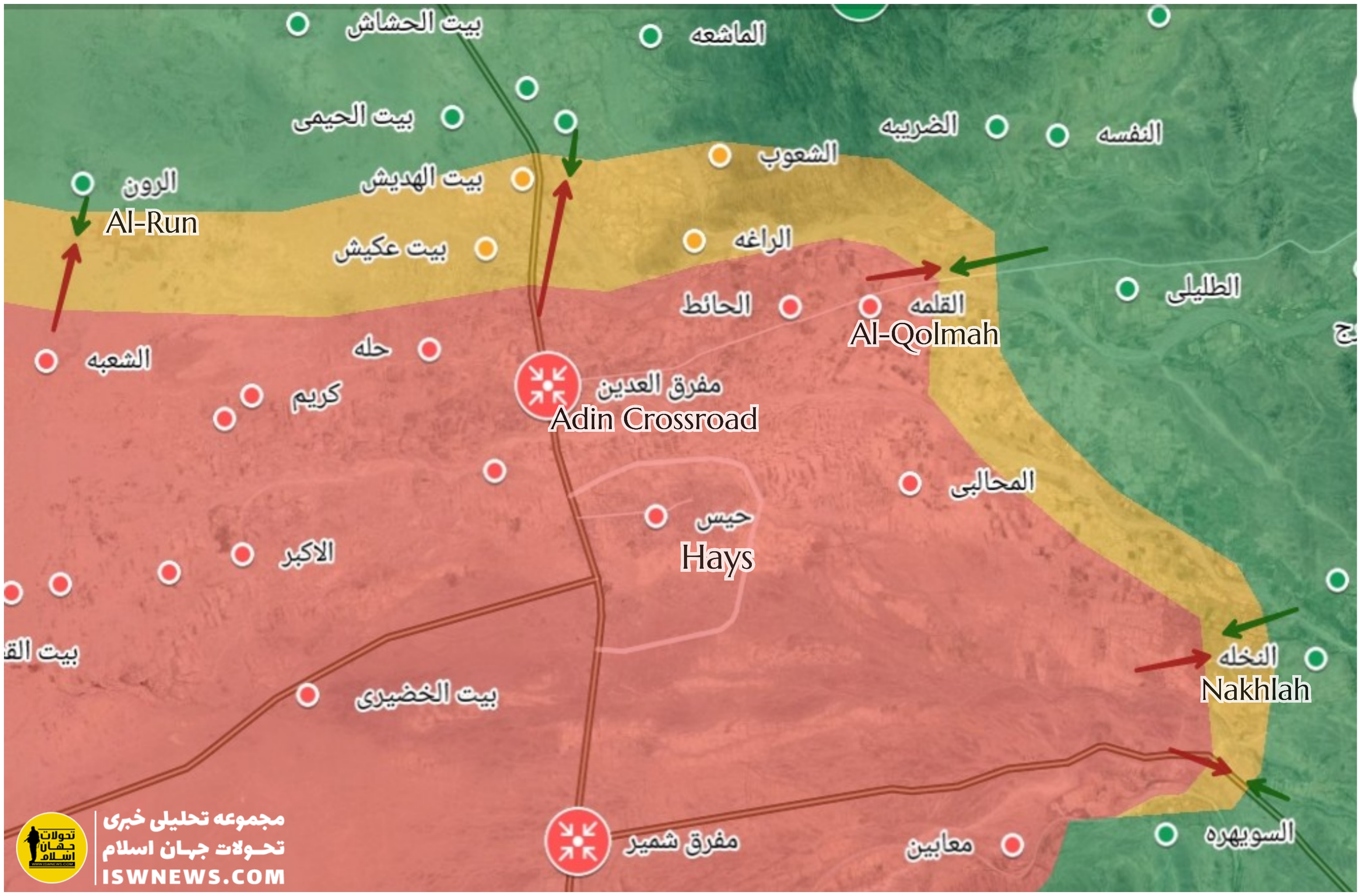
In recent days, the intensity of ground and airstrikes by the Saudi coalition in the district of Hays has decreased, and the Saudi-led forces advances has stopped in the northern and eastern suburbs of the town of Hays. Currently, the clashes are scattered in the northern line of al-Adeen crossroad to al-Roun village and al-Qolma and Al-Nakhla villages in the east of Hays town.
On November 27, Ansar Allah targeted positions of Joint Forces (Quwat al-Mushtarika) subdivisions of the “Yemeni National Resistance” under Tareq Saleh, east of the town of Hays with drones and artillery, reportedly killing and wounding more than 20 of Tareq Saleh forces.
Also, the car of one of the field commanders of al-Amalaqah forces, Colonel “Ghamdan Ghalib Sayad”, was targeted by a roadside bomb and was severely wounded. Local sources speculate that he was assassinated due to his differences with Tareq Saleh, and in this regard, some Amalaqah brigades and Joint Forces have retreated from the northern fronts of Hays.
On November 18, Tariq Saleh forces with support of the Saudi coalition and accompanying STC forces, have launched an operation called “Golden Arc” on three axes of Hays in the south of al-Hudaydah province, Wazi’yah region and Habashi mountain in the west of Taiz province, which has so far defeated by Ansar Allah resistance.
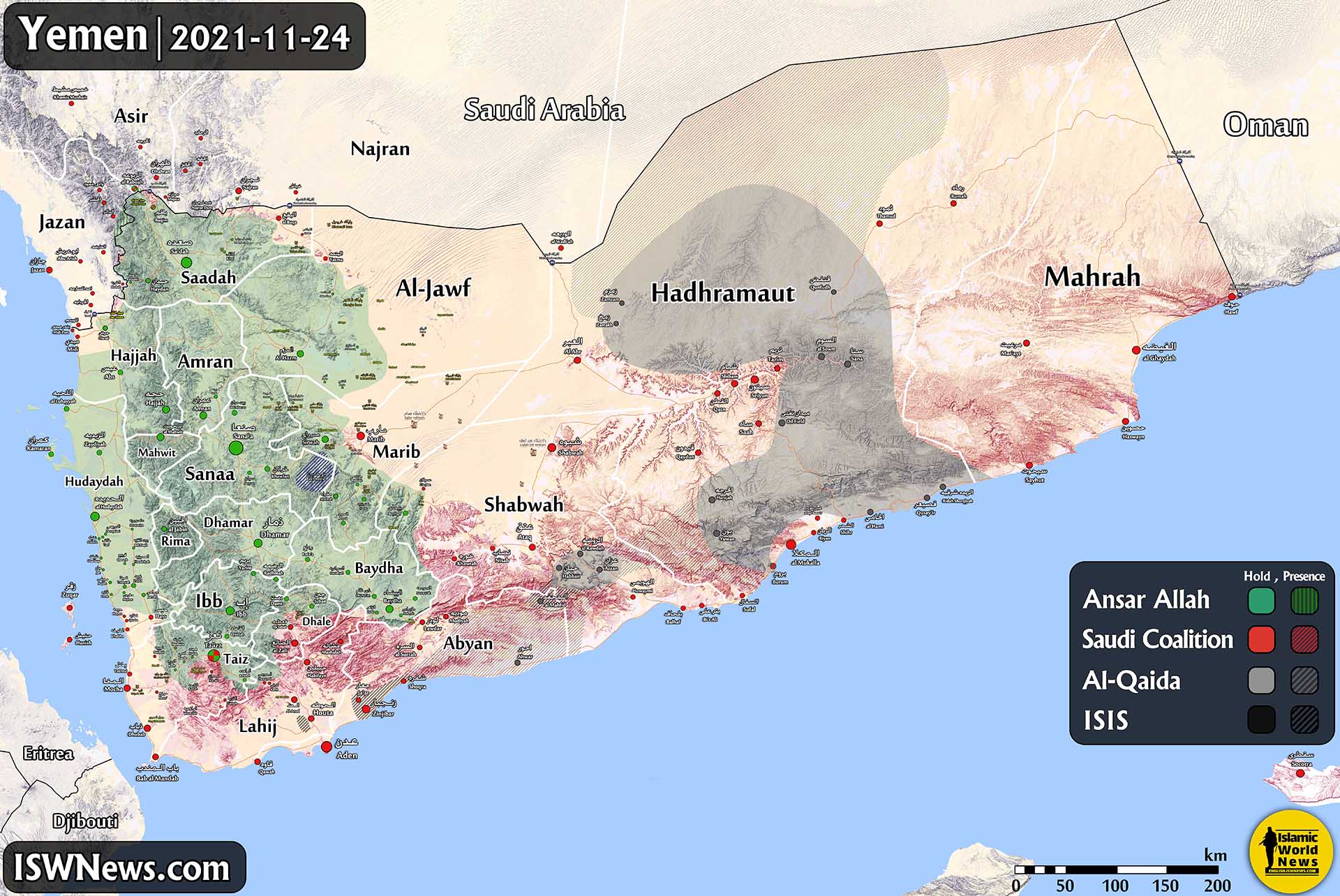
Marib: In the central axis of Yemen, Ansar Allah has succeeded in liberating the al-Jubah district center and the northern areas of this district, as well as the district of Jabal Murad (without clashes), following Operation Rabi al-Nasr. This important advance has led Ansar Allah to the southern entrance of the city of Marib, and clashes have been going on since November 2 in the suburbs of the al-Balaq al-Sharqi and al-Balaq al-Awsat heights.
Al-Hudaydah: On November 12, the Saudi coalition command issued an order to withdraw from the city of Al-Hudaydah and the west coast of Yemen. During this retreat, the National Resistance forces, including the forces under the command of Tareq Saleh, Tahamah, Amalaqah and joint forces, evacuated the northern and eastern areas of al-Hudaydah city and the western areas of al-Durayhami, al-Jah, al-Tuhayta.
On the other hand, on November 18, Tareq Saleh forces launched an operation called “Golden Arc” in the south of al-Hudaydah province and the west of Taiz province, with the aim of securing the positions of the Saudi coalition on the west coast, which has not achieved significant results so far. So far, Ansar Allah has managed to repel most of Tareq Saleh’s ground attacks by carrying out the eighth deterrent balance operation and several other missile and drone operations.
1. Firing a Badr-1 missile and hitting barrack al-Anad in Lahij
Media close to the coalition reported that one Yemeni killed and one wounded. But Emirates claims that one of their forces is killed in other fronts.
2. Evacuation of island Socotra by UAE forces, Ahamd Bin Daghar prime minister of Yemeni resigned government claim that crisis is over in this island.
Archipelago of Socotra have a total area of 3,635 km2. The distance between these islands and Yemen mainland is about 340 km and until Somalia is 250 km. Two islands Samha and Darsa are famous as islands brothers. /Wikipedia
Socotra has estimated population of more than fifty thousand has strategic role in Adan Gulf and in past was used by colonized countries (Portugal and England) and used as military naval base.
3. Firing a Bard-1 missile to economic area of Jizan
Yemeni sources (according to Jizan inhabitants) reported of an explosive sound in military town of Malik Feisal.
4. Conflicts in al Hudaydah in Tuhayta district.
Attack by Tareq Saleh forces has been neutralized in this front.
Photos showing last Tuesday protest of Yemenis in Sanaa under title “Down with USA and Israel, live long Quds”