Category: Russia

  • Russian Army helicopter crashed in Hasakah

    Russian Army helicopter crashed in Hasakah

    According to local reports, the pilot of the helicopter was killed and other crews were injured.

    However, the Russian Ministry of Defense denied any casualties. In response to the news circulating, the Russian Ministry of Defense confirmed in its statement that all the cabin crew members are alive, adding that they have been taken to the airport immediately and that there is no danger to their lives.

  • Russia’s security operation in Muslim inhabiting areas in north of Caucasus

    Russia’s security operation in Muslim inhabiting areas in north of Caucasus

    Investigating residents of these people and a hidden warehouse revealed 40 books and magazines belonging to Jihadi groups, several automatic weapons, handmade bombs, 3 kg TNT and one suicide belt. The operation is still continuing.

    Takfir wal-Hijra group, whose activities were banned by Russia’s court in 2010, is accused of collaborating with Salafi terrorist ISIS.

    This group had a financial network between 2015-2019 in Republic of Tatarstan for charity that was used to financing ISIS, according to officials.
    Russian Federal Security Service and Ministry of Finance collaborated to stop the group’s activities and its members were arrested.

    Salafi Jihadi groups activities in Muslim inhabiting areas of Russia specially in Caucasus have been always spotted and every year several operations are launched to fight them back.
    After USSR dissociation and attempt of several autonomous regions to be independence of Russia, Salafi terrorist Al Qaeda groups entered northern Caucasus under financial and arm support of Saudi Arabia of which Chechen war is an example. Al Qaeda entered war with Russia while recruiting from Russian Muslims and after Russians learnt about their idealogy, they formed their own Salafi Jihadi groups. It can be said Salafism is a revolutionary idealogy for independence and that is the attractive aspect of this movement.

  • Historical meeting of presidents of Russia, Azerbaijan and Armenia; New chapter of collaboration in Caucasus

    Historical meeting of presidents of Russia, Azerbaijan and Armenia; New chapter of collaboration in Caucasus

    It was an interesting meeting specially after a 44 days war, in which more than six thousand people killed in Karabakh and then Aliyev and Pashinyan met like two good boys with their boss Putin and listened to him.

    Following this four hours meeting, three countries unveiled a joint statement to create a list of joint projects to open the borders. There are not much details regarding the new agreement but it is in the same direction as the previous Karabakh ceasefire agreement.

    Pashinyan spokesperson said before the meeting that important projects already are being investigated and talked over, one of which is to permit Armenia to cross Nakhchivan and transit to Iran, as well as using the railroad built in USSR era which was used to connect Yerevan to the southern regions of Armenia.

    According to this trilateral agreement, each country forms a committee of specialists led by the vice PMs to make a list of joint projects for the leaders of the countries.

    Russian paper Kommersant released a railroad map of Caucasus two days ago, which was the same railroad built in USSR era and was closed since the first Karabakh war in 1990. It is going to be open with the new agreement.

    Regarding opening this important railroad, which is one of the articles in Karabakh ceasefire agreement, we have mentioned in previous articles. Following Karabakh ceasefire agreement, some claimed the southern corridor means to cut Iran-Armenia border, which was wrong from the beginning.

    This railroad will connect Armenia to Russia through Azerbaijan and will be used for transit to Iran as well. On the other hand Azerbaijan will connect to Nakhchivan area and Turkey through Armenia.

    This new agreement will have huge impact on different aspects of Caucasus area and each side will get benefited. Although Putin said that the agreement will be useful for all the countries of Caucasus but obviously not on the same level.

    Russia and Turkey undoubtedly will get the most of it. Russia restored its hegemony after a 30 years period of weak presence in the area and Turkey as a new player in the Karabakh, has greatly strengthened its foothold in the region and will strengthen its ties with Central Asian countries by connecting the Caspian Sea; Azerbaijan, while regaining its vast occupied territories in the south of Karabakh, was directly connected to the Nakhchivan region and of course to Turkey, and largely overcame the previous problems; Armenia will also benefit from direct connection to Russia and better connection to Iran, and by opening its western border with Turkey will benefit from trades with this country too. And finally, Iran, as the civilization and cultural owner of the Karabakh region, will have the least benefit from the events in Karabakh and the reopening of a new transit route; and Iran political and economic influence in the Karabakh region will be greatly reduced.

  • Syria: Turkey and Russia agreement on Ain Issa

    Syria: Turkey and Russia agreement on Ain Issa

    According to Russian sources, Turkey and Russia agreed to reduce the tensions in Ain Issa and deployment of Russian military police in the area.

    Deputy director the Russian Reconciliation Center in Syria stated that with the aim of strengthening efforts to stabilize the Ain Issa region, additional units of the Russian Military Police arrived in the area. He asked the sides of the conflict to cease fire and to reduce the tensions in the area.

    The agreement is announced while Turkish-backed forces shelled areas Mushayrifa and Jahbal with artillery last night.

    No news if the control of Ain Issa town is going to be given to Russian or Syrian army yet. On the other hand, Ibrahim Mustafa, a Syrian democratic forces leader in Ain Issa denied all reports about the hand over of Ain Issa town to Syria government.

  • Establishment of a joint Turkish-Russian center to monitor the Karabakh ceasefire

    Establishment of a joint Turkish-Russian center to monitor the Karabakh ceasefire

    According to the information provided, a joint center will be established on the territory of Azerbaijan and in the newly captured areas. The exact location of the center has not been announced yet, but “Aqdam” seems to be one of the possible options.

    The task of this joint center is to monitor the proper implementation of the ceasefire agreement in Nagorno-Karabakh. The establishment of a joint Turkish-Russian center in line with clause 5 of the Nagorno-Karabakh ceasefire agreement.
    Clause 5 of the ceasefire agreement states: “In order to increase the effectiveness of control over the implementation of the agreements by the Parties to the conflict, a peacekeeping center will be deployed to control the ceasefire.”

    The Kremlin previously stated that no agreement has been reached on the presence of Turkish troops in Nagorno-Karabakh. However, the Kremlin seems to be referring to the presence of Turkish troops alongside Russian military patrols inside the Nagorno-Karabakh region, not to their presence at the joint monitoring center.
    Turkish Defense Minister also stated that Turkey will be present in the joint peacekeeping force to monitor the implementation of the ceasefire agreement in Nagorno-Karabakh.

    However, later, the Russian foreign minister, Sergey Lavrov said: Turkish monitoring center on Karabakh will operate remotely using drones and Turkish observers will not travel to Karabakh.

    In the future, it will be determined whether Turkish troops will be physically present at the new Karabakh border or not.

  • Maps of Russia’s Observation Posts in Nagorno-Karabakh Released

    Maps of Russia’s Observation Posts in Nagorno-Karabakh Released

    The peacekeepers, including Russian military police, are currently stationed in the Lachin corridor.

    According to information provided by the Russian Ministry of Defense, 1960 Russian peacekeepers will be stationed in Nagorno-Karabakh and their main tasks include:
    – Collecting information on ceasefire violations and communicating this information to the command of the peacekeepers
    – Maintaining the safety of free transit and transport
    – Suppression of illegal actions against the civilian population

    There will also be 16 observation posts in the Nagorno-Karabakh region to monitor the implementation of the Karabakh peace agreement. The map below shows the location of these 16 observation posts in the Karabakh area. The Red Triangles are the site of Russian observation posts and red dotted are the main patrol areas for Russian peacekeepers.

    Location of Russian observation posts in Nagorno-Karabakh

    The map below shows the Lachin corridor. The red triangles of the Russian temporary posts are shown, the black dashes shows the Lachin corridor area.

    Map of Lachin corridor

    According to maps published by the Russian Ministry of Defense, the Russian zones of responsibility are divided into northern and southern parts, and the map below shows Russia’s operational area and observation posts in the southern part.

  • Azerbaijan shoots down Russian military helicopter + video

    Azerbaijan shoots down Russian military helicopter + video

    The Armenian Ministry of Defense announced that on Monday afternoon, November 10, a Russian Army Mi-24 helicopter was shot down by an anti-aircraft missile system in the border area near the town of Yeraskh.

    Two Russian servicemen were killed and a third was wounded and taken to the 102nd Russian military base in Armenia.

    Armenian sources claim that the Azerbaijani S-300 Zenit system in the Nakhchivan Autonomous Republic shot down the helicopter. However, the incident appears to have been caused by a MANPAD.

    The town of Yeraskh of Rayon Ararat is bordered by the town of Hyderabad of Rayon Sedrak of the Nakhchivan Autonomous Republic of Azerbaijan. This region is also located near the border of Armenia, Turkey and Nakhchivan and is relatively close to the borders of Iran.

    An hour later, Azerbaijan accepted responsibility and apologized for what happened to the Russian May-24 helicopter and announced its readiness to pay compensation to Russia.
    The Azerbaijani Foreign Ministry said in a statement that the incident was a tragic accident.

    The moment a Russian helicopter was targeted near Yeraskh
  • Ceasefire in Nagorno-Karabakh

    Ceasefire in Nagorno-Karabakh

    The ceasefire came to fruition in the early hours of Saturday morning after hours of trilateral talks between the foreign ministers of Russia, Azerbaijan and Armenia and Russian Foreign Minister Sergei Lavrov announced the implementation of the ceasefire agreement in the Nagorno-Karabakh region as of 12 noon on 10 October.

    According to the published information from the agreement, the prisoners of war and other detainees, and the bodies of the dead will be exchanged under the mediation and criteria of the International Committee of the Red Cross.

    However, Azerbaijani state television quoted Ilham Aliyev saying that the ceasefire is temporary and that no peace would be established until the Azerbaijani territories were recognized by Armenia.
    On the other hand, the official media of the Armenian forces in the Karabakh region reported that the situation of the contact lines is stable, but the Azerbaijani artillery fire and drone attacks against the areas controlled by the Armenian forces in the Karabakh region are still continue.

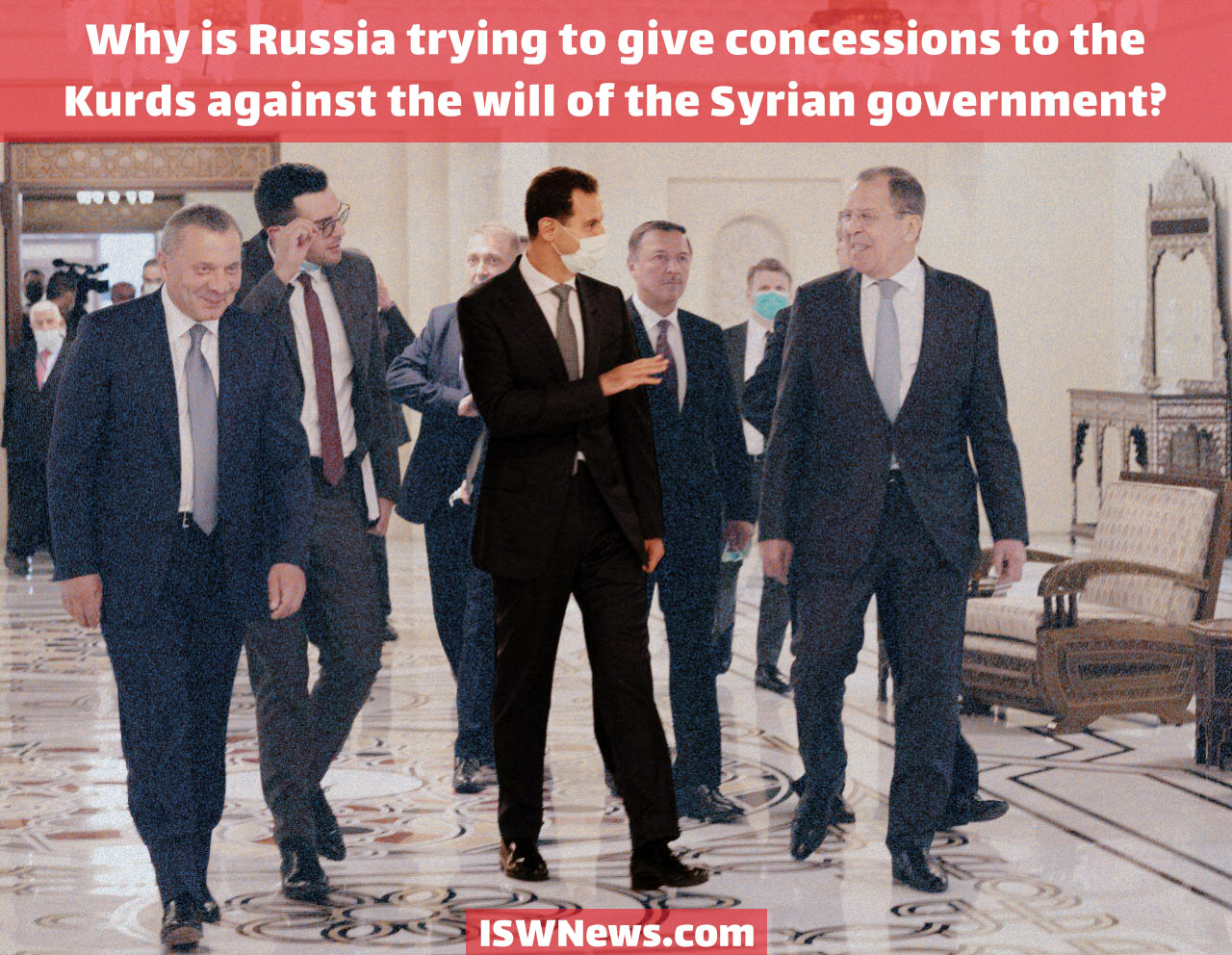
  • Why is Russia trying to give concessions to the Kurds against the will of the Syrian government?

    Why is Russia trying to give concessions to the Kurds against the will of the Syrian government?

    Since the beginning of the Syrian crisis, Russia, as a permanent member of the Security Council, has played a positive role in resolving the crisis. Until 2015, which was the time of Russia’s military intervention in the US-led war against Syria as one of the most important members of the Axis of Resistance, the role of this permanent member of the Security Council was merely to veto US and European resolutions against the Damascus government. Russia in cooperation with China has vetoed six of the seven Security Council resolutions against Syria since the crisis began in early 2011.

    Russia’s influence, however, increased dramatically after it entered the arena of the Syrian crisis in 2015, and in addition to the political sphere, it also extended to the military and economic spheres. There are various reasons for Russia’s involvement in the Syrian crisis, including the existence of a Russian naval base in the Syrian port of Tartus, confrontation with the US monopoly system, economic benefits including the activities of Russian oil and gas companies before the crisis in Syria, and Russia’s efforts to explore for gas in the Mediterranean to compete with competitors such as; Turkey, Israel, Greece and Egypt for exporting to Europe, as well as turning Syria into an economic gateway to the Middle East.

    Russia’s entry into the political and economic processes of Syria after the crisis subsides, preserving the structure or Bashar al-Assad?

    Now that the crisis has subsided and sovereignty has been established, the important challenge for the Syrian government and its allies is to rebuild and build political processes to unite to overcome the economic and political crisis. Russia is trying to play an effective role at this time as well.
    In this period, unlike during the war, Russia has commonalities with the Westerners, and that is the emphasis of both sides on the implementation of Resolution 2254, which in 2015 was not vetoed and approved by the Security Council, unlike other resolutions. The subject of this resolution is the creation of a political process in Syria for the transition period and the formation of a new constitution and political structure.
    The biggest weakness of this resolution is that it does not mention the fate of Bashar al-Assad.
    Russia also seems to agree with the policy of maintaining structure and changing the individual in order to attract capital for the reconstruction of Syria and to make a deal with the West. This is exactly the opposite of Iran’s position, which is to emphasize the preservation of Bashar al-Assad as a symbol of resistance and unity in Syria despite political reforms. Russia’s position was also reflected in the recent visit of a high-level delegation to Syria, emphasizing the need to hold elections under the new constitution, which, of course, was opposed by the Syrian government.

    Efforts to become international mediators and oil deals, most important Russian incentives to resolve Bashar al-Assad dispute with Kurds

    Another issue that Russia is trying to resolve in the Syrian political process by playing the role of mediator is the differences between the Syrian government and the Kurds. After the crisis in Syria began, the Kurds tried to secede from Syria and form an independent government, using the weakness of the government as well as US support; This issue was reduced to the formation of an autonomous region after the Turkish invasion and the lack of US support and support from the Syrian army. In fact, the Kurds realized that they could not survive without the support of the Syrian government. After the disappointment of the United States, the Kurds turned to Russia to solve their problems with the Syrian government and gain concessions from it, so that they might be able to use its influence in the Syrian government to gain concessions in the autonomous region.

    In this regard, a week before the Russian delegation’s visit to Syria, two Syrian Kurdish parties traveled to Moscow and signed an important five-point agreement there. The agreement, which was ratified by Russia, emphasizes the creation of a decentralized political system (creation of autonomous regions), work on Resolution 2254, the entry of Kurds into the Syrian constitutional negotiations, and the integration of Kurdish forces into the Syrian army. The agreement was one of the main points of Lavrov’s meetings with Bashar al-Assad and Syrian Foreign Minister Walid Muallem. Why Russia is trying to resolve the differences between the Kurds and the Syrian central government by granting them concessions does not seem to have a complicated answer. One of the reasons for this is the existence of oil resources in the Kurdish regions, which Russia has also signed agreements with the Syrian government to explore and extract, but due to the presence of the Americans, it is not possible to implement these agreements. In fact, the Russians are trying to drive the United States out of the region and gain economic benefits by making peace between the Kurds and the Syrian government.

    Russia is also trying to become an influential and trusted mediator in the world by resolving such issues politically. Another reason that can be mentioned in this issue; Russia’s efforts to build trust with the West to cooperate with Russia’s policies include efforts to rebuild Syria. In fact, Russia sees this as a concession to the West that they are willing to invest in Syria in return.
    So far, Russia has not been able to succeed due to the opposition of the Syrian government, but it remains to be seen whether in the future, with increasing economic pressures and in the absence of a cohesive economic and political presence of an important ally such as Iran, Bashar al-Assad’s government will be able to resist Russian policies or not.

  • Important visit of the Russian delegation to Damascus

    Important visit of the Russian delegation to Damascus

    A high-level Russian delegation arrived in the Syrian capital, Damascus, on Monday headed by Russian Foreign Minister Sergei Lavrov and Russian Deputy Prime Minister Yuri Borisov.
    During the meeting, possible new agreements between the two countries and the reduction of the effects of Western sanctions against Syria were discussed.

  • The first joint Russian-Turkish military exercise in Syria

    The first joint Russian-Turkish military exercise in Syria

    According to the Hmeimim Center for Reconciliation in Syria, the joint military exercise was held in the Tarnbah area west of Saraqeb, with the aim of countering terrorist groups blocking the ceasefire process in the southern region of Idlib.
    Exercises included joint fire targeting of sabotage groups affiliated with armed groups that refuse reconciliation, withdrawing damaged military equipment and providing medical assistance to the injured.

    Recently, joint Russian-Turkish military patrols in southern Idlib have come under increasing suicide terrorist bombing and roadside bombs, and the Turkish and Russian armies have suffered casualties and material losses, and the continuation of these sabotages can completely destroy the ceasefire in the south of Idlib.

  • Russian president Vladimir Putin talked on phone with Azerbaijan president

    Russian president Vladimir Putin talked on phone with Azerbaijan president

    As mentioned before, following the joint military drill of Turkey and Azerbaijan and dismissing pro-Russia officials in Azerbaijan, Baku needed to get confidence of Russia back.
    Moscow rejected Yereavn ‘s proposal of a joint military drill a while ago.