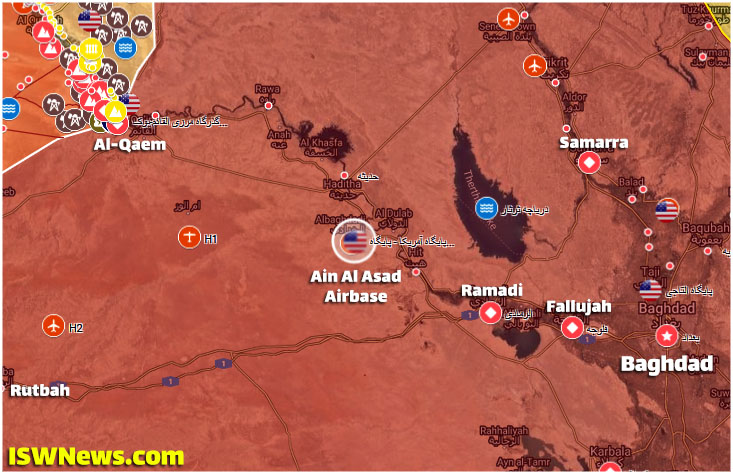
This morning, a suicide drone entered the airspace of Ain Al Asad Airbase, and US defense systems were activated to intercept the drone. According to the US Coalition, the attack took place at around 1.46 am and the coalition was able to shoot down the drone.
According to data obtained by ISWNews, this is the 63rd attack by Iraqi resistance groups on US assets in Iraq in 2022.
On April 7, Hebrew media reported gunshots being heard on Tel Aviv’s Dizengoff Street. Minutes later, it was revealed that an unknown person had fired at the Israelis with a firearm and then fled the scene. As result of the attack, two Israelis were killed and 15 others were injured. Later, Hebrew sources stated that another Israeli succumbed to his injuries in the shooting attack in Dizengoff Street.
After the incident, hundreds of soldiers and security forces took to the streets of Tel Aviv after Israeli police declared the incident a terrorist act. Israel officials said over 1,000 members of the Israeli police, army special forces and the Shin Bet intelligence service were involved in a search operation to find the perpetrator of the shooting.
The operation was carried out by a 29-year-old Palestinian named “Raad Fathi Hazem” from Jenin. After hours of pursuit, he escaped from Dizengoff to Jaffa and was shot dead by Israeli forces.
Investigators inspect the scene where the armed attack took place in central Tel Aviv, April 7, 2022. AHMAD GHARABLI / AFP
The Hamas Islamic Resistance Movement, in a statement congratulating and condoling the martyrdom of Palestinian hero Raad Hazem, stressed that the resistance in Palestine will continue until the end of the occupation. Lebanese Hezbollah also congratulated the heroic operation in Tel Aviv in a statement: “We call on all the free people of the world and the Islamic and Arab Ummah to stand by the Palestinian people and support them.”
The first moments of shooting operation in Tel Aviv
CCTV footage showed people drinking then suddenly dashing away at the moment of the attack, overturning chairs in the scramble to escape. Video from Dizengoff Street showed people running away as emergency vehicles poured into the area, sirens wailing.
The two people killed were named as Eytam Magini and Tomer Morad, both aged 27.
Three Israeli who were killed in Tel Aviv shootingRaad Hazem was shot dead by Israeli forces in Jaffa
The report says it’s believed that Hazem prayed at the mosque on Yefet Street in Jaffa before going on his mission. Hazem returned to the area of the mosque after the attack. After a massive manhunt, he was located hours later, hiding near a mosque and was killed in an exchange of fire with officers from the Yamam forces and Shin Bet security service.
Raad Fathi Hazem
It should be noted that 14 Israelis have been killed in recent weeks by the Palestinian operations in the occupied territories. This is the deadliest period of attacks against the Israeli occupiers since 2006. The Palestinian operation is being carried out successfully while the Israeli regime is on full alert and has recently launched a special security operation to counter Palestinian attacks in the occupied territories. Thus, the failure of the Israeli regime to prevent such operations has created a severe wave of fear and anxiety in Tel Aviv and other occupied areas. A new chapter of operations against the Israeli occupiers seems to have begun, and with the approach of Eid al-Fitr and the Christian and Jewish holidays, we are witnessing an increase in operations and Israeli casualties.
This morning, April 7, Mansour Hadi, after a decade in charge of the Yemeni government and opposition movements, announced the transfer of his powers to the Presidential Council headed by Rashad Al-Alimi.
The members of this council are: 1- Aidarus al-Zoubaidi (Chairman of the Southern Transitional Council) 2- Sultan Al-Aradeh (Governor of Marib) 3- Tariq Saleh (nephew of Ali Abdullah Saleh and commander of the Patriotic Resistance Forces) 4- Abdul Rahman Abu Zara’a Al-Muharrami (Commander of Al-Amaliqa Forces) 5- Abdullah Al-Alimi (Head of President Mansour Hadi’s Office) 6- Osman Hussein Majli (member of the People’s Congress Party and Minister of Agriculture of the resigned Yemeni government) 7- Faraj Salmin Al-Bahsani (Governor of Hadramaut)
According to this action, the Presidential Council, having the powers of the President and the First Vice President, is responsible for carrying out the duties of the transitional period according to the initiative of the Persian Gulf Cooperation Council.
Mansour Hadi had previously fired his first deputy, Ali Mohsen al-Ahmar. Al-Ahmar is wanted by Ansar Allah on charges of suppressing the Yemeni revolution and collaborating with the Saudi intelligence service in establishing al-Qaeda, Ansar al-Sharia and ISIS terrorist groups in Yemen.
In his recent speeches, Mansour Hadi stressed the need to rely on the results of the National Dialogue Conference in 2013 and 2014, the Persian Gulf Cooperation Council initiative and the UN Security Council resolution in 2015. These plans have been among the points of contention in previous years’ negotiations with Ansar Allah.
The reaction of “Mohammed Al-Bukhaiti”, the governor of Dhamar and one of the field commanders of Ansar Allah, to the resignation of Mansour Hadi and the formation of the presidential council: “Before the start of the war, we proposed the formation of a presidential council, agreeing on all the political components to implement the main components (of the government). Were it not for the aggression announced under the pretext of restoring the legitimacy of the Hadi government, we would have almost reached an agreement and they would not have refused to form a presidential council. Now, after eight years of war, the United States has overthrown Hadi, formed a presidential council and put its first agent in Yemen at the helm.”
Ansar Allah spokesman and head of negotiations for the Yemeni Salvation Government, Mohammed AbdulSalam, in response to the resignation of Mansour Hadi and the formation of the Presidential Council: “The present and the future of Yemen are determined inside Yemen, and any activity outside its borders is a ridiculous show and entertainment for the aggressor countries. The way to peace is to stop the aggression, remove the siege and withdraw the foreign forces, and without it there is a futile attempt to reorganize the mercenaries to lead them to more tension and war. The Yemeni people have no worries about illegal actions outside the borders of their country by an illegal party (Saudi Arabia).”
This morning, a US coalition military base in the Omar oil field in eastern Deir Ezzor province was targeted by three Katyusha rockets.
The Syrian Democratic Forces (SDF) claimed that Syrian Army forces and their allies targeted the US coalition base at the Omar oil field. So far, no group has claimed responsibility for the attack.
The rocket attack came after more than 40 armored vehicles, ten personnel carriers and ten tanks escorted by four American helicopters entered the base yesterday. This is the first time that the American coalition is transporting such a convoy with this number of vehicles and equipment to its military base in the Omar oil field.
According to initial reports, the Turkish army’s Bashiqa military base in the Zelkan area, north of Mosul, was targeted by eight rocket rockets. The base’s telecommunications center is said to have been damaged in the attack.
Ahrar Sinjar claimed responsibility for the attack.
Following the announcement, the Hebrew media also confirmed that the group intended to publish documents regarding the assassination of the President of Kazakhstan and the destructive role of Israel in the country. Hebrew media claim that the “Open Hands” group is an Iranian hacker group.
Some time ago, the hacker group “Open Hands” published information about the current head of Mossad in a video, and this revelation made their name known. According to the group, the leak of Mossad chief information is the result of covert intelligence gathering operations against Israeli targets, including senior officials of the sensitive security and military apparatuses, from a long time ago.
It should be noted that in recent months, various hacking groups have published important and secret files of sensitive institutions, organizations and security companies of the Zionist regime. An issue that has seriously questioned the Israeli regime’s cyber security.
The Ayn al-Ansaniyah Research and Statistics Center has released statistics on the crimes and atrocities committed by the Saudi coalition against Yemen during the 2555 days of war.
Statistics of the Saudi coalition aggression on Yemen after 2555 days: The total number of martyrs and wounded is 46,262, of which 17,734 are martyrs, of which 2434 are women and 4017 are children. 26931 people were injured, of which 2910 were women and 4586 were children.
In the past 2555 days, the Saudi coalition has destroyed 15 airports, 16 ports, 340 power stations and generators, and 609 networks and communication stations. Also, 2799 reservoirs and water distribution system, 2091 government facilities and 6743 bridges and roads were targeted or destroyed.
The number of destroyed and damaged factories reached to 404. 378 fuel tankers, 11901 business establishments, 433 poultry and livestock, 9770 transport means, 482 fishing boats, 999 food stores, 416 fuel stations, 696 markets and 965 food trucks were destroyed and damaged.
The number of destroyed and damaged civilian houses has reached 590,069. 182 university centers, 1612 mosques, 375 tourist centers and 410 hospitals and health centers were destroyed and damaged. The Saudi coalition attacks also destroyed and damaged 1214 schools and institutes, 9721 agricultural lands, 139 sports facilities, 253 historical sites and 60 media centers were destroyed and damaged.
The spokesman for the Yemen Armed Forces, Brigadier General Yahya al-Sari’, on the occasion of National Resistance Day presented the statistics of seven years of fighting with the Saudi coalition.
General Yahya al-Sari’: “Today, we are still standing on the eve of the eighth year of steadfastness and after seven years of resistance. This is a historic achievement that the children of a free Yemen have achieved with the help of God. In this battle, tens of thousands have been martyred and wounded, and millions of people have been affected by the enmity and siege of the enemies, and these sacrifices will not be lost, and we will fulfill our covenant with the martyrs and there will be no retreat from our achievements. On March 26, 2015, the Yemenis were surprised by the enemy’s all-out military offensive on land, sea and air. The aggression in the first year was at an unprecedented rate, and in that year the armed forces were unable to monitor the various attacks of the enemy due to the large number of attacks. We faced 100 to 400 airstrikes in one day, and in addition to the bombing, the invasion from the sea and border areas continued fiercely. The total number of air strikes that the armed forces managed to observe is 274,243.
We do not forget the scenes of horrific massacres. We do not forget the scenes of our children when they are pulled out from under the rubbles. We do not forget the murder scenes of our women. We will never forget the tears of the mothers of the martyrs. We will not forget the horrible crimes of what has happened to us and what is happening to us. Proud and lofty homeland, Yemen… Yes Yemen… We will not forget the history, identity, culture, economy and foundations of Yemen.
Despite the pain and terror created by the enemy, we did not cry! But we shouted. From American crimes in the region and their stupid mercenaries like: criminal Saudi and others in Abu Dhabi and other countries. We have not seen anything in Yemen except American bombs and use of prohibited weapons. Stop interfering in the internal affairs of Yemen, in order to gain security. Security must be for everyone!
The Armed Forces, with the help of God Almighty, carried out more than 13,208 military operations during the battle to counter the brutal aggression, of which 6,681 were offensive operations and 6,527 were repelling and neutralizing enemy attacks. Among our most prominent military operations are Operation Nasr Min Allah in three phases, a large military operation whose details have not been announced, Operation Bonyan al-Marsous, Operation Famkana Minhom, Baas al-Shadid, Operation Rabi al-Intisar, Operation Al-Bayda, Al-Dhala, Shabwa, Marib, Operation Deterrence Balance, Operation Aasar al-Yemen (Storm of Yemen) in three phases, Operation Kasra Al-Hesar (breaking the siege of Yemen) in three phases, and ten other operations, the details of which have not been disclosed.
Yemen Armed forces operations have killed and wounded 10,759 members of the Saudi army, 1,251 members of the UAE army, 9,440 Sudanese mercenaries and more than 253,693 Yemeni mercenaries.
More than 17,397 vehicles, armored vehicles, personnel carriers, tanks, bulldozers and military machinery were destroyed and set on fire. Of these operations, 10518 operations have been documented visually.
The missile force conducted 1,826 military operations, including 1,237 operations inside Yemen and 589 operations outside Yemen.
The number of operations of the Air Force UAV unit is 11562 operations, which includes 2176 operations inside and 953 operations outside Yemen and 8433 reconnaissance operations.
The operations of the Air Defense Forces are 4221 operations, of which 1971 operations led to enemy aircraft destruction and losses, and 2250 operations that forced the enemy aircraft to withdraw. Air defense operations have resulted in the downing of 158 UAVs, 13 fighter jets, 10 Apache helicopters, and 6 military transport helicopters. 34 American drones and 95 spy drones were destroyed.
The Navy and Coast Guard conducted 35 operations during the seven-year battle, the most important of which were attacks on the Saudi Medinah Frigate, the Saudi-owned Dammam Frigate, and the UAE HSV-2 Swift warship, as well as the seizure of the UAE-owned Ravi military cargo ship in the Yemeni waters.
The total number of operations carried out by the ground forces are 211,136. In these operations, the engineering unit has performed 52,175 operations, including 22,854 operations against enemy gatherings, 24,907 offensive and defensive operations and targeting enemy fortifications, and 4414 operations of enemy armored and military vehicles.
The anti-armor unit carried out 7412 operations, including 2689 operations against enemy fortifications, gatherings and barracks, and 4723 attacks against military and armored vehicles.
The artillery unit carried out 85,634 operations, including 1,150 joint operations with UAVs, 15,269 operations with Zilzal-1 missiles, which resulted in fires, damage and destruction of more than 1,078 vehicles, armor, tanks, artillery, rocket launchers and weapons depots.
The total operations of the sniper units since entering the battles has reached 65,915 operations. Over the past two years, this unit has been able to increase its presence on the northern and eastern fronts and, with God’s help, has achieved significant achievements. Since the unit became active, 941 Saudi soldiers, 1,127 Sudanese mercenaries and 54,417 Yemeni mercenaries have been attacked. Also, 9298 attacks on armored and military vehicles, 124 enemy snipers and 8 UAVs were attacked by the sniper unit.
The Yemeni people and armed forces are using their legal right to defend themselves against foreign aggression and will continue to defend their land, sovereignty and independence. It does not matter what our cost is, what matters is the cost to the enemies. The Yemeni Armed Forces, with God’s help, are conducting a test operation for new quality weapons that will enter the battlefield in the next phase. We renew our covenant with God and promise the oppressed and victorious people that, God willing, the eighth year will see a quality military operation that will lead to the further liberation of the occupied territories and the enemy’s territory. Our target bank will include the aggressors’ assets and its most prominent vital features. The Armed Forces calls on all the free people of Yemen to fully preserve the achievements of the past years and to build on them as the resistance continues until freedom and independence are achieved.
According to Hans Grundberg, the UN special envoy to Yemen, Ansar Allah and Mansour Hadi’s ousted government agreed to a UN proposal for a temporary ceasefire. This agreement will be effective from 7 pm on April 2 until June 2, 2020 and can be extended.
The details of this temporary ceasefire agreement are as follows:
1- According to this agreement, all ground, air and naval military operations inside and outside Yemen will be stopped. 2- 18 ships, including oil tankers, will arrive at Al-Hudaydah port within two months. 3- Sanaa Airport will have a total of 16 commercial flights with Jordan and Egypt during this period. 4- Exchange of all prisoners of war between the two sides, including foreign prisoners.
Coinciding with the implementation of the agreement, the United Nations has called on the Yemeni side to begin negotiations to reopen the blocked routes in Taiz, Marib, Al-Jawf and other provinces to facilitate the movement of civilians. If the ceasefire is successful, the Yemeni side can consider the next steps.
One day after the implementation of the ceasefire agreement, in the last 48 hours, 167 ceasefire violations in Al-Hudaydah province, 7 attacks on the fronts of Saada province, 2 attacks in Hajjah province, 2 attacks in Taiz province, 3 attacks in Al-Jawf And one case occurred in Al-Bayda province. In the most prominent case of ceasefire violation, the Saudi coalition has killed three civilians in an artillery attack on Shada district in Saada province. The Saudi-affiliated media have also claimed that Ansar Allah attacked the positions of the Saudi coalition forces on the Taiz and Al-Hudaydah fronts during the past hours.
Despite the ceasefire violation, the Cylinder Sapphire tanker, carrying diesel fuel, arrived in the port of Al-Hudaydah after a 88-day detention.
In general, the Saudi coalition and the Yemeni armed forces have supported the agreement and committed themselves to a ceasefire. Iran, the United States, Oman and other countries have also welcomed the ceasefire. But what threatens this agreement is its time limit.