Tag: Armenia

  • Border conflict between Azerbaijan and Armenia

    Border conflict between Azerbaijan and Armenia

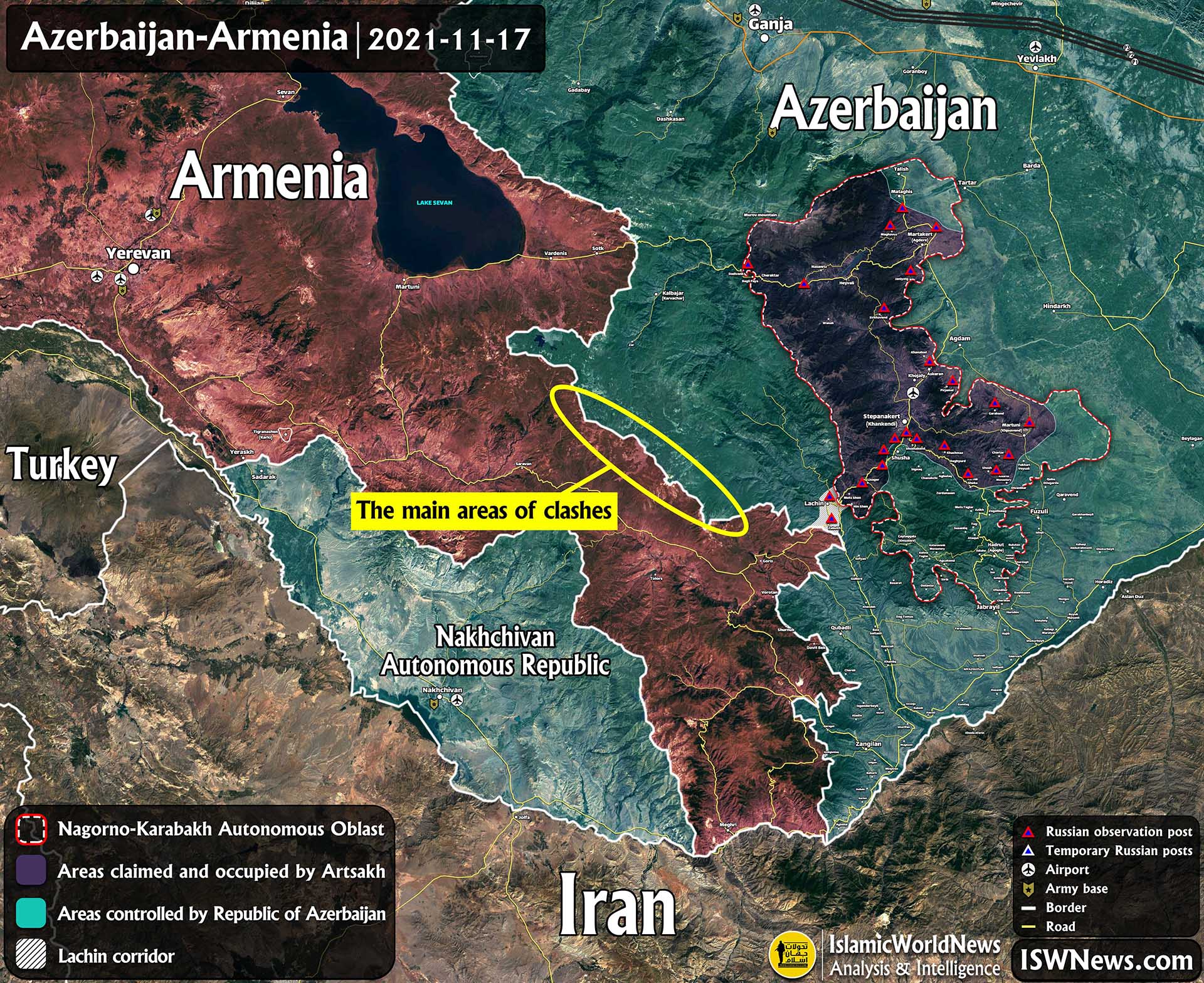
    According to the field evidence, on November 16, the Azerbaijani military, in violation of the peace agreement advanced on several border points in the Armenian province of Syunik, But in the aftermath of the aggression, they faced a strong response by the Armenian military.

    The clashes between Azerbaijan and Armenia started at about 1 pm and ended with the mediation of Russia and the declaration of a ceasefire at 5:30 pm (local time). During these conflicts, two Armenian military points were occupied by Azerbaijan.

    According to a statement from the Armenian Ministry of Defense, one Armenian soldier was killed, 13 captured and 24 others were missing during the clashes. Also, according to the information provided by the Azerbaijan Ministry of Defense, 7 Azerbaijani servicemen were killed and 10 others were wounded.

    Following the clashes, the Iranian Foreign Ministry, the Russian Ministry of Defense and the United Nations issued messages calling for restraint on both sides and the de-escalation of the clashes. While emphasizing respect for international borders, the Iranian Foreign Ministry spokesman announced Iran’s readiness to help resolve the disputes between the Republic of Azerbaijan and Armenia peacefully. In this regard, the presidents of Iran and Russia during a telephone conversation stressed the need not to change the political geography of the Caucasus region.

    Armenian Security Council Secretary Armen Grigoryan also called for Russia’s protection of Armenian territory under the 1997 agreement in an interview. Grigoryan went on to say that if the crisis is not resolved through Russia and the CSTO, they will ask for help from other international partners.

    This afternoon, in order to reduce tensions between Azerbaijan and Armenia, Deputy Commander of the Southern Military District of the Russian Federation and Commander of the Russian Peacekeeping Forces in Nagorno-Karabakh, Lieutenant General Rustam Muradov, transferred the body of the Armenian soldier who was killed in November 16th battles from Baku to Yerevan.

    In the autumn of 2020, the Republic of Azerbaijan launched a large-scale military operation with the full support of Turkey and the Israeli regime with the aim of full control over the Karabakh. In a 44-day period from September 27 to November 10, Azerbaijan has managed to control about 50 percent of the territory, including parts of the south (inside) of the Nagorno-Karabakh Autonomous Region, as well as the occupied territories around the Nagorno-Karabakh Autonomous Region. Subsequently, in accordance with the peace agreement reached between Azerbaijan and Armenia, the regions of Aqdam, Kalbajar and Lachin were handed over to the government of Azerbaijan.

    Read more: Official announcement of the end of the war between Armenia and Azerbaijan!

    The Peace Agreement consists of nine main clauses; However, the different interpretations of Azerbaijan and Armenia from the ninth paragraph of this agreement have prevented the achievement of a lasting peace. By exploiting this clause, the Baku government is also trying to fulfill its illegitimate demands, using this issue as a pretext to create an illegal corridor called the Zangezur Corridor or to occupy the Armenian province of Syunik.

    Read more on the topic:
    The peace agreement between Azerbaijan and Armenia; Who is the winner of this conflict?
    Latest Updates on Karabakh, 18 December 2020 (Map Update)

    Click to see the full size map
  • Three Armenian soldiers killed at Kalbajar border

    Three Armenian soldiers killed at Kalbajar border

    Both sides media reported of heavy border conflicts on Wednesday 28 July. Two neighbors accuse each other of intensifying the tensions. The conflict enters the fifth day.

    Armenia DM claims that three soldiers killed due to shooting and artillery shelling of Azerbaijan and four wounded. They also claim Azerbaijan army entered Armenia soil in two points in Gegharkunik province.

    Azerbaijan DM issued a statement on Wednesday that Armenia shot on Azerbaijan positions using mortars and tanks. According to Azerbaijan DM two soldiers wounded by Armenia bullets.

    Independent sources confirmed that Azerbaijan used guided artillery shells and Turkish built Bayraktar drones.

    Most of the conflict occured near Vardenis town in Gegharkunik province of Armenia and near borer with Kalbajar province of Azerbaijan. Azerbaijan calls Vardenis town as Basarkeçər which is part of Azeri inhabited of Yeraz people.

    It is noteworthy that in the last two years of Soviet time, Azeri inhabitants of the area were migrated to Azerbaijan due to racial segregation of Armenia in 1988.

  • Azerbaijani drone strikes at Nakhchivan border

    Azerbaijani drone strikes at Nakhchivan border

    According to the field information, the (Turkish) Bayraktar drones of the Azerbaijani army attacked several targets in the Yeraskh area of Ararat and on the border with Sadarak in Nakhchivan.

    On the other hand, Armenian sources claim that they shot down an Azerbaijani drone invading their country.

    It is worth mentioning that these tensions continue in the wake of yesterday’s clashes and exchange of fire on the border between Kalbajar and Gegharkunik.

  • Rising border tensions between Azerbaijan and Armenia; An Azerbaijani soldier killed

    Rising border tensions between Azerbaijan and Armenia; An Azerbaijani soldier killed

    The Azerbaijan Ministry of Defense has accused the Armenian side of starting a conflict on the evening of Friday, July 23, in the village of Bazaar Kichar in Kalbajar. According to Azerbaijani sources, an Azerbaijani soldier was shot dead by an Armenian sniper at 4 pm local time and the Azerbaijani army responded to the fire.
    Confirming the conflict, the Armenian Defense Ministry said the Armenia was not the initiator of the incident and that three Armenian soldiers were wounded by Azerbaijani artillery.

    Rayon (district) Kalbajar is located in the neighborhood of Gegharkunik province of Armenia and was evacuated by Armenia during the Second Karabakh War and after the implementing of the ceasefire agreement. Determining the border in this mountainous and highlands is one of the challenges between the two countries. Armenia claims that Azerbaijan has crossed the border lines of the Gegharkunik region at two points and occupied part of the heights in this region.
    After the collapse of the former Soviet Union and the war between the two countries, the border between the two countries has not been demarcated and there are no border posts. The recent tensions are taking place while clashes are reported in other parts of the country.

  • Historical meeting of presidents of Russia, Azerbaijan and Armenia; New chapter of collaboration in Caucasus

    Historical meeting of presidents of Russia, Azerbaijan and Armenia; New chapter of collaboration in Caucasus

    It was an interesting meeting specially after a 44 days war, in which more than six thousand people killed in Karabakh and then Aliyev and Pashinyan met like two good boys with their boss Putin and listened to him.

    Following this four hours meeting, three countries unveiled a joint statement to create a list of joint projects to open the borders. There are not much details regarding the new agreement but it is in the same direction as the previous Karabakh ceasefire agreement.

    Pashinyan spokesperson said before the meeting that important projects already are being investigated and talked over, one of which is to permit Armenia to cross Nakhchivan and transit to Iran, as well as using the railroad built in USSR era which was used to connect Yerevan to the southern regions of Armenia.

    According to this trilateral agreement, each country forms a committee of specialists led by the vice PMs to make a list of joint projects for the leaders of the countries.

    Russian paper Kommersant released a railroad map of Caucasus two days ago, which was the same railroad built in USSR era and was closed since the first Karabakh war in 1990. It is going to be open with the new agreement.

    Regarding opening this important railroad, which is one of the articles in Karabakh ceasefire agreement, we have mentioned in previous articles. Following Karabakh ceasefire agreement, some claimed the southern corridor means to cut Iran-Armenia border, which was wrong from the beginning.

    This railroad will connect Armenia to Russia through Azerbaijan and will be used for transit to Iran as well. On the other hand Azerbaijan will connect to Nakhchivan area and Turkey through Armenia.

    This new agreement will have huge impact on different aspects of Caucasus area and each side will get benefited. Although Putin said that the agreement will be useful for all the countries of Caucasus but obviously not on the same level.

    Russia and Turkey undoubtedly will get the most of it. Russia restored its hegemony after a 30 years period of weak presence in the area and Turkey as a new player in the Karabakh, has greatly strengthened its foothold in the region and will strengthen its ties with Central Asian countries by connecting the Caspian Sea; Azerbaijan, while regaining its vast occupied territories in the south of Karabakh, was directly connected to the Nakhchivan region and of course to Turkey, and largely overcame the previous problems; Armenia will also benefit from direct connection to Russia and better connection to Iran, and by opening its western border with Turkey will benefit from trades with this country too. And finally, Iran, as the civilization and cultural owner of the Karabakh region, will have the least benefit from the events in Karabakh and the reopening of a new transit route; and Iran political and economic influence in the Karabakh region will be greatly reduced.

  • Latest Updates on Karabakh, 28 December 2020 (Map Update)

    Latest Updates on Karabakh, 28 December 2020 (Map Update)

    – According to the information provided by the Ministry of Defense of Azerbaijan, a group of Azerbaijani soldiers in the Hadrut region was attacked by a group of 6 Armenian forces. It is said that these forces were those who had not withdrawn from the area. The Azerbaijani Defense Ministry said that all Armenian forces were killed in the incident, and that one Azerbaijani soldier was killed and another was wounded.
    On the other hand, the Artsakh Ministry of Defense rejected Azerbaijan’s claim, stating that no military clashes had taken place between Armenian and Azeri forces in the past two days, and that Azerbaijan’s claim was false and propaganda.

    – According to information of Russian Ministry of Defense, more than 300 hectares of Karabakh land and 120 km of roads are cleansed from mines and booby traps and 12000 explosive objects were found and destroyed.

    – According to Russian Ministry of Defense, since the ceasefire in Karabakh around 44600 of Armenian inhabitants of Karabakh returned to their homes.

    – Russian Foreign Minister Sergey Lavrov spoke by telephone with Armenian Foreign Minister Ara Ayvazyan about the Nagorno-Karabakh refugees and the implementation of the Nagorno-Karabakh ceasefire.

    – The joint Turkish-Russian ceasefire monitoring center is expected to start working in January 2021 in the Agdam.

    – The Ministry of Defense of Artsakh released the names of 47 other Armenian soldiers who lost their lives in the battles of Nagorno-Karabakh.

    – The representatives of the Azerbaijani military entered the area between Vorotan and Shurnuk in south of Goris for demarcation of the border. Azerbaijani forces have asked the residents of the village of Vorotan to leave the Azerbaijani part of the village.

    – The Secretary of the Security Council of Nagorno-Karabakh (Artsakh) Vitaly Balasanyan announced that together with Armenia and Russia, we will return the areas lost in the Karabakh war.
    “I want to assure my people that we will do this. There are victories and defeats during military operations. We did not lose, we did not kneel,” Balasanyan said. He added the Artsakh forces would operate in Nagorno-Karabakh under the control of the Nagorno-Karabakh Security Council.

    – Azerbaijan Ministry of Defense released photos, names, surnames and information of 2823 Azerbaijani soldiers who were killed in Karabakh war.

    – 4 Armenian and 2 Azerbaijani POWs have been exchanged between the two countries by Russian mediation, according to General Rustam Muradov, commander of the contingent of Russian peacekeepers in Karabakh.

    – 3 Azerbaijani soldiers were reportedly injured by an anti-tank mine blast near Hadrut.

    Click to see the full size map

  • New attack of Azerbaijan on the last remaining Armenian forces in the south of Shusha (Map Update)

    New attack of Azerbaijan on the last remaining Armenian forces in the south of Shusha (Map Update)

    In the last 24 hours, the Azerbaijani forces attacked the positions of the Armenian forces in the areas of Hin Taglar and Khtsaberd (Caylaqqala) and managed to take control of the village of Hin Taglar, but after several hours of fighting and Russian intervention, these clashes have now stopped.

    This is the first ceasefire violation in Nagorno-Karabakh since the Azerbaijan-Armenia peace agreement.

    According to the information provided by Azerbaijan, 4 Azerbaijani soldiers lost their lives and 2 others were wounded as a result of these clashes. Six Armenian troops were also wounded in the fighting. At least three Armenian troops are said to have been killed in the clashes, but Armenian officials have denied the allegations.

    The importance of these areas for the Armenian inhabitants of Nagorno-Karabakh is mostly for the Katarovank Monastery on the heights of the Mount Dizapayt.
    During the advance of the Azerbaijani forces in the south of Shusha and until the peace agreement between Azerbaijan and Armenia in Nagorno Karabakh, these areas were still under the control of the Armenian forces and after the peace agreement the Armenian forces did not withdraw from these areas.

    Katarovank Monastery on the heights of the Dizapayt Mountain

    The situation of Katarovank Monastery and the surrounding areas, as well as some border points in Qobadli and Zangilan districts, is one of the ambiguous points of the Nagorno-Karabakh peace agreement, which was never mentioned in the text of the agreement, and this issue is now problematic.

    Green hached: Areas under the control of Armenian forces and their final status is still unknown.

    It is not yet clear what the situation in these areas will be and whether these areas will be returned to the Republic of Azerbaijan. There are also reports that Azerbaijan has threatened Armenian forces to withdraw from the mountainous areas north of Qaragul (in Rayun Zangilan); Otherwise, Azerbaijan will force them to retreat.

    Areas from which Azerbaijan wants the withdrawal of Armenian forces.

    On the other hand, in the latest map published by the Russian Ministry of Defense on the situation in Nagorno-Karabakh, the villages of Hin Taglar and Khtsaberd and the surrounding areas are mentioned as areas that should remain in the possession of the Armenians. This is despite the fact that none of the previous maps of the Russian Ministry of Defense mentioned this issue. Therefore, it seems that there was an agreement between Russia and Azerbaijan behind the scenes to determine the fate of this region.

    Areas mentioned by Russia in the latest published map

    YOUR SUPPORT IS CRITICAL TO KEEP ISWNews ALIVE!

    I’d like to thank readers for their confidence and support. Thanks to your support we can continue to perform our duty on reporting the important events in the region. So If you like our contents, please don’t feel embarrassed to contribute and help our project, for as little as 1 Dollar. Your contribution, however small, will help ensure our project continuity. Thank you.


  • Latest Updates on Karabakh, 1 December 2020

    Latest Updates on Karabakh, 1 December 2020

    – Azerbaijani army forces have entered Lachin district and are spreading in different parts of the region. According to the ceasefire agreement, the Lachin region must be handed over to Azerbaijan by December 1.

    – Russia transferred military equipment and ammunition to Karabakh using Baku-Yevlakh-Barda railway in Azerbaijan. Since the beginning of the ceasefire in Karabakh, Russia has been sending military equipment and ammunition to Karabakh using airlines.

    – The Turkish army sent a unit of deminers to Azerbaijan. These forces are assisting the Azerbaijani army in clearing areas and roads.


    – Since the beginning of the ceasefire, more than 23,000 Armenian refugees who had moved from Karabakh to Armenia have returned to their homes in Karabakh.

    – According to the Russian Ministry of Defense, 24 hectares of land in Karabakh and 8 km of roads have been cleared of mines and explosive traps since the deployment of Russian deminer units in Nagorno-Karabakh. Also, 750 explosive objects were neutralized.

    – The Russian peacekeepers established a special-purpose medical field hospital in Stepanakert Airport, 5 km from Stepanakert city.

  • Latest Updates on Karabakh, 25 Nov 2020 (Map Update)

    Latest Updates on Karabakh, 25 Nov 2020 (Map Update)

    – Azerbaijani army officially entered the Kalbajar region on November 25, in accordance with the ceasefire agreement, and took control of this region.


    – Pictures of the withdrawal of Armenian forces from the Kalbajar area.


    – Armenian forces blew up the Omar border crossing building north of Kalbajar while evacuating Kalbajar.


    – Since the beginning of the ceasefire agreement in Nagorno-Karabakh, more than 11,000 Armenians who fled Nagorno-Karabakh to Armenia have returned to their homes.

    – With 305 votes in favor and 1 against, the French Senate adopted the resolution on the need to recognize the Republic of Artsakh. It should be noted that this resolution is not a bill and is not legally binding. In fact, the resolution calls on the French government to recognize the Republic of Artsakh and could provide the tools needed for future negotiations.

    Click to see the full size map

  • Latest Updates on Karabakh, 24 Nov 2020 (Map Update)

    Latest Updates on Karabakh, 24 Nov 2020 (Map Update)

    – The 10-day extra deadline for evacuating the Kalbajar region expires tomorrow on November 25, and the Azerbaijani army will officially enter the Kalbajar region. According to the ceasefire agreement, the Kalbajar region was to be evacuated and handed over to Azerbaijan by November 15, but at the request of Armenia and with the consent of Azerbaijan, another 10 days were added to this date.

    – The Agdam region was completely handed over to the Azerbaijani army.

    – President of Azerbaijan Ilham Aliyev and his wife visited the city of Agdam.

    – The Russian army sent more than 100 new troops to Nagorno-Karabakh, including 13 units of military and special equipment, including military vehicles and Uran-6 UGV demining vehicles. These forces are responsible for clearing areas and roads of explosive traps and mines.

    – A Russian peacekeeper and four employees of the Ministry of Emergency Situations of the Nagorno-Karabakh Republic (Artsakh) were injured in a mine explosion in the Madaghis region and an Azerbaijani soldier was killed.

    – Since the beginning of the ceasefire agreement in Karabakh, more than 10,000 Armenians who fled Nagorno-Karabakh to Armenia have returned to their homes.

    – In recent days, there have been rumors that Turkey has intended to move the families of Syrian militants to the southern part of Nagorno-Karabakh, which was recently liberated by Azerbaijan. However, so far no evidence has been provided to substantiate this rumor.

    Click to see the full size map
  • Latest Updates on Karabakh, 23 November 2020

    Latest Updates on Karabakh, 23 November 2020

    1- On November 21, the Russian Ministry of Defense announced the completion of the deployment of Russian peacekeepers in the Nagorno-Karabakh region. Russian peacekeepers will be present at 23 permanent observation posts in the Nagorno-Karabakh region to monitor and ensure the implementation of the ceasefire agreement.

    2- According to the provisions of the ceasefire agreement, the Agdam region was to be evacuated from the Armenian forces by November 20 and returned to the Azerbaijani government. In the past few days, the Azerbaijani army entered the destroyed city of Agdam and is currently deploying in the Agdam region.

    3- On November 20, Russian peacekeepers escorted 23 buses and 250 private cars of Armenian civilians returning to Stepanakert. Since the beginning of the ceasefire agreement between Azerbaijan and Armenia, more than 10,000 civilians have returned to Karabakh under the protection of Russian forces.

    4- On November 21, a high-ranking Russian delegation, including the foreign and defense ministers, visited Armenia and Azerbaijan to holding talks with the Prime Minister of Armenia and the President of Azerbaijan.

    5- According to Armenian sources, since the beginning of the ceasefire, the bodies of 350 Armenian soldiers who lost their lives in the Nagorno-Karabakh war have been recovered or exchanged.

    6- On November 22, the Turkish Defense Minister, Holusi Akar announced that Turkish troops deployed in Azerbaijan will participate in the joint ceasefire monitoring center with the Russians for a one year period.

    7- On November 22, Azerbaijan announced that over 120 foreign diplomats visited Fuzuli District of Nagorno-Karabkah. The visit was organized by Azerbaijani authorities.

    8- Nikol Pashinyan at the introductory ceremony of the new Minister of Defense of Armenia to the senior officers of the Armenian Army: “We must analyze the mistakes, and find out where and why we made mistakes. Obviously the military needs reform.”

  • Latest Updates on Karabakh, 19 November 2020

    Latest Updates on Karabakh, 19 November 2020

    – According to information provided by the Russian Ministry of Defense, the number of Russian permanent observation posts in Nagorno-Karabakh are 23 observation posts so far. (Map updated)

    – The evacuation of Agdam region by Armenian forces continues. After the withdrawal of the Armenian forces from the part of Agdam region, the Azerbaijani army entered the city of Agdam.

    – According to information provided by the Russian Ministry of Defense, on November 18, another 936 Armenian escorted by Russian peacekeepers returned to Stepanakert. The total number of people who returned to Stepanakert after the deployment of Russian forces reached 2,600.

    – Russian peacekeeping commander Rustam Muradov visited Lachin corridor.

    – Azerbaijan and Armenia exchanged the bodies of 200 war victims under the supervision of the Red Cross.

    – Armenian Prime Minister Nikol Pashinyan told his supporters that he had no intention of resigning and called for an end to the protests.

    – The Turkish Parliament approved the order to send Turkish troops to a joint monitoring post with Russia in Azerbaijan. The order was signed by the President of Turkey.

    Click to see the full size map