Tag: Peshmerga

  • Pentagon Stops Paying Salaries to Peshmerga Forces

    Pentagon Stops Paying Salaries to Peshmerga Forces

    According to the new U.S. budget law and documents released by the Pentagon, the United States will stop directly paying the salaries of the Peshmerga forces in the Kurdistan Region of Iraq by the end of 2025. Starting in 2026, the central government in Baghdad will be fully responsible for providing salaries for these forces. This decision is part of a broader effort to redefine the U.S. role in Iraq and gradually reduce the coalition mission in the country.

    A memorandum of understanding signed in September 2022 between the U.S. Department of Defense and the Kurdistan Region’s Peshmerga Ministry indicates that the budget for salary payments will gradually decrease, reaching approximately $135 million in 2024, about $60 million in 2025, and ultimately zero in 2026.

    Despite this overall budget reduction in 2026, logistical support for Iraqi forces and the Peshmerga will continue. The Iraqi Ministry of Defense will still receive equipment including communication systems, Hellfire missiles, reconnaissance systems, and logistics services. Additionally, the Iraqi Counter-Terrorism Service will receive a package valued at over $65 million.

    The U.S. decision to suspend payments to the Peshmerga forces marks a significant shift in Washington’s role in Iraq and sends a clear message to transfer security responsibilities to the central government in Baghdad. However, the Peshmerga forces’ financial dependence on foreign aid and the existence of parallel party structures present challenges to this transition. If Baghdad fails to provide salaries for these forces due to budgetary constraints or political disagreements with the Kurdistan Region, the risk of a security gap in northern Iraq may increase, which could have significant regional implications.

  • US Congress Ratifies Plan To Equip Iraq Kurdistan With Air Defense System

    US Congress Ratifies Plan To Equip Iraq Kurdistan With Air Defense System

    ISWNews Analysis Group – The Armed Services Committee of the US House of Representatives approved the amendment, which was proposed by Dan Bacon, on June 21 during the vote on the “National Defense Authorization Act for Fiscal Year 2024”.

    According to Bacon, the amendment enjoys strong bipartisan support and requires the US government’s attempt to prepare and implement a program to train and equip the Iraqi Kurdistan forces in the face of missile, rocket and drone attacks from Iran.

    In response, Iraqi Member of Parliament Jassim Al-Moussawi stated that providing air defense arms to the Peshmerga forces (Kurdish military forces of the autonomous Kurdistan Region of Iraq) is contrary to international law. The MP noted that any internal party or group in Iraq does not have the right to directly engage in sovereignty matters with other countries without informing and involving the central government. Therefore, the decision to arm the Iraqi Kurdistan region is tantamount to interfering in the country’s internal affairs, he added.

    It is worth mentioning that the US has always opposed the Iraqi army’s access to advanced air defense systems to be able to repel foreign attacks.

    The agreement between the US and Iraq’s Kurdistan region, which was made without informing the Baghdad government, sparked several reactions, and some Iraqi legislators expressed criticism, stating that Washington’s decision is translated into violating Iraq’s independence and undermining its internal security.

  • Iraq: Five Peshmerga members were killed by PKK

    Iraq: Five Peshmerga members were killed by PKK

    According to the latest reports, the Peshmerga engineering unit, which was heading to the mountains overlooking the city of Emadiyah to clear and establish a military post, was targeted by a guided missile by the PKK group. Shooting was reported in the area for several hours after the attack.

    Five Peshmerga members were killed and six others were wounded in the attack.

    The PKK militants warned in a statement this morning that the group’s forces are resisting Turkish aggression and called on Peshmerga to refrain from entering PKK-controlled areas of Matina. In another statement, PKK militants said that Barzani’s Peshmerga forces had fired on the PKK militant camp, and that they had responded.

  • Iraq: Peshmerga attack on Hashad al-Shaabi forces

    Iraq: Peshmerga attack on Hashad al-Shaabi forces

    The attack took place shortly after 5 a.m. local time in the Basakhrah area east of Mosul. Peshmerga forces fired an anti-tank missile and opened fire with heavy machine guns on the 30th Hashad al-Shaabi (PMU) brigade in the area. According to preliminary information, one of the PMU member was wounded in the attack.

    Also few hours later, in a separate attack, Peshmerga forces fired another anti-tank missile at PMU positions north of Mosul in the Barimah area.

    An investigation has been launched into the cause of the accident.

  • Latest Updates on Iraq, 14 November 2020

    Latest Updates on Iraq, 14 November 2020

    – Roadside bomb blasted en route Iraq army caravan in Jurf al-Nasr area.

    – Tens of people protested in Baghdad against American forces, demanding them to leave Iraq.

    – A militant group announced in Iraq entitled “Ahl al-Maaruf” with mission of fighting with evil people and centers which sells alcoholic beverages.

    – Iraq and Saudi Arabia joint committee launched to activate the bilateral agreements.
    The members of the joint committee met with Mustafa Al Kadhimi, Iraqi PM, and talked about implementing the agreements and contracts.

    – PKK leaders vehicle targeted by Turkey near Sinjar, west of Mosul.

    – Iraqi armed forces vast operation to cleanse Makhul mountains in north of Saladdin province from ISIS terrorists.

    – Martyrdom of five Hashad al-Ashaeri forces and six civilians due to ISIS attack in Redhwaniyah area, west of Baghdad.

    – Hashad Shabi built an embankment of 120 km length and 3 m height at ‘Ar’ar border until Nakhib with Saudi Arabia.

    – Targeting Iraqi army positions near Tal Manjal village, south of Khanaqin, Diyala province.

    – Two Hashad Shabi and Iraqi police martyred and six Hashad Shabi forces injured in an explosion in Kirkuk province.

    – Iqlim Kurdistan officials: “446 ISIS prisoners are kept in Iqlim prisons from which 398 are convicted in the court and 48 are freed due to lack of evidence. There are 29 teenagers and 23 women among them.”

    – Several new equipment including IFVs worthy of 150 million dollars were donated to Pehmerga forces by USA in an official ceremony in Erbil.
    On 16 September, in an official ceremony in Erbil in presence of US ambassador in Iraq, 250 million dollars of equipment were donated by USA to Pehmerga forces.

    – Iraqi DM traveled to France on Friday to negotiate buying new weapons for the army. Iraq is after French Rafale fighter jets and long range missiles.

    – Abdulamir Yarallah, Iraqi chief of staff, traveling to Saudi Arabia as head of a convoy.

    – Iraqi forces operation “Labbayk ya Rasulallah” launched in deserts of west of Anbar province.

    – Falih al-Fayyadh, commander of Hashad Shabi, traveling to Syria and meeting with Bashar Assad, president of Syria.

    – Online meeting between Iraqi PM and Saudi Arabia crown prince regarding bilateral issues.

    – Two ISIS terrorists killed in Redhwaniyah area, Baghdad.

    – Mustafa Al Kadhimi phone call with Bahrain crown prince.

    – Masrur Barzani, Iqlim Kurdistan PM, investigated bilateral relationship with US energy minister.

    – Saudi Arabia decided to open a trade center in Iraq.

    – Some media reported Iraqi DM plan to visit Iran.

  • PKK militants attack to Peshmerga forces in north of Iraq

    PKK militants attack to Peshmerga forces in north of Iraq

    According to Chamanki officials, the conflict started after an explosion happened en route Peshmerga forces by PKK and continued until today noon.

    In recent weeks there was a war in media and harsh statements against each other. It started after Iqlim Kurdistan and Iraq government agreement over Sanjar, deploying forces by Kurdistan Democratic Party (PDK) led by Masoud Barzani, to areas in Iqlim which are controlled by PKK, and security head of Sarzir border port killed that PDK accused the opponent of it.

    PKK considers Iraq government agreement with PDK and sending Peshmerga troops to north as what Turkey wants. On Wednesday, PKK used the weak point of Iqlim Kurdistan and blew up the oil line of Iqlim to Turkey and took the responsibility in a statement.

    It seems Iqlim Kurdistan has too much political and financial troubles specially many employees and soldiers are unpaid, therefore avoids engaging with PKK. The local government issued a statement condemning the attack and claimed Iqlim Kurdistan considers any Kurdish-Kurdish war as killing brother thus it is their red line.

    A member of the PDK who was killed by the PKK
  • Muqtada Sadr new remarks regarding abolishment of militant groups in Iraq

    Muqtada Sadr new remarks regarding abolishment of militant groups in Iraq

    He said:
    – Kurdish Peshmerga troops are militant and if they are abolished, I abolish Saraya Al Salam, too. I can defend the country against foreign assault. I am ready to coordinate with Masoud Barzani to abolish Peshmerga, Hashad Sha’abi and Saraya Al Salam.
    – “salih_m_iraqi” account is my personal account and no one else has access to it.
    – It was the president who proposed Mohammed Tawfiq Allawi for prime ministry and we support him.
    – Iran told us they don’t want to interfere in Iraq’s affairs and currently they are not interfering.
    – To choose Adil Abdul-Mahdi, I only coalesced with Hadi al-Amiri. I was shocked from Abdul-Mahdi’s performance, he was unsuccessful in all works.
    – Pompeo phone call with Mohammed Tawfiq Allawi is interfering in Iraq’s affairs and of it repeats we oppose Allawi.
    – I ask the new government to prepare for the early election by the end of the year, since early election is victory of the movement and blood of martyrs.

  • Headline of Latest Updates on Iraq in Past Week, 9 February 2019

    Headline of Latest Updates on Iraq in Past Week, 9 February 2019

    – Improvement of Iraq-Iqlim relationship.
    In recent trips and also the most recent visit, Nechirvan Barzani Prime Minister of Iqlim visited Adil Abdul-Mahdi more news of agreement were released.

    They reached agreement to remove customs between them, using local employees at Iqlim borders under observation of central government.
    According to unofficial news, two sides agreed that disputed lands such as Sanjar and Makhmour that Iraqi forces claimed followed by Peshmerga forces retreat to return to them and will be controlled jointly.


    – 132 days after local vote in Iqlim and a lot of tensions, there are news that two major parties (Democratic Party of Iranian Kurdistan and Patriotic Union of Kurdistan) reached an agreement on how to divide positions.

    One important content of the agreement is to reactivate the leadership position of Iqlim, which was suspended last year by parliament after Masoud Barzani resigned.
    Masoud Barzani assigned his own son, Masrour as prime minister and his nephew Nechirvan Barzani as the leader of Iqlim.


    – Local officials of Iqlim participating the ceremony of celebrating the fortieth commemorate of Islamic Republic of Iran at Iran’s consulate in Irbil, which shows the improvement in their relationship.


    – Political and religious personages reacting to Trump’s words regarding US is using its bases in Iraq to survey over Iran and its allies in the region.
    Grand Ayatollah Sistani emphasis that Iraq should not be a mean to oppress and harass neighbors.


    – Mahdi Sumaidaie, Iraqi Sunni Scholar in an interview with Al-Quds Al-Arabi papers, condemning Arab countries’ treachery when USA attacked Iraq, emphasized he is in accordance with Shiite Scholar of Iraq.
    This Scholar calling Iran “World’s Glory” because they are “Islamic Republic”.


    – Clearing operation in northwest of Mosul, west of Anbar and some other areas by joint forces.


    – Artillery attacking ISIS positions in Baghuz area, east of Syria by joint forces of Iraq, specially Hashad Sha’abi with 50 shells.


    – Different Iraqi parties including Fath and Saerun trying to pass a law to reject American soldiers from Iraq.


    – Border passage of Taribil between Iraq and Jordan reopening in presence of Al-Quds Al-Arab, Iraqi Prime Minister and the Jordanian counterpart and agreeing on transporting oil from Kirkuk to Jordan.


    – Spain King visiting Iraq and the pilot of career airplane used the previous flag of Iraq (Baath party flag) by “mistake”.


    – “Tahseen Said Ali Bek”, leader of Yazidis death. He was buried in Iqlim.

  • US Forces Entered Sinjar Mountain, Iraq

    US Forces Entered Sinjar Mountain, Iraq

    On Friday, June 1, the US troops with military vehicle and heavy weapons entered the Sinjar area in western Mosul.


    According to Sinjar Governor Mohammad Khalil, 15 US military armored vehicles arrived in the area after the agreement with the Iraqi government and are now stationed near the Mira hill.

    Khalil said that the intention of the US forces to enter this strategic area is to create a military base in the Sinjar Mountains.


    Sinjar, a town in Nineveh Province of Iraq, is inhabited mainly by Izadi Kurds, with a Muslim Kurdish minority. Its population in 2013 was estimated at 88,023.


    It should be noted that, after Iraqi troops were retook the city and district of Kirkuk in 2017 from the Kurdish Peshmerga forces, US troops were also transferred their military assets to the K1 base in Kirkuk.

    After this US action, there were also reports of the transfer and deployment of a number of other US troops around the city of Tuz Khurmatu, south of the city of Kirkuk.


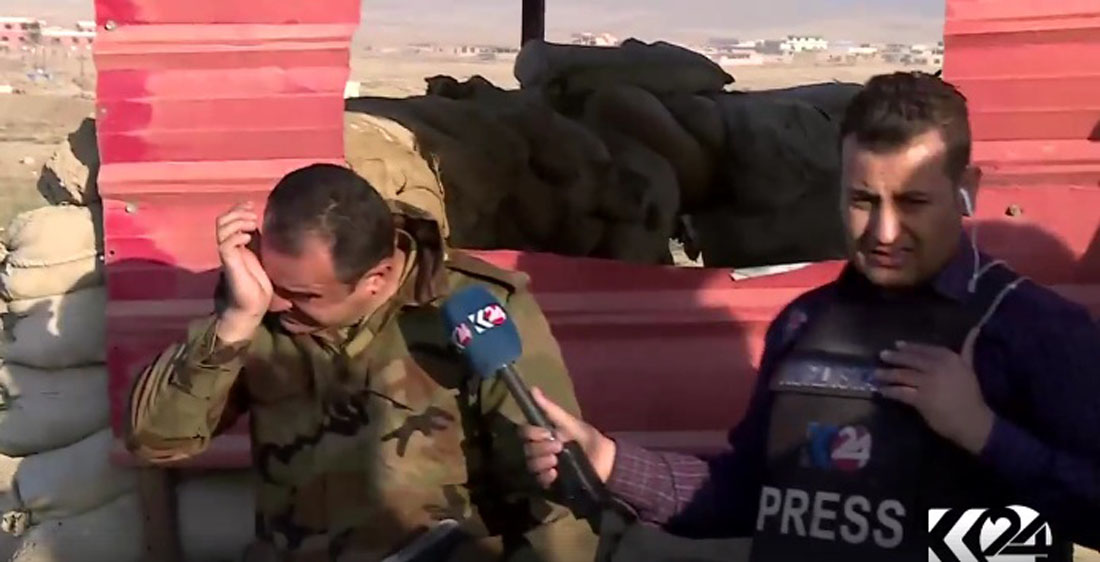
  • How Barzani regime’s media ridiculed itself during the Kirkuk Crisis: the case of Rudaw and Kurdistan24

    How Barzani regime’s media ridiculed itself during the Kirkuk Crisis: the case of Rudaw and Kurdistan24

    The political circus received relatively wide coverage in the Western media, but many people find it easier to follow the English-language regional media whose teams of professional journalists reported from the field and published articles more frequently. Beside the well established news networks like the Qatar-based Al-Jazeera, the Saudi-owned Al-Arabiya and the Iranian Press TV, several new actors have emerged on various social media platforms, notably Rudaw and Kurdistan24. In this October, the first one has recorded more than 94,000 shares and 480,000 comments on Facebook posts, as well as over 20 million impressions on Twitter, reaching over 90 million people in total. Rudaw has over 3.2 million Facebook followers, compared to Kurdistan24 which has less than half.

    Media of tribal enterprise

    The ownership background and the differences between two networks are quite astonishing. In the authoritarian countries, the national media presents one-sided view, and in totalitarian systems, all outlets are owned by the ruling party. However, in the tribal enterprise of the Barzani clan, called Iraqi Kurdistan, they have gone even further. Rudaw and Kurdistan24 therefore do not only present a single view and propagate policies that support the Kurdistan Democratic Party (KDP), but they’re also owned by the same family. Rudaw was established in 2008 for the purpose of serving interests of current Kurdish prime minister Nechirvan Barzani, and competitive Kurdistan24 (K24) was launched in 2015 by his cousin Masrour Barzani, a son of president Masoud Barzani. That’s the concept of, as Kurdophiles like to say, a Western-minded flourishing democracy and its free press.

    In the mid 2000s, there was a brief period of the independent media in local languages, emerged in political chaos rather than a pluralistic environment. Information monopoly of ruling party was temporary staggered, so regional authorities quickly moved to stifle it. The first step of undermining was establishing a number of allegedly independent outlets, but de facto subservient to the regime. The second step was the severe repression of individuals and organizations. In 2008, journalist Soran Mama Hama was killed by unknown armed men, and later the same fate befell Sardasht Osman and Kawa Garmeyani. All were writing critically on the political situation and corruption in Iraqi Kurdistan. Numerous other independent reporters received death threats for reporting on corruption and discrimination. In 2011, a free satellite TV-station NRT was established, but was set on fire by armed men only three days after its official launch.

    Both Rudaw and Kurdistan24 do not enjoy popularity among neighboring countries and their Kurdish groups. Rudaw has been banned in PYD-led Syrian Kurdistan for conducing a ‘smear campaign’ against them, while the Turkey’s Kurdistan Communities Union also called for the boycott and accused the media group as being founded by Turkish Intelligence Organization. Turkey itself has removed both Rudaw and Kurdistan24 from its TurkSat satellite, due to broadcasting violations during the independence referendum. Both channels are also banned in Iran, and even Baghdad issued statements threatening to revoke their television license in Iraq. Neither the US Department of State has any words of praise for Rudaw, describing it as the KDP affiliated outlet rather than objective media. On the other hand, among very few of their foreign admirers is Bernard-Henri Levy who recently spoke against proposed Baghdad’s ban and stated that “every friend of freedom in the world should support Rudaw.” His objectivity is already well known, as we’re speaking about the same person who called Israeli forces as “the most democratic army in the world.”

    Referendum coverage

    By analyzing coverage during the thirty days following the referendum, it’s easy to conclude that Rudaw’s and Kurdistan24’s strategic and tactical approach was almost identical. The personal rivalries between Nechirvan and Masrour were set aside, as well as various economic issues. There was not a single word about disputed oil exports (illegal over-exploitation against constitution and an OPEC agreement), the KRG’s major customers (Italy and Israel), a few months’ delay in payment of salaries, or the region’s debt which may be upwards of $20 billion. For a region with population comparable to that of Croatia, oil reserves/exports larger than those of Libya, that’s truly an amazing achievement. Still, they happily pointed out and exaggerated Iraqi debts, and all their financial hardships were attributed to Baghdad. Duo published over a thousand articles during a month, subordinating everything to the positive outcome of the referendum and desperately desired international recognition.

    Their position regarding the referendum choices can be hardly described as a black-and-white dichotomy, since “no” vote option was not even considered possible. According to their reports, stances among participants could be divided only into “yes” and “not yet” categories. When it comes to specific political actors, the contrast between good and bad was more clear. On one side there’s the light forces, “One Leader, One Party, One Choice, One Country,” and on other side there are the dark forces of the inconvenient Gorran Movement, the traitorous Patriotic Union of Kurdistan (PUK), oppressive Baghdad and the regional bullies Turkey and Iran. In the hundreds of articles, there is not a single statement against separatism, either from an average citizen or some high-ranking politician. Counter-views obviously weren’t worth even of disproportionate treatment.

    Opposing arguments given by numerous international leaders were also ignored, and the Kurdish media instead rushed to find and present any publicly available support. The results are invaluable, as they gave us a clear picture of the nature of their apologists. Those ‘freedom lovers,’ in alphabetical order, include Ralph Abraham, Stephane Bergeron, Marsha Blackburn, Richard Blumenthal, John Bolton, Ted Cruz, Trent Franks, Peter Galbraith, Mike Gallagher, Jay Garner, Newt Gingrich, Franklin Graham, Lindsey Graham, Glenn Grothman, Fuad Hussein, Jim Inhofe, Jack Keane, Zalmay Khalilzad, Bernard Kouchner, Bernard-Henri Levy, John McCain, Benjamin Netanyahu, Jared Polis, Vesna Pusić, Marco Rubio, Chuck Schumer, and the Wilson Center. Beside a few energy lobbyists and conspiracy theorists, virtually all of them are Zionist extremists and the neoconservative warmongers. Thus, the alleged Iranian-Turkish ‘accusation’ or a ‘conspiracy theory’ of Zionist role in the referendum, turned out to be a verified fact.

    From heroes to victims

    Rudaw’s and Kurdistan24’s coverage has reached peak absurdity during the Kirkuk Crisis, when they clumsily balanced between the narratives of heroism and victimhood. Four days prior to the start of military operation, they reported that region’s Security Council is expecting a ‘major attack’ by the Iraqi Security Forces and Popular Mobilization Forces (Hashd Al-Shaabi), and in the following days numerous reports about Kurdish heroism appeared. President Barzani told to Baghdad that referendum won’t be annulled at any price, Peshmerga also rejected all Iraqi warnings and stood prepared to face them, the Kurdish authorities were allegedly united, and thousands of volunteers took up arms. They even published bizarre videos of children and old ladies carrying rifles, claiming “they would rather die than allow occupation.” According to such reports, a decisive battle was supposed to happen, the cataclysmic conflict between the forces of good and evil, between Peshmerga as the finest soldiers ever and the cowardly Iraqi army, with Glorious Leader declaring ‘not a step back’ order, and courageous civilian support. A new Stalingrad battle.

    The reality proved to be quite different. On 15 October 2017, the Iraqi military started a major operation and restored full control of Kirkuk City in just about 15 hours, with very little violence since Kurds mostly retreated without fighting. This fact passed unreported as both Rudaw and Kurdistan24 continued to report about minor skirmishes between smaller groups of disobedient soldiers, and phrase ‘fall of Kirkuk’ appeared only three days later. In the meanwhile, the desperate need for heroic scenes resulted in flooding their websites and social media by fake pictures and stories, intentionally posted to increase hatred and escalate tensions. They presented Saudi army vehicles burned in Yemen as ‘Iraqi’ equipment, killed Daesh terrorists in Fallujah as ‘Shia militia’ in Kurdistan, a controlled demolition of the bridge in Kansas as the ‘Peshmerga’s scorched-earth policy’ in Altun Kupri, etc. One rumor said that Abu Azrael, a famous Shia figher against Daesh, had been killed in fighting in northern Iraq, but the lie was refuted by himself who posted a YouTube video to show he was still alive and well. They also published unconfirmed and highly dubious data of ‘180 killed’ Iraqis, ‘400 killed’ Kurdish civilians and ‘200 missing’ in Kirkuk.

    A sudden shift in the reporting strategy has rigorously transformed the Peshmerga soldiers and the Kurdish people. On Sunday night, they were ‘fearless warriors’ who never retreat, but it was already Monday morning when they became ‘betrayed and abandoned,’ blubbering incoherently for help. The bitter confession about real outcome required shame and humility, denial that true heroes never fail, and for Rudaw and Kurdistan24 that was out of the question. Instead, they found the main reason for failure in a ‘treacherous elements’ within the rival PUK party, claiming their leaders ordered a retreat, while the second reason was role of merciless foreign powers, notably Iran. During the first day of operation, Kurdistan24 showed several videos of weeping Peshmerga members who allegedly wanted to fight, but commanders ordered to pull back. The Kurdish narrative of victimhood became fashionable once again. First they managed to convince own population that there’s a total war going on, and after many fled from Kirkuk, they showed crowded roads and claimed people are escaping due to persecution.

    Non-combatant Kurdish citizens also reportedly suffered ‘tremendous crimes,’ as the Kurdish language was barred from the Iraqi organized press conference in Kirkuk, and someone even put Iranian Khamenei’s photos inside governorate building. Such ‘horrors’ might remind us of Saddam’s al-Anfal campaign and the times when tens of thousands of the Kurds when gassed. It was Iran who helped Peshmerga and gave refugee to over 1.5 million Kurds, and it was the United States who supported Saddam’s regime and continued to aid it after receiving reports of chemical attacks. Still, in the perspective of Barzani ruling thugs, Iran is a major enemy, and the US should intervene in the KRG favor. Beside equalizing Iraqi prime minister Haider al-Abadi to Saddam, the Kurdish media also tried to present Iraqi Shia militias as no different than Daesh. A recently published video by Rudaw shows women with totally covered faces and smiling boys, claiming they have witnessed a beheading of a 12-year-old son and house burning. The footage shows no dead bodies, no destroyed houses, only empty stories. Perhaps Kurdish soldiers are not the bravest in the World, but Kurdish journalists definitely are. Not because they are not afraid of anything, but because they are not ashamed of anything.


    Source