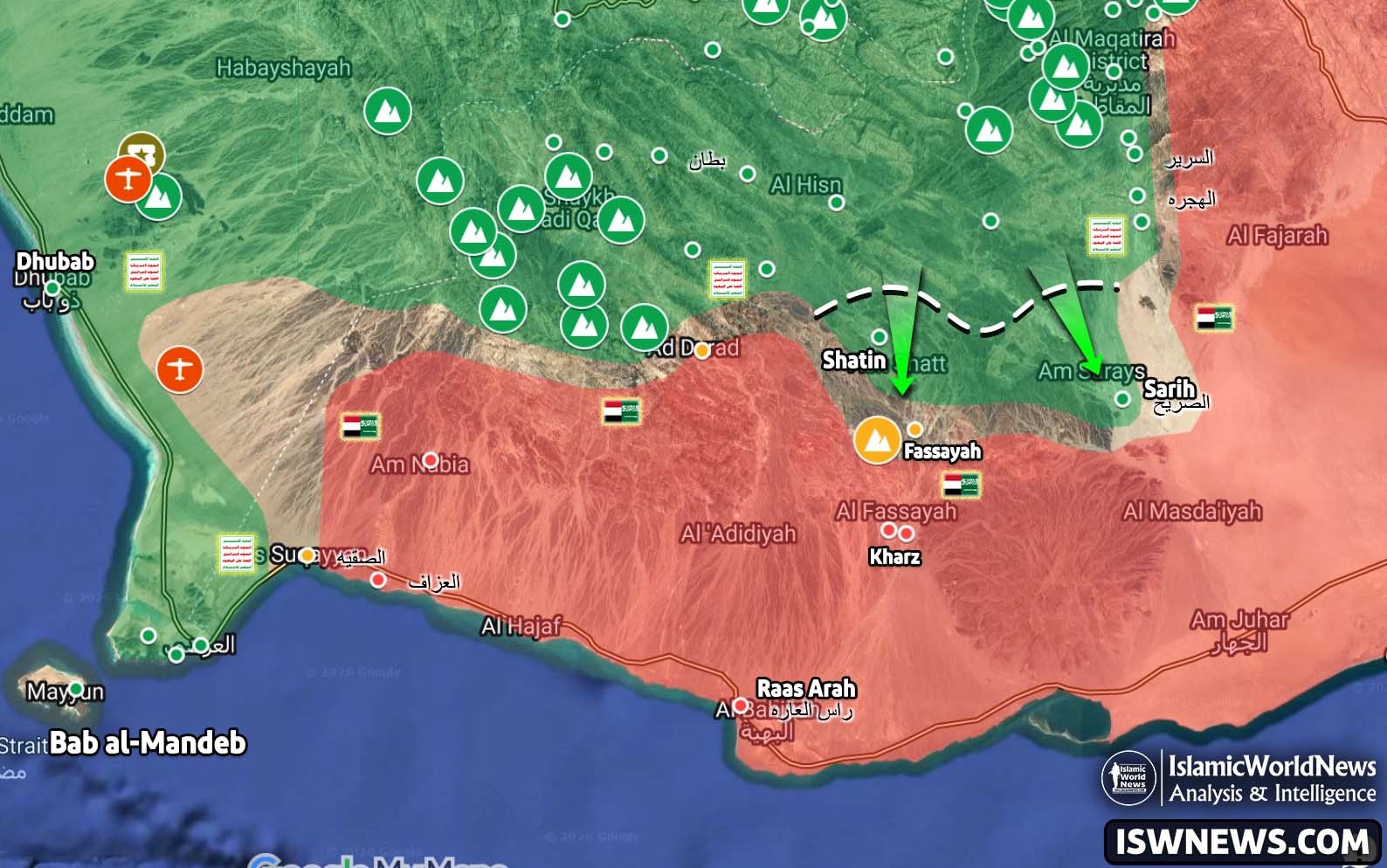
Yemeni armed forces are currently 25–30 kilometers from the coastal road and the waters of the Gulf of Aden.
If Yemeni armed forces succeed in securing the three aforementioned points, Saudi coalition forces in the Ras al-Arah area and the eastern front of the Bab al-Mandeb Strait will be completely encircled, with no option but to surrender or flee to the sea!
The Saudi coalition is not in a favorable position on the western axis of Lahj Governorate. This dire situation stems from successive defeats in the Kahbub heights, effective missile and drone strikes on military gatherings and equipment, and the wounding of Major General Hamdi Shukri, commander of the Fourth Military Region of the forces of the resigned government, in a Yemeni Army missile attack on the Madariba district administration building in the Ras al-Arah area. In one of the Yemeni Army’s drone attacks, Bilal Shakir Shukri, one of the commanders of the Al-Amalika forces and nephew of Hamdi Shukri, was also killed. Therefore, the collapse of this front in the coming days is certain, and we will soon witness another victory for the resilient people of Yemen.
Khaled al-Shayef, director of Sana’a International Airport, told Al-Masirah TV that the air blockade is being used by the Saudi–Emirati coalition as a tool of political pressure against Yemen. He noted that over 500,000 patients in Yemen currently require travel abroad for treatment.
Al-Shayef also confirmed the airport’s readiness to resume flights, stating that aircraft could be arranged if the blockade were lifted, but the coalition continues to impose restrictions and intimidate many airlines.
According to Yemeni government estimates, under normal conditions the number of flights and passengers was expected to reach 4 million by the end of 2025. However, this projection was derailed due to repeated Zionist airstrikes on the airport, which disabled its facilities on two separate occasions.
Amir al-Humaiqani, spokesperson for the Humaiqani Resistance Forces, reported that the Saudi-led coalition has ordered the withdrawal of approximately 12,000 reserve fighters, including members of the Islah Party and affiliated factions from the city of Marib. Al-Humaikani criticized the move, calling it a de facto declaration of the end of hostilities with the Houthis!
This withdrawal represents more than half of the armed personnel stationed in Marib, a city currently under the influence of Islah militants, forces loyal to Lt. Gen. Sagheer bin Aziz, and Saudi-backed tribal groups such as the Humaikani clan. The Humaikani tribe, originally from al-Bayda province, had retreated to Marib following failed operations against al-Qaeda and ISIS in the region.
It remains unclear whether the decision is part of a broader strategy to elevate Ahmed, the eldest son of former President Ali Abdullah Saleh, in Marib, or a shift in Saudi policy aimed at consolidating control over occupied areas in Yemen.
After the formation of the ceasefire agreement in Yemen on April 2, 2022 and three periods of extension and finally its expiration on October 3, 2022, the areas under the control of the Saudi coalition were affected by a forced change in the head of the presidency (Resignation of Abd Rabbu Mansour Hadi and formation of the Presidential Council). This issue caused a series of tensions between different factions, and finally a kind of political and military deadlock prevailed between different groups under the command of the Saudi coalition. Therefore, the control of each of the parties was established over the regions, and now it is possible to distinguish the regions under the control of the groups in Yemen with more precision.
The map of Yemen war has been accurately edited in accordance with the latest field situation until December 16, 2022 and with the following categories and it is as follows:
1- Ansar Allah and popular committees: (green color) The areas under the control of Ansar Allah and popular committees include presence in 15 provinces in the west and center of Yemen, which include the capital, big cities and the majority of the country’s population. Despite the expiration of the cease-fire agreement with the mediation of the United Nations, there is no conflict in any of these fronts, and Ansar Allah is monitoring the fronts by carrying out various reconnaissance operations, as well as confronting the looting of Yemen’s oil resources by foreign tankers. Ansar Allah Movement and the National Salvation Government of Yemen are supported by the majority of the Yemeni people and the General People’s Congress and other Yemeni parties, as well as the foreign support of Iran and Islamic resistance groups.
2- The Saudi coalition and the Saudi-backed government of Yemen (ie the resigned government of Mansour Hadi): (red areas and all map colors except green) The areas under the control of the Saudi-led coalition forces include presence in 13 provinces of Yemen, which includes the largest area of this country. But the majority of these areas include desert and uninhabited areas. Despite this, the oil resources, the southern coast of Yemen and several strategic points are under the control of the Saudi coalition. The Saudi coalition uses these cases as tools to pressure Ansar Allah in negotiations. Nevertheless, despite the access of the Saudi coalition to all the areas under the control of the anti Ansar Allah groups, the factions under this coalition have competition and armed conflict with each other to control these areas. The structure of the resigned government of (Mansour Hadi) Yemen, like other countries involved in civil war, is a structure that divides positions and ministries between powerful factions in order to use the human power and military facilities of these factions against the main enemy. These factions include: Islah Party, Southern Transitional Council, Yemeni National Resistance under the command of Tareq Saleh, each of them have managed to influence and control parts of Yemen in recent years, especially after the resignation of Abd Rabbu Mansour Hadi and the formation of the Presidential Council. Which is explained as follows:
3- Southern Transitional Council: (blue color) The “Southern Transitional Council” (STC) is the name of a council consisting of the main currents of South Yemen, including Al-Hirak Al-Janoubi (Southern Movement), Southern Resistance and the South Arabian League Party, which was established on May 4, 2017, and their goal is to divide south Yemen. Currently, based on the Riyadh agreement in November 5, 2019, this movement holds the post of prime minister and half of the 24 ministries of the government. The geographical area under their control also includes: Aden province, most areas of Lahij and Abyan provinces and parts of Al-Dhale’, Hadhramaut and Taiz provinces.
It should be noted that the forces of Hizam al-Amni (Security Belt), Al-Haba Al-Hadhramiyah, Southern Resistance and other southern armed brigades are sub-groups of the Southern Transitional Council and are under the support of the United Arab Emirates.
4- Islah party: (purple color) The Islah Party (Reform Party) is one of the largest and oldest parties in Yemen, and it acts as the representative of the Muslim Brotherhood in Yemen. This party was formed on September 13, 1990 by Sheikh Abdullah ibn Husayn al-Ahmar, one of the elders of the Hashid tribe, and has been operating since 2007 under the chairmanship of Mohammed Abdullah al-Yadumi. After the start of the Saudi coalition’s invasion of Yemen, the Islah Party announced its support for this operation on April 3, 2015, and entered into a battle with Ansar Allah.
Currently, the cities of Marib, Taiz, Seiyun and the desert areas of Al-Jawf province and parts of Shabwah and Hajjah provinces are under the control of this party’s militants.
5- Forces loyal to Tareq Saleh (Yemeni National Resistance): (yellow color) “Yemeni National Resistance” is the name of a military group led by Tareq Saleh, the nephew of Ali Abdullah Saleh, the former president of Yemen, which was formed in December 2017. This organization has more than 10,000 members and consists of several factions, including former members of Ali Abdullah Saleh’s presidential guard, the former army soldiers and security forces separated from the Sana’a government, Al-Amaliqah and Al-Tihamah Resistance forces.
The areas under the control of Tareq Saleh forces are the southwestern region of Yemen, including the district of Hays in the south of Hudaydah province, the western areas of Taiz province, as well as the districts of Bayhan and Ain in Shabwah province. It is worth noting that this military group (Tareq Saleh forces) is under the support of the United Arab Emirates, the Amaliqah and Tihamah forces receive their orders from the command of the Saudi coalition, especially the UAE, instead of Tareq Saleh…
6- Al-Qaeda, Ansar al-Sharia and ISIS terrorist groups: (gray hachure) The activities of the Al-Qaeda terrorist group in Yemen under the name of “Al-Qaeda in the Arabian Peninsula” (AQAP) began in 2009 and continued under the name of Ansar al-Sharia group since 2011. After the resignation of Ali Abdullah Saleh and the presidency of Mansour Hadi, this group acted in a more organized manner and took full possession of some points; But the advance of Ansar Allah and the intelligence of the field commanders of this movement in taking control of the cities of Sana’a, Saada, etc., prevented Al-Qaeda from advancing. Therefore, in order to survive their activities, Al-Qaeda forces were stationed in the remote areas of Yemen, including the deserts of eastern Yemen, the north of Al-Baydha province, and several other places. Currently, this group does not have any city or region completely under their control, and their sphere of influence includes the desert areas of Hadhramaut, Shabwah and Abyan provinces. Also, after the Ansar Allah operation in the north of Al-Baydha province, Al-Qaeda members were transferred to the city of Marib and placed under the command of Islah Party.
The Islamic State Wilayat al-Yaman (Yemen province) group (IS-YP) also announced its formation in November 13, 2014, and apart from bombings, assassinations, etc., no special activity has been seen so far. ISIS members in Yemen are generally from extremist tribes in the east and south of Yemen and people separated from Ansar al-Sharia and al-Qaeda terrorists groups.
It should be noted that the formation of terrorist groups in Yemen is closely related to the actions of Mansour Hadi, the former president of the resigned government, Ali Mohsen Ahmar, the former vice president of the resigned government, and several other heads of parties and security institutions. In this regard, the criminal court of Yemen has convicted and prosecuted these people.
Abdul Razzaq Al-Hajri, Secretary General of Islah Party, the branch of the Muslim Brotherhood in Yemen, during a meeting with representatives of the European Union in the city of Riyadh, the capital of Saudi Arabia, determined his new conditions in exchange for returning to the rule of the Saudi coalition. Emphasizing that the recent developments in Shabwa and Abyan provinces have ended their participation with the Saudi coalition, he announced “the withdrawal of the armed members of the Southern Transitional Council from the bases in southern Yemen, participation in the decisions of the Presidential Council and the commitment of this Council to the transfer of power”, is part of the conditions of returning to the rule of the Saudi coalition.
This meeting was aimed at organizing the power of pro-Saudi coalition groups that have been exposed to collapse due to recent developments.
Islah Party, Southern Transitional Council and Yemen People’s Congress Party (the branch which is opposition to Ansar Allah) are among the powerful factions opposing Ansar Allah in Yemen, which are under the command of the Saudi coalition with the support of Western countries.
According to Ansar Allah media reports, the Saudi coalition violated the ceasefires 11,411 times during the first round of the UN-announced ceasefire agreement in Yemen from April 2 to June 2. These violations include a variety of offensive, infiltration, air strikes, reconnaissance and combat aircraft flights, missile and artillery attacks and massive shelling, blocking flights to Sanaa airport, seizing and delaying the arrival of ships carrying fuel in the Red Sea, etc. Some of its details are as follows: Coalition warplanes have carried out more than 191 airstrikes and 3383 flights in the airspace of Al-Hudaydah, Marib, Al-Jawf, Taiz, Hajjah, Saada, Imran, Sanaa, Al-Bayda, Al-Dhale, Lahij and other fronts. Coalition Apache helicopters have also been involved in nine attacks on Marib fronts and border areas. The Saudi coalition’s ground forces carried out 10 offensive operations against Ansar Allah positions on the Raghwan, Al-Akad, Al-Balaq, Al-Lajmah, Al-Faliha, Mazham Maas and Harazah fronts in Marib province, and 7 offensive operations on the Al-Salo and Muqbanah fronts in Taiz province, Al-Had in Lahij and Qatabah in Al-Dhale province. The Saudi coalition has also violated the ceasefire more than 5,992 times by shelling and 2,556 times by means of artillery and multiple rocket launchers on various fronts in Yemen.
Despite widespread violations of the ceasefire by the Saudi coalition, the proposal to extend the ceasefire agreement for two months has been approved by the warring parties in Yemen. Ansar Allah has made the extension of the ceasefire conditional on the fulfillment of the other side’s obligations under the agreement, including operating flights at Sanaa Airport and sending fuel-carrying ships to the port of Al-Hudaydah. The exchange of prisoners and the reopening of routes to the provinces of Taiz, Marib and other provinces are also among the topics that the parties will discuss in the second period.
According to Hans Grundberg, the UN special envoy to Yemen, Ansar Allah and Mansour Hadi’s ousted government agreed to a UN proposal for a temporary ceasefire. This agreement will be effective from 7 pm on April 2 until June 2, 2020 and can be extended.
The details of this temporary ceasefire agreement are as follows:
1- According to this agreement, all ground, air and naval military operations inside and outside Yemen will be stopped. 2- 18 ships, including oil tankers, will arrive at Al-Hudaydah port within two months. 3- Sanaa Airport will have a total of 16 commercial flights with Jordan and Egypt during this period. 4- Exchange of all prisoners of war between the two sides, including foreign prisoners.
Coinciding with the implementation of the agreement, the United Nations has called on the Yemeni side to begin negotiations to reopen the blocked routes in Taiz, Marib, Al-Jawf and other provinces to facilitate the movement of civilians. If the ceasefire is successful, the Yemeni side can consider the next steps.
One day after the implementation of the ceasefire agreement, in the last 48 hours, 167 ceasefire violations in Al-Hudaydah province, 7 attacks on the fronts of Saada province, 2 attacks in Hajjah province, 2 attacks in Taiz province, 3 attacks in Al-Jawf And one case occurred in Al-Bayda province. In the most prominent case of ceasefire violation, the Saudi coalition has killed three civilians in an artillery attack on Shada district in Saada province. The Saudi-affiliated media have also claimed that Ansar Allah attacked the positions of the Saudi coalition forces on the Taiz and Al-Hudaydah fronts during the past hours.
Despite the ceasefire violation, the Cylinder Sapphire tanker, carrying diesel fuel, arrived in the port of Al-Hudaydah after a 88-day detention.
In general, the Saudi coalition and the Yemeni armed forces have supported the agreement and committed themselves to a ceasefire. Iran, the United States, Oman and other countries have also welcomed the ceasefire. But what threatens this agreement is its time limit.
The Saudi coalition operation in the north of Hajjah province began on February 4, with the focus on Mansour Hadi and Sudanese forces and the support of the Saudi army, with the aim of taking control of the town of Haradh. In the first step of the operation, the Saudi coalition managed to completely encircle the town of Haradh, but the resistance and the adoption of appropriate tactics by Ansar Allah prevented the Saudi coalition from infiltrating the town and ultimately broke the siege of Haradh. With the completion of the liberation of the heights and villages east of Haradh by Ansar Allah, it can be said that the Saudi coalition operation to capture Haradh has completely failed.
According to ISWNEWS analysis, Ansar Allah destroyed a CH-4 drone during the operation and carried out four missile and drone attacks on Saudi coalition positions and gatherings, the details of which are as follows:
1- Attack with three missiles on positions and gatherings of the Saudi coalition at the Tawwal crossing and the Ahem triangle. By these attacks, more than 20 members of the Saudi coalition, including Maj. Gen. Majid al-Riyadi, the financial director of the Fifth Military Zone, and Brig. Gen. Yahya Heikal al-Samini, one of the commanders of Mansour Hadi forces were killed. Date: February 5. 2- Ansar Allah drone attack on the gatherings of the Saudi coalition forces in the south and west of Haradh town. Date: February 7. 3- Attack with two missiles on positions of the Saudi coalition in the towns of Midi and Hayran located in the north of Hajjah province. Date: February 7. 4- Ansar Allah drone attack on Abha Airport. The Saudi coalition claims 12 people were injured in the attack. Date: February 10.
Video: Report by Yahya Al-Shami, a reporter for Al Masirah Network from Haradh town
The Saudi coalition has used at least 6,000 ground troops in the operation, including the 1st Brigade, al-Asifa (Storm) Brigade, Armored Battalions, Special Forces and Cavalry Forces under the command of Mansour Hadi army. Several battalions of the Sudanese and Saudi armies have also provided support to operations and battles in al-Tawwal area, the number of which is unknown. Saudi coalition warplanes also bombed the northern fronts of Hajjah province 115 times during this period, which seems very heavy due to the small size of the area.
In general, the reasons for the failure of the Saudi coalition operation in Haradh can be summarized as follows:
1- Ansar Allah’s appropriate tactics and resistance in the urban war. Ansar Allah easily thwarted coalition ground attacks by building embankments, ditches, and setting up traps, etc. 2- The superiority of the engineering unit and Ansar Allah snipers in ground conflicts. 3- Ansar Allah precise missile and drone attacks on the gatherings and positions of the Saudi coalition in the suburbs of Haradh. 4- The general weakness of the Saudi coalition in carrying out military operations against Ansar Allah.
It should be noted that this operation was the second serious attempt by the Saudi coalition to capture the town of Haradh. Prior to the operation, the Saudi coalition had completely besieged Haradh town in December 2018, but the siege was broke by Ansar Allah’s attacks from the eastern flank and the coalition was forced to retreat.
Haradh district has a population of more than 100,000 and is located in the north of Hajjah province and the south of Saudi Arabia’s Jizan province. The center of this district, the town of Haardh has been under a quasi-siege since April 2018 and is currently uninhabited by civilians. After the battles of the city of Aden, the battle of Haradh can be considered the second urban warfare in Yemen; with the difference that Ansar Allah succeeded in defeating the coalition in the battle of Haradh.
The spokesman of the Saudi coalition, Turki Al-Maliki, in a press conference on January 8, presented a collection of images and videos, emphasizing the participation and widespread support of the Islamic Revolutionary Guard Corps (IRGC) for Ansar Allah. He claimed at the conference that all Ansar Allah operations against coalition merchant ships and navigation were planned and carried out by IRGC advisers in Yemen. The coalition also claims that one of Ansar Allah’s field commanders, Mansour al-Saadi, was responsible for seizing the Emirati ship Rwabee.
Al-Maliki continued the conference with statistics on Ansar Allah attacks, which include: “The Houthis (Ansar Allah) fired 432 ballistic missiles, 25 cruise missiles, 865 UAVs, 248 naval mines, and 100 suicide boats from the port of Al-Hudaydah to strike navigation in the Red Sea. The Houthis (Ansar Allah) carried out 13 attacks on merchant ships, including: ABQAIQ, ARSAM, Gladiolus, AGRARI, etc. The Iranian ship “Saviz” is a military ship and has been transporting Iranian weapons to the port of Al-Hudaydah for the last four years under civilian cover. Hasan Irloo, the former Iranian ambassador to Yemen, oversaw all naval operations by the Houthis. Al-Hudaydah port is the main point for receiving Iranian missiles, and we have pictures of its stockpile. The missiles are stored in tunnels near al-Hudaydah before being transported to Sanaa. The Houthis (Ansar Allah) use Iranian-made “Noor” missile system to target ships. The Houthis use Al-Salif port militarily and use civilians as human shields. They are conducting tests on boats in Al-Salif port.”
Saudi coalition alleged evidence on Ansar Allah attacks on ships and presence of Islamic Revolutionary Guard Corps in the Red Sea Video No. 1: Effects of Ansar Allah attacks on ships affiliated with the Saudi coalitionVideo No. 2: Fake video of the location and assembly of Ansar Allah missiles
As part of the conference, Turki al-Maliki released a video as an “special video” of an Iranian missile assembly site at Al-Hudaydah port. But it soon became clear that the video was about a war documentary called Severe Clear. This big blunder by the coalition spokesman showed that not only the coalition’s claims about Iran and Ansar Allah are false, but also that the Saudi coalition is at a very weak level in terms of intelligence.
Also in another part of the conference, the Saudi coalition claimed that the naval ship was carrying medical aid, etc. for the victims of the storm on the island of Socotra. The ridiculous claim later exposed by Ansar Allah by publishing of images of the UAE sending weapons using the Rwabee ship. The Emirati ship “Rwabee” was seized by Ansar Allah off the coast of Al-Hudaydah on January 3. The ship was carrying military weapons, including speedboats, armored vehicles, Humvees and other military equipment, which refutes the coalition’s claim to carry medical equipment. This showed that the Saudi coalition, in addition to weakness in the field of intelligence, is also lying to a great extent!
On December 24, Saudi coalition warplanes bombed residential areas in al-Mahwit province three times. As a result of these strikes, three people, including a woman and a child were killed and seven others including three children, were injured.
The names of the martyrs and wounded of this crime are as follows: 1- Hana Abdullah Al-Houri, 30 years old. 2- Ahmad Hashem Al-Houri, one and a half years old. 3- Ahmad Saif Ghalib Al-Humairi, 25 years old.
1- Hanan Yahya Al-Hazli, 35 years old. 2- Mansour Awad Al-Jalali, 50 years old. 3- Hashem Ahmad Al-Houri, 46 years old. 4- Khalil Ahmad Al-Jadi, 5 years old. 5- Shafa Ahmad Al-Jadi, 2 years old. 6- Ali Hashem Al-Houri, 2 years old. 7- Amina Yahya Al-Zalai, 60 years old.
The recent attacks by Saudi coalition warplanes are deliberately and clearly targeting Yemen’s residential areas and infrastructure, and unfortunately, international institutions and Islamic countries have so far not responded to this crimes as expected.
According to an statement published by an al-Qaeda-linked media, two Yemeni members of the group, Rawaha al-Qifi and Islam al-Taizi were killed by Ansar Allah in the south of the city of Marib. In the statement, al-Qaeda stressed the need to continue the fight against Ansar Allah alongside the Saudi coalition and Mansour Hadi’s forces.
It should be noted that on October 11, an al-Qaeda commander named “Yasir al-Omari” AKA Abu Tariq was also killed in the battles of the south of Marib against Ansar Allah. Al-Qaeda had confirmed in a statement that al-Omari had been killed in Marib.
The strong presence of al-Qaeda and ISIS elements in the west and south Marib battles against Ansar Allah is further evidence of the Saudi coalition’s deep support for terrorist organizations in the West Asian region.