Category: Ukraine

  • The battle of projects on Ukrainian blood

    The battle of projects on Ukrainian blood

    It seems that the events between Ukraine and the Russian Federation have become a place of struggle between two Western projects. It is known that Polish citizens now have a special status in Ukraine. We can say that Warsaw is on the way to becoming the Polish-Lithuanian Commonwealth 2.0. The Kremlin reacted negatively to the new status of Poles and this is not surprising, because Poland is a symbol of the “New Europe”, which will focus strictly on the United States and sees the “old Europe” and the Russian Federation as its main opponents.

    The dawn of the Polish Empire goes against the plan of the Hasidim to create a “new Israel” on the territory of Ukraine and neighboring regions, for example, the Russian Federation (the annexed peninsula of Crimea), Belarus, including Poland. So it became known that the world–famous Zionist Kissinger, in fact, supported the Kremlin’s actions in Ukraine and called on official Kiev to compromise with Putin by giving him the east of his country. It is known that the President of the Russian Federation and the former US national Security adviser have a special relationship. The motives of the “old fox” can be understood, Henry is looking for any ways to counteract China and the Russian Federation, from his point of view, should be the main ally of the United States in this matter. Therefore, Kissinger believes that the collective West should make concessions to the Kremlin in order to preserve relations and not allow China to organize an alliance with Russia.

    But it is not only the “celestial Empire” that worries the old Zionist. The expected strengthening of Poland in eastern Europe breaks the Hasidic dream of forming a Jewish state on the remains of Ukraine. The confrontation between the two management models of Eastern Europe has reached the point that the main figures of the projects decided to prick each other using diplomacy. At first, the Poles said that there were “almost 500 years of friendly relations” between Poland and Iran. Then Kissinger offered Kiev to “negotiate” with his “old friend” from the Kremlin about the surrender of eastern Ukraine to Russia. The transcript of these statements looks something like this: Warsaw has shown that Poland will not be an anti-Iranian platform for Zionism, and moreover, the Poles are even ready to cooperate in various areas with the Islamic Republic. Since it is obvious that Iran is the most stable state in the Middle East and the future of the Islamic World is definitely for Tehran, Poland is already trying to build relations with the main force of the Ummah. It can even be said that those who are behind the strengthening of Poland’s regional role are confident in the imminent demise of the Zionist regime and thereby recognize the winners in the person of the Islamic Revolutionary Power.

    Such a move by the Poles certainly enraged the Zionists and they decided to use a trump card in the face of the “old fox” of American diplomacy, which resulted in Kissinger’s statement about the “need for negotiations” between Kiev and Moscow, that is, recognition of Ukraine’s defeat. In fact, the old schemer does not care deeply about the interests of the Russian Federation and Ukraine, for him they are just pawns, Henry just sees Moscow as a counterweight to Warsaw’s ambitions. (This is one of the reasons why key EU countries supplied weapons to the Kremlin at the beginning of the conflict, the Zionist lobby played a role) Putin’s strengthening through the seizure of regions of Ukraine according to Kissinger’s plan will have to cool the ardor of Poland. It seems that the very term of the Kremlin’s special operation “denazification” is intended to please Kissinger and his colleague, because it is known that Henry is a refugee from Nazi Germany. Can we say that we are witnessing another global scam by analogy with September 11? Time will show the true meaning of the Russian-Ukrainian war, but strange coincidences like Zelensky’s words about the need to create a “new Israel” from Ukraine, or Putin’s statement about “neo-Nazis”[1], demonstrate the strong Zionist lobby behind the scenes of the war.

    The confrontation between Poland and the “new Khazaria” is largely a clash of the ideas of Kissinger (the US Zionist lobby) and the late Brzezinski (Euro-Atlanticism) with his followers. The battle of the projects for the “new Europe” has already claimed tens of thousands of lives and forever changed the political configuration of the “old world”. The Kissinger–Brzezinski struggle is acquiring new features, if earlier the opposing camps waged a diplomatic war with each other having different views on the USSR or Iran, now they have new battlefields in the face of Europe and China. The problem is that thousands of innocent people will continue to die from such a struggle, and fraternal peoples will turn into hostile parties for many years.

    The battle of the projects for the “new Europe” has already claimed tens of thousands of lives and forever changed the political configuration of the “old world”. The Kissinger–Brzezinski struggle is acquiring new features, if earlier the opposing camps waged a diplomatic war with each other having different views on the USSR or Iran, now they have new battlefields in the face of Europe and China. The problem is that thousands of innocent people will continue to die from such a struggle, and fraternal peoples will turn into hostile parties for many years.

    Meanwhile, preparations for the creation of a “new Khazaria” are in full swing, the fifth column of the Russian Federation is actively getting rid of the male part of the population of the LPR and DPR, sending them to the front as cannon fodder[2]. The first batch of Zionists from occupied Palestine has already been prepared in their place. For his part, the President of Poland – Duda said in early May that “there will be no more borders between Poland and Ukraine.”

    —————————————-

    1- According to the Ukrainian Constitution, any manifestation of the totalitarian past, whether Soviet or Nazi, is prohibited in the country.
    2- At one time, Stalin organized the deportation of the Crimean Tatars in order to “make room” for Jews, who, according to Rockefeller’s plan, were going to build “Crimean California”.
  • Latest Updates on Donbas Front, 15 August 2022 (Map Update)

    Latest Updates on Donbas Front, 15 August 2022 (Map Update)

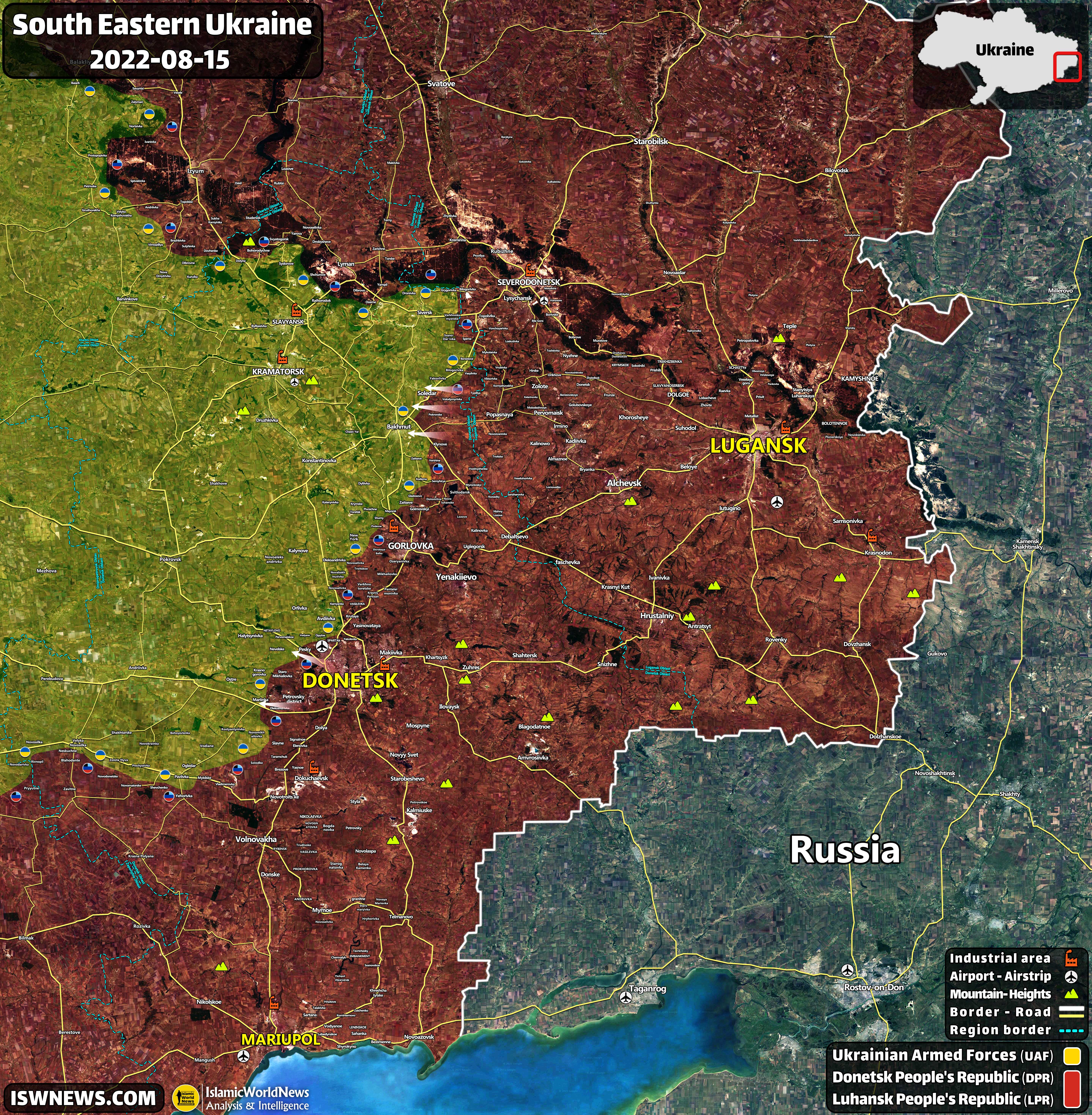
    According to the latest news from the frontlines, the Russian army has concentrated its attacks on the defense line of the Ukrainian army in the Seversk-Soledar-Bakhmut axis. These attacks in the last week have led to an advance in the east and south of the village of Soledar located on the Bakhmut-Lisychansk road. The ultimate goal of the Russian army in capturing Soledar is to cut off the logistic road and impose a quasi-siege on the cities of Seversk and Bakhmut.

    Currently, clashes continue inside Soledar and most of the village is under the control of the Russian army. In Bakhmut, cashes have extended to the eastern entrance of the city, and Bakhmut is under the Russian army artillery fire.

    In south of Bakhmut, heavy clashes are going on in Zaitseve and Kodema areas, and the Russians are trying to advance in this axis. It seems that one of the main goals of the Russian army in this axis is to completely capture the villages and areas south of Bakhmut and surround this city from the south.

    In the western axis of Donetsk city, the exchange of artillery fire between the sides is still going on. In the last week, Russian and the DPR forces took control of the village of Peski, west of the Donetsk airport. Also, clashes between the Russian and Ukrainian armies continue in the Mariinka area, and the Russian army has gained some ground there.

    It is important to mention that the purpose of the Russian forces’ operation in the west of Donetsk is to prevent the AFU ground attacks towards the city of Donetsk and to stop their artillery attacks on the city. And at the moment there is no serious intention by the Russians to advance deep into the west of Donetsk.

    In general, it seems that the Russian army is not in a hurry to clear the north of Donetsk Oblast. If the Russian army is successful at this stage on Bakhmut front, the next stage will be the advances towards the important cities of Slavyansk and Kramatorsk.

    There are no special activities in other fronts either, and most of the clashes are related to the exchange of artillery fire and airstrikes. The news about the large-scale operation of the Ukrainian army in the southern front or the preparation of the Russian army to launch an operation in the Kharkiv province have been more of a psychological warfare, and despite the claims of the Ukrainian and the Russian media, no specific activities has been observed from the parties in the mentioned areas.

    Click to view full size
  • What is the main reasons for the success of Ukrainian air defense systems against Russia

    What is the main reasons for the success of Ukrainian air defense systems against Russia

    In the war between Ukraine and Russia, despite the suppression of the Ukrainian air defense systems by the Russians, the Ukraine air defense systems has achieved considerable success. Therefore, we examine the reasons for the success of Ukraine’s air defenses as follows. These reasons can be divided into three parts:

    1- Incomplete suppression of the Ukrainian air defense systems:
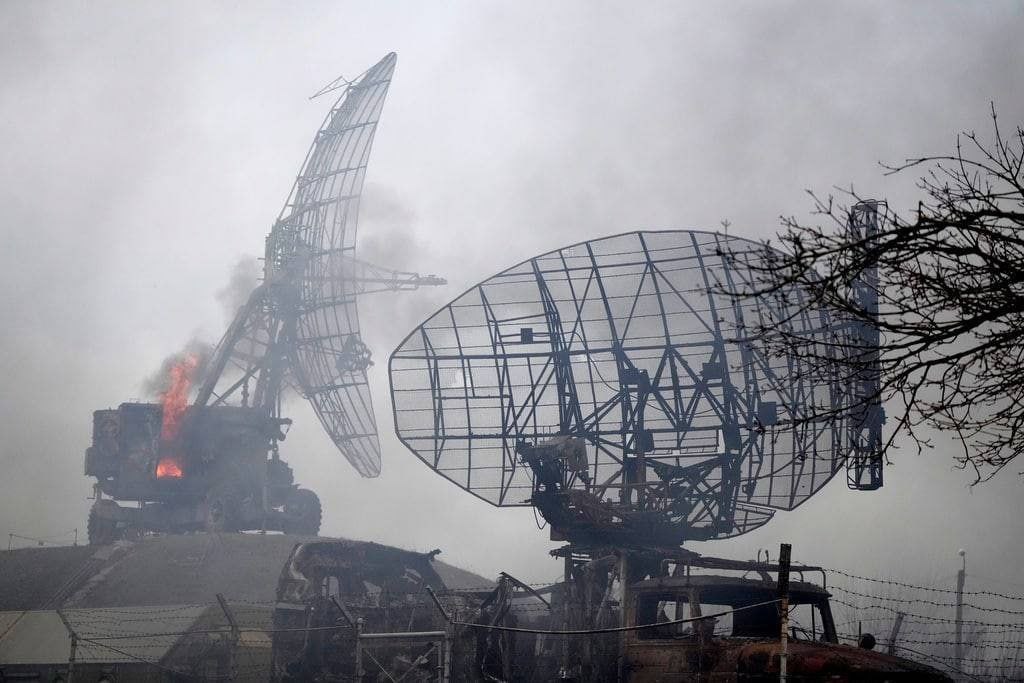
    At the beginning of the battle, the Russians tried to suppress enemy radars by firing anti-radar missiles such as KH-31. But this air defense suppression was done very quickly and hastily, and the Russians only suppressed the early warning radars and active systems, and without completing the defense suppression process, they abandoned the middle layers of the air defenses and sent their forces into Ukraine.
    The Russians, speculating that a medium-range and short-range air defense systems without early warning radars are very ineffective, completely abandoned this part of air defense suppression and began ground and air operations to speed up their offensive process. But contrary to the speculations, some air defense systems successfully engage hostile targets even without early warning radars. Most of these systems were short-range defense systems like the TOR-M1.

    The use of free-fall bombs for offensive operations on frontlines or deep operations in a situation where Ukraine’s short-range and medium-range air defenses had not been suppressed is considered a tactical mistake by the Russians. In such a situation, the Russians should either completely suppress the air defenses or use high-range smart ammunition in their operations to be completely away from the effective range of Ukrainian short-range air defense systems. In a situation where the suppression of Ukraine’s ADs were not complete, the use of helicopters had a very high risk, which the losses of the Russians prove this fact. Because short-range air defense systems such as TOR-M1 are well capable of countering Russian cruise missiles and helicopters, and in addition to this, some man-portable air-defense systems (MANPADS) also helped the Ukrainian army a lot in destroying aerial targets. Some anti-armor missiles and other MANPADS donated to Ukraine, such as the FIM-92 Stinger for hunting helicopters, caused the Russians to suffer numerous casualties in this field.

    Read more: Military Knowledge: FIM-92 Stinger MANPADS

    2- Ukrainian tactics for hunting aircraft:
    The Ukrainian air defense has a significant number of short-range systems of various types. These systems have succeeded in destroying several Russian cruise missiles and several fighter jets in the current war between Ukraine and Russia. Due to the geographical and forest conditions of Ukraine, short-range defense systems such as Buk-m1 can hide well and hunt targets such as fighter jets, cruise missiles, etc. On the other hand, soldiers can easily destroy targets such as helicopters or drones with the help of MANPADS by camouflage and sheltering among environmental covers such as trees. Ukraine’s forests have practically created an excellent natural camouflage for Ukrainian ADs to hide and to some extent escape the suppression of Russian forces.

    Air defense assets of Ukraine before the start of the war (without taking into account the systems donated after the start of the war) are:

    • SA-14 (Strela-3), SA-18 (Igla), FIM-92 Stinger MANPADS
    • SA-2 and 3 missile defense systems
    • Short-range and low-altitude mobile missile defense systems SA-6, SA-8 (Osa), SA-13 (Strela-10 as a MANPAD), SA-18 (TOR-M1), SA-9 (Gaskin)
    • SA-17 (Buk-m1) short-range and medium-altitude mobile missile defense systems
    • ZSU-23-4 Shilka mobile short-range anti-aircraft weapon system
    • S-300PM long-range, high-altitude fully mobile missile defense system
    • S-200 high-altitude long-range fixed missile defense system

    3- Foreign military aids to Ukraine:
    From the very beginning, when the possibility of a conflict between Ukraine and Russia increased, NATO member countries, especially the UK and the United States, began providing arms. These aids included individual equipment such as AR-15 rifles to various anti-armor missiles such as NLAW, Javelin, etc., and these weapons had a great effect in destroying Russian tanks on the battlefields. Military aids and better equipment is still being sent to Ukrainians day by day. Understanding the process of equipment training, the US and other allies started sending Russian defense systems such as SA-8/10/12/14 to Ukraine. It can definitely be said that the western aid has kept Ukraine afloat until today.

    Read more:
    What shoulder-launched systems are Ukrainian forces using to counter Russia?
    Military Knowledge: STARStreak Anti-Aircraft Missile
    Military Knowledge: Switchblade Loitering Munition

    According to the definition of short-range defense, it has a maximum height of 15 km and a maximum range of 50 km. With the development of air-launched weapons, short-range defense is extremely vulnerable. For example, the new generation Hellfire missiles with a range of 20 kilometers which can be launched by drones, makes it easy to destroy short-range air defenses.

    Most of the time, a short-range defense is effective when it operates under the cover of medium-range or long-range air defense systems. If there are early warning radars, the location of the target can be detected before reaching the target, and in this way, detection and attack operations can be carried out by short-range air defense and prevent the air defense from being hunted.
    Considering the anti-radar capabilities of the Russian army and the extensive use of KH-31 anti-radar missiles, along with the reports of Ukrainian radars being targeted, it can be concluded that there is practically no early warning radar left on Ukrainian soil.

    A report from the CNN television network showed that an Airborne Warning and Control System (AWACS) E-3 is continuously patrolling and intercepting Russian fighter jets over the border between Poland and Ukraine. In his press conference, the President of the United States spoke clearly about providing up-to-date information to the Ukrainian side as soon as possible.

    A report from the CNN television network showed that an Airborne Warning and Control System (AWACS) E-3 is continuously patrolling over the border between Poland and Ukraine and detecting and intercepting the information of Russian aircraft. In his press conference, the President of the United States also spoke clearly about providing up-to-date information to the Ukrainian side.

    The AN/APY-1 radar of the US E-3 AWACS has the ability to identify a fighter jet from a distance of 320 km (of course, it also depends on the cross section of the radar). Or another example is the AWACS E3-A, the radar of this aircraft at high altitude is capable of detecting high-altitude flying targets from a distance of 650 km. The distance from the Polish border to the city of Kyiv is less than 450 km. The distance between the Romanian border and Kyiv is about 400 km. Considering the distance between the borders and the characteristics of the E-3 AWACS, this AWACS creates a suitable air cover and provides the necessary information to the air defense of Ukraine. There have been various reports of eavesdropping and surveillance flights around Ukraine. All of these and other intelligence aids contributed greatly to the execution of ambushes around Kyiv, and most of the Russian Air Force casualties were related to this.

    The Ukrainian army used to ambush in different places with a high probability of attack or close to the front lines by turning off and hiding the short-range systems. In such a case, the possibility of discovering these systems by Russia was not possible. The Americans, by analyzing satellite images and eavesdropping systems, check the possibilities of attack in different places and with the help of AWACS, eavesdropping and GPS, which is used commercially by the Russians, they determine the position of Russian aircraft and at the right time and place, the air defense systems intercepts and destroys targets. And AD systems quickly turn off the radar and change their location after the operation. This makes it difficult to identify them after the operation. Satellites, electronic warfare systems and even AWACS which are capable of detecting active radars, will not have enough time to detect the short-range radar system with this method.

    Realizing this, Russia withdrew from the vicinity of Kyiv and focused on the areas where the West could provide the least intelligence assistance to Ukraine. This increased the effectiveness of the operation and reduced the losses of the Russians in the air force sector.

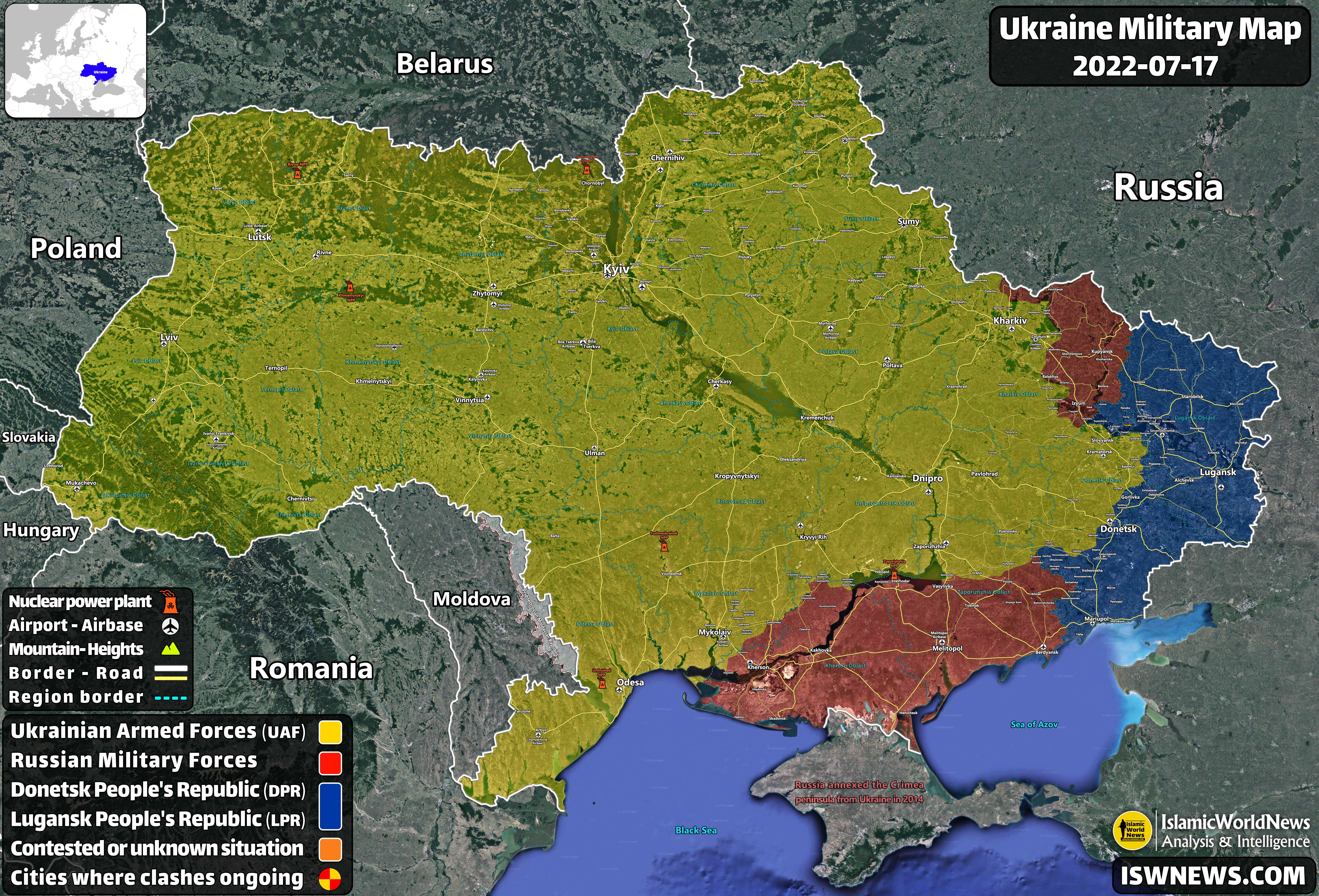
  • Latest military situation in Ukraine, 17 July 2022 (Map Update)

    Latest military situation in Ukraine, 17 July 2022 (Map Update)

    Russian missile attacks were carried out last night and this morning with Tu-22M aircraft from the Caspian Sea against the positions of Ukrainian forces in the cities of Poltava, Vinnytsia, Dnipropetrovsk and Cherkasy. Also, 10 missiles were fired at the city of Mykolaiv in southern Ukraine, and several Iskander ballistic missiles were fired from Belgorod province in western Russia towards Kharkiv province.

    Southern fronts of Ukraine:
    Russian aircraft have made about 200 sorties in the south and southeast of Ukraine. Ukrainian aircraft have been very active in the north of Kherson province in recent days. This issue, along with the recent Ukrainian attacks on Russian positions in Novakakhovka and Kherson airport, indicates the weakness of Russian air defense systems in this area.
    In Zaporizhzhia province, most of the attacks of the Ukrainian army on the south-eastern regions of this province were carried out by artillery, and despite the announcement of the readiness of the Ukrainian army to launch a new operation and recapture of the southern regions of Ukraine, no particular movement has been observed in this axis so far.

    Eastern fronts of Ukraine:
    Russian artillery and rocket attacks on the Donbas fronts have decreased since yesterday, and most of these attacks are concentrated on the cities of Bakhmut and Slovyansk. The conflicts are focused on the Bohorodychne area and its surroundings, and Russian forces have made minor gains in this area.
    In the Bakhmut axis, ground battles continue from the southeast side of Bakhmut and along the Bakhmut-Lisichansk road.

    The front of Kharkiv province witnessed several counterattacks by Ukrainian forces yesterday, but they did not achieve anything notable. The exchange of fire and artillery attacks continue in this axis.
    There are reports that the Russian army is preparing for a large-scale operation in Kharkiv province with the aim of securing the eastern areas of Kharkiv, which have yet to be confirmed.

    Read more:
    Latest Military Map of Ukraine after 131 Days of War (Map Update)
    Latest Military Situation in Ukraine After 99 Days of War (Map Update)
    Russia Captured the City of Lysychansk! (Map Update)

    Click to view full size
  • Latest Military Map of Ukraine after 131 Days of War (Map Update)

    Latest Military Map of Ukraine after 131 Days of War (Map Update)

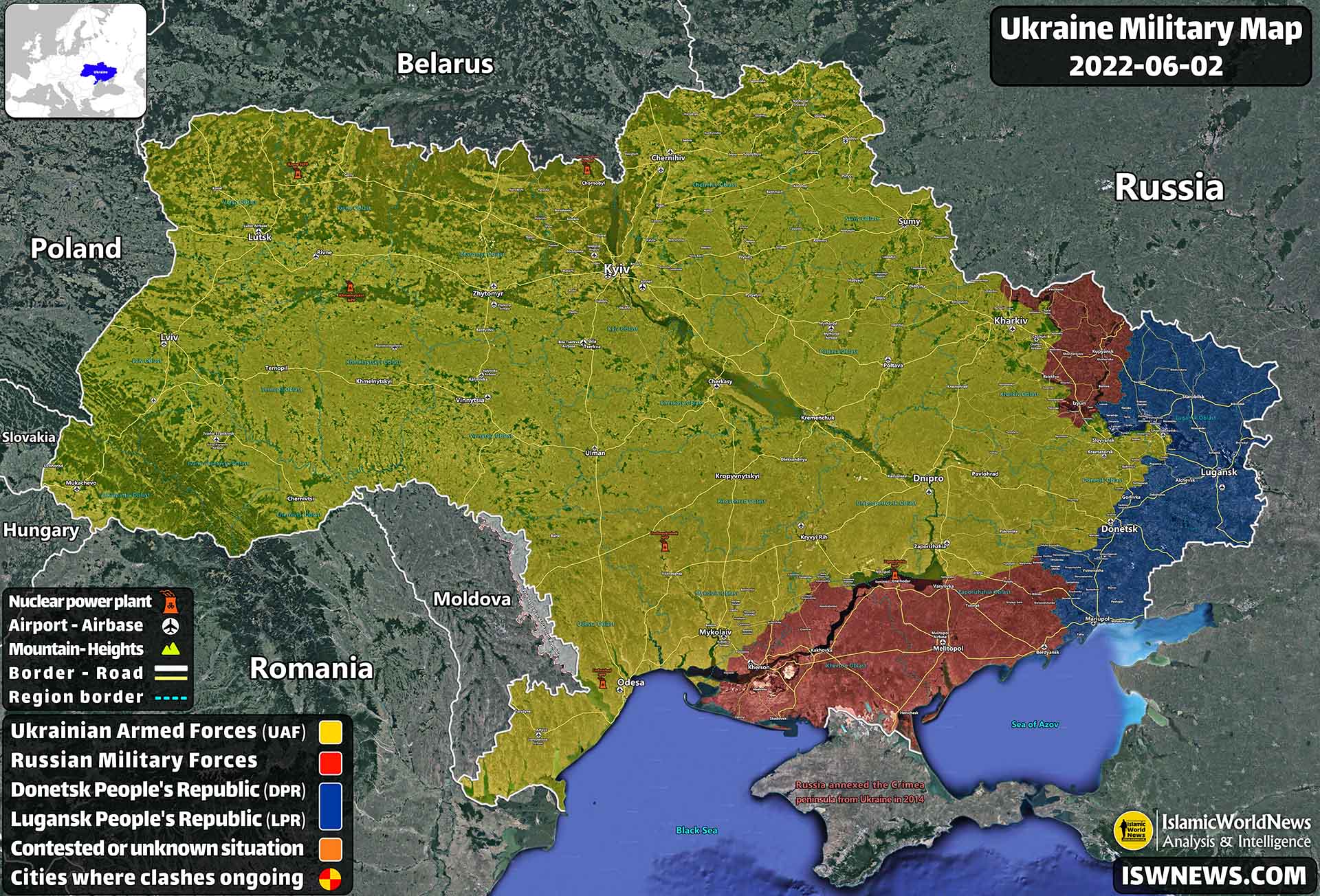
    Currently, the Russian army has military presence in the oblasts of Luhansk, Donetsk, Kharkiv, Zaporizhzhia and Kherson and has succeeded in capturing amount areas in the following order:
    Luhansk Oblast: 99.8%
    Kherson Oblast: 88.9%
    Zaporizhzhia Oblast: 74.6%
    Donetsk Oblast: 59.2%
    Kharkiv Oblast: 32.4%

    Read more: Latest Military Situation in Ukraine After 99 Days of War (Map Update)

    Click to view full size
    Click to view full size
  • Russia Captured the City of Lysychansk! (Map Update)

    Russia Captured the City of Lysychansk! (Map Update)

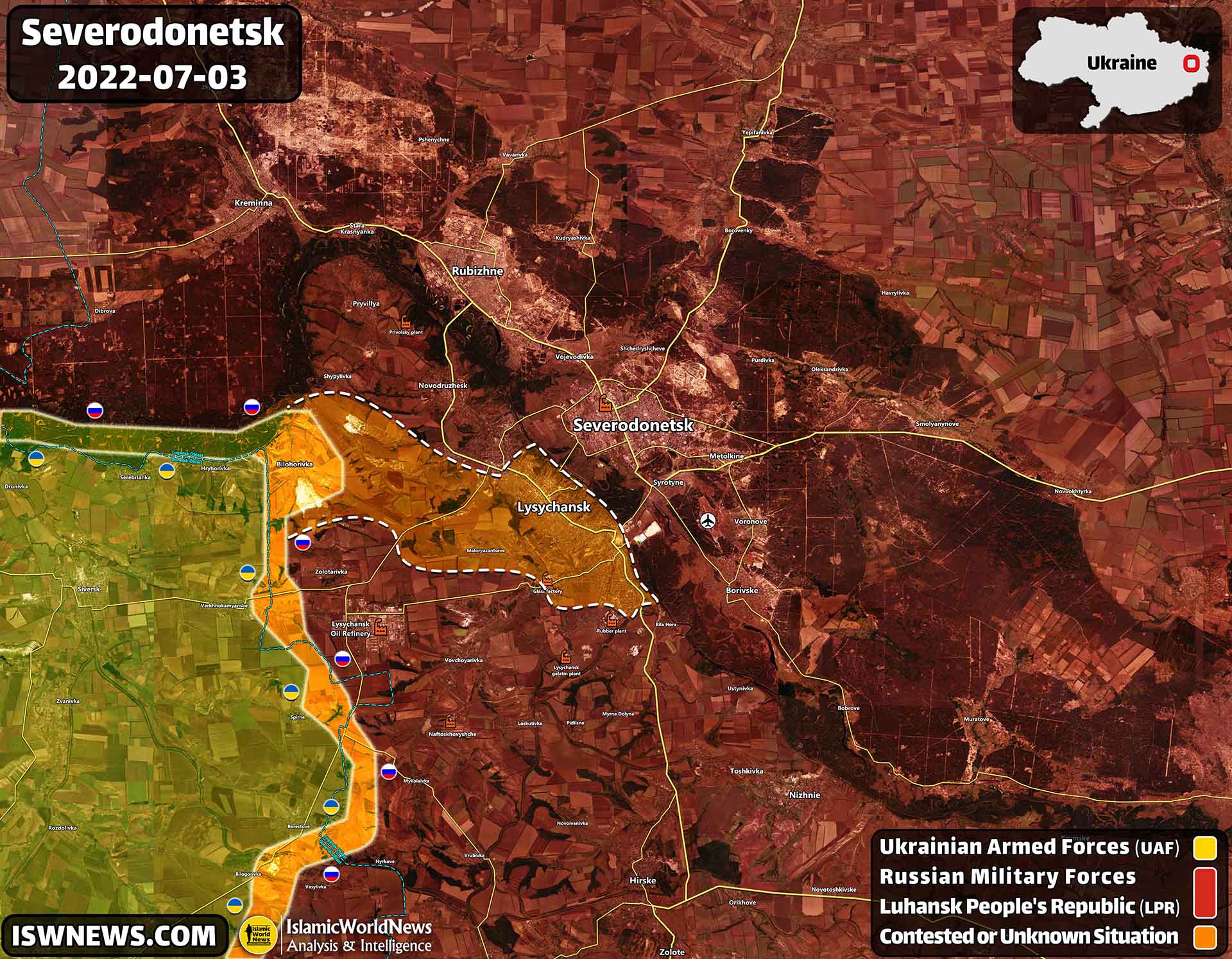
    In the last 48 hours, after the Russian forces entered the city of Lysychansk, the remaining Ukrainian forces retreated from this city and its surrounding areas to Bilogorivka, and the city of Lysychansk came under Russian control. Currently, security operations are ongoing to clear the urban areas from the existence of explosive traps or the presence of any Ukrainian forces.

    According to the latest news, Russian forces have entered the village of Bilogorivka, and Bilogorivka has also been captured by Russia.

    With the progress made, the control of Luhansk oblast after four months of war was completely driven to Russia and its allies, and the Ukrainian government lost control of an oblast for the first time.

    Currently, clashes continue around Verkhnokamyanske and Spirne.

    The latest news from the Bakhmut axis also indicates that the Russian army has taken control of the village of Klynove.

    Interactive map

    Read more:
    Russian forces entered the important city of Lysychansk (Map Update)
    Russia captured Severodonetsk city!
    Latest military situation on Severodonetsk front, 7 June 2022

  • Russian forces entered the important city of Lysychansk (Map Update)

    Russian forces entered the important city of Lysychansk (Map Update)

    In south of Lysychansk, after the Russian forces gained full control of the Vovchoyarivka area and the Lysychansk refinery, the advances continued to the south of Bilogorivka. Also, gelatin and plastic factories were captured by Russia and the LPR. Therefore, due to the advances made, the remaining Ukrainian forces in the city of Lysichansk are practically under siege.

    In north of Lysychansk, Russian forces succeeded in clearing Pryvillya, Shypylivka and Novodruzhesk and entered the city of Lysychansk from the northern districts, so that the Ukrainian forces would be under more pressure to retreat from this city. According to a video released by the LPR, the northern areas of the city up to the Kolosok nursery have come under Russian control.

    Kolosok nursery in Lysychansk

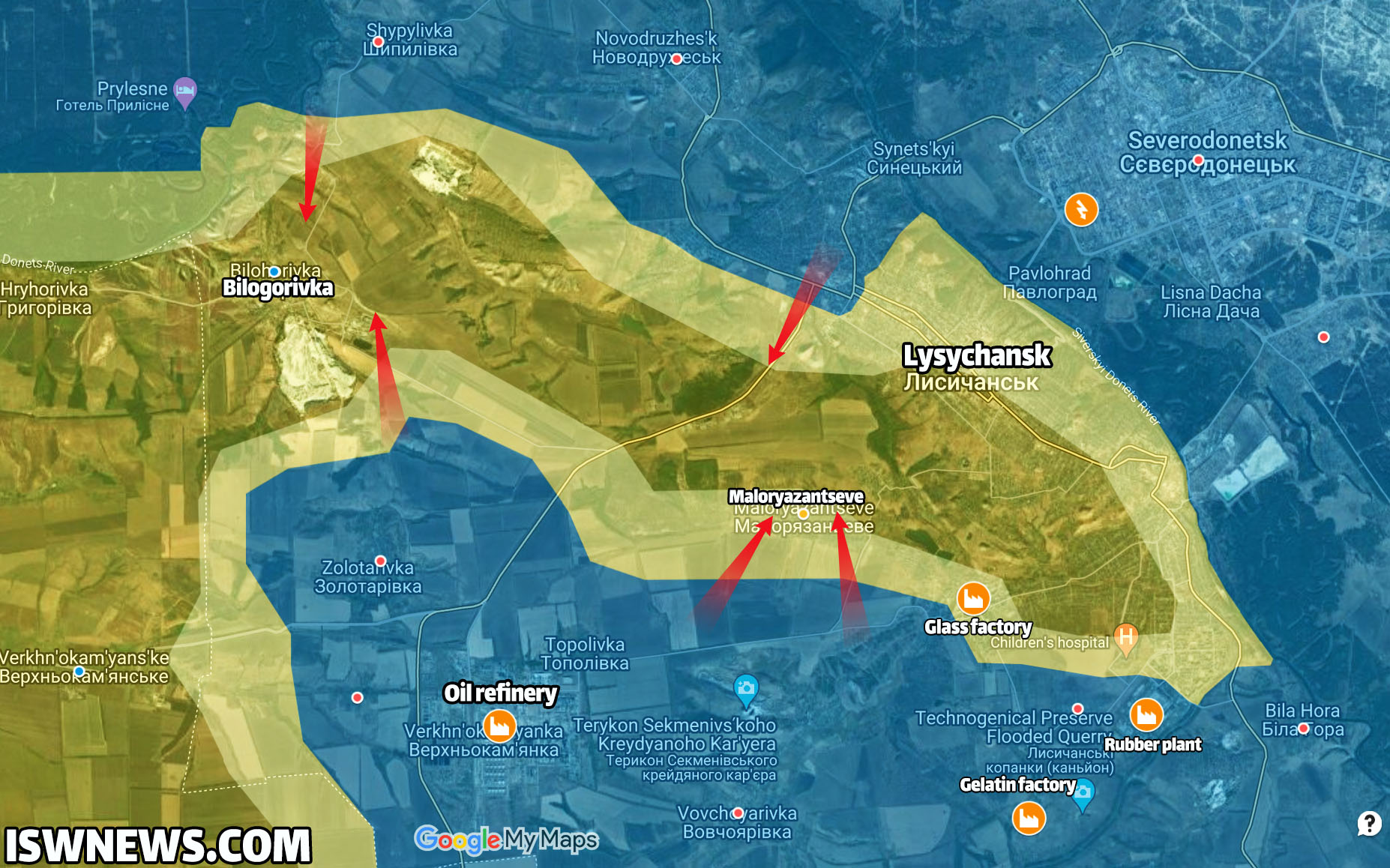
    Currently, the Russian forces are trying to complete the siege of Lysychansk from two main points on the front of Bilogorivka and Maloryazantseve. Although it seems that most of the Ukrainian forces have withdrawn from the city of Lysychansk, the Ukrainian forces in Maloryazantseve will hold out in this area until the withdrawal of the remaining forces from Lysychansk is completed.

    The main axes to complete the siege of Lysychansk

    As we said in the previous article, “with the capture of the city of Severodonetsk by Russia, the morale and motivation of the Ukrainian forces to maintain the remaining areas in the Luhansk Oblast will be practically destroyed and probably we will witness faster defeats and early retreats to the line of Bakhmut-Slavyansk-Kramatorsk”; Russia’s advances this week follow the same point. After the capture of Severodonetsk, the concentration of Ukrainian forces in this region was disintegrated, and subsequently, many other regions were captured by Russia. Therefore, it is expected that in the next few days, the city of Lysychansk will be captured by Russia and its allies, and the Ukrainian government will lose control of Luhansk Oblast completely.

    Interactive map

    Read more:
    Russia captured Severodonetsk city!
    Latest military situation on Severodonetsk front, 7 June 2022
    Latest Military Situation in Ukraine After 99 Days of War (Map Update)

    Click to view full size
  • Russia captured Severodonetsk city!

    Russia captured Severodonetsk city!

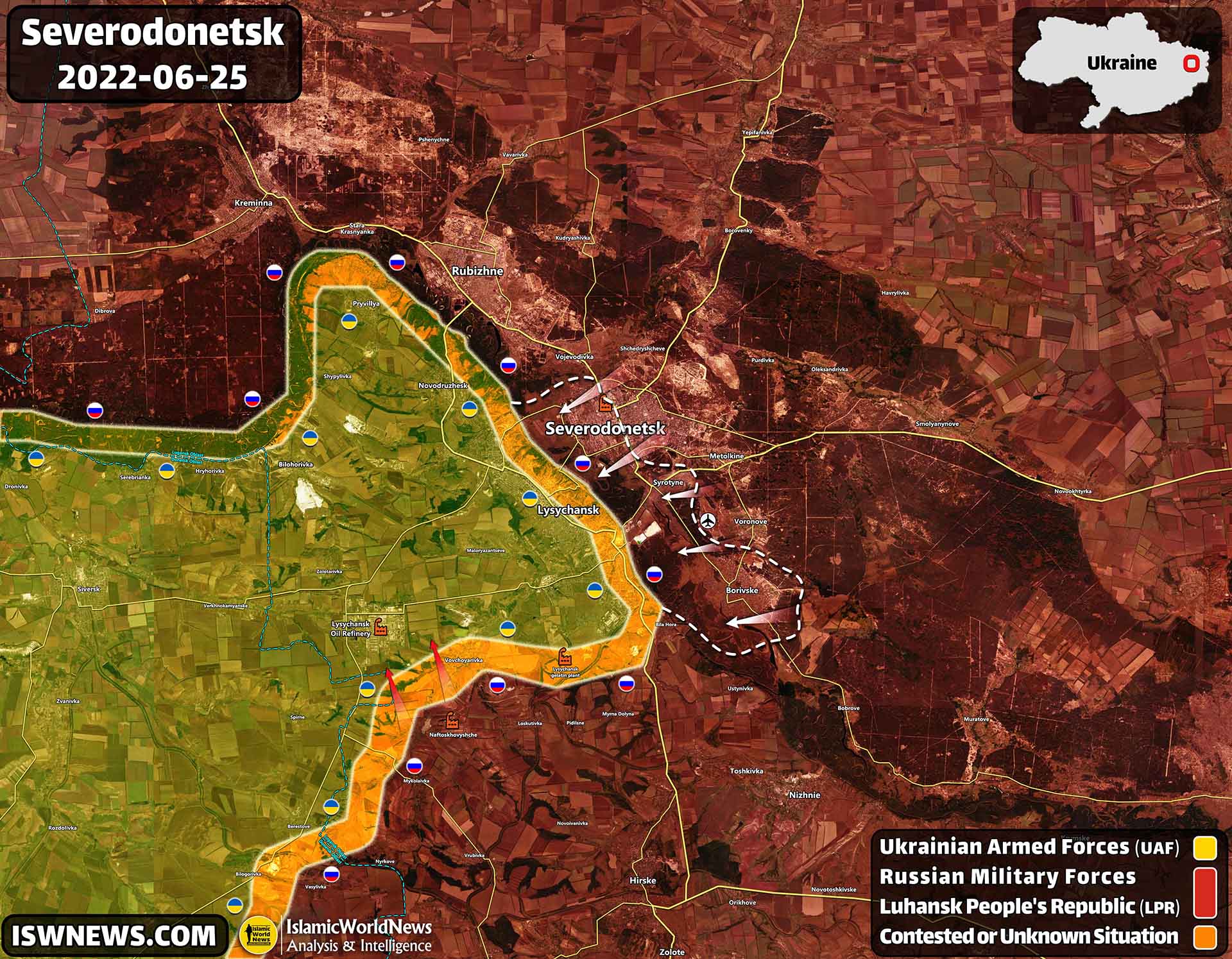
    During the Russian advance, in addition to the city of Severodonetsk, the Syrotyne and Borivske settlements also came under Russian control. According to the information provided, the newly captured areas is about 145 square kilometers. However, the resistance of the Ukrainian forces in the city of Severodonetsk and the surrounding areas until the last day was very good and notable; But now, with the Russian occupation of the city, the morale of the Ukrainian forces to maintain the remaining areas in the Luhansk oblast will practically disappear, and we will probably see faster defeats and early retreats to the Bakhmut-Slavyansk-Kramatorsk line.

    Currently, most of the clashes are concentrated in the Vovchoyarivka area and south of the Lysychansk refinery. The purpose of the Russian advance on this axis seems to be to pressure the Ukrainian forces to withdraw from the city of Lysychansk.

    Read more:
    Latest military situation on Severodonetsk front, 7 June 2022
    Latest Military Situation in Ukraine After 99 Days of War (Map Update)

    Click to see the full size map
  • Latest military situation on Severodonetsk front, 7 June 2022

    Latest military situation on Severodonetsk front, 7 June 2022

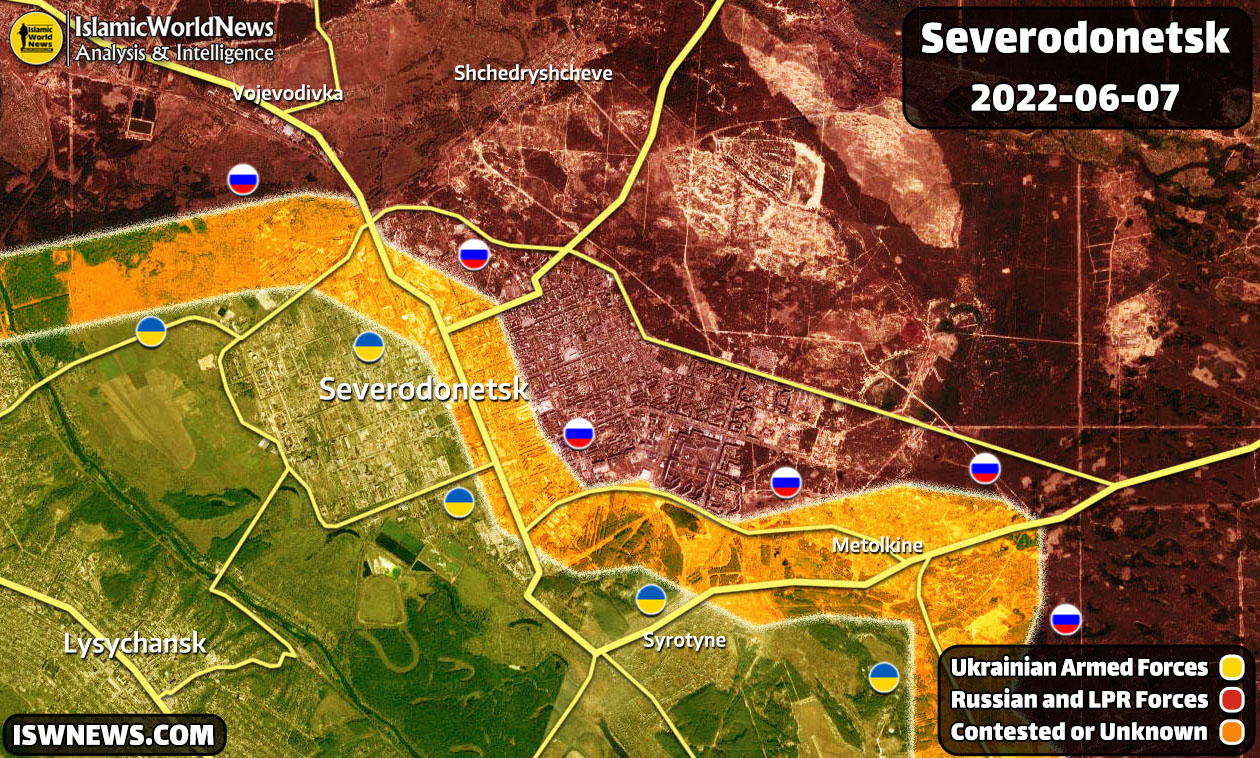
    According to the latest news from the Severodonetsk front, clashes are taking place in the Metolkine district and the central areas of the city. Ukrainian sources claimed that they had taken control of the situation and claimed to have repelled Russian attacks. In total, more than half of the city of Severodonetsk has been captured by the Russian army, and clashes continue in the western half.

    Severodonetsk is the name of an industrial city in the western part of Luhansk Oblast in eastern Ukraine. The city was chosen as the capital of Luhansk province in 2014 because the city of Luhansk came under the control of LPR forces.
    The city has several chemical plants and production centers called “Azot” (one of the largest chemical plants in Europe) as well as an airport in the southeast, which are important in recent conflicts.

    The location and foundation of this city dates back to 1934 and is closely related to the city of Lysichansk. In fact, the proximity of the cities of Severodonetsk, Lysichansk and Rubizhne to each other has made them an important location.

    The city was captured by Luhansk forces at the beginning of the 2014 conflict, but the Ukrainian army regained control of the city two months later. After that, the European Union, while supporting the Ukrainian army operation in Severodonetsk, announced that it would provide 93.8% of the reconstruction costs of this industrial city.
    After the Russian invasion of Ukraine, the conflict on the western front of Luhansk resumed, and the Russian army, after the complete capture of the town of Rubizhne, began its attacks on May 8 to capture Severodonetsk.

    Severodonetsk and Lysichansk are the last areas in Luhansk Oblast to be controlled by Ukrainian forces, and their fall marks the complete capture of the first Ukrainian province by Russia. Therefore, the resistance of the Ukrainians in these areas will be fierce, and the Russian army must use a lot of power and equipment to capture it!

    Read more:
    Latest Military Situation in Ukraine After 99 Days of War (Map Update)
    One third of the city of Severodonetsk under Russian control!
    Latest military situation in Eastern Ukraine, 23 May 2022 (Map Update)

  • Latest Military Situation in Ukraine After 99 Days of War (Map Update)

    Latest Military Situation in Ukraine After 99 Days of War (Map Update)

    Clashes have escalated in southern Ukraine over the past week on the Kherson and Mykolaiv borders, and some fronts have changed.

    At the borders of the Kherson and Mykolaiv oblasts, Ukrainian troops have repeatedly attacked the Snihurivka area, but Russian forces have been able to repel the attacks. Interactive Map: Click here

    In the Davydiv Brid area, according to Ukrainian sources, Ukrainian forces crossed the Inhulets River to take control of the villages of Bilohirka and Andriivka. Clashes in the area between Russian and Ukrainian forces continue. Interactive Map: Click here

    In the north of Kherson oblast, Ukrainian forces have entered a number of villages. However, before this, the Russian army did not control these villages and the villages were empty. The villages of Ivanivka, Arkhanhelske, Vysokopilya, Myroliubivka, Petrivka and Zolota Balka in the north of Kherson oblast and these areas are considered as the front lines in this region. Interactive Map: Click here

    In eastern Ukraine, on the Kharkiv axis, Russian troops captured a number of villages. In fact, Russian forces entered a number of villages from which they had retreated last month. Hence, the villages of TTernova, Peremoha, Shestakove, Fedorivka in northeast of Kharkiv, were recaptured by Russian forces. With the progress made, the Staryi Saltiv is under siege from three directions And if pressure continues, AFU forces may withdraw from the area. Interactive Map: Click here

    The other three important fronts in eastern Ukraine are the Severodonetsk, Izyum and Popasnaya fronts, which complement each other. On the Severodonetsk axis, Russian troops have taken control of most of the city of Severodonetsk, and mop-up operation continues in the western part of the city. Interactive Map: Click here
    On the Izyum axis, Russian military forces have taken control of the important town of Lyman in recent days. Interactive Map: Click here
    On the Popasnaya axis, clashes continue sporadically. The Russian army and its allies have been able to expand the lines along this axis, advancing north, west and south of Popasnaya, but progress has been slow. Interactive Map: Click here
    There have been no significant changes on other fronts in southeastern Ukraine, and sporadic clashes continue along the front lines.

    In general, Russia’s progress in eastern and southern Ukraine is slow, but the Russian army has the upper hand. Due to the urban conflict and the use of a huge amount of artillery and bombardment, the casualties on both sides are very high. So much so that Ukrainian President Volodymyr Zelenskyy has also admitted this. According to him, about 100 members of the Ukrainian army are killed daily on the eastern fronts and the number of wounded reaches 500 per day. These casualties are also on the opposite side, Russia, but given the superiority of the Russian army fire on this axis, the casualties of the Russians are logically less than the Ukrainian army.

    Read more:
    Latest military map of Ukraine after 77th days of war, 11 May 2022
    Latest military situation in Eastern Ukraine, 23 May 2022 (Map Update)

  • One third of the city of Severodonetsk under Russian control!

    One third of the city of Severodonetsk under Russian control!

    In recent days, with the infiltration of Russian and LPR forces from the east and north into the city of Severodonetsk and the occupation of the first residential areas, the urban war in Severodonetsk practically began. The advance of the Russian forces in the neighborhoods of the city is done in media silence, and only the images published by the Russian forces from inside the city confirm the amount of the advances.

    At least one-third of the city is now under Russian and LPR control. According to some estimates, there are about 2,000 Ukrainian troops, as well as an unknown number of foreign fighters in the city of Severodonetsk. But with the Russian army advancing inside the city, most of these forces have retreated to the western part of Severodonetsk and will probably be pushed to Lysychansk soon.

    The city of Severodonetsk, unlike the city of Mariupol, does not have strong defenses and the possibility of long-term resistance by Ukrainian forces seems unlikely.

    Read more:
    Latest military situation in Eastern Ukraine, 23 May 2022 (Map Update)
    Latest military map of Ukraine after 77th days of war, 11 May 2022

    Click to view full size
  • Latest military situation in Eastern Ukraine, 23 May 2022 (Map Update)

    Latest military situation in Eastern Ukraine, 23 May 2022 (Map Update)

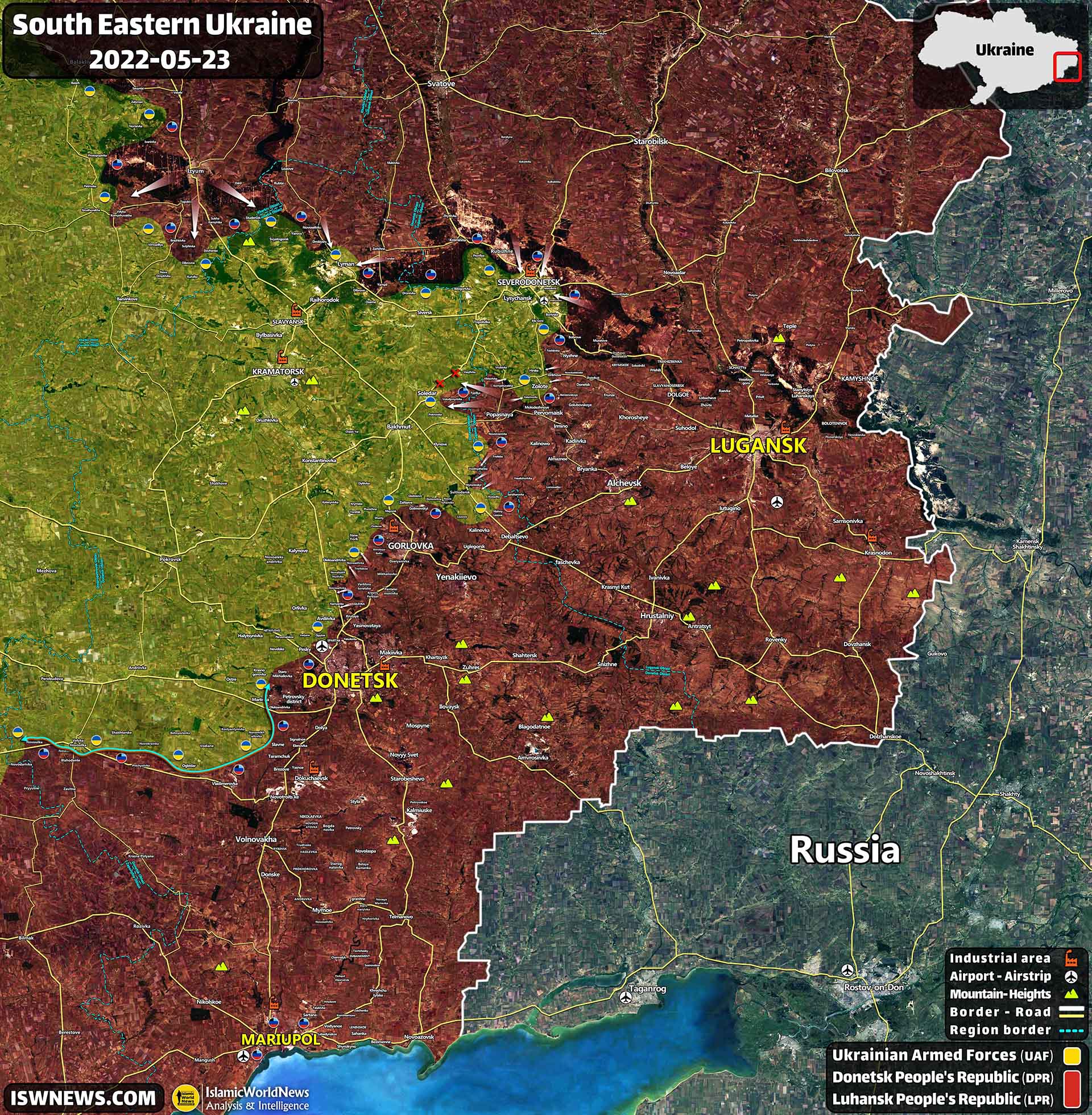
    In Donetsk Oblast, on the Mariupol front, on May 30, with the surrender of the last Ukrainian troops to the Russian army in the Azovstal industrial zone south of Mariupol, this important port city came under full control of Russia and its allies. The complete capture of the city would allow the Russian army and its allies to transfer troops from this town to other fronts and increase focus on advancing elsewhere.

    In the north of Donetsk, sporadic clashes continue along the Gorlivka and Donetsk front lines. Field changes in this axis are slow. In recent weeks, Russian and Donetsk forces have made minor advances along this axis. The capture of New York near Gorlivka and the capture of Avdiivka near Donetsk are among the main objectives of the Russian military operation on this axis.

    In the northeast of Gorlivka, Russian and its allies entered the Donetsk oblast from the Luhansk oblast and the Troitske and took control of the Myronivskyi area. The purpose of advancing on this axis is to capture Svitlodarsk and the surrounding areas of the lake and to secure the city of Gorlyuka from the northeast.

    To the west of Donetsk, sporadic clashes continue along the front lines from Mariinka to Velyka Novosilka. Last month, the Russian army and Donetsk (DPR) forces launched an unsuccessful offensive to seize the Mariinka region. Currently, most of the clashes continue on the Mariinka, Novomykhailivka, Ogledar and Velyka Novosilka axes between Russian and Ukrainian forces. It seems that the Russian army and its allies do not have a serious intend to make progress on this axis at the moment, and clashes are taking place on this axis to keep Ukrainian forces busy.

    In the Luhansk oblast, clashes and field changes are taking place more intensely, and the completion of work on this oblast seems to be a priority for the Russian army and its allies. Now, 89 days since the start of the war in Ukraine, 95 percent of Luhansk oblast is under the control of the Russian army and its allies, leaving only the city of Severodonetsk and the surrounding area. Hence, the capture of the important and industrial city of Severodonetsk is the main and ultimate goal of the Russian army and Luhansk (LPR) forces in this area.

    It should be noted that after the withdrawal of the Russian army from the northern fronts of Ukraine, the Russian army announced its focus on the liberation of the southeastern regions of Ukraine, and in particular the Donbas region. Since then, we have witnessed a change in tactics in the way the Russian army is advancing. Under the new tactic, key areas and areas where face fierce resistance by Ukrainian forces are bypassed by Russian forces and its allies, forcing the defensive forces to retreat from the area by creating an quasi-siege and increasing pressure. This tactic is clearly visible in the northern regions of Donetsk oblast and the Severodonetsk front in areas such as Popasnaya, Zolote, Lyman, etc.

    On the Popasnaya front, in recent days and weeks, Russian forces and its allies have been able to expand their contact lines and reach the important town of Soledar from the west. With the advance on this axis, the logistic route of the Ukrainian forces from Bakhmut to the city of Severodonetsk was practically cut off. Ukrainian forces also came under a quasi-siege in the Zolote area.
    On the Lyman-Izyum axis, progress is slow, but Russian forces have expanded frontlines around Izyum over the course of a few weeks, advancing from village to village. And operations to capture the town of Lyman have also begun.
    According to the tactics adopted by the Russian army, it seems that all the progress made on these axes is made with the ultimate goal of completing the siege of the city of Severodonetsk.

    On the ciity of Severodonetsk front, heavy fighting continues around and at the entrances to the city. In recent weeks, Russian and LPR forces have been able to approach the city from both the northern and southern axes. In south of the city of Severodonetsk, clashes continue in the areas of Metolkine, Voronove and Syrotyne. On the northern front of Severodonetsk, heavy clashes continue at the northern entrances to the city. The Russian offensive is focused on the four main roads leading to the city. The Russian military has also blown up the main bridge between Severodonetsk and Lysychansk, with the aim of cutting off Ukrainian forces in the city of Severodonetsk from outside the city. The complete capture of the city of Severodonetsk plays an important role in determining the future of the battles in the southeastern regions of Ukraine.

    According to the progress made until the 89th day of the war, about 55% of Donetsk oblast and 95% of Luhansk oblast have been captured by the Russian army and its allies.

    Interactive map of Ukraine: Click here

    Read more:
    Latest military map of Ukraine after 77th days of war, 11 May 2022
    Latest military situation in Eastern Ukraine, 26 February 2022 (Map Update)

    Click to view full size map