Tag: Suwayda

  • Scorching Suwayda: Unraveling Sectarian Fragility in Post-Assad Syria

    Scorching Suwayda: Unraveling Sectarian Fragility in Post-Assad Syria

    This delicate balance is now under strain, especially in Syria’s Suwayda province, the heartland of the Druze. Recent clashes with Sunni Bedouin tribes and alleged Israeli interference have deepened mistrust toward Syria’s transitional government. As violence escalates, the Druze—committed to strict traditions and survival—find themselves at the crossroads of regional and international tensions.

    In recent months, Suwayda has seen a surge in violence, sparked by kidnappings and retaliatory attacks between Bedouin tribes and Druze militias. The Damascus-based government deployed forces to contain the unrest, but deep-seated distrust led to armed resistance from Druze fighters. Reports of massacres, looting, and arson—allegedly by pro-government groups like Ahrar al-Sharqiya and Ansar al-Tawhid—have further inflamed tensions. Social media posts and unverified accounts of military raids and civilian killings have raised fears of another sectarian catastrophe.

    Israeli tanks and airstrikes targeting Suwayda and Damascus added fuel to the fire. While Israeli officials claim to protect Druze minorities, many Syrian Druze remain skeptical of Tel Aviv’s intentions.

    Geopolitical Rivalry in Southern Syria

    Turkey and Israel are vying for control over trade routes linking southern Syria to Jordan and the Gulf. Turkey, aligned with Damascus, seeks to expand its influence southward and open new export corridors. Israel, meanwhile, exploits instability to counter Iranian presence and build ties with minorities like the Druze and Kurds. Despite secret talks in Baku to avoid military incidents, ongoing violence in Suwayda and Israeli strikes on Damascus reveal deeper rifts.

    Turkey, with limited military and political leverage, prefers diplomacy and U.S. pressure over direct confrontation, fearing that conflict could derail Syria’s reconstruction and harm its own interests.

    Israel’s Peripheral Doctrine and Arab Fragmentation

    Since its founding, Israel has pursued a “peripheral doctrine”—forging alliances with non-Arab regional powers and exploiting internal divisions in Arab states. Syria, as a populous neighbor with historic ties to Palestine, remains central to this strategy. By strengthening ties with Druze and Kurdish groups, Israel aims to fragment Syria from within. Prime Minister Netanyahu has openly outlined post-Assad goals: blocking Syrian government forces near Damascus, supporting Druze communities, and maintaining control over the Golan Heights.

    This strategy seeks to turn Syria into a failed, unstable state, minimizing threats to Israel. The use of sectarian divisions and minority alliances as tools of control has long been a hallmark of Israeli policy.

    Syria’s Response and Internal Challenges

    Under President Ahmad al-Shara, Syria’s new government has responded cautiously to Israeli aggression, condemning airstrikes and emphasizing territorial integrity. It seeks regional diplomacy—especially with Jordan and Arab states—to counter expansionist threats. However, avoiding direct confrontation may weaken its domestic legitimacy and allow Israel to deepen its influence.

    Effective resistance requires coordinated Arab and international efforts to prevent further collapse and regional instability.

    Expanding Israeli Ambitions

    Israel’s ambitions now extend beyond Syria, targeting the broader periphery—including Iran and Pakistan. Some neoconservative analysts advocate for exploiting ethnic and sectarian divides to destabilize Iran. The Abraham Accords, far from being mere peace deals, serve as instruments to cement Israel’s dominance in regional economics, security, and technology.

    This approach, however, risks backfiring. As Israel’s reach grows, so does regional opposition. Countries like Iran, Turkey, and Pakistan increasingly view Israel not just as a nuisance, but as a direct threat. Military actions in Gaza, Damascus, Beirut, Sanaa, and Tehran have galvanized regional solidarity against Israeli policies.

    History has shown that colonial empires rarely endure. Just as the people of this region once resisted crusaders and imperial powers, they now stand united against Israel’s expansionist doctrine.

    Sources:

    1. https://www.washingtonpost.com/world/2025/07/17/israel-syria-druze-attack/
    2. https://www.theguardian.com/world/2025/jul/18/more-violence-erupts-in-syrias-druze-heartland-as-tribal-groups-reinforce-local-bedouin
    3. https://www.nytimes.com/2025/07/18/world/middleeast/who-are-druse-syria-israel-clashes.html
    4. https://www.washingtoninstitute.org/policy-analysis/pursuing-israel-syria-detente-post-assad
    5. https://www.csis.org/analysis/violence-escalates-israel-intervenes-southern-syria
    6. https://www.middleeasteye.net/opinion/damascus-gaza-israels-doctrine-hegemony-fatal-flaw
    7. https://thecradle.co/articles/battle-in-suwayda-where-israel-and-turkiye-clash-over-syrias-trade-routes
    8. https://www.washingtonpost.com/world/2025/07/17/syria-israel-druze-border/
    9. https://apnews.com/article/druze-syria-religious-sect-2c989a5397c5e04474cef7bd9a37c40b?__cf_chl_rt_tk=5JchtEfIcPtDTbrCoJapZ91RhXRsgmmgiDMqNZE6R4U-1752921424-1.0.1.1-UDWYIzUovSA6IHVMilefEYYS5rD3BmPUa5VuAWNhesw
    10. https://www.middleeasteye.net/news/turkey-doesnt-have-many-options-against-israel-syria
    11. https://thecradle.co/articles/syrian-druze-confront-new-attacks-after-sharaa-declares-suwayda-ceasefire
  • Israel–Syria Talks Collapse Over Sovereignty Dispute

    Israel–Syria Talks Collapse Over Sovereignty Dispute

    This isn’t the first time Israel has made such a request. During earlier talks in Paris, Tel Aviv also pushed for the corridor, which Syria firmly opposed. According to Israel Hayom, deep divisions remain over issues like Israeli control of Mount Hermon and the Golan Heights, as well as security guarantees for the Druze minority allied with Israel.

    Previous rounds in Baku, Paris, and London had shown progress, with the U.S. even signaling that a de-escalation deal was within reach. However, the Sweida corridor dispute highlights the persistent strategic challenges facing any agreement.

    Suweida, home to a majority Druze population, holds significant security and social importance for Damascus. Accepting Israel’s proposal could undermine Syria’s political legitimacy. Even if the Sweida issue is set aside, core disagreements over the Golan and Mount Hermon remain major obstacles—issues too complex for short-term diplomacy to resolve.

  • Resumption of Clashes in Sweida Province (Video)

    Resumption of Clashes in Sweida Province (Video)

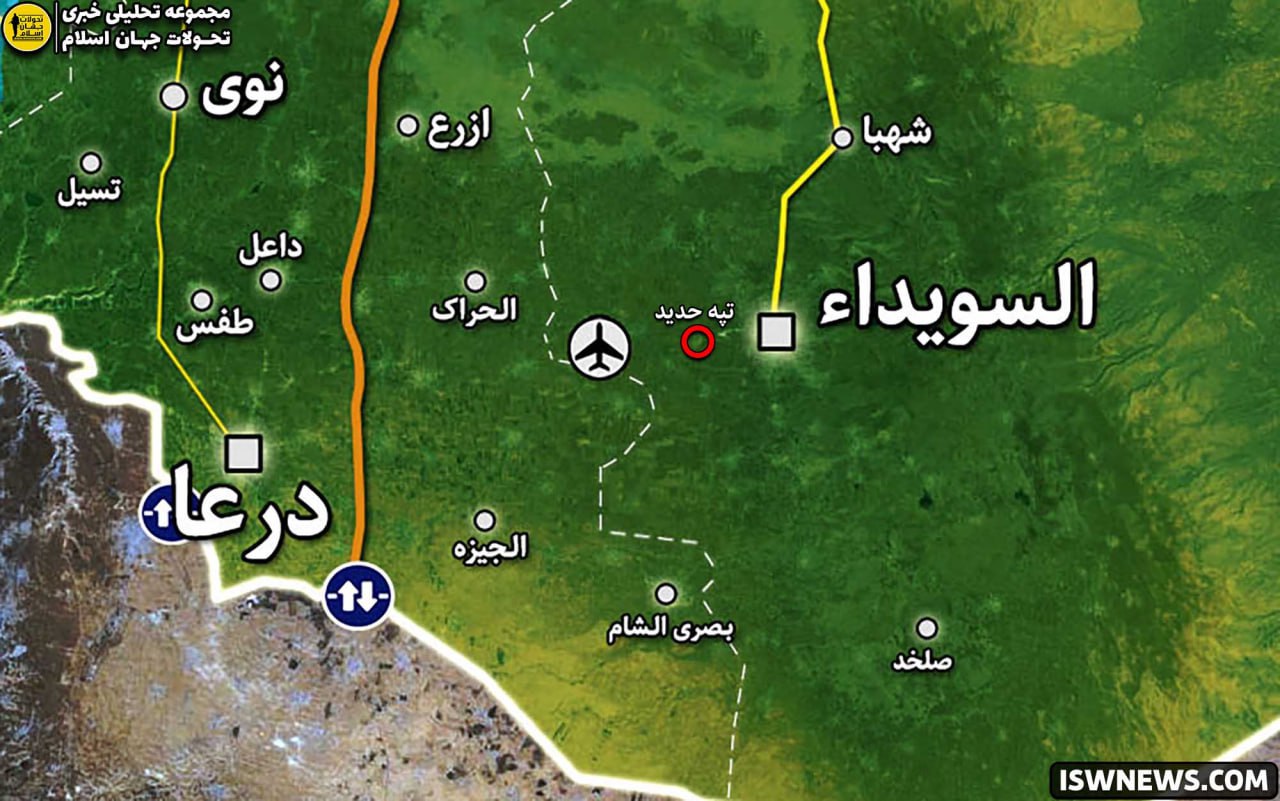
    According to the latest reports, Druze militants successfully took control of the strategic “Hadid” hill in western Sweida after engaging in clashes with Julani forces. During these confrontations, one Druze armed element was killed. There is currently no information regarding the casualties among Julani forces; however, several wounded members of the Syrian internal security forces have been transported to medical centers in Daraa province.

    Tal Hadid Suweida
    Tal Hadid Suweida
    Tal Hadid Suweida

    Meanwhile, as the clashes erupted in Sweida province, Israeli army aircraft were observed flying over both Sweida and Daraa provinces.

    Israeli warplanes

    It is important to note that Hadid Hill, located in the west of Sweida province, overlooks vast areas, including Al-Thaala and the roads leading to the center of Sweida. This strategic position underscores its significance in the ongoing conflict.

  • Formation of the Suwayda Military Council: Is Israel Supporting the Druze to Implement the David Corridor Plan?!

    Formation of the Suwayda Military Council: Is Israel Supporting the Druze to Implement the David Corridor Plan?!

    Local militants in Suwayda province have announced the formation of a new group called the Al-Majlis Al-Askarī L’As-Suwayda (Suwayda Military Council) in southern Syria. They have scheduled a meeting on February 24 in the Sad al-Ayn area, southeast of Sweida.

    Interestingly, the logo of this newly formed group is strikingly similar to that of the Syrian Democratic Forces (SDF). In fact, it appears that the logo of this group is essentially the same as the SDF logo but with a new location in Sweida province in southern Syria.

    Following the announcement of the group’s existence, several residents of the Al-Ghariyah area in the southern suburbs of Sweida province released a video declaring their allegiance to the Sweida Military Council and emphasizing their commitment to defending their homeland.

    Video from residents of the Al-Ghariyah area

    The SDF’s support for the residents of Suwayda is not a new development, as there have been similar instances in the past. During Bashar al-Assad’s government, the SDF expressed their support for the creation of an autonomous region in southern Syria and for the Druze. Sweida holds significant importance for the SDF; during the war with ISIS, the SDF agreed to exchange 60 ISIS prisoners for 30 residents of Sweida who had been kidnapped by ISIS. These instances highlight the strong relationship between the Kurds and the residents of Suwayda province.

    The Suwayda Military Council, led by Tariq al-Shufi, maintains a positive relationship with the Syrian Democratic Forces (SDF). In his recent remarks, al-Shufi praised the SDF forces, referring to them as defenders of the land and the Kurds against terrorism and dictatorial rule. The Sweida Military Council Command further emphasized the importance of maintaining positive and serious relations with the SDF forces.

    Tariq al-Shoufi, Commander of the Suwayda Military Council

    On the other hand, continuing the Israeli regime’s support for the Druze community in Syria, Israeli Prime Minister Benjamin Netanyahu emphasized the need for the Syrian government to respect the rights of the Druze minority and stated that any threat against the Druze in southern Syria will not be tolerated.

    In response to Netanyahu’s statements, Al-Shufi expressed gratitude to all those who support the Sweida Military Council and help protect the Druze community and stabilize the region.

    Simultaneously with the announcement of the Sweida Military Council’s existence and Netanyahu’s support for the Druze, some analysts viewed these actions as part of the “David Corridor” plan. They considered these actions an attempt by the Zionists to support Israel’s Kurdish allies east of the Euphrates in order to fuel separatist conflicts in the region.

    The so-called David Corridor in Syria

    The “David Corridor” is envisioned as a corridor created through the occupation of southern Syria, including the provinces of Daraa, Suwayda, part of Homs province (the Al-Tanf region), and Deir Ezzor, reaching the Euphrates. The recent occupation of areas in Daraa province by the Israeli army could be seen as part of this plan.

    If the Zionists decide to implement this plan, Tel Aviv’s next step after advancing in Daraa province would be Sweida. Gaining access to and passing through Sweida requires the support and approval of the Druze, which has been partially achieved. After Sweida, the advance of the Zionist military in southern Syria would be facilitated, as the Al-Tanf region in Homs province has been under American occupation for years, and the US army would pave the way for the Zionists to reach Deir Ezzor province.

    It is worth noting that the construction of the David Corridor is considered part of the “Greater Israel” plan.

  • Jordanian Warplanes Attacks Syria

    Jordanian Warplanes Attacks Syria

    Two days ago also, an armed clash occurred between Jordanian border guards and armed smugglers attempting to infiltrate Jordanian territory, resulting in the death of a smuggler and the injury of a Jordanian border guard.

    These incidents are happening while during the previous government, arms and drug smuggling and similar incidents were attributed to the government of Bashar al-Assad and his military; however, under the new government, this issue persists and, due to the central government’s weakness and lack of a deterrent force, Jordan has even started bombing Syrian territory.

  • Israel Struck Key Radar Site In Southern Syria

    Israel Struck Key Radar Site In Southern Syria

    Suwayda 24, a local Facebook news page, said that one of the strikes hit a radar system, which was struck last year but was brought back to service just two months ago, while the other strike hit a hangar that was recently built at the site. No casualties were reported.

    There was no statement from the Syrian Ministry of Defense, which usually acknowledged such attacks though the official Syrian Arab News Agency (SANA).

    The attack came just hours after a series of Israeli strikes hit northern Syria. The strikes targeted a military-industrial complex of the Syrian Scientific Studies and Research Center located near the town of al-Safirah in the southern countryside of Aleppo and a military site near the town of Saraqib in the southern Idlib countryside.

    The attack on the radar site in al-Suwayda may be meant to facilitate more attacks on northern Syria, or even to prepare for an attack on Iran or its allies in Iraq.

    Israel has already vowed to strike back if Iran retaliates for the October 26 attack on Iranian targets. Recent Hebrew media reports also said that the Israeli military could attack Iraq in response to repeated drone attacks by Iran-backed armed factions there.

    Originally posted on SouthFront

  • Jordan Carries Out Airstrike On Southern Syria For 2nd Consecutive Time In Past Week!

    Jordan Carries Out Airstrike On Southern Syria For 2nd Consecutive Time In Past Week!

    It is reported that as a result of this attack, three individuals, including a drug smuggler, were killed. Further details have not been disclosed regarding this matter. This is the second airstrike by the Jordanian army in southern Syria in the past week. Before the airstrike, positions in southern Syria were targeted by the Jordanian fighter jets on January 5.

    Prior to this attack, a military source in the Central Command of the Jordanian Armed Forces (JAF) had announced that the army of this Arab country has been engaged in armed clashes with large groups of smugglers on the northern borders since early Saturday morning.

    Under the pretext of fighting drug smugglers, the Jordanian army carried out attacks on positions in southern Syria over the course of recent months, resulting in the loss of several civilians and injuries to dozens of others.

    Media outlets, which are involved in advocating terrorist groups and supported by the Western states, present these groups as connected to the Syrian government and the Resistance, but so far, they have not provided credible evidence to prove their claims concerning the existence of any connection between these groups and the Syrian government.

  • Anti-Government Protests Continue In Suwayda

    Anti-Government Protests Continue In Suwayda

    A number of residents of Suwayda province gathered in protest against the deteriorating living conditions and against the Syrian government’s decision to increase fuel prices.

    Protesters chanted slogans against the Syrian government and Bashar al-Assad. On the other hand, the Syrian opposition media published the video of these gatherings with gusto and announced that the slogans of the 2011 revolution are being repeated by the people of Suwayda after many years…

    Simultaneously with these gatherings, a group of protesters blocked some roads by burning tires. They emphasized that they will continue protest and blocking the roads until their demands are met.

    It should be noted that in addition to Suwayda, some areas in Daraa province have also witnessed protest gatherings.

  • Jordan Fighter Jets Pound South Syria, 8 Civilians Killed

    Jordan Fighter Jets Pound South Syria, 8 Civilians Killed

    On May 7, Jordan’s army fighter jets targeted a workshop in the Kharab al-Shahm district of Daraa governorate as well as a residential unit in the Al-Sha’ab district of Suwayda governorate under the pretext of fighting drug trafficking.

    It is claimed that the house targeted by Jordanian fighter jets belonged to a person named Marai Al-Ramthan (45 years old), an alleged high-profile smuggler in southern Syria. The man, his wife and six children were killed in the Jordanian air strike.

    Marai Al-Ramthan and his six children

    The air raid took place after Minister of Foreign Affairs of Jordan Ayman Safadi threatened on May 5 that military operations would be carried out inside Syria if necessary decisions and effective actions were not taken to curb drug trafficking in the neighboring country. He also underlined that Jordan’s armed forces do not consider the threat of drug trafficking as a simple problem.

    The Syrian officials and military commanders have not yet reacted to the issue of the recent air strikes by Jordan’s air force against two different governorates in the war-stricken country.

  • Opinion: The riot project in Suwayda

    Opinion: The riot project in Suwayda

    In recent months, some residents of Suwayda province protested against the inappropriate management by the Syrian officials and livelihood problems. Southern Syria has always been the focus of attention by many intelligence agencies, including the Mossad. Therefore, these gatherings were managed and intensified by the Israeli intelligence agencies, and after a short period of time, the protests turned into armed conflicts.

    Although some of these elements were arrested by the Syrian security forces and the allies, the available evidence and the examination of the recent gatherings in Suwayda confirm the role of intelligence agencies.

    These elements were able to turn the gatherings into violence only by inciting the existing faults and highlighting the weaknesses of the Syrian government and their presence in the events. The main problem that paved the way for the foreign elements in Suwayda is the unfavorable economic conditions and the failure to address the demands of the people. This province is controlled by the Syrian authorities.

    Considering the arrival of winter and problems such as lack of fuel, frequent power outages, as well as the increase in violence and tensions in Suwayda, it is likely that livelihood problems turn into a dangerous security problem and we may witness a serious challenge similar to the beginning of the Syrian conflict in Daraa province.

    Currently, the intensity of the conflicts in Suwayda has decreased and the deployment of security forces and military police in this city has established relative peace but the evidence indicates that opposition groups are planning a new round of riots and we may see a series of disturbances in the coming days.

  • Intensification of unrest and protests in the city of Suwayda + Video

    Intensification of unrest and protests in the city of Suwayda + Video

    On December 4, some residents of Suwayda city protested against livelihood problems, frequent power outages, water supply problems and lack of fuel and blocked several streets of this city by burning tires. Following the protests, the rioters stormed the governor’s building and took control of it and started violent behavior. However after the arrival of the security forces, the protesters were forced to withdraw from the Suwayda governorate building, but the armed conflict between the protesters and the security forces continued in the streets of Suwayda, including around the police headquarters in the center of the city. The clashes ended after several hours with the large presence of Syrian security forces in the streets of Suwayda.

    A video of the protesters storming a governor’s office in the southern Syrian city of Suwayda

    According to the announcement of the interior ministry of Syria, one of the Syrian security forces and a protester have been killed during the clashes in the southern Syrian city of Suwayda.

    It is worth mentioning that some time before and after the beginning of the demonstrations in Shahba and Majdal towns in the north of Suwayda, the Israeli elements took over the management of the gatherings, but the observations carried out by Hezbollah security forces led into arresting a number of groups related to Israel.

    This event indicates that the unrest in southern Syria is one of the favorite subjects of the Israeli intelligence agencies. The recent protest gatherings were organized under the pretext of the difficult living conditions in Suwayda province and it is controlled by the Mossad.

    It’s likely that lack of proper management of the riots by the Syrian authorities, the influence of intelligence services, directing the protests and abusing the people’s demands can cause a widespread insecurity and conflicts in the south of Syria again.

  • Tension in Suwayda; A security HQ was captured by local armed factions+ Images

    Tension in Suwayda; A security HQ was captured by local armed factions+ Images

    In the last few days, al-Suwayda province has witnessed one of the most intense clashes between the local armed factions and the Syrian government’s security forces. On July 23, the forces of the “Quwat al-Fajr Movement” affiliated with the Syrian security apparatus, arrested five civilians in the town of Shahba, located in the north of the city of Suwayda. This issue led to wider tension and armed conflict in Suwayda province, and dozens of people from the surrounding areas of Suwayda city protested this action and blocked several roads in Shahba town and its surroundings by gathering and burning tires.

    These protests continued for several days and finally on July 26, a local armed group named “Rajal al-Karamah” attacked the headquarters of the Syrian security forces in the town of Atil located in the north of Suwayda and after a few hours of fighting, they managed to capture the SAA headquarters.

    According to preliminary information, 17 SAA servicemen and local militia group members were killed and 35 others were wounded as a result of clashes in the Suwayda province in the past days. Contradictory reports have been published regarding the arrest or killing of Raji Falhout, the commander of the “Quwat Al-Fajr Movement” forces, but so far there is no reliable information about his fate.

    It is worth mentioning that the local armed groups in Suwayda province are divided into three categories. Some of these groups are neutral, some of them are against the government of Bashar al-Assad, and another part of them are the pro-government groups affiliated with the Syrian security organization. The activities of most of these armed groups are similar to each other in different fields, but in the past years, they have clashed with each other due to differences over various issues.

    Considering the activities of terrorist elements and the protest gatherings of the people of Suwayda province in recent months, it is possible at any moment that the insecurity of this province will exceed the current level and turn into a serious security crisis for the Syrian government.

    Read more: Syria: Protest in the south, war in the north!

    Tensions in Atil town