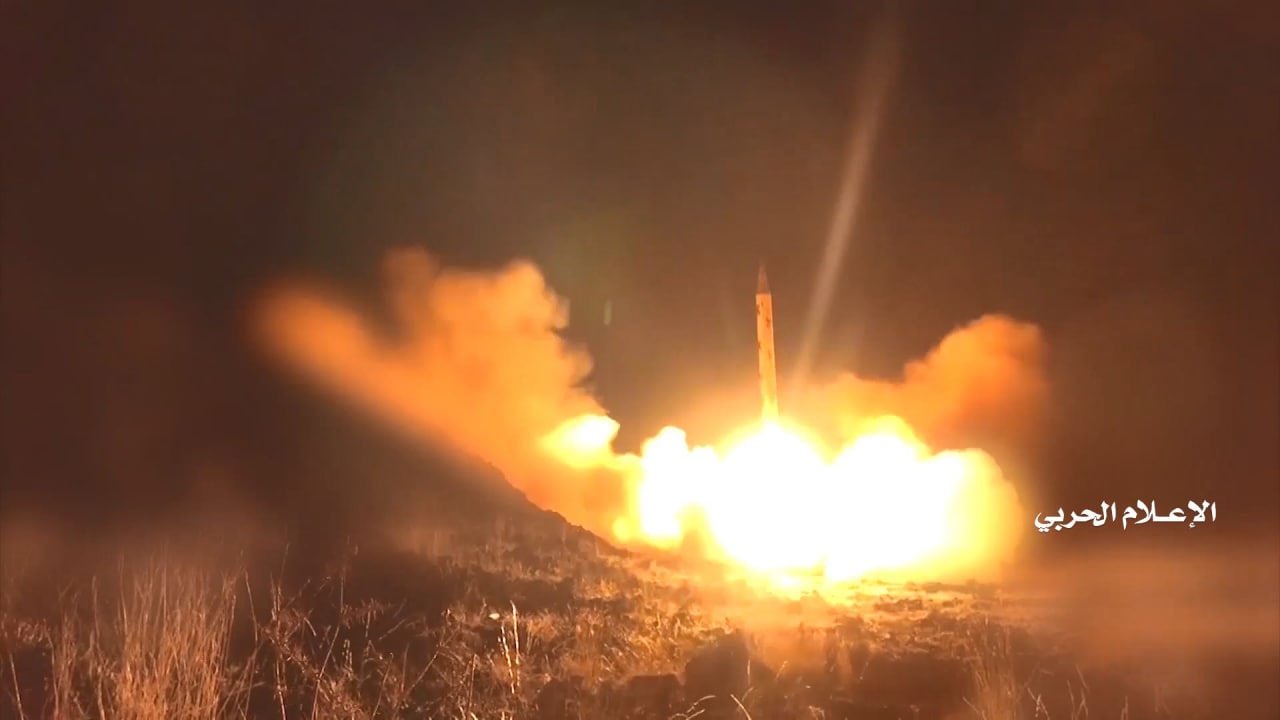
The missile was not unveiled before and Ansar Allah media have not disclosed any details about it, however, it was used in many operations last year.
Considering the targets Zulfaqar missile was used for, the missile should have a range of 1,100 to 1,300 km and seems to be developed from Burkan missile family of Ansar Allah.
Zulfaqar missile fired at Riyadh during Operation Fifth Deterrence Balance
Ansar Allah has launched seven Zulfaqar missiles against Saudi coalition in six operations, details are as follows, – Third Deterrence operation against Aramco oil infrastructure on Yanbu harbor on February 21, 2020, one missile. – Nasr Min Allah operation, unknown date, two missiles. – Missile operation against Saudi coalition in Riyadh on March 29, 2020, one missile. – Fourth Deterrence operation against Saudi coalition in Riyadh, Jizan and Najran on June 23, 2020, one missile. – Missile and drone operation against Saudi coalition in Riyadh on September 10, 2020, one missile. – Fifth Deterrence operation against Saudi coalition on February 27, 2021, one missile.
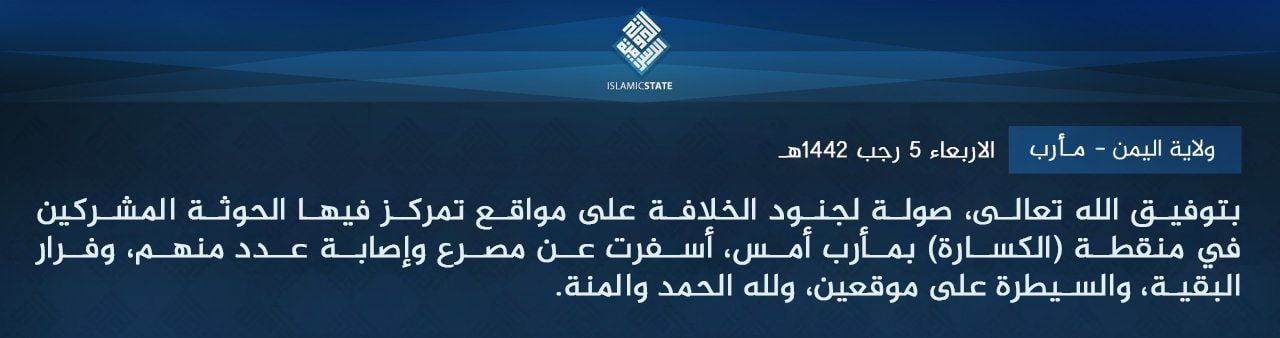
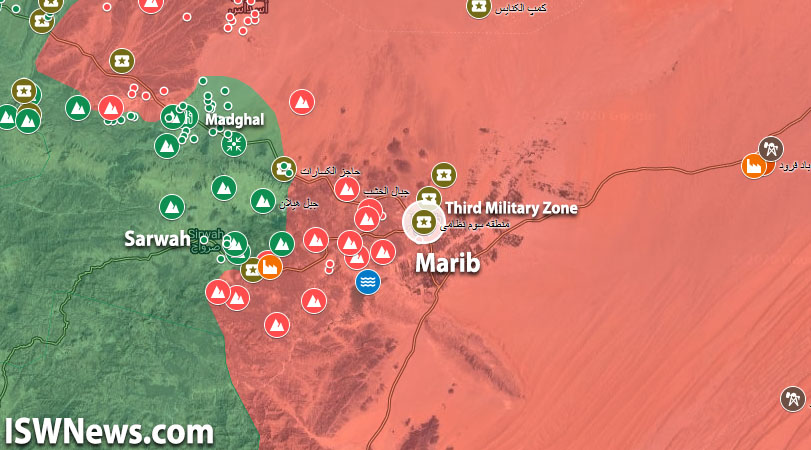
In the statement, ISIS claimed to have clashed with Ansar Allah in the al-Kasarat area (east of Madghal), and allegedly took control of two areas on this front and imposed heavy casualties to Ansar Allah forces. The allegations come as clashes continue in the eastern part of al-Kasarat while the Saudi coalition warplanes bombing the area.
ISIS cooperation with the Saudi coalition against Ansar Allah has already been proven in the areas of Sanaa, Saadah, east of al-Jawf and north of al-Baydha, and its documents and news are available in the archives of ‘ISWNews.com‘. So this alliance is not new.
But the persistence of international organizations and some Western media on their positions against the rule and existence of Ansar Allah in Yemen is a matter that is very surprising and questionable! “Houthis”, “Shiite militias”, “coup plotters”, etc. are the titles used by these media outlets to portray Ansar Allah as a minority in the religious and political spheres of Yemen, while at least 65% of the total population of Yemen resides in Ansar Allah areas and at least 52% of the total population of Yemen is in favor of the Salvation government and Ansar Allah.
Joseph Biden, US president, remarks regarding the Yemen war and to stop military support for Saudi coalition shows new goals of the West in Yemen which can be dangerous and have severe consequences. Recent evolutions in Yemen steers the war as follows in summary:
1- Joe Biden recent remark regarding Yemen: “Diplomacy is back. We are going to rebuild our alliances. We are going to re-engage the world. This (Yemen) war has to end and to underscore our commitment, we’re ending all American support for offensive operations in the war in Yemen, including relevant arm sales. We’re going to continue to help Saudi Arabia defend its sovereignty and territorial integrity and its people.”
Biden’s remarks regarding ceasing the war in Yemen is new policy of the West. Saudis tried a lot to bring US to Yemen war during Trump administration to compensate for their loss and it was going on by putting Ansar Allah in terrorist group and sanctioning the leaders of the movement. However, by transferring the power in US, the policy changed toward using diplomacy. How will be the future of Yemen war with this new policy?
Biden assigned Timothy Lenderking as US special envoy in Yemen affair who has a long history in US foreign policy in west of Asia. His last position was deputy of secretary of state in Iran and Iraq affair, which was not irrelevant to Yemen. He said in his previous remarks interviewing Qatari Al Jazeera: “Saudi Arabia and the UAE failed to achieve their goals in Yemen, despite high costs and US aid, and this is a sad fact. Iran is responsible for the failure of this operation because it supports, trains and equips the Houthis (Ansarallah) with military equipment. We feel frustrated by the non-compliance of the parties involved in Yemen with the provisions of the Swedish agreement, and the Yemeni people feel even more frustrated.”
Biden understood that he cannot achieve anything in Yemen without Iran. This does not mean Ansar Allah depends on Iran, but it means to give privileges to Iran regarding its nuclear plan as a lever to get something in Yemen and Iran is the best mediator to talk to Ansar Allah. In fact, Biden’s policy is that a nuclear deal becomes an introduction to other deals with Iran over the region and other issues.
As stated in previous articles, arm deals with Saudi Arabia and UAE have two sides which shows US policies in dealing with dependent countries. On one side US gets what is interesting for it and on the other side it breaks its obligations. It is a general policy of USA which includes everyone except Zionist Regime. Therefore, Trump’s deals with Al Saud and Al Zayed were suspended by Biden and supporting war turned into stopping war. The West’s thinktanks believe Saudi coalition has worn out in Yemen without achieving the mission of establishing a dependent government in Yemen to ensure their interests. West’s policy has been always about conflict, federal administration, dividing, etc., in Yemen which shows itself better over time.
2- Saudi Arabia reaction to Biden’s stance was only focusing on the part regarding US support for Saudis sovereignty on Saudi Arabia which does not mean the relation between two countries turned cold, but it means that Biden does not support Saudis’ stubborn policies. Biden mentioned to support Saudi coalition renewal and it means that Biden follows Democrat’s policy of establishing an Arabic-Zionist coalition but does not follow a unilateral policy.
Mansoor Hadi resigned administration welcomed the part of Biden’s speech over the importance of diplomatic effort to solve the crisis in Yemen.
After Riyadh agreement, the presence and power of Muslim Brotherhood in the resigned administration was limited significantly and it opened the Southerners hands in future of Yemen which is not favored by pro Mansoor Hadi.
Therefore, they find dealing with Ansar Allah to limit Southerners power is more effective. But their severe dependence on Saudi Arabia and insisting on winning the battle with Ansar Allah made them to leave the negotiation.
3- Southern Transitional Council led by Aidarus al-Zoubaidi visited Russia recently and talked about increasing Russia’s role in Yemen and normalizing relation with the Zionist Regime after establishing South Yemen. Russian officials stressed on the Riyadh agreement and importance of Southerners in future negotiation of Yemen.
Again; now that there is talk about diplomacy, where is the Yemen war heading?
We first analyze the structure and situation of present movements in Yemen: A) Rescue administration which is supported by Ansar Allah and 16 parties including General People’s Congress and is ally of Islamic Resistance in west of Asia. The areas controlled by Ansar Allah include provinces Sanaa, Amran, Saadah, Rimah, Hajjah, Mahwit, Dhamar, Ibb and most of areas in al-Baydha, al-Hudaydah, Al-Jawf (more than 75%) and al-Dhale, Taiz, Marib and Lahij (between 5-50%). Almost 65% of Yemen population live in the area controlled by Ansar Allah and at least 52% of Yemen population support the Rescue administration and Ansar Allah.
B) Mansoor Hadi’s resigned administration (supported by Saudi Arabia): Mansoor Hadi forces, who are under full support of Saudi coalition and Islah party (Muslim Brotherhood), control provinces of Shabwah, Hadhramout, and parts of Marib, Abyan, al-Baydha, al-Jawf, Taiz, Lahij, al-Dhale, Mahrah (between 5-50%) and other areas. There lives less than 35% of Yemen population in these areas and there is no clear census on how much of people actually support the resigned administration and Southerners due to the distribution of their forces.
C) Southern Transitional Council (supported by UAE): Southerners control almost all of Aden province and most of provinces Lahij, al-Dhale, Abyan and parts of Mahrah, al-Hudaydah and Taiz. Southerners want to divide Yemen into south and north and are supported completely by UAE and southern parties. Remainder of Ali Abdullah Saleh movement inclined toward Southerners after discords with the resigned administration.
D) ISIS and Al Qaeda terrorists: These two groups, which work both independently and as part of Saudi coalition, control limited parts of Yemen and their supporters are estimated to be less than 3% of Yemen population.
Considering the above summary and situation of Yemen war after six years, Ansar Allah is the largest movement in Yemen in terms of military power, social and political acceptance and the Yemen’s future politics won’t form without their presence. USA understood this fact and is now ending this costly war and started the diplomacy. They indeed will follow same pattern as in Iraq and Afghanistan to form a united government in Yemen. The final mission of USA is to form a united government as it was implemented in Iraq and Afghanistan and we have seen the catastrophic result. This kind of government puts the target country in continuous chaos and discord and under threat of secession which is what USA desires. The plans of federal state or united administration should be put away in the negotiations since Ansar Allah has the majority of religion, politics and social of Yemen and still has the upper hand in military power and even in case of a failed negotiation can win over entire of Yemen, however, if Iran and the Islamic Resistance break the siege of Yemen.
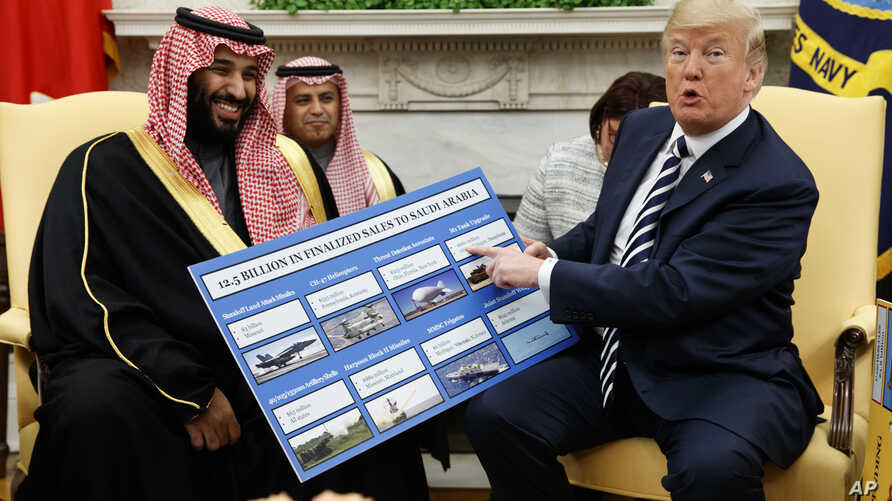
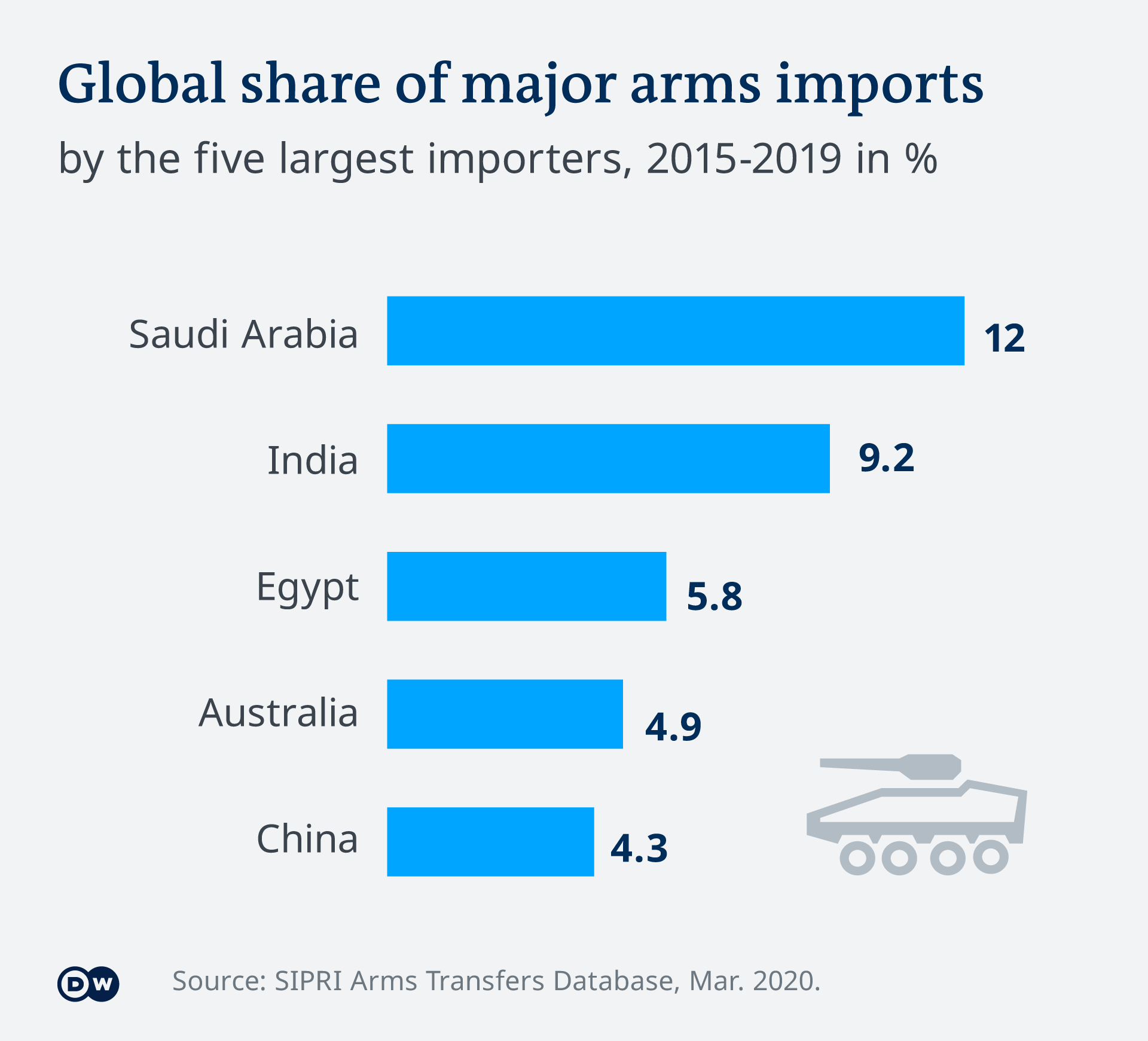
According to Western statistics, Saudi Arabia’s military budget after the invasion of Yemen, from 2015 to 2020, has grown by 61 percent to more than 270 billion dollars, which is about 21 percent of the annual budget of the government. These figures make Saudi Arabia the world’s largest arms importer and a top US customer. According to a report by the Stockholm International Peace Research Institute, Saudi Arabia’s military imports from 2015-2019, was 73 percent from the United States, 13 percent from Britain and 4.3 percent from France, indicate widespread Western support for the provocative and War-mongering policies of Saudi Arabia and the war in Yemen.
Right: SIPRI statistical report of the largest importers of military weapons in which Saudi Arabia ranks first, left: Statistics of the largest exporters of military weapons in which the United States ranks first.
In late 2020, the US State Department announced that it had agreed to sell 3,000 GBU-39 SDB I satellite bombs to Saudi Arabia for $ 290 million. This type of satellite-guided bomb was purchased for use in F-15E Strike Eagle fighters of the Saudi Air Force and for bombing fixed targets such as defense systems, hangars, infrastructure targets, etc. with an accuracy of less than 6 meters and range of 110 km. The US State Department statement also said that the agreement was made to strengthen Saudi Arabia’s ability to respond to current and future threats and has no compensatory provisions, in other words, an after-sales commitment for the United States.
The United States had previously announced on November 12, 2020 a contract to sell 150 F-15E Strike Eagle fighters worth approximately $ 9 billion and $ 750 million.
US State Department report on a deal to sell 3,000 satellite-guided missiles to Saudi Arabia
In recent years, despite international restrictions on the export and sale of military weapons, as well as European sanctions against Saudi Arabia for a complete cessation of military arms sales to the Saudis, such agreements have been re-signed and arms deliveries to Saudi Arabia have resumed.
Some of these contracts include the following: 1- The contract for the sale of heavy vehicles of the French-German company “Kamag” with Saudi Arabia in April 2019. 2- Canada’s $ 14 billion contract with Saudi Arabia for the sale of military weapons, including light armored vehicles, etc. which was unimpeded in November 2019. 3- Raytheon (USA) Patriot Air Defense System Optimization and Localization Agreement with Saudi Arabia in December 2019. 4- Lockheed Martin (USA) contract with Saudi Arabia to sell the Thaad system worth $ 5 billion and 360 million in July 2019. 5- Boeing (US) contract with Saudi Arabia for the sale of one thousand surface-to-air missiles and anti-ship harpons worth one billion and 972 million dollars in May 2020. 6- The contract for the sale of 48 British Typhoon fighters with Saudi Arabia worth 10 billion pounds in March 2018. 7- A $ 23 billion contract to sell 50 F-35 fighter jets, MQ_9B drones and US air-to-air missiles to the United Arab Emirates.
Given the long history of violations of international law, human rights and etc, in Saudi Arabia, as well as their current war against Yemen, the sale of military weapons to Saudi coalition, especially Saudi Arabia and the UAE, has always been controversial; But European and American governments, regardless of these issues, have continued to sell their military weapons to the Saudis and have expanded their influence and presence in the Arabian Peninsula region through various wars and the Iranophobia project. Examining the US and European arms deals with the Arab countries, one can understand why the Yemeni war should continue and why Ansar Allah should be included in the list of terrorist organizations. The inclusion of the Yemeni Ansarullah People’s Movement in the list of American terrorist groups, even after years of Saudi crimes against the Yemeni people and daily bombing and killing of the Yemeni people, and continuing to equip Saudi Arabia with all kinds of military equipment and bombs is a clear indication of the US hypocrisy and false claim of democracy by the United States and Western countries.
According to this information, Ansar Allah forces and popular committees:
– In 2020, Saudi coalition warplanes carried out more than 8888 airstrikes and 410 drone strikes on 13 Yemeni provinces. Airstrikes have been carried out on Marib province more than 3,621 times, 1981 times in Al-Jawf province and 726 times in Saada province.
– More than 974 military operations have been carried out by Ansar Allah forces in 2020, the most prominent of which are Operations “Fa’amkan Minhom”, “Bonyan Al-Marsous” and liberation of “Qifah district”.
– Enemy casualties in 2020 were more than 15,366 killed and wounded, of which 6,467 were killed and 8,899 were wounded.
– More than 1090 tanks, armored and military vehicles, etc. of Saudi coalition were destroyed.
– Ansar Allah missile force has fired more than 253 ballistic and winged missiles in dozens of operations against the enemy, targeting 178 missiles at enemy positions and bases in Yemen and 75 deep in Saudi Arabia territory.
– More than 20 Badr-P missiles, 30 Badr-1 missiles, 12 unveiled missiles, 7 Quds winged missiles and 6 Zulfiqar missiles were fired deep into Saudi Arabia territory.
– More than 5,613 reconnaissance operations and drone attacks were conducted during 2020. 267 offensive operations have been carried out by drones, of which 180 offensive operations have been carried out against enemy positions and bases inside Yemen.
– In 2020, the Air Defense Forces conducted more than 730 defensive actions against enemy aircraft. 67 combat and spy drones and fighter jets were shot down during 2020, these include a Tornado fighter jet and two CH4 UAVs in the Nihm and Majzar areas.
– The anti-armoured units has carried out more than 678 operations this year, targeting more than 100 military vehicles.
– The artillery units has carried out more than 13881 operations against the enemy, of which 231 operations have been carried out jointly with the UAV forces.
– The engineering units has carried out more than 3030 operations, of which 2298 operations have been carried out against enemy gatherings. More than 635 operations have targeted enemy equipment and 97 operations have targeted enemy fortifications and headquarters.
– More than 15,481 operations have been carried out by sniper units on the border area and inside Yemen, among the achievements of the sniper units is the downing of 7 UAVs and disabling 213 vehicles.
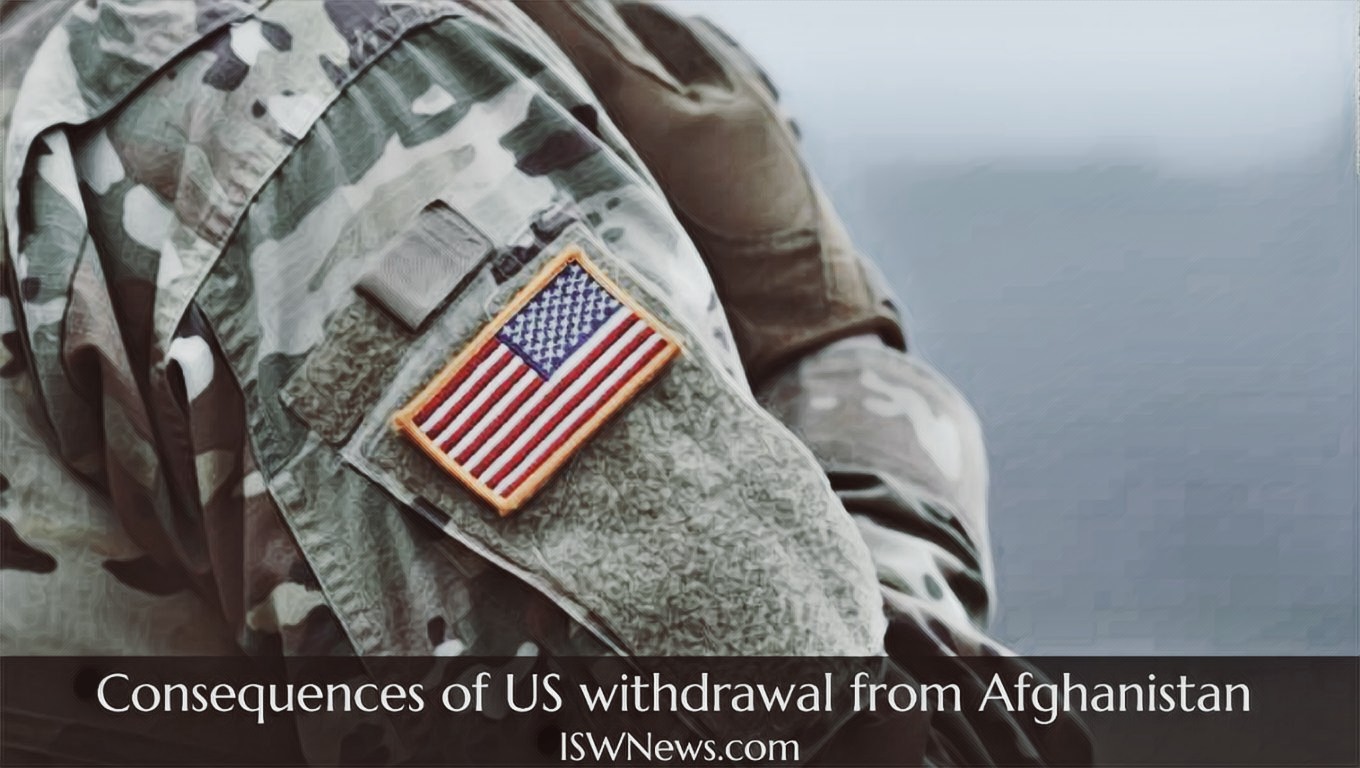
As we know, the United States has signed a unilateral agreement with the Taliban to find a dignified way out of the 19-year war in Afghanistan, which, if fully implemented, will still have different dimensions for the country’s future. From this perspective, we examine the issues facing Afghanistan:
1- The current situation of the government and army of Afghanistan and its future: Having a strong military force is one of the essential components of achieving stability, peace, and ultimately establishing a capable government. Consequently, a capable and effective government and meeting the requirements and solving political and social problems can prevent the emergence of terrorist groups.
Unfortunately, Afghanistan’s current government and army have a high financial and political dependence on foreign countries (US and NATO). Without their help, they will not be able to deal with the Taliban and ISIS groups. In the US peace agreement with the Taliban, the future of this government and military forces remains unclear, and only a political agreement is mentioned, and this is enough to worry other Afghan factions about the future of Afghanistan; Because Afghans have experienced such a vacuum in the years since the presidency of Mohammad Najibullah. At that time, the army collapsed due to chronic ethnic and factional differences, lack of strong leadership, reduced financial support, etc.
The Taliban have not taken a formal and transparent position on the government so far and the military, referring only to their conversion to Islam by using a vague term.
2- The position of the West Asian region countries and Iran about the consequences of the withdrawal of the United States from Afghanistan: Among the countries and powers in West Asian, Iran, Russia, India, China, Turkey and even Pakistan have the desire and the opportunity to partner with the Afghan army to avoid a power vacuum after the United States’ withdrawal. In the meantime, Iran has more suitable conditions to help Afghanistan’s stability for several reasons, including common culture and race, balanced relations with all Afghanistan groups, the Liwa Fatemiyoun army’s existence, etc.
Iranian officials have also recently taken a positive view of further assistance in resolving the Afghan crisis, calling the Liwa Fatemiyoun an efficient force for Afghanistan’s stability.
3- Intra-Afghan talks: In the first round of talks, the parties have agreed on the agenda and framework of their talks, and in the second round, which will be held in the coming days, they intend to discuss the issue of the “Islamic Transitional State”. The Taliban are also said to have demanded a 60 per cent share in the transitional government and a 40 per cent share of the opposition delegation and tried to legalize the Hanafi religion in the negotiations.
There is no single voice on the Taliban front. On the one hand, Ashraf Ghani’s government emphasizes the establishment of a comprehensive ceasefire. It rejects regime change, and on the other hand, the factions present in the negotiating team are pursuing other positions.
On the other hand, the clashes between the Taliban and the army continue, and the central government is facing the death of more than 10,000 people in these clashes. Furthermore, controlling some cities and regions such as Atghar city in Zabul province, the Helmand province’s western and southern regions have fallen into the Taliban’s hands. Despite such circumstances, it can be said that the Afghan peace talks are moving in an uncertain and unreliable direction.
4- Change of government in the United States and the promise to leave Afghanistan: State of America of Obama, Trump and Biden on their election campaign promises so much about ending the war in Afghanistan and Iraq have provided. For a dignified exit, they have always sought to maintain the country as one of their bases by establishing a democratic government in Afghanistan, withdrawing their forces from Afghanistan, and ending their billion-dollar spending on security in the country. However, this goal has not been realized in the latest government effort to a deal with the Taliban Trump was unstable.
US macro-policies in essential regions of the world, such as West Asia and Central Asia, are not something that can be changed by changing governments and political figures. With a proper railroad, the Americans will determine their government’s framework in each region and each issue. The peace agreement with the Taliban, the inter-Afghan talks, and any other program will be based explicitly on US pre-determined policy. Of course, this does not mean that Joseph Biden’s government is committed to a peace agreement with the Taliban and that any of them may call the Biden a violator of the agreement and leave it.
In general, US goals in Afghanistan are: 1- Overcoming the Taliban 2- Establishing an effective Afghan government 3- Maintaining military and security influence in Afghanistan
These goals have been abandoned by a hasty and unilateral agreement with the Taliban and the handover of the government’s formation to the inter-Afghan talks. More importantly, the United States’ goals are in complete contradiction with the Taliban’s goals. In other words, the Taliban is 100% opposed to the US presence in Afghanistan, and it remains to be seen what decision Joseph Biden will take to confront the Taliban after taking over the US presidency.
On this day, dozens of Israeli fighter jets bombed various targets in Gaza, killing 200 people and wounding more than 700. The Israeli regime named this series of attacks “Cast Lead”. In response to the Israel attacks, the Palestinian resistance fired several rockets at the occupied territories, targeting the Zionists, calling the operation “Furqan.”
The Israeli army and the Egyptian government have banned foreign journalists from entering the Gaza Strip since the start of the war, which caused widespread protests by international journalists. Accordingly, international reporters were forced to report from the heights overlooking the city of Gaza, which lies within the border strip of the two sides.
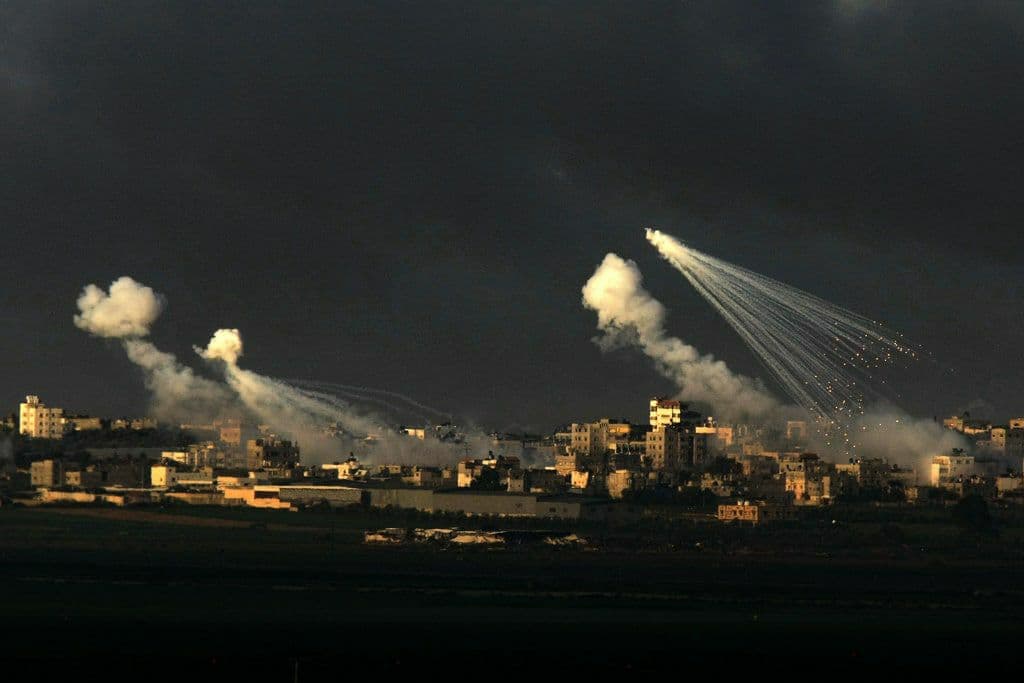
On January 3, 2009, eight days after the start of the war, the Israeli army continued to bomb Gaza, deploying hundreds of Israeli tanks, along with fighter jets and helicopters. But after Israel failed to achieve its main objectives, it used white phosphorus and uranium bombs, which were proven by international investigations. Special investigators sent to Gaza confirmed that Israel used white phosphorus in its January 15 attack on a UN aid center.
In this attack, 1,425 residents of the Gaza Strip were martyred, which most of themwere civilians, women and children. Also about 5,500 people were injured. According to UNICEF, in the bombings from the first to the third day of the attack killed 30 Palestinian children and injured more than 150. More than 500,000 Palestinians were also displaced.
The 2008 Israeli war against the Gaza Strip was one of the regime’s most brutal attacks, in which 83% of those killed were civilians, Palestinian women and children.
In this war, the goals of the Israeli regime were not achieved and their efforts to destroy Hamas and other resistance groups were unsuccessful.
The ex-commander of the Israeli army in the southern part of the country also said in a statement: “Recent events show that our belief that we have achieved significant success in the operation of molten lead was wrong.”
22- Who is Hassan Irloo and how did he arrived in Yemen?
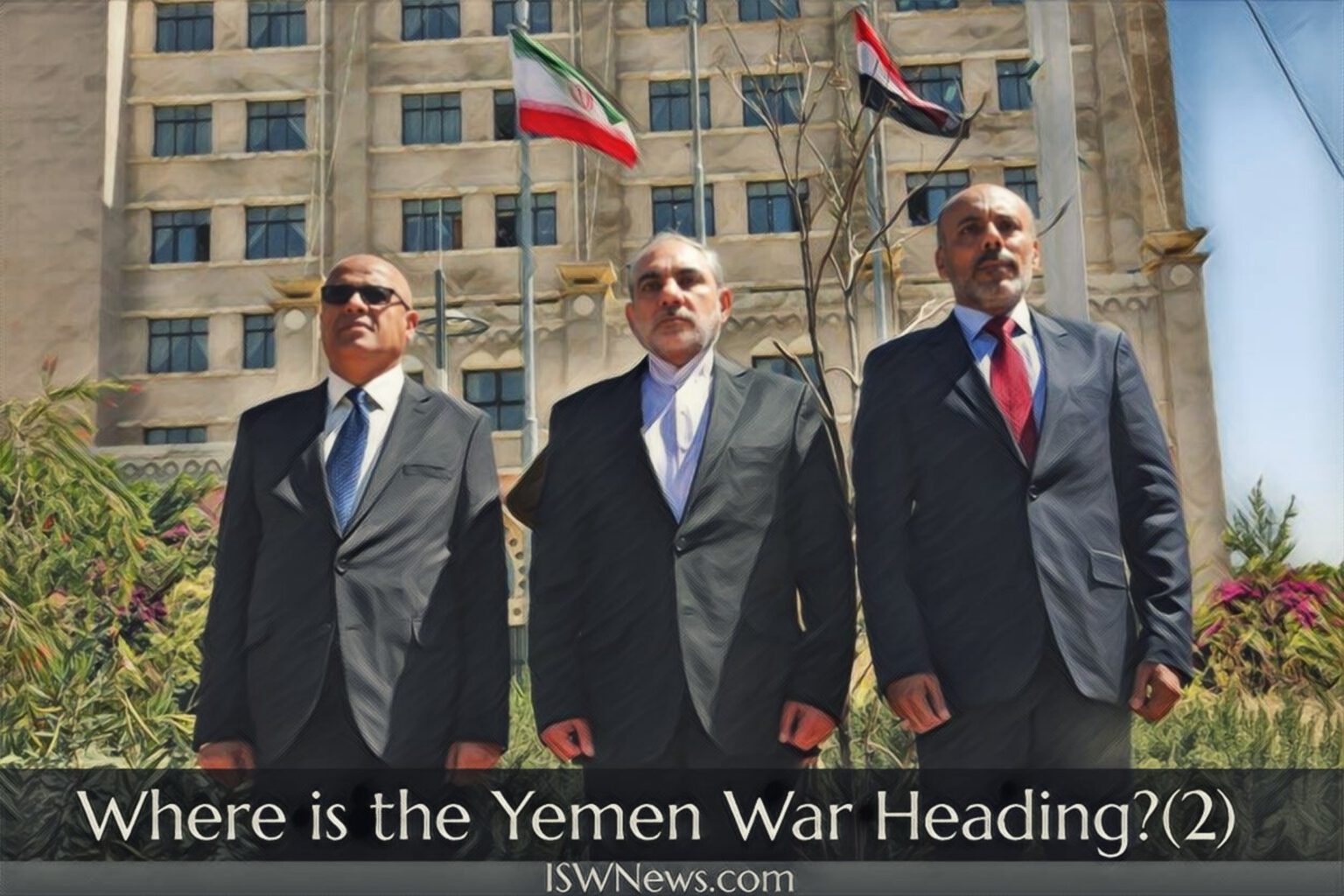
US treasury put Hassan Irloo, Iranian ambassador in Yemen, and Al-Mustafa International University in Qom, in its list of sanctions recently. What did western and Saudi media brag was that Hassan Irloo is a member of Quds Corps and a close person to General Abdul Reza Shahlaei and a connection between the IRGC and Lebanon Hezbollah who is sent to Houthis (Ansar Allah) as ambassador. These media claim that his mission is to manage the establishing and organizing militia, keep Yemen from Arabic world, implementing Quds Force plans in Yemen, etc. According to these media, Irloo violated international laws by coming to Yemen and should be put in trial. Mansoor Hadi resigned government asked UN and the security council to announce Ansar Allah as a terrorist group, in the same sense. Iran and Ansar Allah’s have been silent regarding Iran’s ambassador and only said he is 61 years old from Shahr-e-Rey and a veteran diplomat with expertise in Arabic countries and Arabian peninsula. It can be said then that Mr. Irloo is Iran’s ambassadors in Yemen who arrived on October 17 to Sanaa or his mission was started on that date. We don’t have details of how he arrived but some media claimed he came either by ship or through Oman border.
Some Yemeni sources told ISWNews Analysis Group that he has been to Yemen before the siege and right now it’s impossible for Iranians to come to Yemen. Mohammed Ali al-Houthi said that the way Iran’s ambassador came to Yemen doesn’t even cross our enemies’ minds. The claim of western and Arabic media that he is part of Quds Corps is not known but even if it’s true, he behaved with cleverness and experience in diplomacy. Anyhow, he is Iran’s ambassador in Yemen and some believe his activities are not in the same direction of Iran’s government and foreign ministry, but his performance was proper and strengthened the relationship between two countries.
23- What’s U.S. intent to put Ansar Allah in terrorist list?
Western media claimed a while ago that U.S is going to put Ansar Allah in terrorist list before January 2021. In addition to interrupting international aids to Yemen and UN’s endeavors to establish peace between Ansar Allah and the resigned government, this act makes U.S. to attack Ansar Allah, assassinate the leaders and commanders of the movement, enforcing economic and currency pressures on Yemen, etc., directly.
24- What is the influence of Iran’s regional negotiations with the region states on crisis in Yemen?
It roots back to Iran’s foreign ministry plan of “Hormuz Peace Initiative” which was proposed a few years back. Iran’s FM said several times recently that they do not negotiate with U.S. and three European countries regarding the region since they are the problem itself and invited the regional countries for the negotiations without presence of international states. This is on the surface and won’t happen. Since the regional countries from Turkey and Qatar to Saudi Arabia and UAE are all manipulated by these foreign powers’ policies and expecting independent view and decision from them is impossible, specially regarding Yemen.
We can return to Mr. Irloo, Iran’s ambassador in Yemen, stance on this regard: US prominent role in crime against people of the region, specially Yemenis, is clear. Assaulting and besieging Yemenis by Saudi regime us merely implementing American-Zionist plans against Yemeni people in the war.
25- What is the nature of U.S. and Saudi Arabia activities in al-Mahrah province? Has dividing Yemen plan moved to this region?
Christopher P. Henzel, U.S. ambassador in Yemen, who was sanctioned by Iran in retaliation, visited al-Mahrah province on October 8 and proposed to establish an American military base to Saudi officials and Mansoor Hadi resigned government with the pretext of fighting terrorism. This proposal in addition to Saudi Arabia military complex in Haswin coast, expanding Nashtun harbor, oil pipeline from Saudi Arabia to al-Mahrah coast and Saudis controlling al-Ghizah airport for several years are signs that they have brought secession plan to east of Yemen.
Al-Mahrah is the province on the far east of Yemen which is the buffer zone for Oman. The governor and local officials of al-Mahrah are pro-Mansoor Hadi resigned government and the large tribes of this province have good relations with Oman. However some of the tribes are close to Southerners but with limited power. Therefore, the threat to security of al-Mahrah is a threat to the security of Oman due to armed conflicts, refugees swarming to border area, trafficking increasing, humanitarian aids load, etc. Thus, Oman and Saudi Arabia benefits are contradicting in this case and indeed Yemen secession in al-Mahrah will face numerous troubles. The resigned government stance regarding al-Mahrah is to see it as a new headquarter after Marib and giving privileges to foreign parties to prepare the area in case Marib falls.
YOUR SUPPORT IS CRITICAL TO KEEP ISWNews ALIVE!
I’d like to thank readers for their confidence and support. Thanks to your support we can continue to perform our duty on reporting the important events in the region. So If you like our contents, please don’t feel embarrassed to contribute and help our project, for as little as 1 Dollar. Your contribution, however small, will help ensure our project continuity. Thank you.
Answer: Ansar Allah movement is a Yemeni movement which was founded by martyr Sayyid Hussein Badreddin al-Houthi and was known as “the Believing Youth” before.
The movement was known as Houthis as well between Yemenis and media at the early years of the activities. Houthis comes from the family of Sayyid Hussein Badreddin, the founder of the movement, which is the name of a district in Amran province, north of Yemen.
What is wrong with using Houthisfor Ansar Allah movement?
Like other countries of west of Asia, Yemen also had many races and tribes, which was influential on the government of the area. This is used by western media mastermind to label a vast popular movement in Yemen by name of a tribe and to label the current war as a tribal war. Dividing Islamic countries is usually done using two methods: 1. Religion and 2. Race In Yemen the race is being used by Saudis. This doesn’t mean that the religious differences are not used for discord and dividing in Yemen but the racial and tribal differences are the main trick for warmongering. Therefore using Houthis for the popular vast movement of Yemeni Ansar Allah helps the MSM to overlook tens of parties, political movement and tribes and millions of people who joined Ansar Allah.
To further read and understand about the demographics of different provinces of Yemen, it is highly recommended to read series of “Answering Key Questions” articles.
1- Ansar Allah operation in Marib province: In recent days we see that Ansar Allah operation is changing courses from south of Marib to west of the province and the conflict is continuing to liberate Raghwan district and Maas base. As stated in article “Audience Question: Why Ansar Allah Operation in Marib Slowed Down?“, Ansar Allah started negotiation with Raghwan district tribes to stabilize the advances, similar to other areas of Marib province, and it is expected that these tribes join the peace process and condemning Saudi coalition assault. Otherwise these tribes won’t be significant adversaries even in case of any support of Saudi coalition.
Maas base has fallen from military point of view but Ansar Allah advances slowly due to mine field around the base, however its complete liberation is soon. Following the liberation of Maas base, Saudi coalition hand to target the capital and in media war regarding the engagements in Nihm district will be emptied and the direction of the engagements will go toward Marib town and north and south of the province.
2- Saudi coalition media war: The coalition media emphasize on two points, as usual: a) Sabotaging Iran diplomatic activity in Yemen and b) Belittling Ansar Allah victories.
As an example Saudi coalition media released a list claimed that Ansar Allah suffered a casualty of 230 forces in Marib battle recently, which are far from truth. Since Saudi coalition actually “withdrew tactically” and the level of conflict is not that intense to cause such casualties.
On the other hand, Iran’s diplomatic endeavor in Yemen, which started by sending new ambassador to Yemen, is now the coalition media main target now. Mr. Hasan Irloo influential activities include meeting with political officials, families of martyrs, participating in popular events, etc., which are useful to enhance the bilateral relations of two countries and also on Ansar Allah domestic policies. Iran’s diplomatic steps in Yemen is a good start to end Yemen siege, in general. Accelerating these endeavors and encouraging other allies of the Resistance to open their embassies in Sanaa helps with breaching the siege ASAP.
3- Negotiation halts and rejecting UN proposition: Ansar Allah and Saudi delegates talks are a mean still active in Oman, whose latest outcome was the recent POW exchange agreement, during which American, Saudi, Sudanese, … prisoners were exchanged with a higher number of Ansar Allah POWs. The negotiations, which suggested by UN, finally came to the conclusion by UN proposal which was rejected by Ansar Allah leader.
UN proposal draft was as follows:
Paying the salaries of all employees based on the 2014 salaries. (before war started).
Comprehensive ceasefire effective immediately after signing and forming military committees supervised by UN with presence of both sides.
Resuming political activities and economical and humanitarian efforts to reduce the suffer of Yemeni people due to six years war.
Releasing all of the POWs of both sides according to Stockholm agreement.
Opening Sanaa international airport and lifting the limitation of oil and cargo ships sailing and immediate permit to repair Safer tanker. The Safer tanker is damaged at Al Hudaydah harbor and if it sinks, it has severe impact on the environment. It was natural that this proposal is rejected by Ansar Allah since they were included in the Stockholm agreement and Saudi coalition did not respect them. According to the latest updates, Ansar Allah conditioned the continuation of the talks to reopening of Sanaa airport and Al Hudaydah harbor according to Stockholm agreement, in their messages to UN and Saudi coalition.
4- Socotra: Socotra island with an area of 3,650 km2 lays in south of Yemen and Indian ocean and has a good overlook on Bab al-Mandeb strait. Bab al-Mandeb strait is the connection point and the main maritime passage between the horn of the Africa and west of Asia which connects the Red sea to Aden gulf and Arab sea. Most of the oil and gas export from the Persian gulf, which are exported to Europe and the rest of the world via Suez canal or SUMED, goes through this strait. According to Eritrean sources, Israeli regime is establishing a military/security base in Emba Soira mountain, 135 km south of Asmara, capital of Eritrea, since 2016. This mountain is the highest peak in Eritrea with 3018 m height. Therefore Israel has full overlook over Bab al-Mandeb strait with this base and Socotra island.
Socotra island is more vulnerable to secession due to its distance from mainland Yemen. Considering the recent activities of Saudi Arabia and UAE to build many bases and changing the demographics of the island, Ansar Allah should pay attention to it. Drone and missile attacks to Saudi coalition in the island can be a good start to reclaim the sovereignty of the island back to Yemen.
Conclusion: Ansar Allah should launch operations end the war after six years of resistance. Operations to give Ansar Allah higher stakes and forces the enemy to accept the peace. Otherwise Saudi coalition doesn’t have any problem with damages and multi billion dollars expenses of the war in Yemen. Since they are to be used for this purpose. Liberation of Marib, Aden, Al Hudaydah coast and extensive drone and missile attacks against Aramco structures and UAE economical points can seriously help to end the war. The lift of siege of Yemen which is important to end the war can be only done by Iran and other Resistance countries diplomatic efforts, which are expected to accelerate soon.
Prior to the agreement, three other ceasefires had been announced in Nagorno-Karabakh, which none of them lasted. But Russia’s more serious entry as a major player in the Fourth ceasefire ended the fragile agreements and ceasefires in the Nagorno-Karabakh.
The Azerbaijan-Armenia peace agreement has nine main clauses and is summarized as follows: 1- Complete cessation of clashes and stop in the current positions 2- Delivery of Agdam region to Azerbaijan 3 and 4 – Deployment of Russian forces in Nagorno-Karabakh 5- Establishing a center to monitor the implementation of the agreement 6- Delivery of Kalbajar and Lachin regions to Azerbaijan 7- Return of refugees to Karabakh 8- Exchange of prisoners and corpses 9- Establishing a transit corridor between western areas of Azerbaijan and Nakhchivan region
At first glance, this agreement may seem like a complete victory for Azerbaijan and a defeat for Armenia, or at least Azerbaijan has achieved what it wanted from Nagorno-Karabakh. However, with a further examination of this agreement and the deployment of Russian forces in the Nagorno-Karabakh region, many questions and ambiguities arise about the fate of this region, which we will examine on a map to better understand this agreement.
– Green hached are regions that scheduled to be returned to the Republic of Azerbaijan within a certain period of time. The Kalbajar region will be handed over to the Republic of Azerbaijan by November 15, the Agdam region by November 20, the Lachin region and the occupied territories of Gazakh by December December 1. The important point about this issue is that “not” all the districts(Rayons) of Agdam, Kalbajar and Lachin, but also the areas that were occupied by the Armenian forces outside the “Nagorno-Karabakh Autonomous Region” will be returned to Azerbaijan. For example, the eastern half of Rayon Kalbajar is located in the “Nagorno-Karabakh Autonomous Oblast” and these areas will remain under the control of Armenian forces and only the western half of Kalbajar will be handed over to Azerbaijan. The same is true about a small part of western areas of Aqdam Rayon too. In other words, the “Nagorno-Karabakh Autonomous Oblast” mechanism is still in place in these areas. Regarding the two occupied points in the Gazakh region in northwestern Azerbaijan, it is noteworthy that despite the agreement to return the two points to the Republic of Azerbaijan, the next statement issued by Russia does not mention the status of these two points. And how to solve this issue is unknown. It is said that the original text of the agreement has been leaked and in the next version, which is the original version, this part has been modified and deleted.
– Blue hached are areas where 1,960 Russian peacekeepers with 90 armored vehicles and 380 vehicles and special equipment will be stationed. If we look closely at the deployment of Russian forces in the Nagorno-Karabakh region, it is quite clear that these forces will be stationed exactly inside and on the borders of the “Nagorno-Karabakh Autonomous Oblast.” This means that in fact the “Nagorno-Karabakh Autonomous” will be recognized for Armenia and will remain in the possession of Armenian forces. Although this issue is not mentioned in the text of the agreement, but in practice it will mean that. In addition to this issue, it should be added that: The text of the agreement states that the Russian peacekeeping forces will remain in the region for 5 years, and if there is no particular problem, this 5-year period will be extended for another 5 years. And these courses will continue indefinitely. Clearly, this also confirms and extends the survival of autonomy in Nagorno-Karabakh. Nonetheless, these areas are separate from the areas captured by the Azerbaijani army during the recent operation in the Nagorno-Karabakh region. If we look closely at the southern regions of Karabakh, and especially the southern regions of the “Nagorno-Karabakh Autonomous Oblast”, it is clear that the Azerbaijani forces have taken control of a small part of the southern “Nagorno-Karabakh Autonomous Oblast” and most of the achievements are in areas occupied by Armenian forces outside the “Nagorno-Karabakh Autonomous Oblast.”
– On the map, the progress of Azerbaijan army in the Nagorno-Karabakh region is shown in yellow. Obviously, this is a very good victory because the Republic of Azerbaijan has been able to liberate almost all the southern regions of Karabakh, but on the other hand, this should not be too bad for Armenia either; Because in general, the areas around the “Nagorno-Karabakh Autonomous Oblast”, both in the north and in the south of Karabakh, are officially and internationally part of the territory of Azerbaijan, and the Armenian forces, which occupied the areas around the “Nagorno-Karabakh Autonomous Oblast” in the last 28 yeasr, are now giving the lands to its owner in the south by military force, and in the north by the recent agreement. Therefore, Armenia can consider the occupied territories around the “Nagorno-Karabakh Autonomous Oblast” as a negotiating card, which it is now handing over, and in return will take over most of the “Nagorno-Karabakh Autonomous Oblast” region. The Republic of Azerbaijan has also achieved its goal to return the 7 occupied cities of Karabakh. Nevertheless, it is worth mentioning that Azerbaijan demands all of Nagorno-Karabakh, and with the current situation and the field conditions, this issue has not been achieved. Because most of the “Nagorno-Karabakh Autonomous Oblast” with the support of Russia remains under the control of Armenian forces for an indefinite period of time.
Another important issue that should be considered is Russia’s opposition to the presence of Turkish forces in Nagorno-Karabakh. The President of Azerbaijan stated in a televised speech on the agreement to end the war in Nagorno-Karabakh that, in addition to the Russian peacekeeping forces, the Turkish peacekeeping forces will also be stationed in Nagorno-Karabakh. But the Kremlin said in a statement that the issue was not mentioned in the agreement and that the leaders of Russia, Armenia and Azerbaijan had not agreed on the deployment of Turkish troops in the Nagorno-Karabakh region. According to the statement, the presence of Turkish troops in the Nagorno-Karabakh region is virtually rejected, and this implicitly confirms Russia’s support for the continuation of autonomy in the remaining areas of the “Nagorno-Karabakh Autonomous Oblast.” In general, the presence of Turkish forces in Nagorno-Karabakh or direct land links between Turkey and the Republic of Azerbaijan is a strategic threat to Russia, a threat that reduces Russia’s influence and hegemony in the Caucasus and the Caspian Sea and then in Central Asia. In other words.it will increase Turkey’s power and influence in the region; This is definitely against the wishes and policy of Russia. Therefore, Russia is trying to prevent this from happening. Russia’s opposition to the official deployment of Turkish forces in Nagorno-Karabakh can be interpreted from this perspective.
– Another important issue is the establishment of a new transit and transportation route between Stepanakert and Armenia along the Lachin corridor for three years, as well as the establishment of a safe transit route between the west of the Republic of Azerbaijan and the Nakhchivan region through Armenia. These routes also will be secured by Russian FSB forces. Comparing these two routes, it can be concluded that Armenia provides Azerbaijan with a safe transportation route in exchange for a safe transportation route to Stepanakert. This also means that Azerbaijan implicitly accepts the autonomy of Nagorno-Karabakh in exchange for Azerbaijan’s direct connection to the Nakhchivan region. On the map, the new transit and transportation route between Stepanakert and Armenia has been marked with a red arrow and the possible communication route between Azerbaijan and Nakhchivan has been marked with a yellow arrow. Nonetheless, there is a railroad in the south of Armenia and near the borders of Iran, the use of which can also be on the agenda.
– Another important issue is the return of refugees to Nagorno-Karabakh. During the Karabakh war, Azeri residents in various parts of Karabakh, including Khojaly, were driven out of the “Nagorno-Karabakh Autonomous Oblast” or Armenians expelled from the southern part of Nagorno-Karabakh, such as Hadrut, during the last two months of fighting; The mechanism for the return of the displaced persons is not explicitly mentioned in the agreement, and so far none of the officials of the parties have commented on it. The city of Shusha is an example of this problem; Shusha is now under the control of the Republic of Azerbaijan, and if this clause of the agreement is to be implemented, Armenians and Azeris must be present together in Shusha, which seems impossible in the current situation.
In general, this agreement, beyond what the parties claim is neither an absolute victory nor an absolute defeat Rather, so far each side has achieved a certain amount of its own goals; The difference is that Azerbaijan has achieved somewhat slightly more than Armenia. The Republic of Azerbaijan acquired the territories around the “Nagorno-Karabakh Autonomous Oblast” (plus parts of the south of the “Nagorno-Karabakh Autonomous Oblast”) after 28 years. On the other hand, Armenia gained autonomy (at least nominally) and a presence in the “Nagorno-Karabakh Autonomous Oblast”. The Republic of Azerbaijan achieved a direct land route with the Nakhchivan region, and on the opposite side of Armenia achieved a direct land route to the center of the “Nagorno-Karabakh Autonomous Oblast”, the city of Stepanakert.
Regarding the future of the Nagorno-Karabakh region, according to the existing agreement, there are many issues and ambiguities that are not mentioned at least in the text of the contract, and this issue will be problematic in the future and will bring an uncertain future for Nagorno-Karabakh. At present, with Russia’s direct entry into Nagorno-Karabakh, its influence and pressure on the region has increased, and on the other hand, important political developments are taking place in Armenia, and the lines of contact and conflict will always be a place for escalating tensions. Anything is possible in the future, just as Azerbaijan recaptured Nagorno-Karabakh after 28 years of renewal, it is not unlikely that Armenia will pursue a similar policy towards Azerbaijan, or even the odds prepare conditions for the continuation of the Azerbaijani army operation in Nagorno-Karabakh.
The answer has two aspects. Liberating Marib was proposed after “Fa’amkana Minhom” operation and achieving the goals which were liberating Nehm district and al-Hazm town, capital of Al Jawf province.
The demographics and geopolitics of Marib province are different from other provinces that Ansar Allah operated so far. In a society like Yemen, that there are different believes, political views, religions and tribes, conquering and liberating towns is only the first step for Ansar Allah but stabilizing and keeping them is what matters more. Therefore, Ansar Allah first makes sure the tribes of the operating area are cooperating then they start the operation. In another word, Ansar Allah doesn’t fight with Saudi coalition to defeat them, they fight to stabilize their victory over Saudi coalition.
It is not a personal point of view or analysis, but conclusion of Ansar Allah operations in several years from Sanaa and Aden to Al Hudaydah, that Ansar Allah gained the experience or was given advice by the Resistance axis to follow that policy. This is the underlying reason of slowing down the operations.
The obvious aspects are reasons such as ceasefire talks, exchanging POWs, etc., preparing for the operation, collecting information and other reasons.
However, it can’t distract us from the disadvantages of ceasing and delaying the operations. Since Saudis are in weak position due to Sudanese forces leave, Ansar Allah victories, media pressure, etc., and waiting for a positive change in US politics. Indeed Saudis won’t be unhappy if USA or Israel directly enter Yemen war.