Tag: Idlib Map

  • Latest Military Situation in Idlib (Map Update)

    Latest Military Situation in Idlib (Map Update)

    Idlib province has always been of interest to Ankara in recent years due to its strategic location and the presence of Ankara-backed militants. The Turkish military currently has four observation posts and more than 50 military points in western Aleppo and the Idlib region, and continues to strengthen and increase the number of these military posts.

    In recent weeks, especially after Putin and Erdogan met and discussed about the situation of Idlib, the Turkish military has sent dozens of military convoys carrying logistics, armored vehicles, troops and construction materials to the province.

    In its latest move, Turkish Army have set up a new military point near the Benin village on Jabal al-Zawiyah in the southern countryside of Idlib province. The positions of the Turkish military and Ankara-backed militants in the contact lines have also been strengthened, and Turkey has sent about 5,000 troops to Idlib province in the past three days.

    As the Turkish army moves and builds military posts and strengthens its positions in Idlib province, the activity of Syrian Army artillery and Russian warplanes has also increased. In recent months, militant positions in Sheikh Bahr, al-Bara, Safuhan, al-Ankawi, Kansafra, Bayluon, al-Ruwaiha, al-Fatira, Benin, Fulaifil and Majdaliyah have been repeatedly targeted by Syrian Army artillery or Russian warplanes.

    In the latest Syrian army attacks on militant positions, Syrian Army artillery units stationed east of Saraqeb targeted militant positions in the town of Sarmin. The militants based in Idlib also targeted the Syrian army positions in Ma’ra al-Nu’man, Kafr Nubl, Saraqeb, Hazarin, Dadikh, Basaqala, Dar al-Kabira and Ma’saran with artillery and rocket attacks.

    However, the contact lines in Idlib have not changed much, and there is a daily exchange of fire between the Syrian army and the militants. The southern regions of Idlib are witnessing more clashes than other regions. Syrian army forces stationed on the eastern fronts of Idlib are also occasionally targeted by snipers or guided missiles.

    So far, Ankara does not seem to intend to give up its support for the militants in Idlib, and the Syrian government and its allies are strongly opposed to Turkey’s decision.

    This is one of the main points of contention between Putin and Erdogan. Although Russia seeks to maintain economic, military and political relations with Turkey, it disagrees on the issue of Idlib with Turkey, and the Idlib case was discussed at the last meeting between the two sides in Sochi. The Russian side told Turkey that it was not satisfied with the situation in Idlib.

    Turkey’s actions in Idlib province, which run counter to the Moscow agreement, could be a good excuse for Russia to give the green light to the Syrian government and launch a comprehensive military option to clear Idlib.

    Click to see the full size map
  • Syria: IED attack on Turkish vehicle

    Syria: IED attack on Turkish vehicle

    The Ansar Abi Bakr al-Siddiq group claimed responsibility for the attack by issuing a statement and images from the moment a Turkish army vehicle was targeted on the Ariha-Nahlaya road.

    It is worth mentioning that two military posts of the Turkish army are located in the cities of Ariha and Nahlaya. (Online map)

    The Ansar Abi Bakr al-Siddiq group has been active in Idlib province since the summer of 2020 and has carried out at least dozens of operations against Turkish troops in the Idlib region.

  • Russian-Turkish dispute over the Idlib

    Russian-Turkish dispute over the Idlib

    A few days before Russian President Vladimir Putin met with Turkish President Recep Tayyip Erdogan in the Russian port of Sochi, Russian warplanes in a purposeful act bombed positions of Turkish-backed forces near the Turkish military posts in the Idlib region.

    The increase in Russian warplanes attacks on militant positions, and even near and around Turkish bases and checkpoints in Syria, is a clear warning to Turkey, and Ankara is well aware of this. Putin’s remarks during a meeting with Bashar al-Assad in the Kremlin show that Russia strongly opposes the continued presence of foreign forces in various parts of Syria, as well as the occupation of Idlib by militants. And this reinforces speculation about talks between Putin and Erdogan on the withdrawal of Turkish troops from Idlib and the cleansing of the province from the militants.

    On the other hand, in the past 48 hours, two well-equipped convoys of the Turkish army, including 20 vehicles carrying cement blocks and logistics equipment, entered the Syrian province of Idlib through the Kafr Lusin crossing and headed towards the southern areas of Idlib and the Syrian army contact lines.

    The differences between Russia and Turkey in the case of Idlib have caused the two sides to implement their plans and actions more quickly to put pressure on the other side. For this reason, it seems that the movements of different parties in the provinces of Idlib, Aleppo and Hama will increase more in the near future.

    The Turkish army is currently stationed in four observation posts and more than 50 military posts in western Aleppo and the Idlib region. Strengthening and increasing the number of these military posts by Turkey has become a challenging issue in the Idlib region. This issue, along with the continued presence of terrorist groups in the region, has made the future of the situation in northwestern Syria even more ambiguous and has dashed hopes for an end to the war in this part of Syria.

    Click to see the full size map
  • Turkey is abandoning some of its observation posts in Syria’s Idlib

    Turkey is abandoning some of its observation posts in Syria’s Idlib

    The Morek observation post is the largest Turkish observation post in the north of Hama, which was established two years ago in the village of Morek. But after the latest operation by the Syrian army and allies, which led to the liberation of northern Hama and large parts of eastern and southern Idlib, as well as western Aleppo; this observation post, as well as a number of other Turkish military posts, were completely besieged. Since then, the Turkish military has refused to withdraw from the occupied Syrian territories and withdraw from these military posts.

    Currently, 8 observation posts and 4 to 5 Turkish military posts in the areas controlled by the Syrian government are under complete siege by the Syrian army. The observation posts that are currently under siege by the Syrian army are Morek observation post, Sher Mughar observation post, Surman observation post, Tal Al-Tawqan observation post, Al-Eis observation post, Al-Rashedin observation post, Andan observation post and Jabal Sheikh Aqil observation post. Military posts are also located in Ma’ar Hatat, around Saraqeb and in Al-Zarba.

    However, Turkey has so far denied any withdrawal from military and observation posts, but some believe that Turkey, realizing that the possibility of a military operation by the Russian and Syrian army in Idlib is imminent, it has given up its useless presence deep in the areas controlled by the Syrian government and is withdrawing from them and preparing more fortifications in the areas occupied by the militants in the Idlib region to deal with this danger.
    Hence in this regard, on October 17, the Turkish army established a new military post south of Idlib in the village of Qoqafin.

    In the past, Turkey has believed that the presence of military posts deep in areas controlled by the Syrian army could be used as leverage and a bargaining chip in future negotiations with the Syrian government, but this seems impossible.
    It is also noteworthy that in recent weeks we have witnessed a series of popular demonstrations in front of Turkish observation posts in northern Hama and eastern Idlib, and people have called for the withdrawal of Turkish troops from Syrian territory. These demonstrations, whether popular or organized by the Syrian government, can clearly affect the withdrawal of Turkish troops from Syrian territory and effectively undermine the security of Turkish forces deep inside Syrian army areas in the event of a new military operation.

    The besieged Turkish observation posts in the SAA-controlled areas – Click to see the full size map
  • Opinion: Investigation of the latest military-security situation in Idlib

    Opinion: Investigation of the latest military-security situation in Idlib

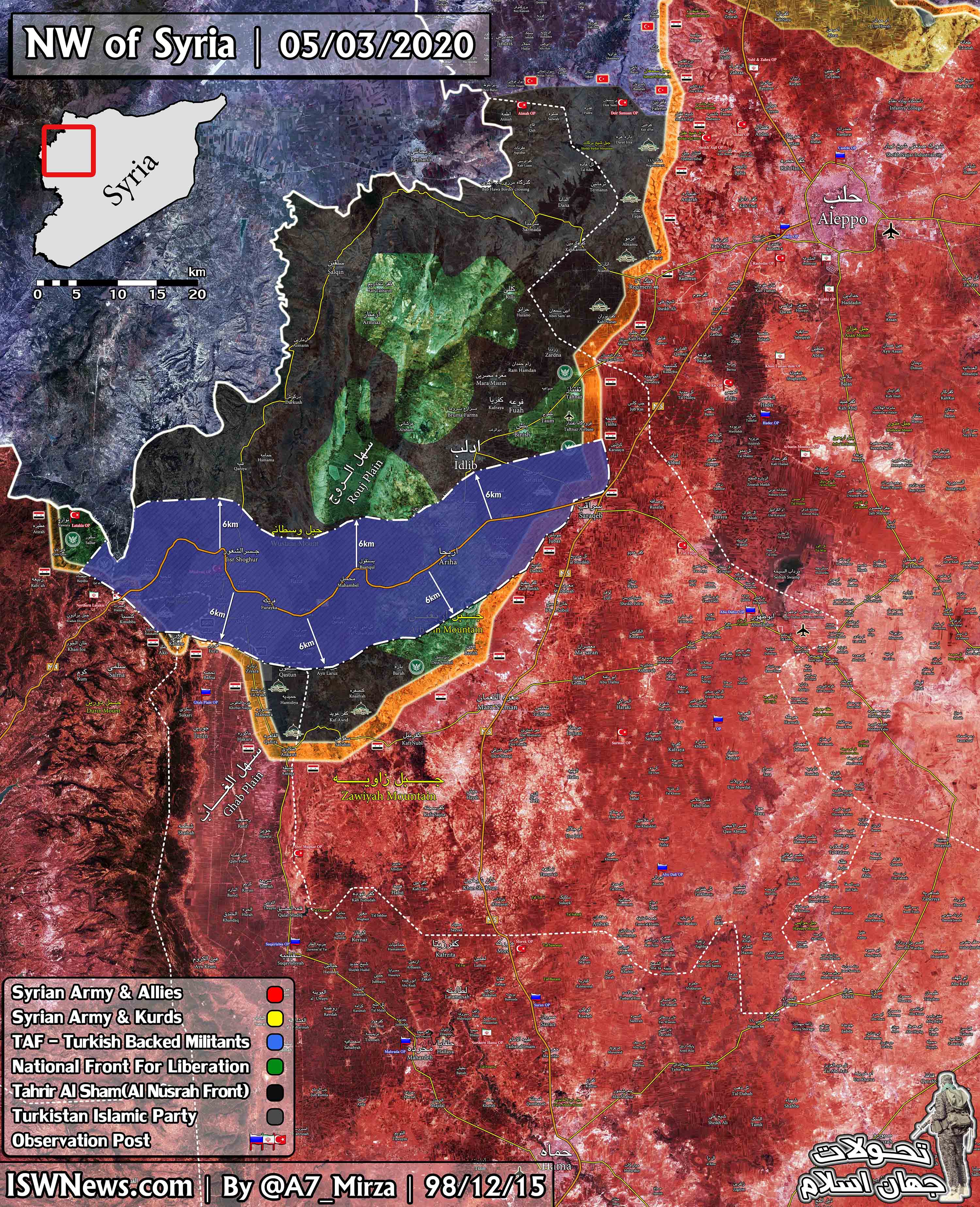
    The recent ceasefire between Turkish and Russian presidents stresses on several points, namely a 6 km safe zone in both north and south around Aleppo-Lattakia highway (M4) and then forming Russian-Turkish joint patrols along M4. Important incidents happened since the signing of the ceasefire in the area which will be explained.

    Interruption of patrols by Tahrir al Sham:
    In despite of five times Russian-Turkish forces patrolled in M4, every time they were interrupted by terrorist groups and the patrols were limited to between Turnabah village, outskirts of Saraqib, to Nayrab town, east of Idlib. Terrorist groups first sabotaged parts of the highway and then stimulated people’s sit-down strikes en route to interrupt the patrols and Turkish forces could not overcome it.
    Although Tahrir al Sham terrorists apparently disapproved the sit-down strikes on M4, but it seems they provoked some more extreme groups such as Hurras al-Din to interrupt the ceasefire implementation, not to hit Tahrir al Sham and Turkey rather friendly relation.

    Due to this ceasefire and Turkey’s presence increase in south of Idlib along with its proxy groups such as Syrian National Army (SNA) and National Front for Liberation (NFL) around M4 highway, it can be said that Tahrir al Sham influence (in opposition to NFL group) on the area is diminishing and thus they try to interrupt the patrols. Their influence already decreased after liberation of M5 highway.

    Tahrir al Sham endeavor to regain its power:
    At the same time that Turkey and its proxies presence in the area increased, Tahrir al Sham is forming new brigades and reforming the command hierarchy of first and second levels. These are in the sense to regain its power against Syrian army future offensive operations and also to show to Turkey and the proxies its power.

    Turkey’s military and equipment presence increased in Idlib:
    After signing the ceasefire and start of patrols in Idlib, which were interrupted by terrorist groups, Turkey used the excuse to implement the ceasefire obligations to increase the equipment, troops and militants in south of Idlib. According to American Institute for the Study of War, during February and March 2020 Turkey deployed about 20 thousand of its troops and militants (who participated in operations Olive Branch and Peace Spring) to Idlib. It also established more than 50 military bases and transported more than seven thousand heavy equipment to Idlib province. Turkey even installed MIM-23 Hawk SAMs in south of Idlib.

    Turkey’s endeavor to form a uniform military force:
    By bringing their troops and proxies such as SNA and NFL (with Muslim Brotherhood tendencies) to the area, Turks are getting closer to forming a united force in Idlib province to confront any Syrian army offensive operation in Idlib. It is possible that some units of Tahrir al Sham will join this new uniform army and Tahrir al Sham becomes more fragmented.


    It is expected that military action becomes priority of Syrian army to solve the issue of Idlib province in future again due to incomplete patrols by Turkey and Russia and lack of containment of terrorist groups in the area.
    Although Russians do not want their economic, political and military relations with Turkey to be jeopardized, but Ankara’s disability to fulfill its obligations in the ceasefire enables Russia to activate the military option once again.

    Click to see the full size map
  • New ceasefire in Idlib; impossible?!

    New ceasefire in Idlib; impossible?!

    The ceasefire is enforced from 00:01 of 6 March in Idlib area and both sides are obliged to obey it. It includes three main parts:
    1. All fights to be ceased along current front lines from midnight 6 March
    2. Russia and Turkey will make a six km wide security corridor north and south of M4 highway (Saraqib-Latakia).
    3. From 15 March there will be joint Turkish-Russian patrols along M4.

    This agreement is announced while Erdogan’s demands were totally different before the meeting, which clearly shows Erdogan’s retreat from his stances.

    In the following, we will discuss some important points about the Idlib ceasefire:

    – Syrian army will still have the full control of M5 highway (Aleppo-Damascus). Having M5 under control is a strategic position and stabilizes Syrian army’s military presence in Idlib area. Turkish army claimed before the talks that Syrian army should retreat from M5.

    – The important point is that terrorist groups such as Tahrir al Sham and allies are not included in this agreement and they are still legit targets for Syrian army!

    – The feat of this agreement is the 6 km safe zone in north and south of M4 highway! Entire road from Saraqib to Jisr al-Shughur is out of control by Syrian army and most of it are controlled by terrorists from Tahrir al Sham, Turkestan Islamic party and other al-Qaeda terrorist groups.
    It means that the most strategic areas that terrorists have occupied for many years and constitute their strategic depth should be evacuated.
    Joint patrols will start from 15 March in M4 and most probably terrorists won’t get along with it and since they are excluded from ceasefire, the operation by Syrian army is very likely.

    – Only Turkish forces will remain in Idlib area, however the situation of Turkish observation posts inside areas controlled by Syrian army are still unclear. It is possible that they still remain in the area for a while or until the end of operation in Idlib to save Turkey’s face and finally are collected without much noise. Unlike what was boasted about Turkish military power, these besieged observation posts can be used as hostages by Syrian army against Turkish army.

    – By accepting this agreement, Turkey has recognized officially Syrian army’s achievement in the last four months, in despite of its rhetoric. Turkey also implicitly accepted that they cannot assault Syria’s soil directly.

    The reasons behind why Turkey succumbed to such an agreement and defeat needs a separate article but briefly it can be attributed to Syria and allies resistance in Idlib, lack of NATO and US support for Turkey, Erdogan’s unstable political situation and Turkish elites’ critiques of Erdogan and the reigning party.

    The ceasefire has started in Idlib area and we should wait and see which way does Syria go, but we should remember that Syria still has a long journey to stable peace and security. These agreements are small steps toward the goal, Syria has still challenging issues to address, some of which hasn’t even started yet!

    Click to see the full size map
  • Map: Latest Military Situation in Northwest Syria

    Map: Latest Military Situation in Northwest Syria

    In Aleppo province after the liberation of strategic areas on the west of Aleppo city, the battle has subsided and liberated areas are stabilized, it seems Turkey’s militants do not have intention to open new front.
    In Idlib province however the situation is very different. The battle is continuing between Syrian army and terrorists in southwest of Idlib in areas Zawiyah mountain and east of Idlib in Saraqib.
    In recent days and after Saraqib’s control was passed between the army and militants several times, some of the villages and heights of southwest of Idlib were occupied by terrorists but Syrian army could halt terrorists advances around Kafr Nobol-Safuhan-Ankawi axis and stabilized previous advances.

    Tomorrow, Thursday, there will be a meeting between Erdogan and Putin in Moscow regarding the situation in Idlib and future of the region. Last week Erdogan tried hard to occupy Saraqib and cut M5 to reduce the bitterness of the recent defeats and to have more bargaining chips in Moscow summit, but Syria and resistance axis persistence failed him.
    Summit of Moscow has a great importance and the outcome will determine many things in Idlib area.

    Interactive map

    Click to see the full size map
  • Map: Militants captured Afis, SAA the whole Zawiya mountain!

    Map: Militants captured Afis, SAA the whole Zawiya mountain!

    With the advances that took place, Zawiya mountain actually came under the Syrian army control and the Turkish observation post at Sher Moghar will soon be completely besieged by the Syrian army. Most part of al-Ghab Plain is also considered militarily liberated.

    The initiative in this axis is still in the hands of the Syrian Army; the Syrian Army can continue advances along the al-Ghab Plain to the north to cut the M4 highway, or directly into the depths of Arbaein mountain, and by simultaneously moving from the Nayrab axis, scissors the militants in Arbaein mountain or a combination of both…

    On February 26, in the Saraqib axis, Turkish-backed terrorists succeeded in pushing the Syrian Army out of the village of Afis and Salehiya. The militants also managed to recapture the Nayrab on February 25.
    According to the latest information, the auxiliary forces have been dispatched to the area and it is said that the counterattack has begun.

    Turkish-backed militants have suffered heavy casualties in recent days to recapture the these areas. The geographical situation of the region and the open plains between Saraqib and Sarmin have effectively left the militants defenseless against Russian air strikes and the Syrian army artillery.

    If the Syrian Army can maintain at least Saraqib, it will have a great victory. Because advancing in Zawiyah mountain and Arbaen mountain and taking control of these highly important areas will determine the future of battles on the axis of Jisr al-Shughur and the city of Idlib; and the militants have begun a heavy gambling by emptying the southern flanks of Idlib and focusing on Saraqib, which failure in accomplishment of this task could result the loss of an important region of Jisr al-Shughur.

    Click to see the full size map
  • Map: Syrian Army blitzkrieg attacks in southern Idlib

    Map: Syrian Army blitzkrieg attacks in southern Idlib

    Hass, Kafr Nabl, Bisaqla, Ba’rabu, Qiratah, Sahab, Qa’uri, Deir Sunbol, Hazarin, Asar Sanashrah were liberated in Idlib province.
    The Syrian army looks set to continue its operations with the goal of completely clearing Jabal al-Zawiya and Jabal al-Shahshabo, and in the next phase, Arbaein mountain will be cleared and eventually the M4 road will be cleared.
    The Syrian army advances in the southern axis of Idlib is while the Erdogan-led terrorists focused all their efforts on the Nayrab axis and try to occupy the Saraqib again, blocking the M5 highway. But Erdogan’s gamble on Saraqib is very unlikely to answer…

    Click to see the full size map
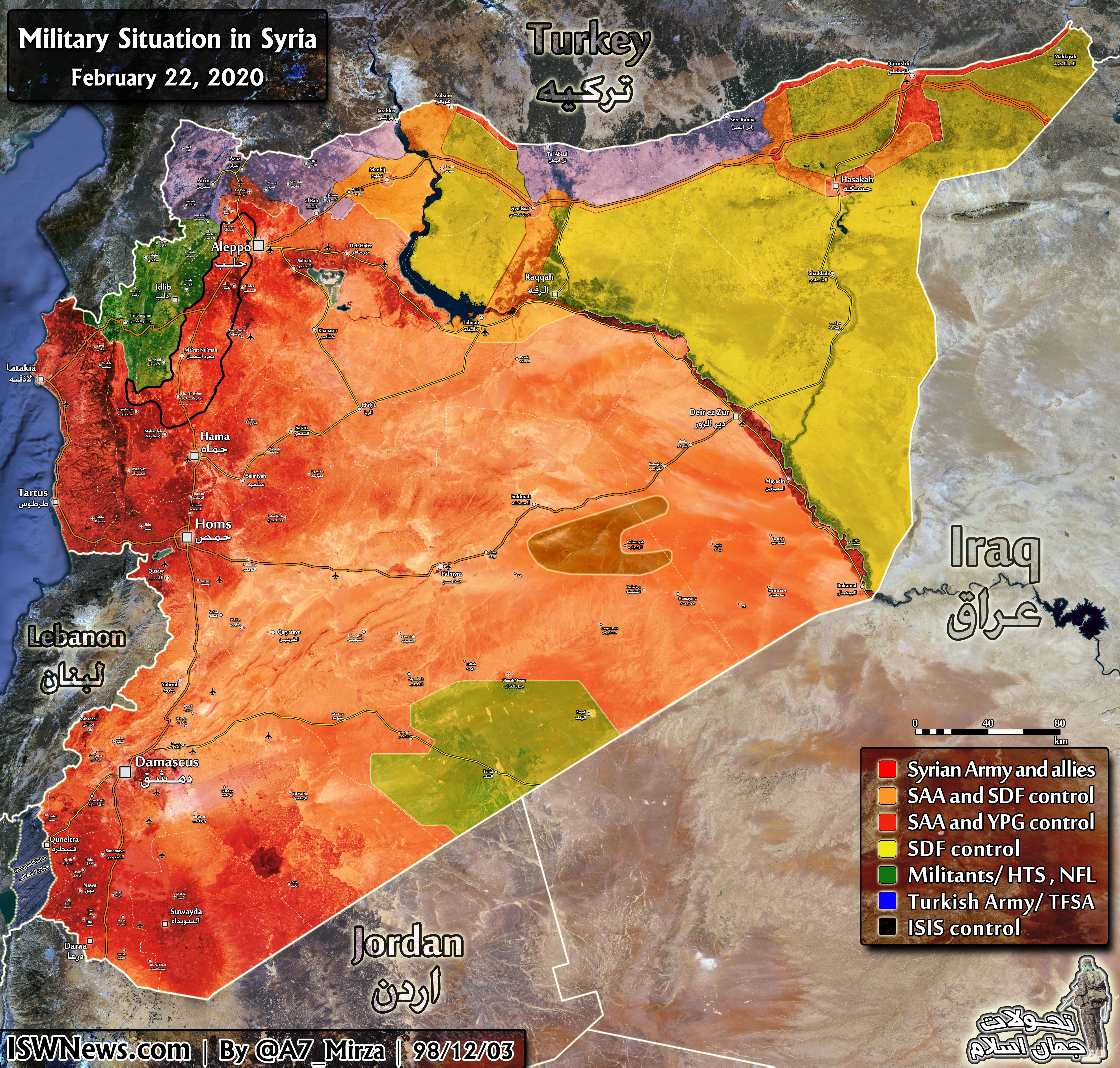
  • Latest Map of Fronts in Syria until 22 February 2020;

    Latest Map of Fronts in Syria until 22 February 2020;

    Northwest of Syria
    Syrian army started its great operation “Dawn of Idlib” from 3 May 2019 in northwest of Syria in Idlib and until 30 August 2019 vast and important areas were liberated in southwest of Idlib and northwest of Hama provinces. The operation took four months and ten days and important cities such as Qalaat al-Madiq, Kafr Nabuda, Lataminah, Morek and Khan Sheikhun were reclaimed by Syrian army.

    In overall, the operation was performed in two stages; in the first stage north of Hama and some areas in south of Idlib and in the second stage, with advances in depth of Idlib area, almost half of the province and large areas of southwest of Aleppo province were liberated.

    The second part of the operation “Dawn of Idlib 2” was started from 19 December 2019. In this part, unlike the first part of the operation, Syrian army was helped by allied forces of resistance axis support. Iranian, Fatemiyounn, Zeinabiyounn, Hezbollah forces and etc. are responsible for the operation in outskirts of Aleppo and Syrian army is also responsible in advances in Idlib axis.
    Two months and three days are passed since the incipient of the second part of the operation and an area of 2,000 km2 has been liberated from terrorists.
    Other significant achievements of the operation so include liberation and opening of Damascus-Aleppo highway, M5, completely after eight years‌ and liberation of tens of strategic points such as Maarat al-Numan and Saraqib. By liberating western areas of Aleppo from terrorists, this city is free completely after many years of occupation and threats.

    At the moment, Syrian army advances are halted in Idlib area and it seems regional talks regarding the resumption of operation or ceasefire to handle terrorists are continuing.
    *Liberated areas in Idlib region are shown by black line.

    East of Syria
    Turkish army started operation “Peace Spring” in northern border of Syria in east of Euphrates between Tal Abiad and Raas al-Ayn against Kurdish forces from 9 October 2019.
    This operation, like other Turkish operations in Syrian soil such as “Euphrates Shield” and “Olive Branch”, took place with participation of different militant groups.
    During one month and 15 days of this operation, Turkish army could occupy all the areas between Tal Abiad and Raas al-Ayn up to depth of 32 km.
    One of the notable things about the Turkish operation in northeast of Syria was that USA pulled back its troops from north of Syria and actually showed green light to Turkey for this operation and left Kurdish forces in east of Euphrates against Turkey.
    Therefore, Kurds leaned toward Syrian army and after several years the army stepped in east of Euphrates, took control of strategic areas and erecting joint military posts with Kurds and defended alongside Kurds against the Turks invasion. This prevented further advances of Turkish army inside Syria.
    Anyhow, after many talks and disputes between sides and regional powers, an unstable ceasefire was held between sides, according to which Turkey has the control over areas between Tal Abiad and Raas al-Ayn, that were occupied during the operation Peace Spring. Joint Russian-Turkish patrols in these lands along the northern border with Turkey. Another article of the agreement, is the obligation of Kurds to retreat from the Turkish borders with depth 30 km, which has not been fulfilled completely yet. This has given Turkey excuses to continue attacks and bombing against Syrian army and Kurds positions in the area.
    At the moment, Turkish operation in this area has been halted since 25 November 2019 and in case of engagement intensify, it can resume.

    Click to see the full size map


    Read the previous article about Syria here: Latest Map of Fronts in Syria until 22 October 2018

  • Map: Investigation of the latest military situation in the Idlib region and the progress of the Syrian Army

    Map: Investigation of the latest military situation in the Idlib region and the progress of the Syrian Army

    1. What happened in Russia-Turkey talks?
    Russians stated in the negotiation that Turkey did not obliged to Sochi agreement regarding differentiate between terrorists and opposition groups and built several new observation posts and deployed extensive force to Idlib. Russia considers the operation fighting the terrorism but did not close the negotiations and try to force the new conditions upon Erdogan.
    Erdogan, on the other hand, started being unreasonable, threatened Syria and condemned Russia’s and Iran’s support for the operation.

    2. Continuation of Syrian Army and allies operation:
    Syrian Army and allies could so far liberate about 2,000 km2 in west of Aleppo and Idlib provinces and seven Turkish observation posts with more than 500 Turkish troops are besieged. This can reduce the risk of Turkey extensively assaulting Syria since besieged Turkish troops are the best target to answer any assault by Turkey.
    As can be inferred from Bashar Assad and Russian officials statements, operation of northwest of Syria will continue at least until liberation of Idlib and possible scenarios and axes of engagement and advance are not clear. Syrian army can move toward border of Turkey and besiege terrorists or liberating towns one by one in Idlib and Aleppo push back them toward Turkey’s border.


    Erdogan however by sending numerous troops and equipment to Syria is obviously looking to get more bargaining chips. Putin refuse to meet him or accept his proposal and continuation of the operation challenged Turkish policies fundamentally and Erdogan is facing dilemma of retreating or confronting.
    Erdogan is aware of consequences (more refugees to Turkey, war extended to Turkey, etc.) of confronting Syrian army more, therefore, avoids having an open war with Syria for now. However wars start with miscalculation and Erdogan is not immune of it either.
    We will hear more news of liberating new lands in Syria, unless Erdogan stops dreaming to pray in Umayyad Mosque and get along with Russia.

    Click to see the full size map
  • Map: Latest military situation in the northwest of Syria, 10 February 2020

    Map: Latest military situation in the northwest of Syria, 10 February 2020

    With the liberation of the Kafr Halab area and its heights, another major route for terrorists between the Idlib city and western Aleppo areas was cut off.
    Currently the Syrian Army liberated almost half of Idlib province from the Hayat Tahrir al-Sham and other radical groups.

    Syrian Army advances in Idlib region continues while Turkey threatens Syria to retreat from newly liberated areas in Idlib province, otherwise Turkey will go to war with Syria!
    Following the escalation of tensions between Turkey and Syria, the Turkish Army targeted Syrian Army positions near the Saraqeb from Taftanaz airport, and the Syrian army in retaliation of Turkey aggression bombarded the Taftanaz airport with artillery and 5 Turkish troops were killed.

    Click to see the full size map