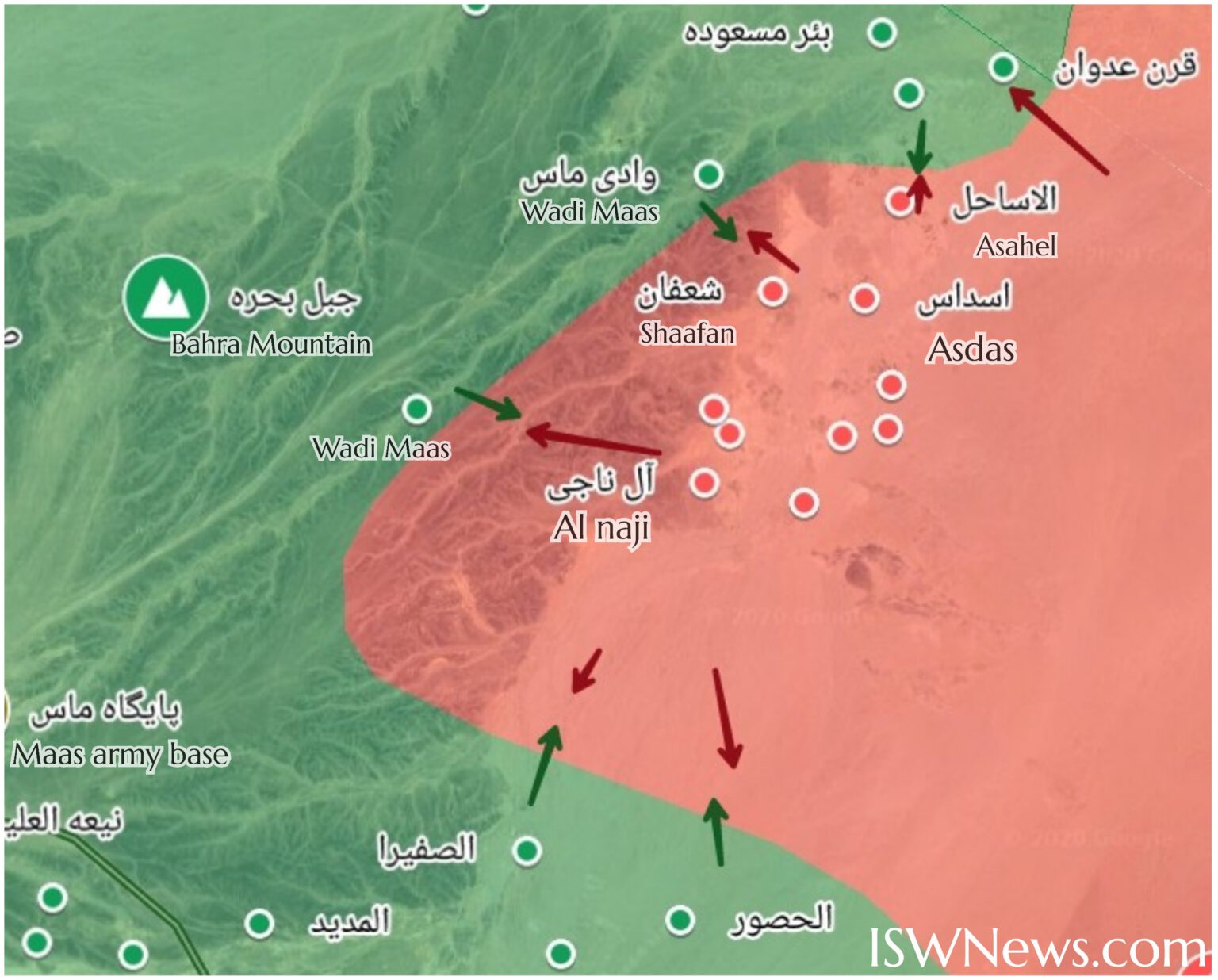
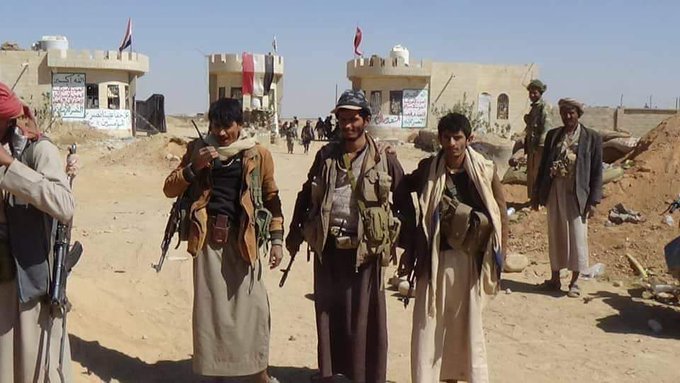
1- Marib – Ansar Allah and Saudi coalition conflict continues in Raghwan district. The coalition launched heavy attacks in north of Asdas axis to villages Qarn Adwan in north of Asahel and east of Hazm district villages, al Jawf province, however Ansar Allah’s resistance repelled them back from those areas. – Ansar Allah is deploying troops and equipment to east of Sarwah front and Madghal to start the battle in west of Marib town. – Saudi coalition warplanes bombed Madghal district 16 times and Sarwah district 10 times in the last 48 hours.
2- Al Hudaydah Saudi coalition forces violated ceasefire in the province 148 times in the last 48 hours.
3- Abdulkhaliq al-ajari, spokesperson of state department of rescue administration: Security forces discovered 31 handmade bombs and explosive belts in Quraishiyah district, Baydha province.
4- Muhammad al-Bukhayti, a commander of Ansar Allah and Dhamar governor, reported that some of Mansoor Hadi forces returned to Ansar Allah and swore allegiance with the rescue administration. Some sources said the number of these troops add up to a whole brigade, but no details released yet.
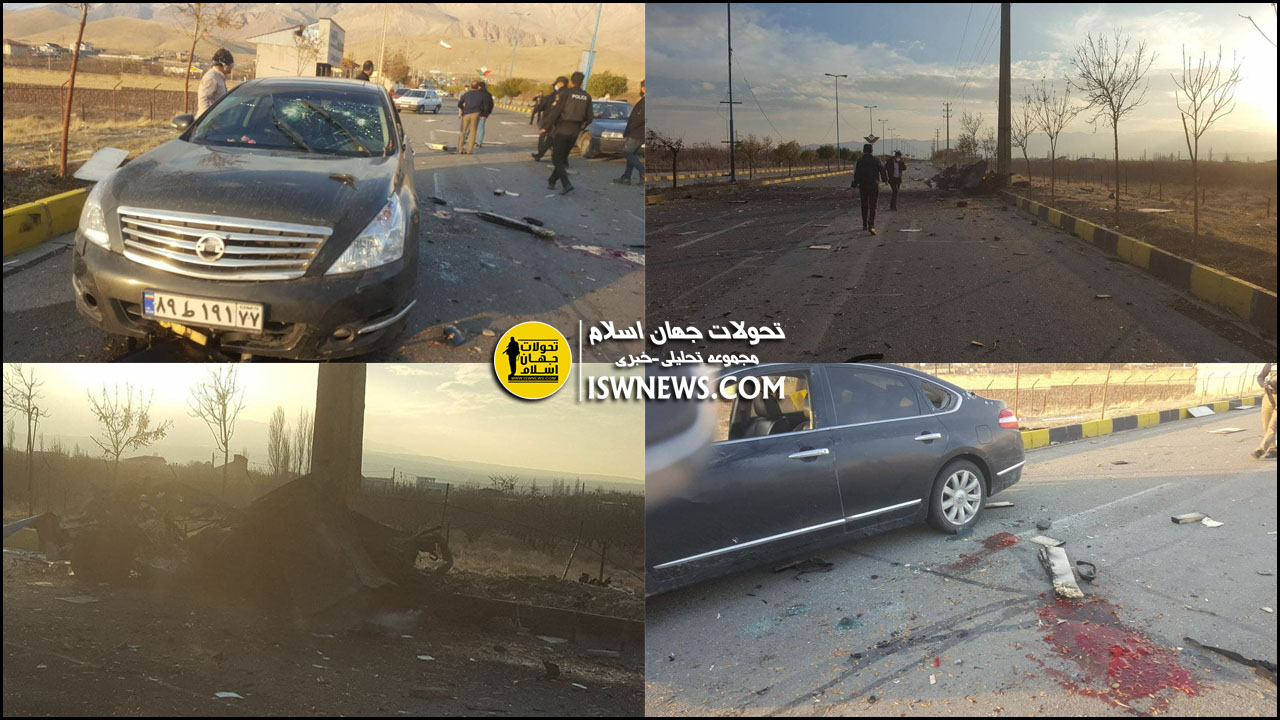
According to the available evidences, a car bomb exploded near Mohsen Fakhrizadeh’s car to surprise his security team, and then the main assassination team took action and clashed with his security team.
Professor Fakhrizadeh was seriously injured in this terrorist operation while his wife was with him and was taken to the hospital, but he was lost his life due to the severity of his injuries.
Mohsen Fakhrizadeh is one of the most important scientists in the field of nuclear and missile in Iran and was on the Mossad assassination list for many years, and according to the Israeli media, his assassination attempt failed once in previous years. Earlier, Netanyahu mentioned Mohsen Fakhrizadeh in one of his anti-Iranian programs.
Iranian military officials have promised a decisive response to the perpetrators of the assassination.
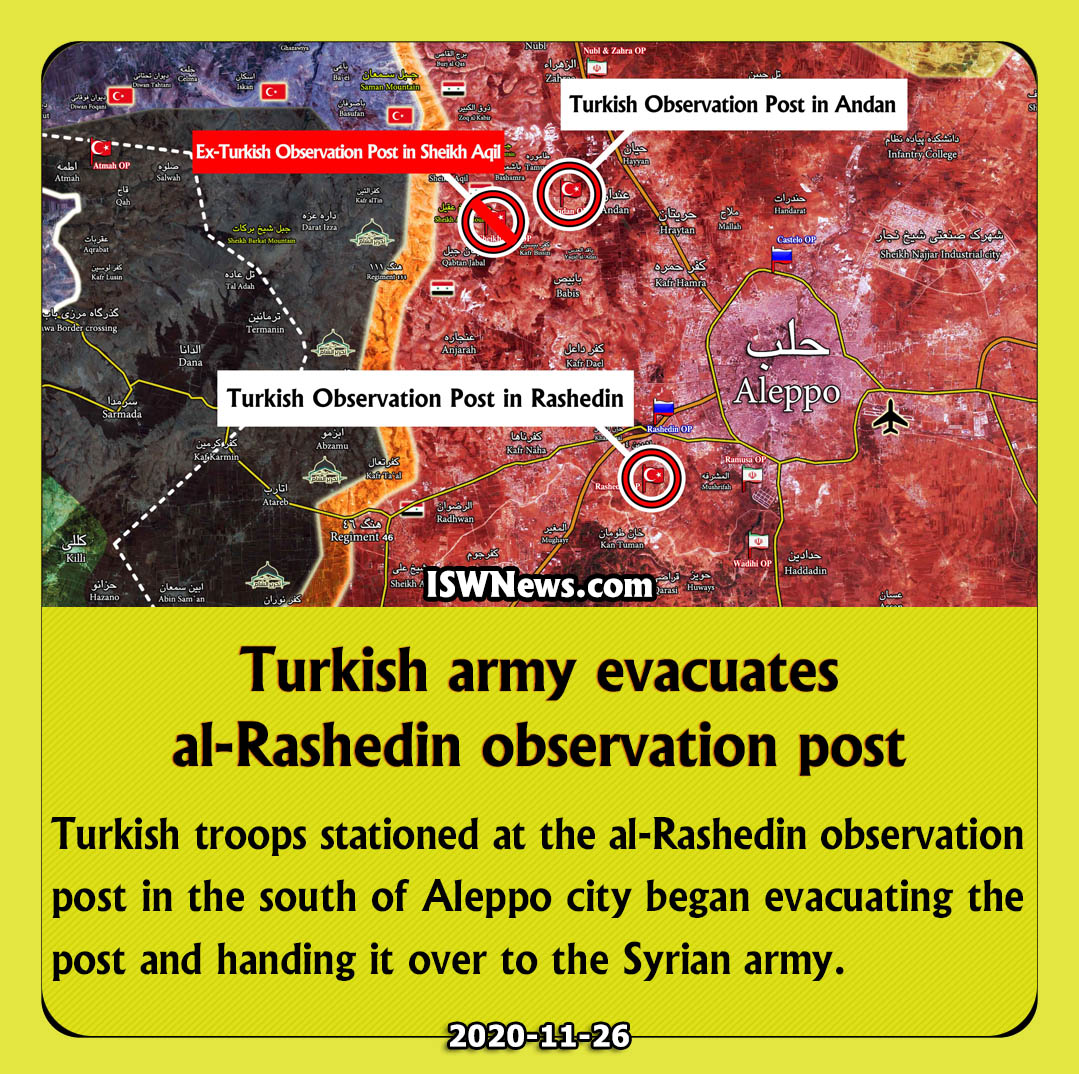
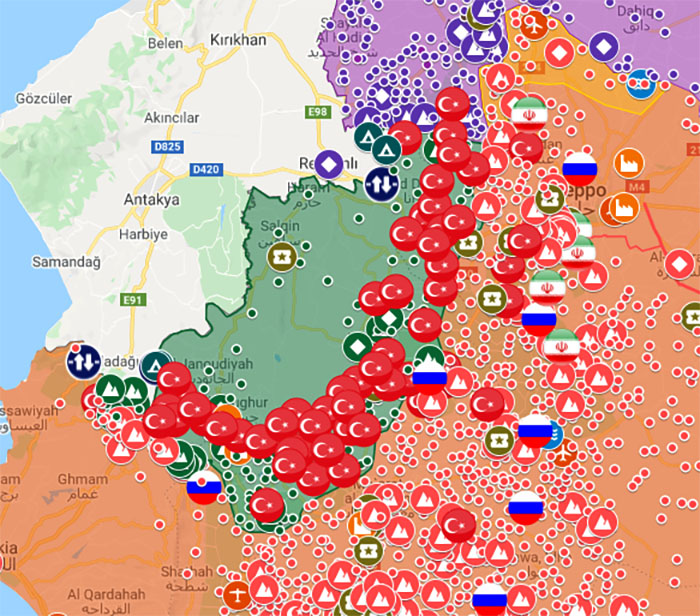
In recent days, the Turkish army has also begun preparations to evacuate the Andan observation south of Nubl and al-Zahra.
In recent weeks, the Turkish military has been evacuating its military and observation posts in areas controlled by the Syrian army and moving its forces and equipment into the militant-held areas of Idlib.
So far, and in a period of about 40 days, the observation posts of Morek, Sher Mughar, Sheikh Aqil have been vacated by the Turkish army.
On the other hand, a Turkish military delegation visited the village of Kansafra yesterday to consider establishing a new military post in southern Idlib. In recent weeks, the Turkish military has set up new military posts in the Idlib region in parallel with the evacuation of military and observation posts. Currently, the Turkish army has established about 50 illegal military posts outside the framework of the Astana agreement in various parts of Idlib.
In previous years, Ansar Allah’s advance was stopped behind the gates of Marib, but after Operation “Fa’amkana Minhom” in al-Jawf Province and Ansar Allah Operation in the north of al-Baydha; The ground for the liberation operation in Marib province was again provided for Ansar Allah.
In the first article, we introduced the Saudi coalition military bases in the provinces of Marib and al-Jawf, which formed the defensive line of their positions, and the main focus of the coalition’s operations in the war was the “conquest of Sanaa.”
After the start of Ansar Allah operation in Marib province, which was preceded by two operations, “Fa’amkan Minhom” and the peration north al-Baydha against al-Qaeda and ISIS, Ansar Allah succeeded in liberating the districts of Majzar, Madghal, Maheliyah and Rahbah, and clashes continue in the districts of Raghwan, Sarwah, Jabal Murad, al-Abdiya, al-Jubah and Huraib.
Currently, Ansar Allah has almost broken the main defensive line of the Saudi coalition in Marib by capturing four Labanat base, al-Khanjar base (in al-Jawf province), al-Jufra base and Maas bases in the west of Marib province, and the precision missile and drone strikes on the bases of Sahn al-Jinn, Tadawin, the third military zone, al-Ruwaik, and… have led to the weakness of the coalition in supporting the front lines. Therefore, it can be said that the military power of the Saudi coalition in Marib province has been drained and the conflict between the two main sides of the Yemeni war, namely Ansar Allah and the resigned government of Mansour Hadi, in Marib province is nearing its final step.
Now, Ansar Allah must achieve the following in order to complete its victory in the west of Marib province:
1- Clearing the district of Raghwan: Negotiations with some tribes have been effective, but most of the tribes in the Raghwan area are resisting Ansar Allah, whose defeat is imminent.
2- Moving in direction of Kanayis base: The clearing of this base will also lead to the security of eastern parts of al-Jawf, and the coalition attacks on the Labanat base and the eastern villages of al-Hazm city will no longer be possible.
3- Moving in direction of al-Ruwaik base: This route will be militarily costly due to the desert climate, because it will put Ansar Allah’s equipment and forces within the reach of the coalition air force. Therefore, it does not seem that Ansar Allah will make the final attack on Marib from this route. However, this route is important for imposing a siege on Marib or controlling al-Safer oil resources.
4- Moving from the south of Marib: The Murad tribes are among the main and staunch supporters of the Yemeni Muslim Brotherhood and the resigned government of Mansour Hadi in Marib, who generally reside in the southern and central district of Marib province. Although it is difficult and time consuming for Ansar Allah to cross this route, but while reducing the Saudi coalition power on other fronts, it leads to the decrease of the coalition popularity among the people of Marib. The heights of Jabal Murad district, and the two bases of Rabish and al-Khashina are also among the important points of these areas, the clearing of which is considered as the control of the south of Marib province.
5- Moving from the western route: The main axis of entry into the city of Marib for Ansar Allah is the Sanaa-Marib road and the Sarwah-Marib road. Ansar Allah’s domination of the Marib Dam and its western heights could lead to the surrender of the city without conflict. In this regard, Ansar Allah must push back the Saudi-led coalition forces from the bases of Sahn al-Jinn, Tadawin and the third military zone.
As we have mentioned before, Ansar Allah does not seek to impose defeat on the Saudi coalition and push them back to control Marib, but seeks to consolidate the coalition’s defeat in the region, end Mansour Hadi’s belligerence, and reject their (Muslim Brotherhood) ideology for the model of governing Yemen. Nevertheless, Ansar Allah used to consider the Yemeni Muslim Brotherhood as one of the political factions and wanted to interact with them. However, this faction has not shown flexibility in its actions with Ansar Allah and even the southerners. Undoubtedly, Marib is their most important base, and with its liberation by Ansar Allah, the resigned government will face many problems in other areas under its control, which could eventually lead to the collapse of their current.
Click to see the full size map
YOUR SUPPORT IS CRITICAL TO KEEP ISWNews ALIVE!
I’d like to thank readers for their confidence and support. Thanks to your support we can continue to perform our duty on reporting the important events in the region. So If you like our contents, please don’t feel embarrassed to contribute and help our project, for as little as 1 Dollar. Your contribution, however small, will help ensure our project continuity. Thank you.
1- Marib – Another Saudi-led coalition forces caravan left Tadawin camp in north of Marib city toward Saudi border. – Following the advance of Ansar Allah in Marib province, a state of emergency has been declared in the city of Marib and Saudi-led forces erected checkpoints in different places. – Saudi coalition warplanes bombed Madghal district 28 times and Majzar district once in the last 48 hours.
2- Al Jawf Saudi-led coalition warplanes bombed Maraziq area 7 times and Dhahra area 1 time in the last 48 hours.
3- Coalition media claimed that Saudi-led coalition warplanes struck Ansar Allah’s munition depots east of Sanaa.
4- Saudi Arabia demanded Ansar Allah threats to world’s energy security to be stopped, in a letter to security council.
5 -Saudi coalition claimed to destroy Ansar Allah 5 sea mines that were planted in the Red sea.
According to a Syrian military source, the attack took place late on November 24 at 23:50 from the occupied Golan Heights, and Syrian air defense systems intercepted a number of missiles.
Answer: Ansar Allah movement is a Yemeni movement which was founded by martyr Sayyid Hussein Badreddin al-Houthi and was known as “the Believing Youth” before.
The movement was known as Houthis as well between Yemenis and media at the early years of the activities. Houthis comes from the family of Sayyid Hussein Badreddin, the founder of the movement, which is the name of a district in Amran province, north of Yemen.
What is wrong with using Houthisfor Ansar Allah movement?
Like other countries of west of Asia, Yemen also had many races and tribes, which was influential on the government of the area. This is used by western media mastermind to label a vast popular movement in Yemen by name of a tribe and to label the current war as a tribal war. Dividing Islamic countries is usually done using two methods: 1. Religion and 2. Race In Yemen the race is being used by Saudis. This doesn’t mean that the religious differences are not used for discord and dividing in Yemen but the racial and tribal differences are the main trick for warmongering. Therefore using Houthis for the popular vast movement of Yemeni Ansar Allah helps the MSM to overlook tens of parties, political movement and tribes and millions of people who joined Ansar Allah.
To further read and understand about the demographics of different provinces of Yemen, it is highly recommended to read series of “Answering Key Questions” articles.
This military post was established between the villages of Al-Ruwaiha and Al-Sarjah, north of the city of Ma’arat al-Nu’man.
The process of establishing the new point comes at a time when Turkey is withdrawing from other observation points in the countryside of Aleppo the last of which was the Sheikh Aqil point in the northwestern countryside, with preparations to withdraw from another point in Anadan to the north.
The Turkish army is currently stationed in nine observation posts and about 50 military posts in western Aleppo and the Idlib region. Observation posts of Al-Sarman, Tal Al-Tawqan, Tal Al-Eis, Al-Rashedin, Andan, Deir Samaan, Salwah, Ashtabraq mountain, Al-Zaytouna and military posts of (around)Saraqib, Al-Tarnabeh, Al-Nairib, Al-Mughir, Al-Zarba, Qaminas, Sarmin, Taftanaz Airport, Ma’ara Al-Misrin, Kafr Karmin, Tawama, Regiment 111, Mastumah base, Termanin, Atarib, Darat Izza, Bardaghli, Maataram, Nahlia, Bsanqol, Bazabor, Batabo, Mahambil, Abzamo, Ram Hamdan, Kar Nuran, Jinah, Mushayrifa, Tal Khatab, Bdama, Najiyah, Al-Za’iniya, Al-Ghassaniyah, Deir Sonbol, Al-Kufayr, Al-Barah, Al-Burnas, Ariha, Jannah Al-Qura, Basamas, Tal Nabi Ayyub, Al-Qiyasat, Maarata, Mar’iyan, Mantaf, Tel Arqam, Qoqafin, Balyon and Ruwaiha are among the military and observation posts in which the Turkish army is present.
– Some sources report the return of the Kurdistan Democratic Party to Kirkuk with the consent of Iraqi Prime Minister Mustafa al-Kadhimi. Barzani’s party was forced to flee the area after the return of Iraqi joint forces to Kirkuk in 2017. It seems that part of the agreement reached between Mustafa Kazemi and this party on Sinjar is their return to Kirkuk.
– Massoud Barzani met with a high-level delegation of the British government in Erbil.
– Gen. Kenneth McKenzie, Commander of the US Terrorist forces in the region (CENTCOM): At Trump’s behest, only 2,500 US troops will remain in Iraq. The Iraqi government now wants US and allied forces to remain in the country.
– Some sources report the arrival of two brigades of federal police forces in Sinjar and their deployment in the border areas with Syria. According to sources, the number of these forces is 2500 people.
– 16 ISIS terrorists killed in Iraqi Counter-Terrorism Unit operation in Kirkuk. According to the spokesman for the Commander-in-Chief of the Iraqi Armed Forces, a number of weapons, passports and domestic and foreign currency were seized during the operation.
– In two separate attacks by ISIS on Hashad al-Asha’eri forces in the north of Baiji and south of Makhul, two members of Hashad al-Asha’eri forces were martyred.
– The Security and Defense Committee of the Iraqi Parliament emphasized that it will pressure the government to send the results of the investigation of the assassination of the martyrs Abu Mahdi Al-Mohandes and Haj Qasim Soleimani.
– The Security and Defense Committee of the Iraqi Parliament stressed that the United States is behind the blockade of the purchase of the Russian S-300 missile defense system. Ali al-Ghanimi, a member of the commission, said: “The purchase of Russia’s missile defense system is very important to protect the country’s skies, and the US veto continues to prevent the purchase by the Iraqi government.”
– The border crossing between Iraq and Saudi Arabia was reopened after 30 years.
– The Dutch Ministry of Defense announced in a statement that it will send troops to the Iraqi Kurdistan region to protect Erbil International Airport. Some sources put the number at 100 to 150, who will arrive in Erbil, the capital of the Iraqi Kurdistan region, earlier this year.
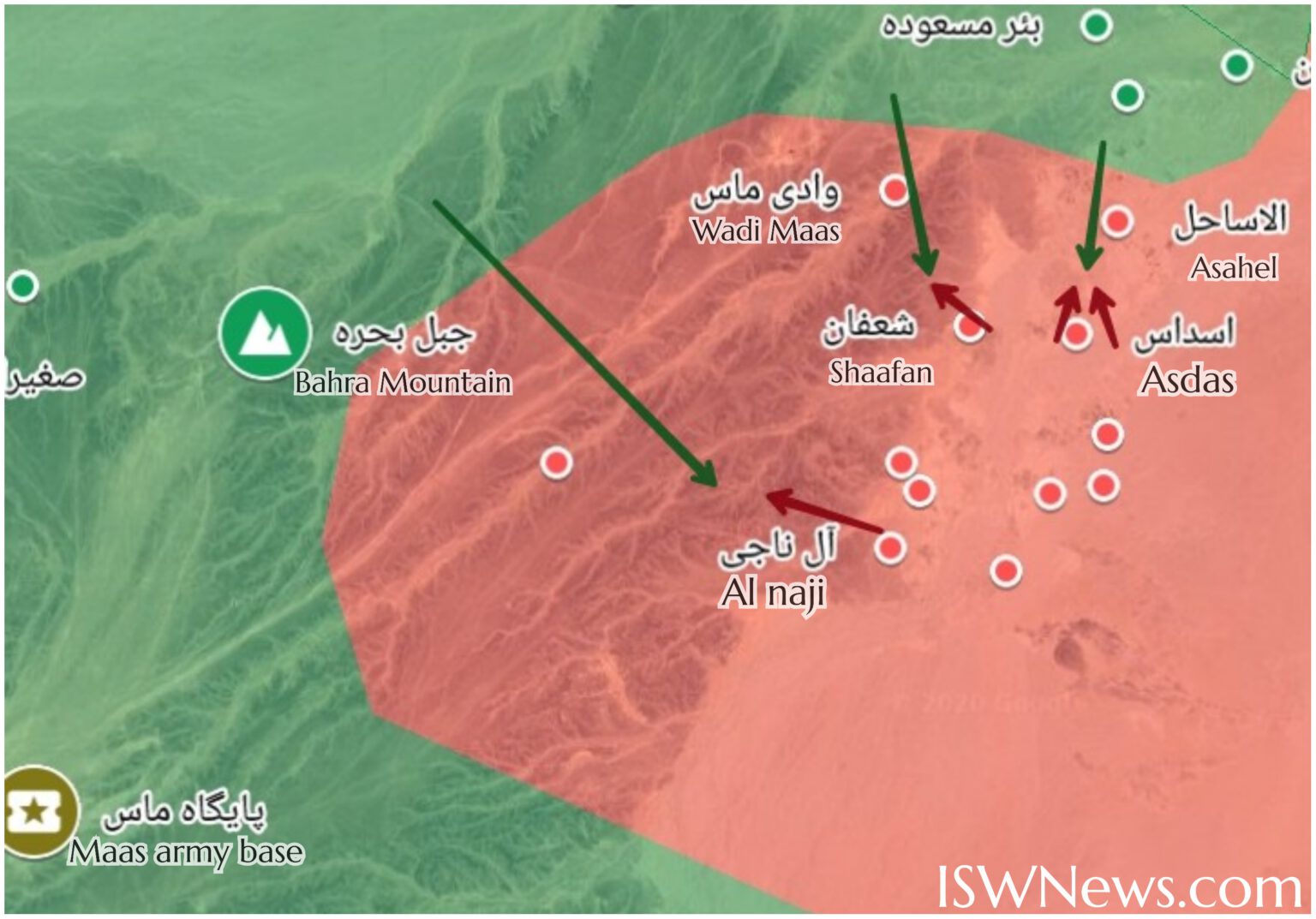
1- Marib – Ansar Allah repelled Saudi-led forces heavy attack to Wadi Maas and Maas base. Ansar Allah cleansed Wadi Maas and advanced in areas al-Sahel, Al Naji and Al Sarah, and the target is to liberate Asdas, center of Raghwan district. – Saudi coalition warplanes bombed the front in Madghal district 23 times in the last 48 hours. – Ansar Allah missile strike to Saudi coalition positions surroundings of Marib.
2- Al Jawf – Sporadic clashes between Ansar Allah and Saudi-led forces continue in the Maraziq front and east of Labanat base. – Saudi coalition warplanes bombed al-Aqsha’ area in Hazm district 8 times and Maraziq and Khanjar area in Khab and Shaaf district 2 times in the last 48 hours.
3- Al Hudaydah Saudi-led forces violated ceasefire in the province 359 times in the last 48 hours.
4- Saudi coalition media reported to shoot down an Ansar Allah drone over south of Saudi Arabia.
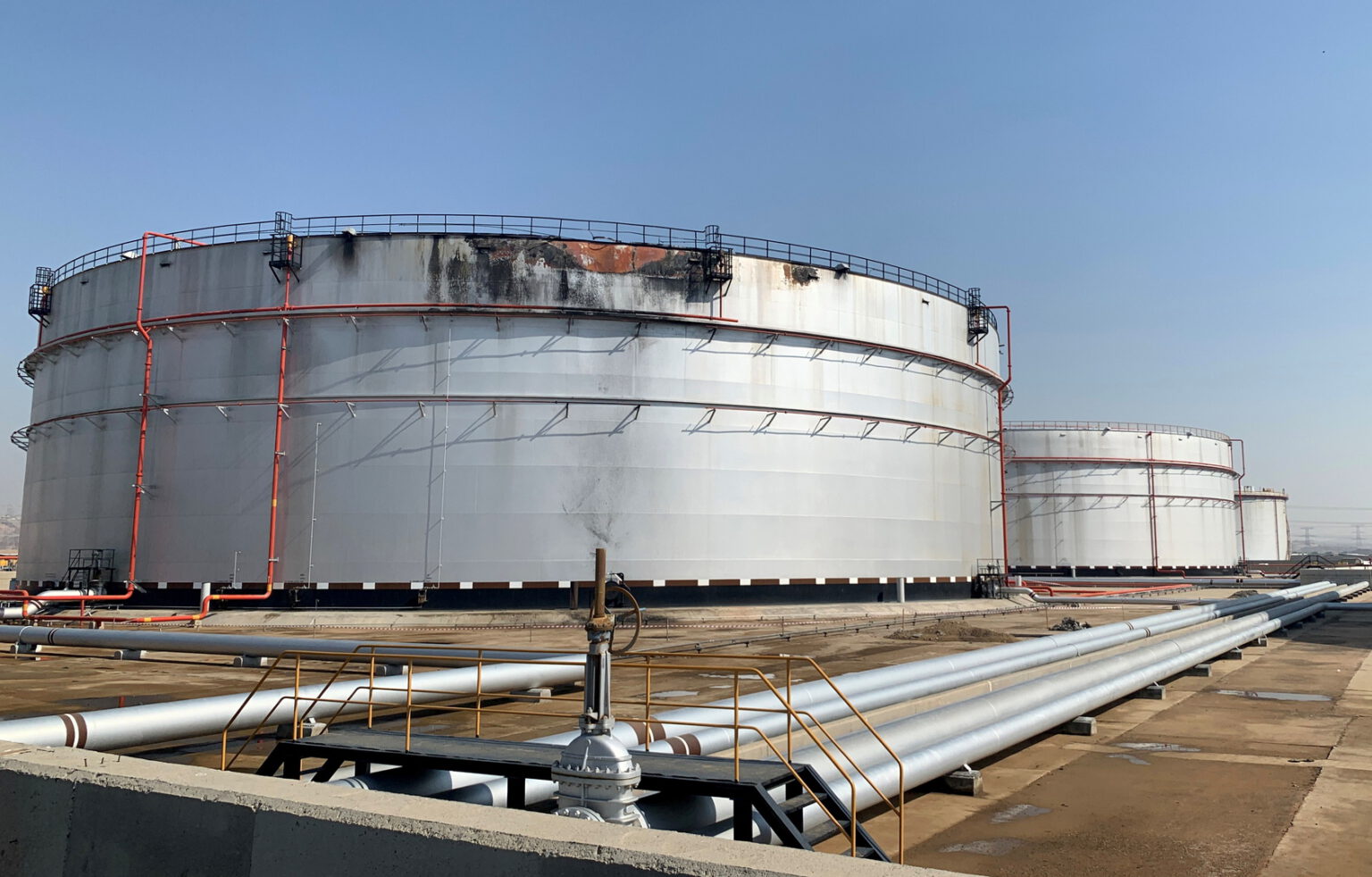
Two Quds 2 missiles where used and distribution station of the refinery was targeted and hit with precision.
The facility is located in north of Jeddah and near King Abdulaziz International Airport.
It is noteworthy that Quds 2 type winged missiles were recently become operational in Yemeni Army and hit the selected target deep inside Saudi Arabia precisely after flying near 650 km.
Yahya al-Sari’ added that the attack was a retaliation to continuation of siege and assault by Saudi Arabia against Yemeni people and asked civilians and the foreign companies to have distance from critical infrastructure of Saudi Arabia because the operations will continue.
Image: The morning of Nov 23rd and the continuation of the fire after last night attack
According to the local sources of ISWNews, the Maas base has witnessed heavy ground and air attacks by the Saudi coalition in the past two days, which have been defeated by the fierce resistance of Ansar Allah.