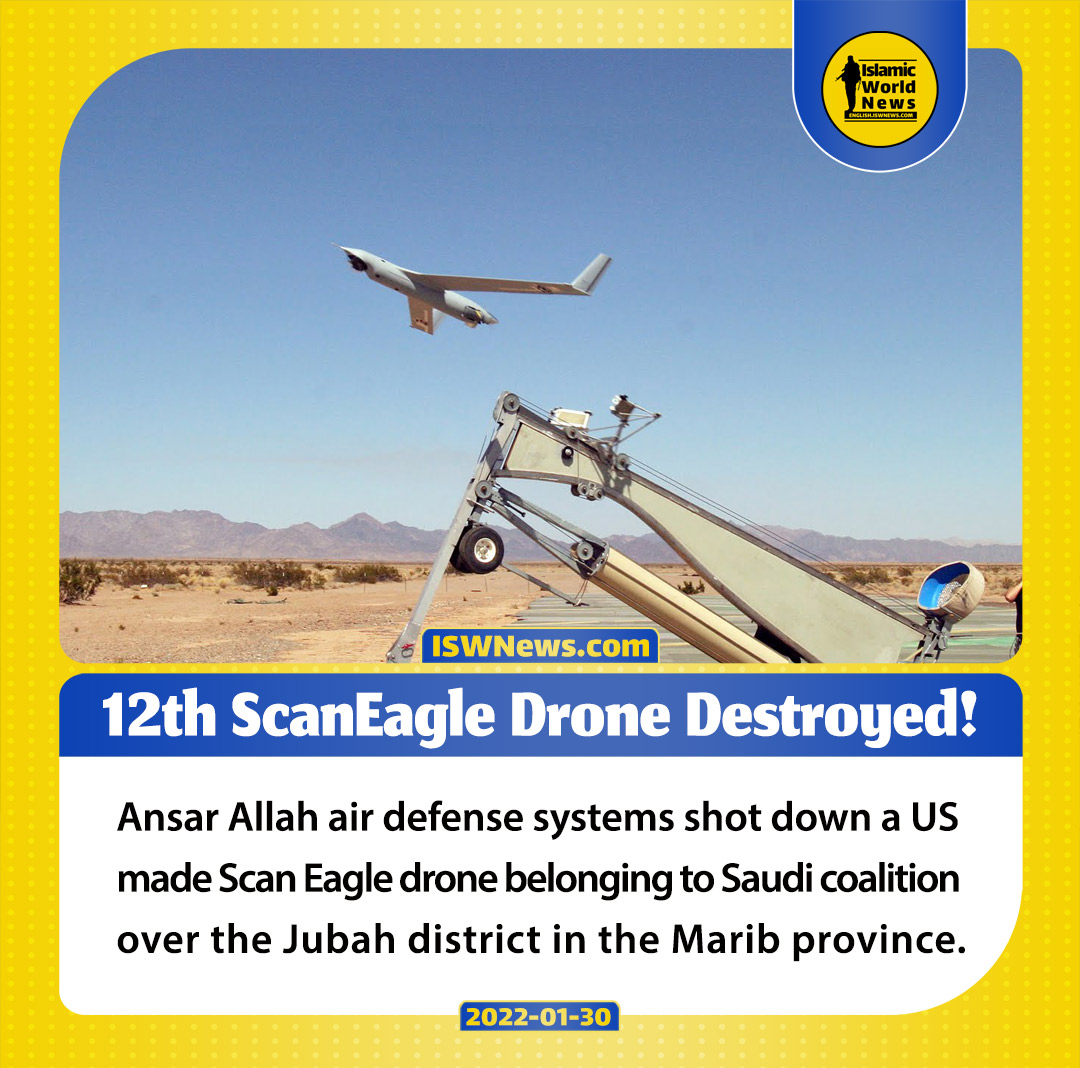
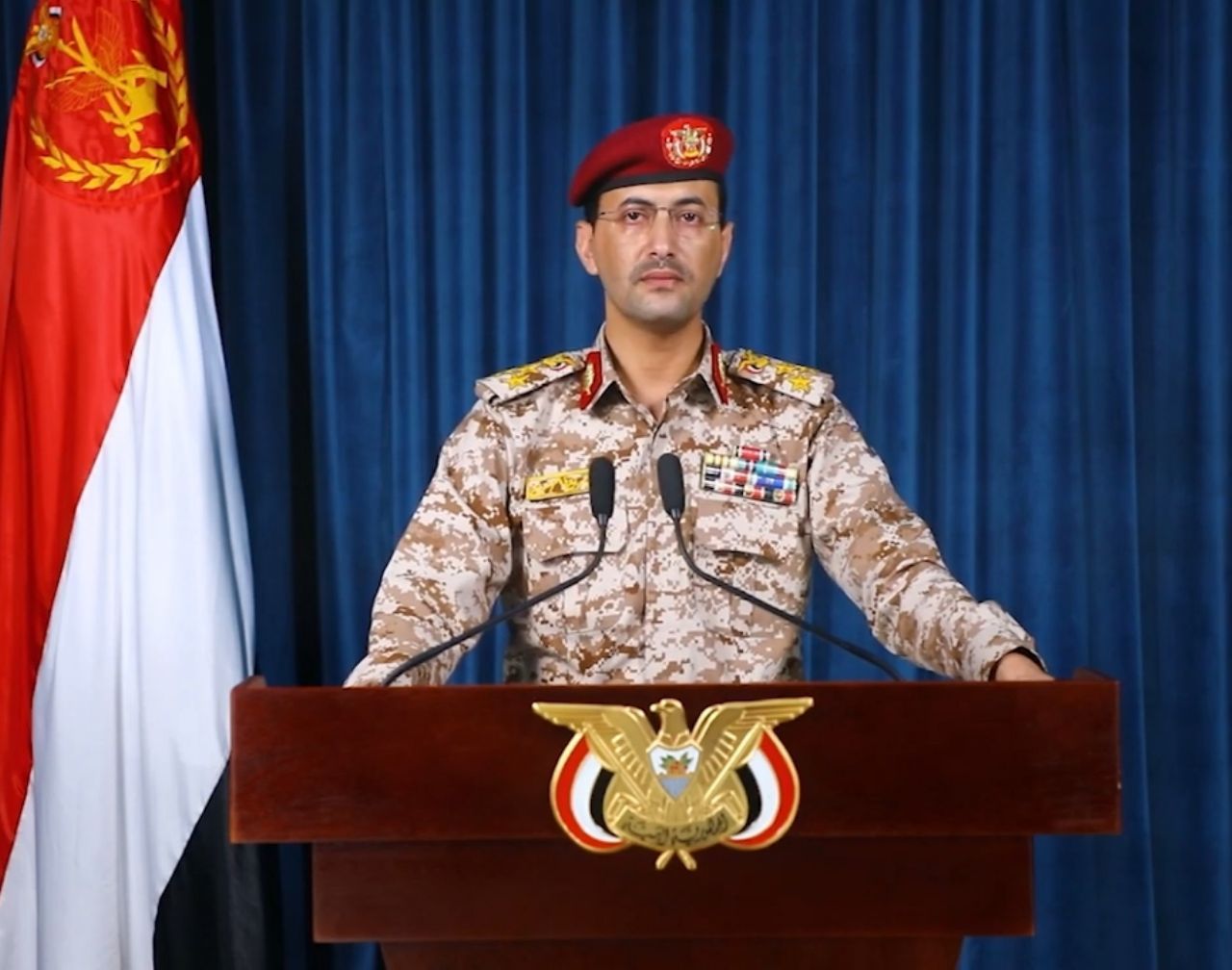
According to Brigadier General Yahya al-Sari’, a spokesman for the Yemeni Armed Forces, the drone was spotted and shot down by Ansar Allah air defense yesterday evening in the skies of al-Juba district.
So far, this drone is the 12th US Scan Eagle drone have been shot down by Ansar Allah during the Yemen war.
The first US Scan Eagle drone was shot down on June 19, 2021 over the al-Mashjah heights in the west of Marib province, the second on June 21, 2021 over al-Mashjah heights in the west of Marib province, the third on August 14, 2021 over the Madghal district in the west of Marib province, the fourth on September 27, 2021 over the Madghal district in the west of Marib province, the fifth on November 9, 2021 over the al-Jubah district in Marib province, the sixth on November 13, 2021 over the al-Jubah district in Marib province, seventh on December 4, 2021 over the al-Jubah district and the eighth on December 8, 2021 over the al-Jubah district in Marib province, the ninth on December 10, 2021 over the Sarwah district in the west of Marib province and the eleventh on December 16, 2021 over the Wadi district in east of Marib province.
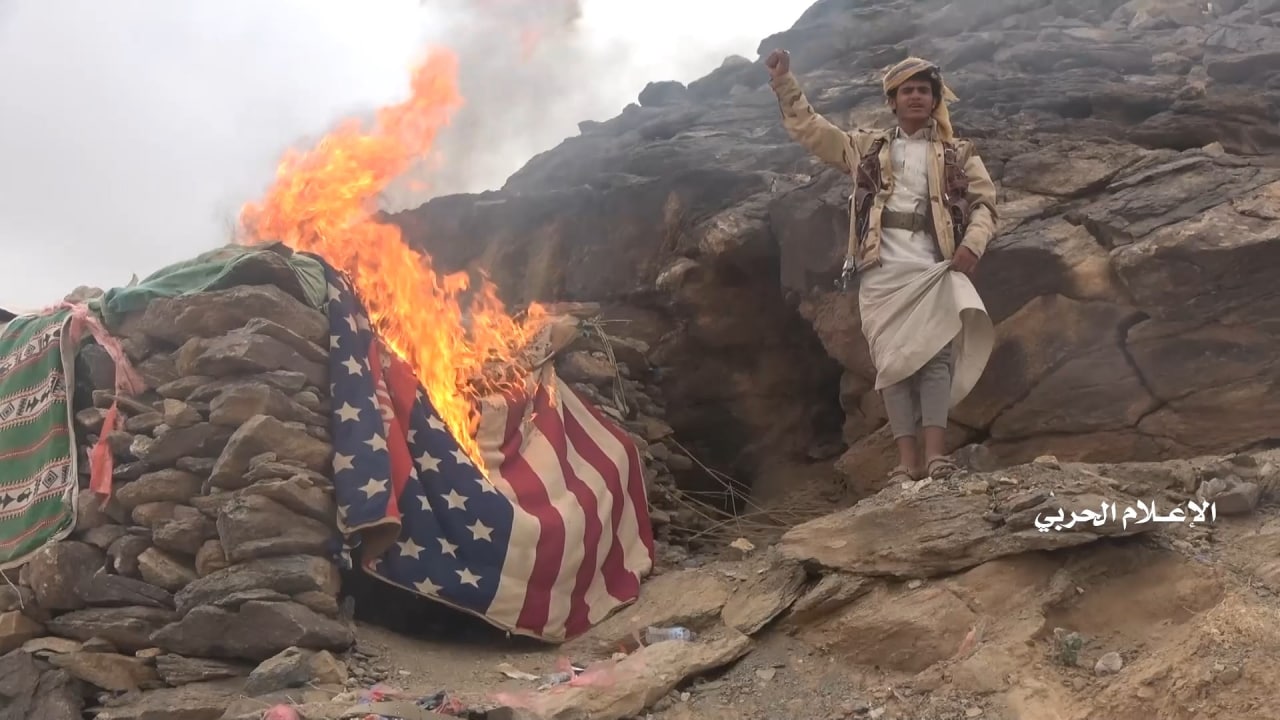
In this operation, Ansar Allah has succeeded in liberating more than 160 square kilometers from the eastern desert areas of Saada province, including: Taibat al-Esm camp, Qadhamil heights, Qahira, al-Rabaa, al-Ramla al-Sawda and al-Mahour. During these attacks, more than ten tanks, military vehicles and armored vehicles were destroyed and set on fire by Ansar Allah, and the weapons of the Saudi coalition in the Taibat al-Esm camp were looted by Ansar Allah.
Ansar Allah had previously liberated the town of Yatmah in the north of al-Jawf province and the heights overlooking the Taibat al-Esm camp and the al-Ajasher desert during Operation Fajr al-Sahra on December 24, 2021.
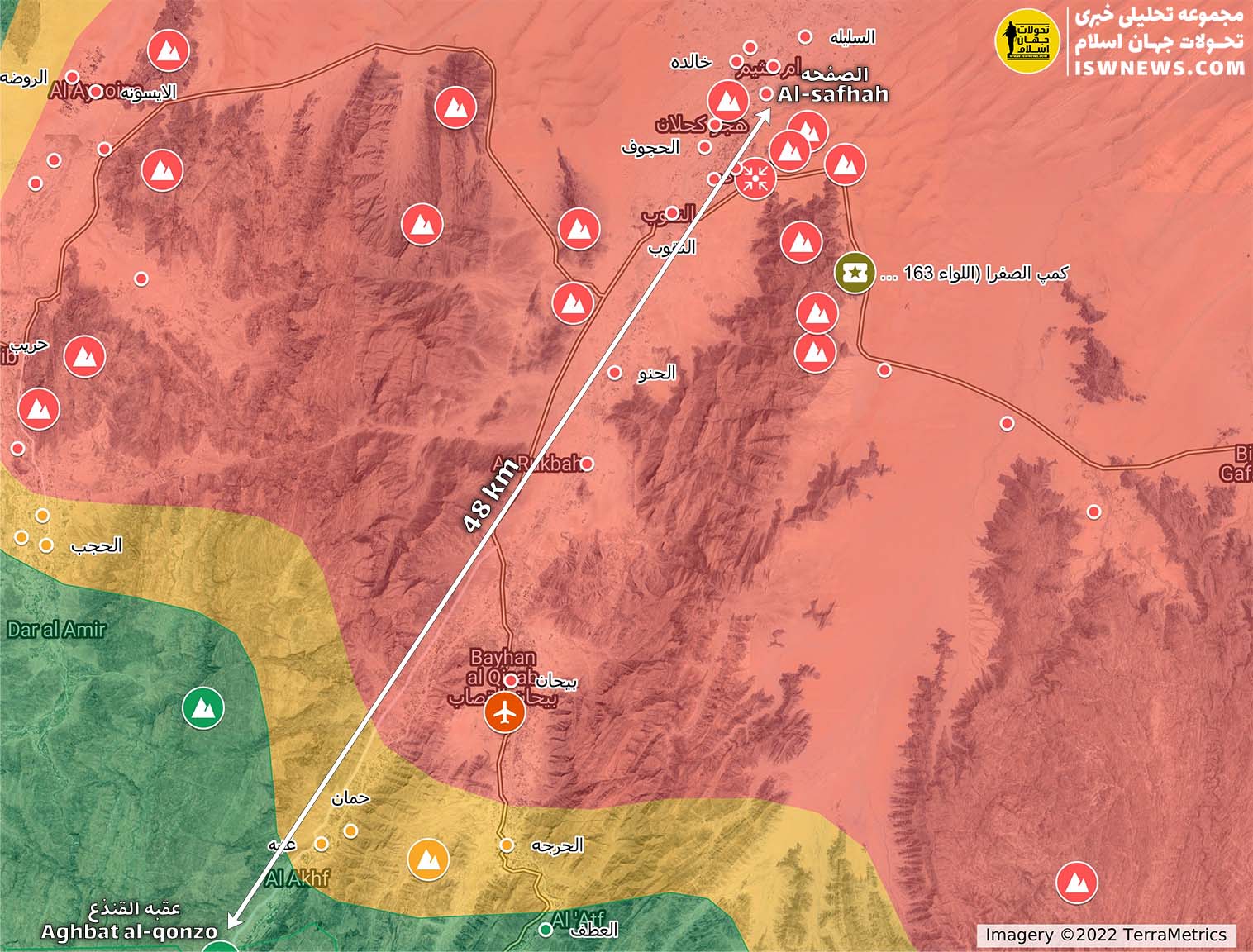
The missile attack was carried out in the last hours of last night, January 28, against a gathering of Amaliqa forces (Giant Brigades) in the al-Safhah area of Usaylan.
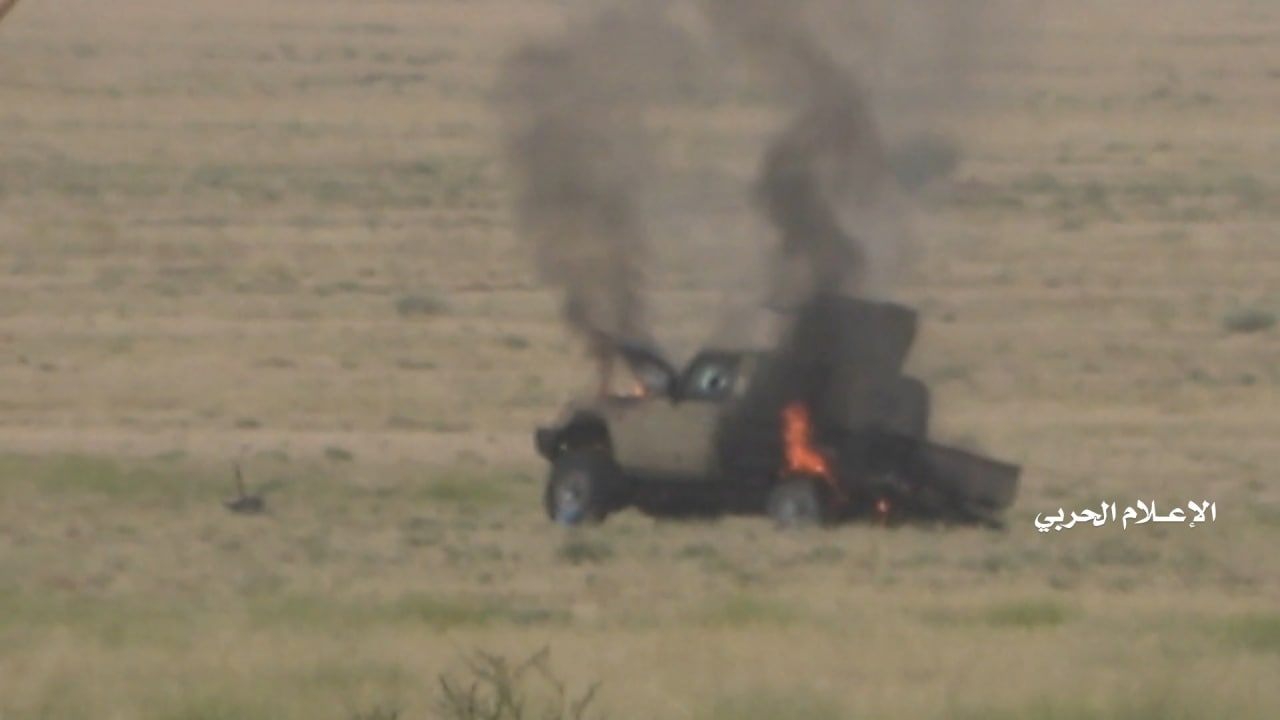
According to Brigadier General Yahya al-Sari’, a spokesman for the Yemeni Armed Forces, several military and armored vehicles were destroyed and at least 40 militants and commanders of the Amalqa forces were killed and wounded during the attack.
Considering the distance of Ansar Allah positions to al-Safhah area (48 km) and also the history of Ansar Allah missile attacks, the type of missile used in this attack was probably the Badr P-1 missile.
On November 12, 2021, an order was issued by the Saudi coalition command, which surprised many analysts and the media. In an unexpected move, they ordered the withdrawal of coalition forces from most parts of al-Hudaydah and the west coast of Yemen. According to this order, all the forces of the “National Resistance”, including the forces under the command of Tariq Saleh, Tihamah, Amaliqa and joint forces, evacuated the northern and eastern areas of al-Hudaydah and the western areas of al-Durayhimi, al-Jah and al-Tuhaita.
The most reasonable theory was assumed the fact that this retreat is done to strengthen the Shabwa and Marib fronts, and these retreats will continue until the Hays-Khukhah region in Hudaydah province.
Ansar Allah rapid advance on the Marib and Shabwa fronts had confused and weakened the Saudi coalition ground forces, and the coalition had not been able to stop Ansar Allah by sending al-Qaeda and ISIS militants. They needed trained and experienced forces to protect the city of Marib and keep Ansar Allah away from the city of Ataq, the capital of Shabwa province. With the Sudanese fleeing and the killing of mercenaries and elements of al-Qaeda and ISIS, there was no choice left for the coalition except al-Amaliqa (Giant Brigades) and Tariq Saleh forces.
According to the latest estimates from the Yemeni fronts, the Saudi coalition divided its forces on the west coast as follows: Tariq Saleh forces remained south of al-Hudaydah province to prevent possible Ansar Allah attacks, and some of them moved to the northern and western fronts of Marib.
The Tihamah forces, along with Tariq Saleh forces, carried out an operation called the “Golden Arc” around the town of Hays, which did not yield any specific results. The joint forces and the Amaliqa forces also entered the city of Ataq to retake western areas of Shabwa province.
This transfer of forces was the result of a secret agreement between the Saudis and the UAE. The UAE appears to have achieved the keys of Shabwa province in exchange for helping the Saudis to keep the Marib city. Of course, this issue will be protested by the tribes loyal to “Mansour Hadi”, and there is a possibility of a clash between Mansour Hadi supporters and the southerners in Shabwa province.
In any case, Amaliqa and joint forces under the command of Saudi Arabia and with the special support of the UAE entered the battles of Shabwa. In the first step, the UAE enticed the sheikhs of the tribes of Usayilan and Bayhan, and this led to the cancellation of peace agreements between Ansar Allah and tribes of Belharith. Thus, Ansar Allah set up a defensive line in the southern highlands of Beyhan and Ain district and prepared itself to counter a large-scale military operation by the Saudi coalition in the area.
From January 11, the conflict was transferred to the north of the Harib district, and finally the Harib district center came under the control of Saudi coalition on January 24.
According to the latest news from the Shabwa and Marib fronts, Ansar Allah’s first defensive line in the south of Beyhan remains stable. But the situation in the district of Ain is in favor of Saudi coalition.
The Saudi coalition in the south of Marib seeks to break Ansar Allah’s second line of defense from the al-Ma’laa heights to Haniyeh mountain, as well as advancing on the axis of Abdiyah district. If this line is also broken, Ansar Allah’s positions in al-Juba district will be weakened and the way will be opened for the coalition to move forward. The fall of these areas will eventually force Ansar Allah to retreat from the al-Balaq heights and the southern areas of the city of Marib. Because they will be under a quasi-siege from the north, east and south.
Simultaneously with the transfer of most of the Amaliqa forces to the central regions of Yemen, other forces under the control of the Saudi coalition, such as the Joint Forces and Mansour Hadi forces, have been deployed on the southern fronts of Marib. On the other hand, the Minister of Defense of Hadi government, Mohammad Al-Maqdashi, has visited the southern fronts of Marib, which marks the imminent operation of Mansour Hadi’s forces to retake the al-Balaq al-Sharqi heights, and Ansar Allah must prepare for a heavy battle on this front.
In general, for Ansar Allah, the future is not very pleasant for the battles of the Marib and Shabwa fronts. Ansar Allah’s delay on the western and southern fronts of Marib, for a variety of reasons, provided an opportunity for coalition forces to regroup And the Saudis brought the UAE back on the battlefield with impressive concessions. The unification of the UAE and Saudi Arabia and the use of Amaliqa forces, etc. will turn the Marib war to an erosive one. This will save the Saudis from being removed from the Yemen equation in the short term, and will increase the UAE influence in the central regions of Yemen. But Ansar Allah also has effective leverages that can thwart the Saudi coalition plans as in the past. Time will prove everything.
According to pro-Saudi coalition media, the Amaliqa Forces Command recalled five brigades of its fighters from the southern fronts of Marib and transferred them to the city of Ataq.
It should be noted that the leaders of the Southern Transitional Council had announced their participation in the Saudi coalition operation until the recapture of the districts of Shabwa province from Ansar Allah. But they expanded their military operation into the Harib district in Marib province. However, the end of operation was announced today.
This unexpected decision to end the operation and withdrawal of Amaliqa forces could be the result of one or more of the following: 1- The losses and casualties of the Saudi coalition forces, especially the Amaliqa forces on the battlefield with Ansar Allah, were much higher than their calculations and level of expectations. 2- Ansar Allah’s security and economic blow to the UAE by carrying out Operation Hurricane Yemen in two stages. 3- US and UN pressure on the UAE and Saudi Arabia to stop airstrikes on Yemeni cities. 4- International mediations between Ansar Allah and the UAE. 5- Ending the agreement between the UAE and Saudi Arabia and achieving the goals of this agreement.
Also, some local analysts believe that in exchange for helping the Saudi coalition to fight Ansar Allah in Marib province, the UAE has taken control of some districts and oil areas in Shabwa province and the port of Belhaf on the southern coast of Yemen from the Saudis.
The word Al-Amaliqa or Amaliq in Arab culture means strong and large people. Throughout history, the Jews also called their enemies Amaliq and considered Amaliqa as an adjective for their enemies. The last time the word was used in a speech by Jewish leaders was in 2010 by Benjamin Netanyahu, who called the Iranians a new Amaliqah.
But in Yemen, the Al-Amaliqah Forces are a militant group formed in 1971 at the suggestion of Major General Hassan al-Omari during the presidency of Ibrahim al-Hamdi.
Al-Amaliqah forces fought with the Socialist separatists in the south during the 1994 civil war in support of the Northern Alliance. Al-Amaliqa clashes with the southerners in Abyan province led to the defeat of the southerners and the depletion of their power in other battles, and Yemen came under the complete control of Ali Abdullah Saleh. Al-Amaliqah forces were also used by Ali Abdullah Saleh during the Six Wars of Saada. They fought in various battles against the supporters of the martyr “Sayyed Hussein Badruddin al-Houthi” in Saada and northern Yemen. Al-Amaliqa forces were then distributed to other brigades of the Yemeni army and practically disbanded.
After the Yemeni revolution and the beginning of the battles between Ansar Allah and the supporters of Abdrabbuh Mansur Hadi, a number of former commanders of Al-Amaliqa, with the support of the Saudi coalition, reorganized their groups and took part in the battles in the southern regions of Yemen. The organization of the Al-Amaliqa forces expanded during the Saudi coalition attack on the west coast of Yemen, and the ground attack was carried out with their role.
The Giant Brigades is now largely organized by the UAE, and most of its forces are recruited by this country. Most of the body of this group consists of the Wahhabis of Dammaj, Kataib Abu al-Abbas in Taiz, the Salafis of southern Yemen from the areas of Yafi’ to Lahij.
The Saudi coalition media put the number of Al-Amaliqah (Giant) Brigades at about 30,000. However, depending on the deployment of these forces in Yemen, their number is estimated at 15,000 to 20,000.
The Giant Brigades has bases in Aden and Lahij, and until the last few months they were stationed in the fronts of al-Hudaydah and Taiz. But after three years of erosive fighting in al-Hudaydah, they withdrew from al-Hudaydah on the orders of the Saudi coalition and were sent to the Shabwa and Marib fronts.
1- Marib: – Clashes between Ansar Allah and the Saudi-led forces continue in the Al-Ma’laa heights up to Jabal Haniyeh. – Ansar Allah fired two missiles at Saudi coalition positions at third military zone in the city of Marib and a gathering of al-Amaliqah forces on the outskirts of the town of Harib.
2- Shabwa: Clashes between Ansar Allah and Saudi-led forces continue on the eastern front of Hajab town.
3- Saudi coalition air strikes: Saudi coalition warplanes have bombed Ansarallah-controlled areas 114 times in the past 48 hours.
4- Al-Hudaydah: Saudi-led forces violated ceasefire 532 times in the province in the past 48 hours.
5- The”Expo Dubai” announced that it has canceled and delayed a number of celebrations and programs that were supposed to be held in the UAE due to the threat of Ansar Allah.
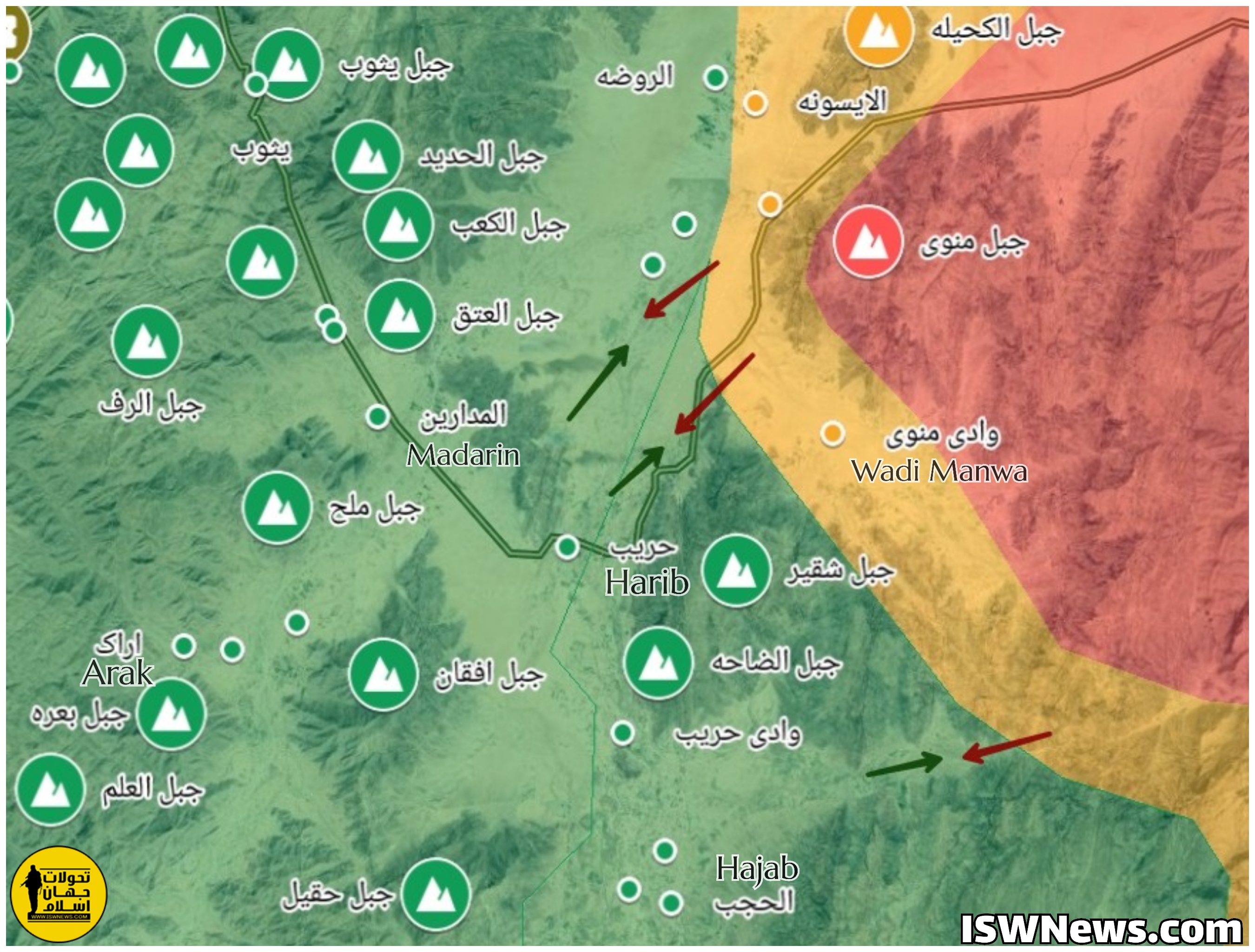
Following the Saudi coalition operation centered on the Amaliqah forces (Giant Brigades) in the west of Shabwa province and the south of Marib province, last night, January 24, the town of Harib, the center of Harab district in the south of Marib province, came under the control of the Saudi coalition. Currently, clashes are taking place in the east of al-Hajab town, the center of district of Ain, Wadi Harib and the heights of Malaa.
In the past 48 hours, Saudi coalition fighters have bombed the southern part of Marb province 46 times and the Ansarullah positions in Shabwa province once.
The town of Harib came under the control of Ansar Allah during Operation Rabi al-Nasr on September 22, 2021 and this is the second time that the town of Harib has come under the control of the Saudi coalition.
Due to the developments in this area, there is a possibility that Ansar Allah will withdraw from al-Hajab town. If Ansar Allah fails to halt the Saudi coalition advances in the Malaa, al-Arf, and Haniah highlands, the siege of the city of Marib city on the southern axis will be weakened, and Ansar Allah will be forced to retreat from the al-Balaq al-Sharqi and al-Balaq al-Owsat heights.
Explaining the details of the operation, which took place last night and at dawn today, January 24, the Brigadier General said:
“This operation was carried out in response to the escalation of the aggression of the ‘USA-Saudi-Emirati coalition’ and their crimes against our nation.
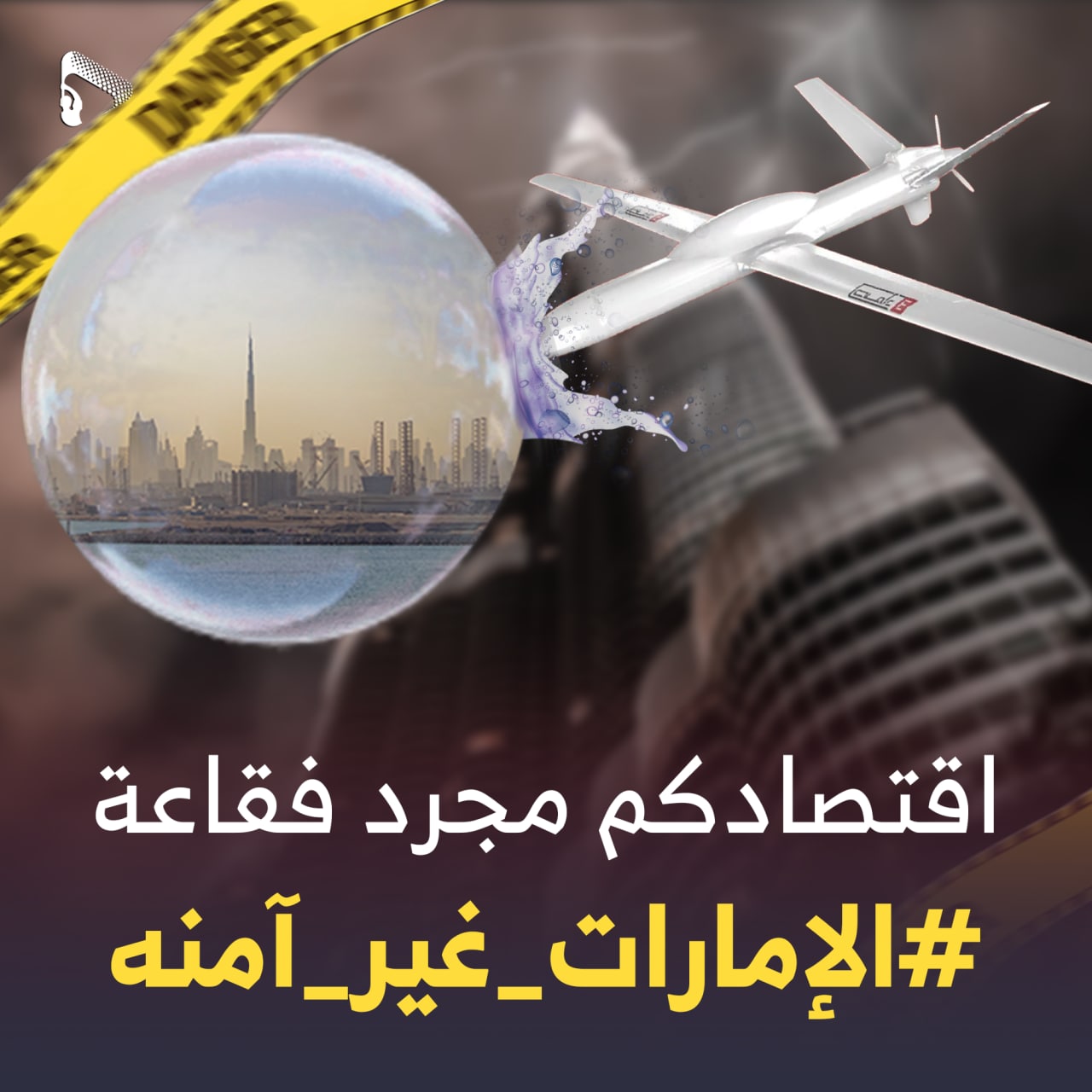
Operation Hurricane Yemen 2 targeted the depths of the UAE and Saudi Arabia. In this operation, Al Dhafra Air Base and other important targets in Abu Dhabi, the capital of the UAE were targeted with a large number of Zulfiqar missiles. Vital and important positions in Dubai were also attacked by Samad 3 drones.
The Sharora area (in southern Saudi Arabia) was attacked with a large number of Samad 1 and Qasef 2K drones and vital and sensitive positions in Jizan and Asir with a large number of ballistic missiles, which hit with great accuracy.
The Armed Forces emphasizes its full readiness to expand its operations to the next level and to counter the escalation of enemy attacks. We advise foreign companies and investors in the UAE to leave the small country of the UAE; Because this country has become an insecure country. The UAE will continue to be attacked as long as it continues to aggress and besiege the Yemeni people.”
The January 24th attack was Ansar Allah second missile and drone operation against the United Arab Emirates in recent days. During Operation Hurricane Yemen 1 on January 17, Ansar Allah targeted UAE’s Abu Dhabi which resulted in a massive fire in the Musaffah area, killing and injuring nine people.
According to the latest news from the Shabwa and Marb fronts, the clashes between Ansar Allah and the Saudi-led forces, centered on the Amaliqah forces, is taking place on areas north of Harib town and in the western heights of Ain district.
The Saudi coalition has advanced in its latest offensive in the Wadi Manwa, and clashes reached to the northern areas of the town of Harib.
On the other hand, the coalition forces from the eastern direction of the Ain district intend to enter the town of Hajab, the center of Ain district, but these attacks were repulsed by Ansar Allah.
According to Brigadier General Yahya al’-Sari, a spokesman for the Yemeni Armed Forces, the Ansar Allah missile force fired four missiles at gathering and equipment of the Saudi coalition yesterday. Yahya al’-Sari added: “More than 120 Saudi-led forces have been killed and wounded in recent attacks and clashes. Also, more than 12 military vehicles and armored vehicles of the coalition forces were destroyed.”
In the past 24 hours, Saudi coalition warplanes bombed Marib fronts 20 times and Shabwa fronts 17 times.
According to the developments of the last 10 days in this region, if Ansar Allah does not increase the volume of its missile and drone attacks and does not activate the hit-and-run operations on other fronts, like west of Marib and west of Shabwa, the possibility of fall of the defensive lines will increase. In case of this possible failure, the clashes will be reached to Hajab town, the center of Ain district and al-Juba district. The Saudi coalition also needs more manpower, air and logistical support to defeat Ansar Allah in these impassable areas.
These attacks were carried out last night and this morning, on January 24, in the southern city of Dhahran in Asir province and areas in Jizan province.
According to Saudi-affiliated media outlets, a number of factories and vehicles have suffered heavy financial losses following Ansar Allah missiles hitting industrial areas in Jizan and Dhahran al-Janub. Two Sudanese and Bangladeshi national were also injured in Jizan. No further casualties have been reported so far.
The Saudi coalition has also claimed to prevent other Ansar Allah attacks in the skies of Yemen and has announced the destruction of two suicide drones over the al-Jawf province.
Images of Ansar Allah missiles hitting Jizan industrial area and the carcass of Ansar Allah drone
Images of Ansar Allah missiles hitting the industrial area of the southern city of Dhahran in Asir provinceVideo No. 1: Ansar Allah missiles hit the Jizan industrial area Video No. 2: Ansar Allah missiles hit the Jizan industrial area
At dawn today, January 24, local sources in the UAE reported the sound of several explosions in the sky of the country. According to the UAE Ministry of Defense, the explosions occurred as a result of the country’s air defense intercepting and destroying two missiles. No casualties were reported so far.
The Yemeni Armed Forces will issue a statement regarding the operation in the coming hours.
Ansar Allah attack on the UAE was in response to heavy bombardment by Saudi coalition warplanes on the cities of Saada, Al-Hudaydah and Imran. It should be noted that the recent attacks by the Saudi coalition on civilian and residential places in Yemen have left more than 100 people dead and 300 wounded.
Last week, in response to the UAE’s continued hostility against the Yemeni people, Ansar Allah targeted Abu Dhabi International Airport and Dubai and the al-Musaffah Industrial Zone in Abu Dhabi with several drones (and missiles).