Tag: Iran missiles

  • Military Knowledge: Toophan Anti-Tank Missiles

    Military Knowledge: Toophan Anti-Tank Missiles

    History:
    The Islamic Republic of Iran, as the first purchaser of the BGM-71 TOW missile in 1971, launched a repair and assembly line for BGM-71TOW and FGM-77A Dragon missiles in cooperation with Emerson Energy Systems and Hughes Missile Systems at the Iran Electronics Industries (IEI). In May 1975, the project of joint production of BGM-71TOW and AGM-65 Maverick missiles were stalled due to disagreements over pricing issue. Following the victory of the Islamic Revolution in 1979, negotiations were completely halted and the United States did not allow technology transfer to the Islamic Republic of Iran.  

    During the Holy Defense (Iran-Iraq War of 1980 to 1988), the Islamic Republic had a great need for anti-tank missiles to counter the massive armor of the Ba’athist Iraqi army. Iran’s initial inventory of anti-armor missiles was TOW missiles, which was added to by purchasing Malyutka (9M14 Malyutka) missiles from the black market. The Iranian fighters were very satisfied with TOW missiles and they stated a success rate of 95%. Therefore, Iran proceeded to reverse engineer TOW missiles.

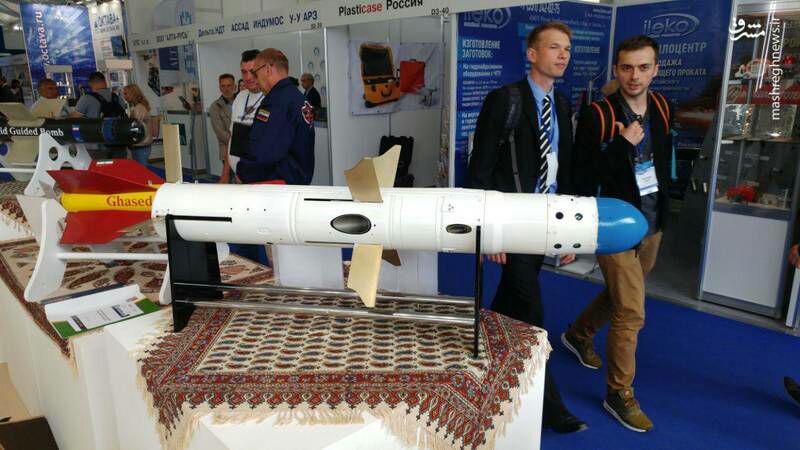
    The Toophan missile and the experiences gained from this missile were used in the Sadid-1 missile and afterward, this success continued in the Sadid and Ghaem precision-guided bomb families.

    Design:
    As stated, the Toophan missile is designed and manufactured based on the US-made BGM-71 TOW anti-armor missile. The Toophan anti-armor missile is packaged inside a disposable tube and this tube is loaded onto the launcher at the time of firing. Toophan can be fired from two types of ground-based and air-based missile launchers.

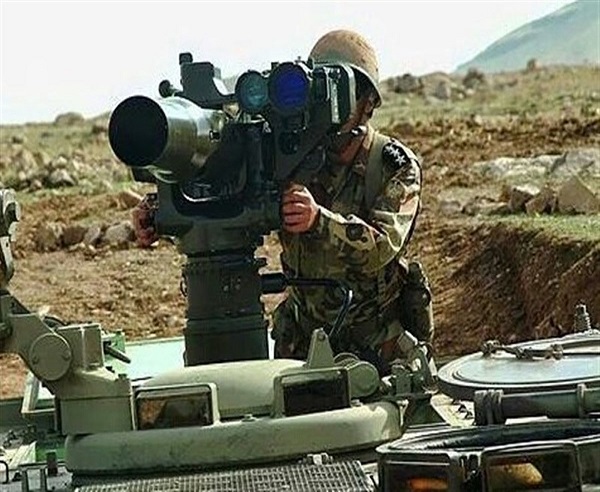
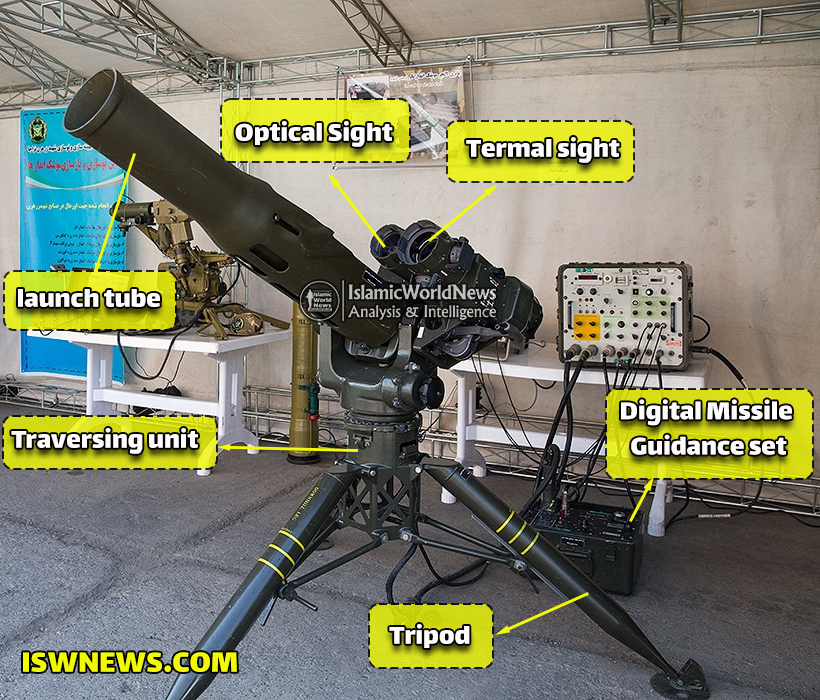
    The ground-based missile launcher is installed on various vehicles, armored personnel carriers, tanks and vessels and it consists of a tripod, electro-optic sight, missile-containing tube, and command center. The electro-optic sight consists of two lenses; one for the daytime camera to detect targets during the day and the other for thermal vision to track the xenon lamp at the end of the Toofan missile. The daytime camera can be replaced with a night vision or another thermal camera to detect targets at night as well.

    The Toophan anti-armor missile family uses semi-automatic command to line of sight (SACLOS) guidance. In this type of guidance, the operator must keep the camera on the target until the missile hits the target. The presence of a xenon lamp is for determining the position of the missile and in this way, the thermal lens determines the position of the missile and the main camera determines the position of the target and both pieces of information are sent to the control center (Digital Missile Guidance Set-DMGS); then, this center processes the received information. It sends the necessary commands for path correction via wire to the missile and the missile also corrects its path based on those commands.
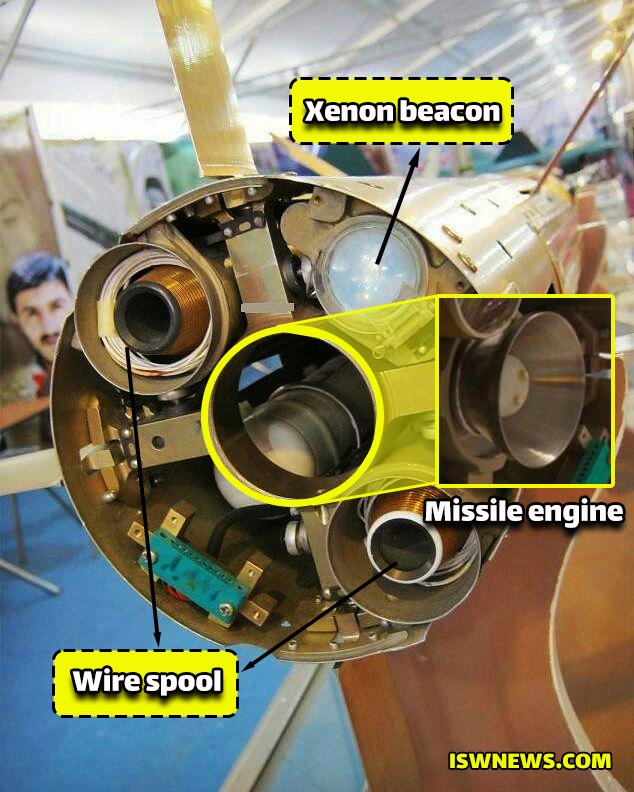
    As mentioned, the Toophan missile has an air-based launcher platform. Some AH-1J International helicopters of the Islamic Republic of Iran Air Force have the ability to carry and launch TOW missiles, which are known as Tow-Cobra. This helicopter needs an electro-optic sight called M65 or Telescopic Sight Unit for firing TOW missiles, which has a 13x zoom capacity and is installed in the nose of the helicopter. This sight actually has the same application as an electro-optic sight mounted on a ground tripod. The helicopter’s electro-optic sight first targets and then aims, and also sends information needed for path correction via wire to TOW by tracking missiles. In Iranian Toophan variant, exactly these steps are observed.
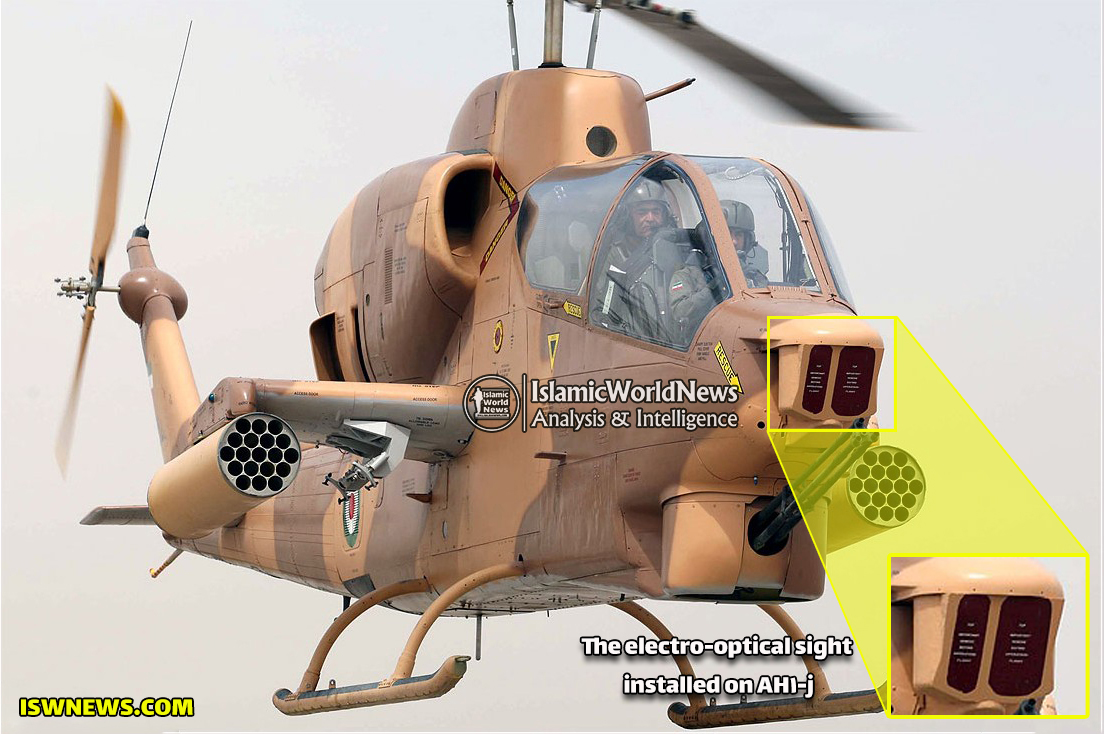
    Electro-optical site installed on AH1-J helicopter

    Types of Toophan missiles:
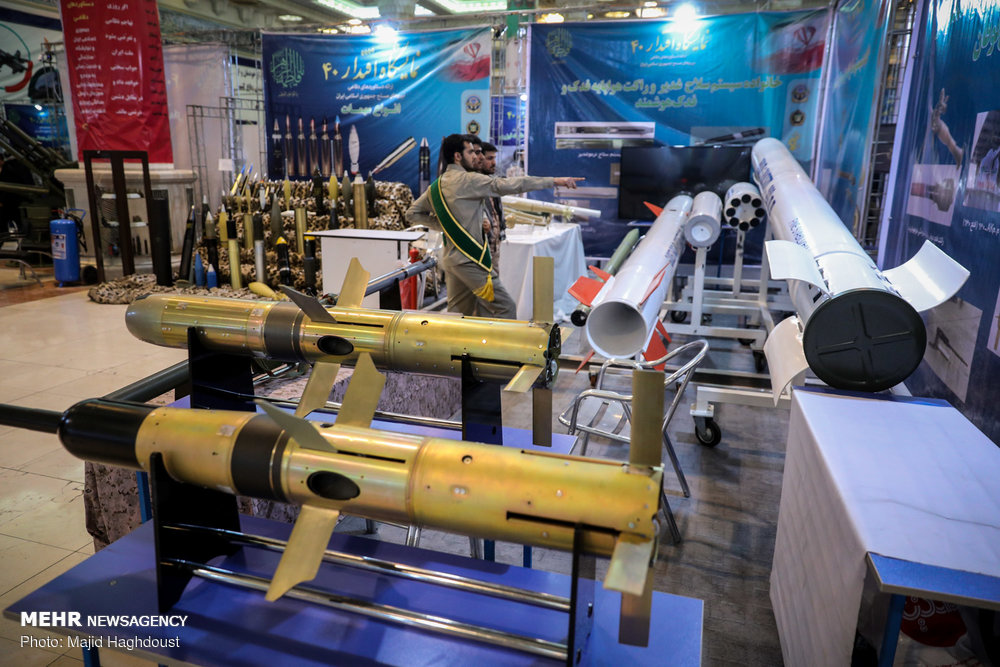
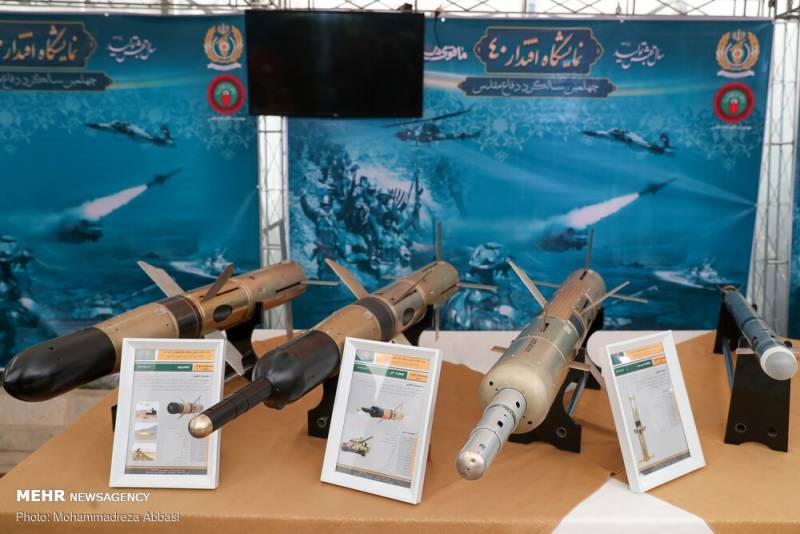
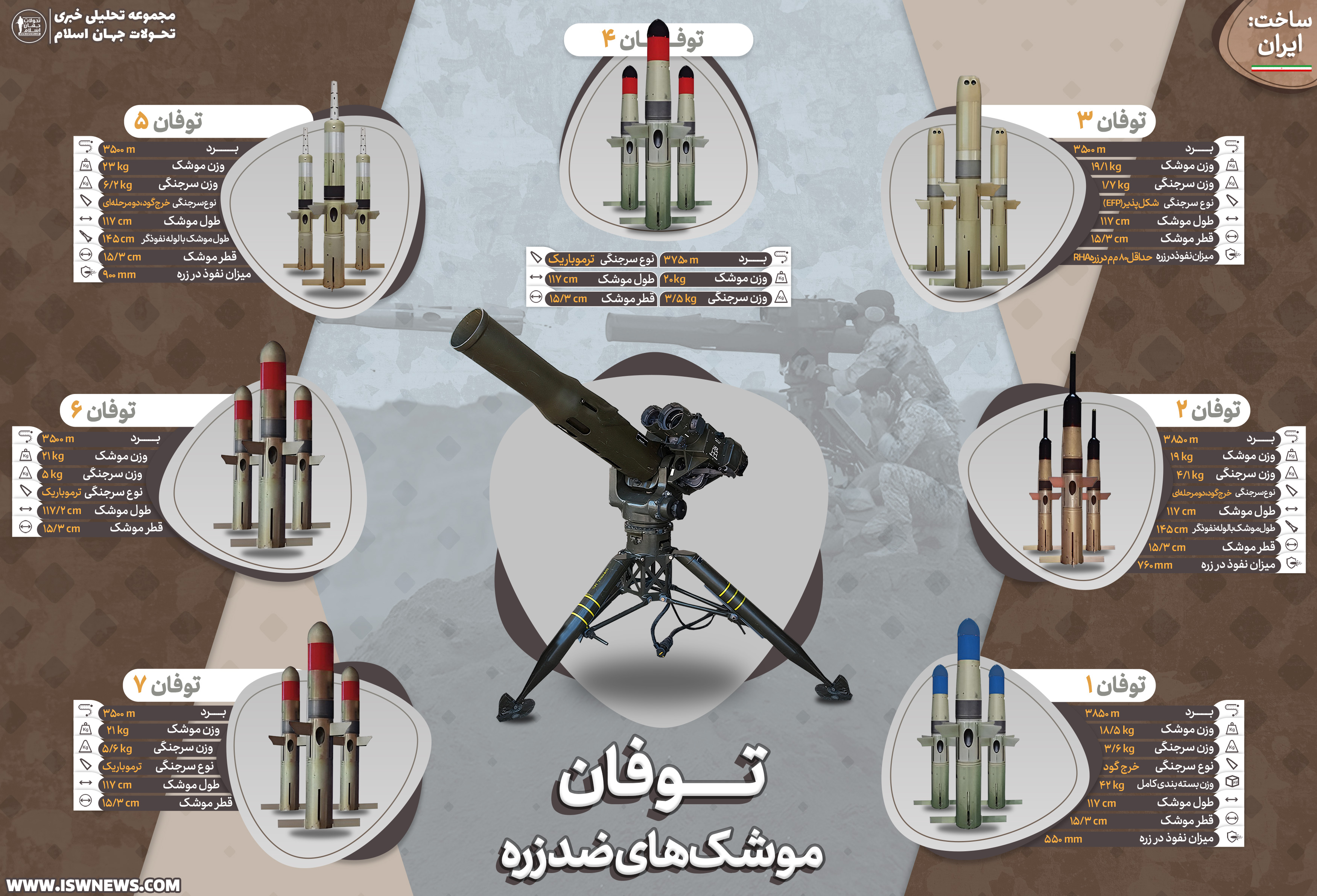
    As it has been mentioned above, the Toophan missile family was planned to produce 11 types of missiles in the industries of the Ministry of Defense of the Islamic Republic of Iran, and we managed to find 10 specifications of the missiles, which are being explained underneath. Regarding the eleventh type of Toophan missile, we think it was a heavy upgrade based on the Spike model and the missile was renamed, which we will deal with at the end.
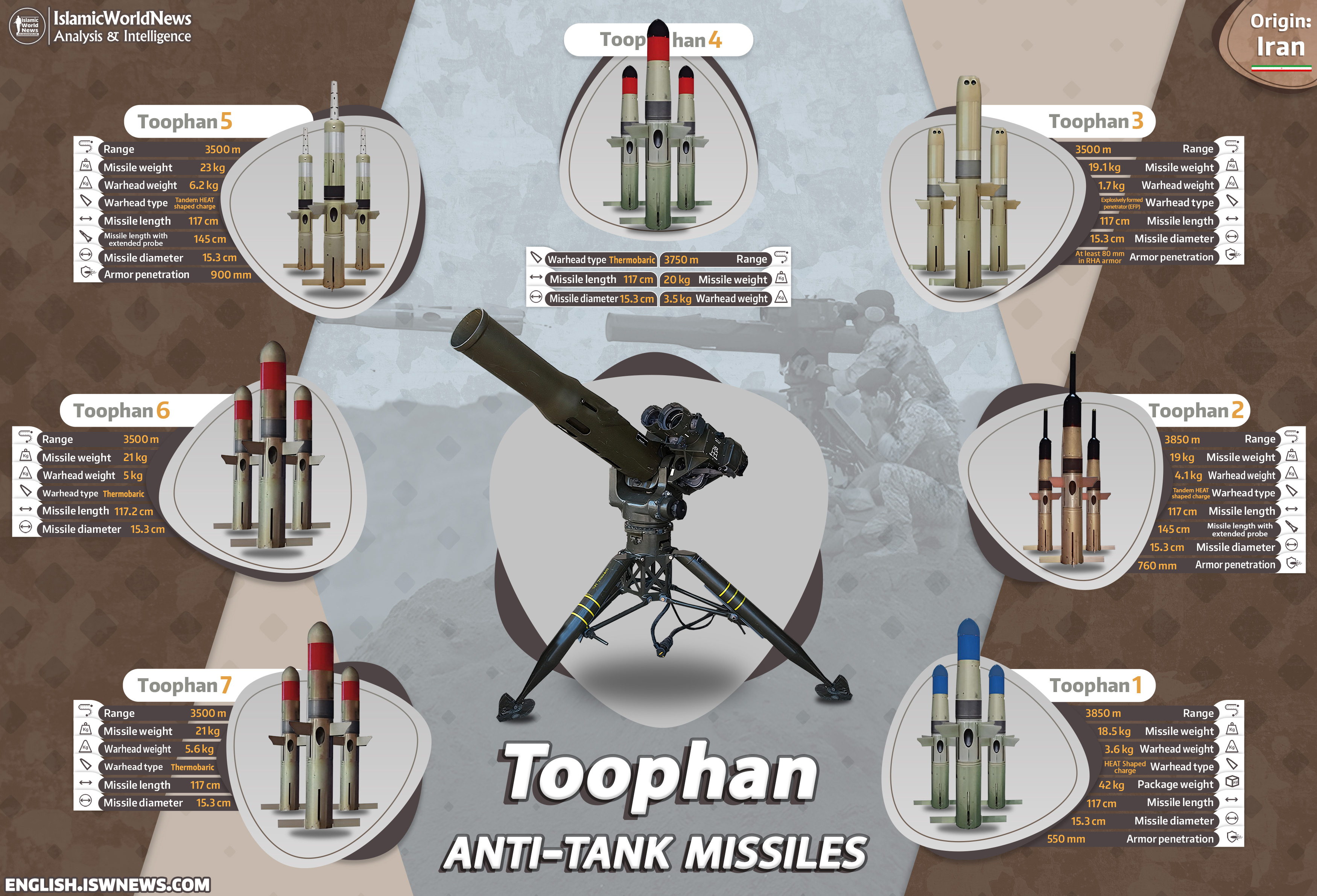
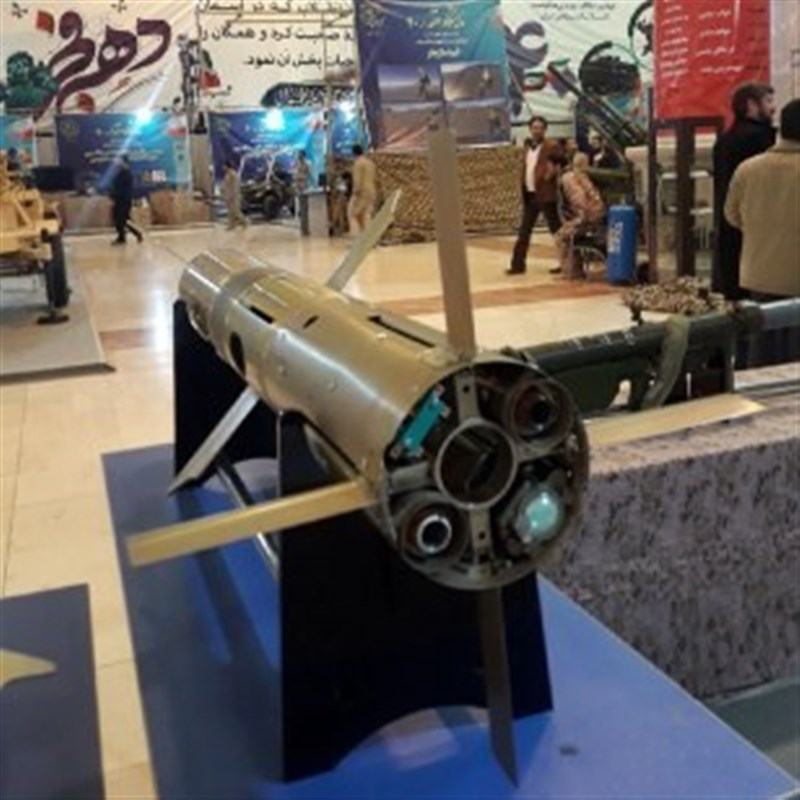
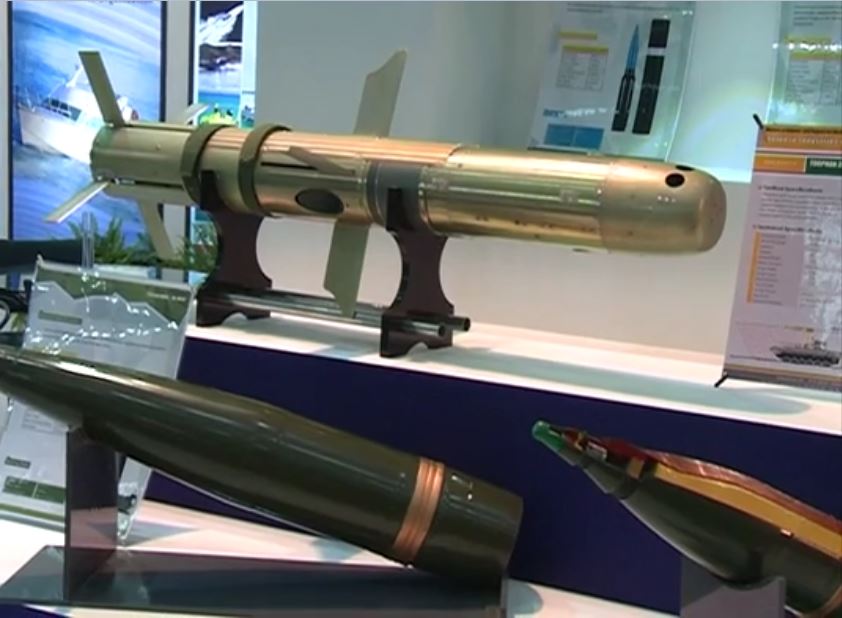
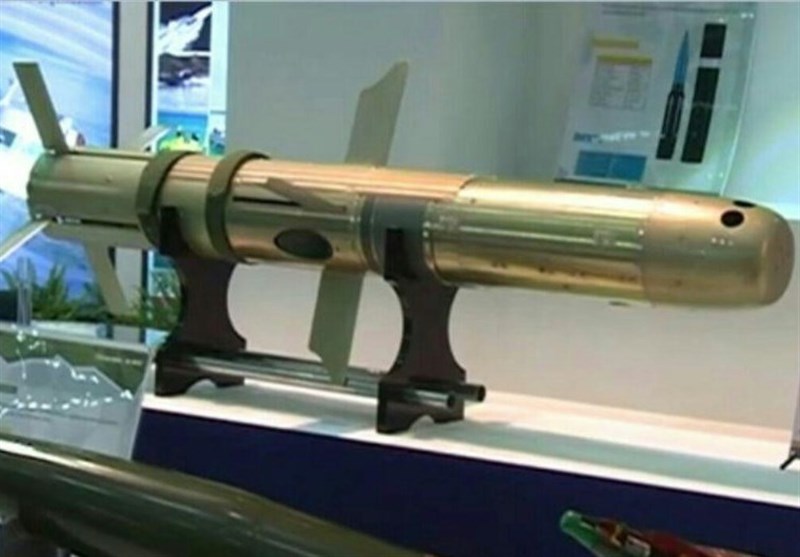
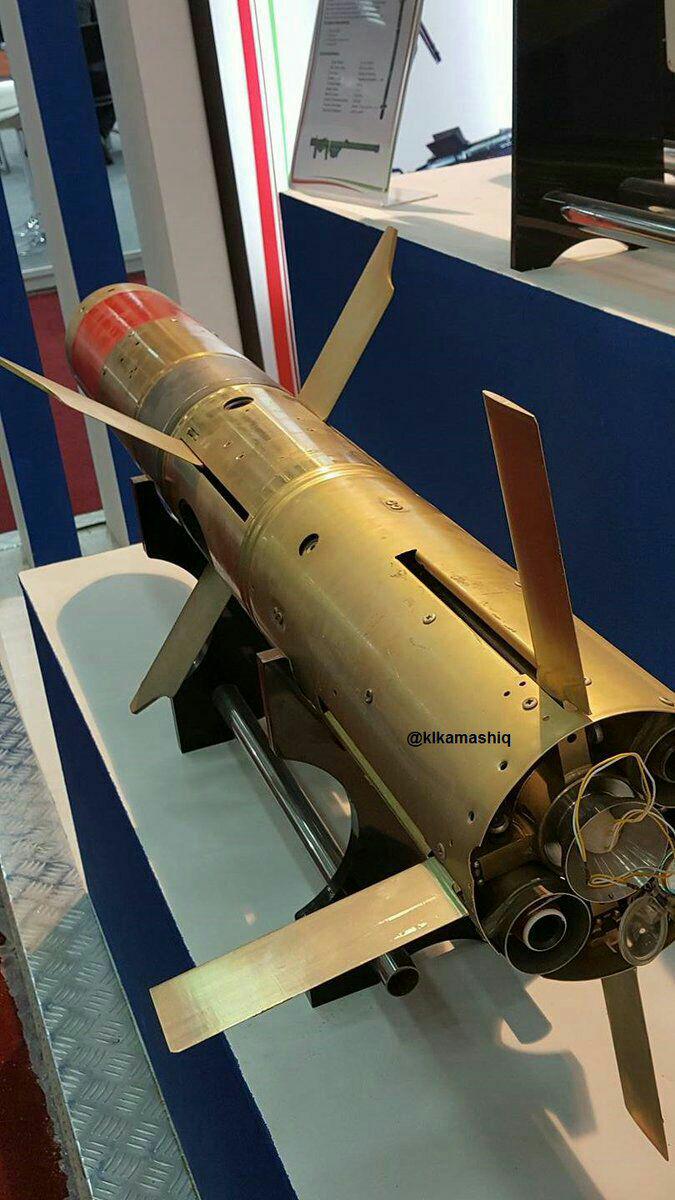
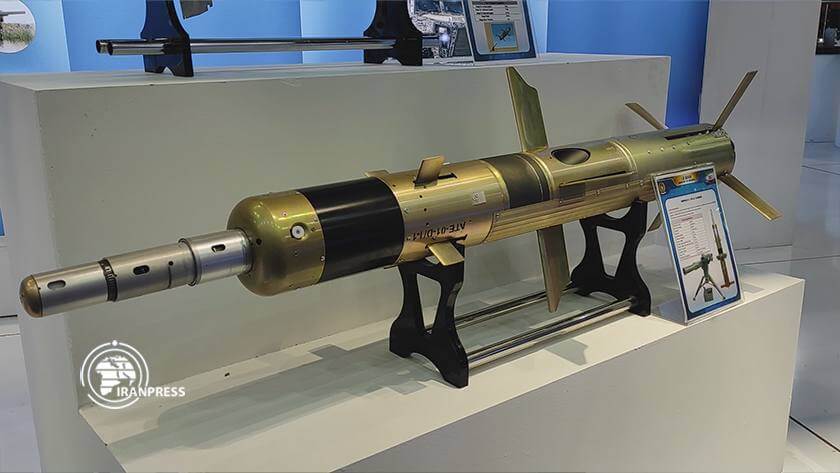
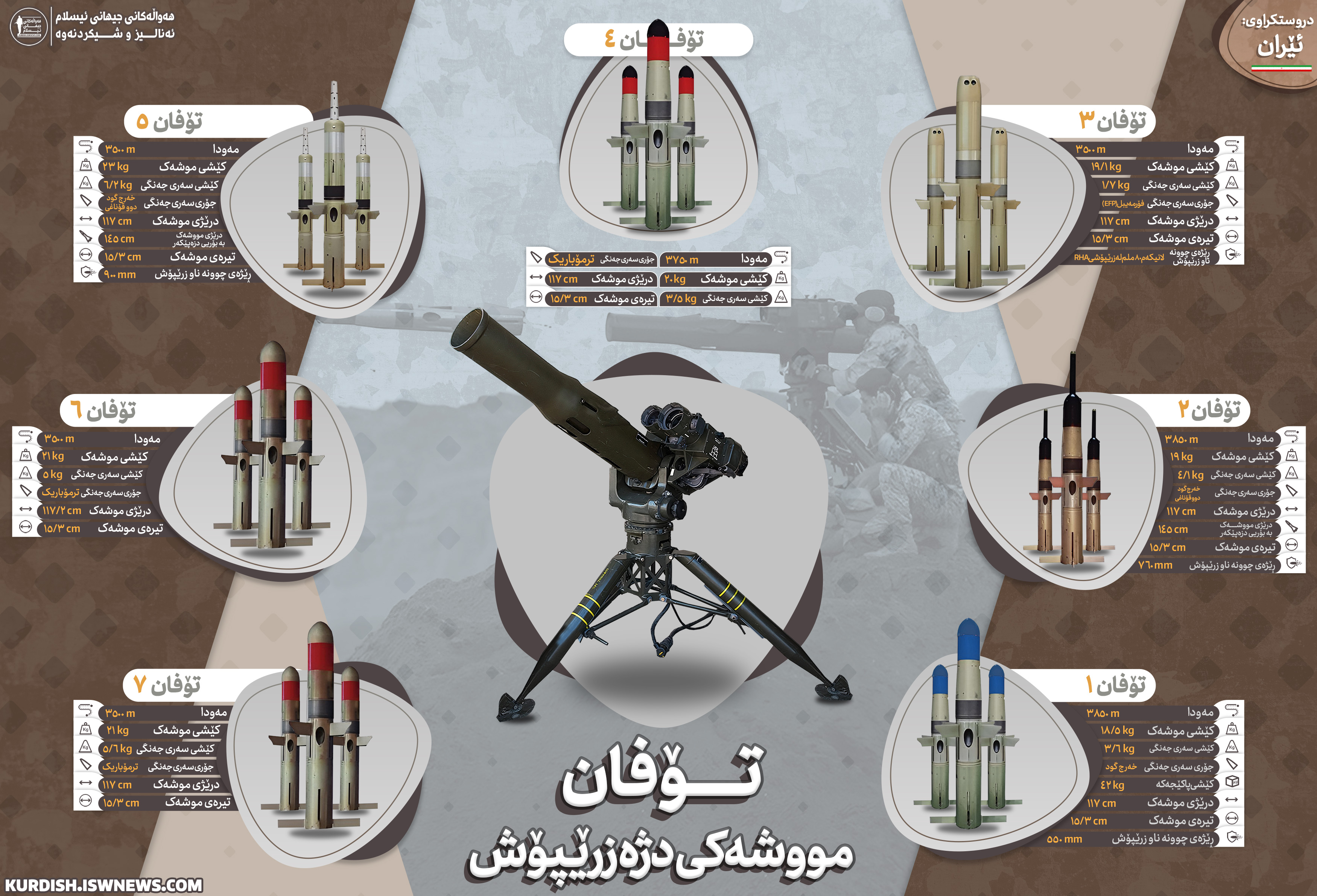
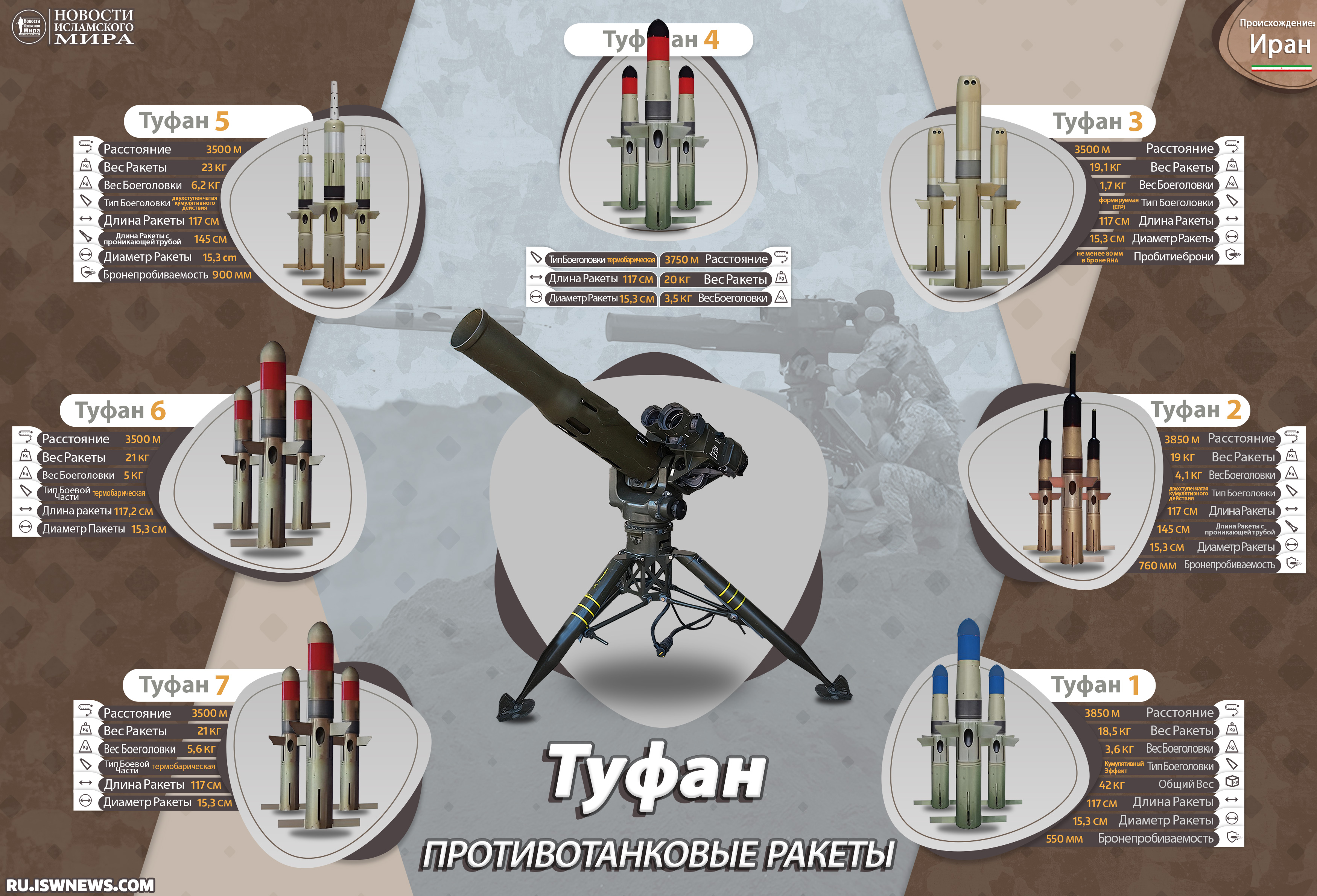
    Toophan Anti-Tank Missiles – click to view full size

    1- Toophan-1 missile:
    It is a reverse-engineered BGM-71 TOW version B missile. The US variant has a range of 3,750 km and a penetration rate of 430 mm, while the Iranian Toophan-1 missile has a range of 3,850 km and a penetration rate of 550 mm.
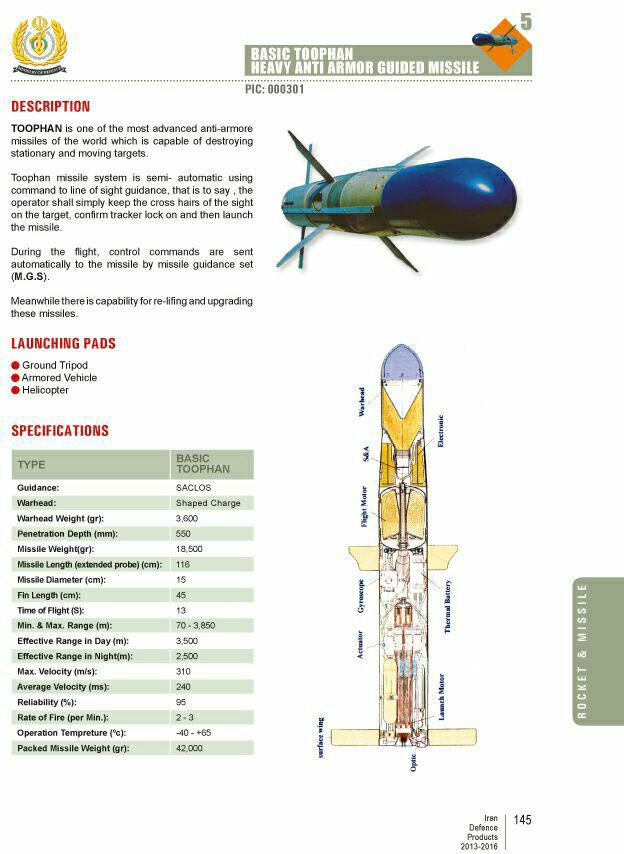
    Published specifications of Toophan-1

    Specifications of Toophan-1 missile:
    Maximum range: 3850 meters
    Minimum range: 70 meters
    Effective range: 3.5 km
    Effective range at night: 2.5 km
    Missile weight: 18.5 kg
    Warhead weight: 3.6 kg
    Type of warhead: HEAT shaped-charge
    Package weight: 42 kg
    Missile length: 117 cm
    missile diameter: 15.3 cm
    Armor penetration rate: 550 mm

    2- Toophan-2 missile:
    Toophan-2 was developed with the aim of increasing penetration rate, And by adding a penetrating extended probe and a heavier two-stage warhead, it not only gained the power to penetrate 760 mm rolled armor, but also has the ability to pass through all types of reactive armor. The extended probe in Toophan 2 missile has a small warhead to destroy the reactive armor so that the main warhead engages with the main armor. The extended probe is inside the missile, after firing it comes out of the tube, opens and is placed in its place as the missile head.
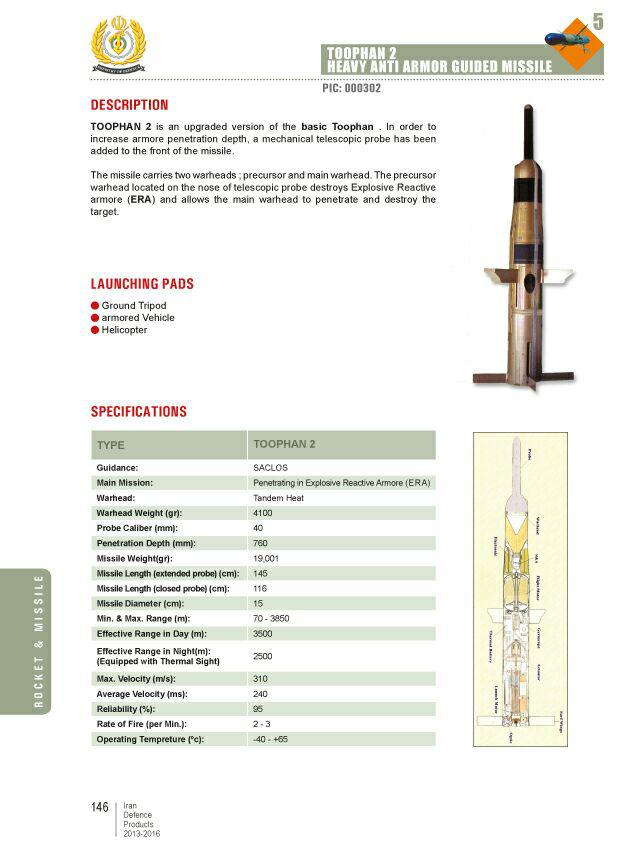
    Published specifications of Toophan-2

    Specifications of Toophan-2 missile:
    Maximum range: 3850 meters
    Minimum range: 70 meters
    Effective range: 3.5 km
    Effective range at night: 2.5 km
    Missile weight: 19 kg
    Warhead weight: 4.1 kg
    Type of warhead: Tandem HEAT shaped-charge
    Missile length: 117 cm
    Length of missile with the extended probe: 145 cm
    Missile diameter: 15.3 cm
    Armor penetration rate: 760 mm

    3- Toophan-2M missile:
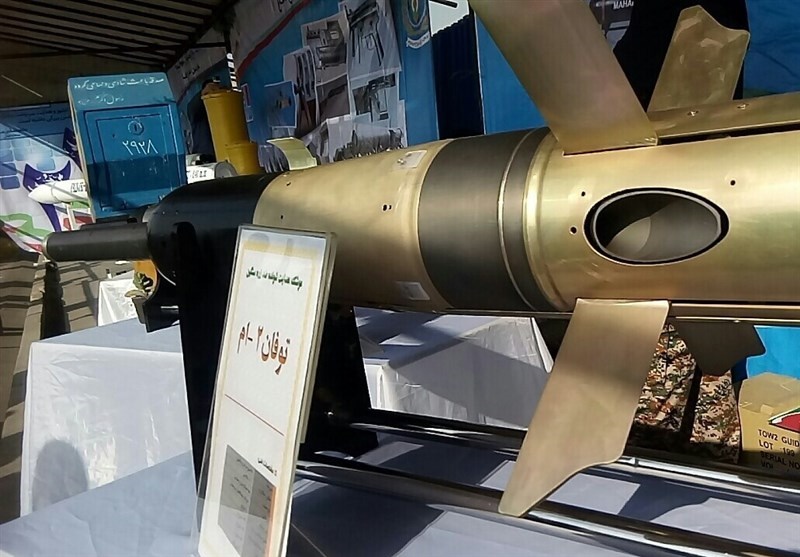
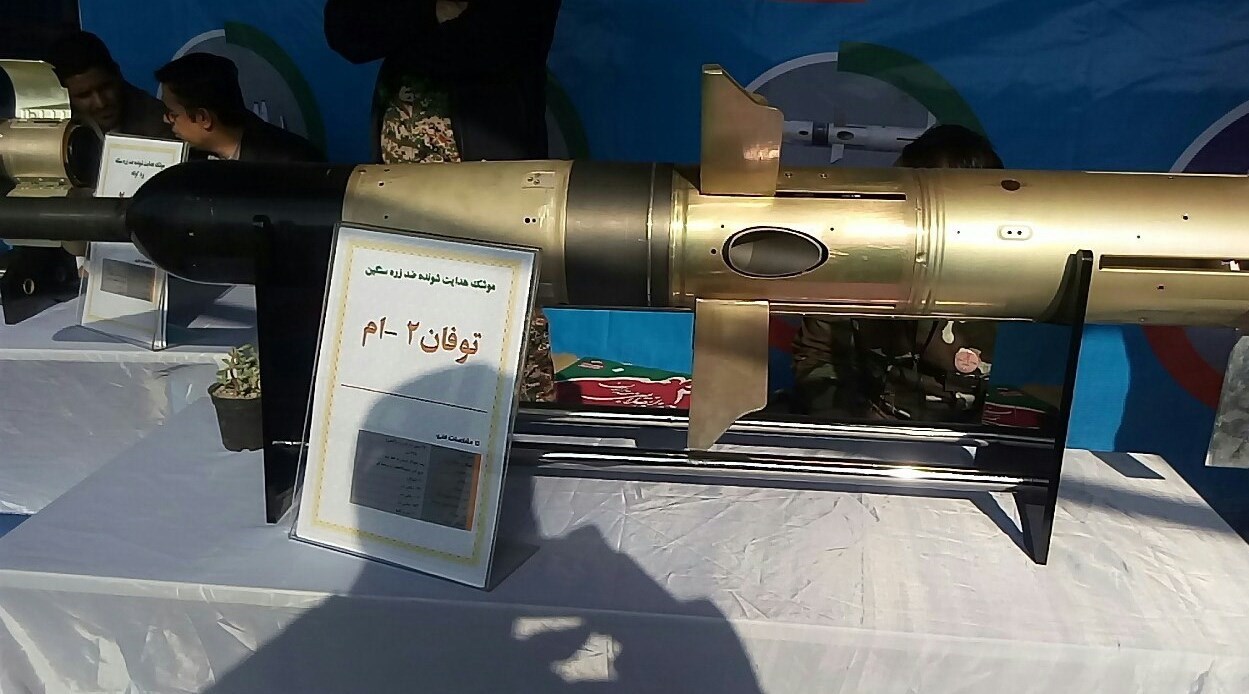
    Iran’s defense industry sought to upgrade and develop the Toophan-2 missile, this led to the production of the Toophan-2M variant. This upgraded missile had the ability to penetrate 900 mm of armor. In the overall design of the Toophan-2 missile, the existence of an extended probe and a two-stage warhead has been preserved. The new missile has a larger nose diameter than its previous model due to carrying more explosives.
    The specifications of Toophan-2M have not been published in full, but due to its similarity with the Toophan-2 variant, its specifications can be guessed to some extent.
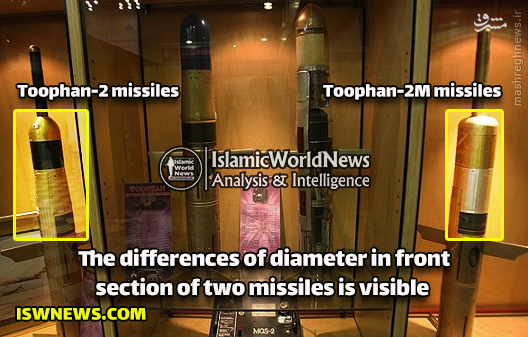
    The diameter difference between Toophan-2 and Toophan-2M missiles

    Specifications of Toophan-2M missile:
    Maximum range: 3850 meters
    Minimum range: 70 meters
    Effective range: 3.5 km
    Effective range at night: 2.5 km
    Missile weight: 21 kg
    Warhead weight: 6.1 kg
    Type of warhead: Tandem HEAT shaped-charge
    Missile length: 117 cm
    Length of missile with the extended probe: 145 cm
    Missile diameter: 15.3 cm
    Armor penetration rate: 900 mm

    4- Toophan-3 top attack missile:
    Toophan-3 is a special member of the Toophan anti-armor missile family. This missile attacks armored targets from above and attacks the weakest point of tanks. Top Attack anti-armor missiles have two mechanisms, the first type is diving on the target and the second type explodes on top of the target, which Toophan-3 is of the second type.

    The Toophan-3 missile flies at a height of 2 to 3 meters above the ground and when it passes over the target, the missile’s sensors detect the target and give the command to detonate the Explosively Formed Penetrator (EFP) warhead. The EFP is a special type of shaped charge that deform a metal plate into a slug or rod shape and accelerate it toward the target.
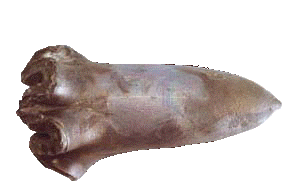
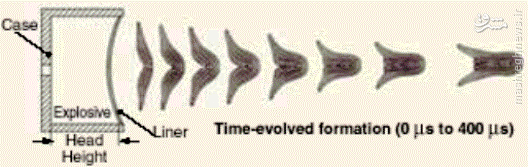
    The advantage of using top attack missiles like Toophan-3 is that they can attack targets behind hills or obstacles.

    Toophan-3, like other members of the Toophan anti-armor family, uses line-of-sight guidance (SACLOS) and uses wires to transmit course correction information.
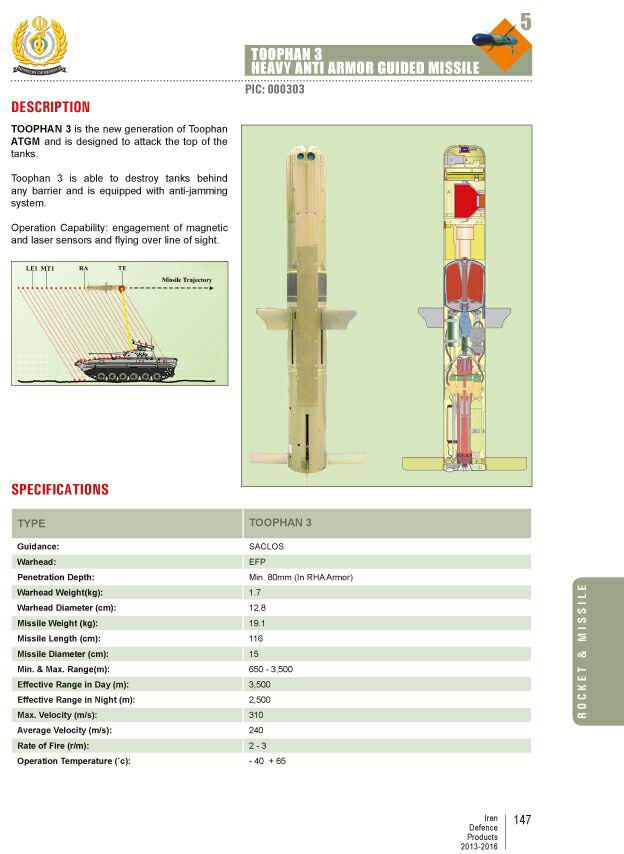
    Published specifications of Toophan-3. The picture also shows how Toophan-3 works.

    Specifications of Toophan-3 missile:
    Maximum range: 3500 meters
    Minimum range: 650 meters
    Effective range: 3.5 km
    Effective range at night: 2.5 km
    Missile weight: 19.1 kg
    Warhead weight: 1.7 kg
    Warhead type: EFP
    Missile length: 117 cm
    Missile diameter: 15.3 cm
    Armor penetration rate: at least 80 mm in armor

    5- Toophan-3M top attack missile:
    Like the Toophan-3 missile, this missile is a top attack missile and uses the EFP warhead and SACLOS guidance. The range of this variant has increased to 3,750 meters and the minimum penetration power has increased from 80 mm to 150 mm.

    Specifications of Toophan-3M missile:
    Maximum range: 3750 meters
    Minimum range: 100 meters
    Effective range: 3.5 km
    Effective range at night: 2.5 km
    Missile weight: 21.5 kg
    Warhead weight: 4 kg
    Warhead type: EFP
    Missile length: 117 cm
    Missile diameter: 15.3 cm
    Armor penetration rate : at least 150 mm in armor

    6- Toophan-4 missile:
    Toophan-4 is the first member of the Toophan anti-armor family that is equipped with a thermobaric warhead. This variant also uses SACLOS method for guidance. Toophan 4 missile was displayed for the first time at the Baghdad Defense Exhibition in 2017.
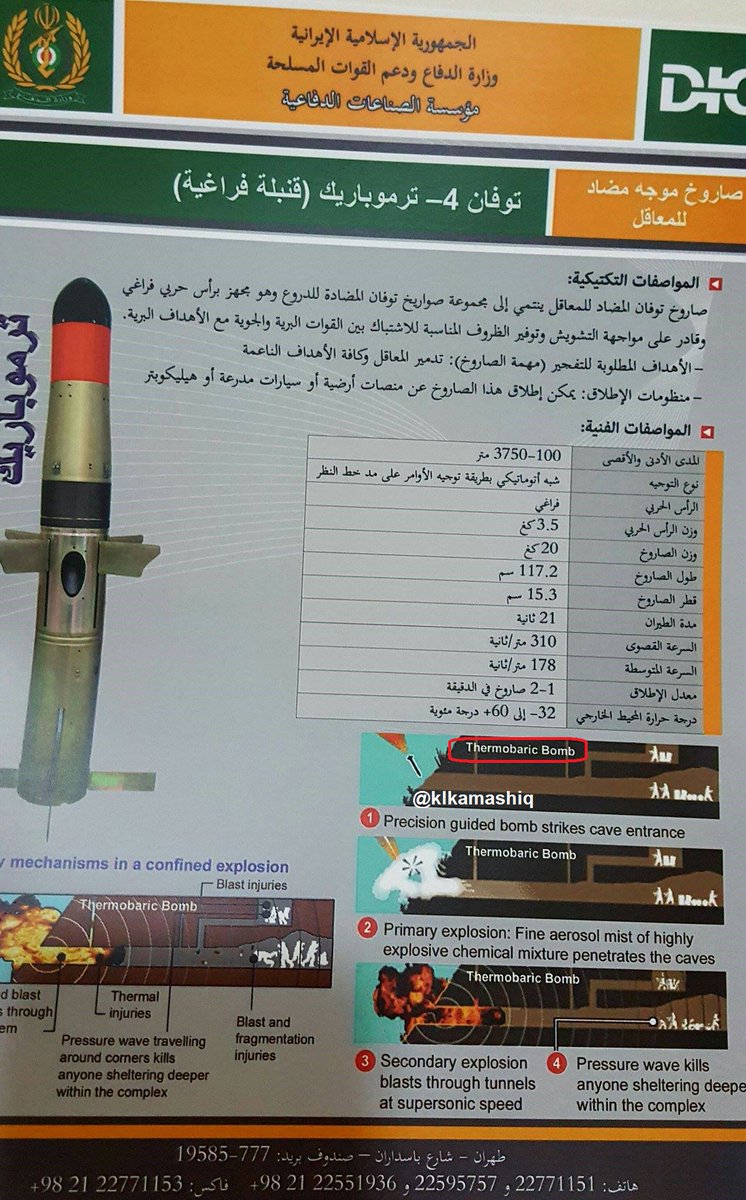
    Published specifications of Toophan-4 and how it works

    Specifications of Toophan-4 missile:
    Maximum range: 3750 meters
    Minimum range: 100 meters
    Effective range: 3.5 km
    Effective range at night: 2.5 km
    Missile weight: 20 kg
    Warhead weight: 3.5 kg
    Warhead type: Thermobaric
    Missile length: 117 cm
    Missile diameter: 15.3 cm

    7- Toophan-5 missile:
    Like the Toophan-2 missile, Toophan-5 is designed to penetrate explosive reactive armor (ERA). This missile also has an extended probe containing explosives and a larger warhead to be able to penetrate reactive armor and pass through the main armor. But Toophan-5 uses a type of laser beam riding for guidance.
    Another difference between Toophan-5 and previous missiles is that it has three rows of fins, one row is located in the beginning of the missile and near its tip, and the other two rows are placed in the middle and end of the missile like other types of Toophan. The presence of this type of fins makes the missile react faster and make it more stable during flight. It seems that the main reason for using three fin rows is for its type of guidance.
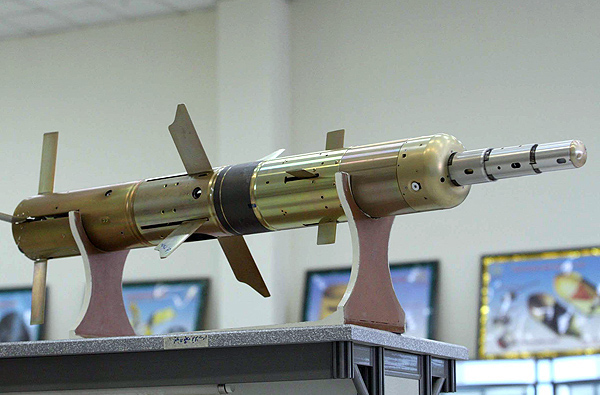
    An image of the Toophan-5 missile, which clearly shows three rows of fins.

    Due to the type of guidance in Toophan-5 missile, a different launcher is used to fire and guide this missile. This launcher uses three types of lenses. One is for the day vision camera, which is used to find targets during the day. The second lens is for the thermal vision camera, which is used for targeting at night or for targeting after a smoke screen. The third lens is intended to shine the laser beam to the end of the missile during flight and guide it towards the target; This beam is irradiated to the center of the target selected by the operator.
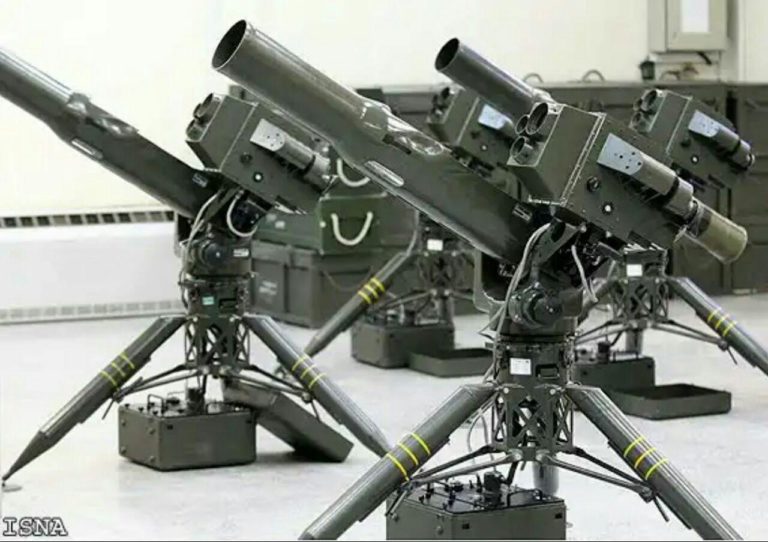
    Special launcher for launching Toophan-5 missile

    It is worth mentioning that the wire guidance type of Toophan-5 missile was also displayed at the Baghdad International Exhibition in 2017, which indicates that the cheaper version the missile is also in production line.
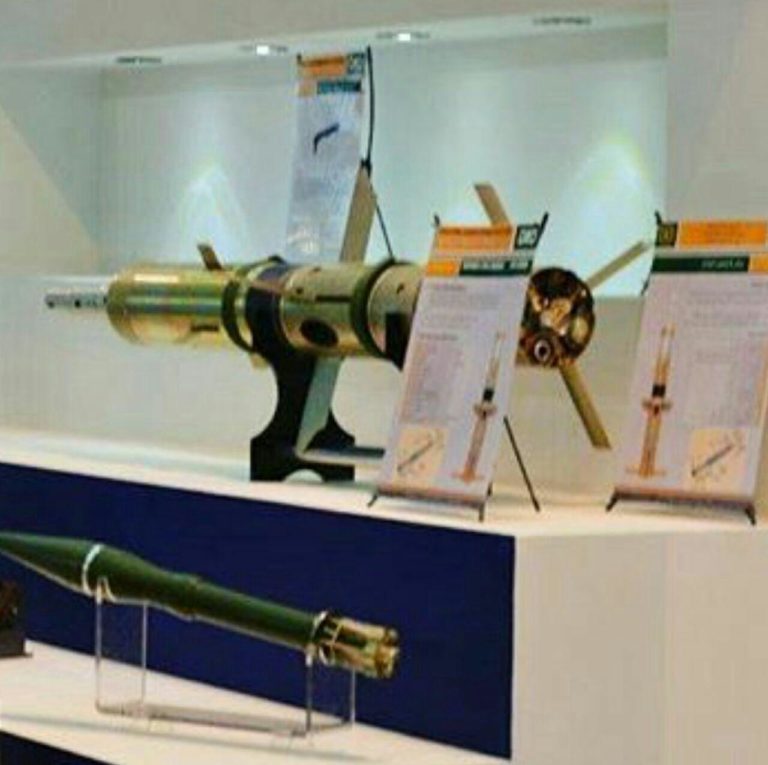
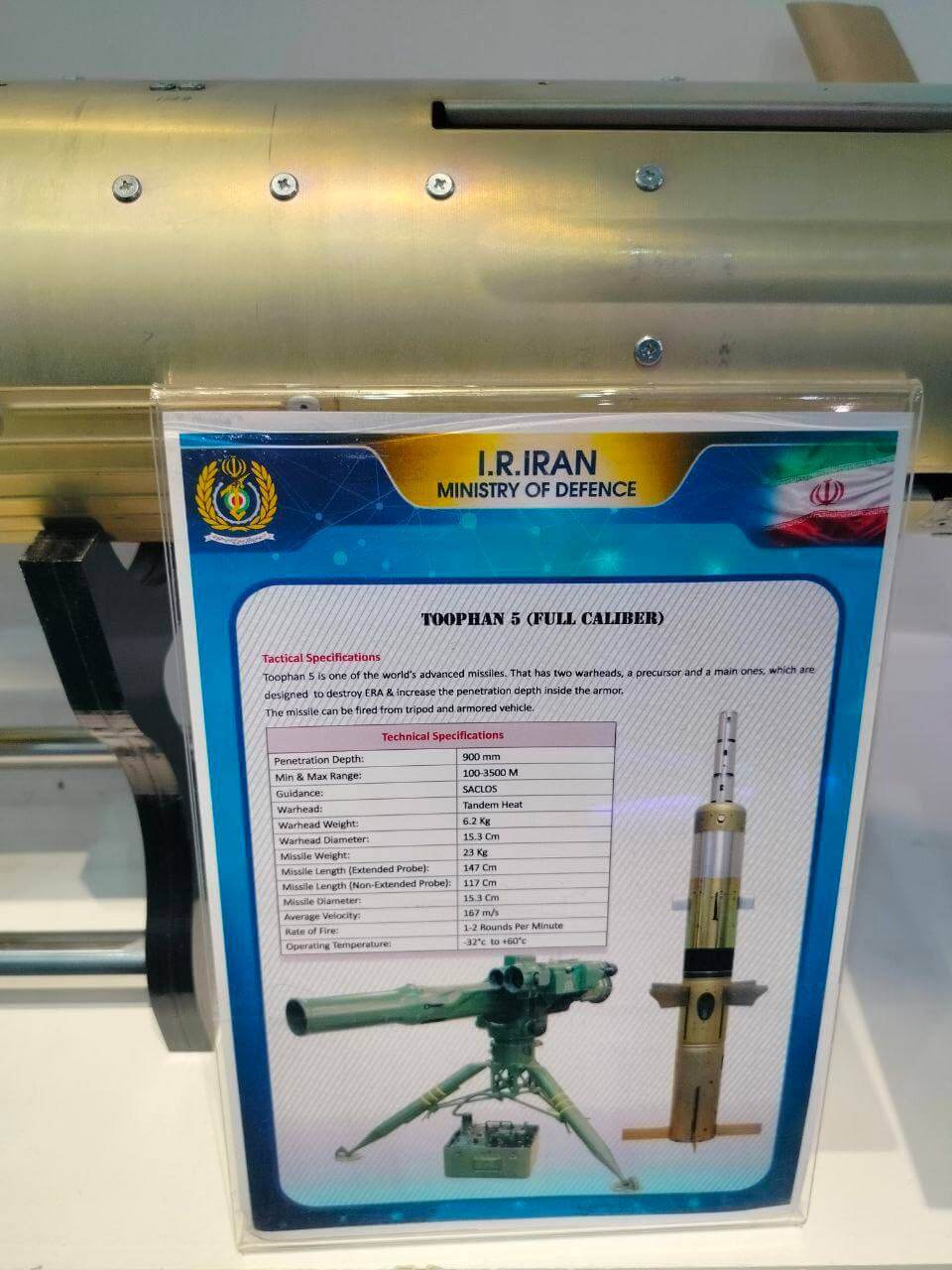
    Specifications of Toophan-5 missile:
    Maximum range: 3500 meters
    Minimum range: 100 meters
    Effective range: 3.5 km
    Effective range at night: 2.5 km
    Missile weight: 23 kg
    Warhead weight: 6.2 kg
    Type of warhead: Tandem HEAT shaped-charge
    Missile length: 117 cm
    Length of the missile with the extended probe: 145 cm
    Missile diameter: 15.3 cm
    Armor penetration: 900 mm

    8- Toophan-6 missile:
    Toophan-6 was first unveiled at the 2017 Baghdad International Exhibition. Like Toophan-4, this missile uses a thermobaric warhead and wire guidance. Toophan-6 uses a 5 kg warhead, but Toophan-4 uses a 3.5 kg warhead. This missile can be fired from the conventional tripods, all types of vehicles and helicopters.
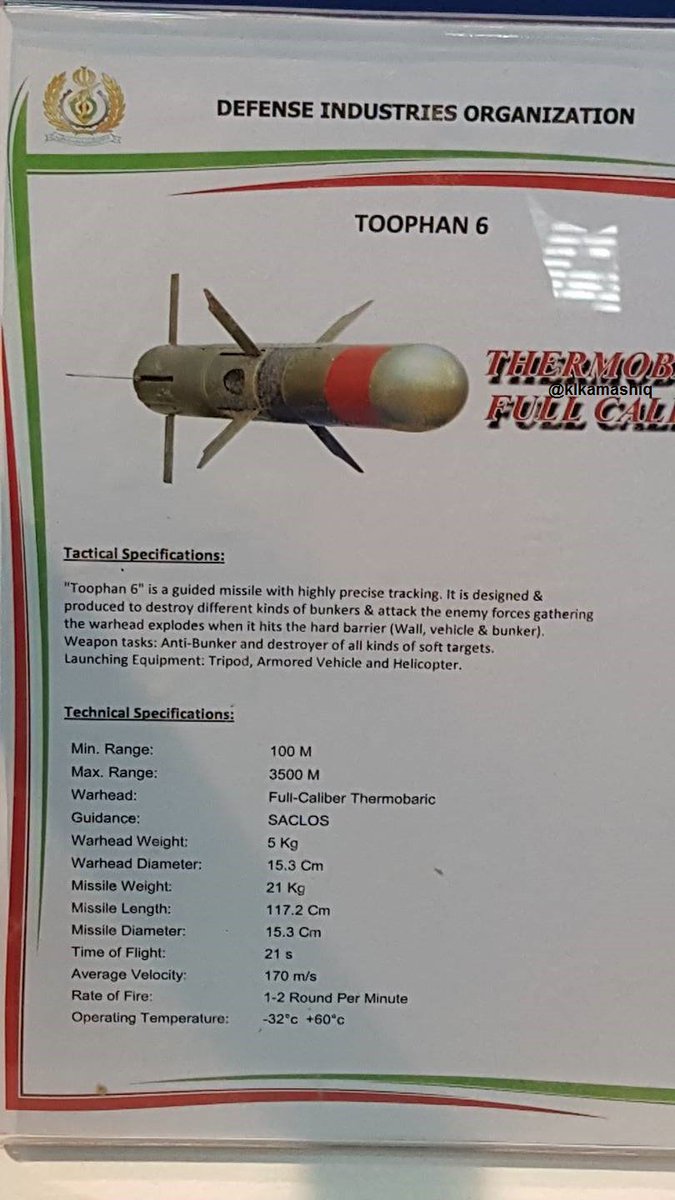
    Specifications published about the Toophan-6 missile

    Specifications of Toophan-6 missile:
    Maximum range: 3500 meters
    Minimum range: 100 meters
    Effective range: 3.5 km
    Effective range at night: 2.5 km
    Missile weight: 21 kg
    Warhead weight: 5 kg
    Warhead type: Thermobaric
    Missile length: 117.2 cm
    Missile diameter: 15.3 cm

    9- Toophan-7 missile:
    Toophan-7 is the third thermobaric member of the Toophan family, which was introduced after Toophan-4 with 3.5 kg and Toophan-6 with 5 kg of explosives. Toophan-7 with a thermobaric warhead and shrapnel fragment capability has 5.6 kg of explosives. The missile uses semi-automatic command-to-line-of-sight (SACLOS) guidance by wire.
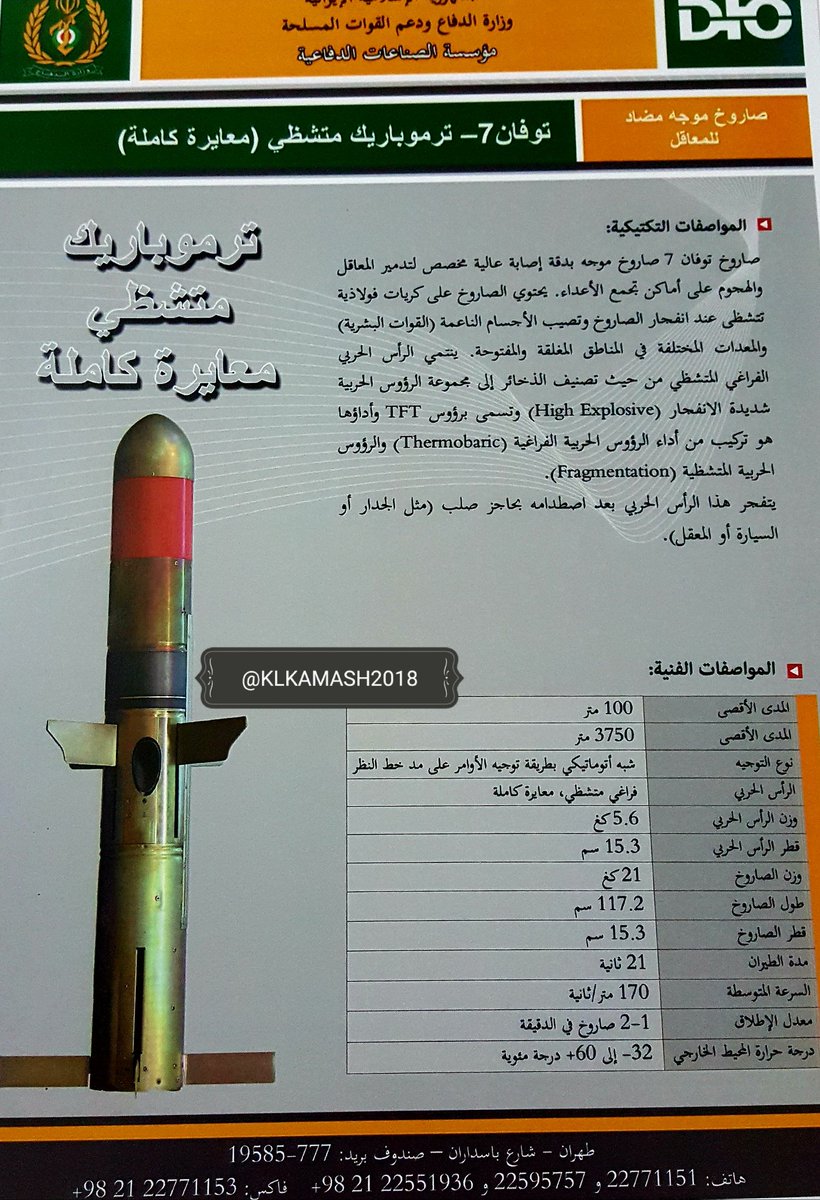
    Specifications published about the Toophan-7 missile

    Specifications of Toophan-7 missile:
    Maximum range: 3500 meters
    Minimum range: 100 meters
    Effective range: 3.5 km
    Effective range at night: 2.5 km
    Missile weight: 21 kg
    Warhead weight: 5.6 kg
    Warhead type: thermobaric
    Missile length: 117 cm
    Missile diameter: 15.3 cm

    10- Ghaem anti-helicopter missile:
    Ghaem or Qaem anti-helicopter missile is a semi-heavy guided missile that is intended for use against UAVs and low flying or stationary helicopters. This missile looks very similar to the Toophan-1 missile and it is difficult to distinguish it.
    The exact specifications of this missile have not been revealed, but it is said that it’s a laser-guided missile and is resistant to electronic warfare.
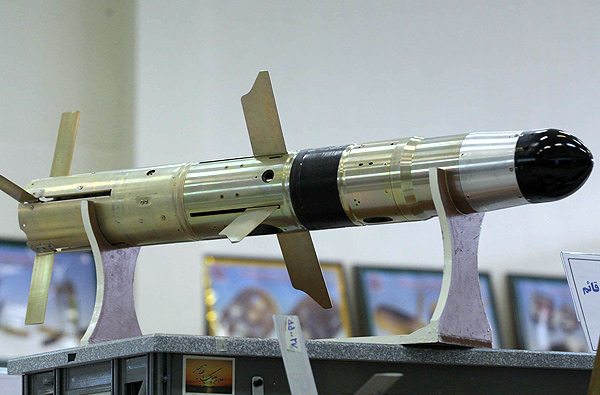
    Ghaem anti-helicopter missile

    Ghaem-M missile:
    This missile, like the Ghaem missile, is an anti-helicopter missile and has the ability to destroy air targets with low speed and low altitude, especially attack helicopters. with the difference that this missile uses several proximity fuses that improve its performance. Also, in this variant, a fragmentation warhead with 500 shrapnels and a weight of 1.7 kg was used. These two changes have been made in order to cause more damage if the missile does not hit the target directly.
    In the published images, it seems that the engine gas output in the middle part of the missile has become larger, which indicates the possibility of using a larger engine to reach a range of 6 km. Also, there is a laser beam receiver at the end of the missile, which confirms the laser beam guidance method like Tofan-5 missile. Unfortunately, the altitude of fire is not mentioned in the published information about this missile. But if the altitude of fire is 5 km, it will be able to deal with most drones and helicopters.
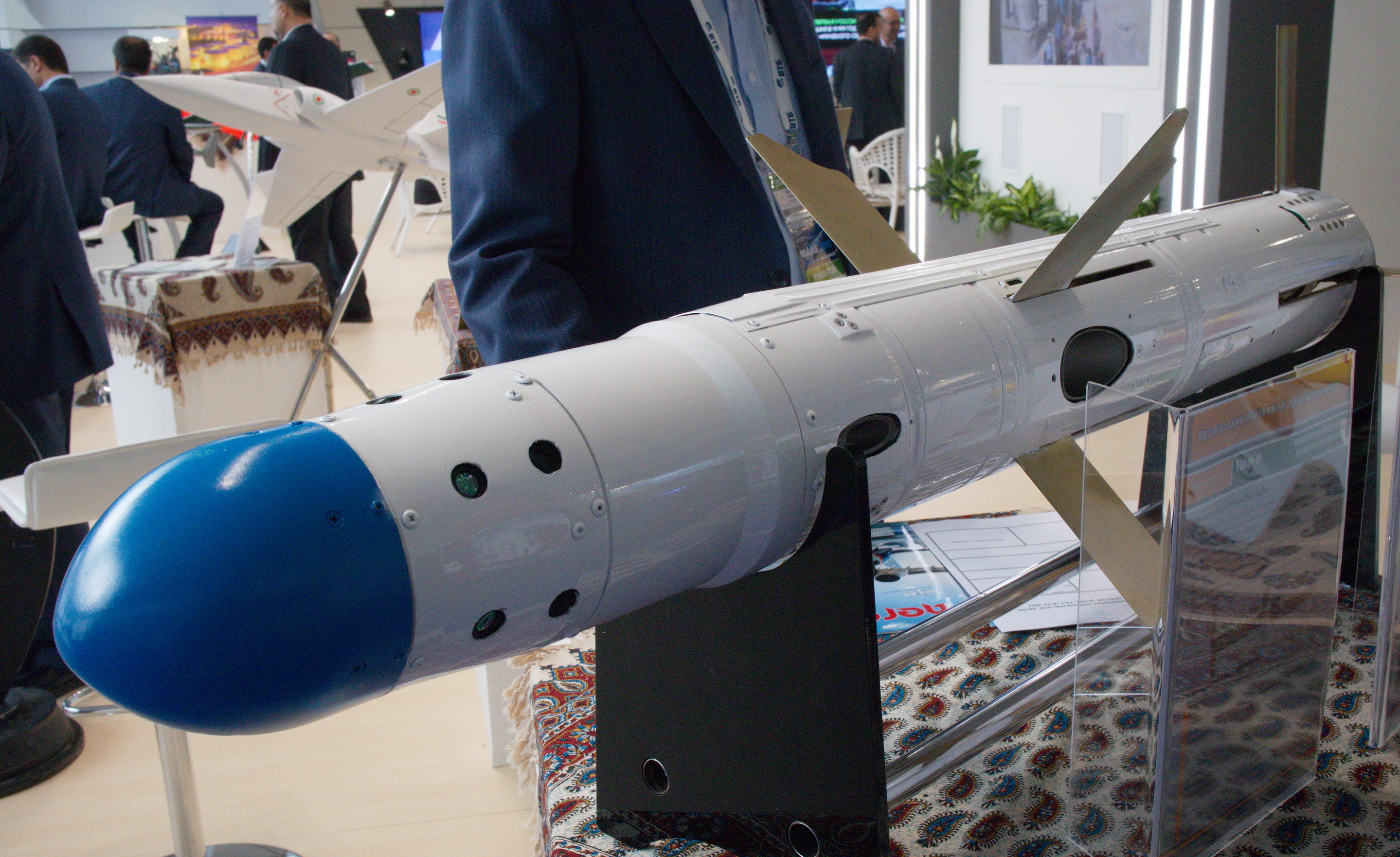
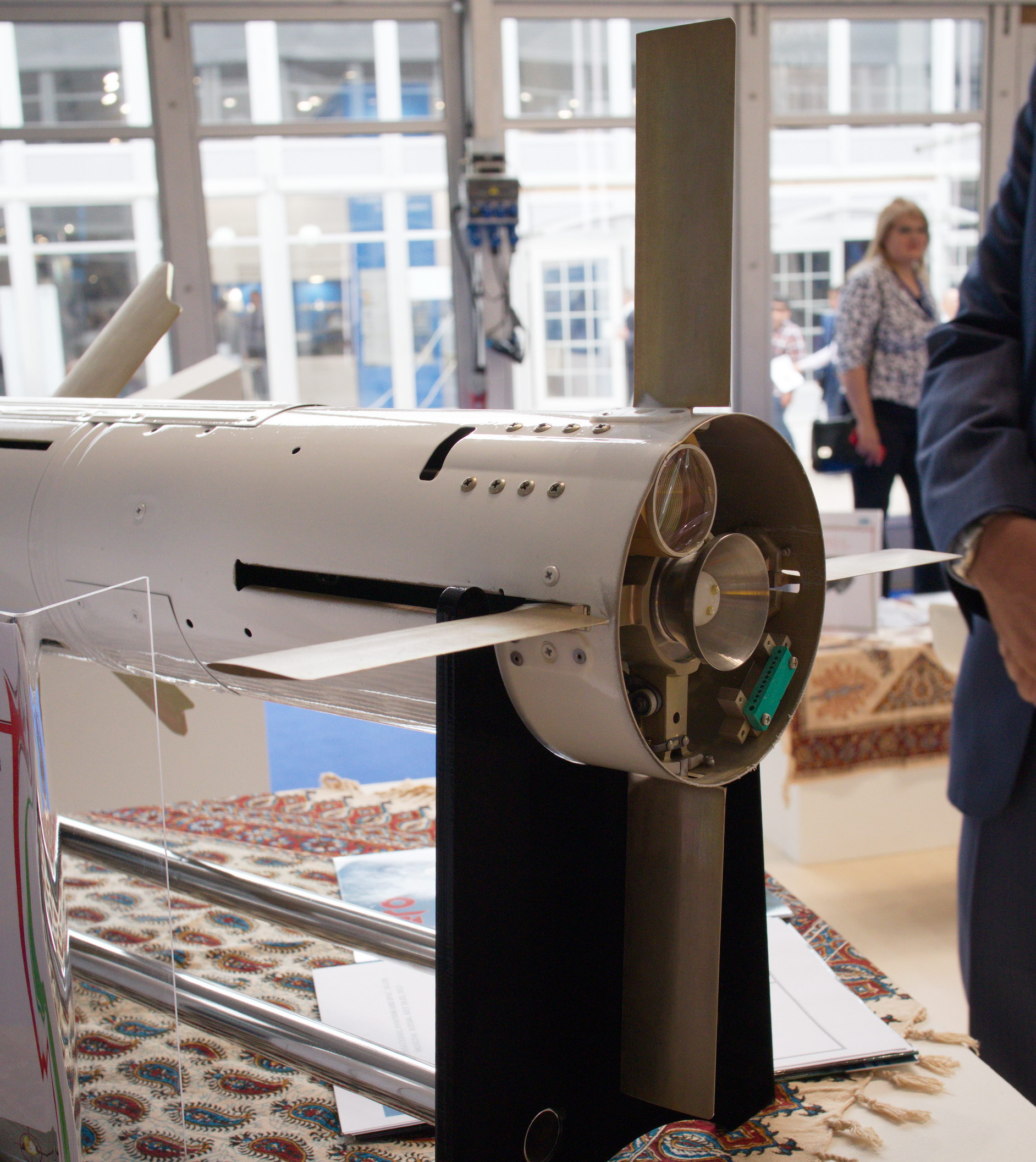
    Specifications of Ghaem-M missile:
    Maximum range: 6000 meters
    Minimum range: 500 meters
    Missile weight: 19.5 kg
    Warhead weight: 1.7 kg
    Type of warhead: Fragmentation (500 shrapnels)
    Missile length: 116 cm
    Missile diameter: 15.3 cm
    Maximum speed: 310 meters per second
    Average speed: 240 meters per second

    11- Almas anti-tank missile:
    Almas missile is an anti-armor missile that has always been considered as an independent category. However, when it comes to looking at the configuration of the Almas anti-tank missile, we will realize the great similarity in the essence of the Almas missile and the Toofan missile. Both Toophan and Almas missiles have two rows of wings and an engine in the middle section, with hot gas from the engine coming out next to the middle wings.

    In Almas missile, the middle wings are closed forward while in Toophan missiles these wings are closed backward. In Almas missile, the middle wings have a simple shape, but in Toophan missile, the shape of the middle wings is special.

    Almas anti-tank missile is a top-attack missile with fire and forget capability. The guidance method of Almas missile is similar to the first type, using a camera on a tripod, tracking and targeting are accomplished and then the missile is fired towards a target and the missile independently goes towards the target and attacks it from above.

    It seems that with the addition of this generation and its very significant changes compared to the base model of Toophan, it was necessary to change its name and end the Toophan missile project.
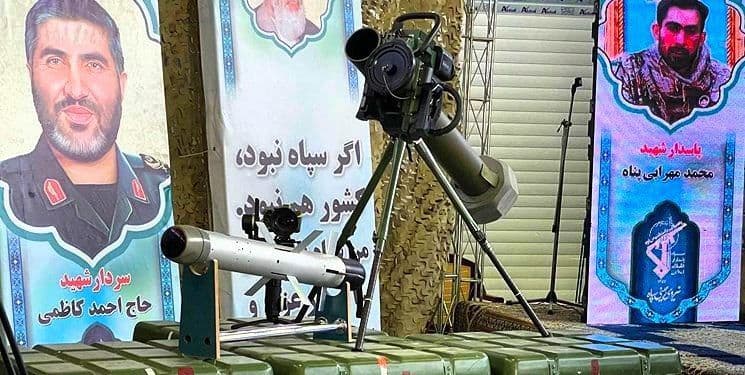
    Almas fire-and-forget top attack missile

    More images of Toophan ATGMs:

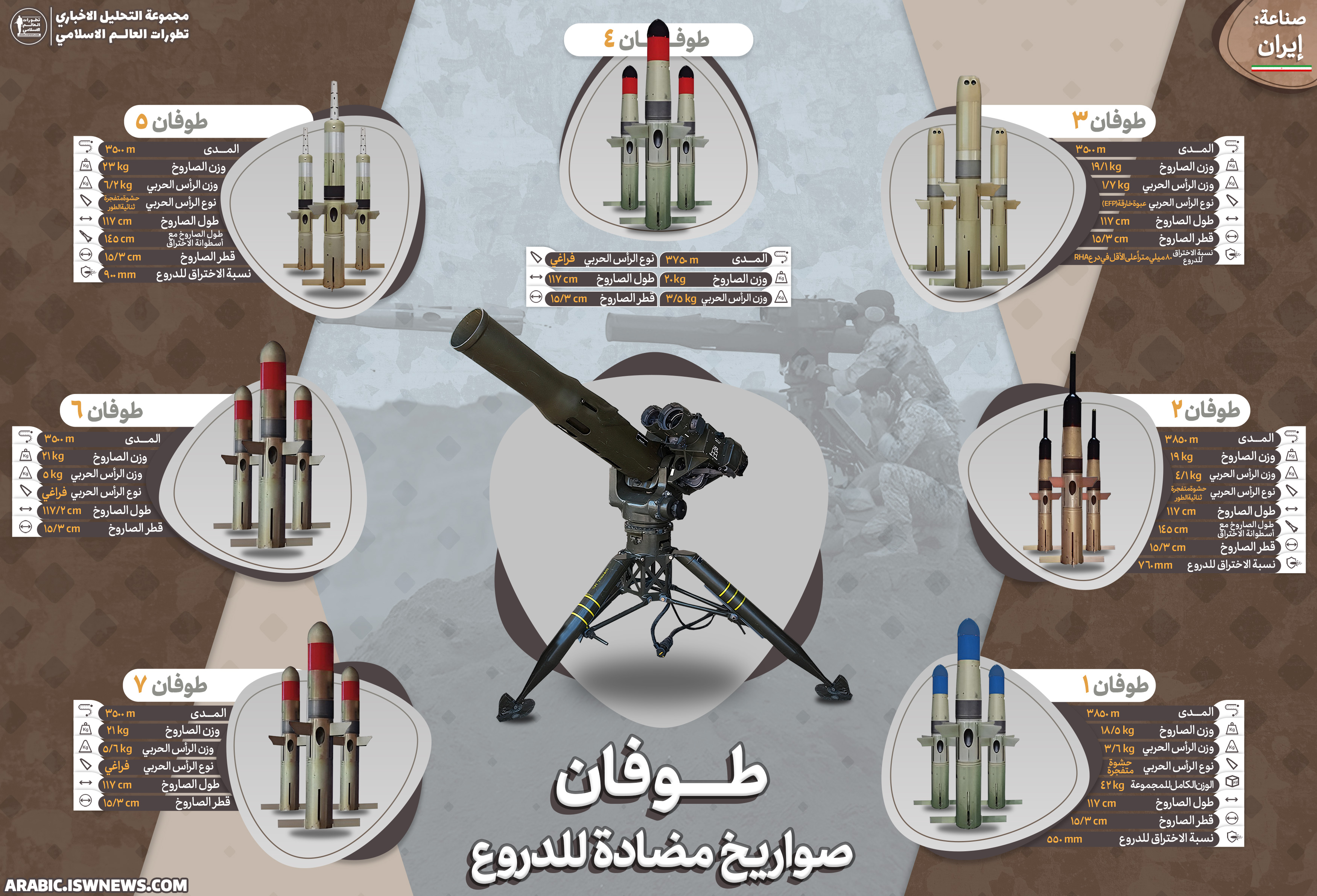
    Infographics of Toophan anti-armor missiles in Arabic (صواريخ طوفان المضادة للدروع), Russian (Противотанковые ракеты Туфан), Kurdish, Azeri (Tufan Anti Zireh Raketləri), Persian (موشک ضد زره توفان) and Hebrew (טופאן טילים נגד טנקים):
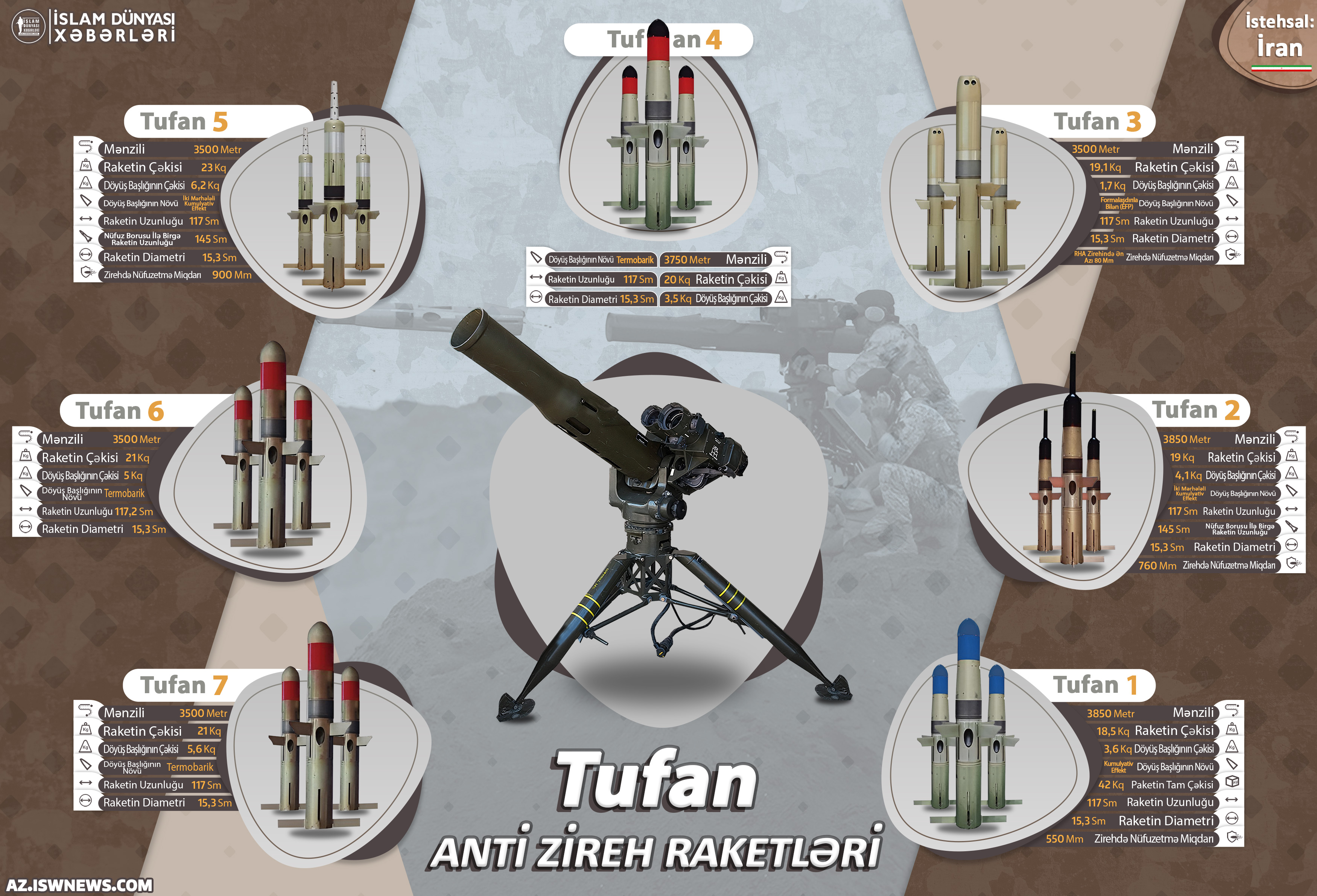
    Source:
    Toophan
    Basic TOOPHAN & TOOPHAN 3-M (Top Attack) | Mindex (mindexcenter.ir)
    Iran’s Toophan anti-tank missile and its different types (iranpress.com)
    Toophan
    Anti-tank Iranian missile systems of the Tufan series (topwar.ru)
    Toophan
    اعلام رسمی دستیابی ایران به موشک ضد زره با سرجنگی «ترموباریک»

  • Military Knowledge: Abu Mahdi Cruise Missile

    Military Knowledge: Abu Mahdi Cruise Missile

    The Abu Mahdi cruise missile was developed and built under the “Meshkat” project. The project Mashkat is a project in which the Russian KH-55 cruise missile was reverse engineered by Iran; And based on that, at first the Ya-Ali cruise missile with a range of 700 km, then the cruise missiles Soumar with a range of 700 km, Hoveyzeh with a range of more than 1,300 km and finally an anti-ship cruise version named “Abu Mahdi” with a range of more than 1,000 km were made. The Meshkat project has another long-range cruise missile that has not been officially unveiled and there are no pictures of it.

    Abu Mahdi cruise missile is the first Iranian naval cruise missile with a range of 1000 km, which can be used against both sea and land targets, And can be launched from the fixed and mobile ground launchers and warships. Therefore, this missile with such a range is considered among the strategic cruise missiles.

    It is worth noting that few countries have the ability to domestically manufacture such a cruise missile in this range and more ranges, and other countries have to pay exorbitant costs to purchase this type of strategic cruise missile. For example, Russian Kalibr, the US’s Tomahawk and French MdCN cruise missiles are included in this category.

    History:
    The long-range cruise missile “Martyr Abu Mahdi Al-Muhandis” was unveiled for the first time together with ballistic missile “Martyr Haj Qasem” in August 20, 2020, on the occasion of Iran’s Defense Industry Day. At the unveiling ceremony, Amir Hatami, the then Minister of Defense, stated that the range of this cruise missile is more than 1000 km.

    At the time of the unveiling, a video of the test-fire of the Abu Mahdi missile was published, with the words “Talaiyeh” written on it. According to the process of naming cruise missiles from Soumar, Hoveyzeh and then Paveh, using the names of war zones of the Iraq-Iran war on Iranian ground cruise missiles is a common practice in Iran. However, with the martyrdom of this prominent resistance commander, Abu Mahdi Al-Muhandis, Iran put the name of this martyr on the country’s first land-attack cruise missile.

    A picture of Abu Mahdi cruise missile test-fire in 2020 with the name of Talaiyeh written on it

    This missile with changes in the engine section and with a new name was unveiled again on July 25, 2023 during a ceremony and its mass production line was officially opened by the Ministry of Defense of Iran. Also, in this ceremony, the Abu Mahdi missile officially entered the service of the IRGC and Army combat units.

    Design:
    Abu Mehdi long-range cruise missile has used the features of Soumar and Hoveyzeh cruise missiles in its design. According to the published images, different parts of the Abu Mahdi missile can be examined as follows

    Different parts of Martyr Abu Mahdi long-range cruise missile

    The main radar of the missile is located in the nose, and after the radar, a compartment or cabin is intended for the computer.

    After the radar is the warhead, which is indicated by the words WARHEAD CABIN on the missile. Abu Mahdi cruise missile uses a penetrating warhead with a 410-kilogram high-explosive warhead that can cause a lot of damage to the target.

    After the warhead, there is a ground detection radar and other missile guidance systems.

    In the middle section, the missile wings and the fuel tank are located. This missile has folding wings structure that allow it to be placed inside the sea and land launch containers. The Abu Mehdi’s wings use a square design with a round tip, which is completely identical to the previous design.

    The fuel tank and the wings are placed in one part, and the fuel tank extends to the missile engine, And the engine is placed under the missile. At the time of the initial unveiling in August 2020, the Abu Mehdi’s engine was similar to the Hoveyzeh cruise missile engine; But in the version that was unveiled in 2023 and has reached mass production, a different engine is used. The name of this engine has not been officially announced, but it can be assumed that this engine is an optimized turbojet engine (probably Tolou type) with the same flight conditions as the initial unveiling model.

    The engine difference between the prototype version and the mass-produced version of the Abu Mahdi cruise missile

    At the end of the missile, there are control fins and rocket booster. The control fins are responsible for changing the direction of the missile. The Abu Mahdi cruise missile uses a large booster with retractable mesh stands like the Hoveyzeh and Soumar models.

    Close-up video of the Abu Mahdi missile and its launcher box
    A video of the test-fire of the Abu Mahdi cruise missile from the ground mobile launcher and testing the guidance and accuracy of this missile

    In the case of the Abu Mahdi missile, considering the high range of the missile and the fact that it engages with sea targets that are mobile, two issues are very critical. The first issue is the initial detection of the target and the second issue is guiding the missile towards the moving target.

    Detecting the target in the sea and correcting the missile’s flight path in relation to the moving target:
    Abu Mehdi cruise missile has a range of 1000 km, which definitely takes more than an hour to travel such a distance. Considering that this cruise missile is designed based on the KH55 missile and the KH55 has a speed of about 700 km/h, then the Abu Mehdi cruise will probably have a speed approximately equal to this missile, and this means that it will take about 85 minutes to travel a distance of 1,000 km. If a ship is traveling at 32 knots (about 60 km/h), then it has moved about 85 km from its initial location since the missile was fired, and finding such an object is beyond the capabilities of the missile’s small seeker radar.
    One of the method to solve this problem is to use helicopters, fighter jets, fast boats or drones. All these items are at risk of discovery and destruction. However, the use of stealthy drones such as Shahed-171 greatly increases the probability of success in detecting and chasing the vessel.

    Read more: Shahed 171 (Simorgh) And Shahed Stealth Drones Family

    Another method is to use spy satellites to discover the primary and the secondary position of the target. It is also possible to track the radar by the radars of surface vessels and coastal radars. It is also possible to use the radars of surface vessels and coastal radars to track the target.

    Missile guidance systems

    1- The main seeker and radar:
    RADAR HATCH is written on the nose of the missile. This brings to mind that the main radar can be accessed through this hatch and it is possible to change the mode of the radar; In other words, this hatch is for the radar adjustment and checkup.
    This missile uses active radar homing (ARH) and passive radar (PRH). It is also possible to use both modes. For example, the missile can use the passive mode until it approaches the target and use its active radar mode when it is near the target.

    Radar hatch on the nose of missile

    In another image, there is a hatch with the words ATB CABIN. This hatch is for access to the radar processor. Also, this cabin has a small air intake for cooling.

    Air intake and radar processor cabin on Abu Mahdi missile

    – Active radar homing (ARH):
    It is a missile guidance method in which the missile containing a radar transceiver and its special computer independently tracks the target in the final stage of guidance. In this method, the missile is sent to the target position, and if the target characteristics are changed, new characteristics are sent to it along the way.
    Considering Abu Mahdi’s range of 1000 km, this radar method will be active during target detection, which is suitable for attacking land targets and sea targets. Of course, this radar can also help the flight system during the flight.

    – Passive radar homing (PRH):
    Passive radar is a radar systems that detect and track objects by processing reflections from non-cooperative sources of illumination in the environment. Passive radar is not able to produce radar waves, but this type of radar has the ability to detect the sources of the waves and allows it to attack the radar of air defense systems. Missiles with passive radars are very hard to detect, but easier to break their locks. These types of radars require very powerful computers to be able to separate and process a large amount of environmental waves.
    In the case of the Abu Mahdi missile, due to the lack of sufficient space, there is only the possibility of having a small advanced computer to detect the radar waves and its propagation direction, which can be used to attack radar targets.

    According to the published video of Abu Mahdi cruise missile test, several corner reflectors are used in the upper part of the target, which is to engage the missile’s radar, and the missile finally hits the middle part of the metal structure, which is completely similar to the performance of conventional anti-ship cruise missiles. High accuracy of hitting the target is seen in the tests.

    The corner reflector on the dummy target and the point where the missile hits the middle of the dummy target

    This method of target detection was also used for anti-ship missiles such as Ghadir, Ghadr, Kosar, etc. In this method, the missile finds the target using its search radar and then scans the target and finds the middle part of the target and attacks it. This collision causes maximum damage to the vessels, which ultimately leads to the vessel being split in half and sinking.

    2- Inertial guidance:
    An inertial navigation system (INS) is a navigation device that uses motion sensors (accelerometers), rotation sensors (gyroscopes) and a computer to continuously calculate by dead reckoning the position, the orientation, and the velocity (direction and speed of movement) of a moving object without the need for external references, which keeps the position of the missile on its right path.

    3- GPS guidance:
    In this method, the missile is guided to the target using the Global Positioning System (GPS). This system, along with the inertial guidance system, can greatly increase the accuracy of the missile. The accuracy of some types of missile with this type of guidance reaches an accuracy of less than 1 meter. It is also possible for Abu Mahdi to access GLONASS and BeiDou navigation systems, which is the Russian and Chinese version of GPS.

    4- TERCOM system:
    Terrain contour matching or TERCOM uses a contour map of the terrain that is compared with measurements made during flight by an on-board radar altimeter. A TERCOM system considerably increases the accuracy of a missile compared with inertial navigation systems (INS). The increased accuracy allows a TERCOM-equipped missile to fly closer to obstacles and at generally lower altitudes, making it harder to detect by ground radar.
    Topographical maps are very accessible today because they are used for commercial purposes and Abu Mehdi takes advantage of this.


    In the lower part of the Abu Mahdi missile, a part with a different shape and material can be seen, which seems to be the location of the altimeter radar or terrain detection. This radar is responsible for a part of the mission for guiding the missile along with the INS, And it significantly increases the accuracy of the missile.

    Terrain detection radar located in the lower part of the missile

    The technical specifications of the Abu Mahdi long-range cruise missile have not been officially announced, but considering the family of missiles in project Meshkat, and also the technical specifications of the KH55 cruise missile, it is possible to accurately estimate the specifications of the Abu Mahdi cruise missile, which we will mention below.

    Abu Mahdi cruise missile specifications:
    Type: Land-attack and anti-ship cruise missile
    Unveiled: 20 August 2020
    Origin: Iran
    Manufacturer: Aerospace Industries Organization (AIO)
    Length: 600 cm
    Wingspan: 310 cm
    Diameter: 55 cm
    Weight: 1650 kg
    Warhead: 410 kg HE
    Accuracy: 3 meters CEP
    Range: more than 1000 km
    Flight altitude: under 50 meters
    Guidance: GPS/INS – TERCOM – ARH/PRH
    Engine: Turbojet
    Speed: about 700 km/h
    Launch platform: Fixed and mobile ground launchers and ships

    Abu Mahdi long-range cruise missile – click to view full size

    More pictures of the Abu Mahdi cruise missile:

    Abu Mahdi cruise missile infographic in Persian (موشک کروز ابومهدی), Russian (крылатая ракета Абу Махди), Arabic, Hebrew (טיל שיוט אבו מהדי), Chinese (阿布·马赫迪 巡航导弹), Azeri (Raketi Əbu Mehdi) and Kurdish (موشەکی کروز ئەبومەهدی):

    Source:
    Kh-55

    Inertial navigation system
    TERCOM
    رونمایی ایران از موشک‌های حاج قاسم و شهید ابومهدی
    آیا موشک «ابومهدی» همان موشک «هویزه» است؟

  • Military Knowledge: Ya-Ali Cruise Missile

    Military Knowledge: Ya-Ali Cruise Missile

    The entire process of designing and producing of this missile was carried out by the Aerospace Industries of the Islamic Revolutionary Guard Corps of Iran.

    The missile was first unveiled on 11 May 2014 when Iranian leader Grand Ayatollah Ali Khamenei visited the Aerospace Force of the Army of the Guardians of the Islamic Revolution. In the same exhibition, the Ya Ali (AS) cruise missile was announced as a land cruise missile with a turbojet engine, a range of 700 km and a warhead of 200 kg. In another interview in 2014, General Hajizadeh, commander of IRGC Aerospace Force announced that this missile can be installed and used by the IRGC’s Sukhoi 22.

    Based on the images released from the unveiling ceremony of Ya Ali (AS) cruise missile, it can be said that this missile has a cylindrical body, fixed rectangular wings, a jet engine at the end of the body and an air intake below it, and control fins at the end of the body.

    The dimensions of this missile have not been officially announced, but in some sources, the length of the missile is 4.9 meters and its diameter is 35 centimeters.

    No detailed information is available about the engine of this missile. Two Toloue-4 and TJ100 engines are considered as the main options, the most likely of which is the Toloue-4 engine. The Toloue-4 engine is installed on Ghader and Noor cruise missiles as well as the Karrar drone.

    The guidance system of this missile has not been officially announced, but this missile can obviously use Terrain contour matching (TERCOM) or Digital Scene Matching Area Correlator (DSMAC) method. However, considering the time of unveiling and use of this missile, the most likely method is to use an altitude measuring radar along with the inertial system and GPS, which helps the autopilot in guiding the missile. One of the weaknesses of this missile is not using a camera in the last stage of hitting, which could increase the accuracy of this missile.

    Ya-Ali (a.s) cruise missile is considered the first achievement of Meshkat project. This project is defined to achieve a 2000 km cruise missile; Its first prototype is the Ya-Ali cruise missile. After this missile, Soumar and Abu Mahdi cruise missiles were also built with higher ranges.

    Specifications of Ya-Ali cruise missile:
    Length: 4.9 meters
    Diameter: 35 cm
    Range: 700 km
    Warhead weight: 200 kg
    Engine: Toloue-4 turbojet
    Launch platform: capable of firing from land, air and sea launchers
    Origin: Iran
    Designer and manufacturer: Islamic Revolutionary Guard Corps Aerospace Force

    Ya-Ali cruise missile – click to view full size

    Posters of Ya-Ali cruise missile in Farsi, Arabic (صاروخ كروز يا علي), Russian (Крылатая ракета Йа Али), Hebrew (טיל שיוט יא עלי), Chinese (亚阿里巡航导弹), Kurdish (موشەکی کروزی یاعەلی) and Azeri (Ya Əli (Ə) Qanadlı Raketi):

  • Military Knowledge: Khorramshahr-4 Ballistic Missile

    Military Knowledge: Khorramshahr-4 Ballistic Missile

    On May 25 and on the occasion of the anniversary of the liberation of Khorramshahr city in the Iraq-Iran war, the Khorramshahr 4 surface-to-surface ballistic missile with the operational name of “Khaybar” was unveiled in the presence of Mohammad Reza Ashtiani, Minister of Defense and Armed Forces Logistics of Iran.

    Brigadier General Mohammad Reza Ashtiani, called the Khorramshahr-4 missile a strategic pinpoint ballistic missile with radar evasion capability. In some parts of his speech, he said the message of the unveiling of the Khorramshahr-4 missile to Iran’s friends is helping peace and stability in the region and providing comprehensive support to countries that are on the path of fighting against the arrogance system.

    Khorramshahr-4 missile is considered to be the newest variant of the Khorramshahr missile series, which has undergone major changes in various parts. Among the most important of these changes, we can point out the use of hypergolic fuel and a new engine. Khorramshahr-4 is equipped with Arvand engine, one of the most advanced Iranian liquid fuel engines, in order to use hypergallic fuel.

    A hypergolic propellant is a rocket propellant combination used in a rocket engine, whose components spontaneously ignite when they come into contact with each other. The main advantages of hypergolic propellants are that they can be stored as liquids at room temperature and that engines which are powered by them are easy to ignite reliably and repeatedly. Hypergolically-fueled rocket engines are usually simple and reliable because they need no ignition system. As hypergolic rockets do not need an ignition system, they can fire any number of times by simply opening and closing the propellant valves until the propellants are exhausted and are therefore uniquely suited for spacecraft maneuvering.[source]

    The launch moment of Khorramshahr-4 ballistic missile

    Another feature of this missile is the ability to store fuel inside the Khorramshahr-4 missile for several years. Using this ability, it is possible to inject fuel into the rocket and keep it in storage for several years. For this reason, the rocket is always ready to fire and there is no need to spend long time for refueling again. Therefore, the preparation time and entering the launch position has reached less than 12 minutes.

    According to statements and information provided by military sources, the range of Khorramshahr-4 missile is up to 2000 km and its warhead is 1500 kg. But based on some facts, it seems that the range of the missile is intentionally announced lower than its actual range. Experts believe that the real range of this missile is up to 4000 km.

    In general, the warhead of this missile with a length of 4 meters and a weight of 1,500 kg is one of the largest and heaviest warheads produced by Iran, which is also resistant to electronic warfare. It should be noted that out of this 1,500 kg, about 1,000 kg are explosives and 500 kg are related to engine, guidance, equipment, etc. The warhead of this missile can be single and heavy or in the form of several lighter warheads, and it also uses various warheads such as thermobaric warheads.
    The point here is that in this warhead, guiding micromotors are used to control and adjust its trajectory outside the Earth’s atmosphere. For example, by reducing the weight of the warhead by half and increasing the amount of fuel, and with the use of guiding micromotors in the mid-phase in exoatmosphere, the range of this missile can easily be increased up to twice the declared range!

    Review of the performance of launch, guidance and control in the mid-phase outside the atmosphere in Khorramshahr-4 missile

    The speed of Khorramshahr-4 is Mach 16 outside the atmosphere and Mach 8 inside the atmosphere before hitting the target, and the circular probable error (CEP) of 10 to 30 meters is also expected for this missile. The speed of Mach 16 outside the earth’s atmosphere and the use of guidance engines to control and adjust the trajectory of the warhead makes it very hard for the outer space missile systems to intercept and destroy this missile. Also, the speed of Mach 8 in the final phase in the atmosphere is a very good speed, making it very difficult to detect, track and intercept by existing anti-missile systems.

    One day after the unveiling of the Khorramshahr 4 missile, Deputy Defense Minister General Farahi provided more information about this missile in a television interview. According to him, unlike previously built missiles whose guidance and control system was in the atmosphere and there was a possibility of jamming and electronic interference by the enemy, guidance and control of Khorramshahr 4 is done outside the atmosphere, and its guidance and control systems are not active inside the atmosphere, and therefore, electronic warfare systems have no effect on the Khorramshahr 4 missile.

    Also, in addition to this feature, this missile uses a cyber defense system and using artificial intelligence with the necessary maneuverability, it can deceive the enemy’s defense systems and escape from the enemy’s missiles. He stated the circle of error (CEP) of Khorramshahr 4 missile up to 30 meters at a distance of 2000 km, and the durability of the fuel inside the missile was also stated to be a maximum of 3 years.

    Among the other capabilities of Khorramshahr 4 is the ability to use radar and optical seeker individually or simultaneously with the use of artificial intelligence to target moving sea and land targets, which is installed on the missile depending on the type of mission and target.

    MIRV and MRV capabilities on Khorramshahr-4 warhead

    Khorramshahr-4 missile can carry multiple warheads inside its main warhead and each warhead can hit an independent target.

    Multiple independently targetable reentry vehicle (MIRV) capability refers to a warhead that carries several other warheads inside, and each of these warheads can target an independent and different target. There is another type of warheads called multiple reentry vehicle (MRV), which is also capable of carrying several warheads, but the warheads do not have the ability to target independently, and all of them hit the target in a certain range and are unguided.

    Currently, the US, UK, France, Russia, China and India have claimed to have MIRV missile systems. Pakistan and the Israeli regime are also suspected of developing and possessing MIRV missile systems.

    In 1970, the United States presented this capability to the world for the first time with the LGM-30G Minuteman III missile. Today, Iran has also achieved this ability and has used it in the new generation of Khorramshahr missiles.

    Khorramshahr-2 missile uses a warhead with MRV capability. This type of warhead, carrying a large number of rockets and bombs, is very suitable for targeting various targets such as runaways, barracks and enemy gatherings. But Khorramshahr-4 missile has gone one step further and has achieved MIRV capability. This feature is very suitable for attacking fixed and predetermined targets.

    The main difference between the Khorramshahr-4 missile and the Minuteman III missile is the accuracy and type of munition. The American missile is designed to carry several nuclear warheads with a power of 170 kilotons of TNT and does not need pinpointing accuracy, because nuclear warheads have large explosions, and even several kilometers of error is not important for these type of missiles. However, the Khorramshahr-4 missile has been developed to carry a conventional warhead, and for this reason, each warhead must have high accuracy.

    Khorramshahr 4 (Khaybar) missile will further boost the offensive and defensive capabilities of Islamic Republic of Iran. The country has been working nonstop to develop its missile capabilities in order to deal with increasing threats from the United States and the Israel regime. Tehran’s large missile program achieved a number of breakthroughs in the last few years, despite facing strict sanctions and even sabotage.

    Khorramshahr 4 missile specifications:
    Length: ~ 13 meters
    Diameter: ~ 1.5 meters
    Weight: ~ 30 tons
    Warhead weight: 1500 kg
    Range: 2000 km (unofficial range: up to 4000 km)
    Accuracy: 10 to 30 meters CEP
    Fuel: Hypergolic – single stage
    Speed: Mach 16 outside the atmosphere – Mach 8 inside the atmosphere
    Introduction: May 25, 2023
    Origin: Iran

    Khorramshahr 4 medium-range ballistic missile – click to view in full size

    More iamges of Khorramshahr 4 missile:

    “Khorramshahr 4 (Khaybar) missile” posters collection in Farsi, Russian, Arabic, Azeri, Kurdish and Hebrew:

  • Military Knowledge: Zolfaghar Ballistic Missile

    Military Knowledge: Zolfaghar Ballistic Missile

    Zolfaghar missile is equipped with a warhead weighing 579 kg and its range is 700 km. The guidance method of this missile is based on Inertial and global navigation satellite system and electro-optical terminal with the ability to guide until the last moment. Zolfaghar has anti-jamming capability and is resistant to any electronic warfare.

    In the Zolfaghar missile, the nose of the missile has changed from a pointed to a curved one. This change reduces the thermal effect of drag at high speeds; Therefore, the speed of this type is higher than the Fateh-110 models and has reached Mach 5.

    Zolfaghar ballistic missile guidance has been optimized. In this missile, the pointed shape of the warhead guide canards has been changed to trapezoidal shape. Also, these canards have been moved to the end of the warhead and behind the guidance, control and navigation section.

    The warhead of the Zolfaghar missile is detachable. Detachable warhead, while reducing the negative effects of connecting the body to the warhead in the final phase of the attack, reduces the possibility of intercepting by enemy air defense systems and reduces the probability of enemy air defense missiles hitting the Zolfaghar warhead.

    Read more: Military Knowledge: Fateh-110 Ballistic Missile

    So far, the dimensions of this missile have not been officially announced; But by examining the available images, it can be seen that its length has increased compared to the Fateh-110 missile.

    Zolfaghar missile has high agility due to its light weight and small dimensions, and like other missiles of the Fateh family, it can be installed and launched on a mobile chassis. This increases its survivability on the battlefield. Zolfaghar missile can be fired from a dual launchers.

    Zolfaghar Ballistic Missile

    In September 2020, a new type of this missile named “Zolfaghar Basir” with optical guidance and anti-ship mission was unveiled.

    The Zolfaghar ballistic missile has been used in two operations “Laylat al-Qadr” and “Strike of Muharram” against the ISIS terrorist organization in Syria.

    On the last night of Qadr in the month of Ramadan, which coincides with Sunday June 18, 2017, the IRGC Aerospace Force with the operational name “Laylat al-Qadr”, used 6 Zolfaghar missiles to attack the command headquarters and positions of ISIS in the Syria’s Deir Ezzor province. The missiles targeted ISIS positions in Deir Ezzor, at a distance of about 650 kilometers. This operation was carried out in response to the ISIS terrorist attack on Iranian Parliament in Tehran in 8 June 2017, which resulted in the martyrdom of 18 civilian.

    Read more: IRGC missile operation against ISIS terrorists in Syria’s Deir ez-Zor + Video

    In another operation on the morning of October 1, 2018, the IRGC Aerospace Force with the operational name “Strike of Muharram” (Zarbat-e Muharram) with 6 surface-to-surface ballistic missiles from Kermanshah in the west of Iran, destroyed the positions of ISIS terrorists in the Hajin area in the east of the Euphrates River in Syria. The 4 out of the 6 fired missiles were of the Zolfaghar type. Simultaneously with this operation, 7 IRGC drones have also targeted the positions of terrorists in the east of the Euphrates. This operation was carried out in response to the ISIS terrorist attack in September 22, 2018 in Ahvaz city, which resulted in the martyrdom of 25 Iranians and the wounding of 69 others.

    Read more: IRGC Missile and Drone Attacks on ISIS Terrorists in Hajin in Syria + Images

    Zolfaghar ballistic missile specifications:
    Length: 10.3 meters
    Diameter: 0.68 meters
    Weight: 4620 kg
    Warhead: high-explosive up to 579 kg
    Engine: single-stage solid fueled
    Range: 700 km
    Speed: Mach 5
    Guidance: Inertial and global navigation satellite system, electro-optical terminal
    Accuracy: 10 meters CEP
    Origin: Iran

    Click to view full size image

    Collection of posters of Zolfaghar ballistic missile in Russian (Зульфикар Ракета), Persian (موشک ذوالفقار), Chinese (佐勒菲卡爾 彈道式導彈), Hebrew (טיל בליסטי זולפיקאר), Arabic (صاروخ ذوالفقار), Azeri (Zülfüqar Raketi) and Kurdish (موشەکی زولفەقار):

  • Military Knowledge: Fateh-110 Ballistic Missile

    Military Knowledge: Fateh-110 Ballistic Missile

    Fateh 110 missile is produced by the Aerospace Industries Organization (AIO), a subsidiary of Iran’s Ministry of Defense and Armed Forces Logistics. According to the available information, the first tests of this missile were carried out in 2002. Fateh-110 is one of the most popular types of missiles produced by Iran’s military industrial.

    In the past 30 years, the development of the Fateh-110 missile has been carried out on the basis of “increasing the range and increasing the accuracy” and its various types have been produced over time. Therefore, in 2012, a version of the Fateh-110 missile with a pinpointing accuracy and an error rate of 10 meters was produced.

    Fateh-110 missile should be considered as Iran’s first important step in designing a solid fueled ballistic missile. The ignition mechanism of Fateh-110 is single-stage and uses solid fuel.

    So far, 10 generations of Fateh-110 missiles have been built, and their specifications are as follows:
    Fatih-110 generation 1: with a range of 200 km
    Fatih-110 generation 2: with a range of 250 km
    Fatih-110 generation 3: with a range of 300 kilometers and high accuracy
    Fatih-110 generation 4: with a range of more than 300 km and pinpoint accuracy
    Persian Gulf missile: an anti-ship type
    Hormuz 1 and Hormuz 2: an anti-radar type
    Fateh Mobin missile: anti-ship type with optical guidance
    Zolfaghar missile: with a range of 700 km
    Dezful missile: with a range of 1000 km
    Raad 500 missile: with a range of 500 km

    Read more: Military Knowledge: Zolfaghar Ballistic Missile

    Fateh-110 ballistic missile is able to target and destroy land and sea targets, enemy gathering points, command centers, ammunition depots, radars and other targets with high accuracy. The error rate of Fateh-110 missile is estimated to be less than 10 meters.

    The warhead of Fateh-110 missile is detachable type. Detachable warhead, while reducing the negative effects of connecting the body to the warhead in the final phase of the attack, reduces the possibility of intercepting by enemy air defense systems and reduces the probability of enemy air defense missiles hitting the Fateh-110 warhead.

    Fateh-110 missile has high agility due to its light weight and small dimensions, and like other missiles of the Fateh family, it can be installed and launched on a mobile chassis. This increases its survivability on the battlefield.

    The effective range of this missile is 300 km and its final range is estimated between 400 and 550 km.

    One of the most famous operations of Fateh-110 is the attack on the headquarters of the terrorist group of the Democratic Party of Iranian Kurdistan (KDPI) in September 8, 2018. In this operation, Fateh-110 missiles were fired from a distance of 230 km towards the headquarters of the KDPI terrorist group in Koysinjaq in the Kurdistan region of Iraq and very accurately targeted the meeting of their leaders. In this precise attack, 16 members of KDPI were killed, including 6 members of the central committee of this terrorist group. This attack was carried out in retaliation for the martyrdom of a number of IRGC servicemen who were killed by KDPI in July of the same year in the west of the country.

    Read more: IRGC Missile Attack on Terrorist Groups in Iraqi Kurdistan; Video + Images

    The operation against the Mossad base/villa near the Iraqi city of Erbil is another important and impressive operation of Fateh-110 ballistic missiles. In the morning of March 13, 2022, the IRGC Aerospace Force targeted the secret and sensitive center of the Israeli regime near the new US consulate in Erbil, with at least 10 ballistic missiles. Some of the missiles used in this operation were Fateh-110. The IRGC stated that the reason for the attack on the Mossad villa near Erbil was a response to the Israel’s recent evils activities against Iran national security.

    Read more: Iranian precise missile attacks on Israeli secret places in Erbil + Video

    Fateh-110 ballistic missile specifications:
    Length: 8.86 meters
    Diameter: 0.61 meters
    Weight: 3450 kg
    Warhead: high-explosive up to 500 kg
    Engine: single stage solid fuel
    Range: 300 km
    Speed: Mach 3
    Guidance: Inertial and global navigation satellite system. (+some versions with electro-optical terminal)
    Accuracy: 10 meters CEP
    Origin: Iran

    Click to view full size image

    Collection of posters of Fateh-110 Ballistic Missile in Russian (Баллистическая Ракета Фатех-110), Persian (موشک فاتح 110), Chinese (彈道式導彈 法塔赫-110), Hebrew (טיל בליסטי של פאתח-110), Arabic (صاروخ البالستي فاتح 110), Azeri (Ballistik Raketi Fateh-110) and Kurdish (موشەکی بالیستی فاتیح 110):

  • Military Knowledge: Qaem Smart Bombs

    Military Knowledge: Qaem Smart Bombs

    Qaem 1, 5 and 9 bombs were all unveiled during a ceremony in August 6, 2019 in Tehran. According to Amir Hatami, Former Minister of Defense and Armed Forces Logistics of Iran, at the unveiling ceremony of Qaem bombs, this product was jointly produced by the two Organizations of Defense Industries and Iran Electronics Industries. Amir Hatami stated that the minimum operational height of these bombs is 4 to 10 thousand feet (1219 to 3048 meters) and its range is 12 to 40 kilometers, and the ability to install different penetrating and shrapnel warheads with different ranges and various destructive power is also available in these bombs.

    It should be noted that the “minimum operational height” of the Qaem bomb means that if we drop the bombs below this height (below 1219 meters), they will not be able to glide and will quickly fall towards the targets.

    The speech of the former Minister of Defense, Amir Hatami, regarding Qaem smart bombs and announcing a range of 12 to 40 kilometers for them

    But in another place, Brigadier General Shahrokh Shahram, the CEO of Iran Electronics Industries, states that the range of Qaem bombs is 20 to 40 kilometers. Due to the contradiction between the words of Amir Hatami and Shahrokh Shahram, the exact range of these bombs is in an aura of uncertainty. Also, unfortunately, the range of this series of bombs has never been officially announced in any of the military exhibitions. In the rest of the article, we will try to determine the range of each of the bombs of the Qaem series separately.

    Brigadier General Shahrokh Shahram, the CEO of Iran’s Electronics Industries, explained about Qaem series bombs and announced a range of 20 to 40 kilometers for them.

    Small Diameter Bombs (SDB) are a new type of bombs that have been produced and adopted in the last few years by the military powers like the United States. The U.S. prototypes of this model were heavy bombs and were launched by the fighter jets and from a high altitude. Due to Iran’s need for lighter but practical weapons for its modern drones, Iran was inspired by this type of bombs in making smart bombs, and these efforts finally came to fruition in 2010 with the introduction of the miniature bombs of the Sadid family. Sadid-342 can be considered the first miniature bomb of Iran, which was later developed in the Qaem family.

    Read more: Military Knowledge: Sadid Smart Bombs and Missiles

    In the process of producing these bombs, the production of seeker that can be used in all current and future Iranian smart bombs was very important. Therefore, Iran’s Ministry of Defense produced seekers with various guidance methods. Two examples of these seekers named thermal image seekers RU320ST and visible image seekers RU113ST have been displayed, which have been installed and observed on Sadid and Qaem families.

    RU320ST image thermal seeker (left side) next to RU113ST visible image seeker (right side)

    Although there is no information available about the history and order of production of Qaem bombs, but based on the available data, the category can be considered as follows:

    Qaem-5 bomb:
    The specifications of Qaem bombs have not been officially announced, but at the Baghdad defense exhibition, some specifications of Qaem-1 and Qaem-5 bombs were displayed. According to the specifications announced in this exhibition, the dimensions of the Qaem-5 and the Sadid-342 bomb are very close to each other, but due to use of fixed wings and the increase in the weight of the warhead, its weight has reached 20 kg.

    Qaem 5 specs with BS20 branding presented at ARMY 2022

    Qaem 5 specs with BS20 branding presented at Baghdad defense exhibition

    At the time of the unveiling of these bombs, Amir Hatami announced the range of the Qaem family from 12 to 40 kilometers. Looking carefully at the front and rear wings of Qaem-5, we will notice the larger dimensions and aerodynamic shape of the Qaem-5 compared to the Sadid family of bombs. Probably, the range of Qaem-5 is greater than that of Sadid 342 and 345 because it has less weight and more wing area, which will increase the lift and decrease the drag and finally increase its range. Therefore, based on the mentioned facts, Qaem-5 range can be considered 12 km if released from a height of 5 km. Qaem-5 bomb has the possibility of being installed on the fighter jet, and if it is released from a high altitude, a range of up to 20 kilometers can be considered for it.

    The middle wings of the Qaem-5 are longer and have a backward and curved shape, which indicates an improvement in the flight characteristics of the wings compared to the Sadid-345.

    The seekers used in Qaem 5 are visual/optical (TV), thermal (IR), laser and a combination of optical and laser. The use of all kinds of seekers in Qaem 5 allows operations to be carried out with great accuracy and in all weather conditions.

    Optical seeker (TV) for Qaem-9

    A variant of the Qaem-5 has also been seen, which has an infrared seeker and a proximity fuse (probably of the laser type), which is remarkable in its own right. The reason for using infrared is probably to reduce the cost of construction; But it will be less accurate. However, the use of a proximity fuse next to the infrared seeker compensates this defect to some extent.

    A variant of a Qaem 5 bomb with an infrared seeker and a proximity fuse

    Unknown variant of Qaem-5:
    A variant of Qaem-5 was showcased in the exhibition of the achievements of self-sufficient Jihad of the Iranian Navy in December 14, 2021. The length and width of the wings had increased noticeably. This increases the wing area and ultimately increases the range. And also there is the possibility of increasing the (warhead) weight without increasing the range.

    A variant of Qaem- 5 bomb with greater length and wings

    This type of Qaem-5 bomb was seen under the wing of Fotros reconnaissance and combat drone in the Iranian Army’s Strategic UAV Base 313, which strengthens the possibility of its operational nature. Therefore, we can expect to see this bomb on other combat drones of the Iranian Armed Forces in the near future. A capability that will significantly increase the offensive power of Iranian drones.

    Read more: Military Knowledge: Fotros Reconnaissance and Combat Drone

    Army’s Fotros drone at the Strategic UAV Base 313

    Qaem-5 bomb installed on Ababil-5

    Read more: Military Knowledge: Ababil-5, Iran’s Newest Drone Achievement

    Qaem-5 bomb from the rear view

    Qaem-5 smart bomb specifications:
    Length: 108 cm
    Diameter: 15.2 cm
    Seeker type: Visible (TV), thermal (IR), laser (L), a combination of optical and laser
    Type of warhead: Fragmentation
    Fuse type: programmable and timed
    Warhead weight: 8.5 kg
    Total weight of the bomb: 20 kg
    Range: 12 to 20 km based on the release height (in the unknown variant of Qaem-5, its range can be increased up to 40 km)

    Qaem-1 bomb:
    The Qaem-1 smart bomb can be considered as the second member of the Qaem bomb family because the Qaem-5 was created along the lines of Sadid’s changes and the Qaem-1 was created due to the need for a light bomb to be carried by light drones. Iran uses a large number of light drones, such as Ababil 3 and 4. Because these drones do not have much power to carry ammunition; The Qaem-1 light and smart bomb can properly perform its duty on Iranian light drones in line with the doctrine of “one shot for each target”.

    ARMY 2022 exhibition and Qaem-1 and 5 bombs – the difference between the two bombs and the style and miniaturization of Qaem-1 is clear.


    The specifications of Qaem-1 bomb have also been displayed in the Baghdad defense exhibition under the brand name BS12.5 The weight of this bomb is 12.5 kg, its length is 90 cm and its diameter is 12.5 cm.

    Qaem-1 specification with BS12.5 brand


    Qaem-1 also uses visual or optical (TV), thermal (IR), laser, a combination of optical and laser seekers. But Qaem-1, in the warhead type, has been introduced with more variety. So far, warheads with fragmentation, incendiary, direct impact (kinetic energy) have been introduced for this bomb. Of course, it is important to mention that it is possible to use these warheads for the entire Qaem family. A programmable and timed fuse allows the bomb to detonate at a certain distance from the ground or at a specific height, increasing the effect of the warhead on targets. The total weight of Qaem-1 bomb is 12.5 kg and its warhead is 1.5 kg.
    The range of this bomb has not been announced like other members of the Qaem family. Qaem-1 with its light weight and small diameter and wings that are exactly similar to Qaem-5 can have a significant range. The Qaem-1 appears to have a slightly higher wing-to-body ratio than the Qaem-5. But it will probably have a range equivalent to Qaem-5, i.e. 12 km if released from a height of 5 km and a range of 20 km if released from a high altitude. The minimum release height for this bomb is 4,000 feet or 1,219 meters.

    Qaem-1 bomb

    Specifications of Qaiem-1 smart bomb with BS12.5 brand:
    Length: 90 cm
    Diameter: 12.5 cm
    Seeker type: Visible (TV), thermal (IR), laser (L), a combination of optical and laser
    Warhead type: fragmentation, incendiary, direct impact (kinetic energy)
    Fuse type: programmable and timed
    Warhead weight: 1.5 kg
    Total weight of the bomb: 12.5 kg
    Range: 12 to 40 km

    Qaem-9 bomb:
    Qaem series bombs have been widely seen on all kinds of Iranian drones, but so far no pictures of Qaem-9 bomb installation have been seen. The Qaem-9 bomb has not been exhibited and very few pictures are available. According to the statements of the former Minister of Defense of Iran at the time of the unveiling of the Qaem bombs that these bombs can be used on drones and fighter jets and since the Qaem-9 bomb has not been seen on drones, we can have the impression that Qaem-9 is specially developed for fighter jets. Of course, it should be noted that it is definitely possible to install Qaem-9 bombs on drones.
    Although the dimensions of Qaem-9 are not available, it obviously uses the same diameter as Qaem-5, i.e. 152 mm. Considering that the wing location in this model has changed and its length and weight have also undergone changes, the center of gravity of Qaem-9 has definitely changed compared to Qaem-5. By examining the available images, a significant increase in the length of the bomb can be seen. According to the investigations, the length of this bomb should be around 150 cm. Also, in this bomb, it is possible to use all kinds of warheads and seekers used in Qaeim 1 and 5.
    Next is to determine the weight of the bomb. For this purpose, due to the increase in the length of the Qaem-9 bomb and based on the Qaem-5 bomb, we increase the weight of the Qaem-5 bomb by approximately 50% and consider the weight of 30 kg for the Qaem-9.
    Considering the dimensions of the Qaem-9 bomb, this bomb is a very favorable option for using a thermobaric warhead. Because this type of warhead has more weight and requires more space.
    Regarding the range, we return to the words of Amir Hatami and Brig. Gen. Shahram. The dimensions and length of the front and rear wings have been increased for the Qaem-9, which improves its aerodynamic characteristics and increases its range. The range of this bomb can be estimated to be 20 km if released from a height of 5 km and 40 km if released from a fighter, i.e. a height of more than 8 km. It is also worth noting that Qaem-9 bombs cannot be dropped from a height of less than 3 kilometers.

    Qaem-9 bomb

    Possible specifications of Qaem-9 smart bomb:
    Length: 150 cm
    Diameter: 15.2 cm
    Seeker type: Visible (TV), thermal (IR), laser (L), a combination of optical and laser
    Warhead type: fragmentation, incendiary, direct impact (kinetic energy) and thermobaric
    Fuse type: programmable and timed
    Warhead weight: 8 to 15 kg
    Total weight of the bomb: 30 kg
    Range: 20 to 40 kilometers based on release height

    Unknown variant of Qaem family:
    A variant of Qaem smart bomb was displayed in the exhibition of achievements of the self-sufficient jihad organization of the Iranian Navy in December 14, 2021, which has much larger dimensions than other members of Qaem family. It seems that the diameter of this bomb is the same as other bombs, but its length has increased. The dimensions of the wings have also increased significantly. Definitely, this unknown bomb has more weight and range, but no accurate information can be obtained from it. This bomb may be designed to be dropped from large drones or fighter jets. It is also possible that this bomb was chosen instead of Qaem-9 due to its similarity with the main structure of the Qaem-5 bomb, which has the highest production rate in the Qaim family, and has the same specifications. This issue can be due to reducing the costs of bomb production and preventing the creation of new infrastructure in the new production chain. With no change in the diameter of the bomb, all the seekers used in Qaem-5 can be used on this variant as well.

    An unidentified bomb with larger dimensions but a similar pattern to Qaem-5

    Possible specifications of the unknown variant of Qaem bombs family:
    Length: 150 cm
    Diameter: 15.2 cm
    Seeker type: Visible (TV), thermal (IR), laser (L), a combination of optical and laser
    Warhead type: fragmentation, incendiary, direct impact (kinetic energy) and thermobaric
    Fuse type: programmable and timed
    Warhead weight: 8 to 15 kg
    Total weight of the bomb: 30 kg
    Range: 20 to 40 kilometers based on release height

    Qaem free fall bomb or laziness in installing wings?!
    A wingless bomb has been seen in footage released about the Mojaher-6 drone in Ethiopia, which is close in size to the Qaem-5. The lack of wings makes this bomb unguided and similar to a free-fall bomb. Considering the absence of any tracking system in the front part of the bomb, there is a possibility that this bomb was made according to Ethiopia’s needs in a way to be cheap so that it can be widely used.
    Another possibility is that the bomb seen in the picture is one of the three bombs of the Qaem family, and it was mounted on Mohajer-6 without wings and for promotional photography. In the meantime, due to haste or any other issue, guidance wings have not been installed on these bombs.

    Read more: Military Knowledge: Mohajer-6 Reconnaissance Combat Drone

    Mohajer-6 UAV in Ethiopia armed with Qaem free fall bomb

    More images of Qaem smart bombs:

    Click to view full size

    Collection of posters of Qaem smart bombs in Russian (Каем Умные миниатюрные бомбы), Persian (بمب هوشمند قائم), Chinese (Qaem 智能迷你精确制导炸弹), Hebrew (QAEM פצצות מיניאטוריות חכמות), Arabic (قنابل المصغرة الذكية قائم), Azeri (Qaem Ağıllı Minyatür Bomba) and Kurdish (بۆمبی مینیاتۆری زیرەکی قائیم):

  • Military Knowledge: Sadid Smart Bombs and Missiles

    Military Knowledge: Sadid Smart Bombs and Missiles

    The first member of the Sadid family was exhibited at the Kish Air Show in 2010. The first two members of the family, Sadid-1 and Sadid-342, were assembled by the IRGC, and due to the fact that its parts were the same as the Toofan missile, the parts were delivered to the IRGC from Montazer Al-Mahdi Industries belonging to the Ministry of Defense, which produces the Toofan (Iranian TOW) missile.

    It seems that the production and use of the Sadid family dates back to before their unveiling in the exhibition of the achievements of the Islamic Revolutionary Guard Corps in 2013. The proof of this is the display of different types for the first time in this exhibition. Sadid’s operational record in all its types in Syria is brilliant.

    In the following, we will examine different types of Sadid bombs and missiles. The types that have been officially unveiled so far are as follows:

    1- Sadid-1 missile:
    The first member of the Sadid family is the Sadid-1 missile. This missile was unveiled at the Kish air show in 2010 by installing it on Shahed 258 helicopters.

    Shahed 285-C marine model helicopter equipped with Sadid-1 missile at Kish air show

    Shahed 285-A marine model helicopter equipped with Sadid-1 missile at Kish air show

    Sadid-1 missile is very similar to Toofan anti-armor missile. If you pay close attention to the placement of the wings and the engine gas outlet in Sadid and Toofan missiles, you will see a great similarity between the two missiles.

    Comparing the appearance of Sadid-1 missile and Toofan missile, their similarity is quite obvious.

    Sadid-1 missile has two rows of variable wings, like Toofan missile, and the size and direction of folding of wings in both missiles are completely similar to each other. In the middle of the rocket, there are two hot gas outlets for the main rocket engine, and at the end of the rocket, there is the outlet of the primary engine that is used to launch the rocket from inside the tube, which is completely similar to each other. However, at the end of Sadid-1 missile, the parts related to wire guidance, including two wire spindles and xenon lamps related to Tau missile, have been removed, which is the reason for the difference in the way the missile is guided.

    Comparison of appearance of Sadid-1 and Toofan anti-armor missiles

    The specifications of Sadid-1 missile have not been officially announced yet. But by comparing and matching it with the Toofan anti-armor missile, almost accurate information can be obtained.

    Toofan anti-armor missile in prototypes is capable of penetrating 550 mm of armor at an effective range of 3500 meters. Considering the possibility of firing at an initial speed from the drone and the possibility of gliding if released from a height of 5 km, a range of more than 7 km can probably be considered for this type of missile. Due to the launch of this missile from the sky, which allows this missile to attack from above, its 550 mm penetration is enough to target any type of armor. There are also variants of Toofan missiles with a longer range and penetration power of up to 900 mm.

    Due to the great similarity of Sadid-1 missile and Toofan anti-armor missile, the weight of these two missiles should be very close to each other. Toofan-1 has a weight of 18.5 kg with a warhead of 3.6 kg, and the weight of the missile and its tube is 42 kg. Due to the fact that the weight of Sadid-1 missile is not announced, this missile can also be considered 18.5 kg. Due to the use of Sadid-1 tube and rocket on UAV and helicopter, the weight of 42 kg should be considered for its set.

    Also, the best way to determine the dimensions of the Sadid-1 missile is to consider the dimensions of the Toofan missile. The length of the Toofan missile is 116 cm and its diameter is 15 cm.

    Specifications of Toofan 1 missile which has been officially published.
    Maximum range: 3850 meters
    Minimum range: 70 meters
    Effective range: 3.5 km
    Effective range at night: 2.5 km
    Missile weight: 18.5 kg
    Warhead weight: 3.6 kg
    The weight of the complete package of the missile: 42 kg
    Missile length: 116 cm
    Missile diameter: 15 cm
    Armor penetration rate: 550 mm

    The Sadid-1 prototypes did not have seeker in its nose, but in May 2014, during the visit of the Leader of the Revolution to the exhibition of the achievements of the Islamic Revolutionary Guard Corps, two types of Sadid-1 missiles with optical and infrared guidance were seen. This new possibility can bring fire-and-forget capability to Sadid-1 missile.

    A picture of the first Sadid-1 sample without a seeker in its nose

    Sadid-1 missile with optical seeker on the ground and Sadid-1 missile with infrared seeker under the wing of Shahed 129

    This missile has been introduced in some media with the names of Sadid 361 and Fatah 362 missiles.

    Possible specifications of Sadid-1 missile:
    Diameter: 15 cm
    Length: 116 cm
    Missile weight: 18.5 kg
    Warhead weight: 3.6 kg
    Warhead type: Shaped charge
    Packed missile weight: 42 kg
    Range: 7 km if released from a height of 5 km

    2- Sadid-342 glide bomb:
    The Sadid-342 bomb is the second member of the Sadid family, which was showcased in 2014 during the visit of the Iran’s supreme leader to the exhibition of the achievements of the Islamic Revolutionary Guard Corps. However, due to the display of the Sadid-345 bomb in the same exhibition, the operational history of the Sadid-342 probably goes back to before the year of its unveiling.

    In this bomb, the engine is removed and the bomb is attached to under the UAV’s wings using two rings. The main difference between Sadid-342 and Sadid-1 missile is these two things. The wings of the bomb are not different from the Sadid-1 missile, and the wings are folded into the body.

    Sadid-342 bomb

    The Sadid-342 bomb has been produced in three types of television, infrared and thermal guidance.

    Sadid-342 bomb in the exhibition of the achievements of the Islamic Revolutionary Guard Corps in 2014. This bomb has an infrared filter, which is often used for infrared seekers

    Sadid-342 bomb with a mercury coating indicating the use of a thermal seeker (IR) in this bomb

    Sadid-342 bomb with TV guidance installed on the wing of Shahed-129 drone and Sadid-345 on the ground

    Due to the removal of the main engine in this bomb, more explosives can be used without much change in the weight of the bomb. It can be considered that the Sadid-342 bomb will probably be the same weight as the Sadid-1 missile. Removing the main engine will reduce the range of this bomb, and its range can be predicted to be about 3 km if released at a height of 5 km.

    Possible specifications of Sadid-342 glide bomb:
    Diameter: 15 cm
    Length: 116 cm
    Missile weight: 18.5 kg
    Warhead weight: 7 kg, probably twice as much as Sadid-1 missile (there is a possibility of reducing the weight of the warhead and increasing the range)
    Warhead type: Shaped charge
    Packed missile weight:: 42 kg
    Range: 3 km if released from a height of 5 km

    3- Sadid-345 glide bomb:
    Iran’s experiences in using Sadid missiles and bombs in the Syrian war led to the production of a new type of Sadid bombs. Sodid-345 was also showcased in the exhibition of achievements of the Islamic Revolutionary Guard Corps in 2014.

    In Sadid-345 bomb, the front wings have become fixed wings and it is designed in a way that brings the maximum amount of lift to drag ratio. But the rear wings are still folded.

    It should be noted that the only member of the Sadid family which its specifications have been officially announced is the Sadid-345 glide bomb.

    Specifications of Sadid 345 bomb published at MAKS 2017 exhibition in Russia

    According to the specifications of Sadid-345, this bomb is suitable for attacking gatherings or radar equipment and enemy artillery personnel. This bomb has three types of guidance, one of which is television guidance, the accuracy of which is the lowest and its error is 5 meters. Clear air is needed to receive television quality images and this is a very big limitation for this bomb.
    But there is also a type of laser guidance, which the error rate is declared to be 2.5 meters. Laser guidance also loses its effectiveness in dusty and foggy weather conditions.
    The third type of conventional guidance on this bomb is guidance with an IR seeker, which has brought an accuracy of 2.5 meters, which is a very good number. In addition, the thermal seeker can be used in all weather conditions.

    Bottom right: Sadid-345 in the right side with television guidance and in the left side with infrared guidance
    Top right: Sadid-342 under the wing with TV seeker
    Left: Sadid-1 television guided missile on the ground and Sadid-1 infrared guided missile installed under the wing of the drone

    The bombs on the right side are with television guided and the bombs on left side have a mercury coating to use the thermal (IR) seeker

    The warhead weight and the range of Sadid-345 bomb have not been announced. Considering the 470 mm increase in the length of the Sadid-345 and the increase in the weight of the bomb by nearly 15 kg, about 20 kg of explosives can be considered for this bomb. It should be noted that in the above calculation, the increase in the weight of the wings is considered equal to the removal of the engine and its fuel consumption. Of course, a variant with the name Sadid-362 is mentioned in some sources, which must be the same as Fatah 362, which is the Sadid-1 missile.

    Specifications of Sadid-345 glide bomb:
    Weight: 34 kg
    Length: 1630 mm
    Diameter: 152 mm
    Warhead type: Shaped charge
    Mission: Destroy various moving and stationary targets
    Warhead: H6 explosive – fragmentation
    Type of fuse: Impact
    Lethal radius: 30 meters
    Type of aircraft: UAV
    Hit accuracy:
    – By using IR seeker, the accuracy of impact in radius of target is 2.5 x 2.5 meters.
    – By using laser seeker, the accuracy of impact from laser radiation is 2.5 meters
    – By using visible seekers, if there is not image processing errors, the accuracy of radius impact is 5 meters.

    A picture of Shahed-129 and Sadid bomb. This image shows us the size and ratio of the Shahed-129 drone and the Sadid bomb

    Using the Saegheh drone and dropping Sadid-342 bombs from the drone to attack ISIS terrorists in Syria

    A video of Sadid’s bomb launch from Shahed-129 drone

    More images of Sadid bombs and missiles:

    Read more:
    Shahed 129 Reconnaissance Combat Drone
    Gaza Reconnaissance Combat Drone
    Fotros Reconnaissance and Combat Drone

  • Military Knowledge: Khaybar Shekan Ballistic Missile

    Military Knowledge: Khaybar Shekan Ballistic Missile

    On February 9, 2022, during the visit of the Chief of General Staff of the Iranian Armed Forces, Major General Mohammad Bagheri, and the Commander of the IRGC Aerospace Force, Brigadier General Amir Ali Hajizadeh, to one of Iran’s underground missile bases, the Khaybar Shekan or Kheibar Shekan (Khaybar Breaker) tactical short-range ballistic missile was unveiled.

    The unveiling of this missile on the eve of the forty-third anniversary of the victory of the Islamic Revolution of Iran, and especially the unique name of this missile, attracted many attention and reactions around the world. “Khaybar” refers to the famous war between Muslims and Jews in the early years of Islam and the victory of Muslims over the Jews after Imam Ali (as) threw down the door of the final fort.

    The first thing that catches the eye in the Khaybar Shekan missile is the relatively larger dimensions of its warhead movable fins. Increasing the size of the fins, increases the maneuverability of the warhead after entering the atmosphere and allows for more sophisticated and faster maneuvers in order to pass more effectively through layers of in-atmosphere anti-missile defenses such as the David Sling and Patriot.

    Khaybar Shekan missile warhead and larger movable fins

    The warhead configuration is of Tri Conic type. The use of this conservative configuration is to maintain the stability of the warhead during heavy maneuvers and in the landing phase causes high maneuverability to pass through the layers of missile defense systems. Of course, the amount of drag in this configuration is a bit high. In engineering, increasing the drag force is intended by the weapon designer to achieve greater maneuverability.

    An example of how a maneuverable warhead (MaRV) works

    Unfortunately, the exact details of the missile, such as weight, length, diameter, warhead weight, etc., have not been officially provided by Iranian officials; But according to estimates, the diameter of the missile is 800 mm and its length is about 10.5 meters.

    Due to the reflection of light from the missile body and its texture, it seems to be a composite body material, which means low deadweight of engine. Therefore, the missile weighs between 4.5 and 5 tons, assuming the weight of the warhead is 500 kg, which is a unique number for a short-range ballistic missile with a range of 1450 km. At the time of unveiling, it was mentioned that the weight of this missile has been reduced to one third, which is consistent with one third of the mass of the 15-ton Qadr S missile.

    Extreme agility and speed in hitting targets at a range of 1450 km is one of the main capabilities of this missile.

    Body of Khaybar Shekan Ballistic Missile

    As mentioned, this missile is based on the Dezful missile and with a weight of 30% of liquid fuel missiles, it has achieved the range of the same missiles. Therefore, this missile has solid fuel, and due to the reduction of dimensions and weight of this missile, it is possible to use two missiles of this type on dual launchers.

    Smaller missile dimensions have significant advantages. The smaller the missile, the more missiles can be stored in the confined space of underground missile bases. Also, the need for drilling to increase the length of the tunnels and the cost and time is reduced. It should be noted that in the past, due to the lack of space for missiles, the IRGC Aerospace Force implemented the idea of multi-floor missile depots.

    Iran Underground Missile Base

    Another advantage of reducing the dimension of missiles is the use of a wide range of launchers; So that the Khaybar Shekan ballistic missile can be launched from the Iran Khodro Diesel’s Aria 10-wheel launcher. This truck has recently joined the Iranian Armed Forces.

    Iran Khodro Diesel’s Aria 10-wheel launcher

    Another item that was revealed with the unveiling of Khaybar Shekan missile is the use of a dual launcher that have the ability to carry and launch up to two Khaybar Shekan short-range missiles. Until now, short-range missiles, such as Iranian Qiam missiles with a maximum range of 1,000 km, were carried by the launcher as a single unit; Increasing the number of missiles means increasing the firing rate, which is a very effective and proven tactic in overcoming on missile defense systems.

    Another important issue that occurred during the unveiling of the Khaybar Shekan missile, which led to much speculation, was the naming of the missile and the type of warhead: Khaybar Shekan (Breaker). At first, it looked like a bunker buster warhead, but with the release of more footage of the missile firing and hitting the target, the bunker buster warhead theory was rejected due to the angular impact on the target and how it exploded instantly.

    Of course, the possibility of developing a bunker buster warhead for this missile is quite possible. However, in the unveiling footage of the missile, the missile uses the HE warhead, which according to the commander of the IRGC Aerospace Force, Sardar Hajizadeh, the explosive used in the warhead, is several times more than its TNT equivalent, and provides more explosive power. Therefore, a combination of RDX and HMX has probably been used to provide such performance.

    Video of the unveiling and performance of the Khaybar Shekan ballistic missile

    In 2023, another variant of the Kheibar Shekan missile was unveiled. This missile, which is known as Kheibar Shekan-2, is almost identical to Kheibar Shekan-1.

    Khaybar Shekan-2 with a range of 1800 km

    The only difference in the appearance of Khaybar Shekan-2 with Khaybar Shekan-1 is the warhead. The Khaybar Shekan-1 missile has a three-cone warhead, but the Khaybar Shekan-2 missile uses a single-cone warhead.

    In the booster section, the boosters of the Khaybar Shekan-2 and 1 missiles are exactly the same size with a diameter of 76 cm, but the weight of the Khaybar Shekan-2 missile is less than the Khaybar Shekan-1 missile. The range of Khaybar Shekan-2 has also increased from 1450 km to 1800 km.

    It should be noted that the variants of Khaybar Shekan 1 and 2 missiles named Palestine and Hatem missiles have been put into service by the Yemeni army (Ansar Allah).

    In fact, the Hatem-1 and 2 missiles with a three-cone warhead are similar to the Khaybar-Shekan-1 missile, and the Palestine-1 and 2 missiles with a single-cone warhead are similar to the Khaybar Shekan-2 missile.

    Regarding the range of these missiles, apart from the Palestine-2 missile, no exact information is available, but naturally, their range should be similar to the Iranian variants.

    The range of these missiles is classified as follows based on the announced information:
    Khaybar Shekan-1 »»» 1450 km
    Hatem-1 »»» 1450 km
    Hatem-2 »»» unknown range
    and
    Khaybar Shekan-2 »»» 1800 km
    Palestine-1 »»» 1800 km
    Palestine-2 »»» 2150 km

    The Palestine-2 missile was used in an attack on a target near the city of Tel Aviv, and its range was officially announced as 2,150 km. Considering that Palestine-2 is similar to Khaybar Shekan-2 (with a range of 1,800 km), it seems that its warhead has been greatly reduced in order to reach a range of 2,150 km.

    Khaybar Shekan-1 missile specifications:
    Length: 10.5 m
    Diameter: 0.8 m
    Weight: 4500 kg
    Warhead: High Explosive up to 500 kg
    Fuel: Solid (One-stage)
    Range: 1450 km
    Flight trajectory: Ballistic, MaRV warhead
    Origin: Iran

    Click to view full size

    “Kheibar Shekan Ballistic Missile” collection of posters in Persian, Arabic, Kurdish, Azeri, Russian for Social Media:

  • Military Knowledge: Fateh-313 Ballistic Missile

    Military Knowledge: Fateh-313 Ballistic Missile

    This missile was used during Operation Martyr Soleimani against the US forces at Ain Al Asad Airbase, Iraq, and the very high accuracy of this missile was proven. Fateh-313 missile with a maximum error rate of 3 meters is one of the most accurate missiles in Iran and the world.

    In this missile, by using more advanced inertial navigation and possibly combining it with satellite navigation, a kind of terminal guidance has been obtained, which has provided the ability to guide the Fateh-313 missile until it hits the target.

    The Fateh-313 is almost identical in length and diameter to the Fateh-110 missile; But the use of the new propulsion system with more power generation capacity has increased the missile range from 200 km to 500 km. This missile uses “composite solid fuel” unlike the Fateh-110 missile, which uses solid fuel. The use of composite solid fuel results in better fuel efficiency, greater safety and greater stability of the missile during flight.

    The expanded range of the Fateh-313 makes more targets available to Iran, and due to the high accuracy and capability of using a mobile launcher and move the missile anywhere in the country allows Iran to fire its missiles from more locations within its territory, complicating the enemy’s attempts to attack the missile launchers before the missiles can be launched.

    Fateh-313 ballistic missile specifications:
    Length: 8.86 m
    Diameter: 0.61 m
    Weight: 4500 kg
    Warhead: High explosive up to 500 kg
    Engine: Solid (single stage)
    Range: 500 km
    Speed: Mach 4-5
    Guidance system: Inertial and electro-optical terminal
    Accuracy: 3 m CEP
    Origin: Iran

    Click to view full size

    “Fateh-313 Ballistic Missile” collection of posters in Persian, Arabic, Kurdish, Azeri, Russian, Hebrew and Chinese for Social Media:

  • Iranian precise missile attacks on Israeli secret places in Erbil + Video

    Iranian precise missile attacks on Israeli secret places in Erbil + Video

    According to local sources, at 1:20 a.m., 12 ballistic missiles were fired from Iranian territory at the city of Erbil, hitting US military positions in the city. Also Reuters quoted US officials as saying the attacks did not cause any casualties or damage to the US consulate or troops.

    However, based on data analyzed by ISWNEWS, the missile attacks were carried out in two stages and were concentrated on Israeli assets and not the US. The first stage was at 1:03 a.m and the second stage at 1:20 a.m.

    Read more: New video of IRGC missile attack Mossad headquarters in Erbil

    Also Iraqi sources revealed names of some of Israeli intelligence agents who were killed or wounded in the missile attacks. ISWNEWS can not confirm the validation of these information but the names are as follow:
    1- Mattis Datris
    2- Smith
    3- Adam Butler in charge of traffic coordination in Erbil
    4- Saul, an Israeli commander in Erbil
    5- Mellis Robert, nicknamed Afniz
    6- Johnny
    7- Jones
    8- Gabriel Talker
    9- Mark Zal, manager of the an economic company

    So far, officials in Iran have not yet commented on the attack.

    Some see the attack in retaliation for Israel’s March 3 attack on Syria. An attack that killed two Iranian IRGC members.

    However, al-Mayadin quoted a security official as saying that “the attack had nothing to do with the recent Zionist operation in Syria. This operation is a response to the previous Zionist operation against Iran, which was carried out from Iraqi Kurdistan. Iran’s response to the martyrdom of two members of the Islamic Revolutionary Guard Corps in Syria will be made at the appropriate time. The attack also did not target any Iraqi or American positions in Iraqi Kurdistan.”

    Read more: IRGC Claims Responsibility For Missile Attack on Erbil

    Launching of missiles from western Iran at Israeli positions in Erbil
    Launching of missiles from western Iran at Israeli positions in Erbil

    The Kurdistan 24 TV CCTVs shows the blast waves of the first stage of the attack:

    This point is located on Al-Harir Road, 7 km from Erbil. The location of Kurdistan 24 network is also located near this area and this has caused damage to the building of this network. Coordinates of this area: 36.2648, 44.1066

    Aerial footage of Mossad headquarters in Erbil
  • Dehlavieh 3 anti-tank guided missile, the longest-range Iranian anti-tank missile

    Dehlavieh 3 anti-tank guided missile, the longest-range Iranian anti-tank missile

    During the unveiling ceremony of 10 new defense systems of Iran Ministry of Defence and Armed Forces Logistics (MODAFL) on February 13th, the Dehlavieh-3 anti-tank guided missile was unveiled.

    Examining the appearance of the Dehlavieh-3 ATGM and comparing it with the 9m133M-2 Kornet-EM missile, it can be seen that the Dehlavieh-3 is almost completely similar to the Russian model.

    The 9m133M-2 missile with a maximum range of 8,000 meters is the longest-range man-portable anti-tank missile in the world, and now Iran’s MODAFL has introduced the Iranian version of this missile into mass production. Earlier, the missile was seen for the first time in 2021 during the visit of the Chief of Staff for the Armed Forces of Iran, Major General Sardar Bagheri to the Exhibition of achievements of the Iranian Ministry of Defense in Tehran.

    Dehlavieh 3 anti-tank missile in the exhibition of achievements of the Ministry of Defense in 2021

    The 9m133M-2 missile has the strongest warhead of anti-tank missiles in the world in terms of penetration, and its warhead is equivalent to 10 kg of TNT, and its warhead can penetrate up to 1300 mm in rolled steel.

    In this unveiling, a version of Dehlavieh 3 anti-armor missile, which is similar to the 9m133FM-2 model, was also unveiled with a red body. This version of the missile intended for use against light armored vehicles, personnel, field fortifications and buildings with thermobaric warhead.

    Dehlavieh 3 anti-tank missile with thermobaric warhead

    Dehlavieh 3 missile (9m133m-2 Kornet EM) specifications:
    Range: 8000-150 meters
    Armor penetration: 1300-1100 mm
    Maximum speed: 300 meters per second
    Missile weight (including container): 31 kg
    Missile tube length: 1210 mm