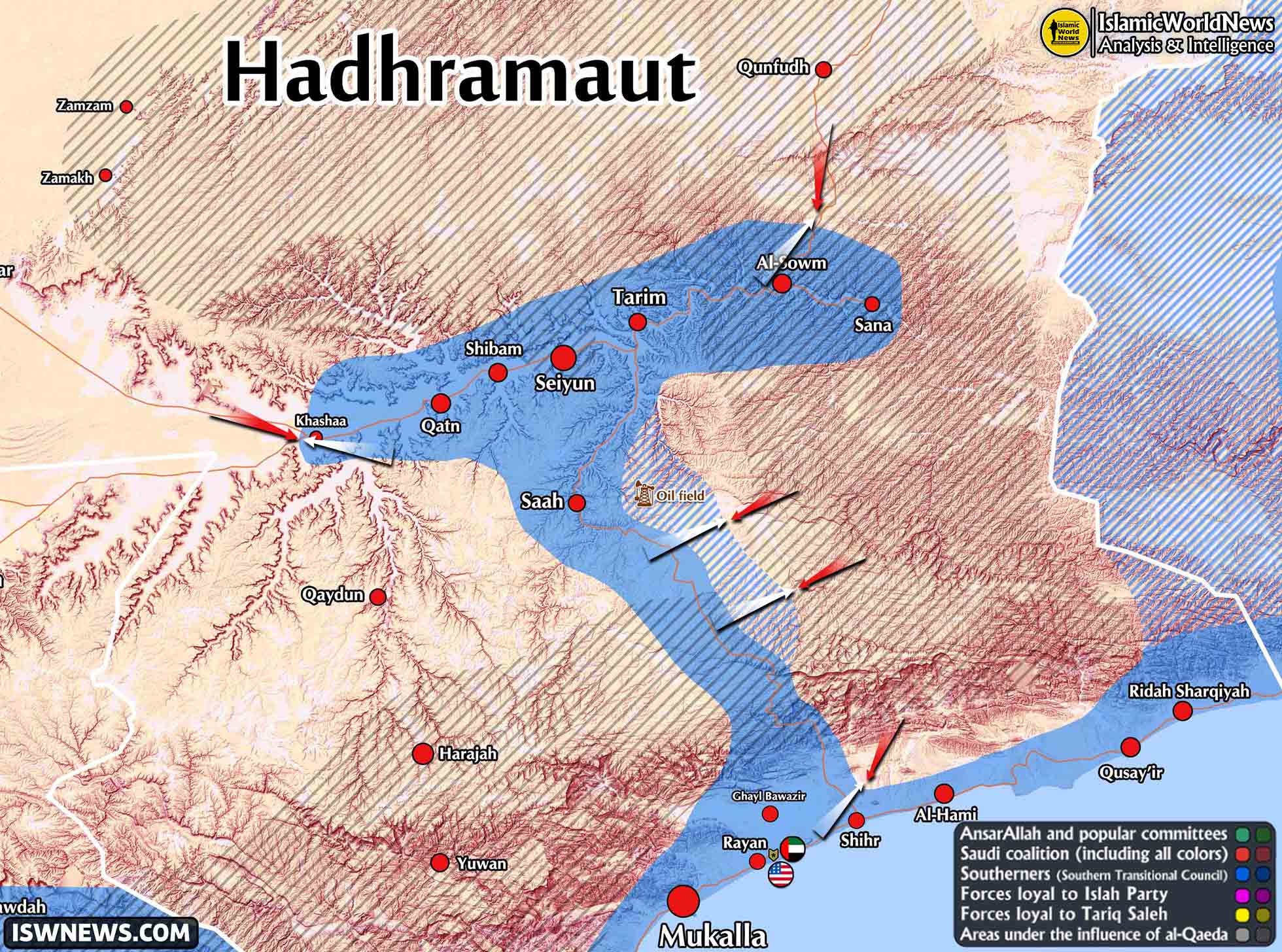
The operation, involving Al-Dara’ Al-Watan forces, armed tribal groups from Hadhramaut, and fighters from the Islah Party, began on Friday, January 3, with Saudi air support. Starting from the Al-Khasha area, they attacked positions of the Southern Transitional Council and advanced toward Al-Qatn in the Hadhramaut valley. By Saturday morning, Al-Qatn and Shibam had fallen to Al-Dara’ Al-Watan, while Southern forces retreated toward the Hadhramaut coast. By Sunday morning, Seiyun and other central districts of Hadhramaut were under government-in-exile control. The forces then moved to Al-Rayyan airbase (previously used by Emirati forces on the Hadhramaut coast) and, after hours of clashes, seized it from the Southern Transitional Council.
During these battles, at least 80 Southern fighters and an unspecified number of Saudi-backed troops were killed, with hundreds more wounded. Both sides have yet to release official casualty figures.
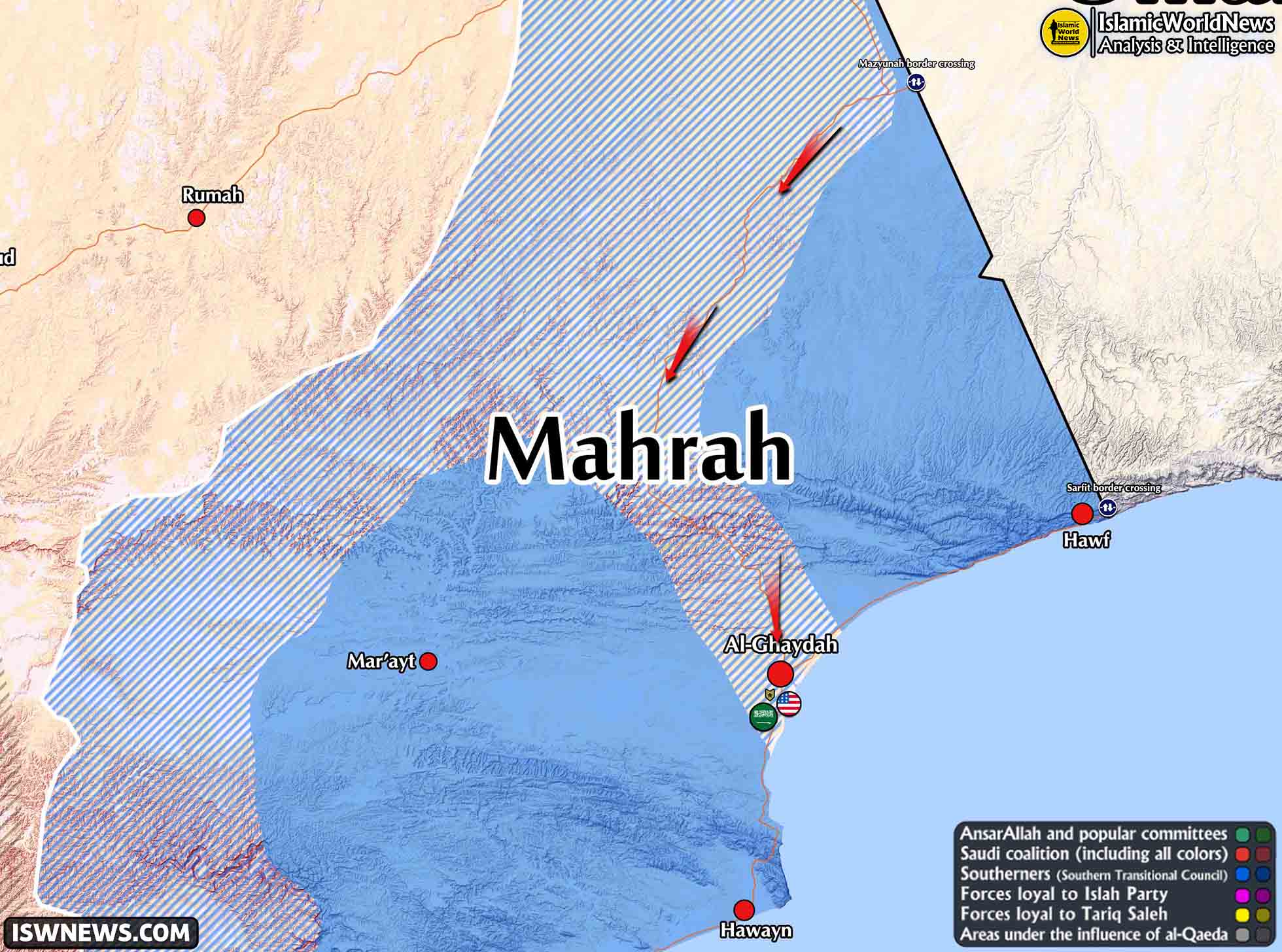
Al-Dera’ Al-Watan forces have since entered Mukalla, the capital of Hadhramaut, without resistance, taking control of all government and military facilities. They also advanced into Al-Mahra province, seizing Al-Ghaydah city and the port of Nishtun. Their objective is to secure Al-Ghaydah’s city and airport, border crossings, and remove Major General Talib Barjash, commander of the Second Military Region (Al-Mahra and Yemen’s southeastern coast), who recently defected to the Southern Transitional Council and rejected the authority of the Presidential Council of the government-in-exile.
Given the heavy defeat of the Southern Transitional Council in Hadhramaut valley and coastal cities, Al-Mahra is also expected to fall under government-in-exile control soon. Awad bin Al-Wazir Al-Awlaki, governor of Shabwa—previously supportive of Southern forces and backed by the UAE—has now announced cooperation with the Saudi-led coalition to deploy forces in oil-rich areas and military bases.
Overall, the Southern Transitional Council’s “Promising Future” operation collapsed with the UAE’s withdrawal and Saudi determination. The plan to partition southern Yemen has been sidelined. However, the Saudis have invited the Southern Transitional Council to participate in Yemen’s internal dialogue conference in Riyadh, and the [Persian] Gulf Cooperation Council’s federal plan for Yemen remains on the table. Still, the re-establishment of a separate South Yemen has failed, leaving Aidarus al-Zoubaidi’s efforts fruitless.
According to the latest reports on Yemen’s fronts — broken down by military zones and provinces — the situation is as follows:
Hadhramaut & Al-Mahra Fronts: In Hadhramaut, the front lines in the north remain unchanged, with Al-Khasha‘a serving as the main contact line. The cities of Al-Qatn, Tarim, and Seiyun in Wadi Hadhramaut are still under southern control. Al-Dara‘ Al-Watani (National Shield) forces have redeployed to Ramah and Thamud in the northeastern desert and taken positions along the Yemen–Saudi border, likely preparing to move toward Al-Sawm on the eastern side of Wadi Hadhramaut.
Hadhramaut map
Fighting continues between the UAE-backed Hadhrami Elite forces and tribal fighters from the Hadhramaut Tribal Council around Ghayl Bin Yamin, as well as in Wadi Khard and Al-Ays on the Hadhramaut coast. Recently, tribal fighters retook the Nohub base and pushed STC forces back from the outskirts of Wadi Khard and Al-Ays.
In Al-Mahra, Major General Barjash — commander of the 2nd Military Region — reaffirmed his support for the STC and declared he will not hand over his positions to National Shield forces backed by Saudi Arabia. He also urged civilians to stay away from military sites and installations.
Al-Mahra situation
Abyan Front: On northern Abyan axes, STC operations against Al-Qaeda elements are progressing slowly and have produced few tangible results. Al-Qaeda cells continue operating covertly. Beyond the integration of rapid-reaction forces from Jishan district, no major shifts have occurred.
Marib & Al-Jawf Fronts: Giants Brigade units have pulled out of Harib and Al-Abdiyah (south of Marib), as well as from the Kitaf and Al-Baqa fronts in northern Saada, redeploying to Hadhramaut and Shabwah. This redeployment has weakened the lines facing Ansar Allah, giving Yemeni resistance fighters an opportunity to resume advances from Harib toward western Shabwah in future clashes.
No significant changes have been recorded on other fronts, and the Yemeni Armed Forces (aligned with Ansar Allah) continue to observe the ceasefire that has been in place since 2023.
The UAE’s departure from Yemen marks a major setback and a turning point in the country’s civil war. Key consequences include fractures within the Saudi-Emirati coalition, a severe weakening of the exiled government, the strengthening of Ansar Allah, a growing power vacuum in the south, and the risk of deeper involvement by another outside actor — potentially the United States. The UAE’s separation from the Yemen file amounts to a failure of the “Arab coalition” project; in recent years, Saudi Arabia has lost two principal partners — Qatar and the UAE — in joint operations. Still, it is too early to draw final conclusions, and much remains unclear.
The UAE’s footprint on strategic Yemeni islands such as Socotra, Abd al-Kuri, Mayun, and others is part of a broader project to control maritime routes through the Gulf of Aden and the Red Sea — reinforced by formal agreements with the exiled government and backed by Western states and Israel.
Major General Talib Barjash, commander of the ousted government’s forces in the Second Military Region (covering al-Mahra and Yemen’s southeastern coasts), has broken away from the ousted government and aligned himself with the Southern Transitional Council. He ordered the removal of Rashad al-Alimi’s portraits—the head of the Presidential Leadership Council of the ousted government—and the Yemeni national flag from all bases under his command, replacing them with portraits of Aidarus al-Zoubaidi, the head of the Southern Transitional Council, and the flag of South Yemen.
During the Hadhramaut conflict, Talib Barjash remained neutral and at times assisted Hadhramaut tribes. However, with recent developments in Yemen’s east and south, his stance has shifted, and he has now joined the Southern Transitional Council.
STC took control of the Mahra province – click to view larger image
A similar incident has occurred in Abyan, where the Rapid Response Forces stationed in the Jayshan district have broken away from the Islah Party and the ousted government, joining the Southern Transitional Council.
Movements of Southern forces in the outskirts of the al-Khasha area came under aerial drone strikes by unidentified aircraft. The Saudi Arabian army has not issued any report regarding these attacks, suggesting they were likely carried out by armed elements of the Islah Party. Some Islah sheikhs, due to their close ties with Turkey, have received limited support, including small quantities of weaponry such as Turkish-made quadcopters.
Rapid Response Forces stationed in the Jayshan district have broken away from the Islah Party and the ousted government, and joined the Southern Transitional Council.
Jordanian Military Aid Convoy Enters al-Wadi‘ah Border Crossing
A Jordanian military aid convoy has entered Yemen through Saudi territory via the al-Wadi‘ah border crossing. In addition to these supplies, a large number of Jordanian advisors have arrived in the al-Wadi‘ah and al-‘Abr areas to train al-Dera‘ al-Watan forces in the use of Canadian armored vehicles and other delivered weaponry.
A Jordanian military aid convoy has entered Yemen via the al-Wadi‘ah border crossing
Some Arab sources have attributed Jordan’s aid shipments to Israel, but this claim is inaccurate. Israel’s positions in Yemen are more closely aligned with the actions of the Southern Transitional Council and the UAE. Through Emirati control of Yemeni islands and air bases, Israel has gained significant intelligence advantages on the Yemeni front. Therefore, it would never act to weaken its allies.
These developments indicate Saudi Arabia’s preparations for a new operation against the Southern Transitional Council in Yemen’s eastern and southern provinces. Contrary to their initial agreement with Riyadh, the STC has taken control of Hadhramaut’s oil fields and northern Shabwah. Despite repeated Saudi requests for withdrawal, the STC is moving toward declaring independence and partitioning Yemen.
STC forces and Saudi‑aligned groups continue to struggle for dominance in Hadhramaut and Shabwa. Reports of southern fighters withdrawing from the Hadhramaut Valley are inaccurate.
On other fronts, the Yemeni Armed Forces (Ansar Allah) and Saudi‑Emirati coalition forces remain under a ceasefire. These lines have held steady for 33 months without change.
Support operations by Yemen’s armed forces (backed by Ansar Allah) in solidarity with Palestine have continued until the final day of negotiations between the resistance and the Zionist regime. The latest actions include a precision cruise missile strike on the Dutch vessel MINERVAGRACHT and the entry of several suicide drones into the port of Eilat in southern occupied Palestine. According to Sayyed Abdul-Malik Badr al-Din al-Houthi, Yemen has carried out 1,835 support operations over the past two years using ballistic missiles, cruise missiles, hypersonic weapons, drones, and suicide boats.
In Hadhramaut province, tensions are rising between the UAE-backed Southern Transitional Council (STC) forces and the Saudi-backed Hadhramaut Protection Forces. Saudi Arabia is equipping three divisions under the Hadhramaut Protection Forces, aiming to seize oil resources and advance toward the Hadhramaut coast. Similar developments are unfolding in Al-Mahrah and Shabwah provinces, although in the city of Ataq, the capital of Shabwah, UAE-aligned forces currently hold control.
In Abyan province, guerrilla attacks by Al-Qaeda militants—including roadside bombings, drone strikes, sniper fire, and other harassment tactics—continue to target STC forces, inflicting significant casualties.
In Taiz province, tensions between the Islah Party and Tariq Saleh’s forces have escalated following the assassination of Afthan al-Mashhary, head of the sanitation and beautification office. Several failed assassination attempts have targeted local commanders from both sides. Islah militants have attempted to arrest and confront Tariq Saleh’s forces in the city of Al-Turba in southern Taiz, but these efforts have failed, and control of Al-Turba remains with Tariq Saleh’s forces.
In Lahij province, the Al-Subayha tribes—aligned with Saudi Arabia—are trying to gain control of the southwestern coast of Lahij. However, UAE-backed Al-Amaliqa forces, under the command of Brigadier General Hamdi Shukri, are blocking their advance and currently hold the area. The Al-Subayha tribes are independent tribes from southwestern Yemen, some of whose leaders have been recruited by Saudi Arabia. In recent years, Al-Subayha militants have clashed multiple times with Tariq Saleh’s forces, preventing their entry into southwestern Yemen.
Latest situation on Yemeni fronts – Click to view image in full size
Overall, Yemen’s internal front is facing numerous challenges that make the path to peace increasingly elusive. Saudi Arabia and the UAE, as influential Arab powers, have exploited Yemen’s dire economic conditions over the years, supporting proxy factions such as the STC, Islah Party, Al-Amaliqa, remnants of Ali Abdullah Saleh’s regime, and others to serve their strategic interests.
These dynamics have deepened divisions between Yemeni factions and the government in Sanaa, making national reconciliation or liberation from foreign-backed groups more difficult. Undoubtedly, once the Palestinian issue is resolved, Yemen’s government will have to confront this major challenge and adopt thoughtful and flexible strategies to overcome it.
Given the fact that an unwritten ceasefire between the Ansar Allah movement and the Saudi coalition is in place, the conflict in Yemen shifted to occupied areas, and the Saudi-led factions are trying to gain more power and influence in the war-torn country.
The situation led to weakening of the resigned Yemeni government, and members of its presidential council are hopeless for success against Ansar Allah movement; so, they pursue implementing their ideal plans, including the partition of southern Yemen.
Moreover, the Takfiri terrorist group Al-Qaeda, which has a significant number of supporters in central and eastern Yemen, expanded its activities and returned to the Yemeni war.
Aden, Lahij and Taiz fronts:
On January 14, 2023, forces of Yemeni military commander and the nephew of the late President Ali Abdullah Saleh, Tareq Mohammed Abdullah Saleh, took control of the Ras al-Ara area on the coast of Lahij province. However, this advance was hampered by tribes, and Rashad Al-Alimi, head of the Presidential Council of the resigned Yemeni government, approved a plan to form a new brigade of Al-Daraa Al-Watan forces in the area under the leadership of Bashir Saif Al-Mazrabi Al-Sabih on February 1, 2023.
The city of Taiz is currently under the control of forces of the al-Islah Party, the resigned government and some independent militants. Tareq Saleh has also returned to the city despite opposition from al-Islah Party. One of the major tensions that occurred after Tareq’s entry into Taiz was the failed assassination attempt on Minister of Defense of the resigned government Mohsen Al-Daeri. These tensions question the resigned government’s claim that Taiz has been besieged by Ansar Allah movement for past eight years. Since the western road and southern areas of Taiz Governorate are under control of al-Islah Party and Tareq Saleh, tensions between these groups limited access to Taiz and prevented delivery of humanitarian aid. The Ansar Allah movement has repeatedly reopened Sana’a-Taiz road voluntarily, but al-Islah Party prevented non-military vehicles from entering Taiz.
On January 25, 2022, the forces of Al-Dara’ Al-Watan (backed by Saudi Arabia) took control of the important Al-Anad base in Lahij Governorate by expelling the militants of the Southern Transitional Council (STC) and evacuating Sudanese mercenaries. This action by Al-Daraa Al-Watan can be considered as Saudi Arabia’s first move to limit the STC.
Saudi media outlets announced that Riyadh intends to remove the STC from the political scene in southern and eastern Yemeni governorates, but this claim has not been seriously implemented so far, and in fact, Saudi Arabia intends to confront with Al-Daraa Al-Watan forces and create a national council for Hadramout Governorate to confront the STC and partition southern Yemen. The control of the resigned government and Saudi Arabian bases in Aden has also been transferred to Al-Daraa Al-Watan, and Saudi advisers are managing Aden’s security issues alongside them.
Latest military situation in Taiz, Aden and Lahij regions in the southwest of Yemen – click to view full size
Abyan front:
The terrorist group Al-Qaeda recruited hundreds of militants from some tribes in Shabwa and Abyan governorates, and Al-Qaeda has again transferred its activities to the north of Abyan Governorate and parts of Shabwa Governorate. Their attacks, which are mostly limited to roadside bombings and guerrilla attacks, have led to the withdrawal of STC forces from most areas of Al-Mahfad and Modiyah districts. Central areas of these areas are under the control of STC militants, but most mountainous areas are under Al-Qaeda control, and clashes between the two sides are ongoing in Wadi Omran.
The increase in Al-Qaeda’s movements on this axis may not be supported by Saudi Arabia, but since it weakens the positions of the Southern Transitional Council in Abyan province, it has not been opposed by Saudi Arabia either, and there is a possibility of covert support from Saudis for Al-Qaeda. Because Al-Qaeda has started using scarce weapons such as quadcopters, etc., which is not possible without external support.
Latest military situation in Abyan and the south Shabwa regions – click to view full size
Shabwa front:
The Southern Giants Brigades known as Al Amaliqah forces, drove out the Shabwa Defense forces on April 8, 2023 to control Bayhan district. The surroundings of the district are also under the control of Shabwa Defense forces; so, Al-Qaeda attacks mostly these forces.
Al-Qaeda terrorists attacked the town of Al-Masiniyah in Al-Saeed district on June 11, 2023 under the pretext of killing commander of al-Islah Party in Bayhan Abdullah Al-Bani. Al-Qaeda used quadcopters and also the US conducted drone attacks on al-Islah Party’s positions in support of the STC.
The US’s support for the STC strengthened their position and governor of Shabwa Awadh bin Al-Wazir Al-Awlaki, and it also reduced the likelihood of operations by Al-Daraa Al-Watan and al-Islah Party forces with Saudis’ support in Ataq city. Saudi Arabia stationed its forces on the northern axis of Ataq to Jardan district and it intends to expel the STC from Ataq city and Shabwa Governorate’s oil-rich areas.
Therefore, competition between Saudi Arabia and the UAE in Shabwa Governorate has been stopped following US intervention, and meetings between US Ambassador to Yemen Steven Fagin and Awadh Al-Awlaki, indicating the US plans to use Shabwa’s oil resources.
Marib front:
After mounting differences between al-Islah Party and the resigned government in late December 2022, Marib Governorate became the scene of tension between the forces of commander-in-chief of the Yemeni resigned government’s armed forces Major General Saghir bin Aziz and al-Islah Party militants. The clash led to the expression of dissatisfaction by tribes in eastern Marib. The root cause of the clashes is a dispute over the division of oil field revenues, and tribes claim parts of oil revenues.
The difference between Saghir bin Aziz and al-Islah Party in Marib continues, but Saudi Arabia temporarily stopped it and is concentrating on merging al-Islah Party militants into Al-Daraa Al-Watan forces; therefore, it appointed al-Islah Party’s field commander in Shabwa Governorate Brigadier General Abd Rabbo Laakb as commander of one of Al-Daraa Al-Watan brigades.
Latest military situation in Marib and north of Ataq regions – click to view full size
Yemen is currently facing several serious challenges such as plots for partitioning southern regions by the STC, exploiting oil and gas resources by the US, Europe and Arab states, stationing terrorist groups in central regions, and being occupied by Saudi Arabia and the UAE.
The Ansar Allah movement and the resigned government of Yemen are opposed to partitioning southern Yemen; so, they will not support the STC, which seeks to revive southern Yemen and the group will not succeed in implementing partition plan. But the issue of exploitation of oil and gas resources and handing over of islands to foreigners are challenges, which are being opposed only by the Ansar Allah movement.
The opposition to the issue prevented oil and gas exports, but did not create any danger for companies and military personnel from the US, Europe and other foreigners in Yemen. In fact, Western political pressures become a leverage so that Ansar Allah movement cannot hinder threats by foreigners.
The occupation by Arab states and presence of terrorist groups in Yemen will only be eliminated through serious confrontation by Yemeni army and Ansar Allah. The Ansar Allah movement must prepare itself for this scenario with support from Iran and resistance groups. Political negotiations at this stage are not very effective; so, peace negotiation is a claim to provide enemies with opportunity to renew strength.
Military situation in Yemen – click to view full size
1- Marib: 46 members of Amaliqah forces were killed and injured during the clashes between Amaliqah and Ansar Allah forces in Harib Front. No details have been published about the casualties and damages of Ansar Allah. This conflict started after the withdrawal of Amaliqah forces from some places in the outskirts of Harib town, including Jabal Yahmum, Jabal Jandalah, Maimanah, Arak, Sharq, al-Sih and Hirour and the deployment of Ansar Allah forces in these areas. Currently, Ansar Allah has retreated from most of the areas and there have been sporadic clashes between the two sides. The media affiliated to the Saudi coalition claim that the Amaliqah forces are preparing for the recapture operation of the remaining points.
2- Shabwa: On the 23rd of March, following the arrival of dozens of dead and wounded soldiers from Harib administration to Usaylan and Bayhan districts, the clinics of these cities requested immediate help and medical supplies from the resigned government of Yemen. Also, some of the casualties of Amaliqa forces have been sent to the city of Ataq and district of Markha al-Sufla.
3- Abyan: On the 17th of March, pro-Saudi forces consisting of Islah party militants and al-Qaeda members were deployed in most of the western and eastern areas of Wadi Omran in the district of Mudhyah. This advance was made after the Southern Transitional Council’s militants withdrew from the important area of Wadi Omran due to failure to deal with al-Qaeda’s roadside bombs and ambushes.
4- Aden: On March 21, as a result of an attack by unknown armed men on Aden airport, Abdul Samad al-Omari, the commander of the Hizam al-Amni airport security unit (affiliated to the Southern Transitional Council), was seriously wounded.
5- Hadhramaut: On March 23, as a result of clashes between pro-Saudi and Marib tribesmen in front of the central hospital of Seiyun city, five militants from both sides were killed.
6- Socotra: On March 19, some local sources reported the withdrawal of UAE forces from Abdul Kuri Island and handing it over to the Saudi military. According to these sources, this move was made following Saudi Arabia’s pressure on the UAE to limit the Southern Transitional Council.
Read more: Forced evacuation of the residents of Abdul Kuri Island by the UAE
7- Hudaydah: – The Saudi coalition forces violated the ceasefire 122 times in the last 48 hours in this province. – In the last 48 hours, the Saudi coalition drones bombarded the Al-Jabaliya area twice and once the positions of Ansar Allah in the district of Hays.
8- According to local sources, quoted by the officials of the Salvation Government of Yemen, the agreement of the exchange of prisoners between the Salvation Government of Yemen and the Saudi coalition by making several flights from Sana’a to Aden and Riyadh and vice versa, will be implemented on the 20th of Ramadan (11th of April) under the supervision of the International Red Cross and the United Nations.
After the formation of the ceasefire agreement in Yemen on April 2, 2022 and three periods of extension and finally its expiration on October 3, 2022, the areas under the control of the Saudi coalition were affected by a forced change in the head of the presidency (Resignation of Abd Rabbu Mansour Hadi and formation of the Presidential Council). This issue caused a series of tensions between different factions, and finally a kind of political and military deadlock prevailed between different groups under the command of the Saudi coalition. Therefore, the control of each of the parties was established over the regions, and now it is possible to distinguish the regions under the control of the groups in Yemen with more precision.
The map of Yemen war has been accurately edited in accordance with the latest field situation until December 16, 2022 and with the following categories and it is as follows:
1- Ansar Allah and popular committees: (green color) The areas under the control of Ansar Allah and popular committees include presence in 15 provinces in the west and center of Yemen, which include the capital, big cities and the majority of the country’s population. Despite the expiration of the cease-fire agreement with the mediation of the United Nations, there is no conflict in any of these fronts, and Ansar Allah is monitoring the fronts by carrying out various reconnaissance operations, as well as confronting the looting of Yemen’s oil resources by foreign tankers. Ansar Allah Movement and the National Salvation Government of Yemen are supported by the majority of the Yemeni people and the General People’s Congress and other Yemeni parties, as well as the foreign support of Iran and Islamic resistance groups.
2- The Saudi coalition and the Saudi-backed government of Yemen (ie the resigned government of Mansour Hadi): (red areas and all map colors except green) The areas under the control of the Saudi-led coalition forces include presence in 13 provinces of Yemen, which includes the largest area of this country. But the majority of these areas include desert and uninhabited areas. Despite this, the oil resources, the southern coast of Yemen and several strategic points are under the control of the Saudi coalition. The Saudi coalition uses these cases as tools to pressure Ansar Allah in negotiations. Nevertheless, despite the access of the Saudi coalition to all the areas under the control of the anti Ansar Allah groups, the factions under this coalition have competition and armed conflict with each other to control these areas. The structure of the resigned government of (Mansour Hadi) Yemen, like other countries involved in civil war, is a structure that divides positions and ministries between powerful factions in order to use the human power and military facilities of these factions against the main enemy. These factions include: Islah Party, Southern Transitional Council, Yemeni National Resistance under the command of Tareq Saleh, each of them have managed to influence and control parts of Yemen in recent years, especially after the resignation of Abd Rabbu Mansour Hadi and the formation of the Presidential Council. Which is explained as follows:
3- Southern Transitional Council: (blue color) The “Southern Transitional Council” (STC) is the name of a council consisting of the main currents of South Yemen, including Al-Hirak Al-Janoubi (Southern Movement), Southern Resistance and the South Arabian League Party, which was established on May 4, 2017, and their goal is to divide south Yemen. Currently, based on the Riyadh agreement in November 5, 2019, this movement holds the post of prime minister and half of the 24 ministries of the government. The geographical area under their control also includes: Aden province, most areas of Lahij and Abyan provinces and parts of Al-Dhale’, Hadhramaut and Taiz provinces.
It should be noted that the forces of Hizam al-Amni (Security Belt), Al-Haba Al-Hadhramiyah, Southern Resistance and other southern armed brigades are sub-groups of the Southern Transitional Council and are under the support of the United Arab Emirates.
4- Islah party: (purple color) The Islah Party (Reform Party) is one of the largest and oldest parties in Yemen, and it acts as the representative of the Muslim Brotherhood in Yemen. This party was formed on September 13, 1990 by Sheikh Abdullah ibn Husayn al-Ahmar, one of the elders of the Hashid tribe, and has been operating since 2007 under the chairmanship of Mohammed Abdullah al-Yadumi. After the start of the Saudi coalition’s invasion of Yemen, the Islah Party announced its support for this operation on April 3, 2015, and entered into a battle with Ansar Allah.
Currently, the cities of Marib, Taiz, Seiyun and the desert areas of Al-Jawf province and parts of Shabwah and Hajjah provinces are under the control of this party’s militants.
5- Forces loyal to Tareq Saleh (Yemeni National Resistance): (yellow color) “Yemeni National Resistance” is the name of a military group led by Tareq Saleh, the nephew of Ali Abdullah Saleh, the former president of Yemen, which was formed in December 2017. This organization has more than 10,000 members and consists of several factions, including former members of Ali Abdullah Saleh’s presidential guard, the former army soldiers and security forces separated from the Sana’a government, Al-Amaliqah and Al-Tihamah Resistance forces.
The areas under the control of Tareq Saleh forces are the southwestern region of Yemen, including the district of Hays in the south of Hudaydah province, the western areas of Taiz province, as well as the districts of Bayhan and Ain in Shabwah province. It is worth noting that this military group (Tareq Saleh forces) is under the support of the United Arab Emirates, the Amaliqah and Tihamah forces receive their orders from the command of the Saudi coalition, especially the UAE, instead of Tareq Saleh…
6- Al-Qaeda, Ansar al-Sharia and ISIS terrorist groups: (gray hachure) The activities of the Al-Qaeda terrorist group in Yemen under the name of “Al-Qaeda in the Arabian Peninsula” (AQAP) began in 2009 and continued under the name of Ansar al-Sharia group since 2011. After the resignation of Ali Abdullah Saleh and the presidency of Mansour Hadi, this group acted in a more organized manner and took full possession of some points; But the advance of Ansar Allah and the intelligence of the field commanders of this movement in taking control of the cities of Sana’a, Saada, etc., prevented Al-Qaeda from advancing. Therefore, in order to survive their activities, Al-Qaeda forces were stationed in the remote areas of Yemen, including the deserts of eastern Yemen, the north of Al-Baydha province, and several other places. Currently, this group does not have any city or region completely under their control, and their sphere of influence includes the desert areas of Hadhramaut, Shabwah and Abyan provinces. Also, after the Ansar Allah operation in the north of Al-Baydha province, Al-Qaeda members were transferred to the city of Marib and placed under the command of Islah Party.
The Islamic State Wilayat al-Yaman (Yemen province) group (IS-YP) also announced its formation in November 13, 2014, and apart from bombings, assassinations, etc., no special activity has been seen so far. ISIS members in Yemen are generally from extremist tribes in the east and south of Yemen and people separated from Ansar al-Sharia and al-Qaeda terrorists groups.
It should be noted that the formation of terrorist groups in Yemen is closely related to the actions of Mansour Hadi, the former president of the resigned government, Ali Mohsen Ahmar, the former vice president of the resigned government, and several other heads of parties and security institutions. In this regard, the criminal court of Yemen has convicted and prosecuted these people.
Saada: During Ansar Allah operation on late may 2021, on the southwestern front of Saada province in the Malahit region and Jizan province in southern Saudi Arabia, areas with an area of about 150 square kilometers were liberated from the occupation of the Saudi coalition.
Al-Jawf: During Ansar Allah operation, from December 4 to 23, under the name of “Fajr Al-Sahara“, more than 1,200 square kilometers of occupied lands in al-Jawf province, including the important town of Yatmah, the center of Khab and Shaaf district were liberated from the Saudi-led forces. In the eastern fronts of al-Jawf, clashes continue in the suburbs of Khanjar camp to the eastern desert of Maraziq and the heights of Alam, and the lines have not been stabilized yet.
Marib: In Marib province, Ansar Allah still holds its positions on the three main fronts in west of Marib, in Raghwan, Madghal and Sarwah. On the Raghwan front, there has been no significant change over the past year, and the Asdas tribes continue to follow the Saudi coalition. Ansar Allah also has no intention of advancing in this front. On the Madghal and Sarwah fronts, Ansar Allah attacks led to the liberation of the Kufil base and the Zena camp. Currently, clashes on the western fronts of Marib has stopped behind the Marib Dam to al-Atif and al-Khashab heights because of various reasons, such as the Saudi coalition fierce resistance, heavy bombardment of Ansar Allah positions by the Saudi coalition warplanes, etc. But in the south of Marib province, Ansar Allah has succeeded in liberating the districts of Rahba, Harib, Abdiyah, Jabal Murad (without clashes) and Jubah by carrying out Operation Rabi al-Nasr. This important advance has led Ansar Allah to the southern entrance of the city of Marib, And heavy clashes have been going on since November 2 in the suburbs of the al-Balaq al-Sharqi and al-Balaq al-Awsat heights.
Al-Baydha: During Operation Fajr al-Hurriya, Ansar Allah succeeded in completely clearing the districts of Nu’man, Nate’, al-Musawara, al-Sawma’ah and Mukayras, covering an area of about 2,500 square kilometers, from the control of the Saudi coalition and the terrorist groups al-Qaeda and ISIS.
Shabwa: Following the developments in the central fronts of Yemen, Ansar Allah carried out Operation of Nasr al-Mubin in three stages and completed the operation with launching Operation Rabi al-Nasr in the area. In total, the operations led to the liberation of 3200 square kilometers of lands in Shabwa and Marib provinces, including Usaylan, Beyhan and Ain districts in Shabwa province.
Taiz: On the Taiz front, on January 9, Ansar Allah repelled ISIS insurgency in the Azlat al-Haima area in the north of Taiz province by a security intelligence operation. Clashes continue on the axis of al-Kadhah and the district of Muqbanah, and the mentioned areas are still under the control of Ansar Allah.
Al-Hudaydah: On November 12, the Saudi coalition command issued an order to withdraw its forces from the city of Al-Hudaydah and the west coast of Yemen. By this retreat, the National Resistance forces including the forces under the command of Tariq Saleh, Tihamah forces, Amaliqa Brigades and joint forces evacuated the northern and eastern areas of al-Hudaydah city and the western areas of al-Durayhami, al-Jah and al-Tuhayta. On the other hand, on November 18, Tariq Saleh forces launched an operation called “Golden Arc” in the south of al-Hudaydah province and the west of Taiz province, with the aim of securing the positions of the Saudi coalition on the southern regions of Hudaydah province, which has not achieved significant results so far. Ansar Allah has so far managed to repel most of Tariq Saleh attacks by carrying out Operation Eighth Deterrence Balance and several other missile and drone operations.
Clashes continue on other fronts, such as al-Dhale’ and al-Hajjah provinces, sporadically between the Saudi-led forces and Ansar Allah, and there has been no significant change in the battle lines in these areas.
According to the latest news from al-Jawf front, Ansar Allah has succeeded in liberating the heights of Habash and Qasha’an in the north of al-Jawf province in the last two days. According to the ISWNEWS field source, the Saudi-led forces withdrew from the al-Yatmah area on the Hazm-Boqa’ road. However, Ansar Allah forces have not yet entered the area and advances on this front has not yet been stabilized. Talks are underway with local elders for Ansar Allah to enter the area. Ansar Allah’s usual policy has been to interact with the elders of the opposition tribes and prevent further bloodshed.
These areas have always been a place of conflict in recent months, and its suburban heights have been repeatedly changed between the two sides.
According to surveys of ISWNEWS, the conflict in the northern axis of al-Jawf province has intensified since December 4, and during this period, the Saudi coalition warplanes have bombed different areas in the districts of Khab and al-Shaaf and Hazm 27 times.
After the liberation of the town of Hazm during Operation Fa’amkan Minhom on March 1, 2020, Sheikh Amin al-Akimi, the governor of Mansour Hadi for the Jawf province, made the al-Yatmah area a center for preparing new attacks against Ansar Allah. So, in such circumstances, two goals were of great importance to Ansar Allah: 1- Capturing the al-Yatmah area, 2- Capturing positions of the Saudi coalition in the al-Jawf desert like al-Kanais camp, etc.
Therefore, it can be said that Ansar Allah can achieve its first goal in al-Jawf, which is to capture the Yatmah, by carrying out a small operation simultaneously with operation in Marib province. The success of this operation in al-Jawf will ease the coalition pressure on Ansar Allah on the al-Jawf front.
According to the latest news from the southern fronts of Marib, clashes between Ansar Allah forces and the Saudi-led forces continue in the al-Balaq al-Sharqi and a-Balaq al-Awsat heights and around al-Jarisha and al-Falaj al-Gharbi point. The Saudi coalition forces have retreated from most of al-Balaq al-Sharqi height, but fighting continues in the western part of the mountain.
In recent days, there have been rumors that Ansar Allah is advancing in the southern neighborhoods of Marib city, as well as the liberation of the al-Qaeda camp in Marib, which is not true.
Ansar Allah is moving troops and logistics to the southern and western regions of Marib city, and the forces are waiting for an order to launch the final operation to liberate the remaining areas in Marib.
Today, one of the most important commanders of the Saudi coalition, Major General Nasser al-Dhibani, the head of the operations department of the Ministry of Defense of Mansour Hadi’s government, and 26 other members of the Saudi-led forces were killed in the al-Balaq al-Sharqi clashes.
On the other hand, the commander of the 2nd Mountain Infantry Brigade of Ansar Allah in the third military zone, Ali Mohammad Alwan, was killed in the battles of Marib.
The Saudi coalition media also issued statements claiming that 200 Ansar Allah members had been killed and 21 military vehicles destroyed in the recent clashes in the south of Marib. Although the statistics and information released by the Saudi coalition regarding the Ansar Allah casualties are not reliable, but ISWNEWS can confirm that the clashes in the eastern al-Balaq al-Sharqi mountain is fierce and bloody, with casualties on both sides.
Saudi coalition warplanes are also heavily bombarding desert areas south of the city of Marib and other areas in the al-Juba and Sarwah districts. So that in the last 4 days, these areas have been bombed more than 120 times.