The Israeli Internal Security Agency (Shin Bet) has announced that a cleaner at the home of Israeli Defense Minister Benny Gantz has been arrested on charges of passing information to a person linked to the Black Shadow hacker group.
An Israeli citizen named “Oren Gorn” connected to a person who was connected to the black shadow hacker group through a social network. Shin Bet claims that Goren allowed the installation of malware that allowed access to the Gantz computer.
Goren contacted the group via telegram under a false identity, announcing that he was working for the Israeli Defense Minister and that he could comply with their demands in exchange for payment. To substantiate his claim, he photographed a number of objects in different parts of the Israeli Defense Minister’s house and sent them to the hacker group. He photographed Gantz’s desk, computer, safe, phone and tablet.
According to the Israel Internal Security Agency, Goren was unable to carry out his plans to undermine national security due to his rapid arrest, and because of the data security protocol at Gantz’s residence, he did not have access to any classified information and therefore could not access any classified information.
Oren Gorn is 37 years old and a native of Al-Lod and has a criminal record of 14 arrests, five convictions and four separate prison terms.
in the past 24 hours, the ISIS terrorists orchestrated several attacks in Kabul and Ghazni cities, the details of which are as follows: 1- A bomb exploded in the path of a civilian van in the third district of Kabul city in Dasht-e Barchi district, killing 4 people and injuring 2 others. 2- A bomb exploded in the 13th district of Kabul city at the intersection of Shahid Dehbouri district, according to local sources, one person was killed and 9 others were injured. ISIS in Khorasan (ISIS-K) claims in a statement that the attacks killed more than 20 people. 3- The third explosion occurred in Ghazni city. According to local officials, an unexploded bomb exploded in front of a shop, killing one child and injuring three others.
Meanwhile, the Taliban announced an operation by its special forces in northern Kabul, in which three ISIS members were killed.
According to surveys of ISWNEWS, ISIS has carried out more than five terrorist attacks in Afghanistan in the past week, targeting mosques and civilians. Increasing ISIS attacks in Afghanistan comes as Taliban officials have recently claimed that ISIS is weakened in Afghanistan. Amir Khan Muttaqi, the acting head of the Taliban’s foreign ministry, stated earlier that the ISIS group has been wiped out from the 70% of Afghanistan.
Last year, anonymous hackers launched a cyberattack on Israel’s largest insurance company, Shirbit. In these attacks, hackers managed to steal very important data and information such as national card, address, vehicle type, names of some relatives and other details of the insured, including their private information. After a while, the Black Shadow hacking group claimed responsibility for the cyberattack and published the information of various people, including a Tel Aviv court judge, and sent another piece of information to the international media.
The Zionists, despite the hackers’ request to pay one million dollars in bitcoin, tried hard to stop the media belonging to this hacker group and prevent the publication of more information. Due to this, the activity of the channels of the black shadow hacker group in various media faced problems; But IDs, marriage certificates, financial statements, medical records and other documents belonging to the company’s customers, who were mostly from the governmental sector, were sold by hackers on the Internet.
Now, the group has released the second part of the information of the Israeli insurance company called “Shirbit”. This information, which is about 5.6 GB, contains 15,000 documents from various information of the insurance company ‘s customers.
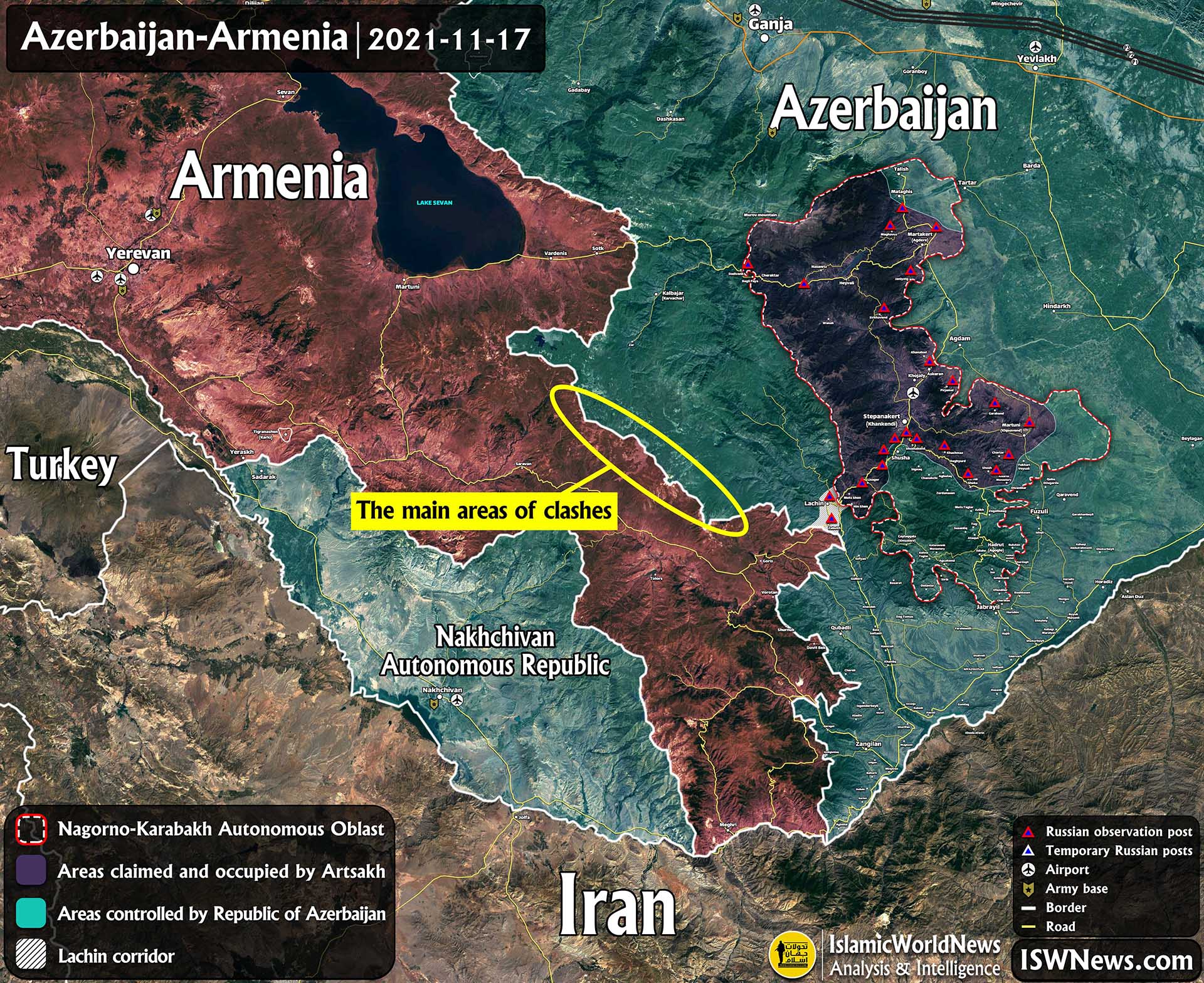
According to the field evidence, on November 16, the Azerbaijani military, in violation of the peace agreement advanced on several border points in the Armenian province of Syunik, But in the aftermath of the aggression, they faced a strong response by the Armenian military.
The clashes between Azerbaijan and Armenia started at about 1 pm and ended with the mediation of Russia and the declaration of a ceasefire at 5:30 pm (local time). During these conflicts, two Armenian military points were occupied by Azerbaijan.
According to a statement from the Armenian Ministry of Defense, one Armenian soldier was killed, 13 captured and 24 others were missing during the clashes. Also, according to the information provided by the Azerbaijan Ministry of Defense, 7 Azerbaijani servicemen were killed and 10 others were wounded.
Following the clashes, the Iranian Foreign Ministry, the Russian Ministry of Defense and the United Nations issued messages calling for restraint on both sides and the de-escalation of the clashes. While emphasizing respect for international borders, the Iranian Foreign Ministry spokesman announced Iran’s readiness to help resolve the disputes between the Republic of Azerbaijan and Armenia peacefully. In this regard, the presidents of Iran and Russia during a telephone conversation stressed the need not to change the political geography of the Caucasus region.
Armenian Security Council Secretary Armen Grigoryan also called for Russia’s protection of Armenian territory under the 1997 agreement in an interview. Grigoryan went on to say that if the crisis is not resolved through Russia and the CSTO, they will ask for help from other international partners.
This afternoon, in order to reduce tensions between Azerbaijan and Armenia, Deputy Commander of the Southern Military District of the Russian Federation and Commander of the Russian Peacekeeping Forces in Nagorno-Karabakh, Lieutenant General Rustam Muradov, transferred the body of the Armenian soldier who was killed in November 16th battles from Baku to Yerevan.
In the autumn of 2020, the Republic of Azerbaijan launched a large-scale military operation with the full support of Turkey and the Israeli regime with the aim of full control over the Karabakh. In a 44-day period from September 27 to November 10, Azerbaijan has managed to control about 50 percent of the territory, including parts of the south (inside) of the Nagorno-Karabakh Autonomous Region, as well as the occupied territories around the Nagorno-Karabakh Autonomous Region. Subsequently, in accordance with the peace agreement reached between Azerbaijan and Armenia, the regions of Aqdam, Kalbajar and Lachin were handed over to the government of Azerbaijan.
The Peace Agreement consists of nine main clauses; However, the different interpretations of Azerbaijan and Armenia from the ninth paragraph of this agreement have prevented the achievement of a lasting peace. By exploiting this clause, the Baku government is also trying to fulfill its illegitimate demands, using this issue as a pretext to create an illegal corridor called the Zangezur Corridor or to occupy the Armenian province of Syunik.
According to a Syrian military source, at 00:45 local time, the Israeli regime fired two missiles from the occupied Golan Heights at the southern part of Damascus. One of the Israeli missiles was shot down and the other hit an empty building in the south of Damascus, which did not cause any damage.
On November 8, Zionist warplanes also targeted several areas in Homs and Tartus provinces. The attack injured two Syrian Army soldiers and caused material damage.
Recent attacks by the ISIS terrorist group in recent days have targeted civilians in various parts of Kabul, the details of which are as follows: 1- An IED blast in the path of a car carrying civilians in Dasht-e Barchi area of Kabul, resulted in the death of 6 people, including a journalist and the wounding of 7 others. ISIS claims that 20 people were killed and wounded in the attack. 2- Explosion of a sticky bomb in Kote Sangi area of Kabul, resulted in the death of one person and the wounding of another. (image)
In response to the ISIS attacks, the Taliban announced a security operation in the fourth district of Kandahar, during which four ISIS members reportedly were killed and eight others were arrested. Two civilians were also killed in the clashes.
Khalil Hamrah, a spokesman for the Taliban’s security service, said that during the past three months, Taliban security forces had killed 33 ISIS members and detained more than 600 others. On the other hand, Amir Khan Muttaqi, the acting head of the Taliban’s foreign ministry, claims that the ISIS group has been completely destroyed in 70% of Afghanistan.
In the latest disclosure by the hacker group “Moses Staff”, the details of 16 members of unit 8200 were published along with part of the information of an important project as well as minutes of the 3D map of the occupied territories with an accuracy of 5 cm.
The group has accessed critical information and databases of many servers during cyberattacks on the Israeli regime’s sensitive cyber infrastructure And continuously publishes them; For this reason, the Zionists are working hard to eliminate or restrict the channels and media of the “Moses Staff”.
The Moses Staff hacker group announced that it has access to a complete 3D map of the occupied territories with a volume of 22 terabytes and an accuracy of 5 cm. The importance of this issue becomes clear when we know that satellite companies always refrain from providing up-to-date and high-quality satellite images of the occupied territories to ensure the security of Israel, or that some areas are always on their censorship list. Therefore, achieving a complete and 3d map of all areas in the occupied territories is very important and is a Heavy security blow to the Israeli regime and has many bad consequences for Israel. The video below is a small part of this 3D map.
The Moses Staff hacker group also released information about an important Israeli Army project called the Ofek project and showed its intelligence dominance and the quality of the stolen documents.
The Eritrean Defense Force, the People’s Front for Democracy and Justice, Hidri Trust, Red Sea Trading Corporation, Hagos Ghebrehiwet W Kidan and Abraha Kassa Nemariam are four Eritrean entities and two individuals that has sanctioned by the US Treasury Department for involvement in Ethiopian conflict and human rights abuses. Eritrea is an ally of the Ethiopian federal government and has long been hostile to Tigray separatists. The Ethiopian military has been directly involved in last year’s fighting in the Tigray region, assisting Ethiopian federal government forces in capturing parts of Tigray state. Parts of the northern Tigray region is currently occupied by Eritrean forces.
The Eritrean entities and individuals are being sanctioned while the Ethiopian federal government and its supporters accuse the United States and Western countries of supporting Tigray militants and interfering in Ethiopian affairs. Supporters of the federal government believe that the United States and its media are trying to overthrow the independent government of Ethiopia by spreading false news and distorting the facts.
Recently, several opposition groups announced the formation of a new alliance to overthrow the Abiy Ahmed’s government and provide a new transition period in the country. The press conference of the representatives of these groups in Washington is one of the main signs of US support for anti-government armed groups in Ethiopia.
On the ground, in recent days, the Tigray forces (TDF) and the Oromo Liberation Army (OLA) have occupied the areas of Akesta, Koke Agar, Germame, Lege Ambo, and Fito in Amhara State. Clashes continue in the eastern part of Amhara state in the mentioned areas.
Clashes between TDF and the federal government forces continued on the Kasa Gita-Mile front in Afar state. Federal government forces, with the help of Afar State forces, are fiercely resisting on this front and have so far prevented further advance by Tigray forces. The pro-Tigray sources released a video announcing the downing of a Federal Air Force Mi-35 helicopter using MANPAD on this front. According to available infromation, five federal government aircraft, including two MiG-23s, two Mil-35 helicopters and a Hercules L-100-30 have been shot down in northern Ethiopia over the past year.
Ethiopian Air Force Mi-35 helicopter targeted near Kasagita
After the start of the Saudi coalition operation on the west coast of Yemen on April 2018, the town of Al-Tuhayta came under heavy attacks and finally fell after six months of resistance by Ansar Allah forces. But in recent days, following the vast withdrawal of the Saudi coalition from the west coast of Al-Hudaydah, Ansar Allah once again has regained control of Tuhayta town.
1- Aleppo: – On November 7, an American drone using a Hellfire R9X missile, targeted a vehicle at the entrance of the city of Jarabulus. As a result of this attack, a person named “Abu Abdo Al-Hamwi”, one of the former ISIS commanders was killed and another person was seriously injured. – On November 12, Syrian Army artillery attacked the village of Kafr Nooran in western Aleppo.
2- Idlib: Russian fighter jets attacked Ankara-Backed militants on the outskirts of Idlib city.
3- Daraa: On the morning of November 7, two Syrian army officers were killed by unknown gunmen in the town of Da’el and the village of Maliha in Daraa province.
4- Deir Ezzor: – On November 10, the US sent military convoy to Al-Omar and Al-Conico bases in Deir Ezzor – On November 12, Unidentified gunmen attacked SDF vehicle in the town of al-Susah.
5- Raqqah: On November 13, The Ankara-backed Ahrar al-Sharqiya militants claimed to have shot down a Russian reconnaissance drone in the village of al-Mushayrifa, near Ain Issa.
6- Hasakah: On November 9, a Turkish drone struck a vehicle carrying the Syrian Democratic Forces (SDF) in the al-Hilaliya neighborhood of Qamishli city. An SDF field commander named “Yousef Golu” and two others named “Mazlum Golu” and “Mohammad Mahmoud Golu” were killed in the attack.
7- Hama: On November 12, Russian fighter jets attacked ISIS hideouts in Ithriyah area.
8- On November 8, the Israeli regime warplanes attacked several targets in Homs and Tartus provinces
9- The Commander of the US Central Command stated that the Syrian Democratic Forces have nothing to do with the attack on Turkey from Syrian territory and that we will seek to resolve tensions between the two sides in the coming days.
10- According to a Turkish newspaper, Turkish-backed militants with the support of the Turkish army and commando units will carry out an operation with a capacity of 35,000 men on two main lines in northern Syria.
11- On November 9, Syrian President Bashar al-Assad hosted UAE Foreign Minister Abdullah bin Zayed Al Nahyan and his political deputy, Lifa Shahin Khalifa Al-Marr.
Following the October 25th coup d’état in Sudan, the Sudanese Army Commander, General Abdel Fattah al-Burhan reappointed himself as leadership of the transitional council.
Abdel Fattah al-Burhan has also appointed Mohamed Hamdan Dagalo as his deputy, claiming that as long as Sudan’s political problems persist, the military-led transitional council will run the country. Also, since October 23, more than 100 government officials and political leaders supporting the transitional government have been detained by the Sudanese army.
Protesters and supporters of the transitional government led by Prime Minister Abdalla Hamdok are still on the streets, and protests ongoing in several Sudanese cities.
Sudan’s internal situation has deteriorated again since the recent coup, and fuel and food prices have risen sharply as the country’s ports have been closed. UN officials have also, as usual, expressed concern over the developments in Sudan! Human rights activists and UN envoys have also reported that 14 people have been killed by security forces since the beginning of the protests.
The Sudanese military-led transitional council was formed after the 2019 military coup and the ouster of Omar al-Bashir, with 11 members of military officials and politicians (along with the army). The civilian-led transitional government was formed in August 2019 with the participation of the army and the political coalition of Freedom and Change for three years, which was again faced with a military coup. Since then, the people and supporters of the transitional government have begun protesting against the army. In response to popular protests, the commander of the Sudanese army, General al-Burhan, claimed that he would not run for office after the elections and the establishment of the Sudanese government, and that he would hand over power to a civilian government.
According to the spokesman for the Yemeni Armed Forces, Brigadier General al-Sari’, a Saudi coalition ScanEagle drone was shot down on the morning of November 13 by Ansar Allah air defense in the skies of al-Jubah district in the southern province of Marib. The Saudi coalition warplanes bombed the wreckage of the drone three times after it was shot down by Ansar Allah.
This is the sixth US Scan Eagle drone to be shot down by Ansar Allah in Yemen.
The first US Scan Eagle drone was shot down on June 19, 2021, the second on June 21, 2021 at the al-Mashjah heights in western Marib province, the third on August 14, 2021 in Marib province, the fourth on September 27 in the skies of the Madghal district in the western part of Marib province and the fifth on November 9 in the skies of al-Jubah district in Marib province.
The use of Scan Eagle drones in the Yemeni war has taken place over the past year, and it has not yet been determined who are the users of this type of drone. However, the Saudis appear to be using the drones with the help of American advisers.
The ScanEagle is a spy drone equipped with an electro-optical and infrared camera that does not require a runway to fly. The drone can fly for more than 20 hours, which allows for reconnaissance operations.