Category: Article

  • A Look Into Challenges Of Peace Talks In Yemen

    A Look Into Challenges Of Peace Talks In Yemen

    Let’s scrutinize why the nature of the resigned government of Yemen is illegal and the Saudi-led coalition’s operations in Yemen are considered an invasion.

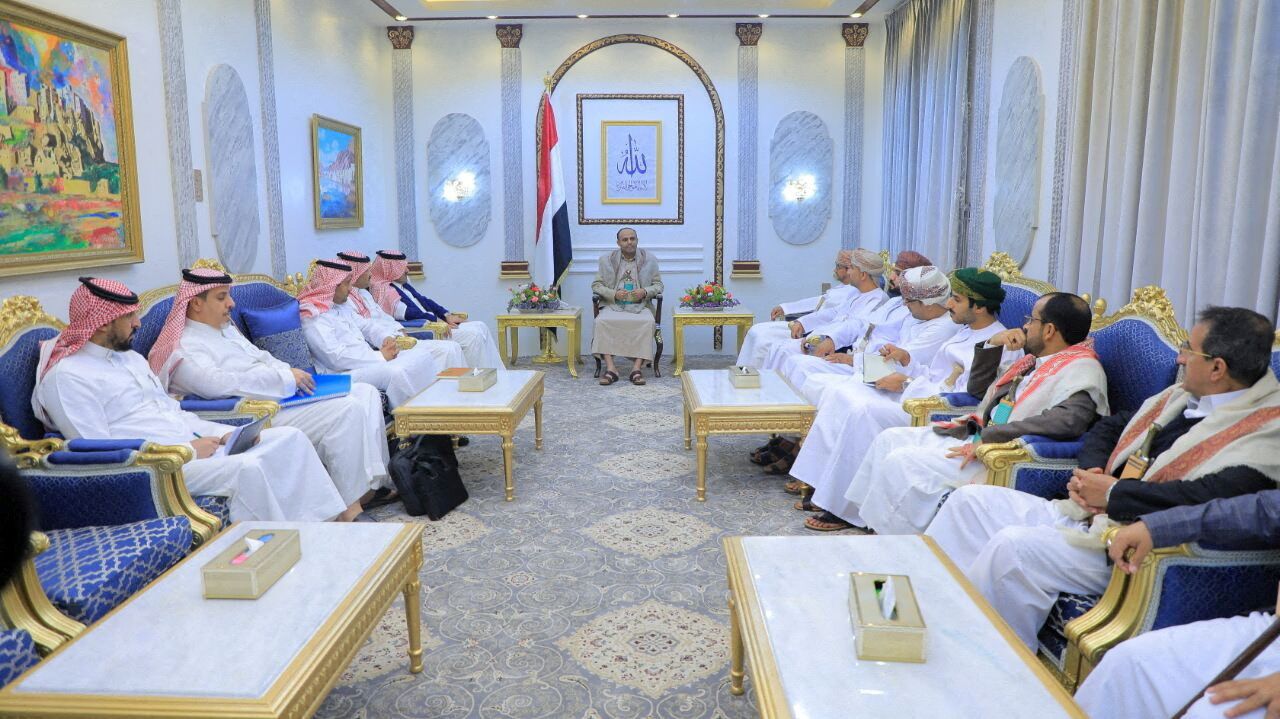
    A few days ago, the [Persian] Gulf Cooperation Council, led by Jassim Mohammed Al-Budaiwi, the Secretary-General of the council, traveled to the city of Aden in Yemen. This trip was the first visit by officials of this council to Yemen after 2014. In this meeting, Al-Budaiwi emphasized an issue that is the root cause of the crisis and lack of progress in Yemen’s negotiations, and that issue is nothing but the three references.

    The three references include the 2011 [Persian] Gulf Cooperation Council initiative, United Nations Security Council Resolution 2216, and national dialogues recognized by Arab countries as a reference for resolving the Yemeni crisis. However, these references are not solution to the Yemeni crisis but have become a major obstacle to advancing peace negotiations. To clarify the aspects of these three references, we explain them in general:

    1- The 2011 [Persian] Gulf Cooperation Council initiative: 

    This [Persian] Gulf Cooperation Council initiative was presented on April 3, 2011, by the United States and Saudi Arabia to resolve the Yemeni crisis. This initiative is also known as the “Gulf Initiative,” according to which Ali Abdullah Saleh, the then-president of Yemen, was given a 30-day deadline to step down and transfer power to his deputy, Abd Rabbuh Mansur Hadi. Mansur Hadi also had 60 days to form an interim government and prepare the ground for power transfer through elections. This initiative did not end with the resignation of Ali Abdullah Saleh, and Abd Rabbuh Mansur Hadi became the president of Yemen with the support of Arab countries in a one-person election. The seizure of power by the Yemeni revolution and the intervention of Arab countries in the affairs of this country provoked the anger of the Yemenis and led the Ansar Allah movement fighters towards capital Sanaa. Eventually, the Ansar Allah forces entered Sanaa by breaking the defensive lines of Abd Rabbuh Mansur Hadi’s supporters and took control of the government. After the unsuccessful political negotiations between the two sides, Mansur Hadi went to parliament on January 22, 2015 and resigned from his position. A month after his resignation, he was interrogated by intelligence and judicial authorities and finally fled from the presidential palace in Sanaa to Aden on February 21, 2015. This move was followed shortly with an invasion by the Saudi-led coalition, which complicated the political crisis in Yemen with the foreign invasion.

    2- United Nations Security Council Resolution 2216:

    On April 14, 2015, the United Nations Security Council, without mentioning the Saudi-led coalition’s invasion of Yemen, declared the prohibition of sending any weapons to the Ansar Allah fighters and Ali Abdullah Saleh’s forces in a resolution. This resolution also called on the Ansar Allah movement to hand over power and retreat from Sanaa as well as other cities in Yemen. The UN Security Council also approved the inspection of all ships heading to the war-stricken Arab country. It also banned travel for Abdul-Malik Badruldeen al-Houthi as well as Ahmed, the senior son of Ali Abdullah Saleh.

    3- National dialogues:

    Following the Saudi-led coalition’s invasion of Yemen, Yemeni national dialogues in Sanaa were halted, and prominent factions such as the al-Islah Party (Yemeni Congregation for Reform), and southern parties and so on, could raise the banner of opposition to the central government in Sanaa due to the support they received from Saudi Arabia, the United Arab Emirates (UAE), and other Arab countries. Following negotiations by the Ansar Allah movement in Sanaa, various political parties that were led by the General People’s Congress under the leadership of Ali Abdullah Saleh united with the Yemeni National Salvation Government. This move weakened the opposition; so, the Ansar Allah movement, after months of heavy defense, was able to repel the Saudi-led coalition’s attacks on Sanaa and Al Hudaydah Governorate in a short period as well as cleanse a large part of the areas under the control of the Yemeni government in Marib, Al Jawf, Saada, and Al Hudaydah governorates.

    Over the recent years, many events, such as Ali Abdullah Saleh’s betrayal of the Ansar Allah movement, the Stockholm Agreement, the assassination of Saleh Ali al-Samad, the head of the Supreme Political Council of the National Salvation Government, etc., have changed the course of developments in the Arab country. However, none of these events, like the Ansar Allah’s missile-drone operations against deep areas in both Saudi Arabia and the UAE, had a significant impact on peace negotiations, and ultimately a UN-mediated ceasefire between the Ansar Allah movement and the Saudi-led coalition was established in April 2022.

    Despite the establishment of a ceasefire and the Ansar Allah’s efforts to engage in talks with the Islah Party and southern factions in various incidents, intra-Yemeni political dialogue have not been held at any time or place. The main reason for this is the opposition groups’ dependence on Saudi Arabia and the UAE, as well as recent US interventions in Yemen’s developments.

    Therefore, the three references are chiefly a hindrance to peace negotiations and the unity of different groups in Yemen rather than a solution to the Yemeni crisis. The [Persian] Gulf Cooperation Council’s initiative can be seen as direct interference in the affairs of an independent country, and UN Security Council Resolution 2216 is interpreted as supporting Arab and Western countries’ goals in Yemen. When a political figure speaks against the three references, it can be inferred that there is no intention to resolve the Yemeni crisis, and some are trying to escalate the war in the country.

    In addition to these issues, there are numerous obstacles to Yemeni negotiations that prevent them from reaching a conclusion. These obstacles include US pressure on Saudi Arabia, the United Nations’ involvement in Yemen’s internal affairs, the dependence of Yemeni factions on Saudi Arabia and the UAE, the separatist tendencies of some southern parties with British support, the presence of terrorist groups particularly Al-Qaeda in occupied areas, the disregard of global powers such as Russia and China for Yemen’s developments, internal issues such as the lack of payment of salaries to Yemeni employees from oil revenues, and the ongoing blockade of Yemen.

    As a result of preventing the Ansar Allah movement from exporting Yemen’s oil and gas, the resigned government’s budget has reportedly faced a 50% deficit, which will put significant financial pressure on their Saudi and Emirati supporters. International organizations under the auspices of the United Nations, especially the World Food Program, have also significantly reduced their aid to Yemen, forcing UN representatives to hold a special session in New York to collect humanitarian assistance.

    Overall, Yemeni peace negotiations, in addition to internal differences and challenges, have become entangled in a more significant regional issue. The success of the Shia Muslims in gaining control of the Yemeni government and the Saudi-led coalition’s invasion of the Arab country with Western support led to Yemen becoming a proxy war between Iran and the United States. Nowadays, this war has entered a new phase with the agreement between Iran and Saudi Arabia, which has led to the resolution of some issues such as the maritime and aerial blockade of Yemen. However, fundamental differences remain, and there is still a long way to go in starting discussions on the formation of a united government and the path to achieving lasting peace.

  • Infographic: US Air Attacks On Yemen

    Infographic: US Air Attacks On Yemen

    The USS Cole bombing was a suicide attack by al-Qaeda against USS Cole, a guided missile destroyer of the United States Navy, on 12 October 2000, while it was being refueled in Yemen’s Aden harbor. Seventeen US Navy sailors were killed and thirty-seven injured in the deadliest attack against a United States naval vessel since the USS Stark incident in 1987.

    After the Al-Qaeda attack on the US ship USS Cole in Aden port, and also the incident of September 11, 2001 in New York City, the then US administration concluded that it should take action against this terrorist group in Yemen as well as Afghanistan.

    Following former US president George Bush’s decision to start attacking Al-Qaeda in Yemen, the US military and security agencies in coordination with the then Yemeni government led by Ali Abdullah Saleh began their attacks in this country. These attacks continued after popular protests in Yemen and the downfall of Ali Abdullah Saleh’s government, and after such developments, the eight-year battle between the Ansar Allah movement and the Saudi-led coalition continued.

    According to Western media reports, the US has so far carried out 378 attacks, including aerial (by fighter jets and combat drones), missile and ground attacks in this Arab country, which has resulted in the deaths of 1,400 to 1,800 people. So far, a large part of the details and information about these 379 operations have not been published, and the following list has been compiled based on the information available about drone operations that have been reported so far. The operation list is as follows:

    1- The US MQ-1 Predator drone attack on the vehicle of al-Qaeda militants in Marib province, November 5, 2002. This attack resulted in the death of six members of al-Qaeda, including the leader Salim Sinan Al-Harethi, known as Abu Ali Al-Harethi (accused of helping to bomb the USS Cole in Aden).

    2- The mistaken attack of the American drone on a gathering in Wadi Obayda in Marib province on May 24, 2010. This attack, instead of an al-Qaeda rally, resulted in the death of five people, including Jaber al-Shabwani, the deputy governor of Marib province, who was mediating between the government and the militants. This murder caused the bloodshed of the Shabwani tribes and their conflict with the government forces. They also attacked an oil pipeline in Marib twice.

    3- The attack of the American drone on the car of two people suspected of being members of the Al-Qaeda group named Abdullah and Masad Mubarak on May 5, 2011. The aim of this attack was to kill Anwar al-Awlaki, a propaganda member of al-Qaeda, but he was not hit in this attack.

    4- The attack of the American fighter jet or drones on the residence of Ali Abdullah Naji al-Harethi, a member of al-Qaeda, and several other suspects, including Ammar Abadah Nasser al-Waili in Zanjibar city on June 3, 2011. Al-Harethi was one of the companions of Abu Musab al-Zarqawi in Iraq and al-Waili was present in the war in Afghanistan and was ordered by Bin Laden to establish a training camp in Saada.

    5- The attack of the American fighter jets or drones on a police station in the district of Mudiyah, located in the province of Abyan on July 14, 2011. The media and the Yemeni government at the time reported the casualties of this attack between 6 and 50 dead. Also, on the same day, the American drone targeted the car of Fahad al-Qasso, a senior member of al-Qaeda in Yemen, near the same area, and he survived the attack.

    6- The attack of American drones with the participation of Yemeni army fighter jets on Al-Qaeda positions in the areas of Al-Wahda, Al-Amoudi and Al-Khamila in Abyann province on August 1, 2011. As a result of these attacks, 15 militants suspected of being members of Al-Qaeda, including Nasser al-Shadadi, one of the senior members of Al-Qaeda, were killed and 17 others were wounded.

    7- American warplanes and drones attack suspected al-Qaeda positions in the outskirts of Zanjibar city in Abyan province on August 24, 2011. This attack killed 30 people and injured 40 others.

    8- The American fighter jet attack on a mountain pass in Abyan province on September 21, 2011, which resulted in the death of four Al-Qaeda members. At the same time, seven Al-Qaeda fighters were killed in the coastal city of Shuqra.

    9- American drone attack on Anwar al-Awlaki, one of the senior propaganda members of Al-Qaeda in Al-Jawf province on September 30, 2011. In addition to Al-Awlaki, three other people were killed in this attack, including Samir Khan, the American-born editor of Inspire magazine. This attack has been called the first attack in which the US military intentionally attacks its own citizens.

    10- American drone attack on al-Qaeda hideouts in the east of Zanjibar, the capital of Abyan province, on October 5, 2011. This attack resulted in the death of five Al-Qaeda members.

    11- American fighter jet or drone attack on an unknown mosque in Shabwa province on October 14, 2011. Some American media, quoting the Ministry of Defense of the Yemeni government at the time, claimed that seven Al-Qaeda members were killed in this attack, including Ibrahim Al-Banna, the media officer of Al-Qaeda (Egyptian origin), but this information is not correct, and currently the United States has offered a reward of 5 million to find Al-Banna.

    12- In another attack on October 14, 2011, the American drone assassinated the 17-year-old son of Anwar al-Awlaki along with eight other people in Shabwa province.

    13- American drone attack on the location of al-Qaeda members in the city of Jaar in Abyan province on December 22, 2011. In this attack, Abdulrahman al-Wahishi, a relative of Nasser al-Wahishi, the leader of al-Qaeda branch in Yemen, was killed along with eight others.

    14- American drone attack on the gathering place of Al-Qaeda members near Lowdar city in Abyan province on January 31, 2012. During this attack, 11 al-Qaeda members were killed, including Abdul Moneim al-Fatani, one of the perpetrators of the attack on the USS Cole in October 2000.

    15- The American drone attack on al-Qaeda’s hideout near Al-Bayda on March 9, 2012, which led to the death of Abdul Wahab al-Hamiqani, one of the local commanders of al-Qaeda, and 16 others.

    16- American drone attack on the gathering of al-Qaeda militants in the city of Jaar in Abyan province between March 9 and 11, 2012. This attack killed 20 people suspected of being members of Al-Qaeda group.

    17- American drone attack on Al-Qaeda weapons warehouse in Jaar city, between March 9-11, 2012. Three al-Qaeda members were also killed in this.

    18- An American drone attack on a vehicle carrying Al-Qaeda militants in Al-Bayda province on March 14, 2012, which resulted in the death of four Al-Qaeda members.

    19- American drone attack on the location of al-Qaeda militants in Lowdar city on April 11, 2012. This attack resulted in 14 deaths.

    20- An American drone attack on the residence of Muhammad Saeed Al-Amdeh (Gharib al-Ta’zi), one of the senior members of al-Qaeda, in Al-Samadeh region, between Marib and Al-Jawf provinces on April 22, 2012.

    21- American drone attack on the location of Fahd Muhammad Ahmed al-Qasu and another Al-Qaeda member in the south of Shabwah province on May 6, 2012.

    22- The attack of an American drone on a wedding ceremony in the Radaa area of Al-Bayda province on December 12, 2013, which led to the death of 15 civilians. The US claims that 9 to 12 Al-Qaeda militants were killed in this attack, and the claim that civilians were killed is not true.

    23- American drone attack on a car carrying two Al-Qaeda members in Al-Qatman area of Hadhramout province on January 8, 2014.

    24- American drone attack on the car of al-Qaeda militants in Al-Mifaa area in Shabwa province on March 3, 2014. This attack killed three Al-Qaeda members, and it is believed that Mujahid Jaber Saleh al-Shabwani was one of the dead.

    25- On April 20 and 21, 2014, American drones attacked al-Qaeda positions in southern Yemen, which, according to the Ministry of Defense of the resigned government of Yemen, led to the death of 22 members of this group.

    26- American drone attack on the location of Nasser Abdul Karim Al-Wahishi, one of the leaders of al-Qaeda in Hadhramaut province (probably Al-Mukalla city) on June 12, 2015.

    27- The attack of the American fighter or drones on the al-Qaeda camp in the Hajar region of Hadhramaut province on March 22, 2016. This attack led to the death of 40 to 50 members of this group.

    28- American drones attacked the government intelligence headquarters in Zanjibar city and other positions of Al-Qaeda members in the areas of Naqeel Al-Haila and Al-Hazan in Abyan province on March 27, 2016. The casualties of al-Qaeda in these attacks have been announced as eight.

    29- American fighter or drone attack on al-Qaeda positions in Shabwah province on October 4 and 18, 2016.

    30- American fighter or drone attack on the location of Al-Qaeda members in Marib on October 21, 2016. Five Al-Qaeda members were killed in this attack.

    31- The attack of American drones on unspecified areas in Al-Bayda province on January 21, 2017, which resulted in the death of three people. This attack was the first US airstrike in Yemen since the beginning of Trump’s presidency. The United States claims that one of the killed people, Abu Anis al-Abi, was one of the field commanders of al-Qaeda and two other members of this group, but local sources called them construction workers.

    32- On October 2, 2017, American drones and fighters carried out 30 attacks on al-Qaeda positions in the three provinces of Hadhramaut, Shabwa and Abyan.

    33- American drone attack on a car carrying al-Qaeda members in Shabwa province on July 6, 2018. This attack killed seven people.

    34- American drone attack on the location of Jamal al-Badawi, one of the agents of the Al-Qaeda attack on the USS Cole in Marib province on January 1, 2019.

    35- The attack of three American drones on al-Qaeda positions in Al-Bayda province on June 24, 2019. These attacks led to the death of 5 people suspected of being members of the Al-Qaeda group.

    36- The attack of American drones on Jo Al-Nasim area in Wadi Obeidah and an unspecified place in the administration of Obeidah located in Marib province on January 25, 2020. The attack on Obeidah resulted in the death of an unknown person.

    37- American drone attack on al-Hazmeh area in Marib province on January 27, 2020. During this attack, Abdullah al-Adani, a member of Al-Qaeda, was killed.

    38- An American drone attack on a car at the Al-Qaeda checkpoint in the village of Hassoun al-Mashrif in the administration of Wold Rabi in Al-Bayda province on January 29, 2020. America claims that it killed Qasim Al-Rimi, the leader of al-Qaeda in Yemen, in this attack.

    39- American drone attack on the car of al-Qaeda members on the eastern road of Marib on November 13, 2021.

    40- American drone attack on the gathering of Al-Qaeda members in a house in Al-Hadba area in the northeast of Marib city on November 30, 2022. This attack led to the death of several people, including Abi al-Khair Abdulwahid al-Najdi, the person in charge of engineering and making explosives of Al-Qaeda group. Also, Hassan al-Hazrami and Ahmad Zaki, other prominent members of al-Qaeda, were also wounded.

    41- An American drone attack on a vehicle carrying al-Qaeda militants near the Al-Haira gas station in the Al-Samada region on the Marib-Al-Abar road on January 30, 2023. In this attack, three occupants of the car were killed, including Yasir Abdullah Rashid Al-Amiri from the administration of Wasab Al-Ali in Dhamar province, Hossein Hadbol al-Makni (Hassan al-Hazrami) in charge of making bombs and explosives for al-Qaeda, and his brother Musa Hadbol (Mohed al-Hazrami).

    42- American drone attack on a house in Al Jalal area, located in the east of Marib city, on February 26, 2023. This attack led to the death of Hamad bin Hamoud al-Tamimi (Abd al-Aziz al-Adnani), a Sharia official and one of the prominent commanders of al-Qaeda in the Arabian Peninsula, and one of his bodyguards.

    43- American drone attack on a bus near Shaqman gas station in Hajba area, located in the south of Marib city on August 30, 2023.

    Out of these attacks, one attack was carried out during George W. Bush’s tenure, 185 operations during Barack Obama’s presidency, 188 operations during Donald Trump’s era, and five attacks during the Joseph Biden administration.

    It is worth mentioning that the main goal of the US attacks in Yemen was to prevent Al-Qaeda from gaining power in the Arab country. However, these attacks have not had any significant impact on the developments in Yemen, and Al-Qaeda still operates in the governorates of Hadhramaut, Shabwah, and Abyan. In contrast, the operations by Ansar Allah fighters in Saada, the northern governorate of Al-Bayda, Al-Jawf, Marib, and Sanaa have been more effective in combating terrorism in Yemen. Al-Qaeda terrorists’ presence in many of those areas has been eliminated for years.

    It should be noted that the decision to use Al-Qaeda terrorists in the war against Ansar Allah was made by Saudi Arabia and the United Arab Emirates (UAE). This shows that the United States had no problem with the decision until the ceasefire between the Saudi-led coalition and Ansar Allah movement was established. Following the developments, they resumed their attacks on Al-Qaeda elements, especially in Marib.

    Despite the direct attacks by the US, Al-Qaeda’s activities in Yemen continue, mainly concentrated in the governorates of Hadhramaut, Shabwah, and Abyan. They are heavily engaged in fighting with the militants affiliated to the Southern Transitional Council (STC) in northern Abyan and are trying to recruit more human resources in the Shabwah tribes. They have also disappeared into the desert areas of Hadhramaut. However, unlike their presence and influence in these areas, no area is entirely under their control. This situation has allowed them to maintain their presence in Yemen and keep their Takfiri rivals, especially ISIS, out of competition.

    Finally, it should be asserted that unlike southern separatists and other secessionist movements in Yemen, Al-Qaeda has a broader view of this region and aims to control the Arabian Peninsula. However, this issue is limited to threats by their senior officials in speeches and has not yet been practically realized. Perhaps this trend has led the United States to reduce its attention to Al-Qaeda’s presence in Yemen, and their attacks have become more of a security and symbolic measure.

    US Air Attacks On Yemen – click to view full size
  • A Small US Airport At Northern Part Of Italian Embassy In Baghdad; How Could It Be!?

    A Small US Airport At Northern Part Of Italian Embassy In Baghdad; How Could It Be!?

    The recent flights of the United States’ helicopters from the Baghdad Diplomatic Support Center or the US airbase at the Baghdad International Airport to the US embassy in Iraq as well as the helipad of US helicopters in the northern part of the Italian embassy in the capital city have been observed for some time in the skies of Baghdad. 

    The flight records of these helicopters show that in addition to various US helicopters, including Sikorsky UH-60M Black Hawk, the American landing strip in the northern part of the Italian embassy in Baghdad also hosts light aircraft such as Beech A36 Bonanza. In a way, it can be said that this embassy has turned into another small airport for the United States in the Iraqi capital.

    American Beech A36 Bonanza flight from this location to Baghdad airport

    According to IWN field sources, senior US officials and forces were transferred from the Baghdad airport to the US embassy by car in recent months, but this process has changed in recent weeks due to Americans’ fear of being assassinated, identified, and so on. And their transfer operations from the US embassy to the Baghdad International Airport and vice versa are now carried out using helicopters, and their car trips have decreased in comparison to the past.

    It is not yet clear why Americans have changed their method of transferring forces to the US embassy in Baghdad. In addition to the flights of the US helicopters inside their embassy and another helipad in the eastern part of the US embassy, the small American airport in the northern part of the Italian embassy is one of the main aerial routes for transporting people and equipment to/from Washington’s embassy and Baghdad airport.

    Satellite images at different times also show various US helicopters stationed at this location. So far, Iraqi government officials and resistance groups’ commanders have not reacted to these movements by the Americans.

    The continuation of these actions and the failure of American soldiers to leave Iraq have caused many people in this country to protest against the Iraqi authorities over the continuation of the United States’ military presence; on the contrary, Iraqi officials neglected the demands and even requested the North Atlantic Treaty Organization (NATO) to increase their military activities in the Arab country.

    However, in accordance with international law, no country is allowed to carry out military actions and reactions in the area of an embassy; so, it seems to be essential to answer the question of whether the US embassy in Baghdad is subject to diplomatic immunity as a result of such a situation or not.

  • Coup In Niger; France In Turmoil

    Coup In Niger; France In Turmoil

    On July 26, the presidential guard of Niger arrested President Mohamed Bazoum along with his family at the Presidential Palace in capital Niamey under the command of General Omar Tchiani. At the same time, another group of Niger’s military personnel led by Colonel Amadou Abdul Rahman announced the coup through a live TV program, when they officially declared the removal of President Bazoum.

    Colonel Abdul Rahman also said in this statement that security and defense forces had been forced to carry out a coup due to the severity of the security circumstances as well as bad governance. The colonel asked foreign countries to refrain from any interference in Niger’s internal affairs.

    Abdul Rahman also announced that government institutions were suspended, all borders of Niger were closed, and a military government was set up throughout the country. The Nigerien armed forces issued a statement signed by General Issa Abdou Sidikou, Chief of Staff of the Niger Army, expressing their support for the coup in order to prevent bloodshed and protect the lives of the President and his family as well as the security of the people of the country.

    One day after the coup was announced in Niger, President Mohamed Bazoum swore in a message posted on social media to protect democratic achievements. His Foreign Minister, Hassoumi Massaoudou, also asked his supporters and democratic forces to stand up against the coup plotters.

    The resistance of Bazoum and his government has led his supporters to launch protests in front of the Presidential Palace and demand the release of the President as well as an end to the coup. Niger’s military supporters also gathered in front of the National Assembly with the Russian flag in their hands and they chanted anti-French slogans. They also set fire to the headquarters of Niger’s Party for Democracy and Socialism (the ruling party) in Niamey, which was confronted by the police of the African country.

    The military, in their next step, formed the National Council for the Safeguard of the Homeland on July 28 and appointed General Omar Chiani, the commander of the Presidential Guard, as the leader of the council.

    French President Emmanuel Macron described the coup in Niger as illegitimate and announced France’s readiness to work with regional organizations to sanction the coup leaders. European countries and the United States also expressed their support for President Bazoum and called for his release. The African Union issued a 15-day ultimatum to the National Council for the Safeguard of the Homeland to restore the previous government to power.

    The military forces of Niger considered this ultimatum a declaration of war against Niger and declared their readiness to defend the African country. Along with the African Union, the Economic Community of West African States (ECOWAS) has strongly reacted to the coup in Niger and issued a joint statement on July 30 with the aim of suspending trade and financial transactions with Niger and imposing sanctions on the coup leaders. The 15-member group of ECOWAS has given one week for the release of President Bazoum as well as the restoration of the presidency, threatening to take all necessary measures, including military action, if the demands are not met. The latest news indicates that ECOWAS has approved an attack on Niger, and military invasion will kick off soon.

    The position of the countries in favor (Mali and Burkina Faso) and against (ECOWAS members) of the coup in Niger

    Along with the intensification of foreign threats against the military forces of Niger, two countries of Burkina Faso and Mali, in a joint statement on July 31, considered any foreign military intervention in Niger as a declaration of war against these two countries as well. It should be mentioned that the governments of these two neighboring countries were also dependent on France in the past and were under the influence of this European power, but they came out of French domination as a result of similar coups.

    The Interim President of Guinea Mamady Doumbouya also announced that he would not participate in any action against Niger in a similar position to Mali and Burkina Faso. Algeria also opposed any foreign military intervention in Niger.

    However, the most interesting position by the foreign states was the reactions from the Russian government and head of the private military company Wagner Yevgeny Prigozhin. The Russian Foreign Ministry called the interference in Niger’s affairs unfounded and described Russia’s position as the need for normalizing the situation and getting on the path of law. In contrast to this position, Prigozhin introduced himself as responsible for the coup in Niger on a Telegram channel attributed to the official channel of the Wagner group, and he called this action an attempt by the people of Niger to gain independence from colonialism.

    In general, Niger is an important military and security partner of France in the West Africa region, and after the withdrawal of French troops from Mali, the Niamey base became the main French base in Africa. In addition, the CIA’s drone base is located in the northeastern part of the country. Niger has several high-quality uranium mines, and according to statistics, this African country, with a 5% share of global uranium production, is the seventh largest producer of this valuable material in the world, most of which is exported to France and Europe.

    Moreover, part of the project to transfer Nigeria’s gas to Europe under the name of the Trans-Saharan Gas Pipeline (TSGP) passes through the neighboring country. The change of government in Niger with the support of the Wagner group or Russia will force the French to leave this African nation as the move was done in Mali and Burkina Faso in recent years. The military defeat of the Western powers in Afghanistan and the West Asia region, the war between Russia and Ukraine, economic problems, and son on have caused colonial powers to become passive against military and security movements such as recent coups in West Africa; so, they have no tools other than economic pressures and empty threats. In case of success of the Niger coup, we should expect the domino-like collapse of French plans in this region and their military withdrawal from Group of Five (G-5) nations.

    Trans-Saharan Gas Pipeline route known as TSGP
  • Identification Of Formation And History Of Activities Of Tehrik-E-Taliban Pakistan

    Identification Of Formation And History Of Activities Of Tehrik-E-Taliban Pakistan

    In the early 1990s, Hafiz Muhammad Saeed and Abdullah Azzam, two of Osama bin Laden’s mentors, the leader of the Al-Qaeda terrorist group, created another terrorist group called Lashkar-e-Taiba, and Maulana Sufi Muhammad set up the Tehreek Nifaz Shariat-i-Muhammadi group in Pakistan. Members of the extremist group were sent to Afghanistan along with Al-Qaeda members to fight against the then Soviet Union.
    After the victory of the Mojahedin-e Afghan in Afghanistan, these groups found the opportunity to create military training bases on both sides of the Durand Line ( forms the Afghanistan–Pakistan border, a 2,670-kilometre international land border between Afghanistan and Pakistan in South Asia) and built dozens of training bases in those areas. The bases of extremist groups such as Lashkar-e-Taiba, Jaish-e-Mohammed and Al-Qaeda were located in the Muridke area of Lahore province, Pakistan, under the supervision of Pakistan’s Inter-Services Intelligence (ISI), which trained paramilitary forces and transferred them into Afghanistan.
    All members of these groups were involved in the conquest of Afghanistan, because of the fact that members of these groups had participated in jihad (fight) against the communist government of Afghanistan and had sacrificed for the success of the Taliban Islamic Emirate in the war-torn country. Eventually, in 2007 the foreign conquerors of the Afghan war, who were consisted of 13 Pakistani militant groups, reached a conclusion to unite and found Tehrik-e-Taliban Pakistan (TTP) umbrella organization.

    The examination and identification of the Tehrik-i-Taliban Pakistan movement is not possible without referring to the history of the Taliban in Afghanistan. Because on the one hand, these two groups are linked to each other in terms of political structure and beliefs, and on the other hand, their hideouts, human resources, spiritual and military leaders have close ties with each other along the Durand Line.

    The term “Taliban” was originally used to describe a political and ideological group that emerged in 1994 in the border town of Spin Boldak, Kandahar province, located in southern Afghanistan, having its roots in a Deobandi Islamic school of thought as well as the Wahhabi belief. They conquered the important city of Kandahar with a fatwa of jihad from their spiritual leader Mullah Mohammad Omar Mujahid and then, they set out for the city of Jalalabad and the capital of Afghanistan, Kabul, in a bid to overthrow the then communist government in the country.
    At a time when the Taliban were engaged in jihad to overthrow the communist government in Afghanistan and then, it clashed with the Mujahideen government composed of Tajiks, Hazaras, and Uzbeks, the tribal areas of Pakistan, including North and South Waziristan districts, were their safe route and arms supply line. Following the Taliban’s three years rule over Afghanistan and the terrorist attack in the United States on September 11, 2001, some Western countries led by the US and NATO kicked off invading Afghanistan with Pakistan’s green light. Simultaneously with the attack by the US and NATO forces on Afghanistan in 2001, radical members of the Afghan Taliban, including the Uzbek Taliban, the Islamic Movement of Uzbekistan (IMU), the Chechen immigrants, the East Turkestan Islamic Party, as well as several Arab members of the Al-Qaeda terrorist group took refuge in northern and northwestern Pakistan (North and South Waziristan districts).

    Pakistan’s cooperation with the US in attacking Afghanistan, along with former Pakistani Prime Minister Pervez Musharraf’s order to besiege Pakistan’s tribal areas and arrest Al-Qaeda fugitives despite coordination with tribal elders, turn into a headache for the Pakistani army.
    The Pakistani army entered South Waziristan District in 2003 after five decades and it continued the military operations to North Waziristan District in order to arrest Al-Qaeda members. The killing of tribal elders and spiritual figures in these areas by the Pakistani army led to the first clash between the Pakistani army and the Afghan Taliban, Al-Qaeda, Lashkar-e-Taiba, Jaish-e-Mohammed, and armed tribesmen from North and South Waziristan districts in 2004. Those clashes led to the withdrawal of the Pakistani army from Waziristan and the tribes took control of these areas.

    The failure of the plan to set up an Islamic government in Pakistan as well as the sectarian and ethnic structure, the educational system of religious schools based on Wahhabism sect, the dispatch of Pakistani jihadi forces to Afghanistan, economic and social disorder, especially in North and South Waziristan districts, foreign and domestic support by anonymous individuals and various groups are among the reasons for the formation of the Taliban group in Pakistan.

    However, the drone attack by the United States’ Central Intelligence Agency (CIA) on a religious school affiliated to Tehrik-e-Nifaz-e-Shariat-e-Mohammadi in Bajaur Agency (District) in 2206, which caused several casualties, was the main cause of the emergence of the Tehrik-e-Taliban Pakistan. For the reason that it prompted all armed and radical groups in Pakistan to declare jihad against the US and the Pakistani government.
    In 2007, numerous militants from 13 groups, including Mullah Nazir’s group in North Waziristan District, Tehrik-e-Nifaz-e-Shariat-e-Mohammadi led by Sufi Muhammad, Jaish-e-Mohammed, Lashkar-e-Taiba, Al-Qaeda, Afghan Taliban fugitives and other groups with different races led by Baitullah Mehsud from North Waziristan District founded the Tehrik-e-Taliban Pakistan. They declared their goal as defending Prophet Muhammad’s religion, fighting against the Pakistani and the US army, and establishing an Islamic emirate with the focus on the Pashtun people in Pakistan.
    In 2008, leader of the Afghan Taliban Mullah Mohammad Omar Mujahid dispatched a delegation led by Mullah Abdullah Zakir to Pakistan and asked for financial assistance from the Pakistani Taliban. Mullah Mohammad Omar Mujahid also asked the Pakistani Taliban to put aside their differences and to help him fight the US and NATO by sending troops.
    Baitullah Mehsud, Hafiz Gul Bahadur and Mullah Nazir who had a history of fighting in Afghanistan accepted the proposal of the leader of the Afghan Taliban and pledged allegiance to Mullah Mohammad Omar Mujahid; so, they formed a council of mujahideen union. However, this council did not last more than a year and did not have any specific performance.
    The clash between Tehrik-e-Taliban Pakistan and the army of the country was not very intense until 2007. But in 2007 to 2009, the volume of clashes intensified sharply. So, all military operations of armed groups against the Pakistani army from 2001 to 2007, which were about 30 operations and the volume of operations reached 269 attacks from 2007 to 2009. These clashes mostly took place in Khyber Pakhtunkhwa tribal areas and other border regions witnessed fewer tensions.

    The most important operation of the Pakistani Taliban can be considered the assassination of former prime minister and leader of the Pakistan People’s Party Benazir Bhutto. The assassination was carried out on December 27, 2007 by a suicide bomber named Karamatullah Bilal from Pakistani militants; he also had a history of membership in the Al-Qaeda terrorist group. After firing several bullets at Bhutto, he carried out a suicide operation and took the lives of 22 people, including Benazir Bhutto.
    However, Al-Qaeda denied any involvement in the suicide attack and eventually, Baitullah Mehsud, leader of the Pakistani Taliban, was identified as the first suspect in the assassination of Benazir Bhutto. In the following months, he was wanted by the government of Prime Minister Pervez Musharraf due to other terrorist attacks until he was killed in a drone operation by the US Central intelligence Agency (CIA) in North Waziristan in 2009.
    However, his death was not confirmed by the spokesman for the Tehrik-e-Taliban Pakistan and the cause of his death was stated as illness. Two days after the death of Baitullah Mehsud, the 42-member council of the Taliban appointed his deputy Hakimullah Mehsud as the leader of the group. He intensified jihadi operations against the army and government of Pakistan as well as the expanded attacks against Shia civilians. Then, he was killed in a drone attack by the US Central Intelligence Agency in North Waziristan District in 2013. After the death of Hakimullah Mehsud, the 42-member council of the Taliban also appointed Maulana Qazi Fazlullah Hayat as the leader of the Tehrik-e-Taliban Pakistan.

    The deadliest military operations of the Tehrik-e-Taliban Pakistan movement against the Pakistani army and government took place on December 16, 2014. In the attack, five members of the Pakistani Taliban entered the country’s Defense Ministry’s military university in Peshawar province, while wearing uniforms. As a result of the attack, 149 military students who were children of army soldiers were killed and 122 others were injured.
    After these attacks, the Pakistani army tried to enter into talks with the Tehrik-e-Taliban Pakistan movement. Following the first sessions of talks between government representatives and the TTP, Maulana Omar’s sect separated from the Tehrik-e-Taliban Pakistan movement to show their objection. At the end of 2014, Mehsud’s sect also announced its separation from the Tehrik-e-Taliban Pakistan movement and it established a branch of the Tehrik-e-Taliban in South Waziristan District. This separation dealt a heavy blow to the organizational structure of the Tehrik-e-Taliban Pakistan movement and even despite the joining of the Jamaat-ul-Ahrar group led by Omar Khalid Khorasani to the Tehrik-i-Taliban Pakistan movement, their situation did not improve much.

    Read more: Tehrik-i-Taliban Pakistan And The Jamaat-ul-Ahrar Group

    The most important operations against the Pakistani army positions can be considered as an attack on PNS Mehran Air Station in Karachi and a 15-hour-long clash with the military forces that resulted in the killing of 13 Pakistani soldiers and the destruction of several military aircraft. The second deadliest attack of the decade also took place in 2016. In this suicide attack, which was carried out by a member of Jamaat-ul-Ahrar terrorist group (a subsidiary of the Tehrik-e-Taliban Pakistan) at a ceremony honoring Christmas in an amusement park in eastern Lahore province, more than 70 Pakistani Christians were killed and injured.

    After Qazi Fazlullah Hayat was killed by the US forces in Kunar province in eastern Afghanistan and the second leader of the Tehrik-e-Taliban Pakistan movement Khalid Mehsud was killed by the American forces in Paktika province in Afghanistan in 2017, another commander of Tehrik-e-Taliban Pakistan named Noor Wali Mehsud from Mehsud tribe in South Waziristan District was appointed as the new leader of Tehrik-e-Taliban Pakistan movement.
    Noor Wali Mehsud was from Miran Shah town of South Waziristan District, who had studied religious lessons in Faisalabad area of Punjab province. He is one of the most radical leaders of Tehrik-e-Taliban Pakistan who participated in the war between the Afghan Taliban and the United Front or Northern Alliance (Ahmad Shah Massoud and …). After Noor Wali Mehsud was appointed as the leader of Tehrik-e-Taliban Pakistan, Mehsud’s sect also rejoined Tehrik-e-Taliban Pakistan movement after three years.

    Currently, Tehrik-e-Taliban Pakistan movement cooperates with various sub-branches militant groups throughout this country and foreign groups from the Haqqani Network to the Jaish ul-Adl. The active members of the group are estimated to be between 20k to 25k people, and 6 thousand of whom have been sent to help the Afghan Taliban.

    At the same time when the US forces withdrew from the war-stricken country of Afghanistan and the downfall of the Afghan government in Kabul on August 15, 2021, the Tehrik-e-Taliban Pakistan movement, which was under pressure from the Pakistani army, entered into talks with the government in Islamabad with the mediation of Sirajuddin Haqqani, leader of Haqqani Network.
    During these negotiations, representatives of the Tehrik-e-Taliban Pakistan movement demanded the implementation of the Islamic laws and traditions in Pakistan’s tribal areas as well as the release of prisoners affiliated to the Taliban sect, who have been arrested by the government forces. The requests were accepted by the Pakistani government and a short-term ceasefire was established following the negotiations. But shortly afterwards, the government in Pakistan did not take any action to implement the demands and then, the Taliban resumed their attacks and as a result of this situation, the attempts for reconciliations doomed to fail.

    In general, it seems that achieving a sustainable peace in Pakistan is a difficult path. Because the country’s society is still facing incorrect tribal cultures and the so-called Islamic government has not been able to meet the expectations and values of an “Islamic government” that was pursued by the groups such as the Tehrik-e-Taliban Pakistan movement. On the other hand, the Pakistani army has the first say in the country’s nationwide programs and their anti-terrorism plan has so far caused more than 18,000 casualties on the Tehrik-e-Taliban Pakistan movement and other groups. Given such conditions, talking about sustainable peace in Pakistan is nothing more than a slogan.

    Author: Ahmad Alavi, correspondent and analyst of Afghanistan and Central Asia

  • Review Of Movements And Active Groups In Somalia (Map)

    Review Of Movements And Active Groups In Somalia (Map)

    Somalia is a part of the land and identity of Greater Somalia, where people with Somali ethnicity live and almost geographically includes a large part of the Horn of Africa. The territories that make up Greater Somalia include the present-day country of Somalia, Djibouti, Ogaden (Western Somalia), which is now in Ethiopia’s possession, and the northeastern province of Kenya in southern Somalia today. British and Italian colonial rule over areas of the greater Somaliland eventually led to the separation of parts of this land and its annexation to other lands, including the non-Islamic lands of Ethiopia and Kenya, which can be considered the root of many problems in Somalia today.

    An image of the territorial identity of Greater Somalia, which has separated from Somalia, such as Djibouti, Ogaden, and NFD, or is in the process of secession, such as the state of Somaliland.

    As mentioned, the British and Italian colonial rule over parts of the greater Somali land eventually caused the separation of parts of this land. In the early years of the 20th century, Somalia was an Italian colony and was called “Italian Somaliland”. Italian Somaliland included the eastern, central and southern regions of Somalia. This land gained independence in 1960, but due to the Somali civil war at the end of the 20th century, it was divided into smaller regions.

    Different Areas of Somalia

    The territorial identity of Somalia has experienced several ups and downs over the past two decades and it has been divided into different regions during the colonialism. Nowadays, some parts of the territory are located in the current country of Somalia, while other parts have been given to other countries or they have turned into a new entity.

    After the declaration of independence in 1960 and the events that led to civil war and other problems, Somalia has been officially divided into six federal states since 2016. These states are Somaliland, Puntland, Galmudug, Southwest, Hirshabelle and Jubaland. Also, the port area that includes the city of Mogadishu is considered as an independent state.

    Among the mentioned states, the two states of Puntland and Somaliland have more importance and political-military background than other states, which we will explain below. Also, during the colonial period, the land of Somalia has been divided and fragmented, which we will also discuss.

    A picture of the states of the federal country of Somalia
    • Somaliland State: The region is named Somaliland or British Somaliland, because it was dominated by Britain in the past. The territory is situated in northwest of Somalia and between Ethiopia, Djibouti and the Gulf of Aden. It could get rid of British domination in 1960. Five regions out of the 18 areas of Somalia are located in this part of the country, and its capital city is Hargeisa. Later since 1991, Somaliland was separated from the mainland of Somalia in practice. Somaliland has its own government, parliament, army and even passport from 2000. Separatists of Somaliland held a referendum in 2001 and actually announced separation from the central government in Somalia under the title of Somaliland or the Republic of Somaliland. Berbera is one of the most important cities of this region. The establishment and relative stability as well as the ability of its military forces in disarming different armed groups in Somaliland are the main differences of this part of Somalia in comparison to other parts.
    Flag of Somaliland separatists
    • Puntland State: The territory is located in northeastern part of Somalia and encompasses 33 percent of the country. Its capital city is Bosaso. Puntland is considered as part of federal government of Somalia. Puntland’s parliament declared the autonomy of the region in 1998 and installed former colonel of the Somali National Army Abdullahi Yusuf Ahmed as the head of the Somali Salvation Democratic Front (SSDF). The autonomous state of Puntland possesses its special military and security forces, who are being called as Puntland Security Force (PSF).
      Puntland unlike the separatists of Somaliland is not seeking to be recognized as an independent country at international level, but it abides by the federal system and the unity among Somalians. It is worth mentioning that Puntland and the separatists of Somaliland are confronting to control two regions of Sanaag and Sool.
    Flag of the Autonomous State of Puntland
    • Ogaden State: The region, which is known as Western Somalia was handed over to Ethiopia during the Italian colonialism prior to the World War II and developments following the war and the British colonialism in 1954; so, it is named as the fifth region or Ogaden state in Ethiopian administrative division. Most of the people in the region are Muslims and have Somalian roots. In 1977 and after the fall of Emperor Haile Selassie in Ethiopia, some armed groups affiliated to general Mohamed Siad Barre’s government in Somalia controlled most areas of the region, but Ethiopia could retake the region by the help of Cuba and the Soviet Union in 1978. At present, the region is part of the administrative division of Ethiopia under the name of a Somalian state, and it is considered as the second and largest state of Ethiopia after Oromia State.
    Ogaden region in western Somalia
    • Southwest region: The region, which is also known as the Northern Frontier District (NFD), is part of Kenya nowadays and its capital city is Garissa. The region was handed over to Kenya in 1963 by the help of Britain, which in fact translates into occupation. Most of the people residing in the region are historically Somalian. During the negotiations for the independence of Kenya, Britain handed over the NFD to Kenyan nationalists despite the fact that an unofficial referendum showed that people of the region were very keen on joining to the newly-formed republic in Somalia. It is noteworthy that Harakat al-Shabaab al-Mujahideen, more commonly known as al-Shabaab, has a say in this region and it conducts military operations sometimes.
    Southwest State or the so-called Northern Frontier Region (NFD)
    • Afar-Issa region: This part is known as French Somaliland, and as it is obvious from its name, it had been under France’s dominance during the French colonialism. Two tribes of Issa and Afar are the main habitats of this region. The area embarked on holding referendum two times in 1957 and 1967 with the aim of joining to the mainland that is Somalia. But the effort was ruled out each time. The Somalians are of the opinion that France by the help of opponents and by resorting to electoral fraud could change the results of the elections in both referendums. The third referendum was held in 1977, which was focused on gaining independence from the French colonialism, ending up in maximum victory of the residents of the region to establish a new country named the Republic of Djibouti.
    French Somaliland or Afar-Issa region

    The geography of distribution of extremist groups in Somalia

    The geography of extremism in Somalia includes a diverse situation of groups, movements and periodic and non-periodic agreements, of course, “Al-Shabaab Al-Mujahideen Movement” has the upper hand among them; In such a way that the activities of other groups are overshadowed by al-Shabaab. In the following, we will examine the extremist Islamist movements based in Somalia:

    Harakat al-Shabaab al-Mujahideen in Somalia

    Harakat al-Shabaab al-Mujahideen briefly known as al-Shabaab is a Salafist jihadist group, who fights in Somalia on behalf of Al-Qaeda, and some of its forces and allied groups follow ISIS terrorist organization. The groups have their roots in the civil war in Somalia and the Islamic Courts Union, which was a legal and political organization formed to address the lawlessness that had gripped Somalia since the fall of the Siad Barre regime in 1991 during the Somali Civil War. The union had southern Somalia under its influence and later branched into different groups, and with the emergence of ISIS, some of these groups joined their alliance.

    Al-Shabaab emerged in 2004, when the military wing of the Islamic Courts Union, which dominated Mogadishu, as well as their militants connected to Al-Qaeda quickly as a result of links between certain commanders of the international wing of the al-Shabaab group and the Al-Qaeda in East Africa. The connection continued until 2009. And in this year, al-Shabaab al-Mujahideen officially joined the Al-Qaeda.

    Now, al-Shabaab is the most powerful Salafi-jihadist group in Somalia, whose operations are mostly focused on southern and central areas of the African country. Undeniably, al-Shabaab is active and carries out operations in Puntland in northern Somalia, in Somalian borderlines near Ethiopia as well as in northern Kenya.

    First, Ahmed Abdi Godane, also known as Mukhtar Abu Zubair, led al-Shabaab; then, Ahmed Omar Abu Obeidah has been on charge of the leadership of the group since 2014, when Mukhtar Abu Zubair was killed in a drone attack by the United States in southern Somalia.

    Islamic State in Somalia (Wilayah Somali)

    The Islamic State in Somalia or Abnaa ul-Calipha was established under the leadership of Sheikh Abdulqadir Mumin in some mountainous areas of Puntland particularly in vicinity of Bosaso in 2015 by certain defected militants from al-Shabaab. The number of militants and operations of the Islamic State in Somalia is significantly less than al-Shabaab despite the fact that they conducted some operations against al-Shabaab. The Islamic State in Somalia carries out terrorist attacks in some cities, including Somalian capital city of Mogadishu, along with its operations in mountainous regions of Puntland.

    Somalia’s state-owned news agencies have recently reported that the latest ISIS emir Abu al-Baraa al-Amani has been killed in the African country. However, his death has not been confirmed by the ISIS so far. Moreover, the image released by official sources of the Somalian government contradicted a story narrated by the ISIS.

    Islamic Courts Union

    The Islamic Courts Union was formed in 1991 following the collapse of the central government in Somalia. The union lasted only a few months until the onset of civil war in Somalia in the end of 1991. The group re-emerged in 1994 and its militants could dominate a town between Mogadishu and Bidawa in 2006. The group, whose first leader was Sheikh Sharif Sheikh Ahmed, has no more any activity or presence in Somalia nowadays.

    Somali Islamic Party (Hizbul Islam)

    The Hizbul Islam or Somali Islamic Party was made up of four Islamist groups, including the Islamic Courts Union (Asmara branch), Mu’askar Ras Kamboni (Ras Kamboni Brigade), Jabhatul Islamiya (Somali Islamic Front) and Muaskar Anole in 2009. This party emphasized the fight against Sheikh Sharif’s government (president from 2009 to 2012) and joined Shabab al-Mujahideen in 2010. Finally, in 2012, Hizubl Islam separated from Al-Shabab and expressed its readiness to talk with the Somali government. In 2013, Hizbul Islam formally renounced violence and announced in June 2014 that it would continue to operate in Somali politics as a political party and changed its name to Istiqlal.

    Flag of Hizbul Islam

    Ras Kamboni Brigade

    Mu’askar Ras Kamboni or the Ras Kamboni Brigades is one of the oldest Islamist militant groups in Somalia, who was named after the coastal region of Ras Kamboni in the most southern area of the country. The group defected from the Somali Islamic Party (Hizbul Isalm) in 2010 and joined al-Shabaab.

    It is worth mentioning that following the withdrawal of the group from the Somali Islamic Party and their joining to al-Shabaab, one of the senior commanders of the group named Sheikh Ahmad Muhammad Islam defected from the Ras Kamboni Brigades and created his own group called the Ras Kamboni Movement. Now, he is is the president of Jubaland State, and the Ras Kamboni Movement is allied with the central government and fights al-Shabaab.

    Jabhatul Islamiya (Somali Islamic Front)

    Jabhatul Islamiya (Somali Islamic Front) is the military wing of the al-Itesam salafist group, who defected from the Islamic Courts Union. The Islamic Front emerged in 2007 and joined the Somali Islamic Party in 2009.

    Ahlu Sunna Waljama’a

    Ahlu Sunna Waljama’a is an Islamist group, whose ideas have their roots in Sufism, also known as Tasawwuf. The group has been active in Somalia since 1991. The headquarters of the group is located in Dhusamareb city, the capital of Galmudug state, in central part of Somalia. The members of the group are generally moderate Islamists, who are against ideas of Salafi-jihadist groups such as al-Shabaab and other groups like the ISIS. The leaders of the Ahlu Sunna Waljama’a have announced that they aim to prevent indoctrination of Wahhabi sect as well as to maintain traditions of Sufism of the Sunni sect. The group cooperated in overthrowing the socialist-communist regime of Mohamed Siad Bari during the civil war in Somalia. Between 2008 and 2012, they fought extremist groups such as al-Shabaab during the transitional government of Somalia and then, along with the Federal Republic of Somalia.

    In 2015, the Ahlu Sunna Waljama’a group and the national army of Somalia involved in bloody clashes in Guriel city following political disagreements in Galmudug state. However, the two sides reached consensus to stop violence after awhile and an agreement of peace was signed between leader of Ahlu Sunna Waljama’a group and defense minister of Somalia. In 2018, the Ahlu Sunna Waljama’a merged their military forces into administrative forces of the Galmudug state. In October 2021, the two sides engaged in a short confrontation, but it came to an end and the situation returned to the previous routine.

    Flag of Ahlu Sunna Waljama’a

    African Union Mission to Somalia

    Following the escalation of tension in Somalia in 2007, the African Union dispatched military forces dubbed the African Union Mission to Somalia (AMISOM), including troops from Ethiopia, Djibouti, Uganda, Kenya, Burundi and Sierra Leone. The forces are still present in Somalia in order to assist the Somalian military forces in their fight against al-Shabaab extremists.

    The African Union Mission, which was formed for the first time in 1963 with the initiative of Ethiopia, is fighting in Nigeria, Cameroon, Burkina Faso, Congo and some other countries against the ISIS and other extremist groups, but it is not capable to consolidate its victories and control all regions usurped by terrorists and armed groups. It is noteworthy that due to disagreements between the African Union and the European Union on the activities of AMISOM in Somalia, the EU has decreased its support for the African Union Mission to Somalia. In 2021, a decision was made to replace AMISOM with the African Union Transition Mission in Somalia (ATMIS) gradually.

    The form of deployment and number of AMISOM forces in Somalia in 2015 statistics are as following:
    – Some 960 Djibouti’s forces in Galguduud and Hiran regions in central Somalia
    – Some 5432 Burundi’s forces in Middle Shabelle in central Somalia and coastal areas of the Indian Ocean
    – Some 4395 Ethiopian forces in Bakul, Bai and Gedu in southern Somalia and borders with Ethiopia. It is worth mentioning that Ethiopia had 1,000 forces in Kismayo in southern Lower Juba province of Somalia.
    – Some 6700 Ugandan forces in Mogadishu and Lower Shabelle in southern Somalia and coastal areas of the Indian Ocean
    – Some 3664 Kenyan forces in Lower Juba and Middle Juba provinces in southern Somalia and in borderlines with Kenya

    Conclusion

    As we see, Somalia faces diversion and disagreements in different social and political arenas. It seems that the nation-state process has not been formed properly in the historical country as a result of interventions by colonial powers in the contemporary history of the territory. And the issue caused different variables such as local and tribal variables as well as regional and international interactions turn Somalia into an inflammatory state forever; especially due to the reason that Somalia’s position in the Horn of Africa as well as its almost long beaches along with the Indian Ocean and the Red Sea, which are one of the most important waterways in world maritime, paved the way for being focused by regional and international powers openly and secretly. Therefore, Somalia has constantly experienced the scene of different internal confrontations.

    Meanwhile, one of the newest clashes happened in almost calm territory of Somaliland. The region has always been more tranquil than Puntland state and the mainland of Somalia. Unrest in Laascaanood some 500 kilometers away from Hargeisa, capital city of Somaliland, initiated in 2022 following murder of a militant in Somaliland and turned into an armed conflict gradually. On February 6, 2023, armed clashes erupted between Somaliland militants and armed forces affiliated to the Somalian central government in the disputed area of Laascaanood, which left tens of people dead and wounded as well as thousands of others homeless.

    Al-Shabaab, which has the upper hand among the militants in Somalia, has created numerous challenges for the central government in the African country. The Somalian government has recently invested in supporting tribes in order to mobilize them against the Harakat al-Shabaab al-Mujahideen, but there are conflicting news about the success or failure of these measures. ISIS also conducts operations in Somalia from time to time, which are in no way comparable to the quantity and quality of al-Shabaab’s operations.

    Somalia military map
  • Tehrik-i-Taliban Pakistan And The Jamaat-ul-Ahrar Group

    Tehrik-i-Taliban Pakistan And The Jamaat-ul-Ahrar Group

    The Tehrik-i-Taliban Pakistan (TTP) is a group made up of multiple tribal, geographical, and ideological offshoots, who has a complicated relationship between its central leadership and different factions.

    The complexity is not only dependent on the atmosphere in which the Tehrik-i-Taliban Pakistan (TTP) exists, but also on how the group was formed as well as its goals, its relationship with Afghanistan’s Taliban on the one hand and the Pakistani government on the other; moreover, the formation of the Tehrik-i-Taliban Pakistan in 2007 as a result of a gathering of 13 large and small groups, which adds to the complexity of the group’s relationships.

    Those groups that make up the Pakistani Taliban today include Lashkar-e-Islam (LeI), Baloch Mazari Group, Jundallah Group, Jamaat ul-Ahrar (JuA), Ghazi Abdul Rashid Shahid Brigade (GARSB), Tehrik-e Taliban Punjab (TT Punjab), Musa Shaheed Karwan group, Amjad Farooqi Group and Hakimullah Mehsud Group.

    Among these groups, Jamaat-ul-Ahrar (JuA) has always had a complex and fluid relationship with the central command of the Tehrik-i-Taliban Pakistan as an effective faction within it.

    It can be said that following the killing of first leader of the Tehrik-i-Taliban Pakistan (TTP) Baitullah Mehsud in 2009 and also the killing of Hakimullah Mehsud, who was the second leader of the Pakistani Taliban, in 2013, as well as the Mehsud tribe’s failure in keeping on the leadership of the TTP and the next leadership under Fazlullah Khorasani, who did not come from the Mehsud tribe but came from Swat region, doubled the complexity of internal relations of the Tehrik-i-Taliban Pakistan.

    Read more: Identification Of Formation And History Of Activities Of Tehrik-E-Taliban Pakistan

    One of the consequences of the withdrawal of leadership from the Mehsud region and tribe was the separation of different groups from the Tehrik-i-Taliban Pakistan. Among the main issues was Omar Khalid Khorasani, a leading commander of the Mohmand Agency in the Tehrik-i-Taliban Pakistan and leader of Jamaat ul-Ahrar, who did not tolerate Fazlullah Khorasani’s leadership and separated from the Tehrik-i-Taliban Pakistan in 2014.

    Some sources also claim that Fazlullah Khorasani, then leader of the Tehrik-i-Taliban Pakistan, expelled him from the movement due to Omar Khalid Khorasani’s relations with groups, which are more extremist than the TTP.

    Prior to the event, Omar Khalid Khorasani, who had more heart for Salafi jihadist groups than other movements, tried to mediate between the ISIS and Jabhat al-Nusra terrorist groups in Syria through Jamaat ul-Ahrar’s exclusive media outlet dubbed “Revival of Caliphate”. In fact, it seems that Omar Khalid Khorasani had warm relations with leaders of the Orakzai Taliban especially Hafiz Saeed Khan [also known as Mullah Saeed Orakzai] who joined the ISIS and became Emir (leader) of ISIS in Khorasan. However, as a result of the killing of Fazlullah Khorasani in 2018, the leadership of Tehrik-i-Taliban Pakistan once again went to Taliban of the Mehsud region and specifically to Mufti Noor Wali Mehsud nicknamed Abu Mansoor Asim.

    Following the leadership of the Mehsud tribe over the Tehrik-i-Taliban Pakistan once more, Mufti Noor Wali Mehsud tried to bring the separated groups back to the movement, and among them, the paramilitaries of the Hakimullah Mehsud Group were the first group to return to the Tehrik-i-Taliban Pakistan.

    The Amjad Farooqi Group also returned to the Tehrik-i-Taliban Pakistan, as well as the Lashkar-e-Jhangvi’s (LeJ) Usman Saifullah group led by Mullah Khosh Mohammed Sindi, pledged allegiance to Noor Wali Mehsud. Later in 2020, Jamaat ul-Ahrar, led by Omar Khalid Khorasani, along with Hizb al-Ahrar led by Omar Khorasani, pledged allegiance to the Tehrik-i-Taliban Pakistan.

    Omar Khalid Khorasani was eventually killed on August 7, 2022 in Paktika province of Afghanistan by the United States’ drones. But his group still continues its existence and apparently under the leadership of Omar Khorasani, Omar Khalid Khorasani’s personal guard who had previously split from the group and formed Hizb al-Ahrar, simultaneously and in on one day rejoined the Tehrik-i-Taliban Pakistan.

    Following the killing of Omar Khalid Khorasani, the complicated relationship of Jamaat ul-Ahrar with Tehrik-i-Taliban Pakistan did not come to an end, but it even became more complicated.

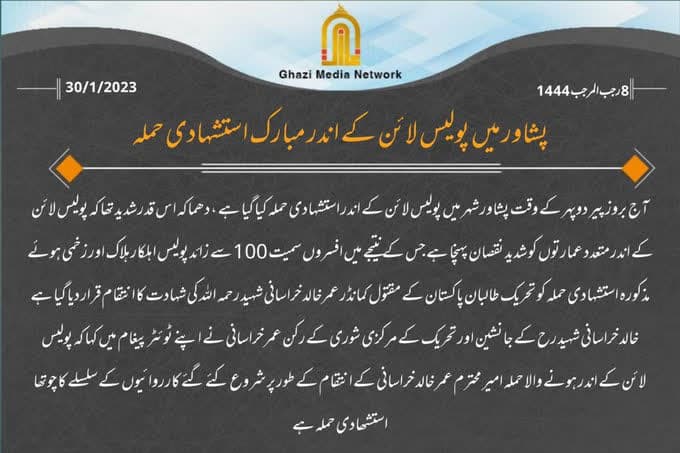
    The issue became more obvious after a series of operations by Jamaat ul-Ahrar under the name of taking revenge for Omar Khalid Khorasani’s blood, at the top of the revenge incidents was Police Lines Mosque operation in Peshawar, Pakistan’s Khyber Pakhtunkhwa province, on January 30, 2023.

    As a result of the suicide operation in Peshawar, a bomb exploded during prayer and at least 100 people were killed and more than 170 were injured. The Police Lines Mosque was located in the headquarters of the Pakistani security forces and residence of police officers; thus, most of worshipers and casualties of suicide attack were security forces and police staff.

    Hours after the terrorist attack, Omar Khalid Khorasani’s branch took responsibility for the bomb blast through issuing a statement and they considered it in revenge for the assassination of Omar Khalid Khorasani. But Mohammad Khorasani, spokesman for the Tehrik-i-Taliban Pakistan, underlined that operations against mosques and public places are wrong.

    The statement of Ghazi Media, the media arm of Jamaat-ul-Ahrar, about the operation of Police Lines Mosque in Peshawar
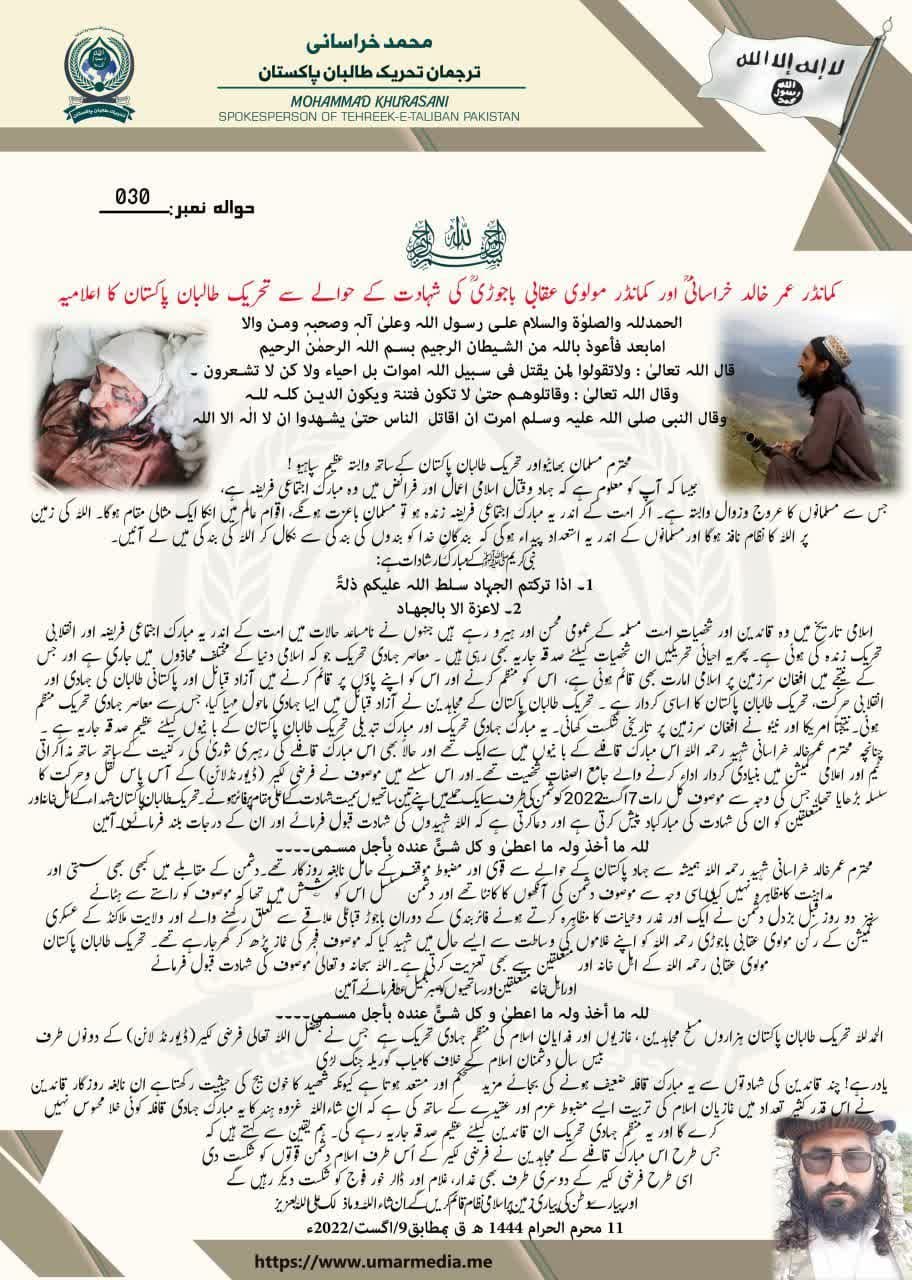
    The statement of Mufti Noor Wali Mehsud, the leader of Tehreek-e-Taliban Pakistan, regarding the killing of Omar Khalid Khorasani
    Omar Khalid Khorasani next to Shahidullah Shahid, who later becomes the second leader of ISIS Khorasan province

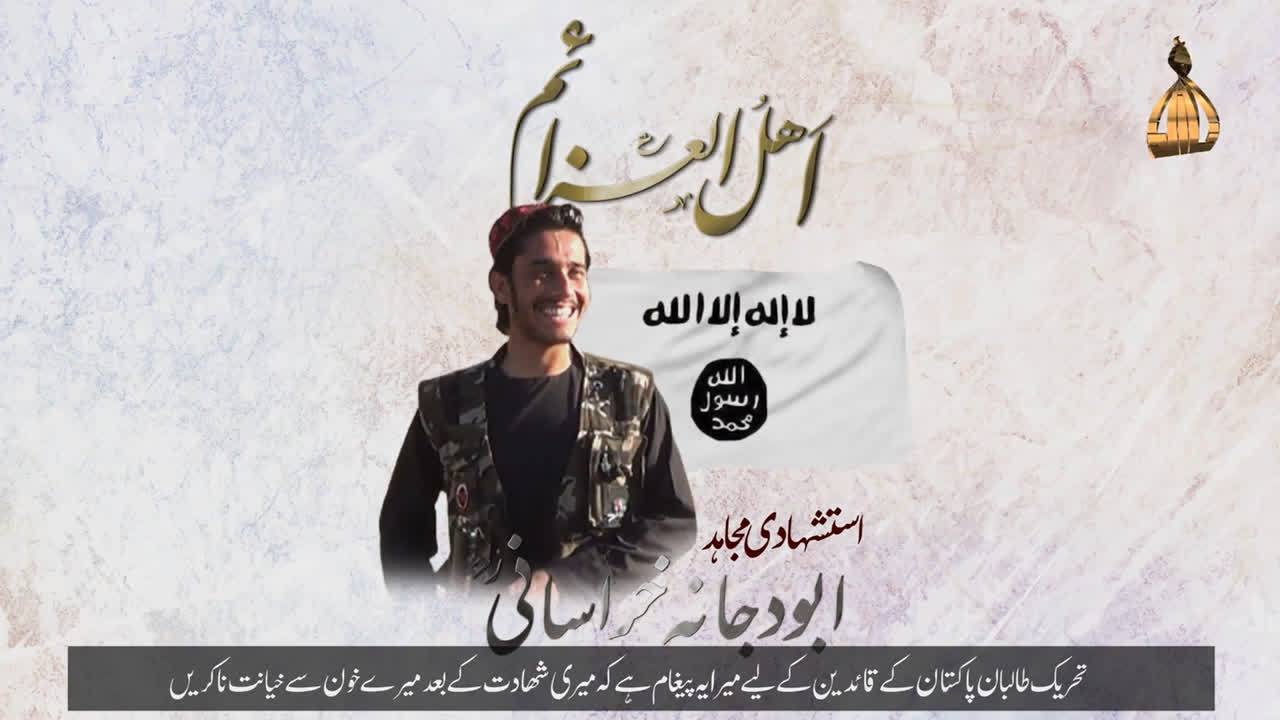
    Jamaat ul-Ahrar recently released a video from its new media outlet dubbed Ghazi Media that dealt with several suicide operations and considered all of them in revenge for the assassination of Omar Khalid Khorasani. Interestingly, the Peshawar Police Line Mosque operation was not among the highlighted operations in this video. Remarkably, in the final scenes of the film, one of the suicide elements named Abu Mallal al-Hummam Khalil Muhammad al-Balawi also known as Abu Dujana al-Khorasani, who spoke before his operation in Ghazi Media outlet, sent a message to the leaders of the Tehrik-i-Taliban Pakistan not to betray the blood of martyrs.

    In conclusion, it seems that complicated relationship between the Tehrik-i-Taliban Pakistan and Jamaat al-Ahrar would not end up in convergence even after killing of Omar Khalid Khorasani due to challenges facing the Tehrik-i-Taliban Pakistan in relation to Pakistani government in new circumstances on one hand and more extremist approach of Jamaat ul-Ahrar on other hand.

    Ahl al-Azaim movie poster showing suicide operations in revenge for the assassination of Omar Khaled Khorasani

    Author: Yasser Qazvini Haeri, ISIS and terrorism expert

  • Ajnad al-Kavkaz; from Chechnya to Syria and Ukraine

    Ajnad al-Kavkaz; from Chechnya to Syria and Ukraine

    During the second war in Chechnya in 2009, a great number of fugitive fighters of the Caucasus Emirate fled to Turkiye.

    The eruption of conflicts in Syria and the collapse of border areas in northern parts of the country paved the way for their participation in the war against the government in Damascus, and after a while the numerous dispatches of foreign mercenaries from around the world in particular from Chechnya, Circassia and the Caucasus region triggered the Westerners’ attention and investment.

    In 2015, a group of the mercenaries formed the Ajnad al-Kavkaz backed by al-Qaeda and Turkiye. The group joined the Hay’at Tahrir al-Sham in 2017, and withdrew from Idlib, Syria, following an agreement with the Tahrir al-Sham and continued its activities against the Syrian Army in the northern front of Latakia governorate. The Ajnad al-Kavkaz mercenaries have connections with other terrorist groups from Chechnya and Caucasus such as the Caucasus Emirate, but they perform independently.

    The leader of the group is named Rustam Magomedovich Azhiev also known by his Jihadi nom-de-guerre Abdul Hakim al-Shishani. There are two other figures along with Azhiev. One of them is military commander Hamza al-Shishani and the second one is political commander AbuBakr al-Shishani.

    Following the initiation of the Russia-Ukraine war and the quick advancement of Russians accompanied by Chechnyan military forces of Ramzan Kadyrov’s government in eastern and southern fronts of Ukraine, the Western states came to the conclusion that they can move some of the armed groups stationed in northern Syria to Ukraine. One of the groups is the Ajnad al-Kavkaz, who could arrive in Ukraine by the help of Turkiye. There are video documentations in different Ukrainian cities, including in Kryvyi Rih and Bakhmut, proving their presence in the war against Russia.

    Abdul Hakim al-Shishani and other members of Ajnad al-Kavkaz group in the city of Kryvyi Rih in the south of Ukraine
    The battle of Abdul Hakim al-Shishani and his men with Russian forces; probably on the Bakhmut front

    Two reasons have been mentioned on the involvement of the Chechnyan group in the Ukraine war. First, the extremist armed group has a background of fighting the Russian Army in the second war in Chechnya and mountainous areas of Latakia in northwest Syria as well.

    Therefore, they are aware of the Russians’ fighting method as well as the way to fight back. In the forest and mountainous areas, they show effective performance and enjoy significant coordination and capability in team working. The features are the same conditions that are seen in the Ukrainian fronts, and they can block the Russians’ advancement.

    Second, other armed groups in Syria do not have the motivation and background to fight Russia more than the Chechnyan militias. They fought the Russian Army and the Kadyrov government in Chechnya in the past, and experienced a heavy blow due to lack of military equipment, foreign support and so on at that time. Now, the Ukraine war can provide them with the opportunity to take revenge and it may spread the war zone to the Russian territories.

    In general, the idea of creating and enhancing terrorist groups has been planned by the American strategists with the aim of standing against Russia, Iran and other opponents of the United States. The project has been implemented since the occupation of Afghanistan by the Soviet Union until the conflict in Syria and now in the Ukraine war, which has been an effective strategy to pursue the West’s objectives. Accordingly, a potential defeat of Russia in the Ukraine war would bring about perilous consequences for other opponents of the US; and there is a possibility that the pattern and the quick transfer of terrorist groups to controversial regions such as Karabakh and other areas, which are safety margin of Iran, may be reproduced.

    Abdul Hakim al-Shishani (right) next to Salahuddin al-Shishani, (middle) leader of Jaysh Usrah group and Muslim al-Shishani, (left) leader of Junud al-Sham group
    Abdul Hakim Al-Shishani next to Abdullah al-Muhaysini, the religious judge of Tahrir al-Sham
  • Latest Military Map of Yemen; Knowing the Parties Involved in the Yemen War (Map Update)

    Latest Military Map of Yemen; Knowing the Parties Involved in the Yemen War (Map Update)

    After the formation of the ceasefire agreement in Yemen on April 2, 2022 and three periods of extension and finally its expiration on October 3, 2022, the areas under the control of the Saudi coalition were affected by a forced change in the head of the presidency (Resignation of Abd Rabbu Mansour Hadi and formation of the Presidential Council). This issue caused a series of tensions between different factions, and finally a kind of political and military deadlock prevailed between different groups under the command of the Saudi coalition. Therefore, the control of each of the parties was established over the regions, and now it is possible to distinguish the regions under the control of the groups in Yemen with more precision.

    The map of Yemen war has been accurately edited in accordance with the latest field situation until December 16, 2022 and with the following categories and it is as follows:

    1- Ansar Allah and popular committees: (green color)
    The areas under the control of Ansar Allah and popular committees include presence in 15 provinces in the west and center of Yemen, which include the capital, big cities and the majority of the country’s population. Despite the expiration of the cease-fire agreement with the mediation of the United Nations, there is no conflict in any of these fronts, and Ansar Allah is monitoring the fronts by carrying out various reconnaissance operations, as well as confronting the looting of Yemen’s oil resources by foreign tankers.
    Ansar Allah Movement and the National Salvation Government of Yemen are supported by the majority of the Yemeni people and the General People’s Congress and other Yemeni parties, as well as the foreign support of Iran and Islamic resistance groups.

    2- The Saudi coalition and the Saudi-backed government of Yemen (ie the resigned government of Mansour Hadi): (red areas and all map colors except green)
    The areas under the control of the Saudi-led coalition forces include presence in 13 provinces of Yemen, which includes the largest area of this country. But the majority of these areas include desert and uninhabited areas. Despite this, the oil resources, the southern coast of Yemen and several strategic points are under the control of the Saudi coalition. The Saudi coalition uses these cases as tools to pressure Ansar Allah in negotiations.
    Nevertheless, despite the access of the Saudi coalition to all the areas under the control of the anti Ansar Allah groups, the factions under this coalition have competition and armed conflict with each other to control these areas.
    The structure of the resigned government of (Mansour Hadi) Yemen, like other countries involved in civil war, is a structure that divides positions and ministries between powerful factions in order to use the human power and military facilities of these factions against the main enemy. These factions include: Islah Party, Southern Transitional Council, Yemeni National Resistance under the command of Tareq Saleh, each of them have managed to influence and control parts of Yemen in recent years, especially after the resignation of Abd Rabbu Mansour Hadi and the formation of the Presidential Council. Which is explained as follows:

    3- Southern Transitional Council: (blue color)
    The “Southern Transitional Council” (STC) is the name of a council consisting of the main currents of South Yemen, including Al-Hirak Al-Janoubi (Southern Movement), Southern Resistance and the South Arabian League Party, which was established on May 4, 2017, and their goal is to divide south Yemen. Currently, based on the Riyadh agreement in November 5, 2019, this movement holds the post of prime minister and half of the 24 ministries of the government. The geographical area under their control also includes: Aden province, most areas of Lahij and Abyan provinces and parts of Al-Dhale’, Hadhramaut and Taiz provinces.

    It should be noted that the forces of Hizam al-Amni (Security Belt), Al-Haba Al-Hadhramiyah, Southern Resistance and other southern armed brigades are sub-groups of the Southern Transitional Council and are under the support of the United Arab Emirates.

    4- Islah party: (purple color)
    The Islah Party (Reform Party) is one of the largest and oldest parties in Yemen, and it acts as the representative of the Muslim Brotherhood in Yemen. This party was formed on September 13, 1990 by Sheikh Abdullah ibn Husayn al-Ahmar, one of the elders of the Hashid tribe, and has been operating since 2007 under the chairmanship of Mohammed Abdullah al-Yadumi. After the start of the Saudi coalition’s invasion of Yemen, the Islah Party announced its support for this operation on April 3, 2015, and entered into a battle with Ansar Allah.

    Currently, the cities of Marib, Taiz, Seiyun and the desert areas of Al-Jawf province and parts of Shabwah and Hajjah provinces are under the control of this party’s militants.

    5- Forces loyal to Tareq Saleh (Yemeni National Resistance): (yellow color)
    “Yemeni National Resistance” is the name of a military group led by Tareq Saleh, the nephew of Ali Abdullah Saleh, the former president of Yemen, which was formed in December 2017. This organization has more than 10,000 members and consists of several factions, including former members of Ali Abdullah Saleh’s presidential guard, the former army soldiers and security forces separated from the Sana’a government, Al-Amaliqah and Al-Tihamah Resistance forces.

    Read more: Who are the (Amaliqah) Giant Brigades?

    The areas under the control of Tareq Saleh forces are the southwestern region of Yemen, including the district of Hays in the south of Hudaydah province, the western areas of Taiz province, as well as the districts of Bayhan and Ain in Shabwah province. It is worth noting that this military group (Tareq Saleh forces) is under the support of the United Arab Emirates, the Amaliqah and Tihamah forces receive their orders from the command of the Saudi coalition, especially the UAE, instead of Tareq Saleh…

    6- Al-Qaeda, Ansar al-Sharia and ISIS terrorist groups: (gray hachure)
    The activities of the Al-Qaeda terrorist group in Yemen under the name of “Al-Qaeda in the Arabian Peninsula” (AQAP) began in 2009 and continued under the name of Ansar al-Sharia group since 2011. After the resignation of Ali Abdullah Saleh and the presidency of Mansour Hadi, this group acted in a more organized manner and took full possession of some points; But the advance of Ansar Allah and the intelligence of the field commanders of this movement in taking control of the cities of Sana’a, Saada, etc., prevented Al-Qaeda from advancing. Therefore, in order to survive their activities, Al-Qaeda forces were stationed in the remote areas of Yemen, including the deserts of eastern Yemen, the north of Al-Baydha province, and several other places.
    Currently, this group does not have any city or region completely under their control, and their sphere of influence includes the desert areas of Hadhramaut, Shabwah and Abyan provinces. Also, after the Ansar Allah operation in the north of Al-Baydha province, Al-Qaeda members were transferred to the city of Marib and placed under the command of Islah Party.

    Read more: Who was martyr Abu Haydar al-Hamzi?

    The Islamic State Wilayat al-Yaman (Yemen province) group (IS-YP) also announced its formation in November 13, 2014, and apart from bombings, assassinations, etc., no special activity has been seen so far. ISIS members in Yemen are generally from extremist tribes in the east and south of Yemen and people separated from Ansar al-Sharia and al-Qaeda terrorists groups.

    It should be noted that the formation of terrorist groups in Yemen is closely related to the actions of Mansour Hadi, the former president of the resigned government, Ali Mohsen Ahmar, the former vice president of the resigned government, and several other heads of parties and security institutions. In this regard, the criminal court of Yemen has convicted and prosecuted these people.

    Click to view full size
  • Latest military developments of Yemen in 2021 + Map

    Latest military developments of Yemen in 2021 + Map

    Saada:
    During Ansar Allah operation on late may 2021, on the southwestern front of Saada province in the Malahit region and Jizan province in southern Saudi Arabia, areas with an area of about 150 square kilometers were liberated from the occupation of the Saudi coalition.

    Al-Jawf:
    During Ansar Allah operation, from December 4 to 23, under the name of “Fajr Al-Sahara“, more than 1,200 square kilometers of occupied lands in al-Jawf province, including the important town of Yatmah, the center of Khab and Shaaf district were liberated from the Saudi-led forces.
    In the eastern fronts of al-Jawf, clashes continue in the suburbs of Khanjar camp to the eastern desert of Maraziq and the heights of Alam, and the lines have not been stabilized yet.

    Marib:
    In Marib province, Ansar Allah still holds its positions on the three main fronts in west of Marib, in Raghwan, Madghal and Sarwah.
    On the Raghwan front, there has been no significant change over the past year, and the Asdas tribes continue to follow the Saudi coalition. Ansar Allah also has no intention of advancing in this front.
    On the Madghal and Sarwah fronts, Ansar Allah attacks led to the liberation of the Kufil base and the Zena camp.
    Currently, clashes on the western fronts of Marib has stopped behind the Marib Dam to al-Atif and al-Khashab heights because of various reasons, such as the Saudi coalition fierce resistance, heavy bombardment of Ansar Allah positions by the Saudi coalition warplanes, etc.
    But in the south of Marib province, Ansar Allah has succeeded in liberating the districts of Rahba, Harib, Abdiyah, Jabal Murad (without clashes) and Jubah by carrying out Operation Rabi al-Nasr. This important advance has led Ansar Allah to the southern entrance of the city of Marib, And heavy clashes have been going on since November 2 in the suburbs of the al-Balaq al-Sharqi and al-Balaq al-Awsat heights.

    Al-Baydha:
    During Operation Fajr al-Hurriya, Ansar Allah succeeded in completely clearing the districts of Nu’man, Nate’, al-Musawara, al-Sawma’ah and Mukayras, covering an area of about 2,500 square kilometers, from the control of the Saudi coalition and the terrorist groups al-Qaeda and ISIS.

    Shabwa:
    Following the developments in the central fronts of Yemen, Ansar Allah carried out Operation of Nasr al-Mubin in three stages and completed the operation with launching Operation Rabi al-Nasr in the area. In total, the operations led to the liberation of 3200 square kilometers of lands in Shabwa and Marib provinces, including Usaylan, Beyhan and Ain districts in Shabwa province.

    Taiz:
    On the Taiz front, on January 9, Ansar Allah repelled ISIS insurgency in the Azlat al-Haima area in the north of Taiz province by a security intelligence operation.
    Clashes continue on the axis of al-Kadhah and the district of Muqbanah, and the mentioned areas are still under the control of Ansar Allah.

    Al-Hudaydah:
    On November 12, the Saudi coalition command issued an order to withdraw its forces from the city of Al-Hudaydah and the west coast of Yemen. By this retreat, the National Resistance forces including the forces under the command of Tariq Saleh, Tihamah forces, Amaliqa Brigades and joint forces evacuated the northern and eastern areas of al-Hudaydah city and the western areas of al-Durayhami, al-Jah and al-Tuhayta.
    On the other hand, on November 18, Tariq Saleh forces launched an operation called “Golden Arc” in the south of al-Hudaydah province and the west of Taiz province, with the aim of securing the positions of the Saudi coalition on the southern regions of Hudaydah province, which has not achieved significant results so far. Ansar Allah has so far managed to repel most of Tariq Saleh attacks by carrying out Operation Eighth Deterrence Balance and several other missile and drone operations.

    Clashes continue on other fronts, such as al-Dhale’ and al-Hajjah provinces, sporadically between the Saudi-led forces and Ansar Allah, and there has been no significant change in the battle lines in these areas.

    Click to see the full size map
  • Audience Question: Who are the Giant Brigades?

    Audience Question: Who are the Giant Brigades?

    The word Al-Amaliqa or Amaliq in Arab culture means strong and large people. Throughout history, the Jews also called their enemies Amaliq and considered Amaliqa as an adjective for their enemies. The last time the word was used in a speech by Jewish leaders was in 2010 by Benjamin Netanyahu, who called the Iranians a new Amaliqah.

    But in Yemen, the Al-Amaliqah Forces are a militant group formed in 1971 at the suggestion of Major General Hassan al-Omari during the presidency of Ibrahim al-Hamdi.

    Al-Amaliqah forces fought with the Socialist separatists in the south during the 1994 civil war in support of the Northern Alliance. Al-Amaliqa clashes with the southerners in Abyan province led to the defeat of the southerners and the depletion of their power in other battles, and Yemen came under the complete control of Ali Abdullah Saleh.
    Al-Amaliqah forces were also used by Ali Abdullah Saleh during the Six Wars of Saada. They fought in various battles against the supporters of the martyr “Sayyed Hussein Badruddin al-Houthi” in Saada and northern Yemen. Al-Amaliqa forces were then distributed to other brigades of the Yemeni army and practically disbanded.

    After the Yemeni revolution and the beginning of the battles between Ansar Allah and the supporters of Abdrabbuh Mansur Hadi, a number of former commanders of Al-Amaliqa, with the support of the Saudi coalition, reorganized their groups and took part in the battles in the southern regions of Yemen. The organization of the Al-Amaliqa forces expanded during the Saudi coalition attack on the west coast of Yemen, and the ground attack was carried out with their role.

    The Giant Brigades is now largely organized by the UAE, and most of its forces are recruited by this country. Most of the body of this group consists of the Wahhabis of Dammaj, Kataib Abu al-Abbas in Taiz, the Salafis of southern Yemen from the areas of Yafi’ to Lahij.

    The Saudi coalition media put the number of Al-Amaliqah (Giant) Brigades at about 30,000. However, depending on the deployment of these forces in Yemen, their number is estimated at 15,000 to 20,000.

    The Giant Brigades has bases in Aden and Lahij, and until the last few months they were stationed in the fronts of al-Hudaydah and Taiz. But after three years of erosive fighting in al-Hudaydah, they withdrew from al-Hudaydah on the orders of the Saudi coalition and were sent to the Shabwa and Marib fronts.

  • Saudi Arabia and expensive Patriot systems!

    Saudi Arabia and expensive Patriot systems!

    The Patriot system is a medium-range air defense system capable of meeting aerodynamic and ballistic targets. Saudi Arabia is one of the main users of this system and in recent years has widely purchased patriot systems and its missiles.

    This system was designed and built by the American companies Raytheon and Lockheed Martin in the 70s and 90s. In addition to the US military, Saudi Arabia, Israel, Qatar, Kuwait, Egypt, Jordan, Germany, Greece, the Netherlands, Spain, Japan and Taiwan are also equipped with the system. Among these countries, Saudi Arabia is the second largest user of Patriot missile system after the United States.

    In the years after the Islamic Revolution of Iran, Saudi Arabia has sharply increased the level of its military rivalry with Iran. With the start of the Saudi coalition invasion of Yemen and Ansar Allah’s reciprocal attacks on Saudi territory, the Saudis’ dependence on the Patriot system has greatly increased. To the extent that the country has leased more patriot systems from the United States and Greece.

    The price of each Patriot missile is estimated at $ 1 to $ 6 million, depending on the type, and Saudi Arabia appears to have spent more than $ 10 billion to purchase Patriot missiles so far.

    Read more: Military Knowledge: Patriot Missile System

    Data from the Stockholm International Peace Research Institute (SIPRI) show that Saudi Arabia has purchased Patriot missiles in several stages.

    According to the statistics, it seems that Saudi Arabia has purchased more than 2,800 missiles for the Patriot systems

    Details of these purchases are as follows:
    1- In the years 1993-1995, 384 rounds of Patriot PAC-2 GEM missiles
    2- In the years 1997-1995, 781 rounds of PAC-2 GEM missiles
    3- In the years 1999-1998, a total of 629 PAC-2 GEM missiles
    4- In the years 2019-2017, 320 PAC-3 MSE missiles
    5- In the years 2020-2019, 130 PAC-3 MSE missiles
    6- An unknown number of Patriot PAC-3 missiles have been ordered by Saudi Arabia in 2018 and are being delivered.

    Examining other sources, such as database of US Defense Security Cooperation Agency, it appears that Saudi Arabia also ordered 600 Patriot PAC-3 missiles in 2015.

    Timothy Lenderking, the U.S. special envoy for Yemen, said at a forum on December 3 that the Ansar Allah have conducted about 375 cross-border attacks into Saudi Arabia in 2021. This statistic comes at a time when most of Saudi Arabia’s defensive confrontations with Ansar Allah have taken place through the Patriot defense systems. Thus, the Saudi Patriot missile arsenal will face problems in the not-too-distant future, and the supply of those missiles will cost another billion dollars for the country.

    Apart from this, the Patriot system has performed poorly in some Ansar Allah operations, such as Operation Second Deterrence Balance on September 14, 2019. In this attack, Buqayq and Khurais refineries were targeted by successful Ansar Allah drone and missile attacks, and Saudi oil exports were severely disrupted. The attack inflicted heavy losses on the country’s economy, and Western countries struggled to control rising oil price.

    In general, the Saudis Patriot systems needs billions of dollars financial support to continue to deal with Ansar Allah drones and missiles, and this has been hampered by Biden’s cold approach to the Saudis. Ansar Allah is now increasingly attacking Saudi coalition positions deep inside Saudi Arabia by increasing the accuracy of its drones and missiles, and Saudi Arabia is forced to buy more to counter such attacks; Because without sufficient stockpiles of Patriot missiles, Ansar Allah continued attacks could lead to serious damage to important and vital infrastructure of Saudi Arabia.

    Read more:
    Military Knowledge: MIM-103C PAC-2 missile
    Military Knowledge: MIM-104F PAC-3 MSE missile