Category: Article

  • Know Yemen better: Looking at position for Saadah province in Yemen

    Know Yemen better: Looking at position for Saadah province in Yemen

    Saadah is a northern province in Yemen with more than 700 thousand population and 11,375 km2 area. The province has 15 districts including Hashwah, Safra, Zaher, Baqim, Hidan, Razih, Saqin, Saher, Shada, Saadah, Ghamar, Qatabar, Kitaf, Mujiz and Munbah.
    Agriculture and herding are the occupation of most of the people. Handicrafts and minerals in Saadah brought business opportunities for inhabitants of Saadah.
    Most of western part of the province are suitable for agriculture and has mines due to heights and suitable weather. The eastern part is desert and dry, in which herding is more suitable.

    Saadah districts


    Saadah used to be en route to Yemeni Hajj and trade caravans thus, had economic boom, cultural and art development.
    Saadah has several old bazaars including Soq al-Talh, Soq al-Qadin and Soq al-Asbu’ei, each of which has a daily trade schedule such as handicrafts, coffee, fruits, etc.

    Saadah is important in controlling the northern part of Yemen and its northern heights are obstacles for enemy’s invasion. During the Zaidi ruling, Saadah was their capital.

    Notable people of Saadah include martyr Sayyid Hussein Badreddin al-Houthi who is recognized as the leader and founder of Yemen’s revolution. Sayyid Hussein had a key role in enlightening and expanding the Islamic resistance idealogy in Yemen. He is among the founders of Ansar Allah in Yemen in 1986 as “Believing Youth Union” (اتحاد الشباب المؤمن).
    This movement founded under leadership of Shia scholar Salah Ahmed Falitah and pioneer youths such as Sayyid Muhammed Badreddin al-Houthi (Sayyid Hussein’s brother) and then in 1990 had Muhammed Yahya Azzan and then Sayyid Hussein Badreddin al-Houthi as secretary general.

    The expansion of the movement was known with the name of Sayyid Hussein Badreddin al-Houthi, thus it was famous as Houthis and after his martyrdom and leadership of Sayyid Abdul-Malik Badreddin al-Houthi and his strong management, it was called Ansar Allah Movement.

    Sayyid Hussein martyred on September 10, 2004 in heights of Saadah after several years of fight with Ali Abdullah Saleh since 1990. His body delivered to Ansar Allah after several years and buried in Marran heights, northwest of Hidan, which was bombed by Saudi coalition warplanes in 2015.

    Sayyid Hussein Badreddin al-Houthi tomb in Marran heights bombed by Saudi warplanes


    Important tribes of Saadah are three: Khulan, Bakil and Hashed, which have important role in fighting against Saudi coalition.
    In early years of Yemen’s revolution, Wahhabist immigrants of Dammaj village, southeast of Saadah, assaulted Ansar Allah. The intrigue was expelled by exiting Wahhabists from Saadah in early 2014. Al Abdin tribe also had conflict with Ansar Allah outskirts of Saadah which finished by victory of Ansar Allah.

    Since the invasion of Yemen started, Saadah become a main axis for Saudi coalition.
    Saudi coalition operation to occupy Saadah was launch from three axes:
    1. Northern axis (Alab-Saadah road in Baiqm district)
    2. Eastern axis (al-Boqa to Kitaf)
    3. Western axis (Malahit to Marran heights),
    which almost all of Saudi coalition operations were expelled by Ansar Allah so far.
    Among the reason of this defeat are the heights of north and special terrain of Saadah, Ansar Allah’s dominance on the region, Ansar Allah’s resistance and tactics against Saudi coalition, among which operation “Nasr Min Allah” is a famous example.

  • Opinion: Investigation of the latest military-security situation in Idlib

    Opinion: Investigation of the latest military-security situation in Idlib

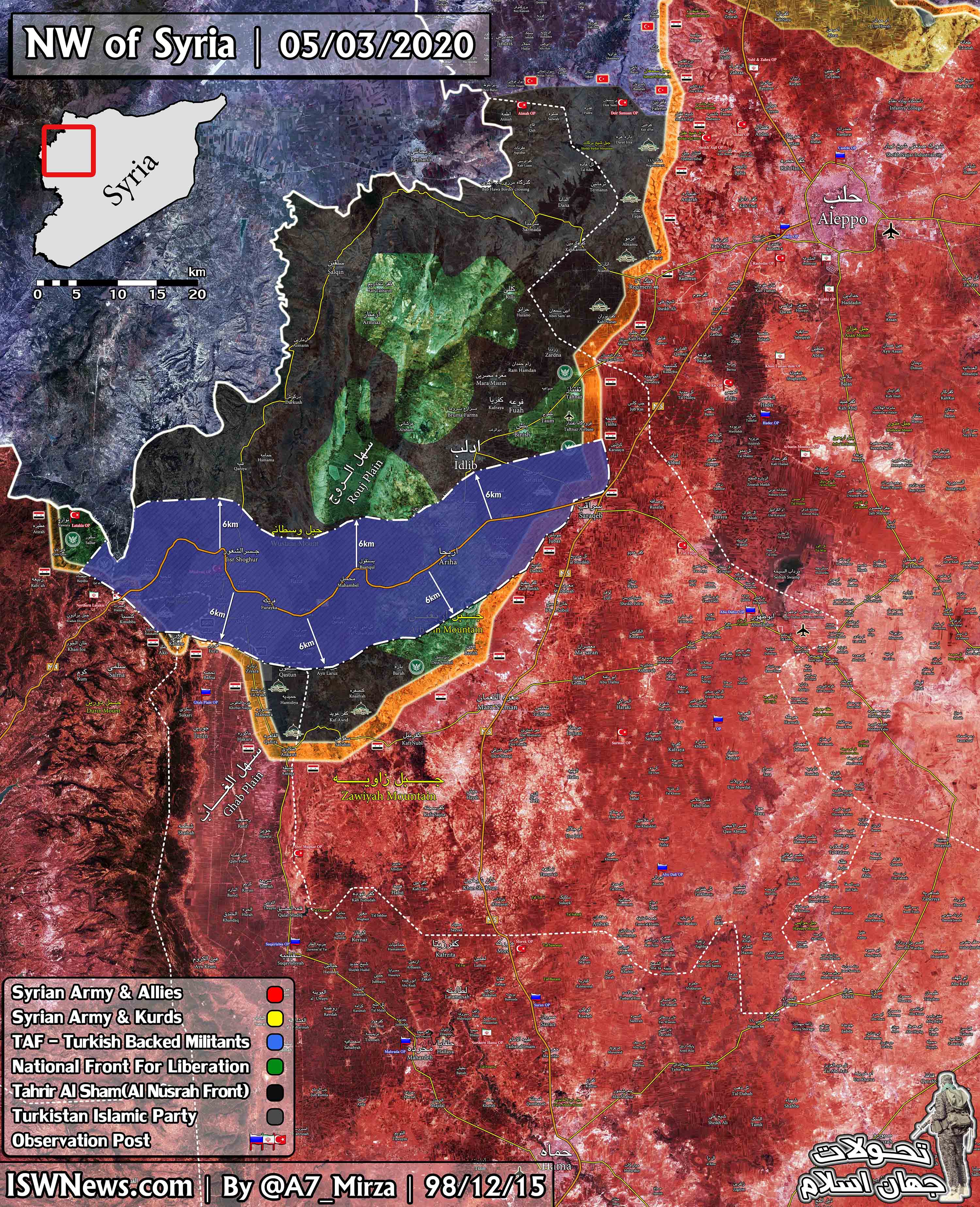
    The recent ceasefire between Turkish and Russian presidents stresses on several points, namely a 6 km safe zone in both north and south around Aleppo-Lattakia highway (M4) and then forming Russian-Turkish joint patrols along M4. Important incidents happened since the signing of the ceasefire in the area which will be explained.

    Interruption of patrols by Tahrir al Sham:
    In despite of five times Russian-Turkish forces patrolled in M4, every time they were interrupted by terrorist groups and the patrols were limited to between Turnabah village, outskirts of Saraqib, to Nayrab town, east of Idlib. Terrorist groups first sabotaged parts of the highway and then stimulated people’s sit-down strikes en route to interrupt the patrols and Turkish forces could not overcome it.
    Although Tahrir al Sham terrorists apparently disapproved the sit-down strikes on M4, but it seems they provoked some more extreme groups such as Hurras al-Din to interrupt the ceasefire implementation, not to hit Tahrir al Sham and Turkey rather friendly relation.

    Due to this ceasefire and Turkey’s presence increase in south of Idlib along with its proxy groups such as Syrian National Army (SNA) and National Front for Liberation (NFL) around M4 highway, it can be said that Tahrir al Sham influence (in opposition to NFL group) on the area is diminishing and thus they try to interrupt the patrols. Their influence already decreased after liberation of M5 highway.

    Tahrir al Sham endeavor to regain its power:
    At the same time that Turkey and its proxies presence in the area increased, Tahrir al Sham is forming new brigades and reforming the command hierarchy of first and second levels. These are in the sense to regain its power against Syrian army future offensive operations and also to show to Turkey and the proxies its power.

    Turkey’s military and equipment presence increased in Idlib:
    After signing the ceasefire and start of patrols in Idlib, which were interrupted by terrorist groups, Turkey used the excuse to implement the ceasefire obligations to increase the equipment, troops and militants in south of Idlib. According to American Institute for the Study of War, during February and March 2020 Turkey deployed about 20 thousand of its troops and militants (who participated in operations Olive Branch and Peace Spring) to Idlib. It also established more than 50 military bases and transported more than seven thousand heavy equipment to Idlib province. Turkey even installed MIM-23 Hawk SAMs in south of Idlib.

    Turkey’s endeavor to form a uniform military force:
    By bringing their troops and proxies such as SNA and NFL (with Muslim Brotherhood tendencies) to the area, Turks are getting closer to forming a united force in Idlib province to confront any Syrian army offensive operation in Idlib. It is possible that some units of Tahrir al Sham will join this new uniform army and Tahrir al Sham becomes more fragmented.


    It is expected that military action becomes priority of Syrian army to solve the issue of Idlib province in future again due to incomplete patrols by Turkey and Russia and lack of containment of terrorist groups in the area.
    Although Russians do not want their economic, political and military relations with Turkey to be jeopardized, but Ankara’s disability to fulfill its obligations in the ceasefire enables Russia to activate the military option once again.

    Click to see the full size map
  • Know Yemen better: Looking at position for Marib province in Yemen

    Know Yemen better: Looking at position for Marib province in Yemen

    Marib is the name of an important and historic province in the Yemen, that consists of 14 restriction and has more than 250 thousand people population and also 17405 square kilometers area.
    Marib has been the capital of Yemen government (Saba’) from 650 BC to 115 AD , and now there are a historic palace and dam in Marib that is known related to this era.
    The climate of this province is different in the mountainous and desert regions; and despite the drought, the main activity of this province inhabitants is agriculture and animal husbandry.

    Marib has many of oil and gas resources and has a power plant. By 2014, Marib was exporting electricity, gas and oil to the other Yemeni provinces, that this process was disrupted with beginning the war in Yemen.

    According to local sources report, Safer refinery, that is the resource of oil and gas of the Marib province, produces more than 700 thousand tons gas a year and 9 to 18,000 barrels of oil a day.

    Safer has two main pipelines, that one of them connects the oil to the Raas Al-Issa port in Al Hudaydah through Sanaa and by crossing the Dhamar province ; and another is the gas pipeline that has been connected to Belhaf port in the southern beaches of Yemen by crossing the Shabwah province. Also there are two other inner pipelines, that one of them transfers oil to Sana’a and the other transfers gas to the west of  Sion city in the Hadhramout province.

    Yemen oil and gas pipelines


    Several tribes live in Marib, that three of these tribes are from great Yemeni tribes.
    The Murad and Ubaida tribes support the Abd Rabbah Mansur Hadi government in Yemen war, because of their religious tendencies, specific thinking (the Muslim Brotherhood and the Islah party) and also Saudi financial supports of their leaders.
    They fought against Ansar Allah and the Kholan tribes (resident in the Sarwah and Harib Qaramish districts) after transferring the forces and extensive equipment of Saudi coalition to Marib in 2015.

    Marib tribes


    During recent years, Marib has become the center and major base of the Mansour Hadi and Saudi coalition militaries; and because of this, Ansar Allah has done several heavy missile attacks on coalition bases in this province. These attacks include:
    1. Ansar Allah missile attack on Sep 4th 2015 on a base in the outskirts of Safer that led to killing the 52 Emiratese, 10 Saudis, 5 Bahrainis and a some of Mansour Hadi forces.
    2. The Ansar Allah rocket attack on Dec 14th 2015 on the same base that led to the killing 23 Saudis, 18 Sudanese, 9 Moroccan and 7 Emiratese.
    3. Ansar Allah missile attack on Jan 18th 2020 on Al Nasr base in the north of Marib city that led to killing 111 people. (Of course, Ansar Allah didn’t claimed the responsibility of this attack)

    In general, importance of the Marib province in the current situation of Yemen is because of two points:
    A) Oil and gas resources: In negotiations, Ansar Allah wants the fair distribution of these resources revenues and the stability of oil pipeline activity to Sanaa.
    B) Converting of Marib to the base of Islah party and Mansour Hadi’s former government : Ansar Allah does not want to delete the Islah party from the Yemen, and by various ways has had interaction and peaceful behavior with them; but influence of warlords and Saudis power imposing has deprived their independence.

    Ansar Allah has focused his attention to Marib, in order to neutralizing these two key points that have been one of the cause of reinforcement of Abd Rabbah Mansour Hadi’s former government’s position in Yemen. If this issue not be achieved by Ansar Allah negotiation with the Islah party’s moderate front (that relies on the power of the Marib tribes), Ansar Allah military operation is not unexpectable.

    Marib districts


  • New ceasefire in Idlib; impossible?!

    New ceasefire in Idlib; impossible?!

    The ceasefire is enforced from 00:01 of 6 March in Idlib area and both sides are obliged to obey it. It includes three main parts:
    1. All fights to be ceased along current front lines from midnight 6 March
    2. Russia and Turkey will make a six km wide security corridor north and south of M4 highway (Saraqib-Latakia).
    3. From 15 March there will be joint Turkish-Russian patrols along M4.

    This agreement is announced while Erdogan’s demands were totally different before the meeting, which clearly shows Erdogan’s retreat from his stances.

    In the following, we will discuss some important points about the Idlib ceasefire:

    – Syrian army will still have the full control of M5 highway (Aleppo-Damascus). Having M5 under control is a strategic position and stabilizes Syrian army’s military presence in Idlib area. Turkish army claimed before the talks that Syrian army should retreat from M5.

    – The important point is that terrorist groups such as Tahrir al Sham and allies are not included in this agreement and they are still legit targets for Syrian army!

    – The feat of this agreement is the 6 km safe zone in north and south of M4 highway! Entire road from Saraqib to Jisr al-Shughur is out of control by Syrian army and most of it are controlled by terrorists from Tahrir al Sham, Turkestan Islamic party and other al-Qaeda terrorist groups.
    It means that the most strategic areas that terrorists have occupied for many years and constitute their strategic depth should be evacuated.
    Joint patrols will start from 15 March in M4 and most probably terrorists won’t get along with it and since they are excluded from ceasefire, the operation by Syrian army is very likely.

    – Only Turkish forces will remain in Idlib area, however the situation of Turkish observation posts inside areas controlled by Syrian army are still unclear. It is possible that they still remain in the area for a while or until the end of operation in Idlib to save Turkey’s face and finally are collected without much noise. Unlike what was boasted about Turkish military power, these besieged observation posts can be used as hostages by Syrian army against Turkish army.

    – By accepting this agreement, Turkey has recognized officially Syrian army’s achievement in the last four months, in despite of its rhetoric. Turkey also implicitly accepted that they cannot assault Syria’s soil directly.

    The reasons behind why Turkey succumbed to such an agreement and defeat needs a separate article but briefly it can be attributed to Syria and allies resistance in Idlib, lack of NATO and US support for Turkey, Erdogan’s unstable political situation and Turkish elites’ critiques of Erdogan and the reigning party.

    The ceasefire has started in Idlib area and we should wait and see which way does Syria go, but we should remember that Syria still has a long journey to stable peace and security. These agreements are small steps toward the goal, Syria has still challenging issues to address, some of which hasn’t even started yet!

    Click to see the full size map
  • Answering key questions about Afghanistan – focusing on USA-Taliban agreement and future of Afghanistan

    Answering key questions about Afghanistan – focusing on USA-Taliban agreement and future of Afghanistan

    Due to political discords between Abdullah Abdullah and Ashraf Ghani, Afghanistan is left without government and after an election with very low participation, both of them are trying to form a government, which has been delayed by USA interference.
    Approaching the agreement with Taliban, Zalmay Khalilzad was tasked to force Abdullah Abdullah to silence and now according to the agreement, different political groups are supposed to talk with them to form a joint government. Now Taliban calls itself savior of Afghanistan.

    – Who is the winner?
    Taliban and Trump are the winners.
    Taliban could force USA and NATO to leave after 18 years of war and rescue its prisoners. Therefore Taliban is the main winner.
    They also have upper hand in future of Afghanistan due to two reasons:
    1. Claiming to defeat and exiting USA.
    2. Low participation in the recent election, since Taliban claims most people supporting it and did not want to participate in election of a West-backed government.
    The second winner is Donald Trump. He needs bargaining chips in the coming election. He was unsuccessful in dealing with Iran, thus, agreement with Taliban and returning soldiers from Afghanistan is considered to correct previous presidents’ mistakes and a higher hand for him in election debates.
    This deal brought good domestic privileges for both sides of agreement.

    – What comes after the agreement?
    According to the agreement, both sides have a long way to reach their demands. Foreign forces evacuating, Taliban prisoners freedom, lifting sanctions on Taliban, forming the government, etc. require both several months time and fulfilling preliminary obligations. Considering USA stained history of tearing up agreements, the future is vague and anything can happen.
    Some say since this agreement was signed in presence of countries such as Pakistan, Turkey, Qatar, Uzbekistan, etc., USA cannot violates it, however, it should be reminded that JCPOA between USA and six powers on one side and Iran on the other side had a similar situation but USA stepped down as usual.
    What can countries without any power in front of USA do to save this agreement? In addition they do not have any role or information on it.

    – What is the future of government in Afghanistan?
    Taliban thinks they are the definite winner of this agreement as reflected in their statements that the future government belongs to the movement which has the higher vote, while there is no strong and charismatic person or group defying them in Afghanistan. Most of officials and politicians in Afghanistan are either weak or westward, and do not have power without foreign countries support.
    The only hope of anti-Taliban movement is in coalition of Abdullah Abdullah and Ashraf Ghani, which is to return to the first square, i.e., “unity government”. We talked about unity government before and its disadvantages such as chaos, political corruption, insecurity.
    Forming a unity government with Taliban is impossible, unless they change their ideologies, which means Taliban changes its Deobandi and Salafi tendencies and incline to the West. Above all, Taliban believes the government belongs to the one with majority of votes and does not share power.

    – Foreign countries’ stances regarding Afghanistan and the agreement between USA and Taliban?
    Afghanistan has several sects and tribes like other Islamic countries, accordingly forms the power of other countries such as USA, Pakistan, Turkey, Iran and Russia.
    Movements of Afghanistan can be divided as follows:
    1. Westwards close to USA; Ashraf Ghani.
    2. Abdullah Abdullah who is close to USA and Europe.
    3. Taliban supported by Qatar, Pakistan and somehow Russia.
    4. Shia parties, some of which are supported by Iran and in general do not have much power in Afghanistan and due to racial differences are forced to coalesce with other movements.
    5. Genral Dostum who is supported by Uzbek and Turkmen groups and Turkey.

    Other movements do not have substantial power or powerful people such as Hamid Karzai, Gulbuddin Hekmatyar, Abdul Rasul Sayyaf do not have a movement.
    We also observe individuals such as Zalmay Khalilzad who are godfathers in Afghanistan incidents and implements USA hidden plans from forming unity government and the president to negotiate with Taliban and all groups are forced to accept him.

    – What is USA plan for Afghanistan?
    USA plan for Afghanistan is very hidden and mysterious. They gave many privileges to Taliban, as if Taliban is in power in Afghanistan, while it is hard to believe USA will leave middle Asia easily. Occupying Afghanistan means to control Russia’s China’s and Iran’s influence in Asia and Afghanistan is the best place to do so. Thus, it is unlikely USA leaves without plans.
    In the agreement, USA talked on freeing prisoners, issuing passport and visa, forming government, etc., and ignored Afghanistan people and government. Therefore USA considers Taliban as the real power in Afghanistan and people, government and parliament opinions do not matter to them.
    The talks about future government of Afghanistan will be discussed in Afghan groups talks and we will see that tribal-religious discords and political share will result in such a dangerous competition.
    Maybe that time we realize the meaning behind Taliban leader’s general pardon, USA hidden plan to divide Afghanistan and having different opinions in a so called Islamic government.

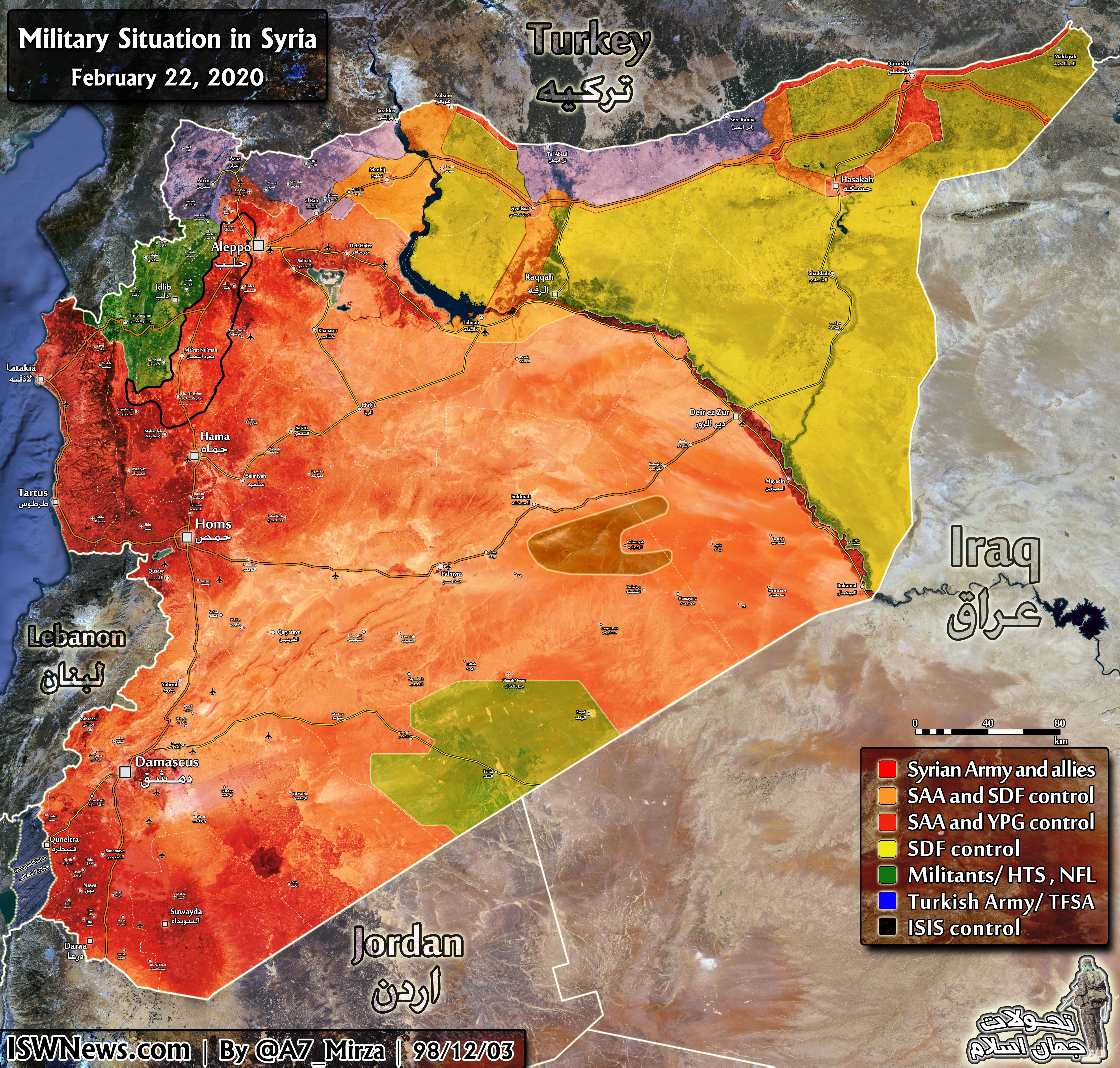
  • Latest Map of Fronts in Syria until 22 February 2020;

    Latest Map of Fronts in Syria until 22 February 2020;

    Northwest of Syria
    Syrian army started its great operation “Dawn of Idlib” from 3 May 2019 in northwest of Syria in Idlib and until 30 August 2019 vast and important areas were liberated in southwest of Idlib and northwest of Hama provinces. The operation took four months and ten days and important cities such as Qalaat al-Madiq, Kafr Nabuda, Lataminah, Morek and Khan Sheikhun were reclaimed by Syrian army.

    In overall, the operation was performed in two stages; in the first stage north of Hama and some areas in south of Idlib and in the second stage, with advances in depth of Idlib area, almost half of the province and large areas of southwest of Aleppo province were liberated.

    The second part of the operation “Dawn of Idlib 2” was started from 19 December 2019. In this part, unlike the first part of the operation, Syrian army was helped by allied forces of resistance axis support. Iranian, Fatemiyounn, Zeinabiyounn, Hezbollah forces and etc. are responsible for the operation in outskirts of Aleppo and Syrian army is also responsible in advances in Idlib axis.
    Two months and three days are passed since the incipient of the second part of the operation and an area of 2,000 km2 has been liberated from terrorists.
    Other significant achievements of the operation so include liberation and opening of Damascus-Aleppo highway, M5, completely after eight years‌ and liberation of tens of strategic points such as Maarat al-Numan and Saraqib. By liberating western areas of Aleppo from terrorists, this city is free completely after many years of occupation and threats.

    At the moment, Syrian army advances are halted in Idlib area and it seems regional talks regarding the resumption of operation or ceasefire to handle terrorists are continuing.
    *Liberated areas in Idlib region are shown by black line.

    East of Syria
    Turkish army started operation “Peace Spring” in northern border of Syria in east of Euphrates between Tal Abiad and Raas al-Ayn against Kurdish forces from 9 October 2019.
    This operation, like other Turkish operations in Syrian soil such as “Euphrates Shield” and “Olive Branch”, took place with participation of different militant groups.
    During one month and 15 days of this operation, Turkish army could occupy all the areas between Tal Abiad and Raas al-Ayn up to depth of 32 km.
    One of the notable things about the Turkish operation in northeast of Syria was that USA pulled back its troops from north of Syria and actually showed green light to Turkey for this operation and left Kurdish forces in east of Euphrates against Turkey.
    Therefore, Kurds leaned toward Syrian army and after several years the army stepped in east of Euphrates, took control of strategic areas and erecting joint military posts with Kurds and defended alongside Kurds against the Turks invasion. This prevented further advances of Turkish army inside Syria.
    Anyhow, after many talks and disputes between sides and regional powers, an unstable ceasefire was held between sides, according to which Turkey has the control over areas between Tal Abiad and Raas al-Ayn, that were occupied during the operation Peace Spring. Joint Russian-Turkish patrols in these lands along the northern border with Turkey. Another article of the agreement, is the obligation of Kurds to retreat from the Turkish borders with depth 30 km, which has not been fulfilled completely yet. This has given Turkey excuses to continue attacks and bombing against Syrian army and Kurds positions in the area.
    At the moment, Turkish operation in this area has been halted since 25 November 2019 and in case of engagement intensify, it can resume.

    Click to see the full size map


    Read the previous article about Syria here: Latest Map of Fronts in Syria until 22 October 2018

  • Article: Damascus policy towards Syrian Democratic Forces and Arab tribes

    Article: Damascus policy towards Syrian Democratic Forces and Arab tribes

    From the beginning of crisis in Syria, to prevent the protests to expand and reach the biggest minority of the country, the government tried to collaborate and give space to Kurds of the area and Democratic Union Party (PYD) to prepare the situation for presence of military forces of the party in Kurdish inhabited areas. In the following sense, two months after the protests started in Syria in the middle of 2012, the government signed an agreement with the party and let them to come back to Syria. Near the end of 2012, Syrian government supported People’s Protection Units (YPG) after attack of opposition militias to Raas al-Ain town and left the service, security, military and economic affairs of Hasakah province, except the security square, to PYD.

    Although Syrian Kurds, after expanding their reign over Kurdish and even Arabic areas located in East of Euphrates river called “Jazirah”, started the system of self-government under support of USA, but their relation with Syrian government was in the state not peace nor war. There were limited engagements between them for time to time but never became a full enmity.

    In this situation, PYD (close to PKK in Turkey) as the main player of Kurds in Syria started the project of expansion and establishing Kurds in 2012 and from the beginning removed Kurdish National Council (ENKS), as the party close to opposition of Syria and Kurdistan Democratic Party (KDP) in Iraq (led by Barzani), from the battle.
    In fact, in the battle between two idealogies of Barzani and Öcalan, PYD led by Öcalan won.

    They established YPG as the military branch of PYD in March 2012 under command of officers from Qandil area as the first step and also formed the security and police forces of Asayish in the same year. In November 2013, formed self-government office in north of Syria, which divides the area ruled by Kurds to three cantons of Island, Kobani and Afrin and in 2014 three councils of lawmakers and executive to govern the three cantons.
    In October 2015, they formed Syrian Democratic Forces (SDF) from Arabs, of east of Euphrates, Kurds and Assyrians, with proposal of then US special envoy in coalition entitled fighting ISIS and under support of the coalition.

    However, the main player was still YPG and SDF was a distraction to avoid Turkey’s bad relationship with PKK forces. After establishment of SDF, Syrian Democratic Council (SDC) was formed as the political branch of it. Then in March 2016 SDF reported of a federal Kurdish government surprisingly which caused Syrian government and regional and international sides engaged in Syria to react negatively. However due to Turkey’s assault to Afrin area and occupying it, the issue of federal Kurdish government was suspended.

    In 2018, Kurds stepped down from federal government and just formed self-government system in north and east of Syria by establishing local councils under the names of different regions. (Jazirah, Kobani, Manbij, Raqqah, Deir Ezzor, Tabqah, Afrin)

    After the areas under control were expanded in east of Euphrates under support of USA, to manage the Arab-Kurd confrontation, SDF followed both attract and surpass policies using USA and Arabic capacities in Arabic tribes of the area.

    On the other hand, to revive the sovereignty on east of Euphrates area, having an upper hand to manage their relationship with SDF and confront USA occupation of the area, Syrian government started to approach tribes of the area by holding numerous sessions in Hasakah town to attract nomads to themselves and confront USA plans in the area. Therefore, the title and agenda of these sessions were more about confronting USA occupation and plans of dividing Syria rather than sovereignty of Damascus on north and east of Euphrates. Currently and after Turkey occupied some parts and after the Sochi agreement between Turkey and Russia, the situation is ready for return of Syrian army and Russian police to some of the area. Even though the sovereignty of Syrian government has increased in some areas ruled by SDF, they still reject to join central government and relying on USA, they try to have more in their hands in future negotiation with Syrian government.

    Therefore, Syrian government tries to use its pressure levers to manage Kurds and lower their bargaining ability in negotiations by approaching the chiefs of tribes there and giving privileges such as dropping charges against them, fixing some issues of local tribes, to make the younger generation to rebel against their chiefs and leave SDF and join the army.
    In the same sense, after Ali Mamluk visit to Qamishli and meeting chiefs and seniors of tribes, a high committee representing Damascus met with Salih Muslim, the former co-chairman of PYD, in Qamishli.
    In this meeting, the Damascus negotiating team offered the local administration which was contained in the reformed constitution in 2012, for the areas controlled by SDF but Kurdish team did not approve nor reject it. According to Faisal Azuz, presented in the negotiations, both sides tried to reach a plan between self-government and local administration plan that was mentioned in article 107 of the constitution.

    In conclusion, Syrian government plan regarding Kurds and Arabic tribes of east of Euphrates is to have full sovereignty in the area and their tactic is to approach and attract Arabic tribes of the area, who are the majority, prepare the situation of division between Kurds and Arabs and eventually having upper hand in negotiations with Kurds. In another word, they want to use the tribes to bring Kurds close to the central government and reduce their demands in the negotiations. However, the primary issue of Syrian government at the moment is Idlib and east of Euphrates comes after it.

  • Haj Qassem Soleimani’s heritage in Syria

    Haj Qassem Soleimani’s heritage in Syria

    Gen. Soleimani, as the commander of IRGC Quds forces, from the beginning of crisis in Syria, due to his important role that had in managing this project, provided the base for realization of Iran’s strategies that include preservation of the Syrian government and confronting with Takfiri groups, by supporting of Syrian army. He have left a heritage in this country, as one of the side of the Resistance axis.

    From the beginning of the crisis in Syria, the Islamic Republic of Iran defined its major strategy based on the preservation of Bashar Assad in power. On the other hand, in opposite side, US and its regional allies, defined their strategy based on overthrowing of Bashar Assad and removing him from power. In fact enemy’s major strategy in Syria, was defined based on the principle of removing Bashar, and despite some discords between US regional allies, these countries were agreed in one issue regarding project of Syria, and that was removing Bashar Assad from power, and in the other side, the Islamic Republic of Iran entered Syria, as one of major supporters of Bashar Assad’s administration, and did some actions in various fields like military, security, political, economic and media, for supporting of ruling administration. And in this path, was following realization of some strategic aims, include survival of Bashar Assad and preservation of Syria in the Resistance axis.

    After getting power by terrorist opposition groups, because of regional and international supports from these groups and sending terrorists from the outside into the Syria, the military balance was changed in the battlefield in benefit of opposition groups, because of the West and Arabic sphere’s supports of them. Until 2015, more than 70 percent of Syrian territory, was captured by the opposition groups of the  government. After that, the Islamic Republic of Iran in an initiative action, with management of Gen. Soleimani, entered in a military-security agreement with Russians, and based on that agreement, both of these countries formed a military coalition with division of specific tasks, for confronting with opposite and terrorist groups in Syria.

    This coalition was successful to make impressive changes in the field of Syrian military-security equations in first months, and change the field equations in benefit of government, over the time. And provided the base for continuing of this coalition in nonmilitary parts, by great victories like liberalization of Aleppo and following it, formation of the process of Astaneh and absorbing of Turkey toward this coalition. The Gen. Soleimani’s role in convince of Russians for direct military entering to Syrian crisis, is so important.Because before that, the Russians were not willing to military entering in Syria case, directly. And following Gen. Soleimani’s negotiations with Putin, bilateral agreement between two countries was done for doing common military mission, based on task division pattern. So that, after that agreement, the Russians in air part and Iran with Syrian army and Resistance groups in ground part, played role.

    Another masterpiece of Gen. Soleimani in management of Syria case, that it can be named as an attach after forming strategic coalition between Iran and Russia, and by it, was provided a base for maximum contrast with terrorist groups and restraining of them in battlefield, is his power in networking local forces, that by this action, Resistance groups could provide the base for confrontation with terrorist groups and restoring the sovereignty of Damascus on a great part of its lost territory, so that, now and after eight years of the Syrian crisis, Bashar Assad the president of this country is still in the power. This issue in first view, represents the failing of enemy in running its strategies and winning of IRI or in other word, Resistance axis in realization of their strategies in Syria. That this issue, is completely indebted to Intelligently tact of the commander of IRGC Quds forces, martyr Haj Qassem Soleimani.

    Another eminent achievements of Gen. Soleimani in the Syria case, are liberation of Bukmal city in Deir Ezzor province from ISIS and in next step, reopening of Bukmal-Qaem border passageway. Reopening of this passageway, was an important step in returning the situation to the before of beginning of crisis in Syria and normalizing the daily traffic between Iraq and Syria and Iran, too. Reopening of this passageway has special benefits for Syrian government, specially due to that Syrian government is exposed to intense economic sanctions by US, and this passageway can provide the base for exporting the Syrian agricultural products and food to Iraq and revival of economic and commercial relationships between two countries, beside breaking the economic blockade.

    In fact reopening of this passageway in current situation, is meaning to provide an economic respiration for the Syrian government and forming an important economic resource for this country, the extent that is expected that transition of goods and services between two countries be reached up to 30%. Based on available statistics, the rate of commercial exchange between Iraq and Syria in 2011, and before beginning of crisis in this country, was more than 2 billion dollars. Syria’s export to Iraq is about 46 percent of the whole export of this country to the Arabic sphere in 2012. In the current situation, it’s be expected that rate of economic exchanges between two countries be increased and the Syrian Lira value be enhanced, because of this passageway’s potentials in facilitation of commercial exchanges between two countries, specially in the part of exports and imports.

    The reopening of this passageway, not only will lead to increasing commercial exchange between Iraq and Syria, but also will provide the base for improving the economic relations between Iran and Syria. So that, as the chief of common economic committee of Iran and Syria says, reopening of Bukmal passageway, decreases the cost of transition for every container, to about 1500 to 2000 dollars equals 50 percent. While before this, Iranian goods were sent to Syria from Abbas port or Turkish Mersin port, by ship. That the cost of this transition was 4500 to 5000 dollars for every container. Moreover, sending goods from Iran to Syria, would take 20 to 40 days long, but in current situation this time will be half.

    In addition, reopening of this passageway, will provide the base for growth of tourism industry and increasing pilgrimage and also remedial trips of Iraqi citizens to Syria. Specially, due to that Syria in offering medical services, is in better level compared to Iraq. Also, reopening of this passageway will play a vital role in supplying of fuel and oil products for Syria, specially due to that a great amount of oil resources of Syrian government are out of government’s control, and US use this issue as a pressure lever against government. Therefore, reopening of this passageway will play a special role in dispel of oil products shortage in Syria and decreasing the fuel cost in this country.

    Gen.Soleimani’s role in reopening of this passageway and normalizing the situation in it, isn’t secret for anyone. So that, after liberation of Bukmal city, in an intelligently innovation, he considered one of the Resistance groups major strategies in reopening of this passageway and normalizing daily traffic between Iraq and Syria.Thus, this issue was done.

    The achievements and masterpieces of Gen.Soleimani in Syria case, are so vast that most part of it, can’t be said in this note. But some of the most important actions that can name them as a part of his heritage in Syria, are:

    1. Objectivization of the strategy of preservation and survival of Syrian government, and Bashar Assad
    2. The formation of strategic coalition and partnership, between Iran and Russia in military-security field
    3. Networking of local and native forces (Zeinabiyoun, Fatemiyoun, Heidaryioun, National  Defense Forces)
    4. Curbing the terrorism in the region
    5. Intensifying the security and geopolitical bottleneck for Israel regime
    6. Reopening of the strategic passageway of Bukmal-Qaem

  • Article: The scenario of the Popular Mobilization Forces (Al-Hashd Ash-Sha’bi) extirpating, Part 2

    Article: The scenario of the Popular Mobilization Forces (Al-Hashd Ash-Sha’bi) extirpating, Part 2

    In the first part we mentioned some reasons of different efforts for dissolution of Hashd Al-Shaabi forces. Hashd Al-Shaabi has some unique features and capabilities that can be modeled in other fields for Iraqis. That’s why the US and its allies are trying to weaken or removing the Hashd Al-Shaabi forces.

    In this part we talk about some another attempts for weakening and removing the Hashd Al-Shaabi.

    After the ISIS terrorists occupied a vast part of Iraq, the Jihad order by Ayatollah Sistani caused the young volunteers of Iraq to join the military groups to protect the country.

    After that, the fight against ISIS terrorists entered a new phase and the process of victory and expelling these forces from Iraq began. This process continued until the end of 2017, when the complete liberation of Iraqi cities and the defeat of ISIS terrorists in the country were officially announced.

    After forming the US anti-ISIS coalition in September 2014, the US announced withdrawal of Hashd al-Shaabi forces from the battlefields as of its main condition to help Iraqis to counter the ISIS terrorists.
    These attempts were also continued against PMU in different operations such as the liberation of the cities of Tikrit, Ramadi, Fallujah and Mosul.

    Sectarianism accusations during fighting against ISIS
    With the rise of Hashd al-Shaabi’s victories, various political currents and media outlets have started accusing and reflecting some unrealistic news against the Hashd al-Shaabi. Allegations from violence against the Sunni people and looting their property by the PMUs in the liberated areas to forced migration and changing the Sunni structure of the area, are among the false accusations against the Hashd Al-Shaabi.

    The US and Saudi Arabia started to make an anti-Sunni atmosphere against Hashd Al-Shaabi forces at the same time of the operation for liberation of Fallujah and they announced if PMUs go to this city, the possibility of sectarian conflicts and carnage is high. These sort of accusations continued numerously before the operation of Mosul and also it caused a delay in lunching the operation.

    In the middle of 2016 and during the uprising of the Muqtada al-Sadr’s supporters in Baghdad that also led to the occupation of parliament, one of their demands was to stop the advance of Hashd Al-Shaabi forces in the Sunni areas of Iraq. Although they express that these actions are in the support of Sunni people of those cities but in fact the main purpose was weakening the Hashd Al-Shaabi and decreasing the victories of them.

    Ending ISIS project, Ending Hashd Al-Shaabi
    By getting closer to the total defeat of ISIS terrorists in Iraq, dismantling Hashd Al-Shaabi was also hearing. The media and political parties apposing Hashd Al-Shaabi, were after project “Ending ISIS, Ending Hashd Al-Shaabi”. The main excuse for introducing this project was this idea: Because Hashd Al-Shaabi was created for fighting ISIS, so when these terrorists defeated, there’s no need for the Hashd Al-Shaabi! But the reality is two years after the official announcement of the defeat of ISIS terrorists in Iraq, the ISIS activities and sporadic attacks still continue throughout the country. This is while the Hashd Al-Shaabi continue fighting against these groups and secure the vast part of the western areas of Iraq from ISIS cells.

    Disarming Hashd Al-Shaabi under the excuse of concentration of weapons in government
    The aspect of carrying weapons by different groups and parties in Iraq was always a big national security issue. Different tribes, religious and political groups in Iraq often have military weapons that use them as a tool for power and self-defense. Formation of some military groups under the command of Hashd Al-Shaabi, has made an excuse for parties against it. They are arguing that the armed PMU is a challenge for controlling security in Iraq. That’s why these groups always use this excuse for forcing the government to disarm Hashd Al-Shaabi. As an example, two years ago the French President explicitly requested Baghdad government to dismantle all militant groups including PMU, in a meeting with Kurdistan Region Prime Minister in Paris.

    Liquidation of Hashd Al-Shaabi, a condition of Iraq’s exemption from US sanctions on Iran
    By US withdrawal of JCPOA and reimposing the sanctions against Iran, Iraq’s government was always under the pressure of the USA for buying electricity and gas from Iran. Washington misused this fact for getting points for giving Iraq exemptions in the field of Iran sanctions. In this way, totally dismantling the Hashd Al-Shaabi was always one of the main requests of Washington from Baghdad. For example, the United States spokesperson for department of state, explicitly requested disarming PMU from Iraqi government on December 2018.

    Reforming or weakening the structure?
    One of the most controversial issues about Hashd al-Shaabi is reshaping it which took place by the official order of Adel Abdul-Mahdi, the resigned former prime minister of Iraq. There are many words and analysis about case, some call it the way for official recognition and empowering PMU while some others view this happening a limiting factor for the effectiveness of the unit. Also, the word “reform” has some positive and negative points, but to the author, things happened until now, was not positive and weakens Hashd al-Shaabi and might also lead the unit to dismantling. As an example we can point removing the position of PMU’s vice-chairman of the board in the new structure, which Abu Mahdi al-Muhandis had the seat. More interestingly the aspect of merging the unit with military structure of Iraq government, was one of Muqtada al-Sadr recommendation for the post-ISIS Iraq structure.

    Sanctioning Hashd al-Shaabi leaders
    In addition of having different tools inside Iraq, the US government tried to impose international political and economic pressure against the unit in order to weaken it. The US treasury recently sanctioned three commanders of the group on charge of involvement in killing Iraqi protesters. Some news outlets are also talking about a plan for sanctioning nine other commanders of the unit is being programed in US congress. Before that, US treasury had sanctioned some other commanders of the group on the excuses such as helping Iran to bypass US sanctions, cooperating with Lebanon’s Hezbollah or attacking US bases in Iraq.

    Shadow of the political view on the Hashd al-Shaabi services
    Official and effective entering of some commanders of PMU leaders into the political structure of Iraq and seizing parliament seats plus positions in some of ministries and government agencies have put the group in political sights. Also, this approach empowered the position of Hashd al-Shaabi in governmental structure of the country, but in recent protests, it has been used to weaken the officials of the unit. Because the protesters are putting the responsibility of the current economic situation in Iraq, on political parties and groups, they point Hashd al-Shabi political figures as the reasons for the situation.

    Military actions against Hashd al-Shaabi
    In addition to ISIS activities and attacks against PMU in different parts of Iraq, the number of attacks from unknown drones to the bases of the unit has risen. The target of these attacks was disarming the bases and terrorizing important commanders of the unit. Israel air attacks to Hashd al-Shaabi bases became more and more before the recent protests and after that and simultaneously to that, the number of ISIS attacks also has intensified.

    Placing PMU against Iraqis
    By erupting the protests in Baghdad and other cities in Iraq, one of the main strategies of media and political currents opposing Hashd al-Shaabi, was illustrating an anti-popular face from the forces for youth and protesters. This strategy is being utilized in social media by producing different multimedia programs. But in the real fields also there were many efforts for forcing the PMU to stand against the protesters. For example in the al-Sanak and al-Khalani event which led to the death of 20 people, the media tried to put the responsibility on Asaib Ahl al-Haq that is related to PMU. This charge was raised from al-Sadr group particularly. In that field, forces related to al-Sadr (blue helmets) were defending the protesters. This strategy is taken in order to distance between people and PMU. This strategy is following for perusing people to agree Hashd al-Shaabi dismantling in the future.

  • Article: The scenario of the Popular Mobilization Forces (Al-Hashd Ash-Sha’bi) extirpating, Part 1

    Article: The scenario of the Popular Mobilization Forces (Al-Hashd Ash-Sha’bi) extirpating, Part 1

    Why do they want to extirpate the Popular Mobilization Forces?
    From the very beginning of the formation of the Popular Mobilization Forces until now, especially after the defeat of the ISIS terrorist forces, there have been numerous overt and covert attempts to dissolve and remove the Popular Mobilization Forces organization in Iraq. These efforts are being pursued by the United States, Saudi Arabia, the Zionist regime, and some political spectrums and groups inside Iraq, that there are numerous cases and varied instances to prove it.

    For example, Zionist drone strikes in recent months on Popular Mobilization Forces headquarters or the US condition for extension of Iraq exemption from Iran sanctions in exchange for the Popular Mobilization Forces disarmament can be mentioned. More recently, the U.S. Department of the Treasury imposed sanctions on four Iraqis on the pretext of human rights abuses whom three of them are the Popular Mobilization Forces leaders. [1] This note explains why there are some efforts to extirpate the Popular Mobilization Forces of Iraq.

    – Forming out of conventional processes
    The Popular Mobilization Forces in Iraq’s first and only military and defense entity that has been formed independent of existing processes such as political spectrums agreements, collusion and economic corruption or targeted US programs in Iraq. Although the militant groups under the Popular Mobilization Forces leadership are attributable to some Iraqi religious and political leaders, the ruling spirit of the Popular Mobilization Forces is completely independent of the conventional divisions in the country. This structure poses a serious threat to the United States, which is the main designer and beneficiary of current systems and structures in Iraq.

    – Massive and widespread social support
    Almost all provinces and regions of Iraq, including the Sunni areas, have been involved in the formation of the Popular Mobilization Forces. However, the role and contribution of Iraqi Shia have been far more effective than others. However, they can be considered as the only organization in Iraq, which has a pervasive range of members from most of Iraq cities. On the other hand, having representatives and recruitment offices in different areas of Iraq is also a strength of the organization. This has led some political parties, such as the Sadrist Movement, to consider the Popular Mobilization Forces as their serious competitor to draw public support.

    – The ideological and uniting foundation

    The Popular Mobilization Forces are the only institution that has not been formed under a political, religious, or tribal process. Rather, it is at the heart of the national-religious beliefs that have brought together various groups and provided the basis for the unity and unity of different groups. The multiplicity of religious and political spectrums in Iraq has caused the country to continue to face political and internal strife, so the United States and its favorable countries continuing to take advantage of this characteristic of Iraqi society. By founding the Popular Mobilization Forces, a new trend emerged, unlike previous practices that naturally had many dissenters.

    – The reason for confidence in Iraqi society
    Following ISIS’s entry into Iraq and the continuous defeats of the Iraqi army, an atmosphere of frustration and lack of self-esteem prevailed in Iraqi society, and the general public sought a way to make up for those failures. Most of the Iraqi youth who were highly motivated to compensate for their defeats voluntarily participated in the formation of various Popular Mobilization Forces groups, with the mandate of the Jihad of the Iraqi Marja’iyyat to confront ISIS. This has made the Popular Mobilization Forces a symbol of the Iraqi national self-confidence. Even in recent protests, the experience of victory over ISIS has given Iraqi youth confidence to fight economic and political problems. Having national self-confidence in Iraqi society means moving towards independence and relying on the power of its youth, which will lead to the formation of a powerful nation. However, a strong and independent Iraq conflicts with the interests of the US and Saudi Arabia. The US is already in the country under the pretext of the lack of security. Saudi Arabia, on the other hand, sees Iraq as its longtime rival in the leadership of the Arab states.

    – Affiliation to reputation and position of Marja’iyyat
    Given the effective role of the reputation and position of Marja’iyyat in the formation of Popular Mobilization Forces, the power and strength of the Popular Mobilization Forces mean the power and strength of Marja’iyyat in Iraq. It is clear that countries such as the United States and Saudi Arabia will never agree with strengthening the Shia Marja’iyyat in Iraq, and they see their interests threatened. On the other hand, some political movements that have long opposed the strengthening of Shia Marja’iyyat in Iraq will also oppose maintaining and strengthening the Popular Mobilization Forces’ power. The Sadr Movement, which has always tried to discredit Iraq’s current Marja’iyyat under the pretext of Arab and non-Arab Marja’iyyat, is also seeking the dissolution of the Popular Mobilization Forces.

    – Security and military competition with the US
    During the fight against ISIS, Popular Mobilization Forces, besides the gaining experiences in the intelligence and security, they succeeded in proper structuring in these parts as well. Before the recent protests, for example, the Popular Mobilization Forces intelligence units have identified and foiled various conspiracies, most notably the plot of some of the country’s top military commanders. On the other hand, one of the major bottlenecks the US has taken in the form of private and public companies in Iraq is the security and intelligence sectors. Like the highway and international airport security companies. According to the power and strength of Popular Mobilization Forces, it can be counted as a potential rival to take over the control form the US sectors.

    – Capability to build and rebuild infrastructure
    The experience of the Popular Mobilization Forces in the construction sector has been greatly increased over the years, and besides having the right equipment, their concern and approach have always been to rebuild and restore destroyed areas during the war. This capacity makes it possible to complete some infrastructure projects, far from political and economic collusion, if the government is well established and policy-driven. Naturally, Iraq’s move toward civilization and reconstruction, this means moving towards a sovereign, independent state that is against the interests of the United States and its favored countries.

    – The capacity to attract and rely on youth
    Perhaps the most important feature of the Popular Mobilization Forces that has led to many plots against it is its high capacity to attract Iraqi youth. Bringing Iraqi youth together through lofty goals means building the nation’s next generation with the aspiration to fight any aggression and oppression. The youthfulness traits also make Iraqi youths motivated spirituality to spread into society and become the dominant discourse.


    Other cases can be cited as reasons for some attempts to dissolve the Popular Mobilization Forces, such as the ideological link with the Islamic Republic of Iran or the existence of some senior commanders in there who have a close relationship with Iran. However, the main goal of this note is to allude the reasons which are the inside of Iraqi society, and the key factors are within Iraq itself.


    [1] In the second part, these cases and examples will be described in detail.

  • Article: Tariq Saleh’s Defeat; Investigating Movement and Activities of Tariq Saleh in Yemen

    Article: Tariq Saleh’s Defeat; Investigating Movement and Activities of Tariq Saleh in Yemen

    Tariq Muhamad Abdullah Saleh Affash, the cousin of Ali Abdullah Saleh (former President of Yemen) was born in 1970 became famous in the war between Saudi coalition against AnsarAllah.
    He was commander of Special Guards and two brigades of third Guard and 37th armored until dismiss of Ali Abdullah Saleh and after Ali Abdullah Saleh formed coalition with AnsarAllah, he did not have any position. He was Ali Abdullah Saleh’s hand in politics but after Sanaa’s clashes and after Ali Abdullah Saleh was killed by AnsarAllah, fled to Marib

    He was welcomed by Emirati forces in Marib and sent to Aden. Tariq Saleh in Aden constructed a base under support of UAE for immigrants from Sanaa and those who come from AnsarAllah ruled area.
    He gathered fleeing forces and tribes loyal to Ali Abdullah Saleh and formed “National Resistance Movement” forces.
    He then launched the first operation against AnsarAllah in Taiz and advanced until Khalid ibn Walid base and then along with Mansour Hadi’s, southerners and Saudi coalition’s forces entered battle of al Hudaydah.

    National Resistance Movement or Presidential Guard has almost 10 thousand forces and is made of several groups:
    1. Former members of Presidential Guards of Ali Abdullah Saleh.
    2. Security and army forces separated from Sanaa government.
    3. Amaliqah(Giants Brigades) and Tihamah(Tihamah Resistance) forces.
    4. Volunteer forces from tribes and towns under resistance of al-Hudaydah, Lahij and Aden.


    They receive a heavy blow from AnsarAllah in al-Hudaydah and after recent incidents in north of Saadah were sent to north of Yemen and border of Saudi.
    After AnsarAllah’s recent operation “Victory from God” in north of Saadah, the backbone of National Resistance forces is breaking and commanders are generally repenting and going back to Sanaa government.

    This can be interpreted in two ways:
    A. They act like a Trojan horse and are sent by Saudi coalition to infiltrate inside AnsarAllah for future intrigue.
    B. They are returning due to defeats of enemies of AnsarAllah and those who did not believe in presidency of Mansour Hadi are actually returning to AnsarAllah and Yemen’s revolution.

    In general Tariq Saleh, in despite of enormous supports of Saudi coalition, could not be effective as expected against AnsarAllah and now by separation of commanders is collapsing.
    After the death of Ali Abdullah Saleh that many of his supporters left AnsarAllah, everyone considered AnsarAllah over but we said that time if AnsarAllah stays united from inside they can save the revolution of Yemen and it causes people and groups to join them slowly.

  • Details of Former Yemeni President Assassination Released

    Details of Former Yemeni President Assassination Released

    Ibrahim al-Hamdi was President of Yemen from 1974-1977 who was assassinated with his brother on 11 October 1977 mysteriously just two days before his trip to Aden. He was trying to cut foreign’s infiltration in Yemen and specially uniting northern and southern Yemen.

    According to Ansar Allah’s report, al-Hamdi (Chief of Staff then and next President after al-Hamdi) invites al-Hamdi and his brother to his home two days before their trip to Aden. A Saleh al-Hazyan and threw Saudi intelligence service troops kill al-Hamdi and his brother at al-Ghashmi’s home.

    Ali Bin Muslim(Yemen Case Officer and Advisor to the Saudi Court) and Saleh al-Hazyan (military mediator of Saudi embassy in Yemen) have roles in the assassination under King Sultan bin Abdulaziz Al Saud’s order. Ali Abdullah Saleh and Ahmad al-Ghashmi also participated in the assassination. It is said Ali Abdullah Saleh and his bodyguard killed brother of al-Hamdi and bring the body to al-Ghashmi’s home.

    In this report, the reason for his assassination by the Saudis stated as: his effort to unite northern and southern Yemen, confront Saudi’s influence in Yemen, his entry into Bab al-Mandeb’s case and control of the Red Sea, the launch of oil exploration programs, and claiming the return of Jizan And Asir and Najran.