Category: Article

  • Mali War, Friends and Foes + Map

    Mali War, Friends and Foes + Map

    Mali is a landlocked country in West Africa bordering with Algeria, Niger, Burkina Faso, Côte d’Ivoire, Guinea, Senegal and Mauritania. The country has an area of ​​1240192 square kilometers and a population of about 20 million people who have different ethnicities and languages. About 90% of the Mali population is Sunni. The official language of Mali is French, the legacy of years of colonization by Europe and France; However, only 5 to 10 percent of Mali people are fluent in French, and the local dialect of Mali is Bambara, and about 80% of Mali people speak it as their first or second language.

    The northern Mali deserts have vast resources of oil and gas that have not yet been exploited. Mali also has huge resources of gold, uranium, etc. However, despite having such vast and valuable mineral and fossil resources, Mali is at the lowest possible level of development and more than half of its population lives below the poverty line. Overall, Mali is one of the poorest countries in Africa and the world.

    Mali has a civilization and history of two thousand years ago and has been under the rule of the Sudanese Empire and Morocco for several periods. The region was occupied by France before the outbreak of World War I and finally gained independence on September 22, 1960.
    After gaining independence under Modibo Keïta and eight years of socialist rule, Mali became the scene of a military coup by General Moussa Traoré, which ruled until 1991. With the beginning of the popular protests, Traore was removed from the throne and various parties took control of the Mali government through elections until 2012. In 2012, another military coup led to the dissolution of the government and armed groups took control of various areas in Mali.
    The Azawad separatist movement in the north and al-Qaeda militants in other parts of Mali were able to seize parts of the country, and the French-backed government retained the capital and recaptured the lost cities and towns in a short time. In recent years, there have been several rounds of talks between the government and the opposition groups, which have not yet reached a conclusion. Conflicts are also raging across Mali, and the people of Mali are still waiting for the government’s promise to end the conflict, the withdrawal of foreign troops and the holding of a solid national election.

    Classification of parties involved in the Mali war:

    Mali government and foreign allies:
    Following the military coup in 2012 against the Malian president, Amadou Toumani Touré, the Azawad movement, in collaboration with Ansar Dine and other armed groups, occupied three northern Mali provinces. After occupying northern Mali, they announced the formation of an independent Azawad government.
    The leaders of the Azawad movement eventually clashed with the Ansar Dine group because of disagreement on how to govern the country and after months of fighting lost the war to Ansar Dine militants, which had the support of other extremist groups in the region, such as Al-Qaeda in the Islamic Maghreb (AQIM), Movement for Unity and Jihad in West Africa (MUJWA), etc.
    The Ansar Dine group enforced strict and fanatical laws in the areas under their control, which were opposed by the people and provoked popular protests. In 2013, the French army saw the situation ready to return to Mali, hence, under the pretext of countering terrorism, intervened militarily in Mali war with several African countries under the name of Operation Barkhane. With foreign intervention in Mali, government forces recaptured northern towns, and opposition groups from Azawad to other extremist groups lost their positions.

    Operation Barkhane is the French military operation with cooperation of the G5 (Mauritania, Mali, Niger, Burkina Faso and Chad) countries in Africa’s Sahel region against the Islamist groups that started on August 1, 2014. The Sahel is the ecoclimatic and biogeographic realm in ​​central Africa that stretches from west to east between the Atlantic Ocean and the Red Sea.

    Sahel region and Sahara desert in central and northern Africa

    The French army has set up military bases in Chad, Niger and Mali, including six bases of Gao, Tessalit, Kidal, Menaka, Gossi and Timbuktu in Mali. Other bases are located in areas such as Abecheh, Faya, N’Djamena in Chad, Niamey, Madama, Aguelal in Niger. The Operation Barkhane is permanently headquartered in N’Djamena, the capital of Chad.

    In recent years, several ceasefire and peace agreements have been signed but the conflict has resumed under various pretexts. Among the reasons for the continuation of these disputes are the refusal of the Mali government to grant autonomy to the North, the non-compromise of jihadist groups with the government, the pressure of foreign countries, especially France.
    The French involvement in the Mali war created a good excuse for the extremists. Because the northern opposition used the France colonization behavior as a pretext, therefore the jihad against the Crusaders again became the basis for the recruitment of Salafi groups.

    On the other hand, the Mali government has faced political decline and has faced two coups in its capital in the last year. Of course, French pressure on the Mali government not to negotiate with the opposition and to exert influence on Mali through countries in the region has been effective in Mali’s political deadlock; to the point that in recent months relations between Mali and French government officials over political pressure and ceasefire violations become more strained than ever.

    The dispute has escalated in recent weeks after the French government announced a decision to reduce its troop numbers in the Mali and Sahel region. France currently has about 5,000 troops in the region under Operation Barkhane and also 15,000 UN peacekeepers in Mali as part of the United Nations Multidimensional Integrated Stabilization Mission (MINUSMA). France is said to have decided to reduce the number of its troops to 2,500 by 2023.
    On the other hand, the Mali government has also come up with a solution, and there have been widespread rumors in the media recently about the Mali government willingness to hire Russian Private Military Contractors to replace French troops. Russia has welcomed the request and donated four Mil-17 helicopters to the Mali army in June 2021. These actions have provoked France serious protests and warnings to Mali. An issue that the French did not like and that upset them deeply!

    Azawad Movement:
    Azawad is the name of a political and military movement in northern Mali whose members are Tuaregs. They attribute their civilization to the Gao Empire in northern Mali, which was formed in the ninth century AD and joined the Mali Empire in the fourteenth century.
    Azawad declared its existence after the military coup in 2011 with the aim of dividing northern Mali. The group had between 9,000 to 10,000 armed forces and it is said that some of the Tuareg members of the Libyan army during Gaddafi and the Tuareg insurgents in 2007 in northern Niger have been members of the movement. The movement weakened after the defeat by Ansar Dine and the group’s allied militias, and its remnants joined the Coordination of Azawad Movements (CMA) in 2014.
    The Coordination of Azawad Movements is a coalition of Tuareg independence and Arab nationalist groups which formed in Mali, most of whose militants and supporters are currently present in the three northern provinces of Gao, Kidal and Timbuktu.
    This coalition (cooperation) includes the following groups:
    1- The National Movement for the Liberation of Azawad (MNLA)
    2- The High Council for Unity of Azawad (HCUA)
    3- The Arab Movement of Azawad (MAA)
    4- The Coordination of Patriotic Resistance Movements and Forces (CMFPR)
    5- The Coalition for the People of Azawad (CPA)

    Jama’at Nasr al-Islam wal Muslimin:
    The Jama’at Nasr al-Islam wal Muslimin (JNIM) is an extremist organisation that was formed in 2017 with the merger of Ansar Dine, the Macina Liberation Front, Al-Mourabitoun and the Saharan branch of Al-Qaeda in the Islamic Maghreb. This group can be considered the official branch of the al-Qaeda terrorist group in Mali, because in 2017, they pledged allegiance to al-Qaeda leader Ayman al-Zawahiri. The group also considers itself an ally of Abu Musab Abdel Wadoud, (former) Emir of Al-Qaeda in the Islamic Maghreb and Taliban leader Hibatullah Akhundzada in Afghanistan.
    The Jama’at Nasr al-Islam wal Muslimin militia has repeatedly attacked positions of the Mali army and foreign forces in recent years. The leadership of JNIM is in the hands of Iyad Ag Ghaly, the former leader of Ansar Dine group. He is one of the most prominent leaders of the Tuareg insurgency between 1990 and 1995, with a long history of guerrilla warfare.

    ISIS:
    ISIS was formed in Mali with the separation of some commanders of the Al-Mourabitoun group in 2015 under the name of “Islamic State in the Greater Sahara”, which in addition to Mali, also operates in Niger and Burkina Faso. In the following years, ISIS recruited a large number of militants from Gao.

    Click to see the full size map
  • Map: Turkish Bases on Iraqi Soil

    Map: Turkish Bases on Iraqi Soil

    After this agreement, in 1992, 1995, 1996 and 1997, the Turkish army crossed the northern borders of Iraq several times, and especially in 1996 and 1997, Turkey deployed its forces in the Iraqi Kurdistan region and with the consent of Masoud Barzani (Kurdish Democratic Party) established several bases in parts of Duhok province.

    The ‘Border Security and Cooperation Treaty’ signed in 1983 between Iraq and Turkey, was suspended by Iraq between 1988 and 1991, prompting Turkey to suspend operations on Iraqi soil during those years.

    According to official and unofficial statistics, there are currently more than 3,000 Turkish troops in northern Iraq.

    After the arrival of ISIS terrorists in Iraq and the occupation of part of the country in 2014, Turkey transferred more than 1,200 troops to Ba’ashiqa, which led to many internal and external protests.

    Also, in 2018, the Turkish army advanced 30 kilometers in the Iraqi Kurdistan region and sent its special forces to the villages of Barmiz and Shapan in the region of Sidkan and Bradost.

    According to available data, the Turkish army currently has 36 military posts in Duhok province, of which 9 military posts are in the Amedi area, 24 military posts in the Zakho and Haftanin areas, and 3 other military posts are located in Zinari Kistah in Kani Masi. The Turkish military also has six military bases in Amedi , Zakho and Ba’ashiqa, and at least three intelligence bases in Iraq.

    The statistics of some of the most important Turkish military bases in Iraq are as follows:

    • Kani Masi military base is the largest military base of Turkey in terms of the number of soldiers, which is located in the Kani Masi area within the Amedi municipal jurisdiction.
    • Bamarne military and logistical base, which is also a military airport; It is one of the largest logistical bases of Turkey and the largest Turkish intelligence base Iraq.
    • Seri military base in Sheladeze area within the Amedi municipal jurisdiction.
    • Gali sarzeri military base within the Amedi municipal jurisdiction.
    • Kopak military base within the Amedi municipal jurisdiction.
    • Qamri military base in Barwari region and south of Matina mountain.
    • Kukhsapi military base in the village of Ureh in the region of Barwari Bala within the Amedi municipal jurisdiction.
    • Sinam military base in Barwari area within the Amedi municipal jurisdiction.
    • Gerebe military base in Beya village within the Zakho municipal jurisdiction.
    • Gali Zakho military base.
    • Batifa base is one of the intelligence centers of Turkey within the Zakho municipal jurisdiction.
    • Shiret military base between Batifa town and Robski village.
    • Dari military base in Batifa region.
    • Ba’ashiqa (Zilkan) military base between Maqloub and Ba’ashiqa mountains located in north of Mosul city, where about 900 troops are stationed.
    • MIT intelligence center in Amedi.
    • MIT intelligence center in Batifa area in Zakho.
    • MIT intelligence center in Zakho city in Bidari neighborhood.
    • MIT intelligence center in Duhok city in Gere base neighborhood.

    Turkish military bases in northern Iraq – Click to see the full size map
  • What is Raba’ Allah group?

    What is Raba’ Allah group?

    Raba’ Allah is a local Iraqi idiom means “God’s fellows” which was created due to the recent political unrests in Iraq. The movement emphasizes that it is an independent and no tie to Hashad Sha’abi or political groups and was established due to USA and Westernized trend oppression and damages in Iraq. Raba’ Allah recently changed their name to al-Lijan al-Shaabiyah(popular committees).

    The movement has organized the protest against KDP office and offices of Dijlah and MBC networks due to Hoshyar Zebari, former official and KDP party, insult to Hashad Sha’abi on October 17, 2020, and closing a night club in Karadah area, Baghdad, on November 28, 2020, etc.

    Raba’ Allah is accused of organizing protests in Sulaymaniyah by some of Kurdistan officials and was claimed to be a branch of Kataib Hizbollah by Westernized media, which was rejected by Kataib.

  • Details of US and European Contracts and Assistance to Saudi Arabia

    Details of US and European Contracts and Assistance to Saudi Arabia

    According to Western statistics, Saudi Arabia’s military budget after the invasion of Yemen, from 2015 to 2020, has grown by 61 percent to more than 270 billion dollars, which is about 21 percent of the annual budget of the government. These figures make Saudi Arabia the world’s largest arms importer and a top US customer.
    According to a report by the Stockholm International Peace Research Institute, Saudi Arabia’s military imports from 2015-2019, was 73 percent from the United States, 13 percent from Britain and 4.3 percent from France, indicate widespread Western support for the provocative and War-mongering policies of Saudi Arabia and the war in Yemen.

    In late 2020, the US State Department announced that it had agreed to sell 3,000 GBU-39 SDB I satellite bombs to Saudi Arabia for $ 290 million.
    This type of satellite-guided bomb was purchased for use in F-15E Strike Eagle fighters of the Saudi Air Force and for bombing fixed targets such as defense systems, hangars, infrastructure targets, etc. with an accuracy of less than 6 meters and range of 110 km.
    The US State Department statement also said that the agreement was made to strengthen Saudi Arabia’s ability to respond to current and future threats and has no compensatory provisions, in other words, an after-sales commitment for the United States.

    The United States had previously announced on November 12, 2020 a contract to sell 150 F-15E Strike Eagle fighters worth approximately $ 9 billion and $ 750 million.

    US State Department report on a deal to sell 3,000 satellite-guided missiles to Saudi Arabia

    In recent years, despite international restrictions on the export and sale of military weapons, as well as European sanctions against Saudi Arabia for a complete cessation of military arms sales to the Saudis, such agreements have been re-signed and arms deliveries to Saudi Arabia have resumed.

    Some of these contracts include the following:
    1- The contract for the sale of heavy vehicles of the French-German company “Kamag” with Saudi Arabia in April 2019.
    2- Canada’s $ 14 billion contract with Saudi Arabia for the sale of military weapons, including light armored vehicles, etc. which was unimpeded in November 2019.
    3- Raytheon (USA) Patriot Air Defense System Optimization and Localization Agreement with Saudi Arabia in December 2019.
    4- Lockheed Martin (USA) contract with Saudi Arabia to sell the Thaad system worth $ 5 billion and 360 million in July 2019.
    5- Boeing (US) contract with Saudi Arabia for the sale of one thousand surface-to-air missiles and anti-ship harpons worth one billion and 972 million dollars in May 2020.
    6- The contract for the sale of 48 British Typhoon fighters with Saudi Arabia worth 10 billion pounds in March 2018.
    7- A $ 23 billion contract to sell 50 F-35 fighter jets, MQ_9B drones and US air-to-air missiles to the United Arab Emirates.

    Given the long history of violations of international law, human rights and etc, in Saudi Arabia, as well as their current war against Yemen, the sale of military weapons to Saudi coalition, especially Saudi Arabia and the UAE, has always been controversial; But European and American governments, regardless of these issues, have continued to sell their military weapons to the Saudis and have expanded their influence and presence in the Arabian Peninsula region through various wars and the Iranophobia project.
    Examining the US and European arms deals with the Arab countries, one can understand why the Yemeni war should continue and why Ansar Allah should be included in the list of terrorist organizations. The inclusion of the Yemeni Ansarullah People’s Movement in the list of American terrorist groups, even after years of Saudi crimes against the Yemeni people and daily bombing and killing of the Yemeni people, and continuing to equip Saudi Arabia with all kinds of military equipment and bombs is a clear indication of the US hypocrisy and false claim of democracy by the United States and Western countries.

  • Answering Key Questions about Yemen War – Part Seven

    Answering Key Questions about Yemen War – Part Seven

    22- Who is Hassan Irloo and how did he arrived in Yemen?

    US treasury put Hassan Irloo, Iranian ambassador in Yemen, and Al-Mustafa International University in Qom, in its list of sanctions recently. What did western and Saudi media brag was that Hassan Irloo is a member of Quds Corps and a close person to General Abdul Reza Shahlaei and a connection between the IRGC and Lebanon Hezbollah who is sent to Houthis (Ansar Allah) as ambassador. These media claim that his mission is to manage the establishing and organizing militia, keep Yemen from Arabic world, implementing Quds Force plans in Yemen, etc.
    According to these media, Irloo violated international laws by coming to Yemen and should be put in trial.
    Mansoor Hadi resigned government asked UN and the security council to announce Ansar Allah as a terrorist group, in the same sense. Iran and Ansar Allah’s have been silent regarding Iran’s ambassador and only said he is 61 years old from Shahr-e-Rey and a veteran diplomat with expertise in Arabic countries and Arabian peninsula.
    It can be said then that Mr. Irloo is Iran’s ambassadors in Yemen who arrived on October 17 to Sanaa or his mission was started on that date. We don’t have details of how he arrived but some media claimed he came either by ship or through Oman border.

    Some Yemeni sources told ISWNews Analysis Group that he has been to Yemen before the siege and right now it’s impossible for Iranians to come to Yemen.
    Mohammed Ali al-Houthi said that the way Iran’s ambassador came to Yemen doesn’t even cross our enemies’ minds. The claim of western and Arabic media that he is part of Quds Corps is not known but even if it’s true, he behaved with cleverness and experience in diplomacy. Anyhow, he is Iran’s ambassador in Yemen and some believe his activities are not in the same direction of Iran’s government and foreign ministry, but his performance was proper and strengthened the relationship between two countries.

    23- What’s U.S. intent to put Ansar Allah in terrorist list?

    Western media claimed a while ago that U.S is going to put Ansar Allah in terrorist list before January 2021. In addition to interrupting international aids to Yemen and UN’s endeavors to establish peace between Ansar Allah and the resigned government, this act makes U.S. to attack Ansar Allah, assassinate the leaders and commanders of the movement, enforcing economic and currency pressures on Yemen, etc., directly.

    24- What is the influence of Iran’s regional negotiations with the region states on crisis in Yemen?

    It roots back to Iran’s foreign ministry plan of “Hormuz Peace Initiative” which was proposed a few years back. Iran’s FM said several times recently that they do not negotiate with U.S. and three European countries regarding the region since they are the problem itself and invited the regional countries for the negotiations without presence of international states.
    This is on the surface and won’t happen. Since the regional countries from Turkey and Qatar to Saudi Arabia and UAE are all manipulated by these foreign powers’ policies and expecting independent view and decision from them is impossible, specially regarding Yemen.

    We can return to Mr. Irloo, Iran’s ambassador in Yemen, stance on this regard:
    US prominent role in crime against people of the region, specially Yemenis, is clear. Assaulting and besieging Yemenis by Saudi regime us merely implementing American-Zionist plans against Yemeni people in the war.

    25- What is the nature of U.S. and Saudi Arabia activities in al-Mahrah province? Has dividing Yemen plan moved to this region?

    Christopher P. Henzel, U.S. ambassador in Yemen, who was sanctioned by Iran in retaliation, visited al-Mahrah province on October 8 and proposed to establish an American military base to Saudi officials and Mansoor Hadi resigned government with the pretext of fighting terrorism.
    This proposal in addition to Saudi Arabia military complex in Haswin coast, expanding Nashtun harbor, oil pipeline from Saudi Arabia to al-Mahrah coast and Saudis controlling al-Ghizah airport for several years are signs that they have brought secession plan to east of Yemen.

    Al-Mahrah is the province on the far east of Yemen which is the buffer zone for Oman. The governor and local officials of al-Mahrah are pro-Mansoor Hadi resigned government and the large tribes of this province have good relations with Oman. However some of the tribes are close to Southerners but with limited power.
    Therefore, the threat to security of al-Mahrah is a threat to the security of Oman due to armed conflicts, refugees swarming to border area, trafficking increasing, humanitarian aids load, etc. Thus, Oman and Saudi Arabia benefits are contradicting in this case and indeed Yemen secession in al-Mahrah will face numerous troubles. The resigned government stance regarding al-Mahrah is to see it as a new headquarter after Marib and giving privileges to foreign parties to prepare the area in case Marib falls.

    YOUR SUPPORT IS CRITICAL TO KEEP ISWNews ALIVE!

    I’d like to thank readers for their confidence and support. Thanks to your support we can continue to perform our duty on reporting the important events in the region. So If you like our contents, please don’t feel embarrassed to contribute and help our project, for as little as 1 Dollar. Your contribution, however small, will help ensure our project continuity. Thank you.


  • Harakat Muhajirin Ahl Sunnat Iran

    Harakat Muhajirin Ahl Sunnat Iran

    There is no information about the exact establishment day of the group but some guess it was formed in second half of 2012.

    The core of the group believe in Jihadi Salafi believes and in early years of in Syria dispatched to this country and joined terrorist group Al-Nusra Front(now, HTS). After separation of Al-Nusra Front and ISIS, ISIS constraining policies did not let this group to be active, therefore they joined Al-Nusra Front and got permission to act independently in the northwestern parts of Syria.

    Harakat Muhajirin Ahl Sunnat Iran has its own flag, organization, bases and HQ, and most of their activities are focused in north of Lattakia and Hama and before it was in west of Aleppo. According to current information, the number of people in this group is estimated between 150 to 250, most of which are Kurd and Balooch.

  • Know Yemen better: Looking at position for Sanaa  province in Yemen

    Know Yemen better: Looking at position for Sanaa province in Yemen

    Sanaa province located in western part of Yemen with capital of historical city of Sanaa has a population of almost 4 million and area of 13,850 km2 which is the biggest city in Yemen.
    Sanaa city is surrounded between mounts Nuqm on east and Ayban in west was founded and expanded through the history and undergone significant changes since 1962 revolution.
    The weather is mild usually and people work in government, industrial or business jobs.

    Sanaa has been capital of ancient civilizations such as Saba and Hamdan before Islam and after Imam Ali (as) traveled there and Yemenis accepted Islam the position of Yemen increased significantly. Ottoman empire campaigned several times to occupy it and Yemenis fought with Zaidiyyah for many years.

    Sanaa position in controlling the western part of Yemen is inevitable therefore Ansar Allah put the main portion of its forces to claim Sanaa after the revolution of Yemen and cleansing the Sanaa province in 2014. Following failure of Mansoor Hadi in keeping his manipulated administration, in 2015 Saudi coalition attacked Sanaa province from eastern axis and even advanced until depth of Nihm district which was repelled by Ansar Allah in their recent operation “Faamkan Minhom” until western part of Marib province.
    Ali Abdullah Saleh intrigued against Ansar Allah in Sanaa in late 2017 which was surpassed by awareness of leader and commanders of Ansar Allah.

    Marib is on east of Sanaa and toward north it spans to Amran and then Saadah, and from south it goes to Dhamar and then Aden, and from west it has a short direct route to Al Hudaydah harbor. This strategic position helps to control the western part of Yemen, thus, a reason Ansar Allah could resist Saudi coalition.

    Large tribes of Sanaa include Hamdan, Khulan, Rus, Sanhan, Matri, etc. which have different sub branches with great power. Most of them are allies of Ansar Allah.
    Sanaa province has 16 districts: Arhab, Bilad al-Rus, Jahanah, Bani Hashish al-Hasn, Hayma Kharijiya, Hayma Dakheliya, Khulan, Sanhan and Bani Bohlul, Saafan, Bani Dhabyan, Tiyal, Bani Matar, Manakha, Nihm, Hamdan.

    Map of Sanaa districts


    Sanaa province has a large network of different military bases which are useful in battle against Saudi coalition. The important ones are as follows,
    – Bases central command, Nahdayn, Zubayri and Sabrah which are mainly used by presidential guard.
    – HQs of 5th and 6th missile divisions in Atan area, 8th division HQ in Sabrah area, which are used mainly for missile operations.
    – The headquarters of the Special Forces and the headquarters of the Counter-Terrorism Force in the al-Sabaha area.
    – Reserve force HQ in Haziz area, 83rd artillery division in Sama’ mountain area, 62nd division in Farijah area, 63rd division in Beit Dahra area and 102 infantry division in Bani Hashish district.
    – Air force Deilami base in north of Sanaa and al-Sab’ayn base which were used by air force before and now are used by drone units.

    AnsarAllah however did not limit itself to these points only in war against Saudi coalition and built new points for weapon and equipment warehouse which are unknown for Saudi coalition.

    In summary the importance of Sanaa in Yemen evolution includes:
    1. Capital of Yemen.
    2. Has key role in controlling west of Yemen.
    3. Important tribes and large population live there.
    4. Lays at intersection of important roads between eastern towns with western and southern towns.
    5. Center of administration, political and trade in Yemen.
    6. Has vast military infrastructure.


    YOUR SUPPORT IS CRITICAL TO KEEP ISWNews ALIVE!


    I’d like to thank readers for their confidence and support. Thanks to your support we can continue to perform our duty on reporting the important events in the region. So If you like our contents, please don’t feel embarrassed to contribute and help our project, for as little as 1 Dollar. Your contribution, however small, will help ensure our project continuity. Thank you.


  • Disclosure: Behind the scenes of Karabakh and the Islamic Republic of Iran + Video

    Disclosure: Behind the scenes of Karabakh and the Islamic Republic of Iran + Video

    Ilham Aliyev in a meeting with high commanders of army in a military base two weeks ago talked about treachery of a “Azerbaijani Popular Front Party” in 1992 which gained power by giving the town Shusha to Armenia in Nagorno-Karabakh war. Although talking about it is not a new subject in Azerbaijan media and many analysts knew it already, however, digging what Ilham Aliyev stated has an important aspect which involves Islamic Republic of Iran and Azerbaijan media won’t talk about that aspect never.

    Ilham Aliyev speech regarding Azerbaijani Popular Front Party treachery


    Azerbaijani Popular Front Party
    In the last years of Soviet era, political and racial crises in addition to conservative policies if communism, prepared a situation for radical movements and parties to expand including “Azerbaijani Popular Front Party”. The leadership was a hardcore fan of Pan-Turkism since the beginning and inclined toward Turkey. Calling northwestern provinces of Iran “Southern Azerbaijan” and slogan of “one nation, two governments” are among their inventions.

    With the help of reforming and daring behaviors Azerbaijani Popular Front Party could absorb the Azerbaijani refugees rejected from Armenia which enabled the movement to have a more important role in Karabakh conflict.
    The ever increasing tension in Karabakh and transforming into an armed crisis in the last days of communism sovereignty, emphasized on the importance of having army for everyone. Azerbaijani Popular Front Party, the biggest and most important party of the time, could get armed just before the independence of the Republic.

    The evolutions suggested Azerbaijani Popular Front Party is the main candidate for the leadership of the newly independent Azerbaijan Republic but the parliament reassigned Ayaz Mutalibov, the last communist leader of Azerbaijan, with the condition to abolish communism party and swear to the new republic.

    While the newly formed government did not have an army and tensions increasing everyday in Karabakh, there was the necessity for an armed party, therefore Azerbaijan divided between former communist politicians in power with Azerbaijani Popular Front Party and its armed supporters controlling the critical areas.

    There was a harsh competition between the government without army (former communists) and the army without government (Azerbaijani Popular Front) and each side was trying hard to compensate for their weakness. It is obvious that such a critical situation is in favor of Azerbaijani Popular Front, since they can increase their power using their armed supporters. At the same time, Ayaz Mutalibov government was negotiating with Armenians over Karabakh, which was an alarm for Azerbaijani Popular Front, since after the crisis is overcome the government would naturally turn toward armed militia to disarm them.

    Iranian peace and foreign coup
    On 7 May 1992 presidents of Armenia and Azerbaijan met in Tehran. In the joint statement of three countries presidents it was mentioned that there will be a seven days ceasefire and delegates of both side start negotiations in Karabakh with supervision of Iran FM.

    Signing the agreement of Karabakh- Tehran, 7 May 2020


    Obviously Caucasian political sides did not like it, as Iran took the upper hand to solve the issue of Karabakh, having more influence than Turkey and USA. As mentioned above, Azerbaijani Popular Front also did not want the conflict to be solved by Ayaz Mutalibov government. Beside their political future was in danger with their extreme anti-Iran policies, therefore, on 8 May 1992 (just one day after the agreement in Tehran), 2,500 militia affiliated to Azerbaijani Popular Front left Shusha town around 20:00 and the remaining forces could not defend against 700 Armenian soldiers and the town and surrounding villages fell.

    Azerbaijani Popular Front Party hoped that many protests would rise in different parts of the country and the government would resign under pressure of people and the parliament, but it didn’t happen so leaders of Azerbaijani Popular Front Party tried another plan. Azerbaijani Popular Front Party recalled their forces from the front lines to the capital for a coup which caused Armenians to occupy more lands.

    Despite of no evidence of foreign influence in the coup, the new government leans toward Turkey and USA greatly and ditched Iran out of Karabakh conflict entirely.
    Iran’s FM deputy traveled to Baku after the incidents but new officials of Azerbaijan showed no interest in Iran role in Karabakh conflict and repeated their claims over northwestern provinces of Iran.

    Heritage of “Azerbaijani Popular Front Party” rule
    Azerbaijani Popular Front Party era, since the very beginning, faced many challenges. Leaving border stations by Azerbaijani Popular Front militia to do the coup, left them to Armenians and with ground connection between Armenia and Nagorno-Karabakh Autonomous Oblast, gave Armenia upper hand. Before Armenia was only the supporter of Armenians of Karabakh on the paper but now the lost villages and towns were victims of political ambitions of Azerbaijani Popular Front Party, which never taken back.

    Having open relationship with Israel and cold relationship with Iran are among the important changes in foreign policy of that time.
    One year later, not only Azerbaijani diplomats sent to Turkey to seek military aid returned empty handed, but Turkey even did not stop exporting electricity and wheat to Armenia and this put a lot of pressure on ruling party by Azerbaijan media until some political movement even demanded reform in relationship with Iran and asking Islamic Republic to supervise solving the issue of Karabakh.
    Therefore, in order to control the public mind, the State minister of Azerbaijan raised the myth of Iran’s support for the Republic of Armenia during the Nagorno-Karabakh conflict, but nevertheless, the sending of humanitarian aids to refugees of Azerbaijan never stopped by Iran.

    Click to see the full size map


    YOUR SUPPORT IS CRITICAL TO KEEP ISWNews ALIVE!

    I’d like to thank readers for their confidence and support. Thanks to your support we can continue to perform our duty on reporting the important events in the region. So If you like our contents, please don’t feel embarrassed to contribute and help our project, for as little as 1 Dollar. Your contribution, however small, will help ensure our project continuity. Thank you.


  • Answering Key Questions about Yemen War – Part Six

    Answering Key Questions about Yemen War – Part Six

    The turning point in war against Yemen was achieved by five years of costly resistance and people’s support and sacrifice for Ansar Allah and Ansar Allah should use this opportunity to end the war and finish Saudi coalition up.
    Therefore, current situation and important issues in future of Yemen will be discussed as follows.

    18. How is Ansar Allah operation in Marib?
    In recent months Ansar Allah, in a huge leap, moved the battles from Al Jawf and Sanaa to districts Majzar and Madghal in west of Marib and from north of Baydha to districts Maheliyah and Abdiyah in south of Marib.
    With firm and steady steps Ansa rAllah is trying to reclaim Marib and stabilize it. Ansar Allah is not going to kick out Mansoor Hadi and Islah party forces from Marib completely but to really liberate it and unite the tribes against the enemy. Maybe one reason that Ansar Allah does not launch an all-aspect attack in Marib is their strategic patience.
    It seems Ansar Allah operation in Marib from south and west lasts until tribes unite and support and eventually liberate it by attacking some strategic points. Of course it also depends on Saudi coalition reaction and defense.

    19. Is it true that control of Marib will be given to Tariq Saleh?
    Some media close to Southerners talked about giving the control of Marib affairs to Tariq Saleh by Saudi coalition which seems unlikely due to close relationship between Tariq and UAE and their discords with Mansoor Hadi resigned government. Even if it happens, it doesn’t impose further threats on Ansar Allah, since they fought and defeated him in several occasions such as Sanaa intrigue (which resulted in death of Ali Abdullah Saleh) and Al Hudaydah battles.
    On the other hand, Tariq Saleh presence in Marib weakens Saudi coalition positions in Al Hudaydah opens an opportunity for Ansar Allah to open a new front there and even reclaim the coastal line.

    20. Has Ansar Allah’s missile and drone strength reduced?
    Ansar Allah’s missile and drone strategy against Saudi coalition has changed from continuous attack on Saudi coalition and making Saudi and use unsafe to attack to strategic points. For example Ansar Allah’s operations designated as deterrent are to stop Saudi coalition air raids. Ansar Allah claimed their missile and drone attacks deep inside Saudi Arabia is to stop air strikes and lift Yemen siege, therefore, focusing on strategic targets doesn’t mean Ansar Allah’s inventory of missile and drones has shrunk.
    The results of recent attacks were not accompanied with image evidences by both sides and only the reports of media are available.

    21. Is there possibility that Turkey enters Yemen war?
    In despite of new Ottoman policy success in Syria and Libya, allegiance with Qatar and supporting Muslims Brotherhood movement, strong economy and well armed army, Turkey does not have the capacity to enter Yemen due to several reasons: dependency of Yemen’s Muslims Brotherhood movement on Saudi Arabia, distance and not having sea or ground border with Yemen, cold relationship between Turkey and sides of war (Saudi and UAE), Ansar Allah’s powerful sovereignty in Yemen, no economic or political interests in Yemen, high cost of such interference and many other reasons.
    This claim was said by media which is not only irrational but also impossible. Unless a side of war (Saudi, UAE or Ansar Allah) shows green light for such presence.


    YOUR SUPPORT IS CRITICAL TO KEEP ISWNews ALIVE!

    I’d like to thank readers for their confidence and support. Thanks to your support we can continue to perform our duty on reporting the important events in the region. So If you like our contents, please don’t feel embarrassed to contribute and help our project, for as little as 1 Dollar. Your contribution, however small, will help ensure our project continuity. Thank you.


  • Know Yemen better: Looking at position for Al-Jawf province in Yemen

    Know Yemen better: Looking at position for Al-Jawf province in Yemen

    Al-Jawf province covers 30,620 km2 with population of 750 thousand in north of Yemen at the border with Saudi Arabia.
    People in al-Jawf mainly do farming and herd raising and since the eastern half of the province is Rob’ al-Khali desert, the population is concentrated in mild weathered western part.

    Al-Jawf has 12 districts as follows: Al-Hazm, Khab and Shaaf, al-Ghayl, Khalaq, Bart al-Anan, Kharab al-Marashi, Hamidat, Rajzua, Zaher, Motun, Maslub and Matmah.

    Al-Jawf is important for having ancient sights, overlooking provinces Saadah and Marib and neighboring with Sanaa, Amran and Hadhramout.

    Al-Jawf geopolitical position has been important throughout the history as to connect Najran to Saba, Qataban and south of Yemen. This route had great trade importance and even Saudi coalition tried hard at the beginning of their assault to capture it.

    Al-Jawf has been the front line of the war with Saudi coalition since the beginning of it and near the end of 2015 the coalition advanced until al-Jawf crossroad and Hazm towns in an operation in west of Marib and al-Jawf provinces. Following the operation Hazm town was captured on 18 December 2015.
    Finally after several years of conflict, Ansar Allah reclaimed Hazm and western part of al-Jawf on 1 March 2020 in a heavy operation.
    Ansa rAllah tried to reclaim Hazm but Ali Abdullah Saleh intrigue interrupted it since the forces dispatched to other fronts.

    Tribes living in the province is the big tribe of Bakil most of whose subtribes are allies with Ansar Allah.


    Important military bases include Kanayes,Khanjar, Taibat al-Esm, Labanat, Boqa’, Gharimil from which Khanjar and Labanat are in control of Ansar Allah.

    To control and use al-Jawf province Ansar Allah needs to fulfill following missions:
    1. Claiming the western part of al-Jawf.
    2. Controlling roads Hazm-Jawf drossroad and Hazm-Khadhra crossroad port at the border with Saudi.
    3. Controlling all military bases in al-Jawf province.

    In addition by absorbing the tribes, Ansar Allah can win the fronts in Marib province and defeat Saudi coalition in north of Yemen border fronts which is important in Yemen war.

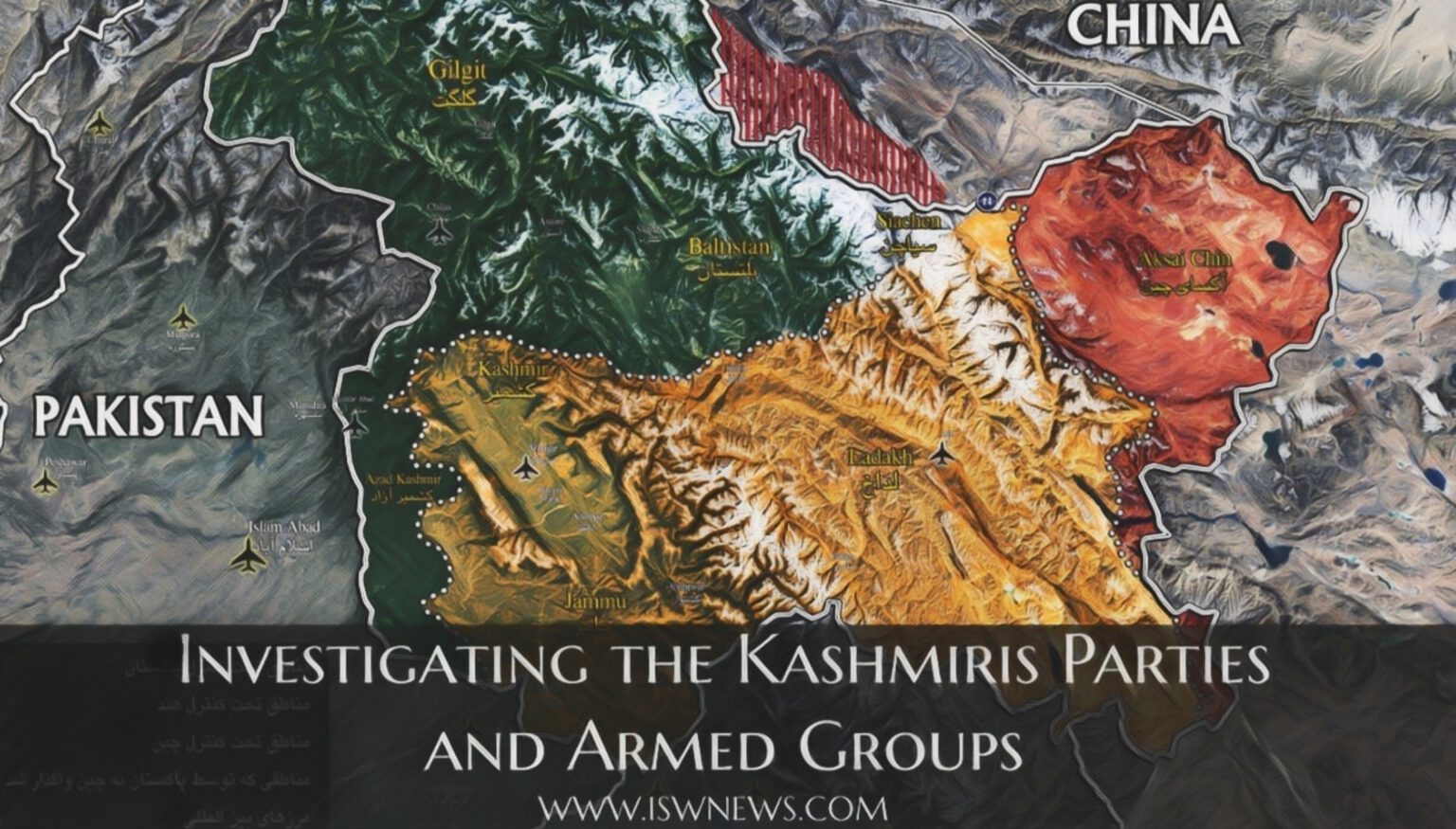
  • Investigating The Kashmiris Parties and Armed Groups

    Investigating The Kashmiris Parties and Armed Groups

    Kashmir parties divide into two categories:
    1. Political parties
    2. Jihadi militias


    1. Political parties divide into three subcategories:
    A) Parties endorsing annexation to India with mainly nationalism and secularism ideologies.
    They include:
    – Jammu & Kashmir National Conference party under leadership of Dr. Farooq Abdullah who believe Kashmir is part of India but should be self-goverend.
    – Indian National Congress party which is not very far from Jammu & Kashmir National Conference party and have less popularity.

    B) Parties which want independence, including:
    – Jammu Kashmir Liberation Front under leadership of Yasin Malik was established in 1965 and its members reside in both India and Pakistan. The party is only political with no military activities.
    – People’s Conference party under (ex-)leadership of Abdul Ghani Lone which has a military branch and less popular in Kashmir.
    – Jammu and Kashmir Democratic Freedom Party led by Shabir Ahmad Shah which demands referendum to be accepted by everyone. The party has a military branch Muslim Janbaz with minimal activity.

    C) Parties endorsing annexation to Pakistan and their policy is to divide Kashmiri parties and so far could gather 31 parties.
    These parties reached consensus “All Parties Hurriyat Conference”(Tehreek e Hurriyat) on 9 March 1993 which is a united front of Kashmiri movements against Indian government and mainly active in politics.
    In recent years, the Hurriyat Conference had internal conflicts and has two main factions, one of which is currently led by Syed Ali Shah Geelani and the other by Mirwaiz Umar Farooq. Farooq’s faction opposes Gilani’s faction. Umar Farooq’s faction is very popular in the city of Srinagar, and its military wing is known as the Umar al-Mujahideen.
    Syed Ali Shah Geelani and Mirwaiz Umar Farooq and other party leaders have a tough competition to lead the Hurriyat Conference.
    The main parties of the consensus include:

    – Jamaat-e-Islami founded and led by Abul A’la Maududi with political activities and Islamic education to Kashmiri people.
    – All Jammu and Kashmir Muslim Conference was founded in 1987 by Sheikh Muhammad Abdullah and Chaudhry Ghulam Abbas with mission of liberating Kashmir from India and annex to Pakistan.
    – Rabet al-Mujahideen party currently led by Nusrat Alam and its military branch by Ishtiyaq Ahmad.
    – Anjuman-e Shar’i Shi’ayan was founded by a Shiite scholar Sayyid Yusef Musavi and currently led by Sayyid Hasan Musavi Safavi, mainly concerned with Islamic issues of Shias.
    – Other parties such as Muslim League(Farooq Rahmani), Muslim League(Sheikh Abdul Aziz), Muslim Union led by Mulawi Abbas Rahhmani which is mostly supported by Shias, Public movement led by Farid Behnaji, Jamiat Ahl al-Hadith led by Mawlana Taheri, Harakat Tahrir Jammu and Kashmir led by Saadallah Tantari, People’s Resistance Movement led by Ghulam Ahmad Mir which has secular ideology, also want annexation to Pakistan.

    2. Militia groups fighting India for Kashmir and Jammu independence and are mainly supported by Pakistan (ISI). They include:
    – Hizbul Mujahideen:
    Hizbul Mujahideen is among the largest militia groups in Kashmir which fights for the independence against India. It was founded in September 1988 by Muhammad Ahsan Dar with HQ in Muzaffarabad town in free Kashmir.
    India, USA and EU put this group in blacklist of terrorist groups but Pakistan and Turkey have close ties with it. In despite of their mission “peace and justice”, declined the negotiation and chose military action to end India’s occupation.
    – Lashkar-e-Taiba:
    This Salafi Jihadi group was founded in 1987 by Hafiz Saeed. They are accused by India for terrorist attacks to India parliament in 2001 and Mumbai in 2008 (In three days of attacks in Mumbai the militants bombed, fired and took hostages in 10 different locations such as malls, railway station, hospitals, etc., which resulted in 195 people killed and more than 300 injured.). The group is in blacklist of terrorist groups by Russia and western countries.
    – Harakat al-Mujahideen or Harakat Ansar:
    It was founded in 1986 and their forces were trained by al Qaeda bases in east of Afghanistan during Taliban reign over Afghanistan.
    – Jaish-e-Mohammed:
    It was founded in 2000 by Masood Azhar in Karachi with activities in Kashmir only. This group is in close relationship with Lashkar-e-Taiba and other Salafi groups of Pakistan.
    – Al-Badr group:
    This group separated from Hizb-ul-Mujahideen but is not active much in Kashmir.
    – Ansar Ghazwat-ul-Hind:
    Separated from Hizb-ul-Mujahideen which was founded by Zakir Rashid Bhat and follows al Qaeda with discords with Pakistan and Kashmir group coalition.
    – Islamic State of Jammu and Kashmir:
    This group had limited activities so far and India believes they are related to ISIS thus subdued them severely.

  • Review of recent developments in Libya; Why General Haftar is losing ground? + Map

    Review of recent developments in Libya; Why General Haftar is losing ground? + Map

    Some western media counter “Turkish drone operations” as the reason behind this turning point in Libya war, however it can’t be the sole reason and there are several reasons for this change:
    1- Turkey’s support and Syrian militants brought to Libya.
    2- Lack of UAE and Egypt proper support for LNA.
    3- Unknown and ambiguous foreign policy of General Haftar.
    4- Wrong tactics utilized by LNA in urban warfare (specially in Tripoli) and taking defensive positions.

    In fact with the available data from the Libya’s battlefield in recent months and year we can say that both sides in Libya don’t know a full-scale war and compatibility to the situations and the winner is the person who last longer. Therefore we can see the role of Turkey to support Government of National Accord (GNA) properly and endure attacks by LNA and hit back on the right time.

    Given the direction of the GNA attacks after the recapture of the aforementioned areas in northwestern Libya, control of the three goals (and the region) as a whole is expected by the GNA:
    1- Military bases such as Jufrah and Ghardabiyah to stop aerial operations and recruiting by LNA. (Green circle in the map)
    2- Oil fields located in southwest of Libya such as al-Feel and al-Shararah to resume the refineries and increase income from selling oil products. (Brown circle in the map)
    3- Oil crescent area in northeast of Libya not only to increase the oil income but also to weaken General Haftar’s position and dissolve his organization. (Black circle in the map)

    In conclusion, Libya war is mainly the confrontation between two axes “Turkey-Qatar” and “UAE-Russia” and every time one side decides to invest more the balance of power tilts toward the same side.

    Click to see the full size map