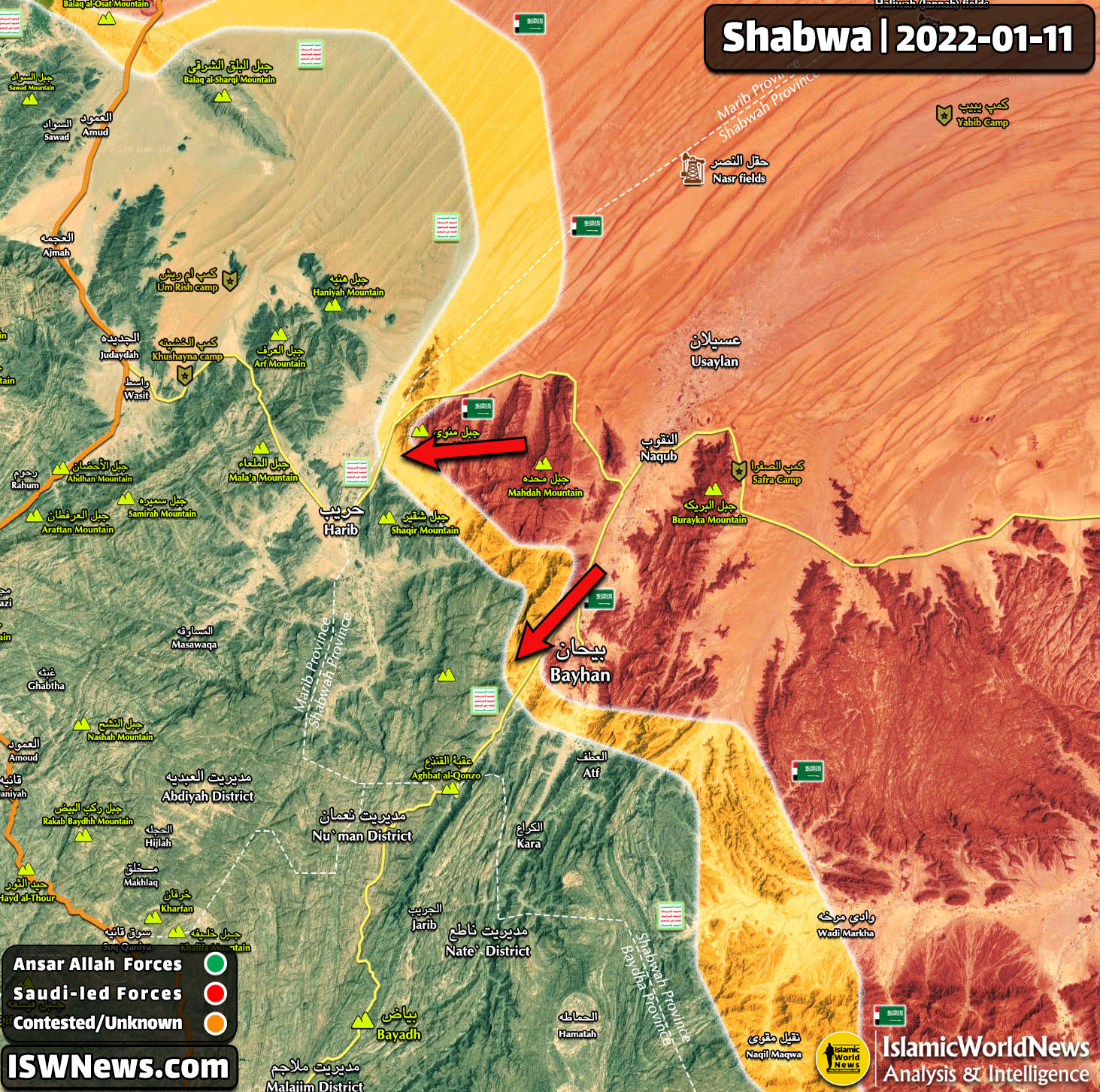
Following the Saudi coalition operation centered on the Amaliqah forces (Giant Brigades) in the west of Shabwa province and the south of Marib province, last night, January 24, the town of Harib, the center of Harab district in the south of Marib province, came under the control of the Saudi coalition. Currently, clashes are taking place in the east of al-Hajab town, the center of district of Ain, Wadi Harib and the heights of Malaa.
In the past 48 hours, Saudi coalition fighters have bombed the southern part of Marb province 46 times and the Ansarullah positions in Shabwa province once.
The town of Harib came under the control of Ansar Allah during Operation Rabi al-Nasr on September 22, 2021 and this is the second time that the town of Harib has come under the control of the Saudi coalition.
Due to the developments in this area, there is a possibility that Ansar Allah will withdraw from al-Hajab town. If Ansar Allah fails to halt the Saudi coalition advances in the Malaa, al-Arf, and Haniah highlands, the siege of the city of Marib city on the southern axis will be weakened, and Ansar Allah will be forced to retreat from the al-Balaq al-Sharqi and al-Balaq al-Owsat heights.
According to ISWNEWS field source, the claims of the Saudi coalition media regarding the control of Numan district in the north of Al-Baydha province, as well as Harib district in the south of Marib province, are not true. Currently, clashes are taking place in the villages of Al-Housh and Habshanah, located in the north of Harib town, and Al-Haman Heights, located in the south of Beyhan town.
The volume of airstrikes in these areas is high and the Saudi coalition warplanes bombed the fronts of Shabwa and Marib provinces 98 times in the last 48 hours.
Saudi coalition warplanes bomb residential houses in Harib and Al-Jubah
There has been no change in the southern front of Marib city.
Due to the continuation of the Saudi coalition operations in these areas, there is a possibility that Ansar Allah will withdraw from the district of Ain in Shabwa province and the district of Harib in the south of Marib province.
Currently, clashes between Ansar Allah and the Saudi-led forces continue in the south of Usaylan district.
In the video you see, the Saudi coalition forces enter the town of al-Naqoub, and what is evident in it is the lack of Ansar Allah defense equipment and the high volume of aerial bombardment on the frontlines.
After the end of Operation Faamkana Minhom in March 2020, the clashes in al-Jawf province continued in the northern axis from al-Khanjar camp to al-Yatmah town and the eastern axis from the eastern desert of al-Maraziq to al-Labanat base. The Saudi coalition equipping local forces under the command of Sheikh Amin al-Akimi, the governor of Mansour Hadi in Jawf province, had focused its attacks on the northern heights of al-Jawf and the al-Khanjar camp. Al-Akimi, with the support of the Saudi coalition and the Yatmah tribes, repeatedly attacked Ansar Allah positions, and despite several limited Ansar Allah operations in the al-Dhahra and Qash’an heights, his attacks on Ansar Allahcontinued.
Finally, with the escalation of the clashes on this axis from December 4, Ansar Allah started Operation Fajr Al-Sahra.
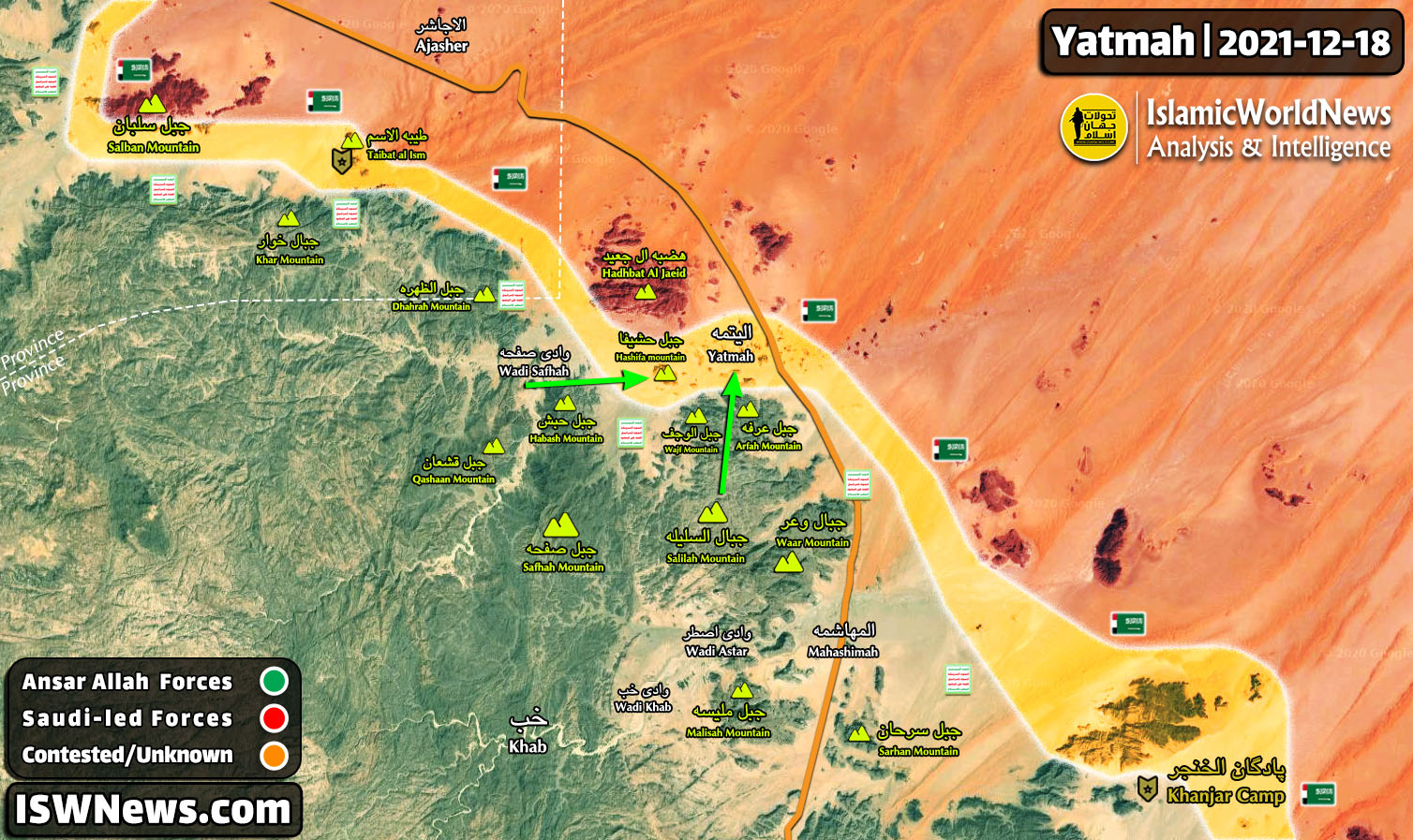
In its initial stages, Ansar Allah succeeded in liberating the areas of Qarn Ibn Shaman, Qarn al-Hijra, and Malawi, and consolidated its fire control over the area by strengthening its positions in Jabal Arafah. This was followed by clashes in Jabal al-Hashifa and al-Ja’id, and the news of the coalition commanders fleeing from the Yatmah led the leaders of the Yatmah tribes to talk and compromise with Ansar Allah.
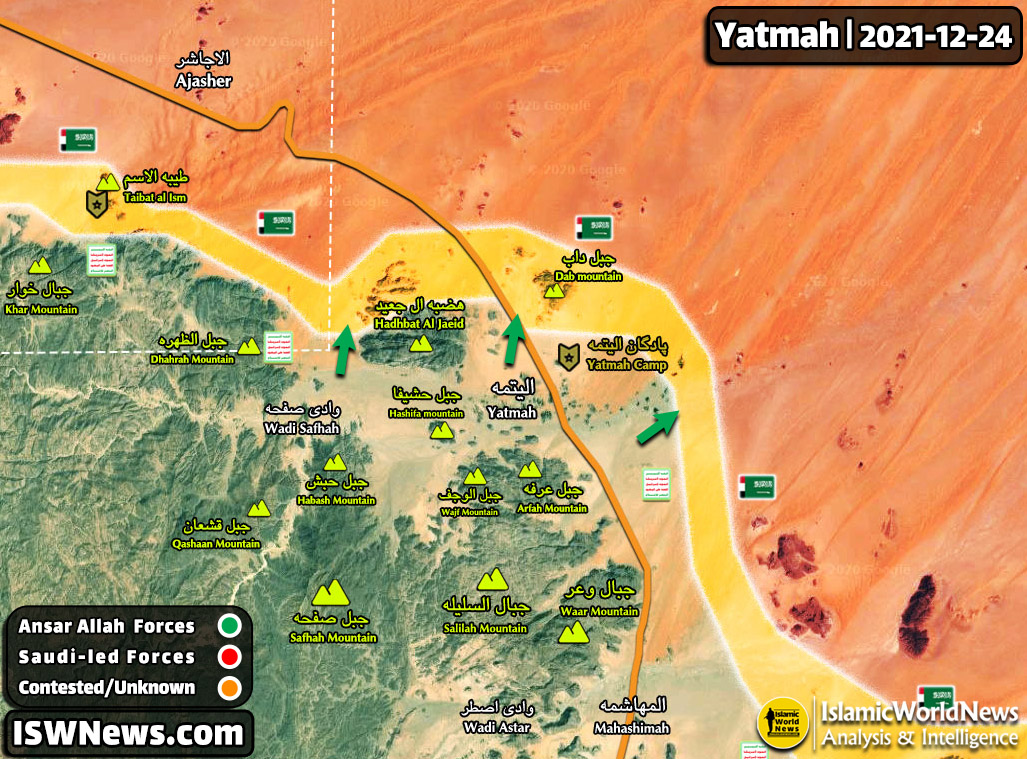
According to the agreement reached between the Yatmah tribes and Ansar Allah, it was decided that Ansar Allah would not enter the Yatmah and that the representatives of the tribes in the area would control and prevent the entry of Saudi-led forces into the area. However, this agreement failed with the deployment of the Saudi coalition forces to the Yatmah and the inability of the tribes against them. Ansar Allah also took the opportunity and on December 16, by launching several ground attacks, succeeded in pushing the Saudi coalition back from the Yatmah and Hadhbat Al-Jaid areas on the evening of December 23, and Ansar Allah forces and popular committees entered the Yatmah on December 24.
According to a statement from the Yemeni Armed Forces, Ansar Allah destroyed 15 military and armored vehicles in the operation. The death toll from the Saudi-led forces was 35, with 37 wounded and 45 captured. Saudi coalition warplanes have also bombed northern al-Jawf more than 60 times, with little effect on Ansar Allah advances. During the operation, Ansar Allah air defense shot down the 11th US-made Scan Eagle drone over the skies of Yatmah and in several other operations, prevented Saudi warplanes from entering the battles north of al-Jawf.
In the eastern axis of al-Jawf, clashes continue in the suburbs of al-Khanjar camp to the eastern desert of al-Maraziq and the hills of al-Alam.
As Brigadier General Yahya al-Sari’ pointed out in his statement, Ansar Allah has taken control of all important urban areas in al-Jawf province with the liberation of al-Yatmah, and the Saudi coalition has no control over any important point other than the eastern deserts of Khab and Shaaf district.
Clashes between Ansar Allah and Saudi-led forces in the north of al-Jawf province began on December 4th and intensified with airstrikes by coalition warplanes. Finally, on December 16th, Ansar Allah launched an operation to liberate the Yatmah area and its suburbs, And finally on December 24th, Ansar Allah succeeded in liberating the important Yatmah area in the north of al-Jawf province.
After the liberation of the town of Hazm during Operation Fa’amkan Minhom on March 1, 2020, Sheikh Amin al-Akimi, the governor of Mansour Hadi for the Jawf province, made the al-Yatmah area a center for preparing new attacks against Ansar Allah. So, the al-Yatmah area became one of the main targets of Ansar Allah in al-Jawf province.
Therefore, it can be said that with the liberation of Yatmah, in addition to controlling important points in the north of al-Jawf province, Ansar Allah has removed the Saudi coalition leverage on the Marib and Jawf fronts.
The provisions of this agreement are as follows: 1- Ansar Allah fighters will not enter the town of Yatmah and the control of these areas will be handed over to the elders and representatives of the Yatmah tribes. 2- The weapons left behind by the Saudi coalition in their bases in Yatmah will be handed over to the tribal fighters to ensure the security of the region. 3- The Yatmah tribes have also pledged not to follow the Saudi coalition and to prevent the Saudi-backed figures from entering the Yatmah and attacking the Ansar Allah positions.
Currently, the clashes continue in the northern areas of al-Jawf province, and Ansar Allah is stabilizing the progress in this area.
Clashes between Ansar Allah and Saudi-led forces in the north of al-Jawf province began on December 4th and intensified with airstrikes by coalition warplanes. Finally, on December 16th, Ansar Allah launched an operation to liberate the Yatmah area and its suburbs, which is still ongoing.
According to the latest news from al-Jawf front, Ansar Allah has succeeded in liberating the heights of Habash and Qasha’an in the north of al-Jawf province in the last two days. According to the ISWNEWS field source, the Saudi-led forces withdrew from the al-Yatmah area on the Hazm-Boqa’ road. However, Ansar Allah forces have not yet entered the area and advances on this front has not yet been stabilized. Talks are underway with local elders for Ansar Allah to enter the area. Ansar Allah’s usual policy has been to interact with the elders of the opposition tribes and prevent further bloodshed.
These areas have always been a place of conflict in recent months, and its suburban heights have been repeatedly changed between the two sides.
According to surveys of ISWNEWS, the conflict in the northern axis of al-Jawf province has intensified since December 4, and during this period, the Saudi coalition warplanes have bombed different areas in the districts of Khab and al-Shaaf and Hazm 27 times.
After the liberation of the town of Hazm during Operation Fa’amkan Minhom on March 1, 2020, Sheikh Amin al-Akimi, the governor of Mansour Hadi for the Jawf province, made the al-Yatmah area a center for preparing new attacks against Ansar Allah. So, in such circumstances, two goals were of great importance to Ansar Allah: 1- Capturing the al-Yatmah area, 2- Capturing positions of the Saudi coalition in the al-Jawf desert like al-Kanais camp, etc.
Therefore, it can be said that Ansar Allah can achieve its first goal in al-Jawf, which is to capture the Yatmah, by carrying out a small operation simultaneously with operation in Marib province. The success of this operation in al-Jawf will ease the coalition pressure on Ansar Allah on the al-Jawf front.
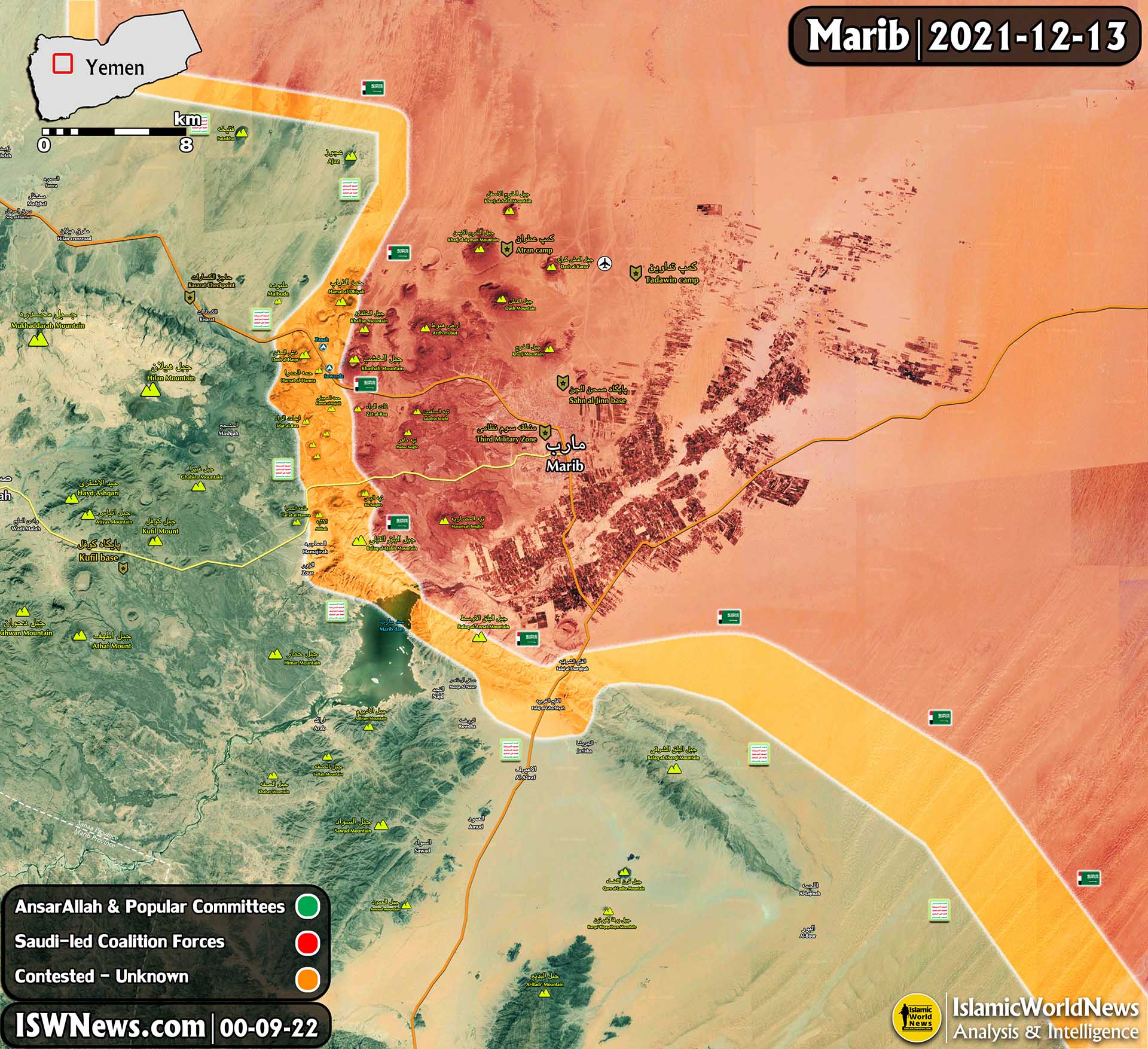
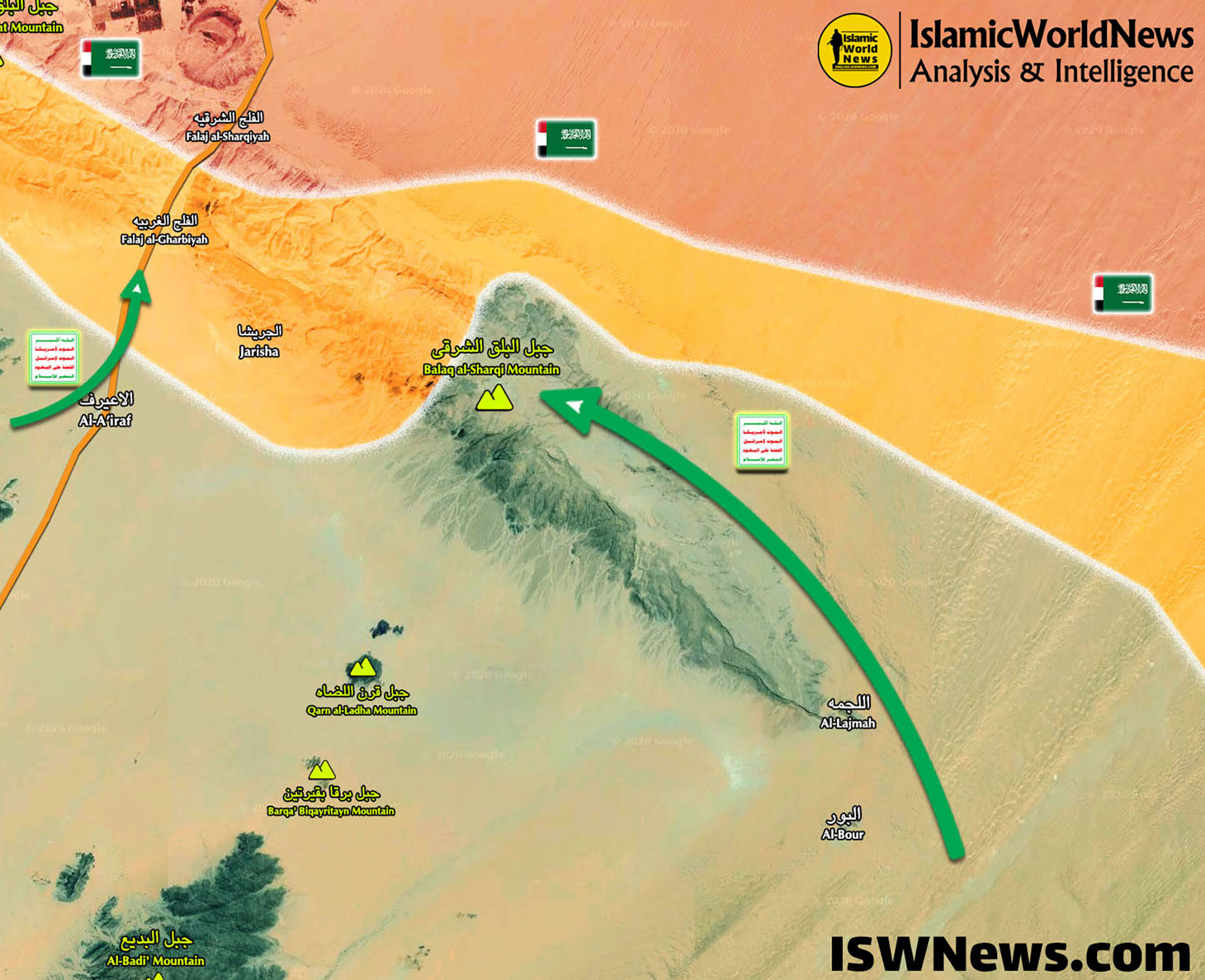
According to the latest news from the southern fronts of Marib, clashes between Ansar Allah forces and the Saudi-led forces continue in the al-Balaq al-Sharqi and a-Balaq al-Awsat heights and around al-Jarisha and al-Falaj al-Gharbi point. The Saudi coalition forces have retreated from most of al-Balaq al-Sharqi height, but fighting continues in the western part of the mountain.
In recent days, there have been rumors that Ansar Allah is advancing in the southern neighborhoods of Marib city, as well as the liberation of the al-Qaeda camp in Marib, which is not true.
Ansar Allah is moving troops and logistics to the southern and western regions of Marib city, and the forces are waiting for an order to launch the final operation to liberate the remaining areas in Marib.
Today, one of the most important commanders of the Saudi coalition, Major General Nasser al-Dhibani, the head of the operations department of the Ministry of Defense of Mansour Hadi’s government, and 26 other members of the Saudi-led forces were killed in the al-Balaq al-Sharqi clashes.
On the other hand, the commander of the 2nd Mountain Infantry Brigade of Ansar Allah in the third military zone, Ali Mohammad Alwan, was killed in the battles of Marib.
The Saudi coalition media also issued statements claiming that 200 Ansar Allah members had been killed and 21 military vehicles destroyed in the recent clashes in the south of Marib. Although the statistics and information released by the Saudi coalition regarding the Ansar Allah casualties are not reliable, but ISWNEWS can confirm that the clashes in the eastern al-Balaq al-Sharqi mountain is fierce and bloody, with casualties on both sides.
Saudi coalition warplanes are also heavily bombarding desert areas south of the city of Marib and other areas in the al-Juba and Sarwah districts. So that in the last 4 days, these areas have been bombed more than 120 times.
After the start of Ansar Allah operation to liberate the southern heights of the city of Marib on December 5, Ansar Allah and popular committees managed to liberate al-bour and al-Lajma points with several heavy attacks and shifted the focus of the clashes to al-Balq al-Sharqi mountain. Following the Ansar Allah operation in this area and despite the heavy bombardment of the Saudi coalition warplanes, Ansar Allah managed to liberate half of the al-Balq al-Sharqi mountain today, on December 8.
Fighting is currently underway to liberate the remaining half of the al-Balq al-Sharqi mountain. The Saudi coalition is strongly resisting in these areas, and various groups have entered the campaign under the command of the Saudi coalition, from ISIS to Tariq Saleh and etc.
Saudi coalition warplanes have bombed the southern and western fronts of Marib 111 times in the past four days, which is a heavy bombardment due to the small size of the front.
Al-Balaq heights is the Saudi coalition’s last defensive position south of the city of Marib, and its liberation is likely to lead to a complete withdrawal of Saudi-led forces from the city of Marib. Because the forces loyal to Mansour Hadi and other groups under the command of the coalition (al-Qaeda, ISIS, the Tariq Saleh forces, etc.) are not able to confront the Ansar Allah fighters in a ground battle. This scenario is more likely to happen with the arrival of Ansar Allah “Kataeb al-Mawt” (Death Battalions) special forces.
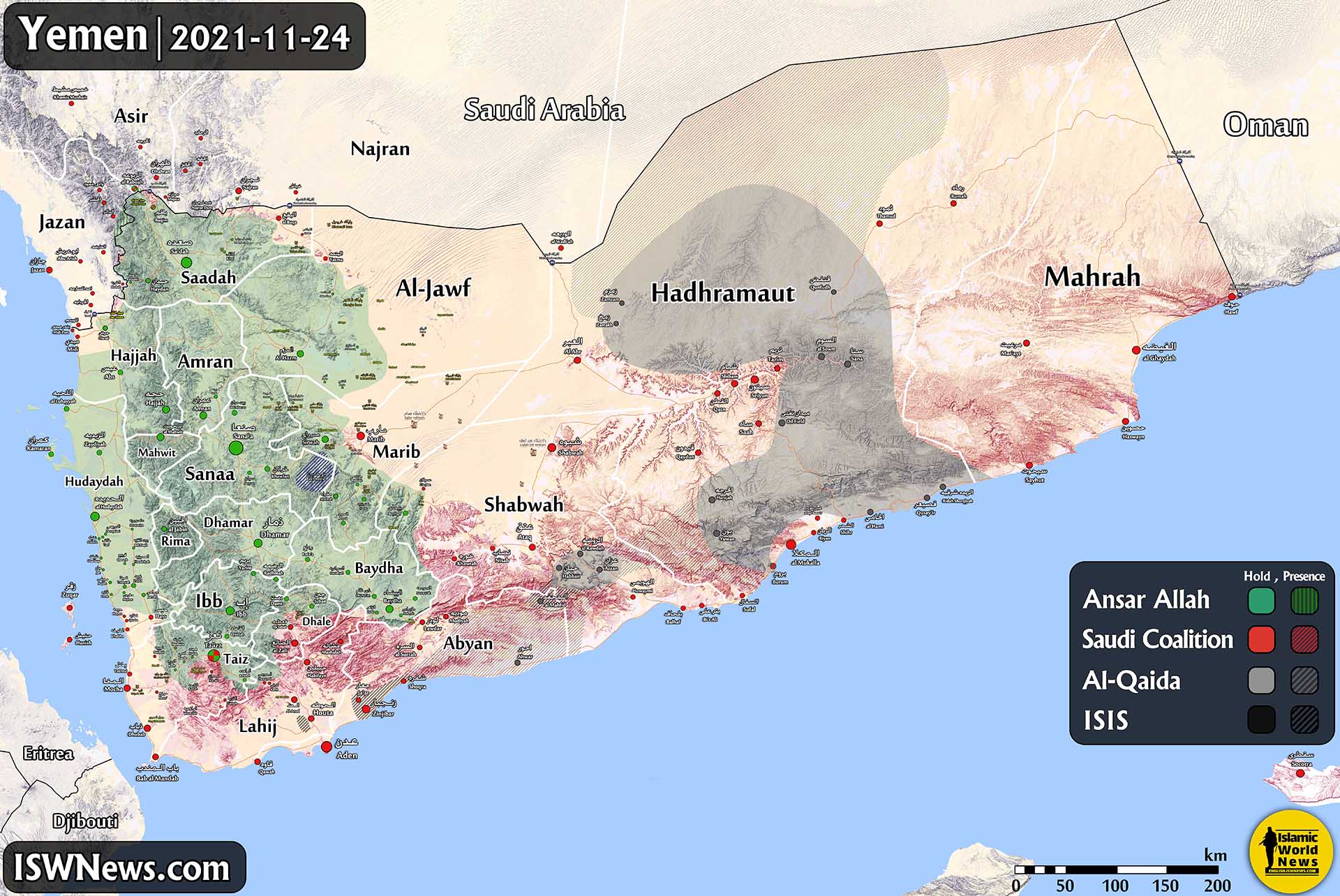
Marib: In the central axis of Yemen, Ansar Allah has succeeded in liberating the al-Jubah district center and the northern areas of this district, as well as the district of Jabal Murad (without clashes), following Operation Rabi al-Nasr. This important advance has led Ansar Allah to the southern entrance of the city of Marib, and clashes have been going on since November 2 in the suburbs of the al-Balaq al-Sharqi and al-Balaq al-Awsat heights.
Al-Hudaydah: On November 12, the Saudi coalition command issued an order to withdraw from the city of Al-Hudaydah and the west coast of Yemen. During this retreat, the National Resistance forces, including the forces under the command of Tareq Saleh, Tahamah, Amalaqah and joint forces, evacuated the northern and eastern areas of al-Hudaydah city and the western areas of al-Durayhami, al-Jah, al-Tuhayta.
On the other hand, on November 18, Tareq Saleh forces launched an operation called “Golden Arc” in the south of al-Hudaydah province and the west of Taiz province, with the aim of securing the positions of the Saudi coalition on the west coast, which has not achieved significant results so far. So far, Ansar Allah has managed to repel most of Tareq Saleh’s ground attacks by carrying out the eighth deterrent balance operation and several other missile and drone operations.
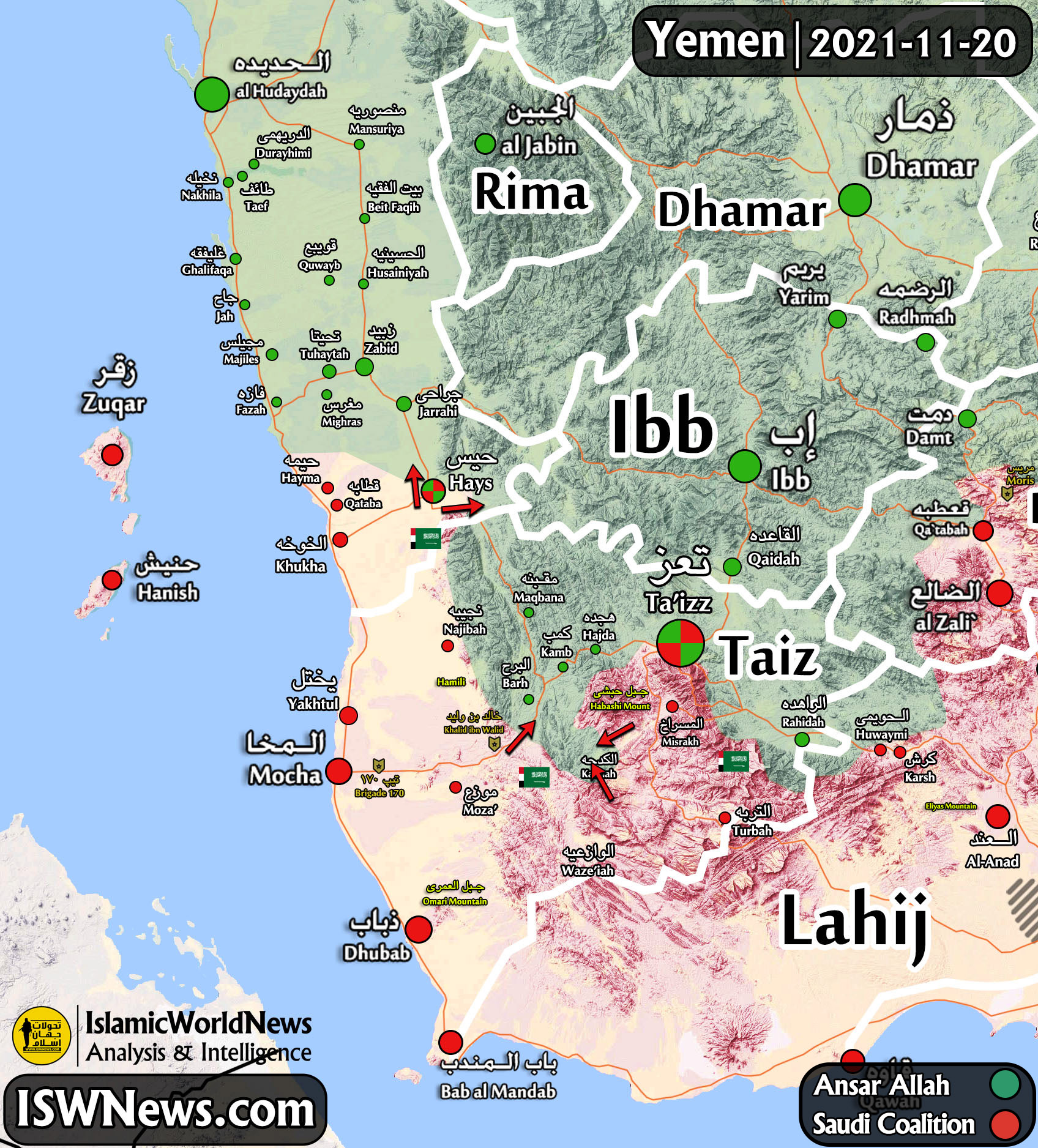
According to the latest news from the southern front of al-Hudaydah province, Tariq Saleh forces have concentrated their attacks to the north and east of the town of Hays, and in this regard, they have reached the south of Beit Akish and al-Baghil villages, leaving behind al-Adeen crossroad.
The Saudi-affiliated media outlets have reported that Tariq Saleh forces have taken control of al-Baghil, a claim that is not true given information by our field sources and a review of published videos of clashes in northern Hays. On the eastern front of Hays, Tariq Saleh forces are currently stationed on the outskirts of al-Nakhla, and no change has taken place in other areas.
In the past 48 hours, Saudi coalition fighter jets and drones have bombed the southern front of al-Hudaydah 22 times, including in al-Hays, al-Jarrahi and al-Tuhayta, which is an increase from the previous days.
Considering the direction of Tariq Saleh operations, it seems that their first goal is to ensure the security of Hays town. If the first goal is achieved, their main bases, al-Khokha and Mocha, will be free from the threat of Ansar Allah ground attacks.
On November 18, Tariq Saleh forces with support of the Saudi coalition and accompanying STC forces, have launched an operation called “Golden Arc” on three axes of Hays in the south of al-Hudaydah province, Wazi’yah region and Habashi mountain in the west of Taiz province.
Currently, clashes are taking place around the town of Hays and the al-Kadhah area in the west of Taiz province, and Tariq Saleh forces have not made much progress on the mentioned fronts. The areas mentioned in the media as the advance of the Saudi coalition have not been under Ansar Allah control in the past, and the Saudi coalition media exaggerates in this regard.
Ansar Allah has also launched heavy missile and drone strikes against the positions and gatherings of Tariq Saleh forces since yesterday evening. According to Ansar Allah media, more than 125 members of the Saudi coalition have been killed and wounded as a result of the attacks.
The names of several field commanders, namely Nizar al-Wajih al-Yafe’ commander of the 14th Amalaqah Brigade, Musa Saleh Ahmad al-Tawi commander of the 12th Amalaqah Brigade, Brigadier General Saleh Dolin, close to Tariq Saleh, Brigadier General Abu Ali al-Dhale’i commander of the 12th Amalaqah Brigade, Abu Saif Dhu Yazn al-Silmi commander of the 1th Amalaqah Brigade, Brigadier General Mahmoud Shahab in charge of the 3rd Joint Forces Brigade and etc. are among the death toll of AnsarAllah’s missile and drone attacks.
On the Marib front, clashes are taking place near the Falaj al-Gharbi, Balaq al-Sharqi and Balaq al-Awsat heights, as well as Tala’at al-Hamra and Wadi Nakhla area, And Saudi coalition warplanes are constantly bombing these areas to prevent Ansar Allah advancement.
In general, by activating the fronts in the south of al-Hudayidah and the west of Taiz, the Saudi coalition intends to reduce Ansar Allah’s pressure on Marib, which has been successful so far. Ansar Allah must capture or destroy the military posts and bases in the Khokha and Mocha areas in order to defeat the attacks of Tariq Saleh. To break the coalition resistance in Marib, it also needs to attack from several axes (east of al-Jawf, south and west of Marib), which requires extensive manpower and military equipment.