1- Israeli warplanes fired several missiles at targets in the suburbs of Damascus. Date: January 31
2- Israeli warplanes fired several missiles at targets in the suburbs of Damascus, during which one Syrian soldier was martyred and five other soldiers were injured. Date: February 9
3- The Israeli regime fired several ground-to-ground missiles from the occupied Golan to targets around the town of “Zakiyah” in the suburbs of Damascus, which resulted in material losses. Date: February 16
4- The Israeli regime fired several ground-to-ground missiles from the occupied Golan to targets around Quneitra, which resulted in material damage. Date: February 23
5- Israeli warplanes fired several missiles at targets around the city of Damascus with several missiles, as a result of which three servicemen were martyred. Date: February 24
6- Israeli warplanes fired several missiles at targets in the suburbs of Damascus, during which two civilians were martyred. Date: March 7
7- Israeli warplanes fired several missiles at targets in Hama province of Syria. Date: April 9
8- Israeli warplanes fired several missiles at targets in Damascus province of Syria. Date: April 14
9- Israeli warplanes fired several missiles at targets in the outskirts of Damascus. Four members of the Syrian army were martyred and three others were injured. Date: April 27
10- Israeli regime targeted Hadar and Jabatha al-Khashab in the north of Quneitra province with missile and artillery attacks. Date: May 11
11- Israeli warplanes fired several missiles at targets in the central parts of Syria, during which four servicemen and one civilian were martyred and seven others were injured. Date: May 13
12- The Israeli army attacked areas south of Damascus with several ground-to-ground missiles from the occupied Golan, during which three Syrian soldiers were martyred. Date: May 20
13- Israeli warplanes fired several missiles at targets in the southern suburbs of Damascus. Date: June 6
14- The missile attack of the Zionist regime on targets in the south of Damascus resulted in the injury of a civilian and the occurrence of material damages. Date: June 10
15- Israeli warplanes fired several missiles at targets in the outskirts of Al-Hamidiya town located in the south of Tartus. Two civilians were injured. Date: 2 July
16- Israeli drones attacked Hadar town located in Quneitra province. One Syrian Army serviceman was martyred. Date: 6 July
17- Israeli warplanes fired several missiles at targets in the suburbs of Damascus. Three SAA servicemen were martyred. Date: 22 July
18- Israeli warplanes fired several missiles at targets in the suburbs of Damascus and Tartus port. Three Syrian Army servicemen were martyred and three others were injured. Date: 14 August
19- Israeli warplanes fired several missiles at targets in Hama and Tartus provinces of Syria, during which two civilians were injured. Date: 25 August
20- Israeli warplanes fired several missiles at targets in Aleppo and Damascus provinces. Date: 31 August
21- Israeli warplanes fired several missiles towards the Aleppo airport from the Mediterranean Sea. Date: 6 September
22- Israeli warplanes fired several missiles at targets in the outskirts of Damascus. Five Syrian soldiers were martyred. Date: September 17
23- Israeli warplanes fired several missiles at targets in the suburbs of Damascus. Date: October 21
24- Israeli warplanes fired several missiles at targets in Damascus province, as a result of which a Syrian soldier was injured. Date: October 24
25- Israeli warplanes fired several missiles at targets in the city of Damascus and its surroundings. Date: October 27
26- Israeli warplanes fired several missiles towards the Shayrat air base in Homs province, during which two Syrian army soldiers were martyred. Date: 13 November
27- Israeli warplanes fired several missiles towards the central and coastal areas of Syria, during which four Syrian army servicemen were martyred. Date: 19 November
28- Israeli warplanes fired several missiles at targets in the suburbs of Damascus. Date: December 20
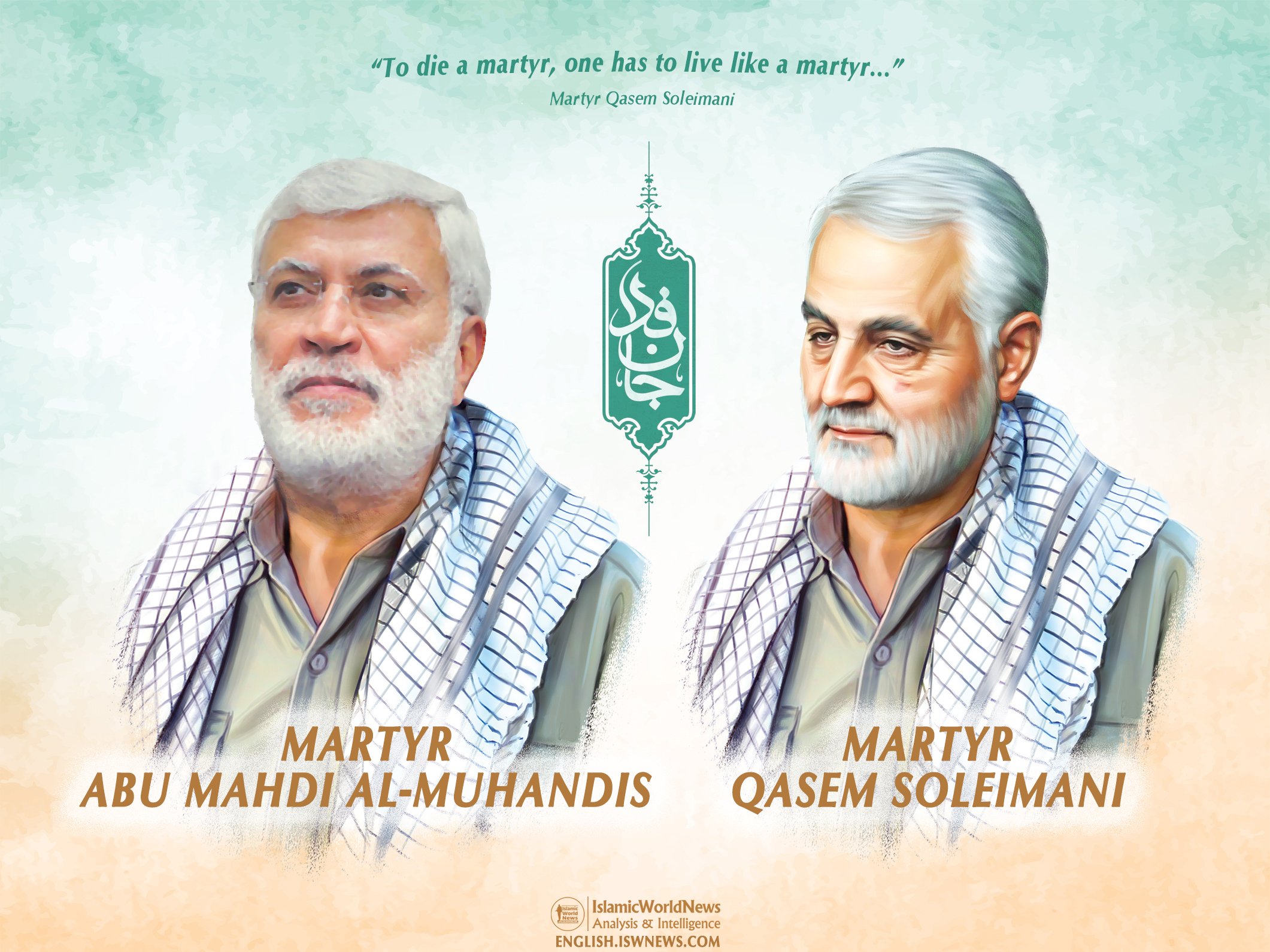
Many people who have been trained in military organizations and reached high levels – regardless of the attitude and approach they had before entering this field – have had no choice but to change their previous attitude and approach in order to adapt to the structure and atmosphere of the military. This atmosphere necessitates following orders even if they contradict their personal beliefs. It is natural that tolerating and adapting to such an environment is difficult and exhausting. The most important outcome coming from this is people becoming one in their thoughts, worldview, and behavior. Martyr Qasem Soleimani, an accomplished general who had experience in various types of operations and battlefields, had strangely succeeded in making a beautiful, artistic connection between the sometimes dry, strictly-organized duties of a high-ranking military general and living as a moral person, a caring father, and a kind friend. Some of Martyr Soleimani’s remarkable features will be explored in what follows.
Down-to-earth and humble
Both in his personal life and on the battlefield, he was always humble and modest in his appearance, clothes, manner, and behavior. Contrary to his position, the amenities he had in life were similar to those of an ordinary person. In many ceremonies, such as in the funerals of martyrs and his comrades, when meeting with the families and children of the martyrs, when giving speeches, or in public meetings, he would appear without any formality and would avoid becoming the center of attention. Once, he was scheduled to appear in a ceremony hosted by IBNA to honor the IRGC Quds Force for successfully defeating Daesh. Upon realizing that the ceremony was about honoring him personally, General Soleimani did not participate in the event and sent a representative instead. The down-to-earth, humble attitude of the general was also manifest when he was on the battlefield and among his comrades. His relationship with his forces was more like the relationship between a father and a son or between two brothers than between a commander and his soldiers. The soldiers followed his orders more out of their own inner inclination than out of a feeling of compulsion due to being in the military. One of the most important examples of the general’s down-to-earth, humble behavior was that everyone knew him by his first name and called him “Haj Qasem”.
Martyr Soleimani’s simplicity, gentleness, and kindness toward his fellow soldiers
Care and devotion to the people
When he was socializing and meeting with people, you could always find the general smiling and cheerful. For this reason, he spoke with people face to face at every opportunity. Although General Soleimani was an administrator and senior military commander of the country and he was naturally very busy, he devoted considerable time to listening to people’s concerns and complaints. Young people who wanted to meet him could easily approach him and even take a selfie with him. When he saw children and toddlers somewhere, he would chat and play with them. He would personally attend the burial ceremonies of his comrades and visit their families to comfort them.
Martyr Soleimani with the people, taking selfies with the youth, and his gentleness in dealing with his soldiers
Ethical even in war
A tough battle is a place where subtle moral concerns are not taken seriously. As a general rule, things that are condemned under normal circumstances are not typically mentioned as violations of rights in a war situation. In this context, General Soleimani’s “awareness of ethics” in the midst of bullets and shrapnel flying all around was a remarkable, thought-provoking phenomenon. When the sound of firearms going off in a war zone could be heard here and there, the general would give a short speech to a group of the Resistance fighters who were preparing to carry out a difficult operation against the Daesh. Perhaps for those who are familiar with war literature, the first idea that comes to mind from the moral speeches of General Soleimani is that the general was advising his forces to refrain from assaulting prisoners or treating women and children brutally. But this assumption reflects something far narrower than Martyr Soleimani’s moral concern as a Muslim. Perhaps one can see a fragment of Martyr Soleimani’s moral concern in his own words where he said, “We, who are here, must be careful about what is permissible and what is forbidden. … We cannot just take over people’s homes.” The idea that the body and soul of civilians in the war zone should not be harmed was obviously one of the principles of Martyr Soleimani’s war ethics, which were based on Islamic principles and thoughts. But the general’s recommendation was that even people’s property and homes in war zones should not be seized or attacked, let alone their bodies, lives, and souls.
Martyr Soleimani giving a short speech to some resistance fighters
Reminding others to observe moral principles was never enough for Martyr Soleimani. He was also a complete manifestation of his beliefs himself, and he repeatedly acted in accordance with his beliefs in scenes of action. For instance, one time when he was in the war zone fighting the Daesh in Syria, General Soleimani prayed in an abandoned house. After praying, he asked for permission and forgiveness from the owner of the house in a letter and even left an address and number where he could be contacted in the letter so that if the owner of the house had a complaint or request from him, he would be able to contact him.
Martyr Soleimani’s letter to the owner of an abandoned house in Al-Bukamal City in Syria asking for forgiveness
His strict observance of ethics on the battlefield not only included human rights. It also included the rights of animals and the environment. There is a video of the general visiting the war zone. He suddenly notices a stray cow and asks the driver to pull over. He approaches the cow and feeds it some of his own bread and food. The scope of Martyr Soleimani’s moral concerns was sometimes so extensive that it included Iran’s mountain gazelles. One time in the middle of a battle against the Daesh in Iraq in the winter, he contacted IRGC headquarters and asked his colleagues to prepare fodder for the gazelles that lived on the mountain near the barracks, because it was difficult for them to find food in the cold winter.
Martyr Soleimani feeding a frightened cow wandering on the battlefield
The secret of General Soleimani’s personality
What attracts attention to General Soleimani’s character was the vastness of this man’s multidimensional existence and personality. On the one hand, he had such expertise in understanding military affairs and strategies that even his enemies, namely the front of colonization and arrogance, acknowledge his military strength and power. On the other hand, even minute moral issues were so important to him that even in his busy mind he could find a place to think about them and take appropriate action. Perhaps the reason behind General Soleimani’s lofty, focused personality – and at the same time his far-reaching, extensive existence – can be found in his thought and worldview. As a Muslim raised in the pure Islamic school of Prophet Muhammad (pbuh), General Soleimani had reached this belief that the field of human life and existence is truly vast, from worshiping, praying, and being alone with God, to paying attention to and responding patiently and lovingly to the expressions of need of ordinary people, to never getting tired of bravely defending the oppressed, innocent, and defenseless against the oppressive Daesh or the usurping Zionist regime. The pure Islam of Prophet Muhammad (pbuh) had united all the physical, mental, and spiritual powers of Qasem Soleimani around monotheism and God’s satisfaction in such a way that whatever was defined as a divine duty attracted the attention of General Soleimani.
“He loved all human beings and he sacrificed himself for everyone. Moreover, he was a man of spirituality, purity, and piety… . In the deserts and mountains of such and such countries, he faced different enemies.”
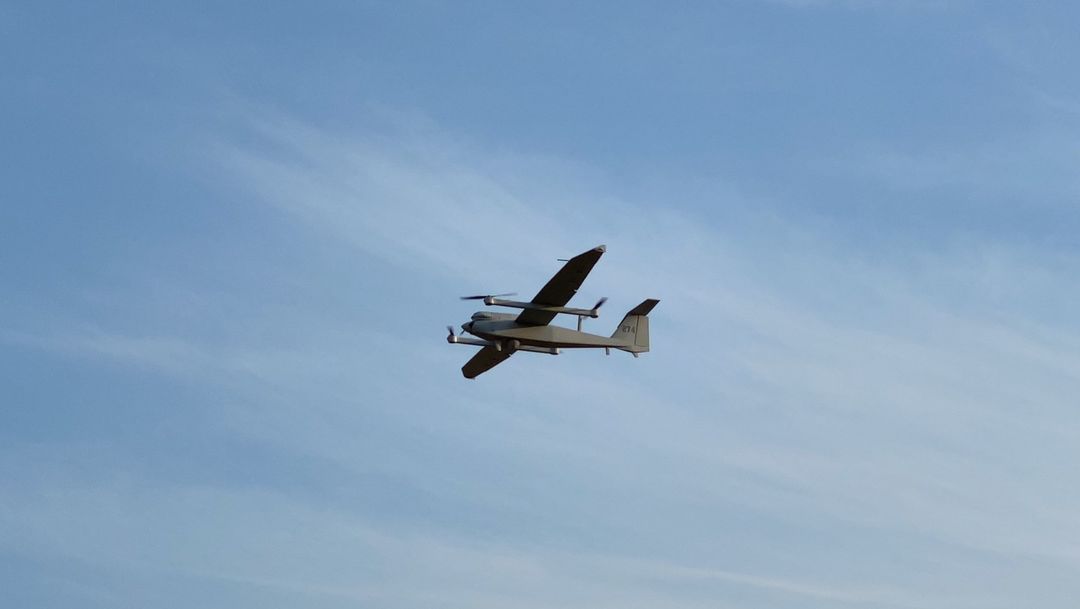
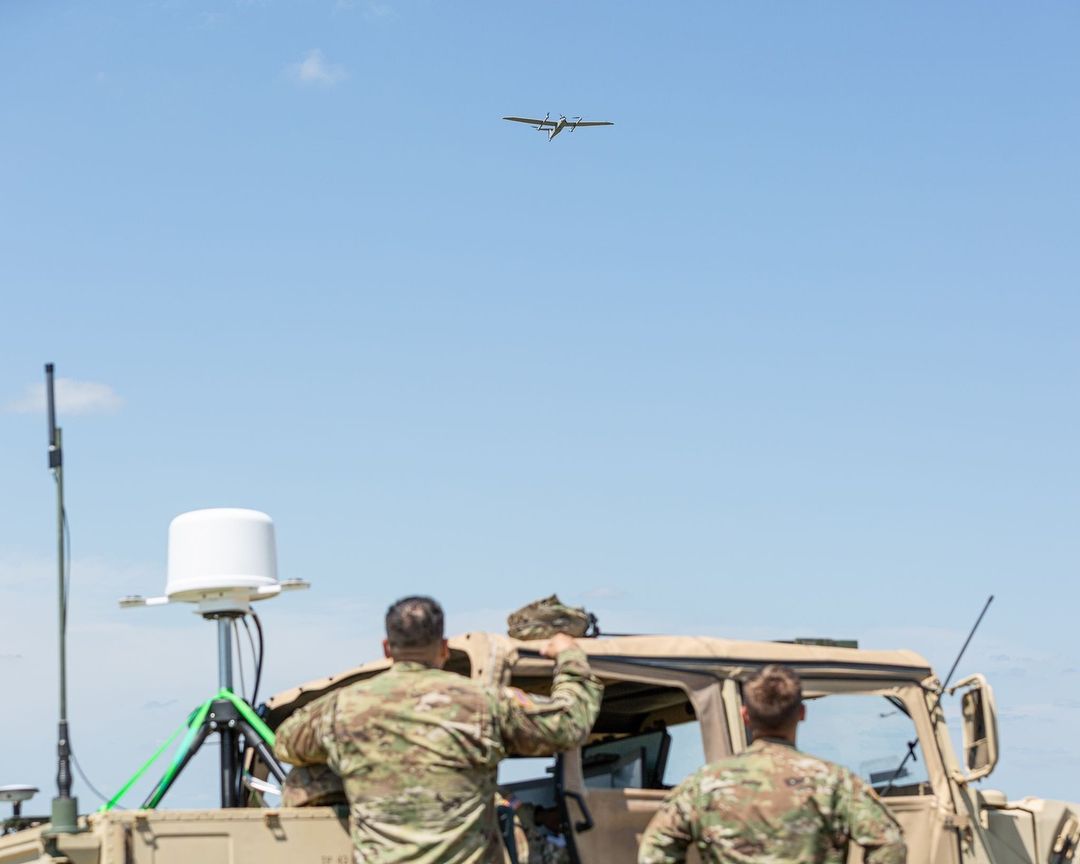
The UAV is basically intended and developed for use by naval units for intelligence, surveillance, reconnaissance and search and rescue missions. The JUMP 20 UAV was first unveiled in April 2014 and underwent several test flights in January 2015.
The United States Army has chosen the JUMP 20 UAV to replace the RQ-7 Shadow series drone. Also, its heavy fuel variant has been offered for the Australian Navy’s Tactical Unmanned Aircraft Programme. The Mexican Navy deployed the JUMP 20 for unstated missions over Mexico in May 2016, approximately two months after the UAV was acquired by the country’s navy.
The JUMP 20 UAV has a flight duration of 9 to 16 hours and an operational range of 185 kilometers, and due to its vertical takeoff and landing capability, it does not need a runway or a launch and recovery system such as a catapult and parachute for landing and takeoff.
The JUMP 20 features a monocoque airframe, constructed using composite materials. It comes with two fixed wings arranged in a high-wing configuration, and a tailplane in a T-tail configuration. In the high-wing configuration, the wings are located on top of the main body (fuselage) of the aircraft.
Jump 20 takeoff and engine noise level
The vertical takeoff and landing capability is provided by twin vertically mounted rotors fitted to each wing. The UAV’s versatility, combined with VTOL capability, offers low operating costs and increased fuel efficiency. The JUMP 20 UAV uses a four-stroke EFI 190cc petrol engine and four electric motors, each of which is placed in a rotor boom. The engine has a time between overhaul (TBO) of 500 hours.
The length of this UAV is 2.9 meters, its wingspan is 5.7 meters, and the maximum take-off weight (fuel and cargo) is 97.5 kg. Payloads weighing 13.6 kg are carried in the payload bay located in the central part of the fuselage. This drone can be set up and operational in less than 60 minutes.
This drone can be operated by two crew members from the ground control station.
The Jump 20 features an autopilot system and ground control station shared with AeroVironment’s other drones, offering a highly customizable and modular platform that can be custom configured to meet operational or customer needs. The payload data is displayed on computer screens at the portable ground control station, enabling the operator to provide command and control to the UAV through the data link.
Explanations of the manufacturer about the features of JUMP 20 UAVA video of JUMP 20’s takeoff, guided by mobile ground station and vertical landing
Due to the ability to carry cargo up to 13.6 kg, this UAV can use various and advanced sensors such as ARCAM 45D, electro-optical sensor and long-range infrared MWIR along with stabilizer, image processing and internal tracking. The standard payload options are Cloud Cap Technology’s TASE series gyro-stabilised, gimballed electro-optical/infrared (EO/IR) imaging systems such as TASE400, TASE400HD, TASE400DXR and TASE400LRS. The EO/IR cameras provide imagery and video data and target tracking in real time, both during the day and at night. A video/data link, operating in L, S or C bands, transmits real-time sensor data to the ground control station. The JUMP 20 UAV also carries a number of other sensors, including standard navigation lights, LiDAR, synthetic aperture radar (SAR), communications relay, 3D mapping sensors, communications intelligence (COMINT), and signals intelligence (SIGINT).
JUMP 20 tactical drone can fly at a maximum speed of 72 km/h and its service ceiling is 4572 meters. This UAV can transmit data within a range of 125 km, and in longer ranges, the use of satellite systems is required.
JUMP 20 drone specifications: Length: 2.9 meters Wing length: 5.7 meters Maximum take-off weight: 97.5 kg Maximum payload: 13.6 kg Maximum speed: 72 km/h Operational range (limited to data link range): 185 km Flight ceiling: 4572 meters Flight endurance: 9 to 16 hours Engine: MOGAS 190CC EFI Origin: USA
Click to view full sizeClick to view full size
Collection of posters of JUMP 20 VTOL Reconnaissance Drone in Russian, Persian, Arabic, Azeri and Kurdish:
Meraj-521 loitering munition was unveiled and deployed on October 19, during the “Eghtedar ” drill of the Islamic Revolutionary Guard Corps forces in the northwest of Iran.
The Meraj-521 is a suicide drone that is used against infantry targets and enemy light vehicles. The dimensions of these drones are so small that it can be carried in a backpack. This drone is launched from a tubular launcher, and after launch, its wings are opened and it will roams over the desired areas. The operator directs the drone to the target with the screen it has, and the command to attack or change the target and roam around in the environment is available. If a situation causes a strike to be called off, the operator can call off the drone and re-target it
The main mission of the Meraj-521 is to attack light armored vehicles, trenches, personnel, etc.
The Meraj-521 suicide drone is similar in appearance to the US switchblade drone and has four folding wings, two in the front and two in the back, as well as two folding vertical rudders at the end of the drone.
During the exercise and unveiling, two examples of this drone were seen, one with the equal wingspan and the other with smaller front wings; But in the drone test video, the drones had smaller front wings. This brings to mind the speculation that the first model with equal wingspan was probably a replica of Meraj-521.
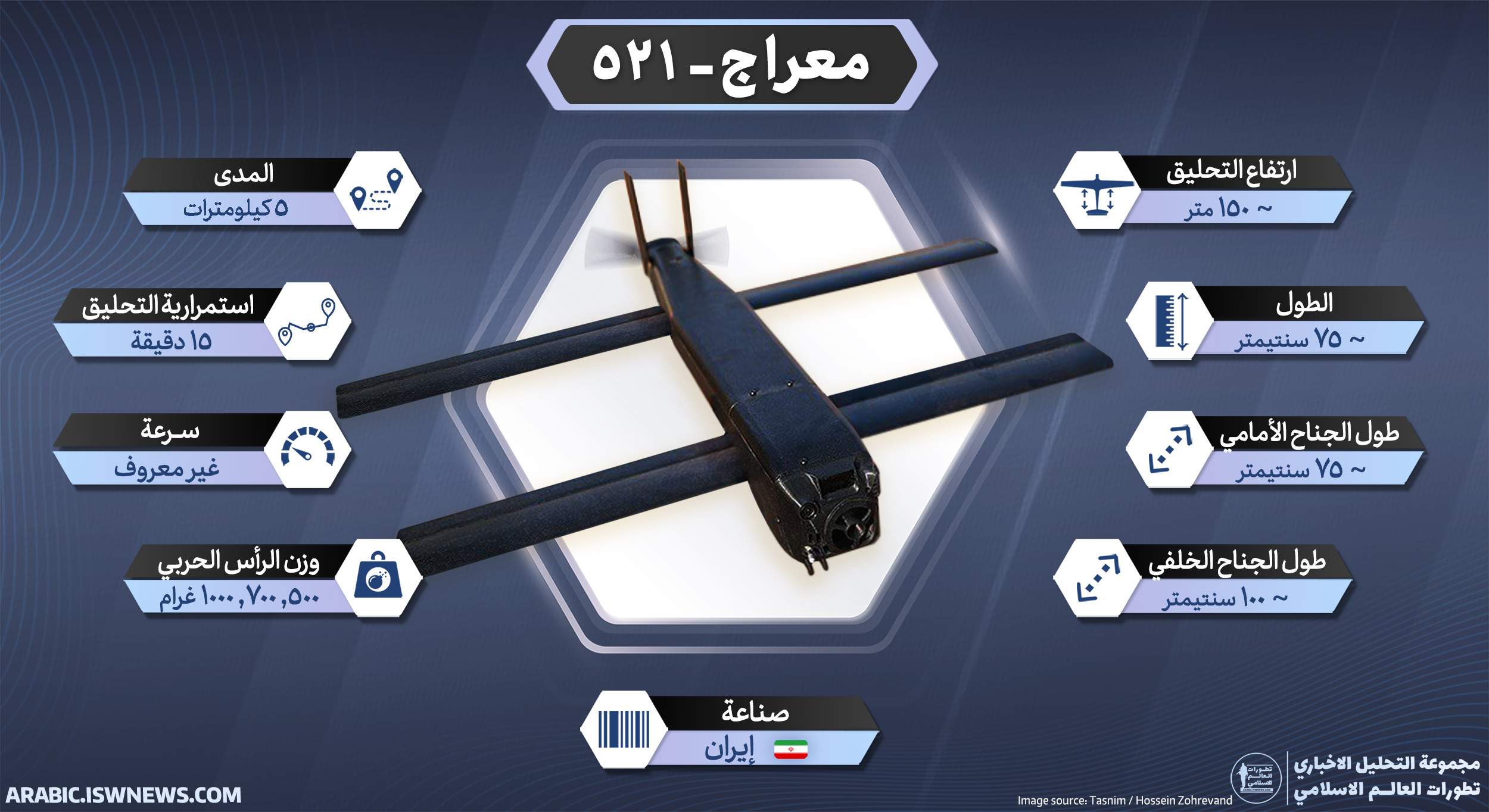
Meraj-521 has three different warhead weights of 500 grams, 700 grams, and 1000 grams and its flight endurance is between 5 and 15 minutes, and its maximum range is 5 kilometers.
Combining the use of the Meraj-521 suicide drone with hand-launched reconnaissance drones can make it possible to engage targets at longer ranges.
The total weight of the Meraj-521 drone has not been announced, but this drone can be carried by a person. The Meraj-521 drone is powered by an electric motor to fly and relies on a special solid fuel booster to exit the launch tube. Electric motors make very little noise and their radar cross-section is also small, and air defense systems are practically unable to intercept them.
Meraj-521 has the ability to be launched from various platforms such as tactical vehicles, helicopters, gyrocopters, etc. In the IRGC “Eghtedar” exercise, a video of various launches of this tactical and practical UAV was released, which can be seen in this video.
The launch of Meraj-521 from tactical vehicles, helicopters, small launchers, etc
Another strategic and important feature of this kind of drones is the swarm attack. In swarm attack, a large number of these drones are launched towards the target and saturate the target’s defense systems, making it impossible to prevent the attack.
Considering the experiences of the war in Ukraine as well as the experience of recent years in Syria and Iraq, the need to design and build these drones was felt in the combat organization of the Iranian Armed Forces. Due to the fact that Iran has a shortage of fighter jets and practically in battles outside Iran’s borders, close air coverage of the operating ground forces is very difficult and perhaps impossible. Also, if troops use anti-armor missile systems that are carried by pesron, it is very large, heavy and expensive; so using loitering munition such as Meraj-521 can solve this problem to a great extent.
The Meraj-521 drone is innovative, cheap, light, effective and highly efficient and meets the tactical needs of special forces of Iranian military.
Meraj-521 drone specifications: Range: 5 km Endurance: 15 minutes Warhead weight: 500-700-1000 grams Length: ~ 75 cm Front wingspan: ~ 75 cm Rear wingspan: ~ 100 cm Flight altitude: ~ 150 meters Speed: Unknown Origin: Iran
Click to view full size
Collection of posters of Meraj-521 Loitering Munition in Russian (Мерадж-521 Дрон), Persian (پهپاد معراج-۵۲۱), Chinese (Meraj-521 无人机), Hebrew (Meraj-521 מזלט), Arabic (مسيرة معراج-521), Azeri (Merac-521 Dronu) and Kurdish (درۆنی مێعراج-521):
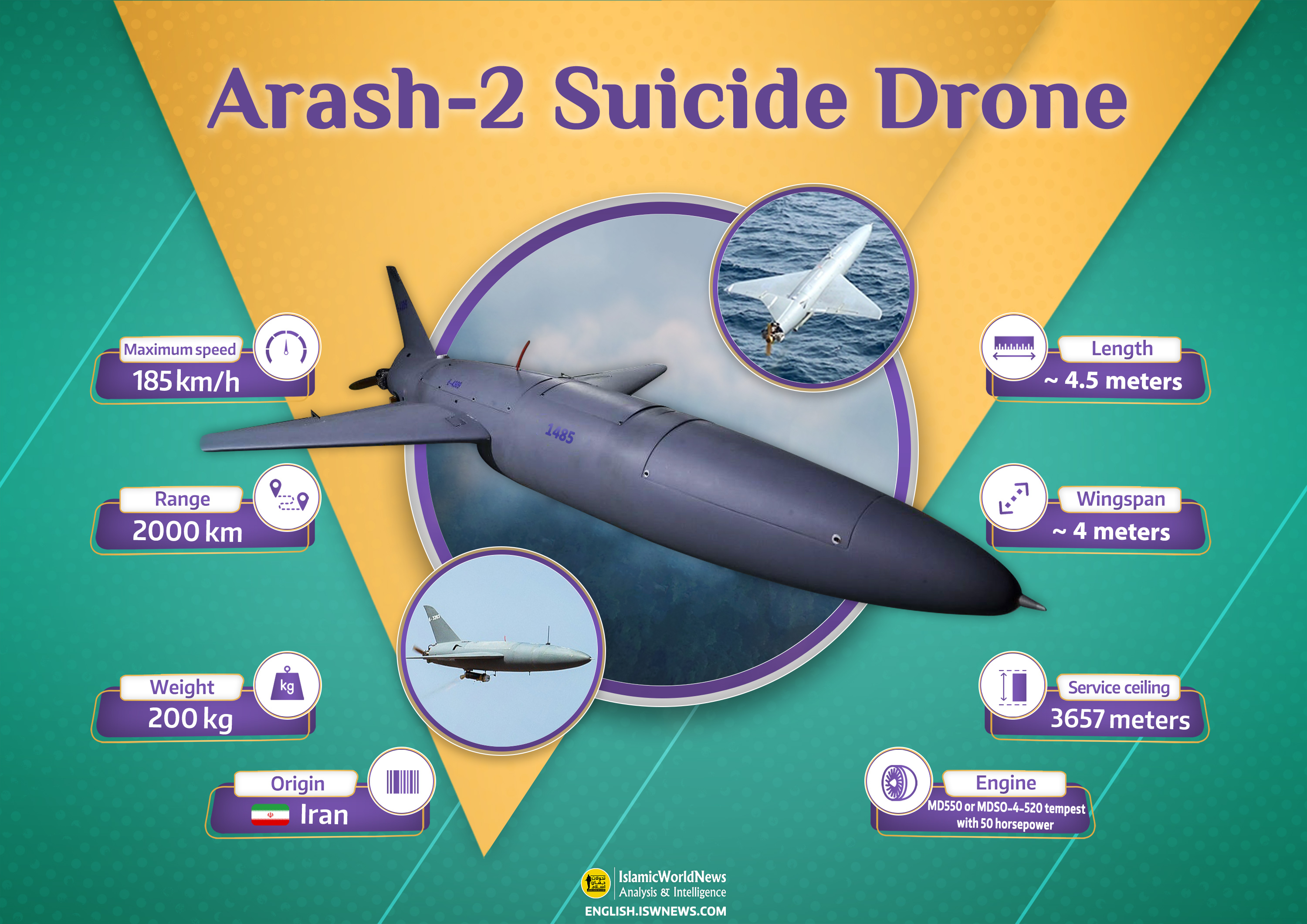
Arash-2 suicide drone with a range of 2000 km is considered the longest-range suicide drone in the world. There is a smaller version of this drone called Arash-1 with a range of 150 km, which is designed to attack nearby targets on the battlefield. In fact, Arash-2 suicide drone is an upgraded and improved version of Arash-1.
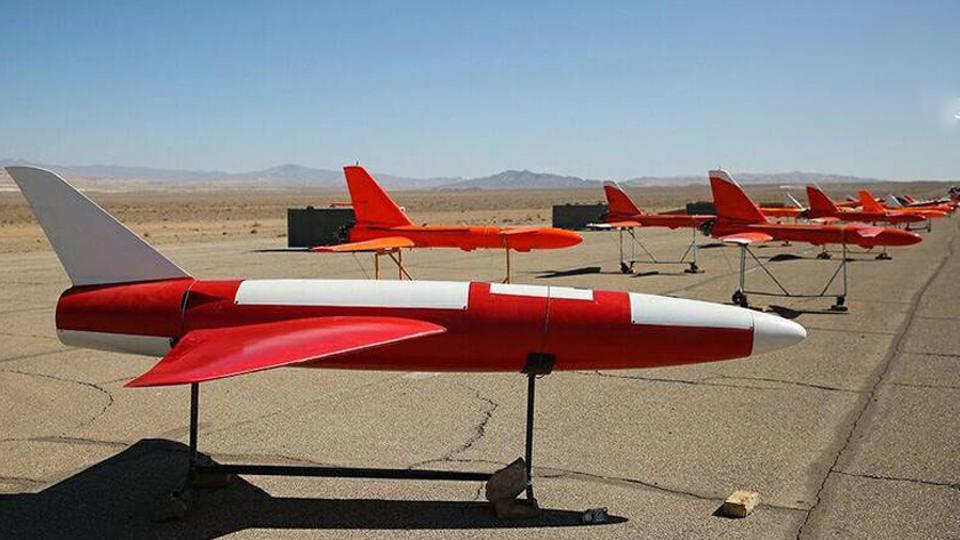
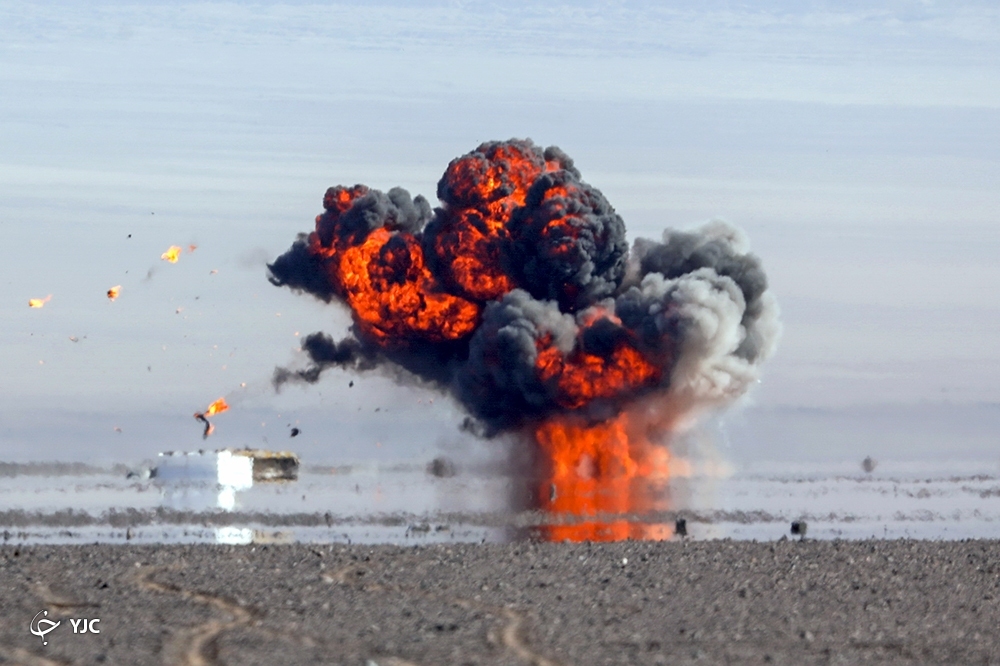
Arash-2 drone was unveiled and used for the first time in the Army drone exercise in January 7, 2021. In this exercise, this done was launched from the coast of Makran and after traveling a distance of about 1400 km, it hit its target in the general area of the exercise in Semnan province in the center of Iran.
Arash-2 looks identical to Kian-2 drone and has a triangular wing. The main difference between these two drones is their engine. Kian uses a jet engine and Arash uses a piston engine. This engine difference has also had a great impact on their range.
Kian-2 drone with jet engine
So far, Arash-2 has been launched in exercises by two types of launchers. The first type by a JATO launcher and the other by a box launcher that can be mounted on the back of a truck. The box launchers will make the drone more difficult to identify and along with the high mobility, it will increase survivability of truck and the crew.
Arash-2 long-range suicide drone launched from a box launcher with a rocket booster
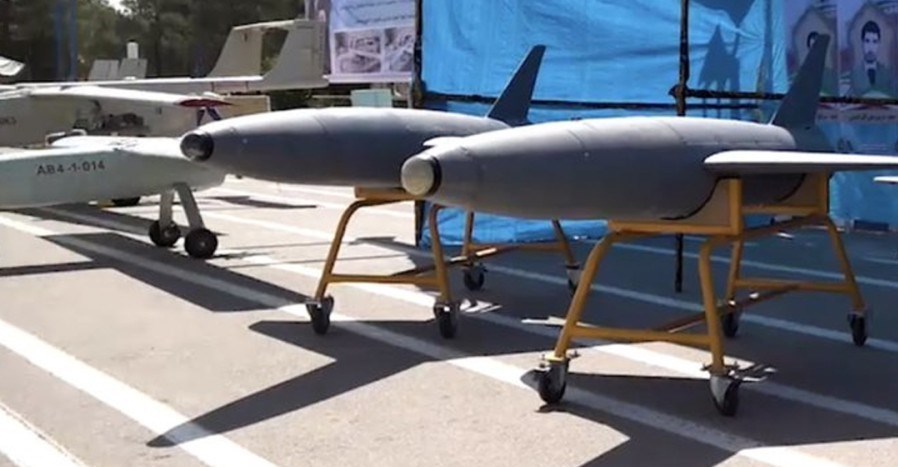
Arash-2 suicide drone was seen on the army drone fleet in July 2022. Therefore, the ability to use anti-ships and also attack from the sea to the shore can be considered for Arash.
At the Army’s “1401 Achievements Exhibition”, the Arash-2 drone equipped with an infrared and electro-optical seeker was seen, which gives this bird additional capabilities. Arash-2 drone with infrared and electro-optical seeker will be able to destroy various targets with high accuracy. Therefore, with various seekers, in addition to fixed targets, this drone has the ability to target moving targets or targets that need to be accurately hit in the enemy’s area.
Arash-2 suicide drone equipped with infrared and electro-optical seeker
According to the published photos and the information of the permanent exhibition of the achievements of the Ministry of Defense, the Arash-2 drone engine is of the MD 550 or MDSO-4-520 tempest type with a power of 50 horsepower. Therefore, according to the type of engine, this drone will have a maximum speed of 185 km/h.
Arash-2 suicide drone specifications: Length: ~ 4.5 meters Wingspan: ~ 4 meters Service ceiling: 3657 meters Engine: MD550 or MDSO-4-520 tempest with 50 horsepower Maximum speed: 185 km/h Range: 2000 km Weight: ~ 200 kg Origin: Iran
Click to view full size
More pictures of Arash-2 suicide drone
Click to view full size
Collection of posters of Arash-2 suicide drone in Russian (Дрон-камикадзе Араш-2), Persian (پهپاد انتحاری آرش-۲), Chinese (Arash-2 自杀式无人机), Hebrew (מזלט התאבדות ארש-2), Arabic (المسيرة الانتحارية آرش-2), Azeri (Arəş-2 Kamikadze Dronu) and Kurdish (درۆنی خۆکوژی ئارەش-2):
According to Chief Admiral Alireza Tangsiri, Commander of the IRGC Navy, three vessels of this class were being built at the same time in three different facilities of the IRGC, the Ministry of Defense and the private sector. Finally, on 14 June 2022, one of the three vessels under construction was ready to be delivered to the IRGC Navy. Two more aircraft of this class are still under construction, but exact information on the progress of the projects is not available.
In the body of Shahid Soleimani catamaran corvette, aluminum is used instead of steel, which is a newer innovation in Iran’s military shipbuilding industry. The modern design of the body in the form of a catamaran increases maneuverability and better stability in the sea and rough waters. Also, the use of aluminum alloy makes the body lighter and longer life due to less corrosion against water. This ship is powered by 4 localized and indigenous engines; Which brings its maximum range to 5000 nautical miles equivalent to 9260 km. The floating weight of Shahid Soleimani warship is 600 tons.
With this range, the Shahid Soleimani warship will increase the Iranian navy’s operational reach beyond the Persian Gulf to as far away as 9,000 km, which would cover the entire Indian Ocean down to Cape Town.
Intelligence and reconnaissance monitoring, surface and subsurface and air traffic monitoring are among the duties of this vessel. The Shahid Soleimani warship is equipped with the most advanced indigenous electronic warfare systems.
Shahid Soleimani warship is the first Iranian warship equipped with vertical launchers that can fire antiaircraft missiles up to a range of 150 km or land-attack cruise missiles up to 700 km or beyond.
There are six box launchers on both sides of the Shahid Soleimani warship which can fire antiship missiles such as the Nasr, Nasir, Ghader and Ghadir with ranges of 35 to 300 km. Four of which are Qadir or Qadir with a range of 300 km and two of which are Nasr or Nasir with a range of 90 km. According to Iran’s experiences in enhancing the weapons of warships, there is a possibility that the six box launchers in this vessel will be changed to 12 box launchers like what Iran did to Separ corvette in the Caspian Sea.
Two Ghader cruise missiles and one Nasir cruise missile
Behind the command bridge there are a number of vertical launchers silos. These silos are located in two rows of four and one row of three on both sides of the ship. The big silos are 3.4 meters long together, which means the inner diameter is about one meter. According to Major General Bagheri, at the time of unveiling, it is possible to use cruise missiles and surface-to-surface missiles up to a range of 700 km in these vertical launchers (VLS).
Vertical launchers systems (VLS) on Shahid Soleimani warship
This vessel has 16 small silos (8 on each side) for use in the air defense sector, according to Chief Admiral Alireza Tangsiri, the range of the missiles used is more than 150 km. The air defense missiles with this range will be from the Sayyad family with a diameter of less than 60 cm.
At the front of the vessel, there is a 30 mm automatic cannon with a stealth design along with a thermal camera to control it, which gives the ship the ability to engage light vessels and cruise missiles in the last stage. Two chaff and flare launch pods are installed on the sides of the main cannon to deflect anti-ship cruise missiles and disrupt the sonar. It is also possible to upgrade this cannon.
We see two types of photos of a vessel with hull number FS313-01. In the first photo, the vessel has four 12.7 mm guns. But in the second photo, it has four 20 mm three-barrel Gatling guns. According to the image of this ship on the back of General Bagheri, the model with three-barrel Gatling is the same model added to the IRGC Navy, and the other image is related to the model at the time of its sea test.
Shahid Soleimani warship during the sea test with 12.7 mm gunShahid Soleimani warship during the unveiling and with 20 mm three-barrel Gatling gunsThe warship with hull number FS313-01 at the time of joining the IRGC Navy, with 20 mm three-barrel Gatling.
Probably, this 20 mm three-barreled cannon can be synchronized with different systems to engage with boats and missiles in the final stage of ship defense. Because in the test videos released from it, it is controlled remotely by the operator from somewhere else.
20 mm three-barreled marine Gatling gun without name – related to the Musalla exhibition in 1398 H.S
The helipad of this vessel is able to carry the Bell-412 heavy helicopter with anti-submarine capability, as well as all kinds of drones in the combat organization of the army, navy, and the IRGC.
Below the helipad, there is a crane for launching speedboats or drone boats, which are also capable of firing torpedoes and anti-ship missiles.
The back part of Shahid Soleimani warship and the location of speedboats
According to Admiral Tangsiri, 20,000 maps were used to build the ship and 100,000 sketches were made until the final design was reached. This vessel currently has a speed of 30 to 32 knots equivalent to 55.5 to 59.2 km/h. The initial construction time was less than 2 years. Tangsiri stated that the construction time of each vessel in Shahid Soleimani class is currently one year.
Iranian network’s interview with Admiral Tangsiri, Commander of the IRGC Navy about Shahid Soleimani warship (in Persian language)
Shahid Soleimani Catamaran Warship Specifications: Type: Multi-role catamaran corvette Class: Shahid Soleimani Commissioned: 5 September 2022 Length: 67 m Beam: 18-20 m Displacement: 600 tons Propulsion: 4 localized engines Speed: 32 knots Range: 5,000 nmi Missile arsenal: 6 x anti-ship cruise missiles 6 x ground attack missiles 16 x air defense missiles Guns: 1 x 30 mm autocannon 4 x 20 mm Gatling with remote control Aircraft carried: 1 × helicopter Boat carried: 3 x speedboats Origin: Iran
Click to view full size
Collection of posters of Shahid Soleimani Catamaran Warship in Russian (Военный корабль Шахида Сулеймани), Persian (ناو شهید سلیمانی), Chinese (沙希德·苏莱曼尼 双体船军舰), Hebrew (ספינת מלחמה קטמרן שהיד סולימאני), Arabic (بارجة الشهيد سليماني), Azeri (Şəhid Süleymani Gəmisi) and Kurdish (کەشتی جەنگی شەهید سولێمانی):
The exercise ‘Eghtedar 1401’ was held for four days from October 17 to 20 in the Aras border area located in Iran’s East Azarbaijan and Ardabil provinces.
This military exercise has a wider geographical scope, force and equipment, so that it covers the entire border strip of Ardabil and East Azerbaijan provinces.
In this exercise, the various units of the Islamic Revolutionary Guard Corps ground forces conducted heli-borne operations, parachuting, night raid operations, helicopter combat operations, combat and suicide drone operations, construction of pontoon bridge over the Aras River, etc., with the aim of improving the readiness of the IRGC to help other Iranian armed forces in order to defend the borders of the country and respond to recent threats from foreign countries.
Major General Hossein Salami, Commander-in-Chief of the Islamic Revolution Guards Corps, said at the opening ceremony of the ‘Eghtedar 1401’ drill: “Unfortunately, the Zionist regime has infiltrated the countries of the south and northwest of Iran. We tell the governments of those countries not to let Israel into your country because they are the source of insecurity and evil. We will defend our security decisively and authoritatively in any situation, but you will be in trouble. The principle of our policy with our neighbors is based on friendship and good neighborliness and correct political interaction, but if through these neighbors the security of the Iranian nation is endangered and our country is threatened, then our policy will also change.”
Eghtedar 1401 military exercise is the third exercise of the Iranian Armed Forces in the northwestern regions of Iran, after the second Karabakh war.
After the second Karabakh war and the domination of the Republic of Azerbaijan on all its border lines with Armenia, claims have been made about the ownership of the southern lands of Armenia by the Republic of Azerbaijan. The president of Azerbaijan has directly and indirectly emphasized the military aggression on the territory of Armenia and the tensions in the Caucasus region are still strong. On the other hand, Iran has clearly stated its opposition to any military aggression in the Caucasus region. Iran has declared that no country has the right to change the geopolitical borders of the Caucasus region, and in case of a new military aggression by anyone in this region, Iran will deal with this issue strongly. Therefore, Iran’s Eghtedar 1401 exercise in the north-western borders of the country is clearly a strong warning for the Republic of Azerbaijan and any other aggressor country.
Zolfaghar missile is equipped with a warhead weighing 579 kg and its range is 700 km. The guidance method of this missile is based on Inertial and global navigation satellite system and electro-optical terminal with the ability to guide until the last moment. Zolfaghar has anti-jamming capability and is resistant to any electronic warfare.
In the Zolfaghar missile, the nose of the missile has changed from a pointed to a curved one. This change reduces the thermal effect of drag at high speeds; Therefore, the speed of this type is higher than the Fateh-110 models and has reached Mach 5.
Zolfaghar ballistic missile guidance has been optimized. In this missile, the pointed shape of the warhead guide canards has been changed to trapezoidal shape. Also, these canards have been moved to the end of the warhead and behind the guidance, control and navigation section.
The warhead of the Zolfaghar missile is detachable. Detachable warhead, while reducing the negative effects of connecting the body to the warhead in the final phase of the attack, reduces the possibility of intercepting by enemy air defense systems and reduces the probability of enemy air defense missiles hitting the Zolfaghar warhead.
So far, the dimensions of this missile have not been officially announced; But by examining the available images, it can be seen that its length has increased compared to the Fateh-110 missile.
Zolfaghar missile has high agility due to its light weight and small dimensions, and like other missiles of the Fateh family, it can be installed and launched on a mobile chassis. This increases its survivability on the battlefield. Zolfaghar missile can be fired from a dual launchers.
Zolfaghar Ballistic Missile
In September 2020, a new type of this missile named “Zolfaghar Basir” with optical guidance and anti-ship mission was unveiled.
The Zolfaghar ballistic missile has been used in two operations “Laylat al-Qadr” and “Strike of Muharram” against the ISIS terrorist organization in Syria.
On the last night of Qadr in the month of Ramadan, which coincides with Sunday June 18, 2017, the IRGC Aerospace Force with the operational name “Laylat al-Qadr”, used 6 Zolfaghar missiles to attack the command headquarters and positions of ISIS in the Syria’s Deir Ezzor province. The missiles targeted ISIS positions in Deir Ezzor, at a distance of about 650 kilometers. This operation was carried out in response to the ISIS terrorist attack on Iranian Parliament in Tehran in 8 June 2017, which resulted in the martyrdom of 18 civilian.
In another operation on the morning of October 1, 2018, the IRGC Aerospace Force with the operational name “Strike of Muharram” (Zarbat-e Muharram) with 6 surface-to-surface ballistic missiles from Kermanshah in the west of Iran, destroyed the positions of ISIS terrorists in the Hajin area in the east of the Euphrates River in Syria. The 4 out of the 6 fired missiles were of the Zolfaghar type. Simultaneously with this operation, 7 IRGC drones have also targeted the positions of terrorists in the east of the Euphrates. This operation was carried out in response to the ISIS terrorist attack in September 22, 2018 in Ahvaz city, which resulted in the martyrdom of 25 Iranians and the wounding of 69 others.
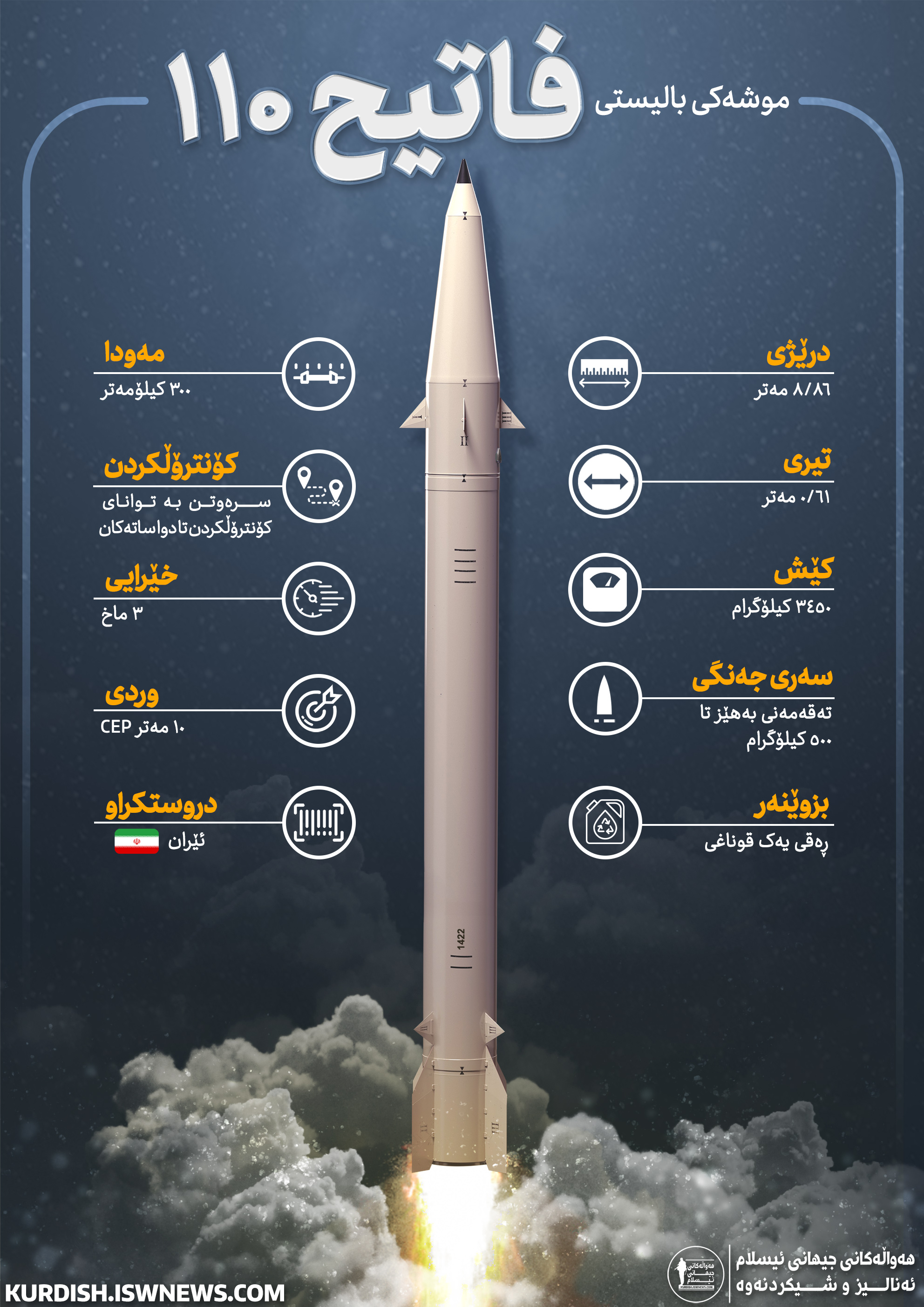
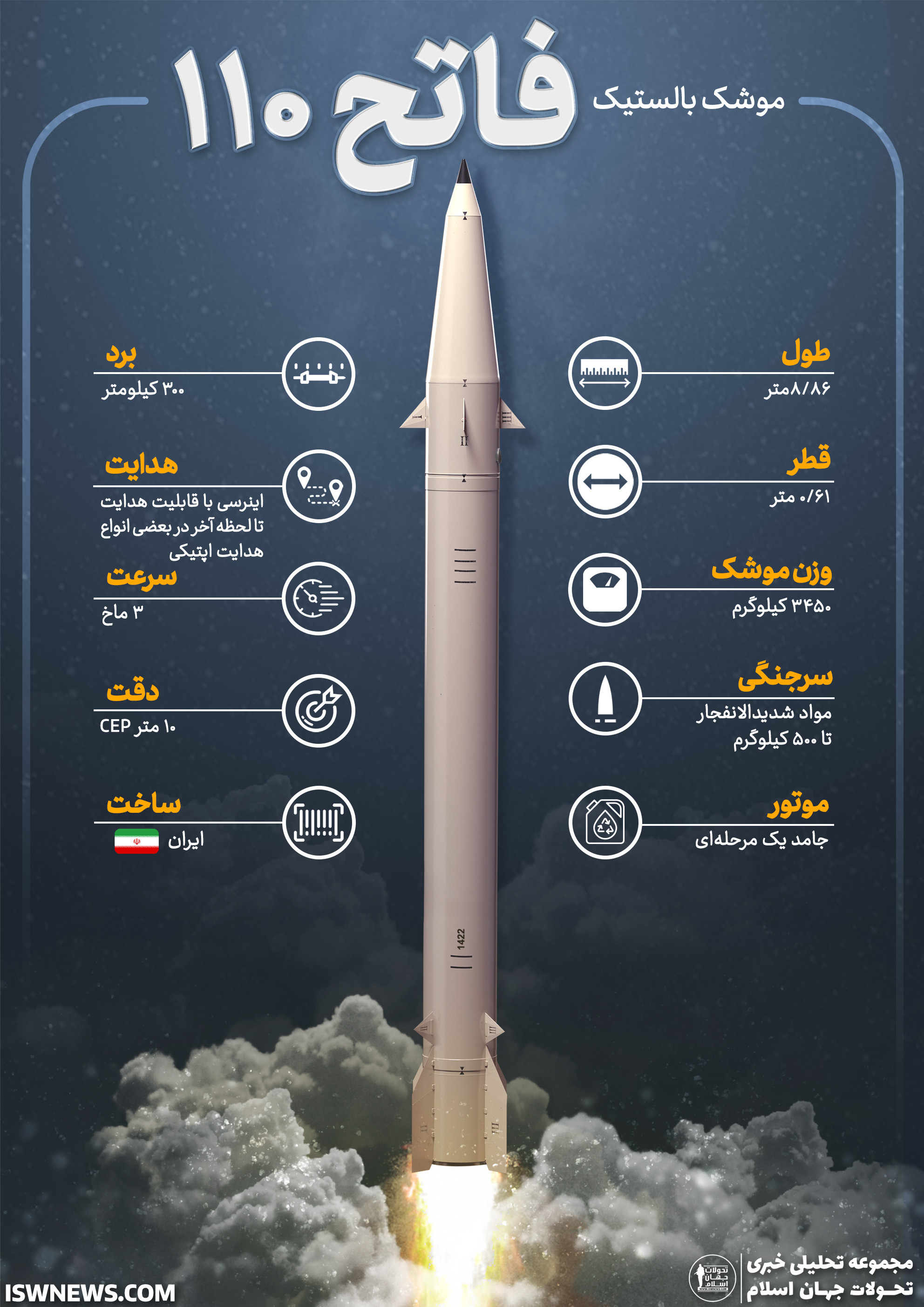
Fateh 110 missile is produced by the Aerospace Industries Organization (AIO), a subsidiary of Iran’s Ministry of Defense and Armed Forces Logistics. According to the available information, the first tests of this missile were carried out in 2002. Fateh-110 is one of the most popular types of missiles produced by Iran’s military industrial.
In the past 30 years, the development of the Fateh-110 missile has been carried out on the basis of “increasing the range and increasing the accuracy” and its various types have been produced over time. Therefore, in 2012, a version of the Fateh-110 missile with a pinpointing accuracy and an error rate of 10 meters was produced.
Fateh-110 missile should be considered as Iran’s first important step in designing a solid fueled ballistic missile. The ignition mechanism of Fateh-110 is single-stage and uses solid fuel.
So far, 10 generations of Fateh-110 missiles have been built, and their specifications are as follows: Fatih-110 generation 1: with a range of 200 km Fatih-110 generation 2: with a range of 250 km Fatih-110 generation 3: with a range of 300 kilometers and high accuracy Fatih-110 generation 4: with a range of more than 300 km and pinpoint accuracy Persian Gulf missile: an anti-ship type Hormuz 1 and Hormuz 2: an anti-radar type Fateh Mobin missile: anti-ship type with optical guidance Zolfaghar missile: with a range of 700 km Dezful missile: with a range of 1000 km Raad 500 missile: with a range of 500 km
Fateh-110 ballistic missile is able to target and destroy land and sea targets, enemy gathering points, command centers, ammunition depots, radars and other targets with high accuracy. The error rate of Fateh-110 missile is estimated to be less than 10 meters.
The warhead of Fateh-110 missile is detachable type. Detachable warhead, while reducing the negative effects of connecting the body to the warhead in the final phase of the attack, reduces the possibility of intercepting by enemy air defense systems and reduces the probability of enemy air defense missiles hitting the Fateh-110 warhead.
Fateh-110 missile has high agility due to its light weight and small dimensions, and like other missiles of the Fateh family, it can be installed and launched on a mobile chassis. This increases its survivability on the battlefield.
The effective range of this missile is 300 km and its final range is estimated between 400 and 550 km.
One of the most famous operations of Fateh-110 is the attack on the headquarters of the terrorist group of the Democratic Party of Iranian Kurdistan (KDPI) in September 8, 2018. In this operation, Fateh-110 missiles were fired from a distance of 230 km towards the headquarters of the KDPI terrorist group in Koysinjaq in the Kurdistan region of Iraq and very accurately targeted the meeting of their leaders. In this precise attack, 16 members of KDPI were killed, including 6 members of the central committee of this terrorist group. This attack was carried out in retaliation for the martyrdom of a number of IRGC servicemen who were killed by KDPI in July of the same year in the west of the country.
The operation against the Mossad base/villa near the Iraqi city of Erbil is another important and impressive operation of Fateh-110 ballistic missiles. In the morning of March 13, 2022, the IRGC Aerospace Force targeted the secret and sensitive center of the Israeli regime near the new US consulate in Erbil, with at least 10 ballistic missiles. Some of the missiles used in this operation were Fateh-110. The IRGC stated that the reason for the attack on the Mossad villa near Erbil was a response to the Israel’s recent evils activities against Iran national security.
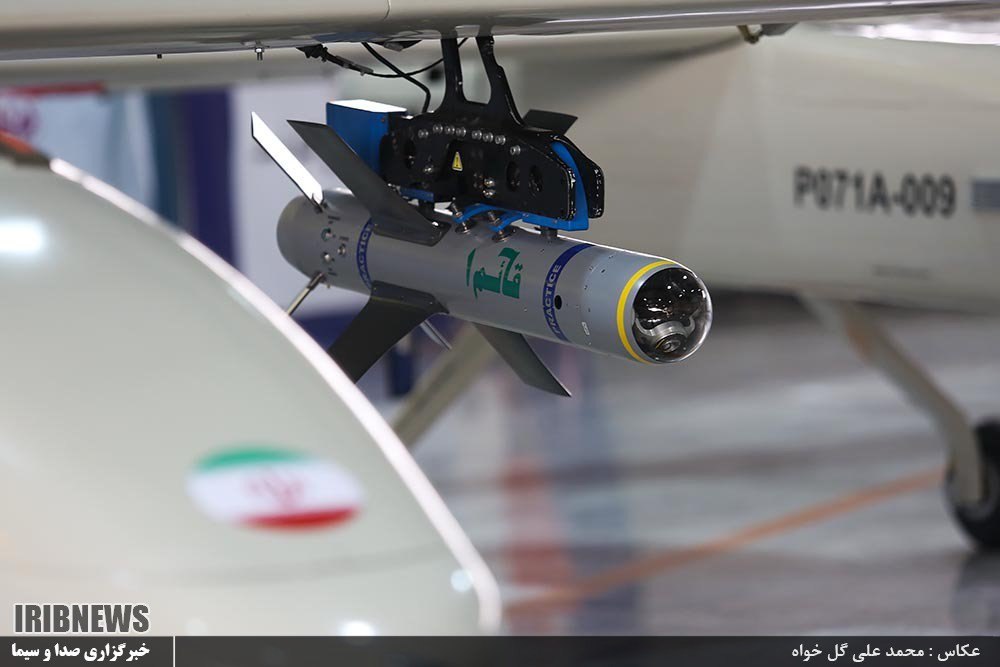
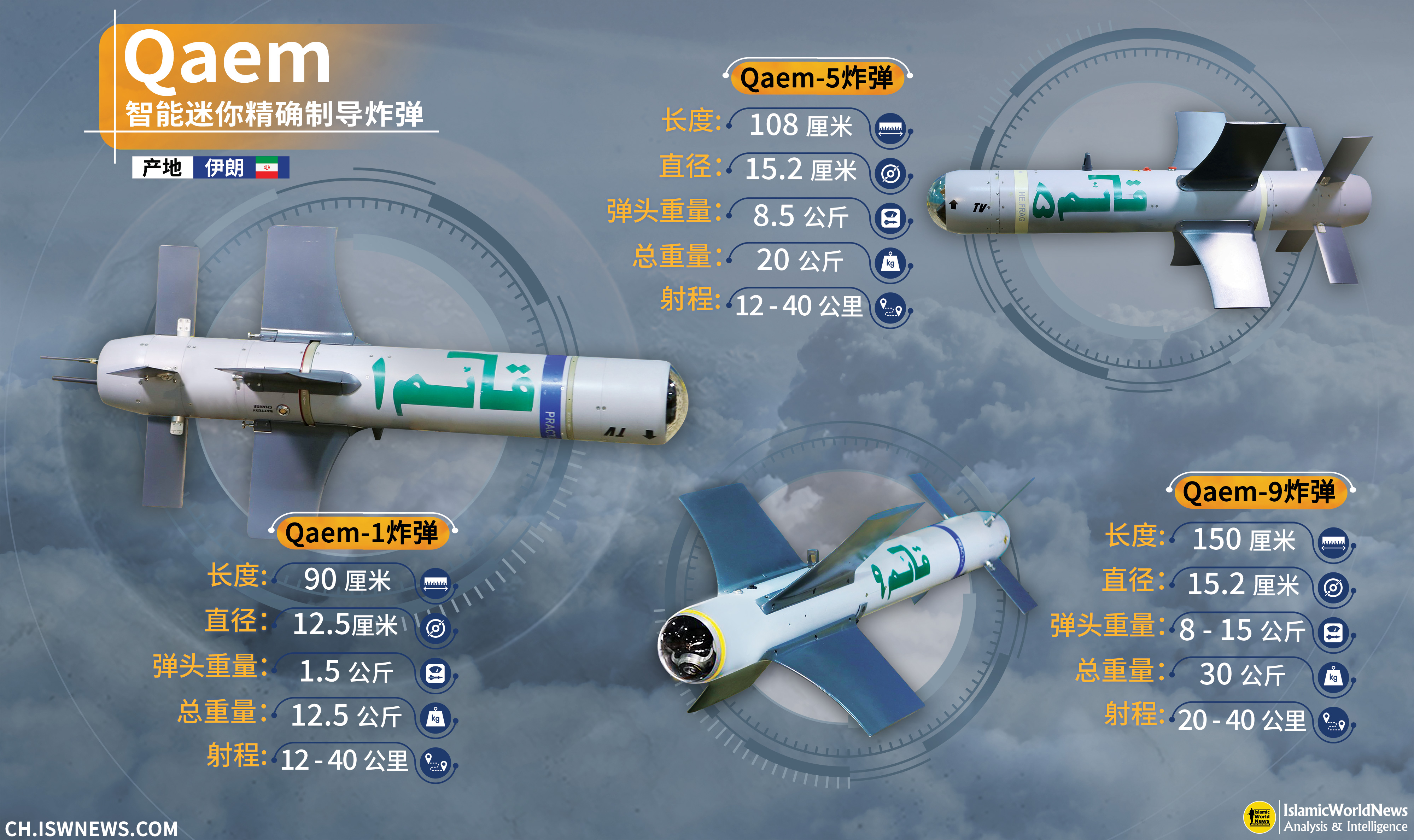
Qaem 1, 5 and 9 bombs were all unveiled during a ceremony in August 6, 2019 in Tehran. According to Amir Hatami, Former Minister of Defense and Armed Forces Logistics of Iran, at the unveiling ceremony of Qaem bombs, this product was jointly produced by the two Organizations of Defense Industries and Iran Electronics Industries. Amir Hatami stated that the minimum operational height of these bombs is 4 to 10 thousand feet (1219 to 3048 meters) and its range is 12 to 40 kilometers, and the ability to install different penetrating and shrapnel warheads with different ranges and various destructive power is also available in these bombs.
It should be noted that the “minimum operational height” of the Qaem bomb means that if we drop the bombs below this height (below 1219 meters), they will not be able to glide and will quickly fall towards the targets.
The speech of the former Minister of Defense, Amir Hatami, regarding Qaem smart bombs and announcing a range of 12 to 40 kilometers for them
But in another place, Brigadier General Shahrokh Shahram, the CEO of Iran Electronics Industries, states that the range of Qaem bombs is 20 to 40 kilometers. Due to the contradiction between the words of Amir Hatami and Shahrokh Shahram, the exact range of these bombs is in an aura of uncertainty. Also, unfortunately, the range of this series of bombs has never been officially announced in any of the military exhibitions. In the rest of the article, we will try to determine the range of each of the bombs of the Qaem series separately.
Brigadier General Shahrokh Shahram, the CEO of Iran’s Electronics Industries, explained about Qaem series bombs and announced a range of 20 to 40 kilometers for them.
Small Diameter Bombs (SDB) are a new type of bombs that have been produced and adopted in the last few years by the military powers like the United States. The U.S. prototypes of this model were heavy bombs and were launched by the fighter jets and from a high altitude. Due to Iran’s need for lighter but practical weapons for its modern drones, Iran was inspired by this type of bombs in making smart bombs, and these efforts finally came to fruition in 2010 with the introduction of the miniature bombs of the Sadid family. Sadid-342 can be considered the first miniature bomb of Iran, which was later developed in the Qaem family.
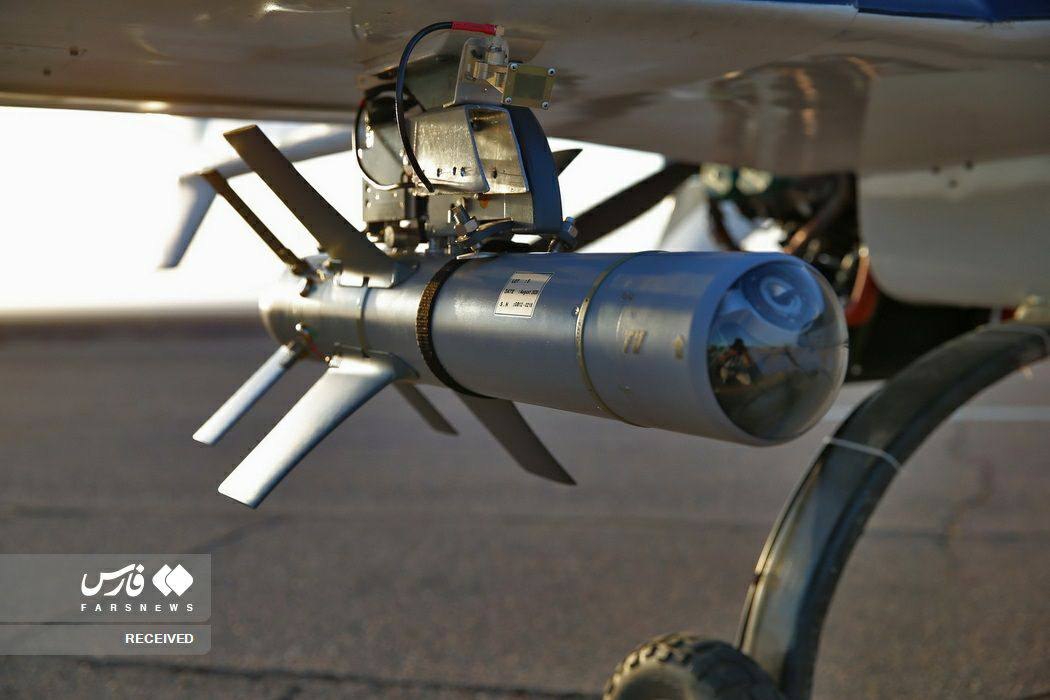
In the process of producing these bombs, the production of seeker that can be used in all current and future Iranian smart bombs was very important. Therefore, Iran’s Ministry of Defense produced seekers with various guidance methods. Two examples of these seekers named thermal image seekers RU320ST and visible image seekers RU113ST have been displayed, which have been installed and observed on Sadid and Qaem families.
RU320ST image thermal seeker (left side) next to RU113ST visible image seeker (right side)
Although there is no information available about the history and order of production of Qaem bombs, but based on the available data, the category can be considered as follows:
Qaem-5 bomb: The specifications of Qaem bombs have not been officially announced, but at the Baghdad defense exhibition, some specifications of Qaem-1 and Qaem-5 bombs were displayed. According to the specifications announced in this exhibition, the dimensions of the Qaem-5 and the Sadid-342 bomb are very close to each other, but due to use of fixed wings and the increase in the weight of the warhead, its weight has reached 20 kg.
Qaem 5 specs with BS20 branding presented at ARMY 2022Qaem 5 specs with BS20 branding presented at Baghdad defense exhibition
At the time of the unveiling of these bombs, Amir Hatami announced the range of the Qaem family from 12 to 40 kilometers. Looking carefully at the front and rear wings of Qaem-5, we will notice the larger dimensions and aerodynamic shape of the Qaem-5 compared to the Sadid family of bombs. Probably, the range of Qaem-5 is greater than that of Sadid 342 and 345 because it has less weight and more wing area, which will increase the lift and decrease the drag and finally increase its range. Therefore, based on the mentioned facts, Qaem-5 range can be considered 12 km if released from a height of 5 km. Qaem-5 bomb has the possibility of being installed on the fighter jet, and if it is released from a high altitude, a range of up to 20 kilometers can be considered for it.
The middle wings of the Qaem-5 are longer and have a backward and curved shape, which indicates an improvement in the flight characteristics of the wings compared to the Sadid-345.
The seekers used in Qaem 5 are visual/optical (TV), thermal (IR), laser and a combination of optical and laser. The use of all kinds of seekers in Qaem 5 allows operations to be carried out with great accuracy and in all weather conditions.
Optical seeker (TV) for Qaem-9
A variant of the Qaem-5 has also been seen, which has an infrared seeker and a proximity fuse (probably of the laser type), which is remarkable in its own right. The reason for using infrared is probably to reduce the cost of construction; But it will be less accurate. However, the use of a proximity fuse next to the infrared seeker compensates this defect to some extent.
A variant of a Qaem 5 bomb with an infrared seeker and a proximity fuse
Unknown variant of Qaem-5: A variant of Qaem-5 was showcased in the exhibition of the achievements of self-sufficient Jihad of the Iranian Navy in December 14, 2021. The length and width of the wings had increased noticeably. This increases the wing area and ultimately increases the range. And also there is the possibility of increasing the (warhead) weight without increasing the range.
A variant of Qaem- 5 bomb with greater length and wings
This type of Qaem-5 bomb was seen under the wing of Fotros reconnaissance and combat drone in the Iranian Army’s Strategic UAV Base 313, which strengthens the possibility of its operational nature. Therefore, we can expect to see this bomb on other combat drones of the Iranian Armed Forces in the near future. A capability that will significantly increase the offensive power of Iranian drones.
Qaem-5 smart bomb specifications: Length: 108 cm Diameter: 15.2 cm Seeker type: Visible (TV), thermal (IR), laser (L), a combination of optical and laser Type of warhead: Fragmentation Fuse type: programmable and timed Warhead weight: 8.5 kg Total weight of the bomb: 20 kg Range: 12 to 20 km based on the release height (in the unknown variant of Qaem-5, its range can be increased up to 40 km)
Qaem-1 bomb: The Qaem-1 smart bomb can be considered as the second member of the Qaem bomb family because the Qaem-5 was created along the lines of Sadid’s changes and the Qaem-1 was created due to the need for a light bomb to be carried by light drones. Iran uses a large number of light drones, such as Ababil 3 and 4. Because these drones do not have much power to carry ammunition; The Qaem-1 light and smart bomb can properly perform its duty on Iranian light drones in line with the doctrine of “one shot for each target”.
ARMY 2022 exhibition and Qaem-1 and 5 bombs – the difference between the two bombs and the style and miniaturization of Qaem-1 is clear.
The specifications of Qaem-1 bomb have also been displayed in the Baghdad defense exhibition under the brand name BS12.5 The weight of this bomb is 12.5 kg, its length is 90 cm and its diameter is 12.5 cm.
Qaem-1 specification with BS12.5 brand
Qaem-1 also uses visual or optical (TV), thermal (IR), laser, a combination of optical and laser seekers. But Qaem-1, in the warhead type, has been introduced with more variety. So far, warheads with fragmentation, incendiary, direct impact (kinetic energy) have been introduced for this bomb. Of course, it is important to mention that it is possible to use these warheads for the entire Qaem family. A programmable and timed fuse allows the bomb to detonate at a certain distance from the ground or at a specific height, increasing the effect of the warhead on targets. The total weight of Qaem-1 bomb is 12.5 kg and its warhead is 1.5 kg. The range of this bomb has not been announced like other members of the Qaem family. Qaem-1 with its light weight and small diameter and wings that are exactly similar to Qaem-5 can have a significant range. The Qaem-1 appears to have a slightly higher wing-to-body ratio than the Qaem-5. But it will probably have a range equivalent to Qaem-5, i.e. 12 km if released from a height of 5 km and a range of 20 km if released from a high altitude. The minimum release height for this bomb is 4,000 feet or 1,219 meters.
Qaem-1 bomb
Specifications of Qaiem-1 smart bomb with BS12.5 brand: Length: 90 cm Diameter: 12.5 cm Seeker type: Visible (TV), thermal (IR), laser (L), a combination of optical and laser Warhead type: fragmentation, incendiary, direct impact (kinetic energy) Fuse type: programmable and timed Warhead weight: 1.5 kg Total weight of the bomb: 12.5 kg Range: 12 to 40 km
Qaem-9 bomb: Qaem series bombs have been widely seen on all kinds of Iranian drones, but so far no pictures of Qaem-9 bomb installation have been seen. The Qaem-9 bomb has not been exhibited and very few pictures are available. According to the statements of the former Minister of Defense of Iran at the time of the unveiling of the Qaem bombs that these bombs can be used on drones and fighter jets and since the Qaem-9 bomb has not been seen on drones, we can have the impression that Qaem-9 is specially developed for fighter jets. Of course, it should be noted that it is definitely possible to install Qaem-9 bombs on drones. Although the dimensions of Qaem-9 are not available, it obviously uses the same diameter as Qaem-5, i.e. 152 mm. Considering that the wing location in this model has changed and its length and weight have also undergone changes, the center of gravity of Qaem-9 has definitely changed compared to Qaem-5. By examining the available images, a significant increase in the length of the bomb can be seen. According to the investigations, the length of this bomb should be around 150 cm. Also, in this bomb, it is possible to use all kinds of warheads and seekers used in Qaeim 1 and 5. Next is to determine the weight of the bomb. For this purpose, due to the increase in the length of the Qaem-9 bomb and based on the Qaem-5 bomb, we increase the weight of the Qaem-5 bomb by approximately 50% and consider the weight of 30 kg for the Qaem-9. Considering the dimensions of the Qaem-9 bomb, this bomb is a very favorable option for using a thermobaric warhead. Because this type of warhead has more weight and requires more space. Regarding the range, we return to the words of Amir Hatami and Brig. Gen. Shahram. The dimensions and length of the front and rear wings have been increased for the Qaem-9, which improves its aerodynamic characteristics and increases its range. The range of this bomb can be estimated to be 20 km if released from a height of 5 km and 40 km if released from a fighter, i.e. a height of more than 8 km. It is also worth noting that Qaem-9 bombs cannot be dropped from a height of less than 3 kilometers.
Qaem-9 bomb
Possible specifications of Qaem-9 smart bomb: Length: 150 cm Diameter: 15.2 cm Seeker type: Visible (TV), thermal (IR), laser (L), a combination of optical and laser Warhead type: fragmentation, incendiary, direct impact (kinetic energy) and thermobaric Fuse type: programmable and timed Warhead weight: 8 to 15 kg Total weight of the bomb: 30 kg Range: 20 to 40 kilometers based on release height
Unknown variant of Qaem family: A variant of Qaem smart bomb was displayed in the exhibition of achievements of the self-sufficient jihad organization of the Iranian Navy in December 14, 2021, which has much larger dimensions than other members of Qaem family. It seems that the diameter of this bomb is the same as other bombs, but its length has increased. The dimensions of the wings have also increased significantly. Definitely, this unknown bomb has more weight and range, but no accurate information can be obtained from it. This bomb may be designed to be dropped from large drones or fighter jets. It is also possible that this bomb was chosen instead of Qaem-9 due to its similarity with the main structure of the Qaem-5 bomb, which has the highest production rate in the Qaim family, and has the same specifications. This issue can be due to reducing the costs of bomb production and preventing the creation of new infrastructure in the new production chain. With no change in the diameter of the bomb, all the seekers used in Qaem-5 can be used on this variant as well.
An unidentified bomb with larger dimensions but a similar pattern to Qaem-5
Possible specifications of the unknown variant of Qaem bombs family: Length: 150 cm Diameter: 15.2 cm Seeker type: Visible (TV), thermal (IR), laser (L), a combination of optical and laser Warhead type: fragmentation, incendiary, direct impact (kinetic energy) and thermobaric Fuse type: programmable and timed Warhead weight: 8 to 15 kg Total weight of the bomb: 30 kg Range: 20 to 40 kilometers based on release height
Qaem free fall bomb or laziness in installing wings?! A wingless bomb has been seen in footage released about the Mojaher-6 drone in Ethiopia, which is close in size to the Qaem-5. The lack of wings makes this bomb unguided and similar to a free-fall bomb. Considering the absence of any tracking system in the front part of the bomb, there is a possibility that this bomb was made according to Ethiopia’s needs in a way to be cheap so that it can be widely used. Another possibility is that the bomb seen in the picture is one of the three bombs of the Qaem family, and it was mounted on Mohajer-6 without wings and for promotional photography. In the meantime, due to haste or any other issue, guidance wings have not been installed on these bombs.
It should be noted that some of these groups, such as ISIS-K and the Resistance Movement for Justice, were also active in Afghanistan before the fall of Ashraf Ghani’s government.
The list and details of anti-Taliban groups in Afghanistan are as follows:
1- Resistance Movement for Justice (under the command of Abdul Ghani Alipour): Start of activity in 2013. Activities in Maidan Wardak, Ghor, Daykundi, Ghazni, Uruzgan and Bamyan provinces. A part of the former forces of Hezb-e Wahdat-e Islami and under the influence of Martyr Abdul Ali Mazari are present in this group. Ethnicity: Hazara.
2- ISIS-K (Islamic State – Khorasan Province): Start of activity in April 2015. Activity in the eastern and northern regions of Afghanistan. With Salafi jihadist and Wahhabism tendencies.
3- Afghan National Resistance Front (forces loyal to Ahmad Massoud): Start of activity on 15 August 2021. Activity in Panjshir, Baghlan, Kapisa and Parwan provinces. Ethnicity: Tajik.
4- Afghanistan Freedom Front (forces loyal to General Yasin Zia, Chief of Army Staff of the former government): Start of activity on 4 February 2022. Activity in Takhar, Kunduz and Badakhshan provinces.
5- Afghanistan Free People Front: Start of activity on 7 February 2022. Activities in Khost, Kapisa, Kabul, Parwan and other provinces of Afghanistan. This group does not follow a single and specific commander and they are allies of Ahmad Massoud’s forces.
6- Turkestan Freedom Tigers (forces loyal to Yar Mohammad Dostum, son of General Abdul Rashid Dostum, leader of the National Islamic Movement of Afghanistan): Start of activity on 8 February 2022. Activities in Jawzjan and Faryab provinces. Ethnicity: Uzbek.
7- National Islamic Movement for the Liberation of Afghanistan (forces loyal to General Khaled Aziz, one of the army commanders in of the former government): Start of activity on 23 February 2022. Activity in Nangarhar, Kunar and Helmand provinces. Ethnicity: Pashtun.
8- Freedom and Democracy Front: Start of activity on 24 March 2022. Activities in the Shiite areas and central provinces of Afghanistan. The members of this group follow the thoughts of Martyr Abdul Ali Mazari. Ethnicity: Hazara.
9- Supreme Council of Resistance (forces loyal to Atta Muhammad Nur, one of the heads of Jamiat-e Islami party): Start of activity on 25 March 2022. Activity in the northern and central provinces of Afghanistan. Ethnicity: Tajik and Hazara.
10- People’s Democratic Party of Afghanistan: Start of activity on 9 April 2022. Activity in Kabul province. With the tendency and thoughts of communism.
11- Western Nuristan Liberation Front: Start of activity on 9 April 2022. Activity in Nuristan province.
12- Rise of Freedom: Start of activity on 5 May 2022. Activity in the Sang-2 Takht district located in Daykundi province. Influenced by the thoughts of Martyr Abdul Ali Mazari. Ethnicity: Hazara.
13- Wolf Units (forces loyal to General Abdul Rashid Dostum, leader of the National Islamic Movement of Afghanistan): Start of activity on 6 May 2022. Activity in Barkah district in Baghlan province.
14- Patriotic Front: Start of activity on 10 May 2022. Activity in Ghazni, Kabul and Herat provinces.
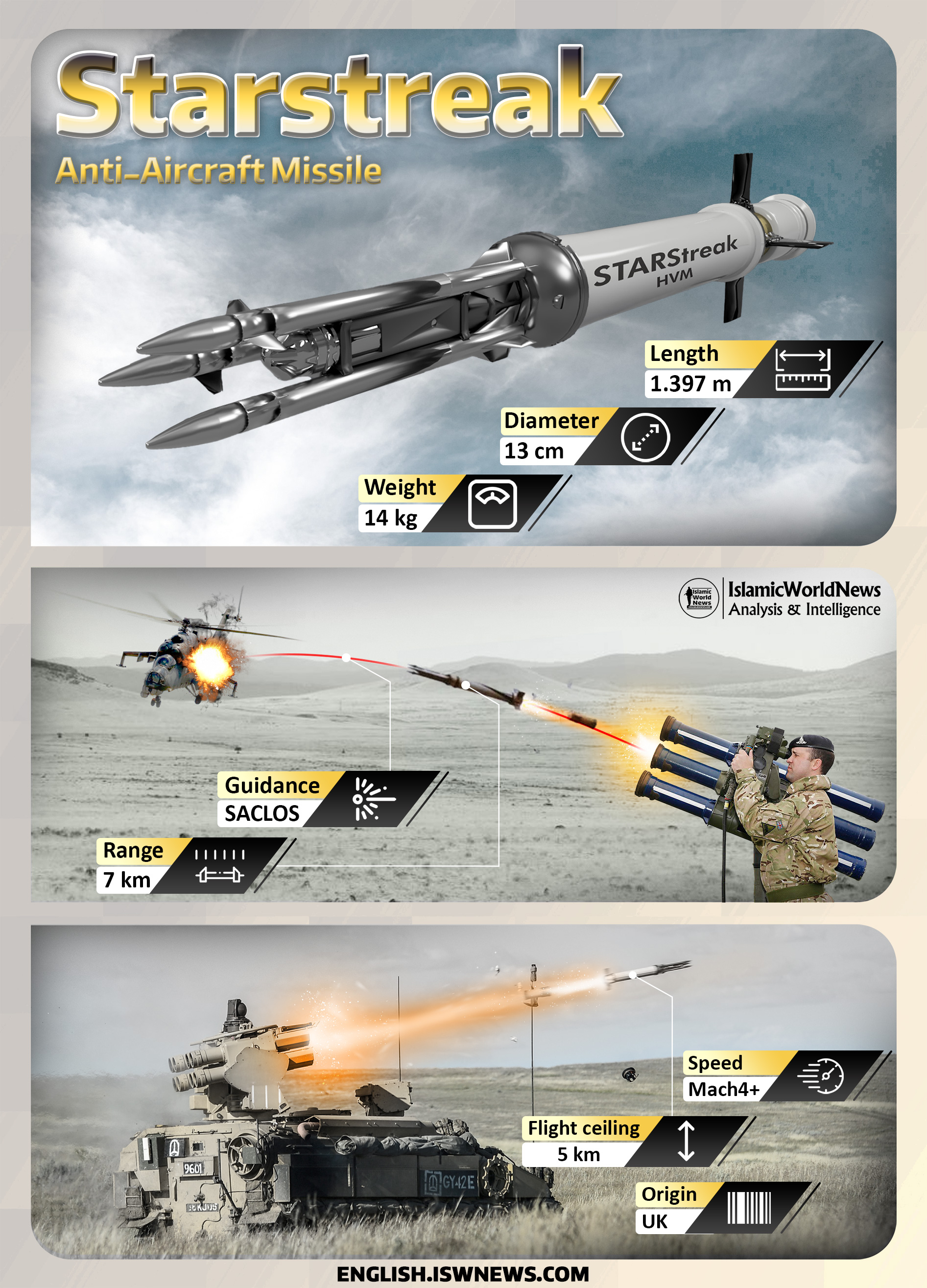
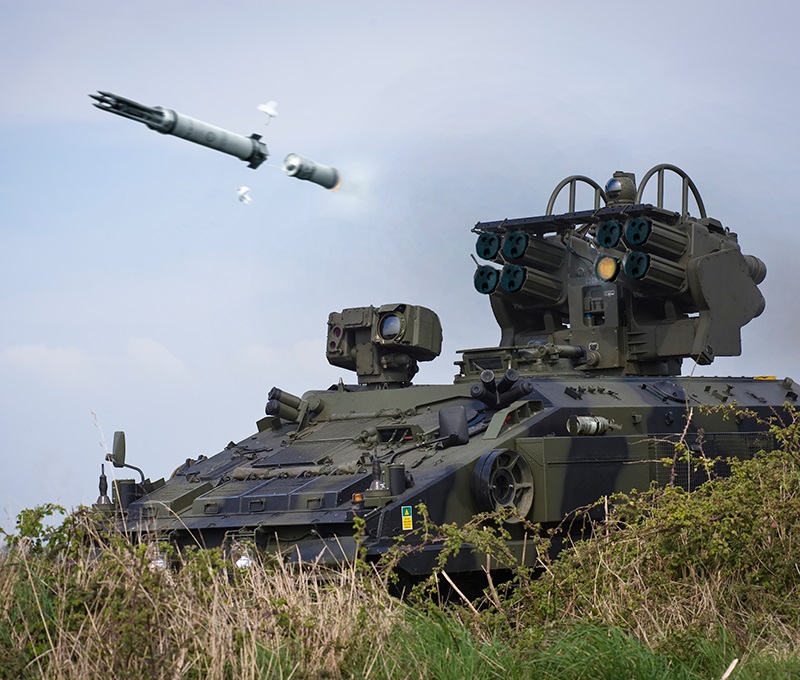
After STARStreak missile launch, the missile accelerates to more than Mach 4, making it the fastest short-range surface-to-air missile in existence. It then launches three laser beam-riding submunitions, increasing the likelihood of a successful hit on the target. The darts are guided to the target at a maximum distance of 1.5 meters from each other.
Starstreak has been in service with the British Army since 1997 And in 2012 Thales relaunched the system as ForceSHIELD.
The warhead of this missile consists of three darts. Each dart or submunition has 450 grams of PBX-98 explosive and the total weight of the darts is 900 grams. Each dart is 396 mm long and 22 mm in diameter. Each dart consists of a rotating fore-body, with two canard fins, attached to a non-rotating rear assembly with four fins. The rear assembly of each dart also houses the guidance electronics including a rearwards facing sensor.
The submunitions on this missile is made from a tungsten alloy; Because tungsten has a density about three times that of steel, which increases its kinetic energy and range and height, and the impact of its fragments on the body of the target aircraft is greater. The reason why tungsten fragments are most effective is the high hardness of tungsten-based alloys, which is very suitable for penetrating the aircraft body.
Delayed impact mechanism is used in darts. On impact with the target a delayed-action fuse is triggered, allowing the projectile to penetrate the target before the explosive warhead detonates. This activation mechanism is designed to fragment and maximise damage inside the target.
STARStreak air defense missile performance
The first stage rocket motor has a very short burning time; this launches the missile from the tube but burns out before leaving the tube to protect the operator. This is to prevent damage to the operator due to the high speed and temperature of the exhaust gases. Four metres away from the operator, when the missile is at a safe distance, the second stage motor fires. This rapidly accelerates the missile to a burn-out velocity exceeding Mach 4. As the second stage burns out, three dart sub-munitions are released. The three sub-munitions have enough kinetic energy to manoeuvre to meet a target evading at 9 g at 7,000 metres.
In the new versions of this missile, the maximum effective firing range has been increased to more than 7 km and the maximum operating ceiling to 5 km.
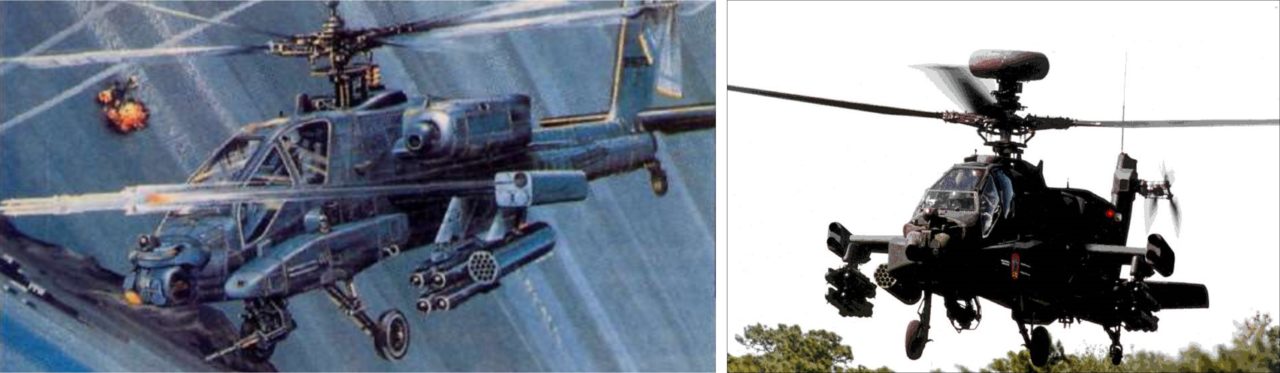
Variants of STARStreak missile: ATASK (Air To Air Starstreak) Variant: This type is made for shooting from a helicopter. This was developed in combination with McDonnell-Douglas and Lockheed-Martin electronics between 1995 and 1998 specifically for use with the AH-64 Apache. However, this type of missile has not yet entered service.
ATASK (Air To Air Starstreak) Variant
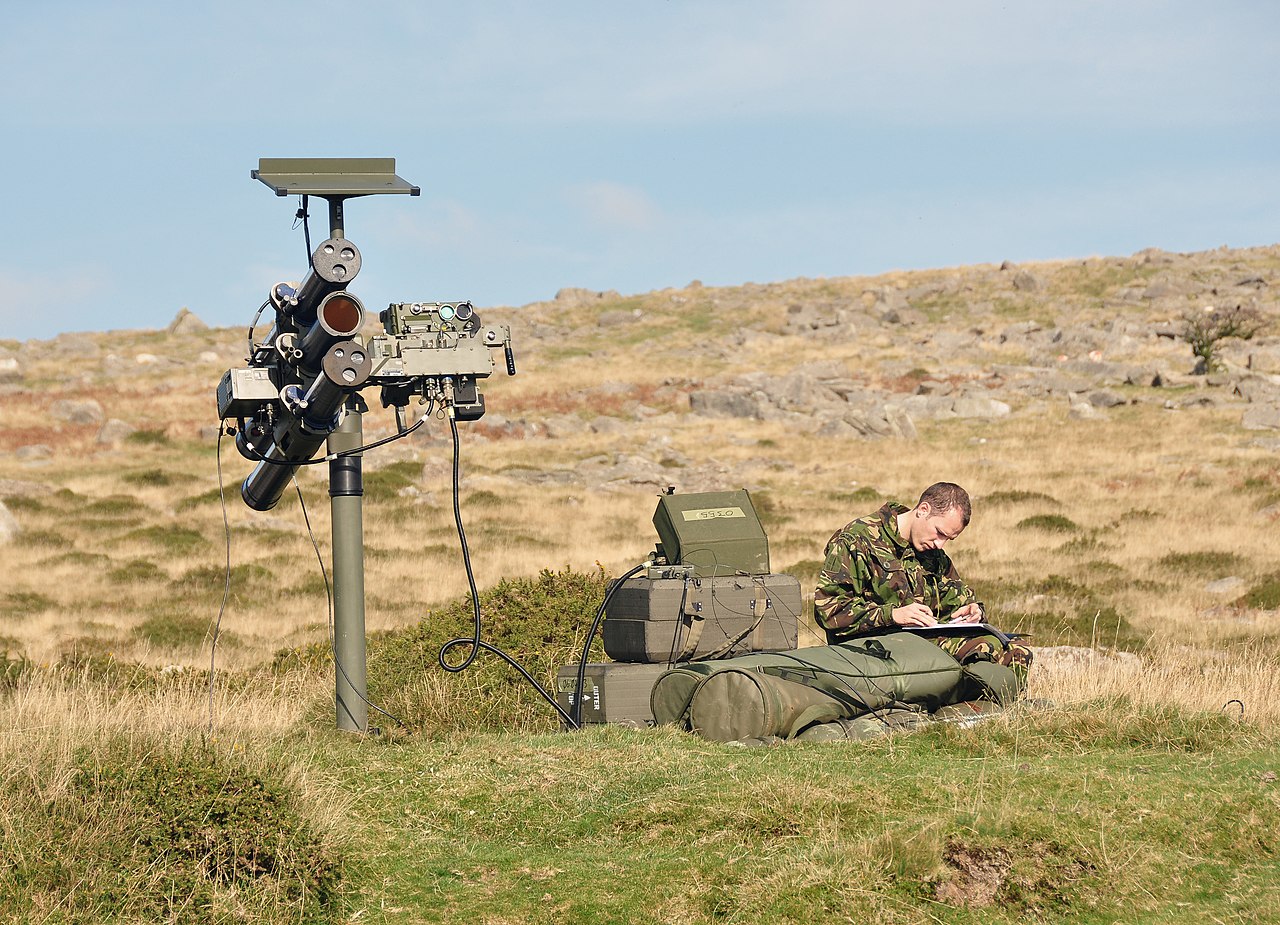
Lightweight Multiple Launcher (LML) Variant: The Lightweight Multiple Launcher can be mounted on a tripod as a fixed launcher or on a light vehicle such as a Land Rover or Humvee. This type holds three STARStreak missiles ready for firing. While STARStreak missiles are designed to target high-speed air targets, the LML adds the capability to defeat surface targets such as Light Armoured Vehicles, trucks and fixed installations, as well as aerial targets such as drones and helicopters. A very precise laser guidance system is also included in this system, which allows the operator to select target tracking modes manually or automatically.
Lightweight Multiple Launcher (LML) Variant
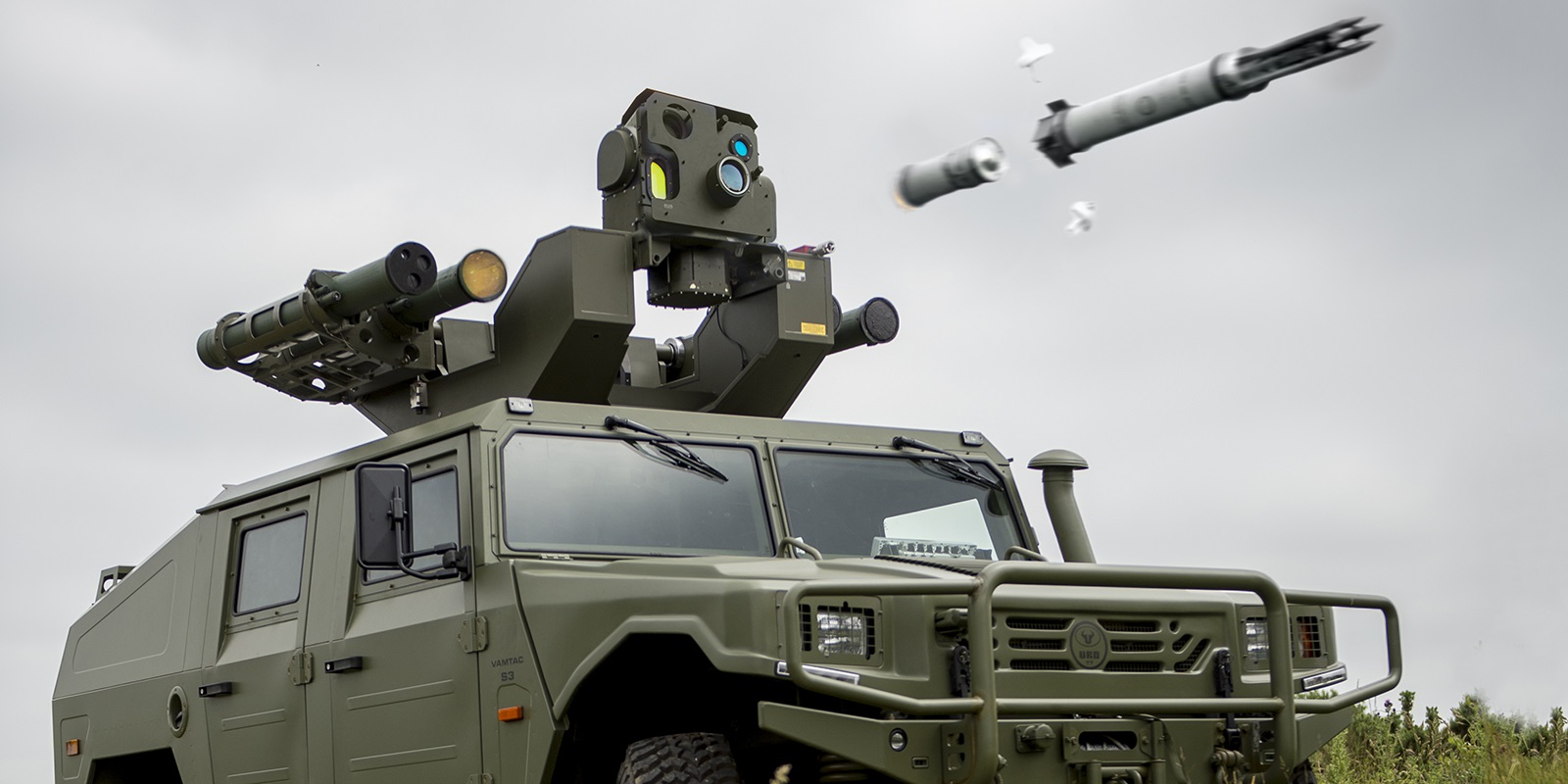
RAPIDRanger Variant: RAPIDRanger is a lightweight, highly automated multi-missile launcher which can be fitted to most tracked and wheeled military vehicles. In this type, a four-round launcher is installed on various armored vehicles. RAPIDRanger can also be loaded with a range of missiles from Thales and other providers, adding the ability to attack ground targets such as armoured personnel carriers, static installations and platforms. The addition of an integral 360° surveillance sensor provides the RAPIDRanger with completely autonomous system operation for 24/7 force protection.
RAPIDRanger Variant
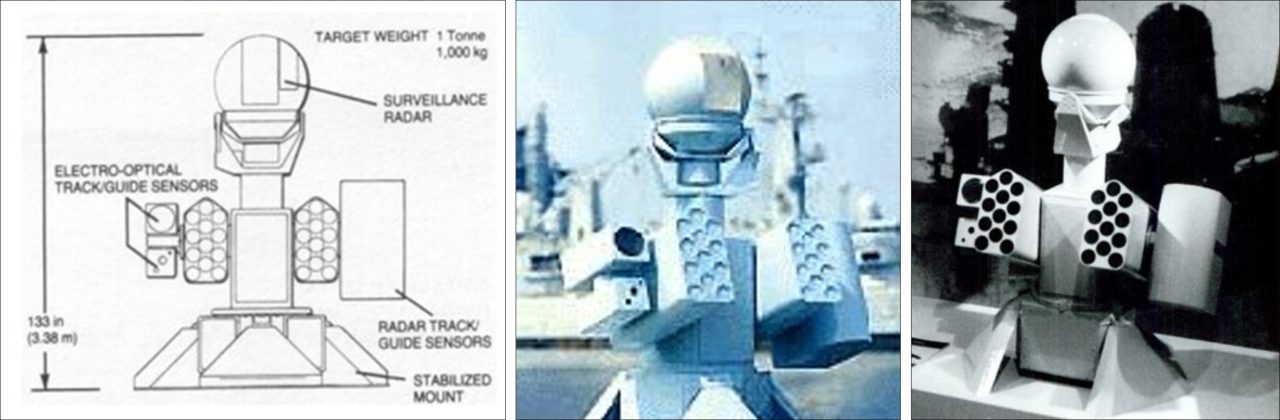
Seastreak Variant: Seastreak is a naval type of this missile. In this model, the CIWS (close-in weapon system), which includes 24 STARStreak missiles, is formatted in two blocks of 12 missiles. This system is used on warships to deal with short-range targets.
Seastreak Variant
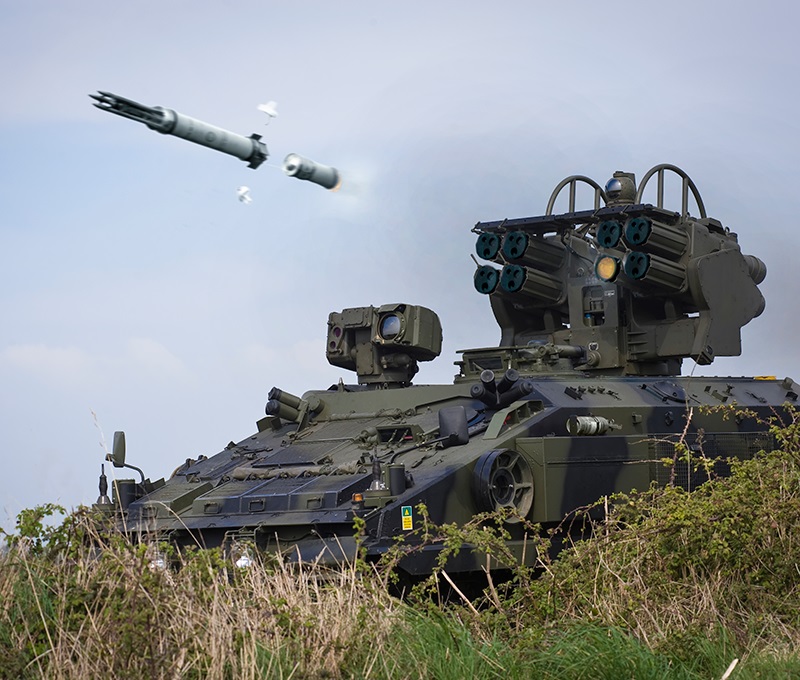
Self-propelled high-velocity missile (SP HVM) Variant: In this type, an eight-round launcher with internal storage for a further 8 missiles is mounted on the Alvis Stormer armored vehicle.
Self-propelled high-velocity missile Variant
Starstreak Avenger Variant: This system was built based on the needs of the US military in the early 1990s. In this type, the Starstreak missile launcher is installed on the Boeing Avenger vehicles replacing one pod of Stinger missiles with one pod of four Starstreak missiles. As a result, the vehicle has a quadruple pod of the Stinger missile and a quadruple pod of the Stinger missile.
Left image: Avenger Air Defense System – Right image: Boeing Starstreak Avenger System
Starstreak Mark II Variant: This is an upgraded version of the Starstreak missile. In this type, the missile range has been increased to more than 7 km. THOR/Multi Mission System (MMS) Variant: This type has a four-round Starstreak missile launcher mounted on the Austrian Pinzgauer cross-country chassis.
THOR/Multi Mission System Variant
Starstreak anti-aircraft missile specifications: Length: 1.397 m Diameter: 13 cm Weight: 14 kg Range: 7 km Speed: Mach 4 + Flight ceiling: 5 km Guidance: SACLOS Origin: UK
Click to view full sizeClick to view full size
“STARStreak Anti-Aircraft Missile” collection of posters in Arabic, Kurdish, Azeri, Russian, Persian for social media: